
View:
By Card
BOOK III.
ARGUMENT.
THE INTERVIEW OF TELEMACHUS AND NESTOR.
Telemachus, guided by Pallas in the shape of Mentor, arrives in the morning at Pylos, where Nestor and his sons are sacrificing on the sea-shore to Neptune. Telemachus declares the occasion of his coming and Nestor relates what passed in their return from Troy, how their fleets were separated, and he never since heard of Ulysses. They discourse concerning the death of Agamemnon, the revenge of Orestes, and the injuries of the suitors. Nestor advises him to go to Sparta, and inquire further of Menelaus. The sacrifice ending with the night, Minerva vanishes from them in the form of an eagle: Telemachus is lodged in the palace. The next morning they sacrifice a bullock to Minerva; and Telemachus proceeds on his journey to Sparta, attended by Pisistratus.
The scene lies on the sea-shore of Pylos.
1
THE sacred sun, above the waters rais'd,
1
Through Heaven's eternal brazen portals blaz'd;
And wide o'er earth diffus'd his cheering ray,
To gods and men to give the golden day.
Now on the coast of Pyle the vessel falls,
5
Before old Neleus' venerable walls.
There, suppliant to the monarch of the flood,
At nine green theatres the Pylians stood,
1
Each held five hundred, (a deputed train,)
At each, nine oxen on the sand lay slain.
10
They taste the entrails, and the altars load
With smoking thighs, an offering to the god.
Full for the port the Ithacensians stand,
And furl their sails, and issue on the land.
Telemachus already press'd the shore;
15
Not first; the Power of Wisdom march'd before,
And, ere the sacrificing throng he join'd,
Admonish'd thus his well-attending mind:
MINERVA
'Proceed, my son! this youthful shame expel;
'An honest business never blush to tell.
20
'To learn what fates thy wretched sire detain,
'We pass'd the wide immeasurable main.
'Meet then the senior far renown'd for sense,
'With reverend awe, but decent confidence:
'Urge him with truth to frame his fair replies;
25
'And sure he will: for wisdom never lies.'
'Proceed, my son! this youthful shame expel;
'An honest business never blush to tell.
20
'To learn what fates thy wretched sire detain,
'We pass'd the wide immeasurable main.
'Meet then the senior far renown'd for sense,
'With reverend awe, but decent confidence:
'Urge him with truth to frame his fair replies;
25
'And sure he will: for wisdom never lies.'
TELEMACHUS
'O tell me, Mentor! tell me, faithful guide,'
'(The youth with prudent modesty replied,)
'How shall I meet, or how accost the sage,
'Unskill'd in speech, nor yet mature of age?
30
'Awful th' approach, and hard the task appears,
'To question wisely men of riper years.'
'O tell me, Mentor! tell me, faithful guide,'
'(The youth with prudent modesty replied,)
'How shall I meet, or how accost the sage,
'Unskill'd in speech, nor yet mature of age?
30
'Awful th' approach, and hard the task appears,
'To question wisely men of riper years.'
To whom the martial goddess thus rejoin'd:
MINERVA
'Search, for some thoughts, thy own suggesting mind;
'And others, dictated by heavenly power,
35
'Shall rise spontaneous in the needful hour.
'For nought unprosperous shall thy ways attend,
'Born with good omens, and with Heaven thy friend.'
'Search, for some thoughts, thy own suggesting mind;
'And others, dictated by heavenly power,
35
'Shall rise spontaneous in the needful hour.
'For nought unprosperous shall thy ways attend,
'Born with good omens, and with Heaven thy friend.'
She spoke, and led the way with swiftest speed:
As swift, the youth pursued the way she led;
40
And join'd the band before the sacred fire,
Where sate, encompass'd with his sons, the sire.
The youth of Pylos, some on pointed wood
Transfix'd the fragments, some prepar'd the food:
In friendly throngs they gather to embrace
45
Their unknown guests, and at the banquet place.
Pisistratus was first to grasp their hands,
And spread soft hides upon the yellow sands;
Along the shore th' illustrious pair he led,
Where Nestor sate with youthful Thrasymed.
50
To each a portion of the feast he bore,
And held the golden goblet foaming o'er;
Then first approaching to the elder guest,
The latent goddess in these words address'd:
PISISTRATUS
'Whoe'er thou art, whom fortune brings to keep
55
'These rites of Neptune, monarch of the deep,
'Thee first it fits, O stranger! to prepare
'The due libation and the solemn prayer:
'Then give thy friend to shed the sacred wine;
'Though much thy younger, and his years like mine,
60
'He too, I deem, implores the powers divine:
'For all mankind alike require their grace,
'All born to want; a miserable race!'
'Whoe'er thou art, whom fortune brings to keep
55
'These rites of Neptune, monarch of the deep,
'Thee first it fits, O stranger! to prepare
'The due libation and the solemn prayer:
'Then give thy friend to shed the sacred wine;
'Though much thy younger, and his years like mine,
60
'He too, I deem, implores the powers divine:
'For all mankind alike require their grace,
'All born to want; a miserable race!'
51
He spake, and to her hand preferr'd the bowl:
A secret pleasure touch'd Athena's soul,
65
To see the preference due to sacred age
Regarded ever by the just and sage.
Of Ocean's king she then implores the grace:
MINERVA
'O thou! whose arms this ample globe embrace,
'Fulfil our wish, and let thy glory shine
70
'On Nestor first, and Nestor's royal line;
'Next grant the Pylian states their just desires,
'Pleas'd with their hecatomb's ascending fires;
'Last, deign Telemachus and me to bless,
'And crown our voyage with desir'd success.'
75
'O thou! whose arms this ample globe embrace,
'Fulfil our wish, and let thy glory shine
70
'On Nestor first, and Nestor's royal line;
'Next grant the Pylian states their just desires,
'Pleas'd with their hecatomb's ascending fires;
'Last, deign Telemachus and me to bless,
'And crown our voyage with desir'd success.'
75
Thus she: and, having paid the rite divine,
Gave to Ulysses' son the rosy wine.
Suppliant he pray'd. And now the victims dress'd
They draw, divide, and celebrate the feast.
The banquet done, the narrative old man,
80
Thus mild, the pleasing conference began:
NESTOR
'Now, gentle guests! the genial banquet o'er,
'It fits to ask ye, what your native shore,
'And whence your race? on what adventure, say,
'Thus far you wander through the watery way?
85
'Relate, if business, or the thirst of gain,
'Engage your journey o'er the pathless main:
'Where savage pirates seek through seas unknown
'The lives of others, venturous of their own.'
'Now, gentle guests! the genial banquet o'er,
'It fits to ask ye, what your native shore,
'And whence your race? on what adventure, say,
'Thus far you wander through the watery way?
85
'Relate, if business, or the thirst of gain,
'Engage your journey o'er the pathless main:
'Where savage pirates seek through seas unknown
'The lives of others, venturous of their own.'
Urged by the precepts by the goddess given,
90
And fill'd with confidence infus'd from Heaven,
The youth, whom Pallas destin'd to be wise
And fam'd among the sons of men, replies:
TELEMACHUS
'Inquir'st thou, father! from what coast we came?
'(Oh grace and glory of the Grecian name!)
95
'From where high Ithaca o'erlooks the floods,
'Brown with o'er-arching shades and pendent woods,
'Us to these shores our filial duty draws,
'A private sorrow, not a public cause.
'My sire I seek, where'er the voice of fame
100
'Has told the glories of his noble name,
'The great Ulysses; fam'd from shore to shore
'For valour much, for hardy suffering more.
'Long time with thee before proud Ilion's wall
'In arms he fought: with thee beheld her fall.
105
'Of all the chiefs, this hero's fate alone
'Has Jove reserv'd, unheard of, and unknown;
'Whether in fields by hostile fury slain,
'Or sunk by tempests in the gulfy main,
'Of this to learn, oppress'd with tender fears,
110
'Lo, at thy knee his suppliant son appears.
'If or thy certain eye, or curious ear,
'Have learn'd his fate, the whole dark story clear:
'And, oh! whate'er Heaven destin'd to betide,
'Let neither flattery smooth, nor pity hide.
115
'Prepar'd I stand: he was but born to try
'The lot of man; to suffer, and to die.
'Oh then, if ever through the ten years' war
'The wise, the good Ulysses claim'd thy care;
'If e'er he join'd thy council, or thy sword,
120
'True in his deed, and constant to his word;
'Far as thy mind through backward time can see,
'Search all thy stores of faithful memory :
''Tis sacred truth I ask, and ask of thee.'
'Inquir'st thou, father! from what coast we came?
'(Oh grace and glory of the Grecian name!)
95
'From where high Ithaca o'erlooks the floods,
'Brown with o'er-arching shades and pendent woods,
'Us to these shores our filial duty draws,
'A private sorrow, not a public cause.
'My sire I seek, where'er the voice of fame
100
'Has told the glories of his noble name,
'The great Ulysses; fam'd from shore to shore
'For valour much, for hardy suffering more.
'Long time with thee before proud Ilion's wall
'In arms he fought: with thee beheld her fall.
105
'Of all the chiefs, this hero's fate alone
'Has Jove reserv'd, unheard of, and unknown;
'Whether in fields by hostile fury slain,
'Or sunk by tempests in the gulfy main,
'Of this to learn, oppress'd with tender fears,
110
'Lo, at thy knee his suppliant son appears.
'If or thy certain eye, or curious ear,
'Have learn'd his fate, the whole dark story clear:
'And, oh! whate'er Heaven destin'd to betide,
'Let neither flattery smooth, nor pity hide.
115
'Prepar'd I stand: he was but born to try
'The lot of man; to suffer, and to die.
'Oh then, if ever through the ten years' war
'The wise, the good Ulysses claim'd thy care;
'If e'er he join'd thy council, or thy sword,
120
'True in his deed, and constant to his word;
'Far as thy mind through backward time can see,
'Search all thy stores of faithful memory :
''Tis sacred truth I ask, and ask of thee.'
To him experienced Nestor thus rejoin'd :
125
NESTOR
102
'O friend! what sorrows dost thou bring to mind!
'Shall I the long, laborious scene review,
'And open all the wounds of Greece anew?
'What toils by sea! where dark in quest of prey
'Dauntless we rov'd; Achilles led the way :
130
'What toils by land! where, mix'd in fatal fight,
'Such numbers fell, such heroes sunk to night:
'There Ajax great, Achilles there the brave :
'There wise Patroclus, fill an early grave:
'There, too, my son-ah! once my best delight,
135
'Once swift of foot, and terrible in fight;
'In whom stern courage with soft virtue join'd,
A faultless body and a blameless mind:
'Antilochus-what more can I relate?
'How trace the tedious series of our fate?
140
'Not added years on years my task could close,
'The long historian of my country's woes:
'Back to thy native islands might'st thou sail,
'And leave half-heard the melancholy tale.
'Nine painful years on that detested shore,
145
'What stratagems we form'd, what toils we bore !
'Still labouring on, till scarce at last we found
'Great Jove propitious, and our conquest crown'd.
'Far o'er the rest thy mighty father shin'd,
'In wit, in prudence, and in force of mind.
150
'Art thou the son of that illustrious sire?
'With joy I grasp thee, and with love admire.
'So like your voices, and your words so wise.
'Who finds thee younger must consult his eyes.
'Thy sire and I were one; nor varied aught
155
'In public sentence or in private thought;
'Alike to council or th' assembly came,
'With equal souls, and sentiments the same.
But when (by wisdom won) proud Ilion burn'd,
And in their ships the conquering Greeks return'd,
160
102
'O friend! what sorrows dost thou bring to mind!
'Shall I the long, laborious scene review,
'And open all the wounds of Greece anew?
'What toils by sea! where dark in quest of prey
'Dauntless we rov'd; Achilles led the way :
130
'What toils by land! where, mix'd in fatal fight,
'Such numbers fell, such heroes sunk to night:
'There Ajax great, Achilles there the brave :
'There wise Patroclus, fill an early grave:
'There, too, my son-ah! once my best delight,
135
'Once swift of foot, and terrible in fight;
'In whom stern courage with soft virtue join'd,
A faultless body and a blameless mind:
'Antilochus-what more can I relate?
'How trace the tedious series of our fate?
140
'Not added years on years my task could close,
'The long historian of my country's woes:
'Back to thy native islands might'st thou sail,
'And leave half-heard the melancholy tale.
'Nine painful years on that detested shore,
145
'What stratagems we form'd, what toils we bore !
'Still labouring on, till scarce at last we found
'Great Jove propitious, and our conquest crown'd.
'Far o'er the rest thy mighty father shin'd,
'In wit, in prudence, and in force of mind.
150
'Art thou the son of that illustrious sire?
'With joy I grasp thee, and with love admire.
'So like your voices, and your words so wise.
'Who finds thee younger must consult his eyes.
'Thy sire and I were one; nor varied aught
155
'In public sentence or in private thought;
'Alike to council or th' assembly came,
'With equal souls, and sentiments the same.
But when (by wisdom won) proud Ilion burn'd,
And in their ships the conquering Greeks return'd,
160
NESTOR
''Twas God's high will the victors to divide,
'And turn th' event, confounding human pride :
'Some he destroy'd, some scatter'd as the dust;
' (Not all were prudent, and not all were just.)
Then Discord, sent by Pallas from above,
2
165
'Stern daughter of the great avenger Jove,
The brother-kings inspir'd with fell debate;
Who call'd to council all th' Achaian state,
'But call'd untimely, (not the sacred rite
'Observ'd, nor heedful of the setting light,
3
170
'Nor herald sworn the session to proclaim,)
'Sour with debauch, a reeling tribe they came.
To these the cause of meeting they explain,
141
'And Menelaüs moves to cross the main ;
'Not so the king of men: he will'd to stay,
175
'The sacred rites and hecatombs to pay,
'And calm Minerva's wrath. Oh blind to fate!
'The gods not lightly change their love, or hate.
With ireful taunts each other they oppose,
'Till in loud tumult all the Greeks arose.
180
Now different counsels every breast divide,
Each burns with rancour to the adverse side:
'Th' unquiet night strange projects entertain'd;
'(So Jove, that urg'd us to our fate, ordain'd.)
'We with the rising morn our ships unmoor'd,
185
'And brought our captives and our stores aboard;
'But half the people with respect obey'd
'The king of men, and at his bidding stay'd.
'Now on the wings of winds our course we keep;
'(For God had smooth'd the waters of the deep ;)
190
'For Tenedos we spread our eager oars,
'There land, and pay due victims to the powers :
''Twas God's high will the victors to divide,
'And turn th' event, confounding human pride :
'Some he destroy'd, some scatter'd as the dust;
' (Not all were prudent, and not all were just.)
Then Discord, sent by Pallas from above,
2
165
'Stern daughter of the great avenger Jove,
The brother-kings inspir'd with fell debate;
Who call'd to council all th' Achaian state,
'But call'd untimely, (not the sacred rite
'Observ'd, nor heedful of the setting light,
3
170
'Nor herald sworn the session to proclaim,)
'Sour with debauch, a reeling tribe they came.
To these the cause of meeting they explain,
'And Menelaüs moves to cross the main ;
'Not so the king of men: he will'd to stay,
175
'The sacred rites and hecatombs to pay,
'And calm Minerva's wrath. Oh blind to fate!
'The gods not lightly change their love, or hate.
With ireful taunts each other they oppose,
'Till in loud tumult all the Greeks arose.
180
Now different counsels every breast divide,
Each burns with rancour to the adverse side:
'Th' unquiet night strange projects entertain'd;
'(So Jove, that urg'd us to our fate, ordain'd.)
'We with the rising morn our ships unmoor'd,
185
'And brought our captives and our stores aboard;
'But half the people with respect obey'd
'The king of men, and at his bidding stay'd.
'Now on the wings of winds our course we keep;
'(For God had smooth'd the waters of the deep ;)
190
'For Tenedos we spread our eager oars,
'There land, and pay due victims to the powers :
NESTOR
To bless our safe return, we join in prayer:
'But angry Jove dispers'd our vows in air,
'And rais'd new discord. Then (so Heaven decreed)
195
'Ulysses first and Nestor disagreed :
Wise as he was, by various counsels sway'd,
'He there, though late, to please the monarch, stay'd.
'But I, determin'd, stem the foamy floods,
'Warn'd of the coming fury of the gods.
4
200
'With us Tydides fear'd, and urg'd his haste :
'And Menelaüs came, but came the last :
'He join'd our vessels in the Lesbian bay,
'While yet we doubted of our watery way;
'If to the right to urge the pilot's toil
205
'(The safer road) beside the Psyrian
5
isle;
'Or the straight course to rocky Chios plough,
'And anchor under Mimas'
6
shaggy brow ?
'We sought direction of the power divine :
'The god propitious gave the guiding sign;
210
'Through the mid seas he bid our navy steer
'And in Eubœa shun the woes we fear.
'The whistling winds already wak'd the sky;
'Before the whistling winds the vessels fly,
'With rapid swiftness cut the liquid way,
215
'And reach Gerestus
7
at the point of day.
There hecatombs of bulls, to Neptune slain,
'High-flaming please the monarch of the main.
'The fourth day shone, when, all their labours o'er,
'Tydides' vessels touch'd the wish'd-for shore.
220
'But I to Pylos scud before the gales,
'The god still breathing on my swelling sails;
184
'Separate from all I safely landed here;
'Their fates or fortunes never reach'd my ear.
To bless our safe return, we join in prayer:
'But angry Jove dispers'd our vows in air,
'And rais'd new discord. Then (so Heaven decreed)
195
'Ulysses first and Nestor disagreed :
Wise as he was, by various counsels sway'd,
'He there, though late, to please the monarch, stay'd.
'But I, determin'd, stem the foamy floods,
'Warn'd of the coming fury of the gods.
4
200
'With us Tydides fear'd, and urg'd his haste :
'And Menelaüs came, but came the last :
'He join'd our vessels in the Lesbian bay,
'While yet we doubted of our watery way;
'If to the right to urge the pilot's toil
205
'(The safer road) beside the Psyrian
5
isle;
'Or the straight course to rocky Chios plough,
'And anchor under Mimas'
6
shaggy brow ?
'We sought direction of the power divine :
'The god propitious gave the guiding sign;
210
'Through the mid seas he bid our navy steer
'And in Eubœa shun the woes we fear.
'The whistling winds already wak'd the sky;
'Before the whistling winds the vessels fly,
'With rapid swiftness cut the liquid way,
215
'And reach Gerestus
7
at the point of day.
There hecatombs of bulls, to Neptune slain,
'High-flaming please the monarch of the main.
'The fourth day shone, when, all their labours o'er,
'Tydides' vessels touch'd the wish'd-for shore.
220
'But I to Pylos scud before the gales,
'The god still breathing on my swelling sails;
'Separate from all I safely landed here;
'Their fates or fortunes never reach'd my ear.
NESTOR
'Yet what I learn'd, attend; as here I sate,
225
'And ask'd each voyager each hero's fate;
'Curious to know, and willing to relate.
'Safe reach'd the Myrmidons their native land,
'Beneath Achilles' warlike sons command.
'Those, whom the heir of great Apollo's art,
230
'Brave Philoctetes, taught to wing the dart;
'And those whom Idomen from Ilion's plain
'Had led, securely cross'd the dreadful main.
How Agamemnon touch'd his Argive coast,
'And how his life by fraud and force he lost,
235
'And how the murderer paid his forfeit breath;
'What lands so distant from that scene of death
'But trembling heard the fame? and heard, admire
'How well the son appeas'd his slaughter'd sire!
8
'Ev'n to th' unhappy, that unjustly bleed,
240
'Heaven gives posterity t' avenge the deed.
'So fell Aegisthus: and mayst thou, my friend,
'(On whom the virtues of thy sire descend,)
'Make future times thy equal act adore,
'And be what brave Orestes was before!'
9
245
'Yet what I learn'd, attend; as here I sate,
225
'And ask'd each voyager each hero's fate;
'Curious to know, and willing to relate.
'Safe reach'd the Myrmidons their native land,
'Beneath Achilles' warlike sons command.
'Those, whom the heir of great Apollo's art,
230
'Brave Philoctetes, taught to wing the dart;
'And those whom Idomen from Ilion's plain
'Had led, securely cross'd the dreadful main.
How Agamemnon touch'd his Argive coast,
'And how his life by fraud and force he lost,
235
'And how the murderer paid his forfeit breath;
'What lands so distant from that scene of death
'But trembling heard the fame? and heard, admire
'How well the son appeas'd his slaughter'd sire!
8
'Ev'n to th' unhappy, that unjustly bleed,
240
'Heaven gives posterity t' avenge the deed.
'So fell Aegisthus: and mayst thou, my friend,
'(On whom the virtues of thy sire descend,)
'Make future times thy equal act adore,
'And be what brave Orestes was before!'
9
245
The prudent youth replied: 'O thou the grace
'And lasting glory of the Grecian race!
TELEMACHUS
'Just was the vengeance, and to latest days
'Shall long posterity resound the praise.
'Some god this arm with equal prowess bless!
250
'And the proud suitors shall its force confess;
'Injurious men! who, while my soul is sore
'Of fresh affronts, are meditating more.
'But Heaven denies this honour to my hand,
'Nor shall my father repossess the land:
255
'The father's fortune never to return,
'And the sad son's to suffer and to mourn!'
'Just was the vengeance, and to latest days
'Shall long posterity resound the praise.
'Some god this arm with equal prowess bless!
250
'And the proud suitors shall its force confess;
'Injurious men! who, while my soul is sore
'Of fresh affronts, are meditating more.
'But Heaven denies this honour to my hand,
'Nor shall my father repossess the land:
255
'The father's fortune never to return,
'And the sad son's to suffer and to mourn!'
Thus he; and Nestor took the word: 'My son,
NESTOR
'Is it then true, as distant rumours run,
That crowds of rivals for thy mother's charms
260
'Thy palace fill with insults and alarms?
'Is it then true, as distant rumours run,
That crowds of rivals for thy mother's charms
260
'Thy palace fill with insults and alarms?
NESTOR
'Say, is the fault, through tame submission, thine?
'Or, leagu'd against thee, do thy people join,
'Mov'd by some oracle, or voice divine ?
'And yet who knows but ripening lies in fate
265
'An hour of vengeance for th' afflicted state;
'When great Ulysses shall suppress these harms,
'Ulysses singly, or all Greece in arms.
'But if Athena, war's triumphant maid,
'The happy son will, as the father, aid,
270
'(Whose fame and safety was her constant care
'In every danger and in every war :
'Never on man did heavenly favour shine
'With rays so strong, distinguish'd, and divine,
'As those with which Minerva mark'd thy sire;
275
'So might she love thee, so thy soul inspire!)
'Soon should their hopes in humble dust be laid,
'And long oblivion of the bridal bed.'
'Say, is the fault, through tame submission, thine?
'Or, leagu'd against thee, do thy people join,
'Mov'd by some oracle, or voice divine ?
'And yet who knows but ripening lies in fate
265
'An hour of vengeance for th' afflicted state;
'When great Ulysses shall suppress these harms,
'Ulysses singly, or all Greece in arms.
'But if Athena, war's triumphant maid,
'The happy son will, as the father, aid,
270
'(Whose fame and safety was her constant care
'In every danger and in every war :
'Never on man did heavenly favour shine
'With rays so strong, distinguish'd, and divine,
'As those with which Minerva mark'd thy sire;
275
'So might she love thee, so thy soul inspire!)
'Soon should their hopes in humble dust be laid,
'And long oblivion of the bridal bed.'
TELEMACHUS
'Ah! no such hope' (the prince with sighs replies)
Can touch my breast; that blessing Heaven denies.
280
'Ev'n by celestial favour were it given,
'Fortune or fate would cross the will of Heaven.'
'Ah! no such hope' (the prince with sighs replies)
Can touch my breast; that blessing Heaven denies.
280
'Ev'n by celestial favour were it given,
'Fortune or fate would cross the will of Heaven.'
229
'What words are these, and what imprudence thine ?"
(Thus interpos'd the martial maid divine)
MINERVA
'Forgetful youth! but know, the Power above
285
'With ease can save each object of his love;
Wide as his will extends his boundless grace ;
'Nor lost in time, nor circumscrib'd by place.
'Happier his lot, who, many sorrows pass'd,
'Long labouring gains his natal shore at last,
290
'Than who, too speedy, hastes to end his life
'By some stern ruffian, or adulterous wife.
'Death only is the lot which none can miss,
'And all is possible to Heaven but this.
'The best, the dearest favourite of the sky
295
Must taste that cup, for man is born to die.'
'Forgetful youth! but know, the Power above
285
'With ease can save each object of his love;
Wide as his will extends his boundless grace ;
'Nor lost in time, nor circumscrib'd by place.
'Happier his lot, who, many sorrows pass'd,
'Long labouring gains his natal shore at last,
290
'Than who, too speedy, hastes to end his life
'By some stern ruffian, or adulterous wife.
'Death only is the lot which none can miss,
'And all is possible to Heaven but this.
'The best, the dearest favourite of the sky
295
Must taste that cup, for man is born to die.'
Thus check'd, replied Ulysses' prudent heir:
TELEMACHUS
'Mentor, no more-the mournful thought forbear;
'For he no more must draw his country's breath,
'Already snatch'd by fate, and the black doom of death!
300
'Pass we to other subjects; and engag
'On themes remote the venerable sage ;
'(Who thrice has seen the perishable kind
'Of men decay, and through three ages shin'd
'Like gods majestic, and like gods in mind :)
305
'For much he knows, and just conclusions draws,
'From various precedents and various laws.
'O son of Neleus! awful Nestor, tell
'How he, the mighty Agamemnon, fell;
'By what strange fraud Aegisthus wrought, relate
310
'(By force he could not) such a hero's fate?
'Liv'd Menelaüs not in Greece? or where
'Was then the martial brother's pious care?
'Condemn'd perhaps some foreign shore to tread;
'Or sure Aegisthus had not dar'd the deed.'
315
'Mentor, no more-the mournful thought forbear;
'For he no more must draw his country's breath,
'Already snatch'd by fate, and the black doom of death!
300
'Pass we to other subjects; and engag
'On themes remote the venerable sage ;
'(Who thrice has seen the perishable kind
'Of men decay, and through three ages shin'd
'Like gods majestic, and like gods in mind :)
305
'For much he knows, and just conclusions draws,
'From various precedents and various laws.
'O son of Neleus! awful Nestor, tell
'How he, the mighty Agamemnon, fell;
'By what strange fraud Aegisthus wrought, relate
310
'(By force he could not) such a hero's fate?
'Liv'd Menelaüs not in Greece? or where
'Was then the martial brother's pious care?
'Condemn'd perhaps some foreign shore to tread;
'Or sure Aegisthus had not dar'd the deed.'
315
To whom the full of days: 'Illustrious youth,
NESTOR
'Attend (though partly thou hast guess'd) the truth.
'For had the martial Menelaüs found
'The ruffian breathing yet on Argive ground,
'Nor earth had hid his carcase from the skies,
320
'Nor Grecian virgin shriek'd his obsequies,
'But fowls obscene dismember'd his remains,
'And dogs had torn him on the naked plains.
'While us the works of bloody Mars employ'd,
'The wanton youth inglorious peace enjoy'd;
325
'He, stretch'd at ease in Argos' calm recess,
'(Whose stately steeds luxuriant pastures bless,)
'With flattery's insinuating art
'Sooth'd the frail queen, and poison'd all her heart,
'At first, with worthy shame and decent pride,
330
'The royal dame his lawless suit denied.
'For virtue's image yet possess'd her mind,
'Taught by a master of the tuneful kind:
'Atrides, parting for the Trojan war,
'Consign'd the youthful consort to his care.
335
'True to his charge, the bard preserved her long
'In honour's limits; such the power of song.
'But when the gods these objects of their hate
'Dragg'd to destruction by the links of fate;
'The bard they banish'd from his native soil,
340
'And left all helpless in a desert isle :
'There he, the sweetest of the sacred train,
'Sung dying to the rocks, but sung in vain.
Then virtue was no more; her guard away,
'She fell, to lust a voluntary prey.
345
'Ev'n to the temple stalk'd th' adulterous spouse,
'With impious thanks, and mockery of vows,
'With images, with garments, and with gold ;
'And odorous fumes from loaded altars roll'd.
276
'Meantime from flaming Troy we cut the way,
350
'With Menelaüs, through the curling sea.
'But when to Sunium's
10
sacred point we came,
'Crown'd with the temple of th' Athenian dame;
'Atrides' pilot, Phrontes, there expir'd;
'(Phrontes, of all the sons of men admir'd,
355
To steer the bounding bark with steady toil,
When the storm thickens, and the billows boil;)
'While yet he exercis'd the steersman's art,
'Apollo touch'd him with his gentle dart;
'Ev'n with the rudder in his hand, he fell.
360
To pay whose honours to the shades of hell,
'We check'd our haste, by pious office bound,
'And laid our old companion in the ground.
'And now, the rites discharged, our course we keep
'Far on the gloomy bosom of the deep:
365
'Soon as Malaea's
11
misty tops arise,
'Attend (though partly thou hast guess'd) the truth.
'For had the martial Menelaüs found
'The ruffian breathing yet on Argive ground,
'Nor earth had hid his carcase from the skies,
320
'Nor Grecian virgin shriek'd his obsequies,
'But fowls obscene dismember'd his remains,
'And dogs had torn him on the naked plains.
'While us the works of bloody Mars employ'd,
'The wanton youth inglorious peace enjoy'd;
325
'He, stretch'd at ease in Argos' calm recess,
'(Whose stately steeds luxuriant pastures bless,)
'With flattery's insinuating art
'Sooth'd the frail queen, and poison'd all her heart,
'At first, with worthy shame and decent pride,
330
'The royal dame his lawless suit denied.
'For virtue's image yet possess'd her mind,
'Taught by a master of the tuneful kind:
'Atrides, parting for the Trojan war,
'Consign'd the youthful consort to his care.
335
'True to his charge, the bard preserved her long
'In honour's limits; such the power of song.
'But when the gods these objects of their hate
'Dragg'd to destruction by the links of fate;
'The bard they banish'd from his native soil,
340
'And left all helpless in a desert isle :
'There he, the sweetest of the sacred train,
'Sung dying to the rocks, but sung in vain.
Then virtue was no more; her guard away,
'She fell, to lust a voluntary prey.
345
'Ev'n to the temple stalk'd th' adulterous spouse,
'With impious thanks, and mockery of vows,
'With images, with garments, and with gold ;
'And odorous fumes from loaded altars roll'd.
'Meantime from flaming Troy we cut the way,
350
'With Menelaüs, through the curling sea.
'But when to Sunium's
10
sacred point we came,
'Crown'd with the temple of th' Athenian dame;
'Atrides' pilot, Phrontes, there expir'd;
'(Phrontes, of all the sons of men admir'd,
355
To steer the bounding bark with steady toil,
When the storm thickens, and the billows boil;)
'While yet he exercis'd the steersman's art,
'Apollo touch'd him with his gentle dart;
'Ev'n with the rudder in his hand, he fell.
360
To pay whose honours to the shades of hell,
'We check'd our haste, by pious office bound,
'And laid our old companion in the ground.
'And now, the rites discharged, our course we keep
'Far on the gloomy bosom of the deep:
365
'Soon as Malaea's
11
misty tops arise,
NESTOR
'Sudden the Thunderer blackens all the skies,
'And the winds whistle, and the surges roll
Mountains on mountains, and obscure the pole.
'The tempest scatters, and divides our fleet;
370
'Part, the storm urges on the coast of Crete,
'Where, winding round the rich Cydonian plain,
The streams of Jardan issue to the main.
There stands a rock, high eminent and steep,
'Whose shaggy brow o'erhangs the shady deep,
375
'And views Gortyna on the western side;
'On this rough Auster drove th' impetuous tide :
With broken force the billows roll'd away,
'And heav'd the fleet into the neighb'ring bay.
'Thus sav'd from death, they gain'd the Phaestan shores,
12
380
With shatter'd vessels and disabled oars :
'But five tall barks the winds and waters toss'd,
'Far from their fellows, on th' Aegyptian coast.
'There wander'd Menelaüs through foreign shores,
'Amassing gold, and gathering naval stores;
385
'While curs'd Aegisthus the detested deed
'By fraud fulfill'd, and his great brother bled.
Seven years, the traitor rich Mycenæ sway'd,
'And his stern rule the groaning land obey'd;
'The eighth, from Athens to his realm restor'd,
390
'Orestes brandish'd the revenging sword,
'Slew the dire pair, and gave to funeral flame
The vile assassin, and adulterous dame.
'That day, ere yet the bloody triumphs cease,
'Return'd Atrides to the coast of Greece,
395
'And safe to Argos' port his navy brought,
'With gifts of price and ponderous treasure fraught.
'Hence warn'd, my son, beware! nor idly stand
'Too long a stranger to thy native land;
'Lest heedless absence wear thy wealth away,
400
While lawless feasters in thy palace sway;
'Perhaps may seize thy realm, and share the spoil;
'And thou return, with disappointed toil,
'From thy vain journey, to a rifled isle.
'Howe'er, my friend, indulge one labour more,
405
'And seek Atrides on the Spartan shore.
'He, wandering long, a wider circle made,
'And many-languaged nations has survey'd;
'And measur'd tracks unknown to other ships
'Amid the monstrous wonders of the deeps:
410
'(A length of ocean and unbounded sky,
Which scarce the sea-fowl in a year o'erfly :)
'Go then; to Sparta take the watery way,
'Thy ship and sailors but for orders stay;
'Or if by land thou choose thy course to bend,
415
'My steeds, my chariots, and my sons attend:
Thee to Atrides they shall safe convey,
Guides of thy road, companions of thy way.
'Urge him with truth to frame his free replies,
'And sure he will: for Menelaüs is wise.'
420
'Sudden the Thunderer blackens all the skies,
'And the winds whistle, and the surges roll
Mountains on mountains, and obscure the pole.
'The tempest scatters, and divides our fleet;
370
'Part, the storm urges on the coast of Crete,
'Where, winding round the rich Cydonian plain,
The streams of Jardan issue to the main.
There stands a rock, high eminent and steep,
'Whose shaggy brow o'erhangs the shady deep,
375
'And views Gortyna on the western side;
'On this rough Auster drove th' impetuous tide :
With broken force the billows roll'd away,
'And heav'd the fleet into the neighb'ring bay.
'Thus sav'd from death, they gain'd the Phaestan shores,
12
380
With shatter'd vessels and disabled oars :
'But five tall barks the winds and waters toss'd,
'Far from their fellows, on th' Aegyptian coast.
'There wander'd Menelaüs through foreign shores,
'Amassing gold, and gathering naval stores;
385
'While curs'd Aegisthus the detested deed
'By fraud fulfill'd, and his great brother bled.
Seven years, the traitor rich Mycenæ sway'd,
'And his stern rule the groaning land obey'd;
'The eighth, from Athens to his realm restor'd,
390
'Orestes brandish'd the revenging sword,
'Slew the dire pair, and gave to funeral flame
The vile assassin, and adulterous dame.
'That day, ere yet the bloody triumphs cease,
'Return'd Atrides to the coast of Greece,
395
'And safe to Argos' port his navy brought,
'With gifts of price and ponderous treasure fraught.
'Hence warn'd, my son, beware! nor idly stand
'Too long a stranger to thy native land;
'Lest heedless absence wear thy wealth away,
400
While lawless feasters in thy palace sway;
'Perhaps may seize thy realm, and share the spoil;
'And thou return, with disappointed toil,
'From thy vain journey, to a rifled isle.
'Howe'er, my friend, indulge one labour more,
405
'And seek Atrides on the Spartan shore.
'He, wandering long, a wider circle made,
'And many-languaged nations has survey'd;
'And measur'd tracks unknown to other ships
'Amid the monstrous wonders of the deeps:
410
'(A length of ocean and unbounded sky,
Which scarce the sea-fowl in a year o'erfly :)
'Go then; to Sparta take the watery way,
'Thy ship and sailors but for orders stay;
'Or if by land thou choose thy course to bend,
415
'My steeds, my chariots, and my sons attend:
Thee to Atrides they shall safe convey,
Guides of thy road, companions of thy way.
'Urge him with truth to frame his free replies,
'And sure he will: for Menelaüs is wise.'
420
329
Thus while he speaks, the ruddy sun descends,
And twilight gray her evening shade extends.
Then thus the blue-ey'd maid: 'O full of days!
Wise are thy words, and just are all thy ways.
MINERVA
'Now immolate the tongues,
13
and mix the wine,
425
'Sacred to Neptune and the powers divine.
'The lamp of day is quench'd beneath the deep,
'And soft approach the balmy hours of sleep :
'Nor fits it to prolong the heavenly feast,
'Timeless, indecent, but retire to rest.'
430
'Now immolate the tongues,
13
and mix the wine,
425
'Sacred to Neptune and the powers divine.
'The lamp of day is quench'd beneath the deep,
'And soft approach the balmy hours of sleep :
'Nor fits it to prolong the heavenly feast,
'Timeless, indecent, but retire to rest.'
430
So spake Jove's daughter, the celestial maid.
The sober train attended and obey'd.
The sacred heralds on their hands around
Pour'd the full urns; the youths the goblets crown'd:
From bowl to bowl the holy beverage flows;
435
While to the final sacrifice they rose.
The tongues they cast upon the fragrant flame,
And pour, above, the consecrated stream.
And now, their thirst by copious draughts allay'd,
The youthful hero and th' Athenian maid
440
Propose departure from the finish'd rite,
And in their hollow bark to pass the night.
But this the hospitable sage denied :
'Forbid it, Jove! and all the gods!' he cried,
NESTOR
'Thus from my walls the much-lov'd son to send
445
'Of such a hero, and of such a friend!
'Me, as some needy peasant, would ye leave,
'Whom Heaven denies the blessing to relieve?
'Me would ye leave, who boast imperial sway,
When beds of royal state invite your stay?
450
'No-long as life this mortal shall inspire,
'Or as my children imitate their sire,
'Here shall the wandering stranger find his home,
'And hospitable rites adorn the dome.'
'Thus from my walls the much-lov'd son to send
445
'Of such a hero, and of such a friend!
'Me, as some needy peasant, would ye leave,
'Whom Heaven denies the blessing to relieve?
'Me would ye leave, who boast imperial sway,
When beds of royal state invite your stay?
450
'No-long as life this mortal shall inspire,
'Or as my children imitate their sire,
'Here shall the wandering stranger find his home,
'And hospitable rites adorn the dome.'
'Well hast thou spoke,' (the blue-ey'd maid replies,)
455
'Belov'd old man! benevolent as wise.
MINERVA
'Be the kind dictates of thy heart obey'd,
'And let thy words Telemachus persuade :
'He to thy palace shall thy steps pursue;
'I to the ship, to give the orders due,
460
'Prescribe directions, and confirm the crew.
'For I alone sustain their naval cares,
'Who boast experience from these silver hairs;
'All youths the rest, whom to this journey move
'Like years, like tempers, and their prince's love.
465
'There in the vessel shall I pass the night;
'And soon as morning paints the fields of light
'I go to challenge from the Caucons
14
bold
'A debt, contracted in the days of old.
'But this thy guest, receiv'd with friendly care,
470
'Let thy strong coursers swift to Sparta bear;
'Prepare thy chariot at the dawn of day,
'And be thy son companion of his way.'
'Be the kind dictates of thy heart obey'd,
'And let thy words Telemachus persuade :
'He to thy palace shall thy steps pursue;
'I to the ship, to give the orders due,
460
'Prescribe directions, and confirm the crew.
'For I alone sustain their naval cares,
'Who boast experience from these silver hairs;
'All youths the rest, whom to this journey move
'Like years, like tempers, and their prince's love.
465
'There in the vessel shall I pass the night;
'And soon as morning paints the fields of light
'I go to challenge from the Caucons
14
bold
'A debt, contracted in the days of old.
'But this thy guest, receiv'd with friendly care,
470
'Let thy strong coursers swift to Sparta bear;
'Prepare thy chariot at the dawn of day,
'And be thy son companion of his way.'
371
Then, turning with the word, Minerva flies,
And soars an eagle through the liquid skies.
475
Vision divine! the throng'd spectators gaze
In holy wonder fix'd, and still amaze.
But chief the reverend sage admir'd; he took
The hand of young Telemachus, and spoke:
NESTOR
'Oh, happy youth! and favour'd of the skies,
480
'Distinguish'd care of guardian deities!
'Whose early years for future worth engage,
'No vulgar manhood, no ignoble age.
'For lo! none other of the court above
'Than she, the daughter of Almighty Jove,
485
'Pallas herself, the war-triumphant maid,
'Confess'd is thine, as once thy father's aid.
'So guide me, goddess! so propitious shine
'On me, my consort, and my royal line!
'A yearling bullock to thy name shall smoke,
490
'Untam'd, unconscious of the galling yoke,
'With ample forehead, and yet tender horns,
'Whose budding honours ductile gold adorns.'
'Oh, happy youth! and favour'd of the skies,
480
'Distinguish'd care of guardian deities!
'Whose early years for future worth engage,
'No vulgar manhood, no ignoble age.
'For lo! none other of the court above
'Than she, the daughter of Almighty Jove,
485
'Pallas herself, the war-triumphant maid,
'Confess'd is thine, as once thy father's aid.
'So guide me, goddess! so propitious shine
'On me, my consort, and my royal line!
'A yearling bullock to thy name shall smoke,
490
'Untam'd, unconscious of the galling yoke,
'With ample forehead, and yet tender horns,
'Whose budding honours ductile gold adorns.'
Submissive thus the hoary sire preferr'd
His holy vow: the favouring goddess heard.
495
Then, slowly rising, o'er the sandy space
Precedes the father, follow'd by his race,
(A long procession,) timely marching home
In comely order to the regal dome.
There when arriv'd, on thrones around him placed,
500
His sons and grandsons the wide circle graced.
To these the hospitable sage, in sign
Of social welcome, mix'd the racy wine,
(Late from the mellowing cask restor'd to light,
By ten long years refin'd, and rosy bright.)
505
To Pallas high the foaming bowl he crown'd,
And sprinkled large libations on the ground.
Each drinks a full oblivion of his cares,
And to the gifts of balmy sleep repairs.
Deep in a rich alcove the prince was laid,
510
And slept beneath the pompous colonnade :
Fast by his side Pisistratus lay spread,
(In age his equal) on a splendid bed :
But in an inner court, securely clos'd,
The reverend Nestor and his queen repos'd.
515
When now Aurora, daughter of the dawn,
With rosy lustre purpled o'er the lawn;
The old man early rose, walk'd forth, and sate
On polish'd stone before his palace-gate
15
:
With unguents smooth the lucid marble shone,
520
Where ancient Neleus sate, a rustic throne;
But he descending to th' infernal shade,
Sage Nestor fill'd it, and the sceptre sway'd.
His sons around him mild obeisance pay,
And duteous take the orders of the day.
525
First Echephron and Stratius quit their bed
Then Perseus, Aretus, and Thrasymed;
The last Pisistratus arose from rest:
They came, and near him place the stranger-guest.
To these the senior thus declar'd his will :
530
NESTOR
'My sons! the dictates of your sire fulfil.
'To Pallas, first of gods, prepare the feast,
'Who graced our rites, a more than mortal guest.
'Let one, despatchful, bid some swain to lead
'A well-fed bullock from the grassy mead;
535
'One seek the harbour where the vessels moor,
'And bring thy friends, Telemachus! ashore;
'(Leave only two the galley to attend ;)
'Another to Laerceus must we send,
'Artist divine, whose skilful hands infold
540
'The victim's horn with circumfusile gold.
'The rest may here the pious duty share,
'And bid the handmaids for the feast prepare,
'The seats to range, the fragrant wood to bring,
'And limpid waters from the living spring.'
545
'My sons! the dictates of your sire fulfil.
'To Pallas, first of gods, prepare the feast,
'Who graced our rites, a more than mortal guest.
'Let one, despatchful, bid some swain to lead
'A well-fed bullock from the grassy mead;
535
'One seek the harbour where the vessels moor,
'And bring thy friends, Telemachus! ashore;
'(Leave only two the galley to attend ;)
'Another to Laerceus must we send,
'Artist divine, whose skilful hands infold
540
'The victim's horn with circumfusile gold.
'The rest may here the pious duty share,
'And bid the handmaids for the feast prepare,
'The seats to range, the fragrant wood to bring,
'And limpid waters from the living spring.'
545
He said, and busy each his care bestow'd;
Already at the gates the bullock low'd,
Already came the Ithacensian crew,
The dexterous smith the tools already drew :
His ponderous hammer, and his anvil sound,
550
And the strong tongs to turn the metal round.
Nor was Minerva absent from the rite;
She view'd her honours, and enjoy'd the sight.
With reverent hand the king presents the gold,
Which round th' intorted horns the gilder roll'd,
555
So wrought, as Pallas might with pride behold.
Young Aretus from forth his bridal bower
Brought the full laver, o'er their hands to pour,
And canisters of consecrated flour.
Stratius and Echephron the victim led;
560
The axe was held by warlike Thrasymed,
In act to strike: before him Perseus stood,
The vase extending to receive the blood,
The king himself initiates to the power;
Scatters with quivering hand the sacred flour.
565
And the stream sprinkles: from the curling brows
The hair collected in the fire he throws.
16
Soon as due vows on every part were paid,
And sacred wheat upon the victim laid,
Strong Thrasymed discharg'd the speeding blow
570
Full on his neck, and cut the nerves in two.
Down sunk the heavy beast: the females round,
Maids, wives, and matrons, mix a shrilling sound.
Nor scorn'd the queen the holy choir to join;
(The first-born she, of old Clymenus' line;
575
In youth by Nestor lov'd, of spotless fame,
And lov'd in age, Eurydice her name.)
From earth they rear him, struggling now with death;
And Nestor's youngest stops the vents of breath.
The soul for ever flies: on all sides round
580
Streams the black blood, and smokes upon the ground.
The beast they then divide, and disunite
The ribs and limbs, observant of the rite :
On these, in double cauls involv'd with art,
The choicest morsels lay from every part.
585
The sacred sage before his altar stands,
Turns the burnt-offering with his holy hands,
And pours the wine, and bids the flames aspire :
The youth with instruments surround the fire.
The thighs now sacrificed, and entrails dress'd,
590
Th' assistants part, transfix, and broil the rest.
While these officious tend the rites divine,
The last fair branch of the Nestorean line,
Sweet Polycastè, took the pleasing toil
To bathe the prince, and pour the fragrant oil.
17
595
O'er his fair limbs a flowery vest he threw,
And issued, like a god, to mortal view.
His former seat beside the king he found,
(His people's father with his peers around ;)
All placed at ease the holy banquet join,
600
And in the dazzling goblet laughs the wine.
The rage of thirst and hunger now suppress'd,
The monarch turns him to his royal guest;
And for the promis'd journey bids prepare
The smooth-hair's horses, and the rapid car.
605
Observant of his word, the word scarce spoke,
The sons obey, and join them to the yoke.
Then bread and wine a ready handmaid brings,
And presents, such as suit the state of kings,
The glittering seat Telemachus ascends;
610
His faithful guide Pisistratus attends;
With hasty hand the ruling reins he drew :
He lash'd the coursers, and the coursers flew.
Beneath the bounding yoke alike they held
Their equal pace, and smoked along the field.
615
The towers of Pylos sink, its views decay,
Fields after fields fly back, till close of day:
Then sunk the sun, and darken'd all the way.
To Pheræ now, Diocleus' stately seat,
(Of Alpheus' race,) the weary youths retreat.
620
His house affords the hospitable rite,
And pleas'd they sleep, the blessing of the night.
But when Aurora, daughter of the dawn,
With rosy lustre purpled o'er the lawn,
Again they mount, their journey to renew,
625
And from the sounding portico they flew.
Along the waving fields their way they hold,
The fields receding as their chariot roll'old:
Then slowly sunk the ruddy globe of light,
And o'er the shaded landscape rush'd the night.
630
Odyssey. Homer. London. 1858.
Sponsored by Perseus Project, Tufts University.
 Zeus, Athena, and Hermes (1810). Drawing by John Flaxman.
 Athena (1810). Drawing by John Flaxman.
 Telemachus with Athena as Mentor (1810). Drawing by John Flaxman.
  Nestor’s Sacrifice (1805). Engraving after John Flaxman (1755-1826). Purchased as part of the Oppé Collection with assistance from the National Lottery through the Heritage Lottery Fund 1996.
  “The Fair Helen.” Willy Pogany (Hungarian, 1882–1955).
Image
“The Fair Helen.” Willy Pogany (Hungarian, 1882–1955).
Image  “Leucothea, the White Goddess, Preserving Ulysses” (1805). John Flaxman (1755–1826). Purchased as part of the Oppé Collection with assistance from the National Lottery through the Heritage Lottery Fund, 1996.
  “Nausicaa” (1878), Frederick Leighton (English, 1830–1896).
 Red-figured pyxis, picturing Nereids at home, “indoors”: the Nereid with her hair down is labeled as Thaleia.
 View of Garitsa, region right outside the northern walls of the city of Corfu, and according to the legend the site of Alcinous’s gardens (1867). Étienne Rey (French, 1789–1867).
  Blind Demodokos sings of the siege of Troy (1810), by John Flaxman (English, 1755–1826).
 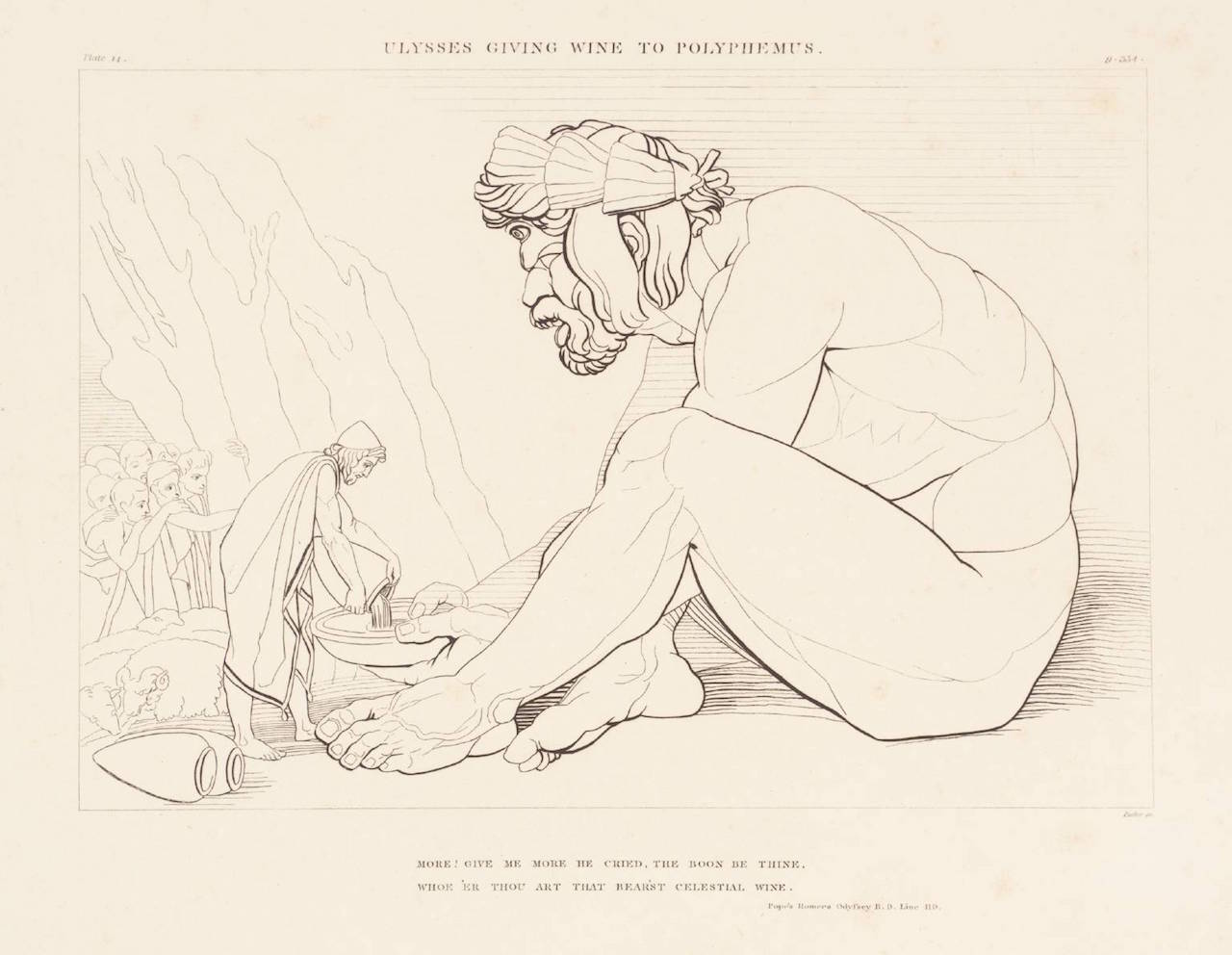 “Ulysses Giving Wine to Polyphemus” (1805). John Flaxman (1755–1826). Purchased as part of the Oppé Collection with assistance from the National Lottery through the Heritage Lottery Fund, 1996.
  “Circe Invidiosa,” (1892). J. W. Waterhouse (English, 1849–1917).
 “Teiresias appears to Ulysses during the sacrifice,” (1780–1785). Henry Fuseli (German, 1741–1825).
  “Ulysses and the Sirens” (ca. 1909). Herbert James Draper (English, 1863–1920).
 “Ulysses Asleep Laid on his Own Coast by the Phaeacian Sailors” (1805). John Flaxman (English, 1755–1826). Purchased as part of the Oppé Collection with assistance from the National Lottery through the Heritage Lottery Fund 1996.
  Minoan—probably Neopalatial—fresco commonly known as the “Lily Prince.” Whatever the exact type of this personage (perhaps a crowned acrobat, according to the interpretation of Maria Shaw), the Lily Prince is certainly a Minoan of elite standing. Public domain image based on a famous watercolor by Émile Gilliéron of a reconstruction by Arthur Evans.
 Detail from a fresco found at Hagia Triadha in Crete. Reconstruction by Mark Cameron, p. 96 of the catalogue Fresco: A Passport into the Past. Minoan Crete through the eyes of Mark Cameron. 1999. Catalogue curated by Doniert Evely. Athens: British School at Athens; and N. P. Goulandris Foundation, Museum of Cycladic Art. Reproduced with the permission of the British School at Athens. BSA Archive: Mark Cameron Personal Papers: CAM 1.
 “Minerva Restoring Ulysses to his Own Shape” (1805). John Flaxman (English, 1755–1826). Purchased as part of the Oppé Collection with assistance from the National Lottery through the Heritage Lottery Fund 1996.
 “Ulysses and his Dog” (1805). John Flaxman (English, 1755–1826). Purchased as part of the Oppé Collection with assistance from the National Lottery through the Heritage Lottery Fund 1996.
  “Ulysses Preparing to Fight with Irus” (1805). John Flaxman (English, 1755–1826) Purchased as part of the Oppé Collection with assistance from the National Lottery through the Heritage Lottery Fund 1996.
  “Euryclea Discovers Ulysses” (1805). John Flaxman (English, 1755–1826). Purchased as part of the Oppé Collection with assistance from the National Lottery through the Heritage Lottery Fund 1996.
  “The Harpies Going to Seize the Daughters of Pandareus” (1805). John Flaxman (English, 1755–1826). Purchased as part of the Oppé Collection with assistance from the National Lottery through the Heritage Lottery Fund 1996.
 Hēraklēs stringing a bow. Silver stater, c. 450–440 BCE, Thebes (Boeotia).
  Swallows, detail of the Spring Fresco at Thera, image via Flickr user
  Original artwork, by Flickr user
  Odysseus kiling Penelope’s suitors. Attic red-figure skyphos, ca. 440 BCE.
  Still life showing eggs, thrushes, napkin: from the House of Julia Felix, Pompeii.
  Eurykleia waking Penelope (1773). Print by Thomas Burke, after a painting by Angelika Kauffmann.
  Big Ed and Norma have just now broken free of the troublesome relationships that have kept these lovers apart for 27 years. Now at long last they can have a life together.
Still from
Big Ed and Norma have just now broken free of the troublesome relationships that have kept these lovers apart for 27 years. Now at long last they can have a life together.
Still from  “Mercury Conducting the Souls of the Suitors to the Infernal Regions” (1805). John Flaxman (English, 1755–1826). Purchased as part of the Oppé Collection with assistance from the National Lottery through the Heritage Lottery Fund 1996.
  “Ulysses Departing from Lacedaemon for Ithaca, with his Bride Penelope” (1805). John Flaxman (English, 1755–1826). Flaxman made this image the last in his Odyssey series, bringing the story of Penelope and Odysseus full circle. Purchased as part of the Oppé Collection with assistance from the National Lottery through the Heritage Lottery Fund 1996.


,_around_440_BC,_Altes_Museum_Berlin_(13718420225)_glare-reduced_white-bg.png)
