
View:
By Card
BOOK II.
ARGUMENT.
THE COUNCIL OF ITHACA.
Telemachus, in the assembly of the lords of Ithaca, complains of the injustice done him by the suitors, and insists upon their departure from his palace; appealing to the princes, and exciting the people to declare against them. The suitors endeavour to justify their stay, at least till he shall send the queen to the court of Icarius her father; which he refuses. There appears a prodigy of two eagles in the sky, which an augur expounds to the ruin of the suitors. Telemachus then demands a vessel to carry him to Pylos and Sparta, there to inquire of his father's fortunes. Pallas, in the shape of Mentor (an ancient friend of Ulysses), helps him to a ship, assists him in preparing necessaries for the voyage, and embarks with him that night; which concludes the second day from the opening of the poem.
The scene continues in the palace of Ulysses, in Ithaca.
1
Now, reddening from the dawn, the morning ray
1
Glow'd in the front of heaven, and gave the day.
The youthful hero, with returning light,
Rose anxious from th' inquietudes of night.
A royal robe he wore with graceful pride,
5
A two-edged faulchion threaten'd by his side,
Embroider'd sandals glitter'd as he trod,
And forth he moved majestic as a god.
Then by his heralds, restless of delay,
To council calls the peers: the peers obey.
10
Soon as in solemn form th' assembly sate,
From his high dome himself descends in state.
Bright in his hand a ponderous javelin shin'd;
Two dogs, a faithful guard, attend behind;
Pallas with grace divine his form improves,
15
And gazing crowds admire him as he moves.
His father's throne he fill'd: while distant stood
The hoary peers, and aged wisdom bow'd.
'Twas silence all. At last Aegyptius spoke;
Aegyptius, by his age and sorrows broke:
20
A length of days his soul with prudence crown'd,
A length of days had bent him to the ground.
His eldest hope
1
in arms to Ilion came,
By great Ulysses taught the path to fame;
But (hapless youth) the hideous Cyclops tore
25
His quivering limbs, and quaff'd his spouting gore.
Three sons remain'd: to climb with haughty fires
The royal bed, Eurynomus aspires;
The rest with duteous love his griefs assuage,
And ease the sire of half the cares of age.
30
Yet still his Antiphus he loves, he mourns,
And, as he stood, he spoke and wept by turns:
AeGYPTIUS
'Since great Ulysses sought the Phrygian plains,
'Within these walls inglorious silence reigns.
'Say then, ye peers! by whose commands we meet?
35
'Why here once more in common council sit!
'Ye young, ye old, the weighty cause disclose :
'Arrives some message of invading foes?
'Or say, does high necessity of state
'Inspire some patriot, and demand debate?
40
'The present synod speaks its author wise;
'Assist him, Jove, thou regent of the skies!'
'Since great Ulysses sought the Phrygian plains,
'Within these walls inglorious silence reigns.
'Say then, ye peers! by whose commands we meet?
35
'Why here once more in common council sit!
'Ye young, ye old, the weighty cause disclose :
'Arrives some message of invading foes?
'Or say, does high necessity of state
'Inspire some patriot, and demand debate?
40
'The present synod speaks its author wise;
'Assist him, Jove, thou regent of the skies!'
He spoke. Telemachus with transport glows,
Embraced the omen, and majestic rose;
(His royal hand th' imperial sceptre sway'd:)
45
Then thus, addressing to Aegyptius, said:
TELEMACHUS
39
'Reverend old man! lo here confess'd he stands
'By whom ye meet; my grief your care demands.
'No story I unfold of public woes,
'Nor bear advices of impending foes:
50
'Peace the blest land, and joys incessant crown:
'Of all this happy realm, I grieve alone.
'For my lost sire continual sorrows spring,
'The great, the good; your father and your king.
'Yet more; our house from its foundation bows,
55
'Our foes are powerful, and your sons the foes;
'Hither, unwelcome to the queen, they come;
'Why seek they not the rich Icarian
2
dome?
'If she must wed, from other hands require
'The dowry: is Telemachus her sire?
60
'Yet through my court the noise of revel rings,
'And wastes the wise frugality of kings.
'Scarce all my herds their luxury suffice;
'Scarce all my wine their midnight hours supplies.
'Safe in my youth, in riot still they grow,
65
'Nor in the helpless orphan dread a foe.
'But come it will, the time when manhood grants
'More powerful advocates than vain complaints.
'Approach that hour! insufferable wrong
'Cries to the gods, and vengeance sleeps too long.
70
'Rise then, ye peers! with virtuous anger rise;
'Your fame revere, but most th' avenging skies.
'By all the deathless powers that reign above,
'By righteous Themis and by thundering Jove,
'(Themis, who gives to councils, or denies
75
'Success; and humbles, or confirms the wise,)
'Rise in my aid! suffice the tears that flow
'For my lost sire, nor add new woe to woe.
'If e'er he bore the sword to strengthen ill,
'Or, having power to wrong, betray'd the will,
80
39
'Reverend old man! lo here confess'd he stands
'By whom ye meet; my grief your care demands.
'No story I unfold of public woes,
'Nor bear advices of impending foes:
50
'Peace the blest land, and joys incessant crown:
'Of all this happy realm, I grieve alone.
'For my lost sire continual sorrows spring,
'The great, the good; your father and your king.
'Yet more; our house from its foundation bows,
55
'Our foes are powerful, and your sons the foes;
'Hither, unwelcome to the queen, they come;
'Why seek they not the rich Icarian
2
dome?
'If she must wed, from other hands require
'The dowry: is Telemachus her sire?
60
'Yet through my court the noise of revel rings,
'And wastes the wise frugality of kings.
'Scarce all my herds their luxury suffice;
'Scarce all my wine their midnight hours supplies.
'Safe in my youth, in riot still they grow,
65
'Nor in the helpless orphan dread a foe.
'But come it will, the time when manhood grants
'More powerful advocates than vain complaints.
'Approach that hour! insufferable wrong
'Cries to the gods, and vengeance sleeps too long.
70
'Rise then, ye peers! with virtuous anger rise;
'Your fame revere, but most th' avenging skies.
'By all the deathless powers that reign above,
'By righteous Themis and by thundering Jove,
'(Themis, who gives to councils, or denies
75
'Success; and humbles, or confirms the wise,)
'Rise in my aid! suffice the tears that flow
'For my lost sire, nor add new woe to woe.
'If e'er he bore the sword to strengthen ill,
'Or, having power to wrong, betray'd the will,
80
TELEMACHUS
'On me, on me your kindled wrath assuage,
'And bid the voice of lawless riot rage.
'If ruin to your royal race ye doom,
'Be you the spoilers, and our wealth consume.
'Then might we hope redress from juster laws,
85
'And raise all Ithaca to aid our cause:
'But while your sons commit th' unpunish'd wrong,
'You make the arm of violence too strong.'
'On me, on me your kindled wrath assuage,
'And bid the voice of lawless riot rage.
'If ruin to your royal race ye doom,
'Be you the spoilers, and our wealth consume.
'Then might we hope redress from juster laws,
85
'And raise all Ithaca to aid our cause:
'But while your sons commit th' unpunish'd wrong,
'You make the arm of violence too strong.'
While thus he spoke, with rage and grief he frown'd,
And dash'd th' imperial sceptre to the ground.
90
The big round tear hung trembling in his eye:
The synod griev'd, and gave a pitying sigh,
Then silent sate. At length Antinoüs burns
With haughty rage, and sternly thus returns:
ANTINOUS
'O insolence of youth! whose tongue affords
95
'Such railing eloquence, and war of words.
'Studious thy country's worthies to defame,
'Thy erring voice displays thy mother's shame.
'Elusive of the bridal day, she gives
'Fond hopes to all, and all with hopes deceives.
100
'Did not the sun, through heaven's wide azure roll'd,
'For three long years the royal fraud behold?
'While she, laborious in delusion, spread
'The spacious loom, and mix'd the various thread,
'Where as to life the wondrous figures rise,
105
'Thus spoke th' inventive queen, with artful sighs:
'"Though cold in death Ulysses breathes no more,
'"Cease yet awhile to urge the bridal hour;
'"Cease, till to great Laërtes I bequeath
'"A task of grief, his ornaments of death.
3
110
'"Lest, when the Fates his royal ashes claim,
'"The Grecian matrons taint my spotless fame;
'"When he, whom living mighty realms obey'd,
'"Shall want in death a shroud to grace his shade."'
'Thus she: at once the generous train complies,
115
'Nor fraud mistrusts in virtue's fair disguise.
'O insolence of youth! whose tongue affords
95
'Such railing eloquence, and war of words.
'Studious thy country's worthies to defame,
'Thy erring voice displays thy mother's shame.
'Elusive of the bridal day, she gives
'Fond hopes to all, and all with hopes deceives.
100
'Did not the sun, through heaven's wide azure roll'd,
'For three long years the royal fraud behold?
'While she, laborious in delusion, spread
'The spacious loom, and mix'd the various thread,
'Where as to life the wondrous figures rise,
105
'Thus spoke th' inventive queen, with artful sighs:
'"Though cold in death Ulysses breathes no more,
'"Cease yet awhile to urge the bridal hour;
'"Cease, till to great Laërtes I bequeath
'"A task of grief, his ornaments of death.
3
110
'"Lest, when the Fates his royal ashes claim,
'"The Grecian matrons taint my spotless fame;
'"When he, whom living mighty realms obey'd,
'"Shall want in death a shroud to grace his shade."'
'Thus she: at once the generous train complies,
115
'Nor fraud mistrusts in virtue's fair disguise.
ANTINOUS
'The work she plied; but, studious of delay,
'By night revers'd the labours of the day.
'While thrice the sun his annual journey made,
'The conscious lamp the midnight fraud survey'd;
120
'Unheard, unseen, three years her arts prevail;
'The fourth, her maid unfolds th' amazing tale.
'We saw, as unperceiv'd we took our stand,
'The backward labours of her faithless hand.
'Then urg'd, she perfects her illustrious toils;
125
'A wondrous monument of female wiles!
'But you, O peers! and thou, O prince! give ear:
'(I speak aloud that every Greek may hear ;)
'Dismiss the queen; and, if her sire approves,
'Let him espouse her to the peer she loves:
130
'Bid instant to prepare the bridal train,
'Nor let a race of princes wait in vain.
'Though with a grace divine her soul is bless'd,
'And all Minerva breathes within her breast,
'In wondrous arts than woman more renown'd,
135
'And more than woman with deep wisdom crown'd;
'Though Tyro nor Mycenè match her name,
'Nor great Alcmena
4
(the proud boasts of fame);
'Yet thus by heaven adorn'd, by heaven's decree
'She shines with fatal excellence, to thee:
140
'With thee, the bowl we drain, indulge the feast,
'Till righteous heaven reclaim her stubborn breast.
'What though from pole to pole resounds her name!
'The son's destruction waits the mother's fame:
'For, till she leaves thy court, it is decreed,
145
'Thy bowl to empty, and thy flock to bleed.'
'The work she plied; but, studious of delay,
'By night revers'd the labours of the day.
'While thrice the sun his annual journey made,
'The conscious lamp the midnight fraud survey'd;
120
'Unheard, unseen, three years her arts prevail;
'The fourth, her maid unfolds th' amazing tale.
'We saw, as unperceiv'd we took our stand,
'The backward labours of her faithless hand.
'Then urg'd, she perfects her illustrious toils;
125
'A wondrous monument of female wiles!
'But you, O peers! and thou, O prince! give ear:
'(I speak aloud that every Greek may hear ;)
'Dismiss the queen; and, if her sire approves,
'Let him espouse her to the peer she loves:
130
'Bid instant to prepare the bridal train,
'Nor let a race of princes wait in vain.
'Though with a grace divine her soul is bless'd,
'And all Minerva breathes within her breast,
'In wondrous arts than woman more renown'd,
135
'And more than woman with deep wisdom crown'd;
'Though Tyro nor Mycenè match her name,
'Nor great Alcmena
4
(the proud boasts of fame);
'Yet thus by heaven adorn'd, by heaven's decree
'She shines with fatal excellence, to thee:
140
'With thee, the bowl we drain, indulge the feast,
'Till righteous heaven reclaim her stubborn breast.
'What though from pole to pole resounds her name!
'The son's destruction waits the mother's fame:
'For, till she leaves thy court, it is decreed,
145
'Thy bowl to empty, and thy flock to bleed.'
TELEMACHUS
129
While yet he speaks, Telemachus replies:
'Ev'n nature starts, and what ye ask denies.
'Thus, shall I thus repay a mother's cares,
'Who gave me life, and nurs'd my infant years?
150
'While sad on foreign shores Ulysses treads,
'Or glides a ghost with unapparent shades,
129
While yet he speaks, Telemachus replies:
'Ev'n nature starts, and what ye ask denies.
'Thus, shall I thus repay a mother's cares,
'Who gave me life, and nurs'd my infant years?
150
'While sad on foreign shores Ulysses treads,
'Or glides a ghost with unapparent shades,
TELEMACHUS
'How to Icarius in the bridal hour
'Shall I, by waste undone, refund the dower?
5
'How from my father should I vengeance dread!
155
'How would my mother curse my hated head!
'And while in wrath to vengeful fiends she cries,
'How from their hell would vengeful fiends arise!
'Abhorr'd by all, accurs'd my name would grow,
'The earth's disgrace, and human-kind my foe.
160
'If this displease, why urge ye here your stay?
'Haste from the court, ye spoilers, haste away :
'Waste in wild riot what your land allows,
'There ply the early feast, and late carouse.
'But if, to honour lost, 'tis still decreed
165
'For you my bowl shall flow, my flocks shall bleed;
'Judge and assert my right, impartial Jove!
'By him, and all th' immortal host above,
'(A sacred oath,) if heaven the power supply,
'Vengeance I row, and for your wrongs ye die.'
170
'How to Icarius in the bridal hour
'Shall I, by waste undone, refund the dower?
5
'How from my father should I vengeance dread!
155
'How would my mother curse my hated head!
'And while in wrath to vengeful fiends she cries,
'How from their hell would vengeful fiends arise!
'Abhorr'd by all, accurs'd my name would grow,
'The earth's disgrace, and human-kind my foe.
160
'If this displease, why urge ye here your stay?
'Haste from the court, ye spoilers, haste away :
'Waste in wild riot what your land allows,
'There ply the early feast, and late carouse.
'But if, to honour lost, 'tis still decreed
165
'For you my bowl shall flow, my flocks shall bleed;
'Judge and assert my right, impartial Jove!
'By him, and all th' immortal host above,
'(A sacred oath,) if heaven the power supply,
'Vengeance I row, and for your wrongs ye die.'
170
With that, two eagles from a mountain's height
By Jove's command direct their rapid flight;
Swift they descend, with wing to wing conjoin'd,
Stretch their broad plumes, and float upon the wind.
Above th' assembled peers they wheel on high,
175
And clang their wings, and hovering beat the sky;
With ardent eyes the rival train they threat,
And, shrieking loud, denounce approaching fate.
They cuff, they tear; their cheeks and necks they rend,
And from their plumes huge drops of blood descend:
180
Then, sailing o'er the domes and towers, they fly
Full toward the east, and mount into the sky.
The wondering rivals gaze with cares oppress'd,
And chilling horrors freeze in every breast.
Till, big with knowledge of approaching woes,
185
The prince of augurs, Halitherses, rose :
Prescient he view'd th' aërial tracks, and drew
A sure presage from every wing that flew.
HALITHERSES
'Ye sons (he cried) of Ithaca give ear;
'Hear all! but chiefly you, O rivals! hear.
190
'Destruction sure o'er all your heads impends;
'Ulysses comes, and death his steps attends.
'Nor to the great alone is death decreed;
'We and our guilty Ithaca must bleed.
'Why cease we then the wrath of heaven to stay?
195
'Be humbled all, and lead, ye great! the way.
'For lo! my words no fancied woes relate :
'I speak from science, and the voice is fate.
'When great Ulysses sought the Phrygian shores,
'To shake with war proud Ilion's lofty towers,
200
'Deeds then undone my faithful tongue foretold :
'Heav'n seal'd my words, and you those deeds behold.
'I see (I cried) his woes, a countless train;
'I see his friends o'erwhelm'd beneath the main;
'How twice ten years from shore to shore he roams;
205
'Now twice ten years are past, and now he comes!'
'Ye sons (he cried) of Ithaca give ear;
'Hear all! but chiefly you, O rivals! hear.
190
'Destruction sure o'er all your heads impends;
'Ulysses comes, and death his steps attends.
'Nor to the great alone is death decreed;
'We and our guilty Ithaca must bleed.
'Why cease we then the wrath of heaven to stay?
195
'Be humbled all, and lead, ye great! the way.
'For lo! my words no fancied woes relate :
'I speak from science, and the voice is fate.
'When great Ulysses sought the Phrygian shores,
'To shake with war proud Ilion's lofty towers,
200
'Deeds then undone my faithful tongue foretold :
'Heav'n seal'd my words, and you those deeds behold.
'I see (I cried) his woes, a countless train;
'I see his friends o'erwhelm'd beneath the main;
'How twice ten years from shore to shore he roams;
205
'Now twice ten years are past, and now he comes!'
EURYMACHUS
177
To whom Eurymachus: 'Fly, dotard, fly,
'With thy wise dreams, and fables of the sky.
'Go prophesy at home, thy sons advise :
'Here thou art sage in vain-I better read the skies.
210
'Unnumber'd birds glide through the aërial way,
'Vagrants of air, and unforeboding stray.
'Cold in the tomb, or in the deeps below,
'Ulysses lies; oh wert thou laid as low!
'Then would that busy head no broils suggest,
215
'Nor fire to rage Telemachus's breast.
'From him some bribe thy venal tongue requires,
'And interest, not the god, thy voice inspires.
'His guideless youth if thy experienced age
'Mislead fallacious into idle rage,
220
'Vengeance deserv'd thy malice shall repress,
'And but augment the wrongs thou would'st redress:
'Telemachus may bid the queen repair
'To great Icarius, whose paternal care
'Will guide her passion, and reward her choice,
225
'With healthy dower, and bridal gifts of price.
'Till she retires, determin'd we remain,
'And both the prince and augur threat in vain :
177
To whom Eurymachus: 'Fly, dotard, fly,
'With thy wise dreams, and fables of the sky.
'Go prophesy at home, thy sons advise :
'Here thou art sage in vain-I better read the skies.
210
'Unnumber'd birds glide through the aërial way,
'Vagrants of air, and unforeboding stray.
'Cold in the tomb, or in the deeps below,
'Ulysses lies; oh wert thou laid as low!
'Then would that busy head no broils suggest,
215
'Nor fire to rage Telemachus's breast.
'From him some bribe thy venal tongue requires,
'And interest, not the god, thy voice inspires.
'His guideless youth if thy experienced age
'Mislead fallacious into idle rage,
220
'Vengeance deserv'd thy malice shall repress,
'And but augment the wrongs thou would'st redress:
'Telemachus may bid the queen repair
'To great Icarius, whose paternal care
'Will guide her passion, and reward her choice,
225
'With healthy dower, and bridal gifts of price.
'Till she retires, determin'd we remain,
'And both the prince and augur threat in vain :
EURYMACHUS
'His pride of words, and thy wild dream of fate,
230
'Move not the brave, or only move their hate.
'Threat on, O prince! elude the bridal day,
'Threat on, till all thy stores in waste decay.
'True, Greece affords a train of lovely dames,
'In wealth and beauty worthy of our flames:
235
'But never from this nobler suit we cease;
'For wealth and beauty less than virtue please.'
'His pride of words, and thy wild dream of fate,
230
'Move not the brave, or only move their hate.
'Threat on, O prince! elude the bridal day,
'Threat on, till all thy stores in waste decay.
'True, Greece affords a train of lovely dames,
'In wealth and beauty worthy of our flames:
235
'But never from this nobler suit we cease;
'For wealth and beauty less than virtue please.'
TELEMACHUS
To whom the youth: 'Since then in vain I tell
'My numerous woes, in silence let them dwell.
'But heaven, and all the Greeks, have heard my wrongs:
240
'To heaven, and all the Greeks, redress belongs.
'Yet this I ask, (nor be it asked in vain,)
'A bark to waft me o'er the rolling main;
'The realms of Pyle and Sparta to explore,
'And seek my royal sire from shore to shore:
245
'If, or to fame his doubtful fate be known,
'Or to be learn'd from oracles alone.
'If yet he lives, with patience I forbear,
'Till the fleet hours restore the circling year:
'But if already wandering in the train
250
'Of empty shades, I measure back the main,
'Plant the fair column o'er the mighty dead,
'And yield his consort to the nuptial bed.'
To whom the youth: 'Since then in vain I tell
'My numerous woes, in silence let them dwell.
'But heaven, and all the Greeks, have heard my wrongs:
240
'To heaven, and all the Greeks, redress belongs.
'Yet this I ask, (nor be it asked in vain,)
'A bark to waft me o'er the rolling main;
'The realms of Pyle and Sparta to explore,
'And seek my royal sire from shore to shore:
245
'If, or to fame his doubtful fate be known,
'Or to be learn'd from oracles alone.
'If yet he lives, with patience I forbear,
'Till the fleet hours restore the circling year:
'But if already wandering in the train
250
'Of empty shades, I measure back the main,
'Plant the fair column o'er the mighty dead,
'And yield his consort to the nuptial bed.'
224
He ceas'd; and, while abash'd the peers attend,
Mentor arose, Ulysses' faithful friend:
255
(When fierce in arms he sought the scenes of war,
'My friend,' (he cried), 'my palace be thy care;
'Years roll'd on years my godlike sire decay,
'Guard thou his age, and his behests obey.')
Stern as he rose, he cast his eyes around,
260
That flash'd with rage; and, as he spoke, he frown'd:
MENTOR
'O never, never more, let king be just,
'Be mild in power, or faithful to his trust!
'Let tyrants govern with an iron rod,
'Oppress, destroy, and be the scourge of God;
265
'Since he who like a father held his reign,
'So soon forgot, was just and mild in vain!
'True, while my friend is griev'd, his griefs I share;
'Yet now the rivals are my smallest care:
'O never, never more, let king be just,
'Be mild in power, or faithful to his trust!
'Let tyrants govern with an iron rod,
'Oppress, destroy, and be the scourge of God;
265
'Since he who like a father held his reign,
'So soon forgot, was just and mild in vain!
'True, while my friend is griev'd, his griefs I share;
'Yet now the rivals are my smallest care:
MENTOR
'They, for the mighty mischiefs they devise,
270
'Ere long shall pay-their forfeit lives the price.
'But against you, ye Greeks! ye coward train!
'Gods! how my soul is mov'd with just disdain!
'Dumb ye all stand, and not one tongue affords
'His injur'd prince the little aid of words.'
275
'They, for the mighty mischiefs they devise,
270
'Ere long shall pay-their forfeit lives the price.
'But against you, ye Greeks! ye coward train!
'Gods! how my soul is mov'd with just disdain!
'Dumb ye all stand, and not one tongue affords
'His injur'd prince the little aid of words.'
275
LEOCRITUS
While yet he spoke, Leocritus rejoin'd:
'O pride of words, and arrogance of mind!
'Would'st thou to rise in arms the Greeks advise?
'Join all your powers! in arms, ye Greeks, arise!
'Yet would your powers in vain our strength oppose:
280
'The valiant few o'ermatch a host of foes.
'Should great Ulysses stern appear in arms,
'While the bowl circles, and the banquet warms;
'Though to his breast his spouse with transport flies,
'Torn from her breast, that hour Ulysses dies.
285
'But hence retreating to your domes repair:
'To arm the vessel, Mentor! be thy care,
'And Halitherses! thine: be each his friend;
'Ye lov'd the father: go, the son attend.
'But yet, I trust, the boaster means to stay
290
'Safe in the court, nor tempt the watery way.'
While yet he spoke, Leocritus rejoin'd:
'O pride of words, and arrogance of mind!
'Would'st thou to rise in arms the Greeks advise?
'Join all your powers! in arms, ye Greeks, arise!
'Yet would your powers in vain our strength oppose:
280
'The valiant few o'ermatch a host of foes.
'Should great Ulysses stern appear in arms,
'While the bowl circles, and the banquet warms;
'Though to his breast his spouse with transport flies,
'Torn from her breast, that hour Ulysses dies.
285
'But hence retreating to your domes repair:
'To arm the vessel, Mentor! be thy care,
'And Halitherses! thine: be each his friend;
'Ye lov'd the father: go, the son attend.
'But yet, I trust, the boaster means to stay
290
'Safe in the court, nor tempt the watery way.'
Then, with a rushing sound, th' assembly bend
Diverse their steps: the rival rout ascend
The royal dome; while sad the prince explores
The neighbouring main, and sorrowing treads the shores.
295
There, as the waters o'er his hands he shed,
The royal suppliant to Minerva pray'd:
TELEMACHUS
'O goddess! who, descending from the skies,
'Vouchsaf'd thy presence to my wondering eyes,
'By whose commands the raging deeps I trace,
300
'And seek my sire through storms and rolling seas,
'Hear from thy heavens above, O warrior maid!
'Descend once more, propitious, to my aid.
'Without thy presence, vain is thy command:
'Greece, and the rival train, thy voice withstand.'
305
'O goddess! who, descending from the skies,
'Vouchsaf'd thy presence to my wondering eyes,
'By whose commands the raging deeps I trace,
300
'And seek my sire through storms and rolling seas,
'Hear from thy heavens above, O warrior maid!
'Descend once more, propitious, to my aid.
'Without thy presence, vain is thy command:
'Greece, and the rival train, thy voice withstand.'
305
267
Indulgent to his prayer, the goddess took
Sage Mentor's form, and thus like Mentor spoke:
MINERVA
'O prince, in early youth divinely wise,
'Born the Ulysses of thy age to rise!
'O prince, in early youth divinely wise,
'Born the Ulysses of thy age to rise!
MINERVA
'If to the son the father's worth descends,
310
'O'er the wide waves success thy ways attends:
'To tread the walks of death he stood prepar'd;
'And what he greatly thought, he nobly dar'd.
'Were not wise sons descendant of the wise,
'And did not heroes from brave heroes rise,
315
'Vain were my hopes: few sons attain the praise
'Of their great sires, and most their sires disgrace.
'But since thy veins paternal virtue fires,
'And all Penelope thy soul inspires,
'Go, and succeed! the rivals' aims despise;
320
'For never, never, wicked man was wise.
'Blind they rejoice, though now, ev'n now they fall;
'Death hastes amain: one hour o'erwhelms them all!
'And lo, with speed we plough the watery way;
'My power shall guard thee, and my hand convey:
325
'The winged vessel studious I prepare,
'Through seas and realms companion of thy care.
'Thou to the court ascend; and to the shores
'(When night advances) bear the naval stores;
'Bread, that decaying man with strength supplies,
330
'And generous wine, which thoughtful sorrow flies.
'Meanwhile the mariners, by my command,
'Shall speed aboard, a valiant chosen band.
'Wide o'er the bay, by vessel vessel rides ;
'The best I choose, to waft thee o'er the tides.'
335
'If to the son the father's worth descends,
310
'O'er the wide waves success thy ways attends:
'To tread the walks of death he stood prepar'd;
'And what he greatly thought, he nobly dar'd.
'Were not wise sons descendant of the wise,
'And did not heroes from brave heroes rise,
315
'Vain were my hopes: few sons attain the praise
'Of their great sires, and most their sires disgrace.
'But since thy veins paternal virtue fires,
'And all Penelope thy soul inspires,
'Go, and succeed! the rivals' aims despise;
320
'For never, never, wicked man was wise.
'Blind they rejoice, though now, ev'n now they fall;
'Death hastes amain: one hour o'erwhelms them all!
'And lo, with speed we plough the watery way;
'My power shall guard thee, and my hand convey:
325
'The winged vessel studious I prepare,
'Through seas and realms companion of thy care.
'Thou to the court ascend; and to the shores
'(When night advances) bear the naval stores;
'Bread, that decaying man with strength supplies,
330
'And generous wine, which thoughtful sorrow flies.
'Meanwhile the mariners, by my command,
'Shall speed aboard, a valiant chosen band.
'Wide o'er the bay, by vessel vessel rides ;
'The best I choose, to waft thee o'er the tides.'
335
She spoke: to his high dome the prince returns,
And, as he moves, with royal anguish mourns.
'Twas riot all, among the lawless train;
Boar bled by boar, and goat by goat lay slain.
Arriv'd, his hand the gay Antinoüs press'd,
340
And thus, deriding, with a smile address'd:
ANTINOUS
'Grieve not, O daring prince! that noble heart:
6
'Ill suits gay youth the stern heroic part.
'Indulge the genial hour, unbend thy soul,
'Leave thought to age, and drain the flowing bowl.
345
'Grieve not, O daring prince! that noble heart:
6
'Ill suits gay youth the stern heroic part.
'Indulge the genial hour, unbend thy soul,
'Leave thought to age, and drain the flowing bowl.
345
ANTINOUS
'Studious to ease thy grief, our care provides
'The bark, to waft thee o'er the swelling tides.'
'Studious to ease thy grief, our care provides
'The bark, to waft thee o'er the swelling tides.'
TELEMACHUS
309
'Is this' (returns the prince) 'for mirth a time?
'When lawless gluttons riot, mirth's a crime;
'The luscious wines, dishonour'd, lose their taste;
350
'The song is noise, and impious is the feast.
'Suffice it to have spent with swift decay
'The wealth of kings, and made my youth a prey.
'But now the wise instructions of the sage,
'And manly thoughts inspir'd by manly age,
355
'Teach me to seek redress for all my woe,
'Here, or in Pyle-in Pyle, or here, your foe.
'Deny your vessels, ye deny in vain :
'A private voyager I pass the main.
'Free breathe the winds, and free the billows flow;
360
'And where on earth I live, I live your foe.'
309
'Is this' (returns the prince) 'for mirth a time?
'When lawless gluttons riot, mirth's a crime;
'The luscious wines, dishonour'd, lose their taste;
350
'The song is noise, and impious is the feast.
'Suffice it to have spent with swift decay
'The wealth of kings, and made my youth a prey.
'But now the wise instructions of the sage,
'And manly thoughts inspir'd by manly age,
355
'Teach me to seek redress for all my woe,
'Here, or in Pyle-in Pyle, or here, your foe.
'Deny your vessels, ye deny in vain :
'A private voyager I pass the main.
'Free breathe the winds, and free the billows flow;
360
'And where on earth I live, I live your foe.'
He spoke and frown'd, nor longer deign'd to stay,
Sternly his hand withdrew, and strode away.
Meantime, o'er all the dome, they quaff, they feast,
Derisive taunts were spread from guest to guest,
365
And each in jovial mood his mate address'd:
A SUITOR
'Tremble ye not, O friends, and coward fly,
'Doom'd by the stern Telemachus to die?
'To Pyle or Sparta to demand supplies,
'Big with revenge, the mighty warrior flies:
370
'Or comes from Ephyré
7
with poisons fraught,
'And kills us all in one tremendous draught!'
'Tremble ye not, O friends, and coward fly,
'Doom'd by the stern Telemachus to die?
'To Pyle or Sparta to demand supplies,
'Big with revenge, the mighty warrior flies:
370
'Or comes from Ephyré
7
with poisons fraught,
'And kills us all in one tremendous draught!'
ANOTHER SUITOR
'Or who can say' (his gamesome mate replies)
'But, while the dangers of the deeps he tries,
'He, like his sire, may sink depriv'd of breath,
375
'And punish us unkindly by his death?
'What mighty labours would he then create,
'To seize his treasures, and divide his state,
'The royal palace to the queen convey,
'Or him she blesses in the bridal day!'
380
'Or who can say' (his gamesome mate replies)
'But, while the dangers of the deeps he tries,
'He, like his sire, may sink depriv'd of breath,
375
'And punish us unkindly by his death?
'What mighty labours would he then create,
'To seize his treasures, and divide his state,
'The royal palace to the queen convey,
'Or him she blesses in the bridal day!'
380
Meantime the lofty rooms the prince surveys,
Where lay the treasures of th' Ithacian race:
Here ruddy brass and gold refulgent blazed;
There polished chests embroider'd vestures graced;
Here jars of oil breath'd forth a rich perfume,
385
There casks of wine in rows adorn'd the dome;
(Pure flavorous wine, by gods in bounty given,
And worthy to exalt the feasts of heaven.)
Untouch'd they stood, till, his long labours o'er,
The great Ulysses reach'd his native shore.
390
A double strength of bars secur'd the gates:
Fast by the door the wise Euryclea waits:
Euryclea, who, great Ops! thy lineage shar'd,
And watch'd all night, all day, a faithful guard.
TELEMACHUS
To whom the prince: 'O thou, whose guardian care
395
'Nurs'd the most wretched king that breathes the air!
'Untouch'd and sacred may these vessels stand,
'Till great Ulysses views his native land.
'But by thy care twelve urns of wine be fill'd;
'Next these in worth, and firm those urns be seal'd;
400
'And twice ten measures of the choicest flour
'Prepar'd, ere yet descends the evening hour.
'For when the favouring shades of night arise,
'And peaceful slumbers close my mother's eyes,
'Me from our coast shall spreading sails convey,
405
'To seek Ulysses through the watery way.'
To whom the prince: 'O thou, whose guardian care
395
'Nurs'd the most wretched king that breathes the air!
'Untouch'd and sacred may these vessels stand,
'Till great Ulysses views his native land.
'But by thy care twelve urns of wine be fill'd;
'Next these in worth, and firm those urns be seal'd;
400
'And twice ten measures of the choicest flour
'Prepar'd, ere yet descends the evening hour.
'For when the favouring shades of night arise,
'And peaceful slumbers close my mother's eyes,
'Me from our coast shall spreading sails convey,
405
'To seek Ulysses through the watery way.'
361
While yet he spoke, she fill'd the walls with cries,
And tears ran trickling from her aged eyes.
EURYCLEA
'Oh whither, whither flies my son?' (she cried)
'To realms, that rocks and roaring seas divide ?
410
'In foreign lands thy father's days decay'd,
'And foreign lands contain the mighty dead.
'The watery way ill-fated if thou try,
'All, all must perish, and by fraud you die!
'Then stay, my child! storms beat, and rolls the main;
415
'Oh, beat those storms, and roll the seas in vain!'
'Oh whither, whither flies my son?' (she cried)
'To realms, that rocks and roaring seas divide ?
410
'In foreign lands thy father's days decay'd,
'And foreign lands contain the mighty dead.
'The watery way ill-fated if thou try,
'All, all must perish, and by fraud you die!
'Then stay, my child! storms beat, and rolls the main;
415
'Oh, beat those storms, and roll the seas in vain!'
TELEMACHUS
'Far hence' (replied the prince) 'thy fears be driven :
'Heaven calls me forth; these counsels are of Heaven.
'But, by the powers that hate the perjur'd, swear
'To keep my voyage from the royal ear,
420
'Nor uncompell'd the dangerous truth betray,
'Till twice six times descends the lamp of day;
8
'Far hence' (replied the prince) 'thy fears be driven :
'Heaven calls me forth; these counsels are of Heaven.
'But, by the powers that hate the perjur'd, swear
'To keep my voyage from the royal ear,
420
'Nor uncompell'd the dangerous truth betray,
'Till twice six times descends the lamp of day;
8
TELEMACHUS
'Lest the sad tale a mother's life impair,
'And grief destroy what time awhile would spare.'
'Lest the sad tale a mother's life impair,
'And grief destroy what time awhile would spare.'
Thus he. The matron with uplifted eyes
425
Attests th' all-seeing sovereign of the skies.
Then studious she prepares the choicest flour,
The strength of wheat, and wines an ample store.
While to the rival train the prince returns,
The martial goddess with impatience burns;
430
Like thee, Telemachus, in voice and size,
With speed divine from street to street she flies,
She bids the mariners, prepar'd, to stand,
When night descends, embodied on the strand.
Then to Noëmon
9
swift she runs, she flies,
435
And asks a bark: the chief a bark supplies.
388
And now, declining with his sloping wheels,
Down sunk the sun behind the western hills.
The goddess shov'd the vessel from the shores,
And stow'd within its womb the naval stores.
440
Full in the openings of the spacious main
It rides; and now descends the sailor-train.
Next, to the court, impatient of delay,
With rapid step the goddess urged her way:
There every eye with slumberous chains she bound,
445
And dash'd the flowing goblet to the ground.
Drowsy they rose, with heavy fumes oppress'd,
Reel'd from the palace, and retir'd to rest.
Then thus, in Mentor's reverend form array'd,
Spoke to Telemachus the martial maid:
450
MINERVA
'Lo! on the seas prepar'd the vessel stands ;
'Th' impatient mariner thy speed demands.'
'Lo! on the seas prepar'd the vessel stands ;
'Th' impatient mariner thy speed demands.'
Swift as she spoke, with rapid pace she leads;
The footsteps of the deity he treads.
Swift to the shore they move; along the strand
455
The ready vessel rides, the sailors ready stand.
He bids them bring their stores; th' attending train
Load the tall bark, and launch into the main.
The prince and goddess to the stern ascend;
To the strong stroke at once the rowers bend.
460
Full from the west she bids fresh breezes blow;
The sable billows foam and roar below.
The chief his orders gives; th' obedient band
With due observance wait the chief's command:
With speed the mast they rear, with speed unbind
465
The spacious sheet, and stretch it to the wind.
High o'er the roaring waves the spreading sails
Bow the tall mast, and swell before the gales;
The crooked keel the parting surge divides,
And to the stern retreating roll the tides.
470
And now they ship their oars, and crown with wine
The holy goblet to the powers divine:
Imploring all the gods that reign above,
But chief the blue-ey'd progeny of Jove.
Thus all the night they stem the liquid way,
475
And end their voyage with the morning ray.
Odyssey. Homer. London. 1858.
Sponsored by Perseus Project, Tufts University.
 Zeus, Athena, and Hermes (1810). Drawing by John Flaxman.
 Athena (1810). Drawing by John Flaxman.
 Telemachus with Athena as Mentor (1810). Drawing by John Flaxman.
  Nestor’s Sacrifice (1805). Engraving after John Flaxman (1755-1826). Purchased as part of the Oppé Collection with assistance from the National Lottery through the Heritage Lottery Fund 1996.
  “The Fair Helen.” Willy Pogany (Hungarian, 1882–1955).
Image
“The Fair Helen.” Willy Pogany (Hungarian, 1882–1955).
Image  “Leucothea, the White Goddess, Preserving Ulysses” (1805). John Flaxman (1755–1826). Purchased as part of the Oppé Collection with assistance from the National Lottery through the Heritage Lottery Fund, 1996.
  “Nausicaa” (1878), Frederick Leighton (English, 1830–1896).
 Red-figured pyxis, picturing Nereids at home, “indoors”: the Nereid with her hair down is labeled as Thaleia.
 View of Garitsa, region right outside the northern walls of the city of Corfu, and according to the legend the site of Alcinous’s gardens (1867). Étienne Rey (French, 1789–1867).
  Blind Demodokos sings of the siege of Troy (1810), by John Flaxman (English, 1755–1826).
 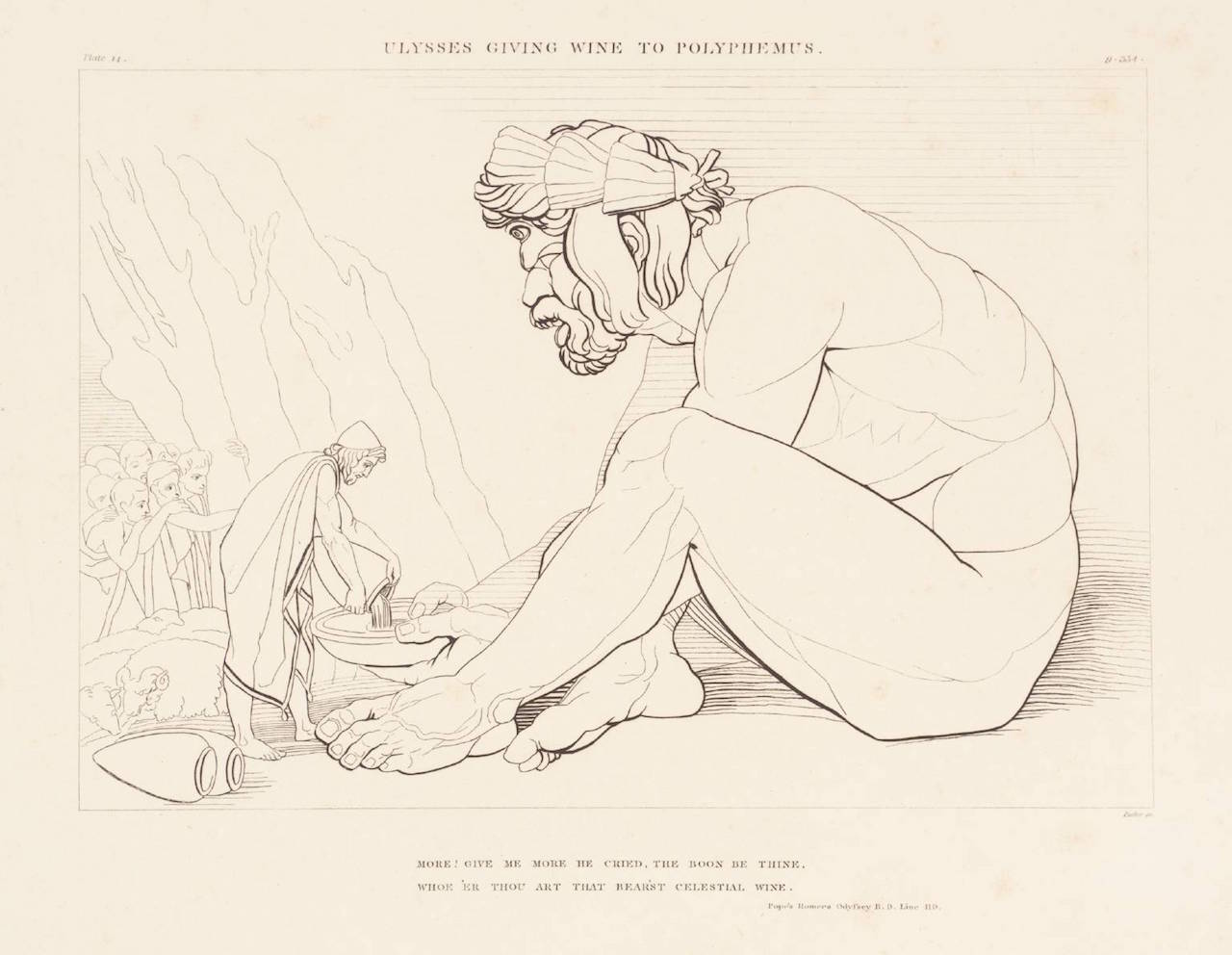 “Ulysses Giving Wine to Polyphemus” (1805). John Flaxman (1755–1826). Purchased as part of the Oppé Collection with assistance from the National Lottery through the Heritage Lottery Fund, 1996.
  “Circe Invidiosa,” (1892). J. W. Waterhouse (English, 1849–1917).
 “Teiresias appears to Ulysses during the sacrifice,” (1780–1785). Henry Fuseli (German, 1741–1825).
  “Ulysses and the Sirens” (ca. 1909). Herbert James Draper (English, 1863–1920).
 “Ulysses Asleep Laid on his Own Coast by the Phaeacian Sailors” (1805). John Flaxman (English, 1755–1826). Purchased as part of the Oppé Collection with assistance from the National Lottery through the Heritage Lottery Fund 1996.
  Minoan—probably Neopalatial—fresco commonly known as the “Lily Prince.” Whatever the exact type of this personage (perhaps a crowned acrobat, according to the interpretation of Maria Shaw), the Lily Prince is certainly a Minoan of elite standing. Public domain image based on a famous watercolor by Émile Gilliéron of a reconstruction by Arthur Evans.
 Detail from a fresco found at Hagia Triadha in Crete. Reconstruction by Mark Cameron, p. 96 of the catalogue Fresco: A Passport into the Past. Minoan Crete through the eyes of Mark Cameron. 1999. Catalogue curated by Doniert Evely. Athens: British School at Athens; and N. P. Goulandris Foundation, Museum of Cycladic Art. Reproduced with the permission of the British School at Athens. BSA Archive: Mark Cameron Personal Papers: CAM 1.
 “Minerva Restoring Ulysses to his Own Shape” (1805). John Flaxman (English, 1755–1826). Purchased as part of the Oppé Collection with assistance from the National Lottery through the Heritage Lottery Fund 1996.
 “Ulysses and his Dog” (1805). John Flaxman (English, 1755–1826). Purchased as part of the Oppé Collection with assistance from the National Lottery through the Heritage Lottery Fund 1996.
  “Ulysses Preparing to Fight with Irus” (1805). John Flaxman (English, 1755–1826) Purchased as part of the Oppé Collection with assistance from the National Lottery through the Heritage Lottery Fund 1996.
  “Euryclea Discovers Ulysses” (1805). John Flaxman (English, 1755–1826). Purchased as part of the Oppé Collection with assistance from the National Lottery through the Heritage Lottery Fund 1996.
  “The Harpies Going to Seize the Daughters of Pandareus” (1805). John Flaxman (English, 1755–1826). Purchased as part of the Oppé Collection with assistance from the National Lottery through the Heritage Lottery Fund 1996.
 Hēraklēs stringing a bow. Silver stater, c. 450–440 BCE, Thebes (Boeotia).
  Swallows, detail of the Spring Fresco at Thera, image via Flickr user
  Original artwork, by Flickr user
  Odysseus kiling Penelope’s suitors. Attic red-figure skyphos, ca. 440 BCE.
  Still life showing eggs, thrushes, napkin: from the House of Julia Felix, Pompeii.
  Eurykleia waking Penelope (1773). Print by Thomas Burke, after a painting by Angelika Kauffmann.
  Big Ed and Norma have just now broken free of the troublesome relationships that have kept these lovers apart for 27 years. Now at long last they can have a life together.
Still from
Big Ed and Norma have just now broken free of the troublesome relationships that have kept these lovers apart for 27 years. Now at long last they can have a life together.
Still from  “Mercury Conducting the Souls of the Suitors to the Infernal Regions” (1805). John Flaxman (English, 1755–1826). Purchased as part of the Oppé Collection with assistance from the National Lottery through the Heritage Lottery Fund 1996.
  “Ulysses Departing from Lacedaemon for Ithaca, with his Bride Penelope” (1805). John Flaxman (English, 1755–1826). Flaxman made this image the last in his Odyssey series, bringing the story of Penelope and Odysseus full circle. Purchased as part of the Oppé Collection with assistance from the National Lottery through the Heritage Lottery Fund 1996.


,_around_440_BC,_Altes_Museum_Berlin_(13718420225)_glare-reduced_white-bg.png)
