
View:
By Card
THE ODYSSEY.
BOOK I.
ARGUMENT.
MINERVA'S DESCENT TO ITHACA.
The Poem opens within forty-eight days of the arrival of Ulysses in his dominions. He had now remained seven years in the island of Calypso, when the gods assembled in council proposed the method of his departure from thence, and his return to his native country. For this purpose it is concluded to send Mercury to Calypso, and Pallas immediately descends to Ithaca. She holds a conference with Telemachus, in the shape of Mentes, king of the Taphians; in which she advises him to take a journey, in quest of his father Ulysses, to Pylos and Sparta, where Nestor and Menelaus yet reigned; then, after having visibly displayed her divinity, disappears. The suitors of Penelope make great entertainments, and riot in her palace till night. Phemius sings to them the return of the Grecians, till Penelope puts a stop to the song. Some words arise between the suitors and Telemachus, who summons the council to meet the day following.
1
THE man, for wisdom's various arts renown'd,
1
Long exercised in woes, O Muse! resound;
Who, when his arms had wrought the destin'd fall
Of sacred Troy,
1
and raz'd her heaven-built wall,
Wandering from clime to clime, observant stray'd,
5
Their manners noted, and their states survey'd.
On stormy seas unnumber'd toils he bore,
Safe with his friends to gain his natal shore:
Vain toils! their impious folly dar'd to prey
On herds devoted to the god of day;
10
The god vindictive doom'd them never more
(Ah, men unbless'd!) to touch that natal shore.
2
Oh, snatch some portion of these acts from fate,
Celestial Muse! and to our world relate.
15
Now at their native realms the Greeks arriv'd;
All who the wars of ten long years surviv'd,
And 'scap'd the perils of the gulfy main.
Ulysses, sole of all the victor train,
An exile from his dear paternal coast,
20
Deplor'd his absent queen and empire lost.
Calypso in her caves constrain'd his stay,
With sweet, reluctant, amorous delay:
In vain for now the circling years disclose
The day predestin'd to reward his woes.
25
At length his Ithaca is given by fate,
Where yet new labours his arrival wait;
At length their rage the hostile powers restrain,
All but the ruthless monarch of the main.
But now the god, remote, a heavenly guest,
30
In Aethiopia graced the genial feast;
3
(A race divided, whom with sloping rays
The rising and descending sun surveys ;)
There on the world's extremest verge rever'd
With hecatombs and prayer in pomp preferr'd,
35
Distant he lay; while in the bright abodes
Of high Olympus, Jove convened the gods:
Th' assembly thus the sire supreme address'd,
Aegisthus' fate revolving in his breast,
Whom young Orestes to the dreary coast
40
Of Pluto sent, a blood-polluted ghost.
4
JUPITER
'Perverse mankind! whose wills, created free,
Charge all their woes on absolute decree;
All to the dooming gods their guilt translate,
And follies are miscall'd the crimes of fate.
45
When to his lust Aegisthus gave the rein,
'Did fate, or we, th' adulterous act constrain?
'Perverse mankind! whose wills, created free,
Charge all their woes on absolute decree;
All to the dooming gods their guilt translate,
And follies are miscall'd the crimes of fate.
45
When to his lust Aegisthus gave the rein,
'Did fate, or we, th' adulterous act constrain?
'Did fate, or we, when great Atrides died,
'Urge the bold traitor to the regicide?
'Hermes I sent, while yet his soul remain'd
50
'Sincere from royal blood, and faith profan'd;
'To warn the wretch, that young Orestes, grown
To manly years, should re-assert the throne.
'Yet, impotent of mind, and uncontroll'd,
'He plunged into the guif which Heaven foretold.
55
44
Here paus'd the god; and pensive thus replies
Minerva, graceful with her azure eyes:
MINERVA
O thou! from whom the whole creation springs,
The source of power on earth deriv'd to kings!
'His death was equal to the direful deed;
60
So may the man of blood be doom'd to bleed!
'But grief and rage alternate wound my breast
For brave Ulysses, still by fate oppress'd.
'Amidst an isle,
5
around whose rocky shore
The forests murmur, and the surges roar,
65
The blameless hero from his wish'd-for home
A goddess guards in her enchanted dome:
'(Atlas her sire, to whose far-piercing eye
'The wonders of the deep expanded lie;
Th' eternal columns which on earth he rears
70
'End in the starry vault, and prop the spheres.)
By his fair daughter is the chief confin'd,
'Who soothes to dear delight his anxious mind:
Successless all her soft caresses prove,
'To banish from his breast his country's love;
75
To see the smoke from his lov'd palace rise,
'While the dear isle in distant prospect lies,
With what contentment could he close his eyes!
'And will Omnipotence neglect to save
'The suffering virtue of the wise and brave?
80
'Must he, whose altars on the Phrygian shore
'With frequent rites, and pure, avow'd thy power
'Be doom'd the worst of human ills to prove,
'Unbless'd, abandon'd to the wrath of Jove?'
O thou! from whom the whole creation springs,
The source of power on earth deriv'd to kings!
'His death was equal to the direful deed;
60
So may the man of blood be doom'd to bleed!
'But grief and rage alternate wound my breast
For brave Ulysses, still by fate oppress'd.
'Amidst an isle,
5
around whose rocky shore
The forests murmur, and the surges roar,
65
The blameless hero from his wish'd-for home
A goddess guards in her enchanted dome:
'(Atlas her sire, to whose far-piercing eye
'The wonders of the deep expanded lie;
Th' eternal columns which on earth he rears
70
'End in the starry vault, and prop the spheres.)
By his fair daughter is the chief confin'd,
'Who soothes to dear delight his anxious mind:
Successless all her soft caresses prove,
'To banish from his breast his country's love;
75
To see the smoke from his lov'd palace rise,
'While the dear isle in distant prospect lies,
With what contentment could he close his eyes!
'And will Omnipotence neglect to save
'The suffering virtue of the wise and brave?
80
'Must he, whose altars on the Phrygian shore
'With frequent rites, and pure, avow'd thy power
'Be doom'd the worst of human ills to prove,
'Unbless'd, abandon'd to the wrath of Jove?'
JUPITER
Daughter! what words have pass'd thy lips unweigh'd!
85
'Deem not unjustly by my doom oppress'd,
Of human race the wisest and the best.
'Neptune, by prayer repentant rarely won,
'Afflicts the chief, t' avenge his giant son,
'Whose visual orb Ulysses robb'd of light;
90
'Great Polypheme, of more than mortal might!
'Him young Thoösa bore (the bright increase
'Of Phorcys, dreaded in the sounds and seas ;)
Whom Neptune ey'd with bloom of beauty bless'd,
'And in his cave the yielding nymph compress'd.
95
'For this, the god constrains the Greek to roam,
'A hopeless exile from his native home,
'From death alone exempt-but cease to mourn ;
Let all combine t' achieve his wish'd return:
'Neptune aton'd, his wrath shall now refrain,
100
'Or thwart the synod of the gods in vain.'
Daughter! what words have pass'd thy lips unweigh'd!
85
'Deem not unjustly by my doom oppress'd,
Of human race the wisest and the best.
'Neptune, by prayer repentant rarely won,
'Afflicts the chief, t' avenge his giant son,
'Whose visual orb Ulysses robb'd of light;
90
'Great Polypheme, of more than mortal might!
'Him young Thoösa bore (the bright increase
'Of Phorcys, dreaded in the sounds and seas ;)
Whom Neptune ey'd with bloom of beauty bless'd,
'And in his cave the yielding nymph compress'd.
95
'For this, the god constrains the Greek to roam,
'A hopeless exile from his native home,
'From death alone exempt-but cease to mourn ;
Let all combine t' achieve his wish'd return:
'Neptune aton'd, his wrath shall now refrain,
100
'Or thwart the synod of the gods in vain.'
MINERVA
80
'Father and king ador'd!' Minerva cried.
'since all who in the Olympian bower reside
'Now make the wandering Greek their public care,
'Let Hermes to th' Atlantic isle
6
repair :
105
'Bid him, arriv'd in bright Calypso's court,
'The sanction of th' assembled powers report:
'That wise Ulysses to his native land
'Must speed, obedient to their high command.
'Meantime Telemachus, the blooming heir
110
'Of sea-girt Ithaca, demands my care:
'Tis mine to form his green unpractis'd years
'In sage debates, surrounded with his peers,
'To save the state, and timely to restrain
'The bold intrusion of the suitor-train;
115
'Who crowd his palace, and with lawless power
'His herds and flocks in feastful rites devour.
To distant Sparta, and the spacious waste
'Of sandy Pyle, the royal youth shall haste.
'There, warm with filial love, the cause inquire
120
'That from his realm retards his godlike sire :
'Delivering early to the voice of fame
'The promise of a great immortal name.'
80
'Father and king ador'd!' Minerva cried.
'since all who in the Olympian bower reside
'Now make the wandering Greek their public care,
'Let Hermes to th' Atlantic isle
6
repair :
105
'Bid him, arriv'd in bright Calypso's court,
'The sanction of th' assembled powers report:
'That wise Ulysses to his native land
'Must speed, obedient to their high command.
'Meantime Telemachus, the blooming heir
110
'Of sea-girt Ithaca, demands my care:
'Tis mine to form his green unpractis'd years
'In sage debates, surrounded with his peers,
'To save the state, and timely to restrain
'The bold intrusion of the suitor-train;
115
'Who crowd his palace, and with lawless power
'His herds and flocks in feastful rites devour.
To distant Sparta, and the spacious waste
'Of sandy Pyle, the royal youth shall haste.
'There, warm with filial love, the cause inquire
120
'That from his realm retards his godlike sire :
'Delivering early to the voice of fame
'The promise of a great immortal name.'
She said: the sandals of celestial mould,
125
Fledged with ambrosial plumes, and rich with goid,
Surround her feet: with these sublime she sails
Th' aërial space, and mounts the winged gales:
O'er earth and ocean wide prepar'd to soar;
Her dreaded arm a beamy javelin bore,
130
Ponderous and vast; which, when her fury burns,
Proud tyrants humbles, and whole hosts o'erturns.
From high Olympus prone her flight she bends,
And in the realm of Ithaca descends.
Her lineaments divine the grave disguise
135
Of Mentes' form conceal'd from human eyes;
(Mentes, the monarch of the Taphian
7
land ;)
A glittering spear wav'd awful in her hand.
There in the portal placed, the heaven-born maid
Enormous riot and misrule survey'd.
140
On hides of beeves, before the palace gate,
(Sad spoils of luxury,) the suitors sate.
With rival art, and ardour in their mien,
At chess they vie, to captivate the queen;
8
Divining of their loves. Attending nigh,
145
A menial train the flowing bowl supply :
Others, apart, the spacious hall prepare,
And form the costly feast with busy care.
There young Telemachus, his bloomy face
Glowing celestial sweet, with godlike grace
150
Amid the circle shines: but hope and fear
(Painful vicissitude!) his bosom tear.
Now, imaged in his mind, he sees restor'd
In peace and joy the people's rightful lord :
The proud oppressors fly the vengeful sword.
155
While his fond soul these fancied triumphs swell'd,
The stranger-guest the royal youth beheld :
Griev'd that a visitant so long should wait
Unmark'd, unhonour'd, at a monarch's gate;
Instant he flew with hospitable haste,
160
And the new friend with courteous air embrac'd.
TELEMACHUS
'Stranger, whoe'er thou art, securely rest,
'Affianced in my faith, a friendly guest :
'Approach the dome, the social banquet share,
'And then the purpose of thy soul declare.'
165
'Stranger, whoe'er thou art, securely rest,
'Affianced in my faith, a friendly guest :
'Approach the dome, the social banquet share,
'And then the purpose of thy soul declare.'
165
125
Thus affable and mild, the prince precedes,
And to the dome th' unknown celestial leads.
The spear receiving from her hand, he placed
Against a column, fair with sculpture graced;
Where seemly ranged in peaceful order stood
170
Ulysses' arms, now long disus'd to blood.
He led the goddess to the sovereign seat,
Her feet supported with a stool of state;
(A purple carpet spread the pavement wide ;)
Then drew his seat, familiar, to her side;
175
Far from the suitor-train, a brutal crowd,
With insolence, and wine, elate and loud;
Where the free guest, unnoted, might relate,
If haply conscious, of his father's fate.
The golden ewer a maid obsequious brings,
180
Replenish'd from the cool translucent springs;
With copious water the bright vase supplies
A silver laver of capacious size :
They wash. The tables in fair order spread,
They heap the glittering canisters with bread :
185
Viands of various kinds allure the taste,
Of choicest sort and savour, rich repast!
Delicious wines th' attending herald brought;
The gold gave lustre to the purple draught.
Lur'd with the vapour of the fragrant feast,
190
In rush'd the suitors with voracious haste:
Marshall'd in order due, to each a sewer
Presents, to bathe his hands, a radiant ewer.
Luxurious then they feast. Observant round
Gay stripling youths the brimming goblets crown'd.
195
The rage of hunger quell'd, they all advance,
And form to measur'd airs the mazy dance:
To Phemius was consign'd the chorded lyre,
Whose hand reluctant touch'd the warbling wire :
Phemius, whose voice divine could sweetest sing
200
High strains responsive to the vocal string.
Meanwhile, in whispers to his heavenly guest
His indignation thus the prince express'd:
TELEMACHUS
'Indulge my rising grief, while these (my friend)
'With song and dance the pompous revel end.
205
'Light is the dance, and doubly sweet the lays
'When for the dear delight another pays.
'His treasur'd stores these cormorants consume,
'Whose bones, defrauded of a regal tomb
'And common turf, lie naked on the plain,
210
'Or doom'd to welter in the whelming main.
'Should he return, that troop so blithe and bold,
'With purple robes inwrought, and stiff with gold,
'Precipitant in fear would wing their flight,
'And curse their cumb'rous pride's unwieldy weight.
215
'But ah! I dream: th' appointed hour is fled;
'And hope, too long with vain delusion fed,
'Deaf to the rumour of fallacious fame,
'Gives to the roll of death his glorious name!
'With venial freedom let me now demand
220
'Thy name, thy lineage, and paternal land;
'Sincere, from whence began thy course, recite,
'And to what ship I owe the friendly freight ?
'Now first to me this visit dost thou deign,
'Or number'd in my father's social train ?
225
'All who deserv'd his choice, he made his own,
'And, curious much to know, he far was known.'
'Indulge my rising grief, while these (my friend)
'With song and dance the pompous revel end.
205
'Light is the dance, and doubly sweet the lays
'When for the dear delight another pays.
'His treasur'd stores these cormorants consume,
'Whose bones, defrauded of a regal tomb
'And common turf, lie naked on the plain,
210
'Or doom'd to welter in the whelming main.
'Should he return, that troop so blithe and bold,
'With purple robes inwrought, and stiff with gold,
'Precipitant in fear would wing their flight,
'And curse their cumb'rous pride's unwieldy weight.
215
'But ah! I dream: th' appointed hour is fled;
'And hope, too long with vain delusion fed,
'Deaf to the rumour of fallacious fame,
'Gives to the roll of death his glorious name!
'With venial freedom let me now demand
220
'Thy name, thy lineage, and paternal land;
'Sincere, from whence began thy course, recite,
'And to what ship I owe the friendly freight ?
'Now first to me this visit dost thou deign,
'Or number'd in my father's social train ?
225
'All who deserv'd his choice, he made his own,
'And, curious much to know, he far was known.'
MINERVA
178
'My birth I boast' (the blue-ey'd virgin cries)
'From great Anchialus, renown'd and wise:
'Mentes my name; I rule the Taphian race,
230
'Whose bounds the deep circumfluent waves embrace:
230
'A duteous people, and industrious isle,
'To naval arts inured, and stormy toil.
'Freighted with iron from my native land,
'I steer my voyage to the Brutian strand;
9
178
'My birth I boast' (the blue-ey'd virgin cries)
'From great Anchialus, renown'd and wise:
'Mentes my name; I rule the Taphian race,
230
'Whose bounds the deep circumfluent waves embrace:
230
'A duteous people, and industrious isle,
'To naval arts inured, and stormy toil.
'Freighted with iron from my native land,
'I steer my voyage to the Brutian strand;
9
MINERVA
'To gain by commerce, for the labour'd mass,
235
'A just proportion of refulgent brass.
'Far from your capital my ship resides
'At Reithrus,
10
and secure at anchor rides;
'Where waving groves on airy Neion grow,
'Supremely tall, and shade the deeps below.
240
'Thence to revisit your imperial dome,
'An old hereditary guest I come :
'Your father's friend. Laertes can relate
'Our faith unspotted, and its early date;
'Who, press'd with heart-corroding grief and years,
245
'To the gay court a rural shed prefers,
'Where, sole of all his train, a matron sage
'Supports with homely food his drooping age,
'With feeble steps from marshalling his vines
'Returning sad, when toilsome day declines.
250
'With friendly speed, induced by erring fame,
'To hail Ulysses' safe return, I came ;
'But still the frown of some celestial power
'With envious joy retards the blissful hour.
'Let not your soul be sunk in sad despair;
255
'He lives, he breathes this heavenly vital air,
'Among a savage race, whose shelfy bounds
'With ceaseless roar the foaming deep surrounds.
'The thoughts which roll within my ravish'd breast,
'To me, no seer, the inspiring gods suggest ;
260
'Nor skill'd, nor studious, with prophetic eye
'To judge the winged omens of the sky.
'Yet hear this certain speech, nor deem it vain ;
'Though adamantine bonds the chief restrain,
'The dire restraint his wisdom will defeat,
265
'And soon restore him to his regal seat.
'But, generous youth! sincere and free declare,
'Are you, of manly growth, his royal heir ?
'For sure Ulysses in your look appears,
'The same his features, if the same his years.
270
'Such was that face, on which I dwelt with joy
'Ere Greece assembled stemm'd the tides to Troy;
'To gain by commerce, for the labour'd mass,
235
'A just proportion of refulgent brass.
'Far from your capital my ship resides
'At Reithrus,
10
and secure at anchor rides;
'Where waving groves on airy Neion grow,
'Supremely tall, and shade the deeps below.
240
'Thence to revisit your imperial dome,
'An old hereditary guest I come :
'Your father's friend. Laertes can relate
'Our faith unspotted, and its early date;
'Who, press'd with heart-corroding grief and years,
245
'To the gay court a rural shed prefers,
'Where, sole of all his train, a matron sage
'Supports with homely food his drooping age,
'With feeble steps from marshalling his vines
'Returning sad, when toilsome day declines.
250
'With friendly speed, induced by erring fame,
'To hail Ulysses' safe return, I came ;
'But still the frown of some celestial power
'With envious joy retards the blissful hour.
'Let not your soul be sunk in sad despair;
255
'He lives, he breathes this heavenly vital air,
'Among a savage race, whose shelfy bounds
'With ceaseless roar the foaming deep surrounds.
'The thoughts which roll within my ravish'd breast,
'To me, no seer, the inspiring gods suggest ;
260
'Nor skill'd, nor studious, with prophetic eye
'To judge the winged omens of the sky.
'Yet hear this certain speech, nor deem it vain ;
'Though adamantine bonds the chief restrain,
'The dire restraint his wisdom will defeat,
265
'And soon restore him to his regal seat.
'But, generous youth! sincere and free declare,
'Are you, of manly growth, his royal heir ?
'For sure Ulysses in your look appears,
'The same his features, if the same his years.
270
'Such was that face, on which I dwelt with joy
'Ere Greece assembled stemm'd the tides to Troy;
MINERVA
'But, parting then for that detested shore,
'Our eyes, unhappy! never greeted more.'
'But, parting then for that detested shore,
'Our eyes, unhappy! never greeted more.'
TELEMACHUS
'To prove a genuine birth (the prince replies)
275
'On female truth assenting faith relies:
'Thus manifest of right, I build my claim
'Sure-founded on a fair maternal fame,
'Ulysses' son; but happier he, whom fate
'Hath placed beneath the storms which toss the great!
280
'Happier the son, whose hoary sire is bless'd
'With humble affluence, and domestic rest!
'Happier than I, to future empire born,
'But doom'd a father's wretched fate to mourn!'
'To prove a genuine birth (the prince replies)
275
'On female truth assenting faith relies:
'Thus manifest of right, I build my claim
'Sure-founded on a fair maternal fame,
'Ulysses' son; but happier he, whom fate
'Hath placed beneath the storms which toss the great!
280
'Happier the son, whose hoary sire is bless'd
'With humble affluence, and domestic rest!
'Happier than I, to future empire born,
'But doom'd a father's wretched fate to mourn!'
MINERVA
To whom, with aspect mild, the guest divine:
285
'Oh true descendant of a scepter'd line!
'The gods a glorious fate, from anguish free,
'To chaste Penelope's increase decree.
'But say, yon jovial troop so gaily dress'd,
'Is this a bridal or a friendly feast ?
290
'Or from their deed I rightlier may divine,
'(Unseemly flown with insolence and wine!)
'Unwelcome revellers, whose lawless joy
'Pains the sage ear, and hurts the sober eye.'
To whom, with aspect mild, the guest divine:
285
'Oh true descendant of a scepter'd line!
'The gods a glorious fate, from anguish free,
'To chaste Penelope's increase decree.
'But say, yon jovial troop so gaily dress'd,
'Is this a bridal or a friendly feast ?
290
'Or from their deed I rightlier may divine,
'(Unseemly flown with insolence and wine!)
'Unwelcome revellers, whose lawless joy
'Pains the sage ear, and hurts the sober eye.'
TELEMACHUS
230
'Magnificence of old' (the prince replied)
295
'Beneath our roof with virtue could reside;
'Unblam'd abundance crown'd the royal board,
'What time this dome rever'd her prudent lord;
'Who now (so Heaven decrees) is doom'd to mourn,
'Bitter constraint! erroneous and forlorn.
300
'Better the chief, on Ilion's hostile plain,
'Had fall'n surrounded with his warlike train;
'Or safe return'd, the race of glory pass'd,
'New to his friends' embrace, had breathed his last !
'Then grateful Greece with streaming eyes would raise
305
'Historic marbles to record his praise;
'His praise, eternal on the faithful stone,
'Had with transmissive honour graced his son.
'Now, snatch'd by harpies to the dreary coast
11
,
'Sunk is the hero, and his glory lost :
310
230
'Magnificence of old' (the prince replied)
295
'Beneath our roof with virtue could reside;
'Unblam'd abundance crown'd the royal board,
'What time this dome rever'd her prudent lord;
'Who now (so Heaven decrees) is doom'd to mourn,
'Bitter constraint! erroneous and forlorn.
300
'Better the chief, on Ilion's hostile plain,
'Had fall'n surrounded with his warlike train;
'Or safe return'd, the race of glory pass'd,
'New to his friends' embrace, had breathed his last !
'Then grateful Greece with streaming eyes would raise
305
'Historic marbles to record his praise;
'His praise, eternal on the faithful stone,
'Had with transmissive honour graced his son.
'Now, snatch'd by harpies to the dreary coast
11
,
'Sunk is the hero, and his glory lost :
310
TELEMACHUS
'Vanish'd at once, unheard of, and unknown!
'And I his heir in misery alone.
'Nor for a dear lost father only flow
'The filial tears, but woe succeeds to woe:
'To tempt the spouseless queen with amorous wiles,
315
'Resort the nobles from the neighbouring isles;
'From Samos,
12
circled with th' Ionian main,
'Dulichium, and Zacynthus' sylvan reign;
'Ev'n with presumptuous hope her bed t' ascend,
'The lords of Ithaca their right pretend.
320
'She seems attentive to their pleaded vows,
'Her heart detesting what her ear allows.
'They, vain expectants of the bridal hour,
'My stores in riotous expense devour,
'In feast and dance the mirthful months employ,
325
'And meditate my doom to crown their joy.'
'Vanish'd at once, unheard of, and unknown!
'And I his heir in misery alone.
'Nor for a dear lost father only flow
'The filial tears, but woe succeeds to woe:
'To tempt the spouseless queen with amorous wiles,
315
'Resort the nobles from the neighbouring isles;
'From Samos,
12
circled with th' Ionian main,
'Dulichium, and Zacynthus' sylvan reign;
'Ev'n with presumptuous hope her bed t' ascend,
'The lords of Ithaca their right pretend.
320
'She seems attentive to their pleaded vows,
'Her heart detesting what her ear allows.
'They, vain expectants of the bridal hour,
'My stores in riotous expense devour,
'In feast and dance the mirthful months employ,
325
'And meditate my doom to crown their joy.'
MINERVA
With tender pity touch'd, the goddess cried:
'Soon may kind Heaven a sure relief provide,
'Soon may your sire discharge the vengeance due,
'And all your wrongs the proud oppressors rue !
330
'Oh! in that portal should the chief appear,
'Each hand tremendous with a brazen spear,
'In radiant panoply his limbs incased!
'(For so, of old, my father's court he graced,
'When social mirth unbent his serious soul,
335
'O'er the full banquet, and the sprightly bowl :)
'He then from Ephyre,
13
the fair domain
'Of Ilus, sprung from Jason's royal strain,
'Measur'd a length of seas, a toilsome length, in vain.
'For, voyaging to learn the direful art
340
'To taint with deadly drugs the barbed dart,
'Observant of the gods, and sternly just,
'Ilus refus'd t' impart the baneful trust:
'With friendlier zeal my father's soul was fir'd,
'The drugs he knew, and gave the boon desir'd.
345
'Appear'd he now with such heroic port,
'As then conspicuous at the Taphian court ;
14
With tender pity touch'd, the goddess cried:
'Soon may kind Heaven a sure relief provide,
'Soon may your sire discharge the vengeance due,
'And all your wrongs the proud oppressors rue !
330
'Oh! in that portal should the chief appear,
'Each hand tremendous with a brazen spear,
'In radiant panoply his limbs incased!
'(For so, of old, my father's court he graced,
'When social mirth unbent his serious soul,
335
'O'er the full banquet, and the sprightly bowl :)
'He then from Ephyre,
13
the fair domain
'Of Ilus, sprung from Jason's royal strain,
'Measur'd a length of seas, a toilsome length, in vain.
'For, voyaging to learn the direful art
340
'To taint with deadly drugs the barbed dart,
'Observant of the gods, and sternly just,
'Ilus refus'd t' impart the baneful trust:
'With friendlier zeal my father's soul was fir'd,
'The drugs he knew, and gave the boon desir'd.
345
'Appear'd he now with such heroic port,
'As then conspicuous at the Taphian court ;
14
MINERVA
'Soon should yon boasters cease their haughty strife,
'Or each atone his guilty love with life.
'But of his wish'd return the care resign;
350
'Be future vengeance to the powers divine:
'My sentence hear: with stern distaste avow'd,
'To their own districts drive the suitor-crowd:
'When next the morning warms the purple east,
'Convoke the peerage, and the gods attest;
355
'The sorrows of your inmost soul relate;
'And form sure plans to save the sinking state.
'Should second love a pleasing flame inspire,
'And the chaste queen connubial rites require,
'Dismiss'd with honour, let her hence repair
360
'To great Icarius
15
, whose paternal care
'Will guide her passion, and reward her choice
'With wealthy dower, and bridal gifts of price.
'Then let this dictate of my love prevail :
280
'Instant, to foreign realms prepare to sail,
365
'To learn your father's fortunes: Fame may prove,
'Or omen'd voice, (the messenger of Jove,)
'Propitious to the search. Direct your toil
'Through the wide ocean first to sandy Pyle;
'Of Nestor, hoary sage, his doom demand :
370
'Thence speed your voyage to the Spartan strand;
'For young Atrides
16
to th' Achaian coast
'Arriv'd the last of all the victor host:
'If yet Ulysses views the light, forbear,
'Till the fleet hours restore the circling year.
375
'But if his soul hath wing'd the destin'd flight,
'Inhabitant of deep disastrous night;
'Homeward with pious speed repass the main,
'To the pale shade funereal rites ordain,
'Plant the fair column o'er the vacant grave,
380
'A hero's honours let the hero have.
'With decent grief the royal dead deplor'd,
'For the chaste queen select an equal lord.
'Then let revenge ycur daring mind employ,
'By fraud or force the suitor-train destroy,
385
'And, starting into manhood, scorn the boy.
'Soon should yon boasters cease their haughty strife,
'Or each atone his guilty love with life.
'But of his wish'd return the care resign;
350
'Be future vengeance to the powers divine:
'My sentence hear: with stern distaste avow'd,
'To their own districts drive the suitor-crowd:
'When next the morning warms the purple east,
'Convoke the peerage, and the gods attest;
355
'The sorrows of your inmost soul relate;
'And form sure plans to save the sinking state.
'Should second love a pleasing flame inspire,
'And the chaste queen connubial rites require,
'Dismiss'd with honour, let her hence repair
360
'To great Icarius
15
, whose paternal care
'Will guide her passion, and reward her choice
'With wealthy dower, and bridal gifts of price.
'Then let this dictate of my love prevail :
'Instant, to foreign realms prepare to sail,
365
'To learn your father's fortunes: Fame may prove,
'Or omen'd voice, (the messenger of Jove,)
'Propitious to the search. Direct your toil
'Through the wide ocean first to sandy Pyle;
'Of Nestor, hoary sage, his doom demand :
370
'Thence speed your voyage to the Spartan strand;
'For young Atrides
16
to th' Achaian coast
'Arriv'd the last of all the victor host:
'If yet Ulysses views the light, forbear,
'Till the fleet hours restore the circling year.
375
'But if his soul hath wing'd the destin'd flight,
'Inhabitant of deep disastrous night;
'Homeward with pious speed repass the main,
'To the pale shade funereal rites ordain,
'Plant the fair column o'er the vacant grave,
380
'A hero's honours let the hero have.
'With decent grief the royal dead deplor'd,
'For the chaste queen select an equal lord.
'Then let revenge ycur daring mind employ,
'By fraud or force the suitor-train destroy,
385
'And, starting into manhood, scorn the boy.
MINERVA
'Hast thou not heard how young Orestes, fir'd
'With great revenge, immortal praise acquir'd?
'His virgin-sword Aegisthus' veins imbrued;
'The murderer fell, and blood atoned for blood.
17
390
'O greatly bless'd with every blooming grace!
'With equal steps the paths of glory trace;
'Join to that royal youth's your rival name,
'And shine eternal in the sphere of fame.—
395
'But my associates now my stay deplore,
395
'Impatient on the hoarse-resounding shore.
'Thou, heedful of advice, secure proceed;
'My praise the precept is, be thine the deed.'
'Hast thou not heard how young Orestes, fir'd
'With great revenge, immortal praise acquir'd?
'His virgin-sword Aegisthus' veins imbrued;
'The murderer fell, and blood atoned for blood.
17
390
'O greatly bless'd with every blooming grace!
'With equal steps the paths of glory trace;
'Join to that royal youth's your rival name,
'And shine eternal in the sphere of fame.—
395
'But my associates now my stay deplore,
395
'Impatient on the hoarse-resounding shore.
'Thou, heedful of advice, secure proceed;
'My praise the precept is, be thine the deed.'
TELEMACHUS
'The counsel of my friend,' (the youth rejoin'd)
'Imprints conviction on my grateful mind.
400
'So fathers speak (persuasive speech and mild)
'Their sage experience to the favourite child.
'But, since to part, for sweet refection due
'The genial viands let my train renew :
'And the rich pledge of plighted faith receive,
405
'Worthy the heir of Ithaca to give.'
'The counsel of my friend,' (the youth rejoin'd)
'Imprints conviction on my grateful mind.
400
'So fathers speak (persuasive speech and mild)
'Their sage experience to the favourite child.
'But, since to part, for sweet refection due
'The genial viands let my train renew :
'And the rich pledge of plighted faith receive,
405
'Worthy the heir of Ithaca to give.'
MINERVA
'Defer the promised boon,' (the goddess cries,
Celestial azure brightening in her eyes,)
'And let me now regain the Reithrian port:
'From Temesé
18
return'd, your royal court
410
'I shall revisit, and that pledge receive,
'And gifts, memorial of our friendship, leave.'
'Defer the promised boon,' (the goddess cries,
Celestial azure brightening in her eyes,)
'And let me now regain the Reithrian port:
'From Temesé
18
return'd, your royal court
410
'I shall revisit, and that pledge receive,
'And gifts, memorial of our friendship, leave.'
Abrupt, with eagle-speed she cut the sky
Instant invisible to mortal eye.
Then first he recogniz'd th' ethereal guest;
415
Wonder and joy alternate fire his breast:
Heroic thoughts, infus'd, his heart dilate;
Revolving much his father's doubtful fate.
At length, compos'd, he join'd the suitor-throng
Hush'd in attention to the warbled song.
420
His tender theme the charming lyrist chose
Minerva's anger, and the dreadful woes
Which, voyaging from Troy, the victors bore,
While storms vindictive intercept the shore.
The shrilling airs the vaulted roof rebounds,
425
Reflecting to the queen the silver sounds,
With grief renew'd the weeping fair descends;
Their sovereign's step a virgin train attends :
A veil, of richest texture wrought, she wears,
And silent to the joyous hall repairs.
430
There, from the portal, with her mild command
Thus gently checks the minstrel's tuneful hand:
PENELOPE
'Phemius! let acts of gods, and heroes old,
'What ancient bards in hall and bower have told,
'Attemper'd to the lyre, your voice employ :
435
'Such the pleas'd ear will drink with silent joy.
'But, oh! forbear that dear disastrous name,
'To sorrow sacred, and secure of fame :
'My bleeding bosom sickens at the sound,
'And every piercing note inflicts a wound.'
440
'Phemius! let acts of gods, and heroes old,
'What ancient bards in hall and bower have told,
'Attemper'd to the lyre, your voice employ :
435
'Such the pleas'd ear will drink with silent joy.
'But, oh! forbear that dear disastrous name,
'To sorrow sacred, and secure of fame :
'My bleeding bosom sickens at the sound,
'And every piercing note inflicts a wound.'
440
TELEMACHUS
'Why, dearest object of my duteous love,'
'will you the bard reprove ?
'Oft, Jove's ethereal rays (resistless fire)
'The chanter's soul and raptur'd song inspire;
'Instinct divine! nor blame severe his choice,
445
'Warbling the Grecian woes with harp and voice:
'For novel lays attract our ravish'd ears;
'But old, the mind with inattention hears :
'Patient permit the sadly pleasing strain;
'Familiar now with grief, your tears refrain,
450
'And in the public woe forget your own;
'You weep not for a perish'd lord alone.
'What Greeks, now wandering in the Stygian gloom,
'With your Ulysses shar'd an equal doom!
'Your widow'd hours, apart, with female toil
455
'And various labours of the loom beguile;
'There rule, from palace-cares remote and free;
'That care to man belongs, and most to me.'
'Why, dearest object of my duteous love,'
'will you the bard reprove ?
'Oft, Jove's ethereal rays (resistless fire)
'The chanter's soul and raptur'd song inspire;
'Instinct divine! nor blame severe his choice,
445
'Warbling the Grecian woes with harp and voice:
'For novel lays attract our ravish'd ears;
'But old, the mind with inattention hears :
'Patient permit the sadly pleasing strain;
'Familiar now with grief, your tears refrain,
450
'And in the public woe forget your own;
'You weep not for a perish'd lord alone.
'What Greeks, now wandering in the Stygian gloom,
'With your Ulysses shar'd an equal doom!
'Your widow'd hours, apart, with female toil
455
'And various labours of the loom beguile;
'There rule, from palace-cares remote and free;
'That care to man belongs, and most to me.'
Mature beyond his years, the queen admires
His sage reply, and with her train retires.
460
Then swelling sorrows burst their former bounds,
With echoing grief afresh the dome resounds;
Till Pallas, piteous of her plaintive cries,
In slumber closed her silver-streaming eyes.
365
Meantime, rekindled at the royal charms,
465
Tumultuous love each beating bosom warms;
Intemperate rage a wordy war began;
But bold Telemachus assum'd the man.
TELEMACHUS
'Instant' (he cried) 'your female discord end,
'Ye deedless boasters! and the song attend:
470
'Obey that sweet compulsion, nor profane
'With dissonance the smooth melodious strain.
'Pacific now prolong the jovial feast;
'But, when the dawn reveals the rosy east,
'I, to the peers assembled, shall propose
475
'The firm resolve I here in few disclose:
'No longer live the cankers of my court;
'All to your several states with speed resort;
'Waste in wild riot what your land allows,
'There ply the early feast, and late carouse.
480
'But if, to honour lost, 'tis still decreed
'For you my bowl shall flow, my flock shall bleed;
'Judge and revenge my right, impartial Jove!—
'By him and all th' immortal thrones above,
'(A sacred oath,) each proud oppressor slain,
485
'Shall with inglorious gore this marble stain.'
'Instant' (he cried) 'your female discord end,
'Ye deedless boasters! and the song attend:
470
'Obey that sweet compulsion, nor profane
'With dissonance the smooth melodious strain.
'Pacific now prolong the jovial feast;
'But, when the dawn reveals the rosy east,
'I, to the peers assembled, shall propose
475
'The firm resolve I here in few disclose:
'No longer live the cankers of my court;
'All to your several states with speed resort;
'Waste in wild riot what your land allows,
'There ply the early feast, and late carouse.
480
'But if, to honour lost, 'tis still decreed
'For you my bowl shall flow, my flock shall bleed;
'Judge and revenge my right, impartial Jove!—
'By him and all th' immortal thrones above,
'(A sacred oath,) each proud oppressor slain,
485
'Shall with inglorious gore this marble stain.'
Aw'd by the prince, thus haughty, bold, and young,
Rage gnaw'd the lip, and wonder chain'd the tongue.
Silence at length the gay Antinoüs broke,
Constrain'd a smile, and thus ambiguous spoke :
490
ANTINOUS
'What god to your untutor'd youth affords
490
'This headlong torrent of amazing words?
'May Jove delay thy reign, and cumber late
'So bright a genius with the toils of state!'
'What god to your untutor'd youth affords
490
'This headlong torrent of amazing words?
'May Jove delay thy reign, and cumber late
'So bright a genius with the toils of state!'
TELEMACHUS
'Those toils' (Telemachus serene replies.)
'Have charms, with all their weight, t' allure the wise.
495
'Fast by the throne obsequious fame resides,
'And wealth incessant rolls her golden tides.
'Nor let Antinoüs rage, if strong desire
'Of wealth and fame a youthful bosom fire:
500
'Elect by Jove his delegate of sway,
'With joyous pride the summons I'd obey.
'Whene'er Ulysses roams the realm of night,
'Should factious power dispute my lineal right,
'Those toils' (Telemachus serene replies.)
'Have charms, with all their weight, t' allure the wise.
495
'Fast by the throne obsequious fame resides,
'And wealth incessant rolls her golden tides.
'Nor let Antinoüs rage, if strong desire
'Of wealth and fame a youthful bosom fire:
500
'Elect by Jove his delegate of sway,
'With joyous pride the summons I'd obey.
'Whene'er Ulysses roams the realm of night,
'Should factious power dispute my lineal right,
TELEMACHUS
'Some other Greeks a fairer claim may plead;
505
'To your pretence their title would precede.
'At least, the sceptre lost, I still should reign
'Sole o'er my vassals, and domestic train.'
'Some other Greeks a fairer claim may plead;
505
'To your pretence their title would precede.
'At least, the sceptre lost, I still should reign
'Sole o'er my vassals, and domestic train.'
EURYMACHUS
To this Eurymachus: 'To Heaven alone
'Refer the choice to fill the vacant throne.
510
'Your patrimonial stores in peace possess ;
'Undoubted, all your filial claim confess :
'Your private right should impious power invade,
'The peers of Ithaca would arm in aid.
'But say, that stranger guest who late withdrew,
515
'What and from whence? his name and lineage shew.
'His grave demeanour and majestic grace
'Speak him descended of no vulgar race:
'Did he some loan of ancient right require,
'Or came fore-runner of your scepter'd sire ?'
520
To this Eurymachus: 'To Heaven alone
'Refer the choice to fill the vacant throne.
510
'Your patrimonial stores in peace possess ;
'Undoubted, all your filial claim confess :
'Your private right should impious power invade,
'The peers of Ithaca would arm in aid.
'But say, that stranger guest who late withdrew,
515
'What and from whence? his name and lineage shew.
'His grave demeanour and majestic grace
'Speak him descended of no vulgar race:
'Did he some loan of ancient right require,
'Or came fore-runner of your scepter'd sire ?'
520
TELEMACHUS
'Oh son of Polybus!' the prince reples
'No more my sire will glad these longing eyes :
'The queen's fond hope inventive rumour cheers,
'Or vain diviners' dreams divert her fears.
'That stranger-guest the Taphian realm obeys,
525
'A realm defended with encircling seas.
'Mentes, an ever-honour'd name, of old
'High in Ulysses' social list enroll'd.'
'Oh son of Polybus!' the prince reples
'No more my sire will glad these longing eyes :
'The queen's fond hope inventive rumour cheers,
'Or vain diviners' dreams divert her fears.
'That stranger-guest the Taphian realm obeys,
525
'A realm defended with encircling seas.
'Mentes, an ever-honour'd name, of old
'High in Ulysses' social list enroll'd.'
421
Thus he, though conscious of th' ethereal guest,
Answer'd evasive of the sly request.
530
Meantime the lyre rejoins the sprightly lay;
Love-dittied airs, and dance, conclude the day.
But when the star of eve with golden light
Adorn'd the matron brow of sable night,
The mirthful train dispersing quit the court,
535
And to their several domes to rest resort.
A towering structure to the palace join'd;
To this his steps the thoughtful prince inclin'd:
In his pavilion there, to sleep repairs;
The lighted torch the sage Euryclea bears :
540
(Daughter of Ops, the just Pisenor's son,
For twenty beeves by great Laërtes won;
In rosy prime with charms attractive graced,
Honour'd by him, a gentle lord and chaste,
With dear esteem: too wise, with jealous strife
545
To taint the joys of sweet connubial life.
Sole with Telemachus her service ends,
A child she nurs'd him, and a man attends.)
Whilst to his couch himself the prince address'd,
The duteous dame receiv'd the purple vest:
550
The purple vest with decent care dispos'd,
The silver ring she pull'd, the door reclos'd:
The bolt, obedient to the silken cord,
To the strong staple's inmost depth restor'd,
Secur'd the valves. There wrapp'd in silent shade,
555
Pensive, the rules the goddess gave, he weigh'd;
Stretch'd on the downy fleece, no rest he knows,
And in his raptur'd soul the vision glows.
Odyssey. Homer. London. 1858.
Sponsored by Perseus Project, Tufts University.
 Zeus, Athena, and Hermes (1810). Drawing by John Flaxman.
 Athena (1810). Drawing by John Flaxman.
 Telemachus with Athena as Mentor (1810). Drawing by John Flaxman.
  Nestor’s Sacrifice (1805). Engraving after John Flaxman (1755-1826). Purchased as part of the Oppé Collection with assistance from the National Lottery through the Heritage Lottery Fund 1996.
  “The Fair Helen.” Willy Pogany (Hungarian, 1882–1955).
Image
“The Fair Helen.” Willy Pogany (Hungarian, 1882–1955).
Image  “Leucothea, the White Goddess, Preserving Ulysses” (1805). John Flaxman (1755–1826). Purchased as part of the Oppé Collection with assistance from the National Lottery through the Heritage Lottery Fund, 1996.
  “Nausicaa” (1878), Frederick Leighton (English, 1830–1896).
 Red-figured pyxis, picturing Nereids at home, “indoors”: the Nereid with her hair down is labeled as Thaleia.
 View of Garitsa, region right outside the northern walls of the city of Corfu, and according to the legend the site of Alcinous’s gardens (1867). Étienne Rey (French, 1789–1867).
  Blind Demodokos sings of the siege of Troy (1810), by John Flaxman (English, 1755–1826).
 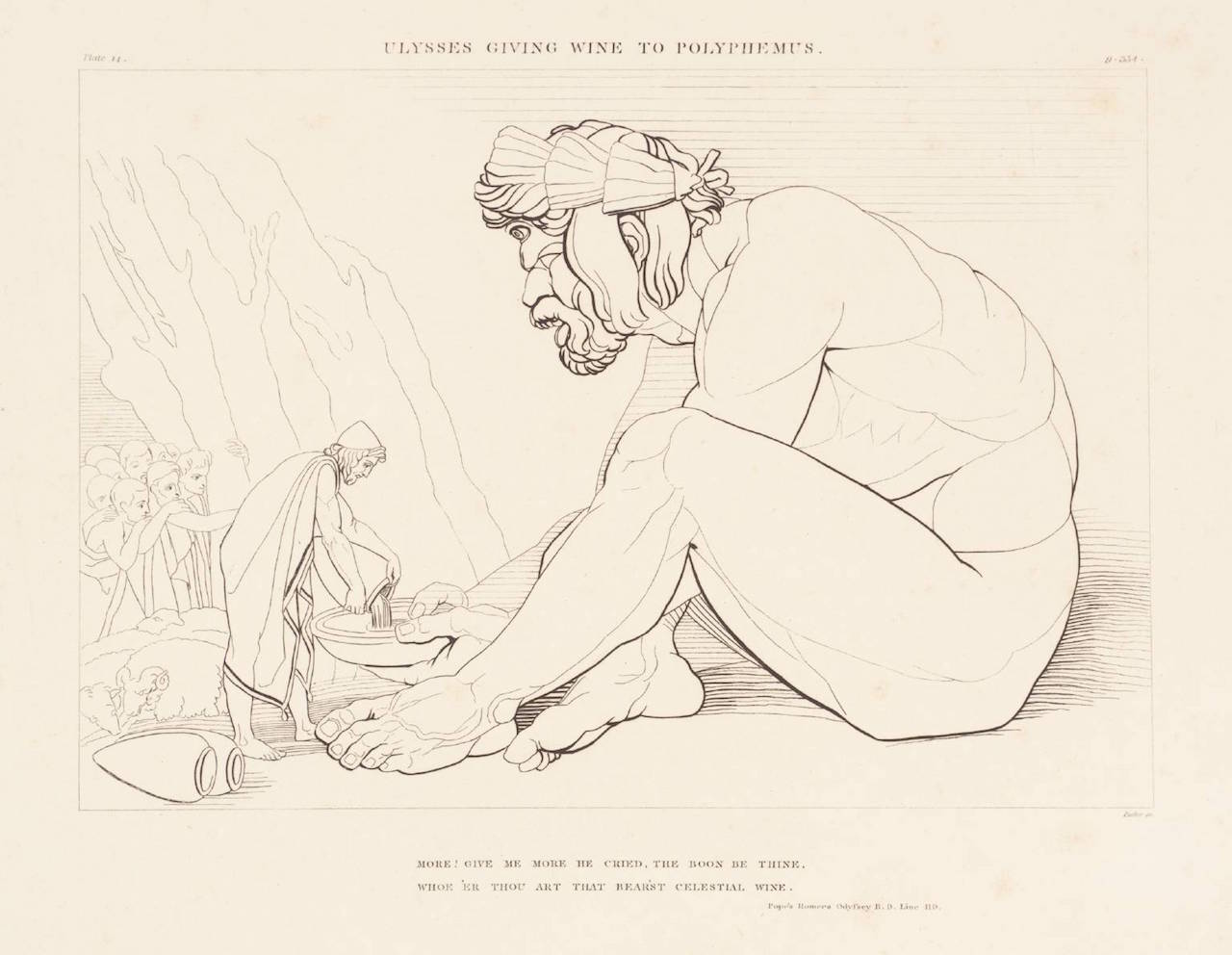 “Ulysses Giving Wine to Polyphemus” (1805). John Flaxman (1755–1826). Purchased as part of the Oppé Collection with assistance from the National Lottery through the Heritage Lottery Fund, 1996.
  “Circe Invidiosa,” (1892). J. W. Waterhouse (English, 1849–1917).
 “Teiresias appears to Ulysses during the sacrifice,” (1780–1785). Henry Fuseli (German, 1741–1825).
  “Ulysses and the Sirens” (ca. 1909). Herbert James Draper (English, 1863–1920).
 “Ulysses Asleep Laid on his Own Coast by the Phaeacian Sailors” (1805). John Flaxman (English, 1755–1826). Purchased as part of the Oppé Collection with assistance from the National Lottery through the Heritage Lottery Fund 1996.
  Minoan—probably Neopalatial—fresco commonly known as the “Lily Prince.” Whatever the exact type of this personage (perhaps a crowned acrobat, according to the interpretation of Maria Shaw), the Lily Prince is certainly a Minoan of elite standing. Public domain image based on a famous watercolor by Émile Gilliéron of a reconstruction by Arthur Evans.
 Detail from a fresco found at Hagia Triadha in Crete. Reconstruction by Mark Cameron, p. 96 of the catalogue Fresco: A Passport into the Past. Minoan Crete through the eyes of Mark Cameron. 1999. Catalogue curated by Doniert Evely. Athens: British School at Athens; and N. P. Goulandris Foundation, Museum of Cycladic Art. Reproduced with the permission of the British School at Athens. BSA Archive: Mark Cameron Personal Papers: CAM 1.
 “Minerva Restoring Ulysses to his Own Shape” (1805). John Flaxman (English, 1755–1826). Purchased as part of the Oppé Collection with assistance from the National Lottery through the Heritage Lottery Fund 1996.
 “Ulysses and his Dog” (1805). John Flaxman (English, 1755–1826). Purchased as part of the Oppé Collection with assistance from the National Lottery through the Heritage Lottery Fund 1996.
  “Ulysses Preparing to Fight with Irus” (1805). John Flaxman (English, 1755–1826) Purchased as part of the Oppé Collection with assistance from the National Lottery through the Heritage Lottery Fund 1996.
  “Euryclea Discovers Ulysses” (1805). John Flaxman (English, 1755–1826). Purchased as part of the Oppé Collection with assistance from the National Lottery through the Heritage Lottery Fund 1996.
  “The Harpies Going to Seize the Daughters of Pandareus” (1805). John Flaxman (English, 1755–1826). Purchased as part of the Oppé Collection with assistance from the National Lottery through the Heritage Lottery Fund 1996.
 Hēraklēs stringing a bow. Silver stater, c. 450–440 BCE, Thebes (Boeotia).
  Swallows, detail of the Spring Fresco at Thera, image via Flickr user
  Original artwork, by Flickr user
  Odysseus kiling Penelope’s suitors. Attic red-figure skyphos, ca. 440 BCE.
  Still life showing eggs, thrushes, napkin: from the House of Julia Felix, Pompeii.
  Eurykleia waking Penelope (1773). Print by Thomas Burke, after a painting by Angelika Kauffmann.
  Big Ed and Norma have just now broken free of the troublesome relationships that have kept these lovers apart for 27 years. Now at long last they can have a life together.
Still from
Big Ed and Norma have just now broken free of the troublesome relationships that have kept these lovers apart for 27 years. Now at long last they can have a life together.
Still from  “Mercury Conducting the Souls of the Suitors to the Infernal Regions” (1805). John Flaxman (English, 1755–1826). Purchased as part of the Oppé Collection with assistance from the National Lottery through the Heritage Lottery Fund 1996.
  “Ulysses Departing from Lacedaemon for Ithaca, with his Bride Penelope” (1805). John Flaxman (English, 1755–1826). Flaxman made this image the last in his Odyssey series, bringing the story of Penelope and Odysseus full circle. Purchased as part of the Oppé Collection with assistance from the National Lottery through the Heritage Lottery Fund 1996.


,_around_440_BC,_Altes_Museum_Berlin_(13718420225)_glare-reduced_white-bg.png)
