
View:
By Card
BOOK VIII.
Alcinous calls a council, in which it is resolved to transport Ulysses into his country. After which, splendid entertainments are made, where the celebrated musician and poet Demodocus plays and sings to the guests. They next proceed to the games, the race, the wrestling, discus, &c., where Ulysses casts a prodigious length, to the admiration of all the spectators. They return again to the banquet, and Demodocus sings the loves of Mars and Venus. Ulysses, after a compliment to the poet, desires him to sing the introduction of the wooden horse into Troy: which subject provoking his tears, Alcinoüs inquires of his guest his name, parentage, and fortunes.
NOW fair Aurora lifts her golden ray,
1
And all the ruddy orient flames with day.
Alcinoüs, and the chief, with dawning light,
Rose instant from the slumbers of the night;
Then to the council-seat they bend their way,
5
And fill the shining thrones along the bay.
Meanwhile Minerva, in her guardian care,
Shoots from the starry vault through fields of air;
In form, a herald of the king she flies
From peer to peer, and thus incessant cries:
10
Minerva
"Nobles and chiefs who rule Phaeacia's states,
The king in council your attendance waits;
A prince of grace divine your aid implores,
O'er unknown seas arriv'd from unknown shores."
"Nobles and chiefs who rule Phaeacia's states,
The king in council your attendance waits;
A prince of grace divine your aid implores,
O'er unknown seas arriv'd from unknown shores."
She spoke, and sudden with tumultuous sounds
15
Of thronging multitudes the shore rebounds:
At once the seats they fill; and every eye
Gaz'd as before some brother of the sky.
Pallas with grace divine his form improves,
More high he treads, and more enlarged he moves:
20
She sheds celestial bloom, regard to draw;
And gives a dignity of mien, to awe;
With strength, the future prize of fame to play,
And gather all the honours of the day.
Then from his glittering throne Alcinous rose:
25
Alcinous
"Attend" (he cried) "while we our will disclose:
Your present aid this godlike stranger craves,
Toss'd by rude tempests through a war of waves;
Perhaps from realms that view the rising day,
Or nations subject to the western ray.
30
Then grant, what here all sons of woe obtain:
(For here affliction never pleads in vain:)
Be chosen youths prepar'd, expert to try
The vast profound, and bid the vessel fly:
Launch the tall bark, and order every oar:
35
Then in our court indulge the genial hour.
Instant, you sailors, to this task attend;
Swift to the palace, all ye peers, ascend;
Let none to strangers honours due disclaim:
Be there Demodocus, the bard of fame,
40
Taught by the gods to please, when high he sings
The vocal lay, responsive to the strings."
46
"Attend" (he cried) "while we our will disclose:
Your present aid this godlike stranger craves,
Toss'd by rude tempests through a war of waves;
Perhaps from realms that view the rising day,
Or nations subject to the western ray.
30
Then grant, what here all sons of woe obtain:
(For here affliction never pleads in vain:)
Be chosen youths prepar'd, expert to try
The vast profound, and bid the vessel fly:
Launch the tall bark, and order every oar:
35
Then in our court indulge the genial hour.
Instant, you sailors, to this task attend;
Swift to the palace, all ye peers, ascend;
Let none to strangers honours due disclaim:
Be there Demodocus, the bard of fame,
40
Taught by the gods to please, when high he sings
The vocal lay, responsive to the strings."
Thus spoke the prince: th' attending peers obey:
In state they move; Alcinoüs leads the way.
Swift to Demodocus the herald flies:
45
At once the sailors to their charge arise:
They launch the vessel, and unfurl the sails,
And stretch the swelling canvas to the gales;
Then to the palace move: a gathering throng,
Youth, and white age, tumultuous pour along.
50
Now all accesses to the dome are fill'd;
Eight boars, the choicest of the herd, are kill'd:
Two beeves, twelve fatlings, from the flock they bring
To crown the feast; so wills the bounteous king.
The herald now arrives, and guides along
55
The sacred master of celestial song;
Dear to the Muse! who gave his days to flow
With mighty blessings, mix'd with mighty woe;
With clouds of darkness quench'd his visual ray,
But gave him skill to raise the lofty lay.
1
60
High on a radiant throne, sublime in state,
Encircled by huge multitudes, he sate:
With silver shone the throne: his lyre, well strung
To rapturous sounds, at hand Pontonoüs hung:
Before his seat a polish'd table shines,
65
And a full goblet foams with generous wines:
His food a herald bore: and now they fed;
And now the rage of craving hunger fled.
Then, fir'd by all the Muse, aloud he sings
The mighty deeds of demi-gods and kings:
70
From that fierce wrath the noble song arose,
That made Ulysses and Achilles foes:
How o'er the feast they doom the fall of Troy;
The stern debate Atrides hears with joy:
2
For heaven foretold the contest, when he trod
75
The marble threshold of the Delphic god,
Curious to learn the counsels of the sky,
Ere yet he loos'd the rage of war on Troy.
Touch'd at the song, Ulysses straight resign'd
To soft affliction all his manly mind.
80
Before his eyes the purple vest he drew,
Industrious to conceal the falling dew:
But when the music paus'd, he ceas'd to shed
The flowing tear, and rais'd his drooping head;
And, lifting to the gods a goblet crown'd,
85
He pour'd a pure libation to the ground.
Transported with the song, the listening train
Again with loud applause demand the strain:
Again Ulysses veil'd his pensive head,
Again unmann'd, a shower of sorrows shed;
90
Conceal'd he wept: the king observ'd alone
The silent tear, and heard the secret groan:
Then to the bard aloud: "O cease to sing,
Dumb be thy voice, and mute th' harmonious string:
Enough the feast has pleas'd, enough the power
95
Of heavenly song has crown'd the genial hour!
Incessant in the games your strength display,
Contest, ye brave, the honours of the day!
That pleas'd th' admiring stranger may proclaim
In distant regions the Phaeacian fame:
100
None wield the gauntlet with so dire a sway,
Or swifter in the race devour the way;
None in the leap spring with so strong a bound,
Or firmer, in the wrestling, press the ground."
Thus spoke the king: th' attending peers obey;
105
In state they move, Alcinous leads the way:
His golden lyre Demodocus, unstrung,
High on a column in the palace hung;
And, guided by a herald's guardian cares,
Majestic to the lists of Fame repairs.
110
Now swarms the populace: a countless throng,
Youth and hoar age; and man drives man along.
The games begin: ambitious of the prize,
Acroneus, Thoön, and Eretmeus rise;
The prize Ocyalus and Prymneus claim,
115
Anchialus and Ponteus, chiefs of fame.
There Proreus, Nautes, Eratreus, appear,
And famed Amphialus, Polyneus' heir;
Euryalus, like Mars terrific, rose,
When clad in wrath he withers hosts of foes;
120
Naubolides with grace unequall'd shone,
Or equall'd by Laodamas alone.
With these came forth Ambasineus the strong:
And three brave sons, from great Alcinoüs sprung.
Ranged in a line the ready racers stand,
125
Start from the goal, and vanish o'er the strand:
Swift as on wings of wind, upborne they fly,
And drifts of rising dust involve the sky.
Before the rest, what space the hinds allow
Between the mule and ox, from plough to plough,
3
130
Clytoneus sprung: he winged the rapid way,
And bore th' unrivall'd honours of the day.
With fierce embrace the brawny wrestlers join;
The conquest, great Euryalus, is thine.
Amphialus sprung forward with a bound,
135
Superior in the leap, a length of ground.
From Elatreus' strong arm the discus flies,
And sings with unmatch'd force along the skies.
And Laodam whirls high, with dreadful sway,
The gloves of death, victorious in the fray.
140
While thus the peerage in the games contends,
In act to speak, Laodamas ascends:
Laodamas
"O friends," (he cries,) "the stranger seems well-skill'd
To try th' illustrious labours of the field:
I deem him brave: then grant the brave man's claim,
145
Invite the hero to his share of fame.
What nervous arms he boasts! how firm his tread!
His limbs how turn'd! how broad his shoulders spread!
By age unbroke!-but all-consuming care
Destroys perhaps the strength that time would spare:
150
Dire is the ocean, dread in all its forms!
Man must decay, when man contends with storms."
"O friends," (he cries,) "the stranger seems well-skill'd
To try th' illustrious labours of the field:
I deem him brave: then grant the brave man's claim,
145
Invite the hero to his share of fame.
What nervous arms he boasts! how firm his tread!
His limbs how turn'd! how broad his shoulders spread!
By age unbroke!-but all-consuming care
Destroys perhaps the strength that time would spare:
150
Dire is the ocean, dread in all its forms!
Man must decay, when man contends with storms."
Euryalus
"Well hast thou spoke," (Euryalus replies,)
"Thine is the guest, invite him thou to rise."
"Well hast thou spoke," (Euryalus replies,)
"Thine is the guest, invite him thou to rise."
Swift at the word, advancing from the crowd,
155
He made obeisance, and thus spoke aloud:
Laodamas
"Vouchsafes the reverend stranger to display
His manly worth, and share the glorious day?
Father, arise! for thee thy port proclaims
Expert to conquer in the solemn games.
160
To fame arise! for what more fame can yield
Than the swift race, or conflict of the field?
Steal from corroding care one transient day,
To glory give the space thou hast to stay;
Short is the time, and lo! even now the gales
165
Call thee aboard, and stretch the swelling sails."
"Vouchsafes the reverend stranger to display
His manly worth, and share the glorious day?
Father, arise! for thee thy port proclaims
Expert to conquer in the solemn games.
160
To fame arise! for what more fame can yield
Than the swift race, or conflict of the field?
Steal from corroding care one transient day,
To glory give the space thou hast to stay;
Short is the time, and lo! even now the gales
165
Call thee aboard, and stretch the swelling sails."
Ulysses
To whom with sighs Ulysses gave reply:
"Ah why th' ill-suiting pastime must I try?
To gloomy care my thoughts alone are free;
Ill the gay sports with troubled hearts agree:
170
Sad from my natal hour my days have ran,
A much afflicted, much-enduring man!
Who, suppliant to the king and peers, implores
A speedy voyage to his native shores."
To whom with sighs Ulysses gave reply:
"Ah why th' ill-suiting pastime must I try?
To gloomy care my thoughts alone are free;
Ill the gay sports with troubled hearts agree:
170
Sad from my natal hour my days have ran,
A much afflicted, much-enduring man!
Who, suppliant to the king and peers, implores
A speedy voyage to his native shores."
Euryalus
"Wide wanders, Laodam, thy erring tongue,
175
The sports of glory to the brave belong,
(Retorts Euryalus:) he boasts no claim
Among the great, unlike the sons of Fame.
A wandering merchant he frequents the main;
Some mean sea-farer in pursuit of gain;
180
Studious of freight, in naval trade well skill'd,
But dreads th' athletic labours of the field."
"Wide wanders, Laodam, thy erring tongue,
175
The sports of glory to the brave belong,
(Retorts Euryalus:) he boasts no claim
Among the great, unlike the sons of Fame.
A wandering merchant he frequents the main;
Some mean sea-farer in pursuit of gain;
180
Studious of freight, in naval trade well skill'd,
But dreads th' athletic labours of the field."
Ulysses
165
Incens'd Ulysses with a frown replies:
"O forward to proclaim thy soul unwise!
With partial hands the gods their gifts dispense:
185
Some greatly think, some speak with manly sense;
Here heaven an elegance of form denies,
But wisdom the defect of form supplies:
This man with energy of thought controls,
And steals with modest violence our souls;
190
He speaks reserv'dly, but he speaks with force,
Nor can one word be changed but for a worse;
In public more than mortal he appears,
And, as he moves, the gazing crowd reveres.
While others, beauteous as th' ethereal kind,
195
The nobler portion want, a knowing mind.
In outward show heaven gives thee to excel,
But heaven denies the praise of thinking well.
Ill bear the brave a rude ungovern'd tongue,
And, youth, my generous soul resents the wrong:
200
Skill'd in heroic exercise, I claim
A post of honour with the sons of Fame.
Such was my boast while vigour crown'd my days,
Now care surrounds me, and my force decays;
Inur'd a melancholy part to bear,
205
In scenes of death, by tempest and by war.
Yet thus by woes impair'd, no more I waive
To prove the hero. Slander stings the brave."
Incens'd Ulysses with a frown replies:
"O forward to proclaim thy soul unwise!
With partial hands the gods their gifts dispense:
185
Some greatly think, some speak with manly sense;
Here heaven an elegance of form denies,
But wisdom the defect of form supplies:
This man with energy of thought controls,
And steals with modest violence our souls;
190
He speaks reserv'dly, but he speaks with force,
Nor can one word be changed but for a worse;
In public more than mortal he appears,
And, as he moves, the gazing crowd reveres.
While others, beauteous as th' ethereal kind,
195
The nobler portion want, a knowing mind.
In outward show heaven gives thee to excel,
But heaven denies the praise of thinking well.
Ill bear the brave a rude ungovern'd tongue,
And, youth, my generous soul resents the wrong:
200
Skill'd in heroic exercise, I claim
A post of honour with the sons of Fame.
Such was my boast while vigour crown'd my days,
Now care surrounds me, and my force decays;
Inur'd a melancholy part to bear,
205
In scenes of death, by tempest and by war.
Yet thus by woes impair'd, no more I waive
To prove the hero. Slander stings the brave."
Then, striding forward with a furious bound,
He wrench'd a rocky fragment from the ground,
210
By far more ponderous, and more huge by far,
Than what Phaeacia's sons discharged in air.
Fierce from his arm th' enormous load he flings;
Sonorous through the shaded air it sings;
Couch'd to the earth, tempestuous as it flies,
215
The crowd gaze upward while it cleaves the skies.
Beyond all marks, with many a giddy round
Down-rushing, it up-turns a hill of ground.
That instant Pallas, bursting from a cloud,
Fix'd a distinguish'd mark, and cried aloud:
220
Pallas
"Even he who sightless wants his visual ray
May by his touch alone award the day:
Thy signal throw transcends the utmost bound
Of every champion by a length of ground:
Securely bid the strongest of the train
225
Arise to throw; the strongest throws in vain."
"Even he who sightless wants his visual ray
May by his touch alone award the day:
Thy signal throw transcends the utmost bound
Of every champion by a length of ground:
Securely bid the strongest of the train
225
Arise to throw; the strongest throws in vain."
She spoke: and momentary mounts the sky:
The friendly voice Ulysses hears with joy;
Then thus aloud, (elate with decent pride,)
Ulysses
"Rise, ye Phaeacians, try your force," (he cried;)
230
"If with this throw the strongest caster vie,
Still, further still, I bid the discus fly.
Stand forth, ye champions, who the gauntlet wield,
Or ye, the swiftest racers of the field!
Stand forth, ye wrestlers, who these pastimes grace!
235
I wield the gauntlet, and I run the race.
In such heroic games I yield to none,
Or yield to brave Laodamas alone:
Shall I with brave Laodamas contend?
A friend is sacred, and I style him friend.
240
Ungenerous were the man, and base of heart,
Who takes the kind, and pays th' ungrateful part:
Chiefly the man, in foreign realms confin'd,
Base to his friend, to his own interest blind:
All, all your heroes I this day defy;
245
Give me a man, that we our might may try:
Expert in every art, I boast the skill
To give the feather'd arrow wings to kill;
Should a whole host at once discharge the bow,
My well-aim'd shaft with death prevents the foe:
250
Alone superior in the field of Troy,
Great Philoctetes taught the shaft to fly.
From all the sons of earth unrivall'd praise
I justly claim; but yield to better days;
To those fam'd days when great Alcides rose,
255
And Eurytus, who bade the gods be foes:
(Vain Eurytus, whose art became his crime;
4
Swept from the earth, he perish'd in his prime;
Sudden th' irremeable way he trod,
Who boldly durst defy the bowyer god.)
260
In fighting fields as far the spear I throw
As flies an arrow from the well-drawn bow.
Sole in the race the contest I decline,
5
Stiff are my weary joints, and I resign;
By storms and hunger worn; age well may fail,
265
When storms and hunger both at once assail."
"Rise, ye Phaeacians, try your force," (he cried;)
230
"If with this throw the strongest caster vie,
Still, further still, I bid the discus fly.
Stand forth, ye champions, who the gauntlet wield,
Or ye, the swiftest racers of the field!
Stand forth, ye wrestlers, who these pastimes grace!
235
I wield the gauntlet, and I run the race.
In such heroic games I yield to none,
Or yield to brave Laodamas alone:
Shall I with brave Laodamas contend?
A friend is sacred, and I style him friend.
240
Ungenerous were the man, and base of heart,
Who takes the kind, and pays th' ungrateful part:
Chiefly the man, in foreign realms confin'd,
Base to his friend, to his own interest blind:
All, all your heroes I this day defy;
245
Give me a man, that we our might may try:
Expert in every art, I boast the skill
To give the feather'd arrow wings to kill;
Should a whole host at once discharge the bow,
My well-aim'd shaft with death prevents the foe:
250
Alone superior in the field of Troy,
Great Philoctetes taught the shaft to fly.
From all the sons of earth unrivall'd praise
I justly claim; but yield to better days;
To those fam'd days when great Alcides rose,
255
And Eurytus, who bade the gods be foes:
(Vain Eurytus, whose art became his crime;
4
Swept from the earth, he perish'd in his prime;
Sudden th' irremeable way he trod,
Who boldly durst defy the bowyer god.)
260
In fighting fields as far the spear I throw
As flies an arrow from the well-drawn bow.
Sole in the race the contest I decline,
5
Stiff are my weary joints, and I resign;
By storms and hunger worn; age well may fail,
265
When storms and hunger both at once assail."
Abash'd, the numbers hear the godlike man,
Till great Alcinoüs mildly thus began:
Alcinous
"Well hast thou spoke, and well thy generous tongue
With decent pride refutes a public wrong:
270
Warm are thy words, but warm without offence;
Fear only fools, secure in men of sense;
Thy worth is known. Then hear our country's claim,
And bear to heroes our heroic fame:
In distant realms our glorious deeds display,
275
Repeat them frequent in the genial day;
When blest with ease thy woes and wanderings end,
Teach them thy consort, bid thy sons attend;
How, lov'd of Jove, he crown'd our sires with praise,
How we their offspring dignify our race.
280
Let other realms the deathful gauntlet wield,
Or boast the glories of th' athletic field;
We in the course unrivall'd speed display,
Or through caerulean billows plough the way;
To dress, to dance, to sing, our sole delight,
285
The feast or bath by day, and love by night:
250
Rise, then, ye skill'd in measures; let him bear
Your fame to men that breathe a distant air:
And faithful say, to you the powers belong
To race, to sail, to dance, to chant the song.
290
But, herald, to the palace swift repair,
And the soft lyre to grace our pastimes bear."
"Well hast thou spoke, and well thy generous tongue
With decent pride refutes a public wrong:
270
Warm are thy words, but warm without offence;
Fear only fools, secure in men of sense;
Thy worth is known. Then hear our country's claim,
And bear to heroes our heroic fame:
In distant realms our glorious deeds display,
275
Repeat them frequent in the genial day;
When blest with ease thy woes and wanderings end,
Teach them thy consort, bid thy sons attend;
How, lov'd of Jove, he crown'd our sires with praise,
How we their offspring dignify our race.
280
Let other realms the deathful gauntlet wield,
Or boast the glories of th' athletic field;
We in the course unrivall'd speed display,
Or through caerulean billows plough the way;
To dress, to dance, to sing, our sole delight,
285
The feast or bath by day, and love by night:
Rise, then, ye skill'd in measures; let him bear
Your fame to men that breathe a distant air:
And faithful say, to you the powers belong
To race, to sail, to dance, to chant the song.
290
But, herald, to the palace swift repair,
And the soft lyre to grace our pastimes bear."
Swift at the word, obedient to the king,
The herald flies the tuneful lyre to bring.
Up rose nine seniors, chosen to survey
295
The future games, the judges of the day.
With instant care they mark a spacious round,
And level for the dance th' allotted ground;
The herald bears the lyre; intent to play,
The bard advancing meditates the lay.
300
Skill'd in the dance, tall youths, a blooming band,
Graceful before the heavenly minstrel stand:
Light-bounding from the earth, at once they rise,
Their feet half-viewless quiver in the skies:
Ulysses gaz'd, astonish'd to survey
305
The glancing splendours as their sandals play.
Meantime the bard, alternate to the strings,
The loves of Mars and Cytherea sings;
How the stern god, enamour'd with her charms,
Clasp'd the gay panting goddess in his arms,
310
By bribes seduced; and how the sun, whose eye
Views the broad heavens, disclos'd the lawless joy.
Stung to the soul, indignant through the skies
To his black forge vindictive Vulcan flies:
Arriv'd, his sinewy arms incessant place
315
Th' eternal anvil on the massy base.
A wondrous net he labours, to betray
The wanton lovers, as entwin'd they lay,
Indissolubly strong! Then instant bears
To his immortal dome the finish'd snares:
320
Above, below, around, with art dispread,
The sure inclosure folds the genial bed;
Whose texture even the search of gods deceives,
Thin as the filmy threads the spider weaves.
Then, as withdrawing from the starry bowers,
325
He feigns a journey to the Lemnian shores,
His favourite isle: observant Mars descries
His wish'd recess, and to the goddess flies;
He glows, he burns; the fair-hair'd queen of love
Descends smooth gliding from the courts of Jove,
330
Gay blooming in full charms: her hand he press'd
With eager joy, and with a sigh address'd:
Mars
"Come, my belov'd! and taste the soft delights;
Come, to repose the genial bed invites:
Thy absent spouse, neglectful of thy charms,
335
Prefers his barbarous Sintians
6
to thy arms!"
295
"Come, my belov'd! and taste the soft delights;
Come, to repose the genial bed invites:
Thy absent spouse, neglectful of thy charms,
335
Prefers his barbarous Sintians
6
to thy arms!"
Then, nothing loth, th' enamour'd fair he led,
And sunk transported on the conscious bed.
Down rush'd the toils, inwrapping as they lay
The careless lovers in their wanton play:
340
In vain they strive; th' entangling snares deny
(Inextricably firm) the power to fly.
Warn'd by the god who sheds the golden day,
Stern Vulcan homeward treads the starry way:
Arriv'd, he sees, he grieves, with rage he burns:
345
Full horribly he roars, his voice all heaven returns:
Vulcan
"O Jove," (he cried,) "O all ye powers above,
See the lewd dalliance of the queen of love!
Me, awkward me, she scorns; and yields her charms
To that fair lecher, the strong god of arms.
350
If I am lame, that stain my natal hour
By fate impos'd; such me my parent bore.
Why was I born? See how the wanton lies!
Oh sight tormenting to a husband's eyes!
But yet I trust, this once even Mars would fly
355
His fair-one's arms-he thinks her, once, too nigh.
But there remain, ye guilty, in my power,
Till Jove refunds his shameless daughter's dower.
7
Too dear I priz'd a fair enchanting face:
Beauty unchaste is beauty in disgrace."
360
"O Jove," (he cried,) "O all ye powers above,
See the lewd dalliance of the queen of love!
Me, awkward me, she scorns; and yields her charms
To that fair lecher, the strong god of arms.
350
If I am lame, that stain my natal hour
By fate impos'd; such me my parent bore.
Why was I born? See how the wanton lies!
Oh sight tormenting to a husband's eyes!
But yet I trust, this once even Mars would fly
355
His fair-one's arms-he thinks her, once, too nigh.
But there remain, ye guilty, in my power,
Till Jove refunds his shameless daughter's dower.
7
Too dear I priz'd a fair enchanting face:
Beauty unchaste is beauty in disgrace."
360
Meanwhile the gods the dome of Vulcan throng;
Apollo comes, and Neptune comes along;
With these gay Hermes trod the starry plain;
But modesty withheld the goddess train.
All heaven beholds, imprison'd as they lie,
365
And unextinguish'd laughter shakes the sky.
Then mutual thus they spoke: "Behold on wrong
Swift vengeance waits; and art subdues the strong!
Dwells there a god on all th' Olympian brow
More swift than Mars, and more than Vulcan slow?
370
Yet Vulcan conquers, and the god of arms
Must pay the penalty for lawless charms."
Thus serious they! but he who gilds the skies,
The gay Apollo, thus to Hermes cries:
Apollo
"Would'st thou enchain'd like Mars, O Hermes, lie,
375
And bear the shame like Mars, to share the joy?"
"Would'st thou enchain'd like Mars, O Hermes, lie,
375
And bear the shame like Mars, to share the joy?"
Hermes
"O envied shame!" (the smiling youth rejoin'd;)
"Add thrice the chains, and thrice more firmly bind;
Gaze all ye gods, and every goddess gaze,
Yet eager would I bless the sweet disgrace."
380
343
"O envied shame!" (the smiling youth rejoin'd;)
"Add thrice the chains, and thrice more firmly bind;
Gaze all ye gods, and every goddess gaze,
Yet eager would I bless the sweet disgrace."
380
Loud laugh the rest, ev'n Neptune laughs aloud,
Yet sues importunate to loose the god:
Neptune
"And free," (he cries,) "O Vulcan! free from shame
Thy captives; I ensure the penal claim."
"And free," (he cries,) "O Vulcan! free from shame
Thy captives; I ensure the penal claim."
Vulcan
"Will Neptune" (Vulcan then) "the faithless trust?
385
He suffers who gives surety for th' unjust:
But say, if that lewd scandal of the sky,
To liberty restor'd, perfidious fly;
Say wilt thou bear the mulct?"
"Will Neptune" (Vulcan then) "the faithless trust?
385
He suffers who gives surety for th' unjust:
But say, if that lewd scandal of the sky,
To liberty restor'd, perfidious fly;
Say wilt thou bear the mulct?"
Neptune
He instant cries;
390
"The mulct I bear, if Mars perfidious flies."
He instant cries;
390
"The mulct I bear, if Mars perfidious flies."
Vulcan
To whom appeas'd: "No more I urge delay;
When Neptune sues, my part is to obey."
To whom appeas'd: "No more I urge delay;
When Neptune sues, my part is to obey."
Then to the snares his force the god applies;
They burst; and Mars to Thrace indignant flies:
395
To the soft Cyprian shores the goddess moves,
To visit Paphos and her blooming groves,
Where to the Power an hundred altars rise,
And breathing odours scent the balmy skies;
Conceal'd she bathes in consecrated bowers,
400
The Graces unguents shed, ambrosial showers,
Unguents that charm the gods! she last assumes
Her wondrous robes; and full the goddess blooms.
Thus sung the bard: Ulysses hears with joy,
And loud applauses rend the vaulted sky.
405
Then to the sports his sons the king commands;
Each blooming youth before the monarch stands,
In dance unmatch'd. A wondrous ball is brought,
(The work of Polybus, divinely wrought;)
This youth with strength enormous hids it fly,
410
And bending backward whirls it to the sky;
His brother, springing with an active bound,
At distance intercepts it from the ground.
The ball dismiss'd, in dance they skim the strand,
Turn and return, and scarce imprint the sand.
415
Th' assembly gazes with astonish'd eyes,
And sends in shouts applauses to the skies.
Ulysses
Then thus Ulysses: "Happy king, whose name
The brightest shines in all the rolls of fame!
In subjects happy! with surprise I gaze;
420
Thy praise was just; their skill transcends thy praise."
385
Then thus Ulysses: "Happy king, whose name
The brightest shines in all the rolls of fame!
In subjects happy! with surprise I gaze;
420
Thy praise was just; their skill transcends thy praise."
Pleas'd with his people's fame, the monarch hears,
And thus benevolent accosts the peers:
Alcinous
"Since wisdom's sacred guidance he pursues,
Give to the stranger-guest a stranger's dues:
425
Twelve princes in our realm dominion share,
O'er whom supreme, imperial power I bear:
Bring gold, a pledge of love: a talent bring,
A vest, a robe, and imitate your king.
Be swift to give; that he this night may share
430
The social feast of joy, with joy sincere.
And thou, Euryalus, redeem thy wrong;
A generous heart repairs a slanderous tongue."
"Since wisdom's sacred guidance he pursues,
Give to the stranger-guest a stranger's dues:
425
Twelve princes in our realm dominion share,
O'er whom supreme, imperial power I bear:
Bring gold, a pledge of love: a talent bring,
A vest, a robe, and imitate your king.
Be swift to give; that he this night may share
430
The social feast of joy, with joy sincere.
And thou, Euryalus, redeem thy wrong;
A generous heart repairs a slanderous tongue."
Th' assenting peers, obedient to the king,
In haste their heralds send the gifts to bring.
435
Euryalus
Then thus Euryalus: "O prince, whose sway
Rules this bless'd realm, repentant I obey!
Be his this sword, whose blade of brass displays
A ruddy gleam; whose hilt a silver blaze;
Whose ivory sheath, inwrought with curious pride,
440
Adds graceful terror to the wearer's side."
He said, and to his hand the sword consign'd;
"And if," he cried, "my words affect thy mind,
Far from thy mind those words, ye whirlwinds, bear,
And scatter them, ye storms, in empty air!
445
Crown, O ye heavens, with joy his peaceful hours,
And grant him to his spouse, and native shores!"
Then thus Euryalus: "O prince, whose sway
Rules this bless'd realm, repentant I obey!
Be his this sword, whose blade of brass displays
A ruddy gleam; whose hilt a silver blaze;
Whose ivory sheath, inwrought with curious pride,
440
Adds graceful terror to the wearer's side."
He said, and to his hand the sword consign'd;
"And if," he cried, "my words affect thy mind,
Far from thy mind those words, ye whirlwinds, bear,
And scatter them, ye storms, in empty air!
445
Crown, O ye heavens, with joy his peaceful hours,
And grant him to his spouse, and native shores!"
Ulysses
"And blest be thou, my friend," (Ulysses cries,)
"Crown him with every joy, ye favouring skies!
To thy calm hours continued peace afford,
450
And never, never may'st thou want this sword."
"And blest be thou, my friend," (Ulysses cries,)
"Crown him with every joy, ye favouring skies!
To thy calm hours continued peace afford,
450
And never, never may'st thou want this sword."
He said, and o'er his shoulder flung the blade.
Now o'er the earth ascends the evening shade:
The precious gifts th' illustrious heralds bear,
And to the court the embodied peers repair.
455
Before the queen Alcinoüs' sons unfold
The vests, the robes, and heaps of shining gold;
Then to the radiant thrones they move in state:
Aloft the king in pomp imperial sate.
Alcinous
Thence to the queen: "O partner of our reign,
460
O sole belov'd! command thy menial train
A polish'd chest and stately robes to bear,
And healing waters for the bath prepare;
That, bath'd, our guest may bid our sorrows cease,
Hear the sweet song, and taste the feast in peace.
465
A bowl that flames with gold of wondrous frame,
Ourself we give, memorial of our name;
To raise in offerings to almighty Jove,
And every god that treads the courts above."
433
Thence to the queen: "O partner of our reign,
460
O sole belov'd! command thy menial train
A polish'd chest and stately robes to bear,
And healing waters for the bath prepare;
That, bath'd, our guest may bid our sorrows cease,
Hear the sweet song, and taste the feast in peace.
465
A bowl that flames with gold of wondrous frame,
Ourself we give, memorial of our name;
To raise in offerings to almighty Jove,
And every god that treads the courts above."
Instant the queen, observant of the king,
470
Commands her train a spacious vase to bring,
The spacious vase with ample streams suffice,
Heap the high wood, and bid the flames arise.
The flames climb round it with a fierce embrace,
The fuming waters bubble o'er the blaze.
475
Herself the chest prepares: (in order roll'd
The robes, the vests are ranged, and heaps of gold:)
And, adding a rich dress inwrought with art,
A gift expressive of her bounteous heart,
Arete
Thus spoke to Ithacus: "To guard with bands
480
Insolvable these gifts, thy care demands;
Lest, in thy slumbers on the watery main,
The hand of rapine make our bounty vain."
Thus spoke to Ithacus: "To guard with bands
480
Insolvable these gifts, thy care demands;
Lest, in thy slumbers on the watery main,
The hand of rapine make our bounty vain."
Then, bending with full force, around he roll'd
A labyrinth of bands in fold on fold,
485
Clos'd with Circaean art.
8
A train attends
Around the bath: the bath the king ascends;
(Untasted joy, since that disastrous hour
He sail'd ill-fated from Calypso's bower;)
Where, happy as the gods that range the sky,
490
He feasted every sense with every joy.
He bathes; the damsels, with official toil,
Shed sweets, shed unguents, in a shower of oil:
Then o'er his limbs a gorgeous robe he spreads,
And to the feast magnificently treads.
495
Full where the dome its shining valves expands,
Nausicaa blooming as a goddess stands;
With wondering eyes the hero she survey'd,
And graceful thus began the royal maid:
Nausicaa
"Hail, godlike stranger! and when heaven restores
500
To thy fond wish thy long-expected shores,
This ever grateful in remembrance bear,
To me thou ow'st, to me, the vital air."
"Hail, godlike stranger! and when heaven restores
500
To thy fond wish thy long-expected shores,
This ever grateful in remembrance bear,
To me thou ow'st, to me, the vital air."
Ulysses
"O royal maid," (Ulysses straight returns,)
"Whose worth the splendours of thy race adorns,
505
So may dread Jove (whose arm in vengeance forms
The writhen bolt, and blackens heaven with storms,)
Restore me safe, through weary wanderings toss'd,
To my dear country's ever-pleasing coast,
As, while the spirit in this bosom glows,
510
To thee, my goddess, I address my vows;
My life, thy gift I boast!"
469
"O royal maid," (Ulysses straight returns,)
"Whose worth the splendours of thy race adorns,
505
So may dread Jove (whose arm in vengeance forms
The writhen bolt, and blackens heaven with storms,)
Restore me safe, through weary wanderings toss'd,
To my dear country's ever-pleasing coast,
As, while the spirit in this bosom glows,
510
To thee, my goddess, I address my vows;
My life, thy gift I boast!"
He said, and sate
Fast by Alcinoüs on a throne of state.
Now each partakes the feast, the wine prepares,
515
Portions the food, and each his portion shares.
The bard an herald guides; the gazing throng
Pay low obeisance as he moves along:
Beneath a sculptur'd arch he sits enthron'd,
The peers encircling form an awful round.
520
Then, from the chine Ulysses carves with art,
Delicious food, an honorary part;
Ulysses
"This, let the master of the lyre receive,
A pledge of love! 'tis all a wretch can give.
Lives there a man beneath the spacious skies
525
Who sacred honours to the bard denies?
The Muse the bard inspires, exalts his mind;
The Muse indulgent loves th' harmonious kind."
"This, let the master of the lyre receive,
A pledge of love! 'tis all a wretch can give.
Lives there a man beneath the spacious skies
525
Who sacred honours to the bard denies?
The Muse the bard inspires, exalts his mind;
The Muse indulgent loves th' harmonious kind."
The herald to his hand the charge conveys,
Not fond of flattery, nor unpleas'd with praise.
530
When now the rage of hunger was allay'd,
Thus to the lyrist wise Ulysses said:
Ulysses
"O more than man! thy soul the Muse inspires,
Or Phœbus animates with all his fires;
For who, by Phœbus uninform'd, could know
535
The woe of Greece, and sing so well the woe?
Just to the tale, as present at the fray,
Or taught the labours of the dreadful day:
The song recalls past horrors to my eyes,
And bids proud Ilion from her ashes rise.
540
Once more harmonious strike the sounding string,
Th' Epean fabric,
9
fram'd by Pallas, sing:
How stern Ulysses, furious to destroy,
With latent heroes sack'd imperial Troy.
If faithful thou record the tale of fame,
545
The god himself inspires thy breast with flame;
And mine shall be the task henceforth to raise
In every land thy monument of praise."
"O more than man! thy soul the Muse inspires,
Or Phœbus animates with all his fires;
For who, by Phœbus uninform'd, could know
535
The woe of Greece, and sing so well the woe?
Just to the tale, as present at the fray,
Or taught the labours of the dreadful day:
The song recalls past horrors to my eyes,
And bids proud Ilion from her ashes rise.
540
Once more harmonious strike the sounding string,
Th' Epean fabric,
9
fram'd by Pallas, sing:
How stern Ulysses, furious to destroy,
With latent heroes sack'd imperial Troy.
If faithful thou record the tale of fame,
545
The god himself inspires thy breast with flame;
And mine shall be the task henceforth to raise
In every land thy monument of praise."
Full of the god he rais'd his lofty strain,
How the Greeks rush'd tumultuous to the main;
550
How blazing tents illumin'd half the skies,
While from the shores the winged navy flies;
How even in Ilion's walls, in deathful bands,
Came the stern Greeks by Troy's assisting hands:
All Troy up-heav'd the steed; of differing mind,
555
Various the Trojans counsell'd: part consign'd
The monster to the sword; part sentence gave
To plunge it headlong in the whelming wave;
Th' unwise award to lodge it in the towers,
An offering sacred to th' immortal powers:
560
Th' unwise prevail, they lodge it in the walls,
And by the gods' decree proud Ilion falls:
Destruction enters in the treacherous wood,
And vengeful slaughter, fierce for human blood.
He sung the Greeks stern-issuing from the steed,
565
How Ilion burns, how all her fathers bleed;
How to thy dome, Deïphobus, ascends
The Spartan king; how Ithacus attends
Horrid as Mars, and how with dire alarms
He fights, subdues; for Pallas strings his arms.
570
Thus while he sung, Ulysses' griefs renew,
Tears bathe his cheeks, and tears the ground bedew:
As some fond matron views in mortal fight
Her husband falling in his country's right:
Frantic through clashing swords she runs, she flies,
575
As ghastly pale he groans, and faints, and dies;
Close to his breast she grovels on the ground,
And bathes with floods of tears the gaping wound:
She cries, she shrieks: the fierce insulting foe
Relentless mocks her violence of woe:
580
To chains condemn'd, as wildly she deplores;
A widow, and a slave on foreign shores.
So from the sluices of Ulysses' eyes
Fast fell the tears, and sighs succeeded sighs:
Conceal'd he griev'd: the king observ'd alone
585
The silent tear and heard the secret groan:
Alcinous
Then to the bard aloud: "O cease to sing,
Dumb be thy voice, and mute the tuneful string;
To every note his tears responsive flow,
And his great heart heaves with tumultuous woe;
590
Thy lay too deeply moves: then cease the lay,
And o'er the banquet every heart be gay:
This social right demands: for him the sails,
Floating in air, invite th' impelling gales:
His are the gifts of love: the wise and good
595
Receive the stranger as a brother's blood.
But, friend, discover faithful what I crave;
Artful concealment ill becomes the brave:
550
Say what thy birth, and what the name you bore,
Impos'd by parents in the natal hour?
600
(For from the natal hour distinctive names,
One common right, the great and lowly claims :)
Say from what city, from what regions toss'd,
And what inhabitants those regions boast?
So shalt thou instant reach the realm assign'd,
605
In wondrous ships, self-mov'd, instinct with mind;
No helm secures their course, no pilot guides;
Like man intelligent, they plough the tides,
Conscious of every coast, and every bay,
That lies beneath the sun's all-seeing ray;
610
Though clouds and darkness veil th' encumber'd sky,
Fearless thro' darkness and thro' clouds they fly;
Though tempests rage, though rolls the swelling main,
The seas may roll, the tempest rage in vain;
Ev'n the stern god that o'er the waves presides,
615
Safe as they pass, and safe repass the tides,
With fury burns; while careless they convey
Promiscuous every guest to every bay.
These ears have heard my royal sire disclose
A dreadful story, big with future woes;
620
How Neptune raged, and how, by his command,
Firm rooted in the surge a ship should stand
A monument of wrath; how mound on mound
Should bury these proud towers beneath the ground.
But this the gods may frustrate or fulfil,
625
As suits the purpose of th' eternal will.
But say through what waste regions hast thou stray'd,
What customs noted, and what coasts survey'd:
Possess'd by wild barbarians fierce in arms,
Or men whose bosom tender pity warms?
630
Say why the fate of Troy awaked thy cares,
Why heav'd thy bosom, and why flow'd thy tears?
Just are the ways of Heaven: from Heaven proceed
The woes of man; Heaven doom'd the Greeks to bleed,
A theme of future song! Say, then, if slain
635
Some dear-lov'd brother press'd the Phrygian plain?
Or bled some friend, who bore a brother's part,
And claim'd by merit, not by blood, the heart?"
Then to the bard aloud: "O cease to sing,
Dumb be thy voice, and mute the tuneful string;
To every note his tears responsive flow,
And his great heart heaves with tumultuous woe;
590
Thy lay too deeply moves: then cease the lay,
And o'er the banquet every heart be gay:
This social right demands: for him the sails,
Floating in air, invite th' impelling gales:
His are the gifts of love: the wise and good
595
Receive the stranger as a brother's blood.
But, friend, discover faithful what I crave;
Artful concealment ill becomes the brave:
Say what thy birth, and what the name you bore,
Impos'd by parents in the natal hour?
600
(For from the natal hour distinctive names,
One common right, the great and lowly claims :)
Say from what city, from what regions toss'd,
And what inhabitants those regions boast?
So shalt thou instant reach the realm assign'd,
605
In wondrous ships, self-mov'd, instinct with mind;
No helm secures their course, no pilot guides;
Like man intelligent, they plough the tides,
Conscious of every coast, and every bay,
That lies beneath the sun's all-seeing ray;
610
Though clouds and darkness veil th' encumber'd sky,
Fearless thro' darkness and thro' clouds they fly;
Though tempests rage, though rolls the swelling main,
The seas may roll, the tempest rage in vain;
Ev'n the stern god that o'er the waves presides,
615
Safe as they pass, and safe repass the tides,
With fury burns; while careless they convey
Promiscuous every guest to every bay.
These ears have heard my royal sire disclose
A dreadful story, big with future woes;
620
How Neptune raged, and how, by his command,
Firm rooted in the surge a ship should stand
A monument of wrath; how mound on mound
Should bury these proud towers beneath the ground.
But this the gods may frustrate or fulfil,
625
As suits the purpose of th' eternal will.
But say through what waste regions hast thou stray'd,
What customs noted, and what coasts survey'd:
Possess'd by wild barbarians fierce in arms,
Or men whose bosom tender pity warms?
630
Say why the fate of Troy awaked thy cares,
Why heav'd thy bosom, and why flow'd thy tears?
Just are the ways of Heaven: from Heaven proceed
The woes of man; Heaven doom'd the Greeks to bleed,
A theme of future song! Say, then, if slain
635
Some dear-lov'd brother press'd the Phrygian plain?
Or bled some friend, who bore a brother's part,
And claim'd by merit, not by blood, the heart?"
Odyssey. Homer. London. 1858.
Sponsored by Perseus Project, Tufts University.
 Zeus, Athena, and Hermes (1810). Drawing by John Flaxman.
 Athena (1810). Drawing by John Flaxman.
 Telemachus with Athena as Mentor (1810). Drawing by John Flaxman.
  Nestor’s Sacrifice (1805). Engraving after John Flaxman (1755-1826). Purchased as part of the Oppé Collection with assistance from the National Lottery through the Heritage Lottery Fund 1996.
  “The Fair Helen.” Willy Pogany (Hungarian, 1882–1955).
Image
“The Fair Helen.” Willy Pogany (Hungarian, 1882–1955).
Image  “Leucothea, the White Goddess, Preserving Ulysses” (1805). John Flaxman (1755–1826). Purchased as part of the Oppé Collection with assistance from the National Lottery through the Heritage Lottery Fund, 1996.
  “Nausicaa” (1878), Frederick Leighton (English, 1830–1896).
 Red-figured pyxis, picturing Nereids at home, “indoors”: the Nereid with her hair down is labeled as Thaleia.
 View of Garitsa, region right outside the northern walls of the city of Corfu, and according to the legend the site of Alcinous’s gardens (1867). Étienne Rey (French, 1789–1867).
  Blind Demodokos sings of the siege of Troy (1810), by John Flaxman (English, 1755–1826).
 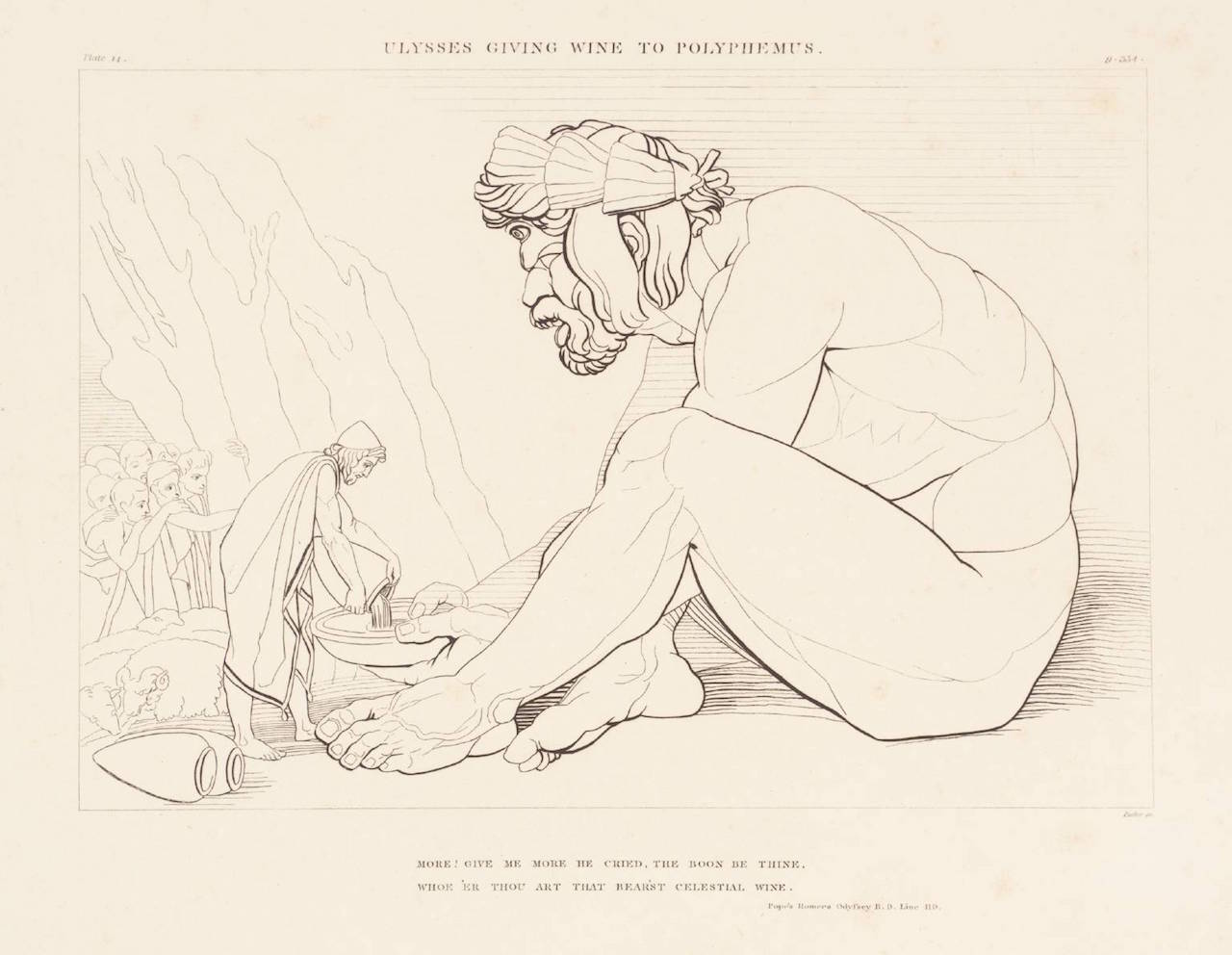 “Ulysses Giving Wine to Polyphemus” (1805). John Flaxman (1755–1826). Purchased as part of the Oppé Collection with assistance from the National Lottery through the Heritage Lottery Fund, 1996.
  “Circe Invidiosa,” (1892). J. W. Waterhouse (English, 1849–1917).
 “Teiresias appears to Ulysses during the sacrifice,” (1780–1785). Henry Fuseli (German, 1741–1825).
  “Ulysses and the Sirens” (ca. 1909). Herbert James Draper (English, 1863–1920).
 “Ulysses Asleep Laid on his Own Coast by the Phaeacian Sailors” (1805). John Flaxman (English, 1755–1826). Purchased as part of the Oppé Collection with assistance from the National Lottery through the Heritage Lottery Fund 1996.
  Minoan—probably Neopalatial—fresco commonly known as the “Lily Prince.” Whatever the exact type of this personage (perhaps a crowned acrobat, according to the interpretation of Maria Shaw), the Lily Prince is certainly a Minoan of elite standing. Public domain image based on a famous watercolor by Émile Gilliéron of a reconstruction by Arthur Evans.
 Detail from a fresco found at Hagia Triadha in Crete. Reconstruction by Mark Cameron, p. 96 of the catalogue Fresco: A Passport into the Past. Minoan Crete through the eyes of Mark Cameron. 1999. Catalogue curated by Doniert Evely. Athens: British School at Athens; and N. P. Goulandris Foundation, Museum of Cycladic Art. Reproduced with the permission of the British School at Athens. BSA Archive: Mark Cameron Personal Papers: CAM 1.
 “Minerva Restoring Ulysses to his Own Shape” (1805). John Flaxman (English, 1755–1826). Purchased as part of the Oppé Collection with assistance from the National Lottery through the Heritage Lottery Fund 1996.
 “Ulysses and his Dog” (1805). John Flaxman (English, 1755–1826). Purchased as part of the Oppé Collection with assistance from the National Lottery through the Heritage Lottery Fund 1996.
  “Ulysses Preparing to Fight with Irus” (1805). John Flaxman (English, 1755–1826) Purchased as part of the Oppé Collection with assistance from the National Lottery through the Heritage Lottery Fund 1996.
  “Euryclea Discovers Ulysses” (1805). John Flaxman (English, 1755–1826). Purchased as part of the Oppé Collection with assistance from the National Lottery through the Heritage Lottery Fund 1996.
  “The Harpies Going to Seize the Daughters of Pandareus” (1805). John Flaxman (English, 1755–1826). Purchased as part of the Oppé Collection with assistance from the National Lottery through the Heritage Lottery Fund 1996.
 Hēraklēs stringing a bow. Silver stater, c. 450–440 BCE, Thebes (Boeotia).
  Swallows, detail of the Spring Fresco at Thera, image via Flickr user
  Original artwork, by Flickr user
  Odysseus kiling Penelope’s suitors. Attic red-figure skyphos, ca. 440 BCE.
  Still life showing eggs, thrushes, napkin: from the House of Julia Felix, Pompeii.
  Eurykleia waking Penelope (1773). Print by Thomas Burke, after a painting by Angelika Kauffmann.
  Big Ed and Norma have just now broken free of the troublesome relationships that have kept these lovers apart for 27 years. Now at long last they can have a life together.
Still from
Big Ed and Norma have just now broken free of the troublesome relationships that have kept these lovers apart for 27 years. Now at long last they can have a life together.
Still from  “Mercury Conducting the Souls of the Suitors to the Infernal Regions” (1805). John Flaxman (English, 1755–1826). Purchased as part of the Oppé Collection with assistance from the National Lottery through the Heritage Lottery Fund 1996.
  “Ulysses Departing from Lacedaemon for Ithaca, with his Bride Penelope” (1805). John Flaxman (English, 1755–1826). Flaxman made this image the last in his Odyssey series, bringing the story of Penelope and Odysseus full circle. Purchased as part of the Oppé Collection with assistance from the National Lottery through the Heritage Lottery Fund 1996.


,_around_440_BC,_Altes_Museum_Berlin_(13718420225)_glare-reduced_white-bg.png)
