
View:
By Card
BOOK VII.
THE COURT OF ALCINOUS.
The princess Nausicaa returns to the city, and Ulysses soon after follows thither. He is met by Pallas in the form of a young virgin, who guides him to the palace, and directs him in what manner to address the queen Areté. She then involves him in a mist, which causes him to pass invisible. The palace and gardens of Alcinoüs described. Ulysses, falling at the feet of the queen, the mist disperses, the Phaeacians admire, and receive him with respect. The queen inquiring by what means he had the garments he then wore, he relates to her and Alcinoüs his departure from Calypso, and his arrival on their dominions.
The same day continues, and the book ends with the night.
THE patient heavenly man thus suppliant pray'd;
1
While the slow mules draw on th' imperial maid:
Through the proud street she moves, the public gaze;
The turning wheel before the palace stays.
With ready love her brothers gathering round,
5
Receiv'd the vestures, and the mules unbound.
She seeks the bridal bower: a matron there
The rising fire supplies with busy care,
Whose charms in youth her father's heart inflam'd;
Now worn with age, Eurymedusa nam'd:
10
The captive dame Phaeacian rovers bore,
Snatch'd from Epirus, her sweet native shore,
(A grateful prize,) and in her bloom bestow'd
On good Alcinous, honour'd as a god;
Nurse of Nausicaa from her infant years,
15
And tender second to a mother's cares.
Now from the sacred thicket, where he lay,
To town Ulysses took the winding way.
Propitious Pallas, to secure her care,
Around him spread a veil of thicken'd air;
20
To shun th' encounter of the vulgar crowd,
Insulting still, inquisitive and loud.
When near the fam'd Phaeacian walls he drew,
The beauteous city opening to his view,
His step a virgin met, and stood before:
25
A polish'd urn the seeming virgin bore,
And youthful smil'd; but in the low disguise
Lay hid the goddess with the azure eyes.
Ulysses
"Show me, fair daughter," (thus the chief demands)
"The house of him who rules these happy lands.
30
Through many woes and wanderings, lo! I come
To good Alcinoüs' hospitable dome.
Far from my native coast, I rove alone,
A wretched stranger, and of all unknown!"
"Show me, fair daughter," (thus the chief demands)
"The house of him who rules these happy lands.
30
Through many woes and wanderings, lo! I come
To good Alcinoüs' hospitable dome.
Far from my native coast, I rove alone,
A wretched stranger, and of all unknown!"
Pallas
The goddess answer'd: "Father, I obey,
35
And point the wandering traveller his way:
Well known to me the palace you inquire,
For fast beside it dwells my honour'd sire:
But silent march, nor greet the common train
With question needless, or inquiry vain:
40
A race of rugged mariners are these:
Unpolish'd men, and boisterous as their seas;
The native islanders alone their care,
And hateful he who breathes a foreign air.
These did the ruler of the deep ordain
45
To build proud navies, and command the main;
On canvas wings to cut the watery way;
No bird so light, no thought so swift as they."
37
The goddess answer'd: "Father, I obey,
35
And point the wandering traveller his way:
Well known to me the palace you inquire,
For fast beside it dwells my honour'd sire:
But silent march, nor greet the common train
With question needless, or inquiry vain:
40
A race of rugged mariners are these:
Unpolish'd men, and boisterous as their seas;
The native islanders alone their care,
And hateful he who breathes a foreign air.
These did the ruler of the deep ordain
45
To build proud navies, and command the main;
On canvas wings to cut the watery way;
No bird so light, no thought so swift as they."
Thus having spoke, th' unknown celestial leads:
The footsteps of the deity he treads,
50
And secret moves along the crowded space,
Unseen of all the rude Phaeacian race.
(So Pallas order'd. Pallas to their eyes
The mist objected, and condens'd the skies.)
The chief with wonder sees th' extended streets,
55
The spreading harbours, and the riding fleets;
He next their princes' lofty domes admires,
In separate islands, crown'd with rising spires;
And deep intrenchments, and high walls of stone,
That gird the city like a marble zone.
60
At length the kingly palace gates he view'd;
There stopp'd the goddess, and her speech renew'd.
Pallas
"My task is done; the mansion you inquire
Appears before you: enter, and admire.
High-thron'd, and feasting, there thou shalt behold
65
The sceptred rulers. Fear not, but be bold:
A decent boldness ever meets with friends,
Succeeds, and ev'n a stranger recommends.
First to the queen prefer a suppliant's claim,
Alcinoüs' queen, Aretè is her name,
70
The same her parents, and her power the same.
For know, from ocean's god Nausithoüs sprung,
And Peribœa, beautiful and young;
(Eurymedon's last hope, who rul'd of old
The race of giants,
1
impious, proud, and bold;
75
Perish'd the nation in unrighteous war,
Perish'd the prince, and left this only heir;)
Who now, by Neptune's amorous power compress'd,
Produced a monarch that his people bless'd,
Father and prince of the Phaeacian name;
80
From him
2
Rhexenor and Alcinoüs came.
The first by Phœbus' burning arrows fir'd,
New from his nuptials, hapless youth! expir'd.
No son surviv'd: Aretè heir'd his state,
And her Alcinoüs chose his royal mate.
85
With honours yet to womankind unknown
This queen he graces, and divides the throne;
In equal tenderness her sons conspire,
And all the children emulate their sire.
When through the street she gracious deigns to move,
90
(The public wonder and the public love,)
The tongues of all with transport sound her praise,
The eyes of all, as on a goddess, gaze.
She feels the triumph of a generous breast;
To heal divisions, to relieve th' oppress'd;
95
In virtue rich; in blessing others, bless'd.
Go then secure, thy humble suit prefer,
And owe thy country and thy friends to her."
77
"My task is done; the mansion you inquire
Appears before you: enter, and admire.
High-thron'd, and feasting, there thou shalt behold
65
The sceptred rulers. Fear not, but be bold:
A decent boldness ever meets with friends,
Succeeds, and ev'n a stranger recommends.
First to the queen prefer a suppliant's claim,
Alcinoüs' queen, Aretè is her name,
70
The same her parents, and her power the same.
For know, from ocean's god Nausithoüs sprung,
And Peribœa, beautiful and young;
(Eurymedon's last hope, who rul'd of old
The race of giants,
1
impious, proud, and bold;
75
Perish'd the nation in unrighteous war,
Perish'd the prince, and left this only heir;)
Who now, by Neptune's amorous power compress'd,
Produced a monarch that his people bless'd,
Father and prince of the Phaeacian name;
80
From him
2
Rhexenor and Alcinoüs came.
The first by Phœbus' burning arrows fir'd,
New from his nuptials, hapless youth! expir'd.
No son surviv'd: Aretè heir'd his state,
And her Alcinoüs chose his royal mate.
85
With honours yet to womankind unknown
This queen he graces, and divides the throne;
In equal tenderness her sons conspire,
And all the children emulate their sire.
When through the street she gracious deigns to move,
90
(The public wonder and the public love,)
The tongues of all with transport sound her praise,
The eyes of all, as on a goddess, gaze.
She feels the triumph of a generous breast;
To heal divisions, to relieve th' oppress'd;
95
In virtue rich; in blessing others, bless'd.
Go then secure, thy humble suit prefer,
And owe thy country and thy friends to her."
With that the goddess deign'd no longer stay,
But o'er the world of waters wing'd her way:
100
Forsaking Scheria's ever-pleasing shore,
The winds to Marathon the virgin bore:
Thence, where proud Athens rears her towery head,
With opening streets and shining structures spread,
She pass'd, delighted with the well-known seats;
105
And to Erectheus' sacred dome retreats.
Meanwhile Ulysses at the palace waits,
There stops, and anxious with his soul debates,
Fix'd in amaze before the royal gates.
The front appear'd with radiant splendours gay,
110
Bright as the lamp of night, or orb of day.
The walls were massy brass: the cornice high
Blue metals crown'd in colours of the sky;
Rich plates of gold the folding doors incase;
The pillars silver, on a brazen base;
115
Silver the lintels deep-projecting o'er,
And gold, the ringlets that command the door.
Two rows of stately dogs on either hand,
In sculptur'd gold and labour'd silver stand.
These Vulcan form'd with art divine, to wait
120
Immortal guardians at Alcinoüs' gate;
Alive each animated frame appears,
And still to live beyond the power of years.
Fair thrones within from space to space were rais'd,
Where various carpets with embroidery blaz'd,
125
The work of matrons: these the princes press'd,
Day following day, a long continued feast.
Refulgent pedestals the walls surround,
Which boys of gold with flaming torches crown'd;
The polish'd ore, reflecting every ray,
130
Blaz'd on the banquets with a double day.
Full fifty handmaids form the household train;
Some turn the mill, or sift the golden grain;
Some ply the loom; their busy fingers move
Like poplar-leaves when Zephyr fans the grove.
135
Not more renown'd the men of Scheria's isle,
For sailing arts and all the naval toil,
Than works of female skill their women's pride,
The flying shuttle through the threads to guide:
Pallas to these her double gifts imparts,
140
Inventive genius, and industrious arts.
Close to the gates a spacious garden lies,
From storms defended and inclement skies.
Four acres was th' allotted space of ground,
Fenced with a green enclosure all around.
145
Tall thriving trees confess'd the fruitful mould;
The reddening apple ripens here to gold.
Here the blue fig with luscious juice o'erflows,
With deeper red the full pomegranate glows;
The branch here bends beneath the weighty pear,
150
And verdant olives flourish round the year.
The balmy spirit of the western gale
Eternal breathes on fruits, untaught to fail;
Each dropping pear a following pear supplies,
On apples apples, figs on figs arise:
155
The same mild season gives the blooms to blow,
The buds to harden, and the fruits to grow.
Here order'd vines in equal ranks appear,
With all th' united labours of the year;
Some to unload the fertile branches run,
160
Some dry the blackening clusters in the sun;
Others to tread the liquid harvest join,
The groaning presses foam with floods of wine,
Here are the vines in early flower descried,
Here grapes discolour'd on the sunny side,
165
And there in autumn's richest purple dyed.
Beds of all various herbs, for ever green,
In beauteous order terminate the scene.
Two plenteous fountains the whole prospect crown'd;
This through the gardens leads its streams around,
170
Visits each plant, and waters all the ground;
While that in pipes beneath the palace flows,
And thence its current on the town bestows:
To various use their various streams they bring,
The people one, and one supplies the king.
175
Such were the glories which the gods ordain'd,
To grace Alcinous, and his happy land.
Ev'n from the chief whom men and nations knew,
Th' unwonted scene surprise and rapture drew;
In pleasing thought he ran the prospect o'er,
180
Then hasty enter'd at the lofty door.
Night now approaching, in the palace stand,
With goblets crown'd, the rulers of the land;
Prepar'd for rest, and offering to the god
3
Who bears the virtue of the sleepy rod.
185
Unseen he glided through the joyous crowd,
With darkness circled, and an ambient cloud,
Direct to great Alcinous' throne he came,
And prostrate fell before th' imperial dame.
Then from around him dropp'd the veil of night;
190
Sudden he shines, and manifest to sight.
The nobles gaze, with awful fear oppress'd;
Silent they gaze, and eye the godlike guest.
Ulysses
"Daughter of great Rhexenor!" (thus began,
Low at her knees, the much-enduring man,)
195
"To thee, thy consort, and this royal train,
To all that share the blessings of your reign,
A suppliant bends: oh pity human woe!
'Tis what the happy to th' unhappy owe.
A wretched exile to his country send,
200
Long worn with griefs, and long without a friend.
So may the gods your better days increase,
And all your joys descend on all your race:
So reign for ever on your country's breast,
Your people blessing, by your people bless'd!"
205
152
"Daughter of great Rhexenor!" (thus began,
Low at her knees, the much-enduring man,)
195
"To thee, thy consort, and this royal train,
To all that share the blessings of your reign,
A suppliant bends: oh pity human woe!
'Tis what the happy to th' unhappy owe.
A wretched exile to his country send,
200
Long worn with griefs, and long without a friend.
So may the gods your better days increase,
And all your joys descend on all your race:
So reign for ever on your country's breast,
Your people blessing, by your people bless'd!"
205
Then to the genial hearth he bow'd his face,
And humbled in the ashes took his place.
4
Silence ensued. The eldest first began,
Echeneus sage, a venerable man!
Whose well-taught mind the present age surpass'd,
210
And join'd to that th' experience of the last.
Echeneus
Fit words attended on his weighty sense,
And mild persuasion flow'd in eloquence.
"Oh sight" (he cried) "dishonest and unjust!
A guest, a stranger, seated in the dust!
215
To raise the lowly suppliant from the ground
Befits a monarch. Lo! the peers around
But wait thy word, the gentle guest to grace,
And seat him fair in some distinguish'd place.
Let first the herald due libation pay
220
To Jove, who guides the wanderer on his way;
Then set the genial banquet in his view,
And give the stranger-guest a stranger's due."
Fit words attended on his weighty sense,
And mild persuasion flow'd in eloquence.
"Oh sight" (he cried) "dishonest and unjust!
A guest, a stranger, seated in the dust!
215
To raise the lowly suppliant from the ground
Befits a monarch. Lo! the peers around
But wait thy word, the gentle guest to grace,
And seat him fair in some distinguish'd place.
Let first the herald due libation pay
220
To Jove, who guides the wanderer on his way;
Then set the genial banquet in his view,
And give the stranger-guest a stranger's due."
His sage advice the listening king obeys;
He stretch'd his hand the prudent chief to raise,
225
And from his seat Laodamas remov'd,
(The monarch's offspring, and his best-belov'd ;)
There next his side the godlike hero sate;
With stars of silver shone the bed of state.
The golden ewer a beauteous handmaid brings,
230
Replenish'd from the cool translucent springs,
Whose polish'd vase with copious streams supplies
A silver laver of capacious size.
The table next in regal order spread,
The glittering canisters are heap'd with bread:
235
Viands of various kinds invite the taste,
Of choicest sort and savour, rich repast!
Thus feasting high, Alcinoüs gave the sign,
And bade the herald pour the rosy wine.
Alcinous
"Let all around the due libation pay
240
To Jove, who guides the wanderer on his way."
"Let all around the due libation pay
240
To Jove, who guides the wanderer on his way."
He said. Pontonoüs heard the king's command;
The circling goblet moves from hand to hand;
Each drinks the juice that glads the heart of man.
Alcinoüs then, with aspect mild, began:
245
Alcinous
"Princes and peers, attend; while we impart
To you the thoughts of no inhuman heart.
Now pleas'd and satiate from the social rite
Repair we to the blessings of the night;
But with the rising day, assembled here,
250
Let all the elders of the land appear,
Pious observe our hospitable laws,
And Heaven propitiate in the stranger's cause;
Then join'd in council, proper means explore
Safe to transport him to the wished-for shore:
255
(How distant that, imports not us to know,
Nor weigh the labour, but relieve the woe.)
Meantime, nor harm nor anguish let him bear:
This interval, Heaven trusts him to our care;
But to his native land our charge resign'd,
260
Heaven's is his life to come, and all the woes behind.
Then must he suffer what the Fates ordain;
For Fate has wove the thread of life with pain!
And twins ev'n from the birth are Misery and Man!
198
But if, descended from th' Olympian bower,
265
Gracious approach us some immortal power;
If in that form thou com'st a guest divine;
Some high event the conscious gods design.
As yet, unbid they never graced our feast,
The solemn sacrifice call'd down the guest;
270
Then manifest of heaven the vision stood,
And to our eyes familiar was the god.
Oft with some favour'd traveller they stray,
And shine before him all the desert way;
With social intercourse, and face to face,
275
The friends and guardians of our pious race.
So near approach we their celestial kind,
By justice, truth, and probity of mind;
As our dire neighbours of Cyclopean birth
Match in fierce wrong the giant-sons of earth.
5
"
280
"Princes and peers, attend; while we impart
To you the thoughts of no inhuman heart.
Now pleas'd and satiate from the social rite
Repair we to the blessings of the night;
But with the rising day, assembled here,
250
Let all the elders of the land appear,
Pious observe our hospitable laws,
And Heaven propitiate in the stranger's cause;
Then join'd in council, proper means explore
Safe to transport him to the wished-for shore:
255
(How distant that, imports not us to know,
Nor weigh the labour, but relieve the woe.)
Meantime, nor harm nor anguish let him bear:
This interval, Heaven trusts him to our care;
But to his native land our charge resign'd,
260
Heaven's is his life to come, and all the woes behind.
Then must he suffer what the Fates ordain;
For Fate has wove the thread of life with pain!
And twins ev'n from the birth are Misery and Man!
But if, descended from th' Olympian bower,
265
Gracious approach us some immortal power;
If in that form thou com'st a guest divine;
Some high event the conscious gods design.
As yet, unbid they never graced our feast,
The solemn sacrifice call'd down the guest;
270
Then manifest of heaven the vision stood,
And to our eyes familiar was the god.
Oft with some favour'd traveller they stray,
And shine before him all the desert way;
With social intercourse, and face to face,
275
The friends and guardians of our pious race.
So near approach we their celestial kind,
By justice, truth, and probity of mind;
As our dire neighbours of Cyclopean birth
Match in fierce wrong the giant-sons of earth.
5
"
280
Ulysses
"Let no such thought" (with modest grace rejoin'd
The prudent Greek) "possess the royal mind.
Alas! a mortal, like thyself, am I;
No glorious native of yon azure sky:
In form, ah how unlike their heavenly kind!
285
How more inferior in the gifts of mind!
Alas, a mortal! most oppress'd of those
Whom Fate has loaded with a weight of woes;
By a sad train of miseries alone
Distinguish'd long, and second now to none!
290
By heaven's high will compell'd from shore to shore
With heaven's high will prepar'd to suffer more.
What histories of toil could I declare!
6
But still long-wearied nature wants repair;
Spent with fatigue, and shrunk with pining fast,
295
My craving bowels still require repast.
Howe'er the noble, suffering mind, may grieve
Its load of anguish, and disdain to live,
Necessity demands our daily bread;
Hunger is insolent, and will be fed.
300
But finish, oh ye peers! what you propose,
And let the morrow's dawn conclude my woes.
Pleas'd will I suffer all the gods ordain,
To see my soil, my son, my friends again.
That view vouchsaf'd, let instant death surprise
305
With ever-during shade these happy eyes!"
"Let no such thought" (with modest grace rejoin'd
The prudent Greek) "possess the royal mind.
Alas! a mortal, like thyself, am I;
No glorious native of yon azure sky:
In form, ah how unlike their heavenly kind!
285
How more inferior in the gifts of mind!
Alas, a mortal! most oppress'd of those
Whom Fate has loaded with a weight of woes;
By a sad train of miseries alone
Distinguish'd long, and second now to none!
290
By heaven's high will compell'd from shore to shore
With heaven's high will prepar'd to suffer more.
What histories of toil could I declare!
6
But still long-wearied nature wants repair;
Spent with fatigue, and shrunk with pining fast,
295
My craving bowels still require repast.
Howe'er the noble, suffering mind, may grieve
Its load of anguish, and disdain to live,
Necessity demands our daily bread;
Hunger is insolent, and will be fed.
300
But finish, oh ye peers! what you propose,
And let the morrow's dawn conclude my woes.
Pleas'd will I suffer all the gods ordain,
To see my soil, my son, my friends again.
That view vouchsaf'd, let instant death surprise
305
With ever-during shade these happy eyes!"
Th' assembled peers with general praise approv'd
His pleaded reason, and the suit he mov'd.
Each drinks a full oblivion of his cares,
And to the gifts of balmy sleep repairs.
310
Ulysses in the regal walls alone
Remain'd: beside him, on a splendid throne,
Divine Aretè and Alcinoüs shone.
The queen, on nearer view, the guest survey'd,
Robed in the garments her own hands had made,
315
Not without wonder seen. Then thus began,
Her words addressing to the godlike man:
Arete
"Cam'st thou not hither, wondrous stranger! say,
From lands remote, and o'er a length of sea?
Tell then whence art thou? whence that princely air?
320
And robes like these, so recent and so fair?"
"Cam'st thou not hither, wondrous stranger! say,
From lands remote, and o'er a length of sea?
Tell then whence art thou? whence that princely air?
320
And robes like these, so recent and so fair?"
Ulysses
240
"Hard is the task, O princess! you impose,"
(Thus sighing spoke the man of many woes,)
"The long, the mournful series to relate
Of all my sorrows sent by Heaven and Fate!
325
Yet what you ask, attend. An island lies
Beyond these tracts, and under other skies,
Ogygia nam'd, in Ocean's watery arms;
Where dwells Calypso, dreadful in her charms!
Remote from gods or men she holds her reign,
330
Amid the terrors of the rolling main.
Me, only me, the hand of fortune bore,
Unblest! to tread that interdicted shore:
When Jove tremendous in the sable deeps
Launch'd his red lightning at our scatter'd ships,
335
Then, all my fleet, and all my followers lost,
Sole on a plank, on boiling surges toss'd,
Heaven drove my wreck th' Ogygian isle to find,
Full nine days floating to the wave and wind.
Met by the goddess there with open arms,
340
She bribed my stay with more than human charms;
Nay, promis'd, vainly promis'd, to bestow
Immortal life, exempt from age and woe;
But all her blandishments successless prove,
To banish from my breast my country's love.
345
I stay reluctant seven continued years,
And water her ambrosial couch with tears;
The eighth she voluntary moves to part,
Or urged by Jove, or her own changeful heart.
A raft was form'd to cross the surging sea;
350
Herself supplied the stores and rich array,
And gave the gales to waft me on the way.
In seventeen days appear'd your pleasing coast,
And woody mountains half in vapours lost.
Joy touch'd my soul: my soul was joy'd in vain,
355
For angry Neptune rous'd the raging main;
The wild winds whistle, and the billows roar;
The splitting raft the furious tempest tore;
And storms vindictive intercept the shore.
Soon as their rage subsides, the seas I brave
360
With naked force, and shoot along the wave,
To reach this isle; but there my hopes were lost;
The surge impell'd me on a craggy coast.
I chose the safer sea, and chanced to find
A river's mouth impervious to the wind,
365
And clear of rocks. I fainted by the flood;
Then took the shelter of the neighbouring wood.
287
'Twas night, and cover'd in the foliage deep,
Jove plunged my senses in the death of sleep.
All night I slept, oblivious of my pain:
370
Aurora dawn'd, and Phœbus shin'd in vain,
Nor, till oblique he sloped his evening ray,
Had Somnus dried the balmy dews away.
Then female voices from the shore I heard:
A maid amidst them, goddess-like, appear'd;
375
To her I sued, she pitied my distress;
Like thee in beauty, nor in virtue less.
Who from such youth could hope considerate care?
In youth and beauty wisdom is but rare!
She gave me life, reliev'd with just supplies
380
My wants, and lent these robes that strike your eyes.
This is the truth: and oh, ye powers on high!
Forbid that want should sink me to a lie."
"Hard is the task, O princess! you impose,"
(Thus sighing spoke the man of many woes,)
"The long, the mournful series to relate
Of all my sorrows sent by Heaven and Fate!
325
Yet what you ask, attend. An island lies
Beyond these tracts, and under other skies,
Ogygia nam'd, in Ocean's watery arms;
Where dwells Calypso, dreadful in her charms!
Remote from gods or men she holds her reign,
330
Amid the terrors of the rolling main.
Me, only me, the hand of fortune bore,
Unblest! to tread that interdicted shore:
When Jove tremendous in the sable deeps
Launch'd his red lightning at our scatter'd ships,
335
Then, all my fleet, and all my followers lost,
Sole on a plank, on boiling surges toss'd,
Heaven drove my wreck th' Ogygian isle to find,
Full nine days floating to the wave and wind.
Met by the goddess there with open arms,
340
She bribed my stay with more than human charms;
Nay, promis'd, vainly promis'd, to bestow
Immortal life, exempt from age and woe;
But all her blandishments successless prove,
To banish from my breast my country's love.
345
I stay reluctant seven continued years,
And water her ambrosial couch with tears;
The eighth she voluntary moves to part,
Or urged by Jove, or her own changeful heart.
A raft was form'd to cross the surging sea;
350
Herself supplied the stores and rich array,
And gave the gales to waft me on the way.
In seventeen days appear'd your pleasing coast,
And woody mountains half in vapours lost.
Joy touch'd my soul: my soul was joy'd in vain,
355
For angry Neptune rous'd the raging main;
The wild winds whistle, and the billows roar;
The splitting raft the furious tempest tore;
And storms vindictive intercept the shore.
Soon as their rage subsides, the seas I brave
360
With naked force, and shoot along the wave,
To reach this isle; but there my hopes were lost;
The surge impell'd me on a craggy coast.
I chose the safer sea, and chanced to find
A river's mouth impervious to the wind,
365
And clear of rocks. I fainted by the flood;
Then took the shelter of the neighbouring wood.
'Twas night, and cover'd in the foliage deep,
Jove plunged my senses in the death of sleep.
All night I slept, oblivious of my pain:
370
Aurora dawn'd, and Phœbus shin'd in vain,
Nor, till oblique he sloped his evening ray,
Had Somnus dried the balmy dews away.
Then female voices from the shore I heard:
A maid amidst them, goddess-like, appear'd;
375
To her I sued, she pitied my distress;
Like thee in beauty, nor in virtue less.
Who from such youth could hope considerate care?
In youth and beauty wisdom is but rare!
She gave me life, reliev'd with just supplies
380
My wants, and lent these robes that strike your eyes.
This is the truth: and oh, ye powers on high!
Forbid that want should sink me to a lie."
Alcinous
To this the king: "Our daughter but express'd
Her cares imperfect to her godlike guest.
385
Suppliant to her since first he chose to pray,
Why not herself did she conduct the way,
And with her handmaids to our court convey?"
To this the king: "Our daughter but express'd
Her cares imperfect to her godlike guest.
385
Suppliant to her since first he chose to pray,
Why not herself did she conduct the way,
And with her handmaids to our court convey?"
Ulysses
"Hero and king," (Ulysses thus replied,)
"Nor blame her faultless, nor suspect of pride:
390
She bade me follow in th' attendant train;
But fear and reverence did my steps detain,
Lest rash suspicion might alarm thy mind:
Man's of a jealous and mistaking kind."
"Hero and king," (Ulysses thus replied,)
"Nor blame her faultless, nor suspect of pride:
390
She bade me follow in th' attendant train;
But fear and reverence did my steps detain,
Lest rash suspicion might alarm thy mind:
Man's of a jealous and mistaking kind."
Alcinous
"Far from my soul" (he cried) "the gods efface
395
All wrath ill-grounded, and suspicion base!
Whate'er is honest, stranger, I approve,
And would to Phœbus, Pallas, and to Jove,
Such as thou art, thy thought and mine were one,
Nor thou unwilling to be call'd my son.
400
In such alliance could'st thou wish to join,
A palace stor'd with treasures should be thine.
But if reluctant, who shall force thy stay?
317
Jove bids to set the stranger on his way,
And ships shall wait thee with the morning ray.
405
Till then, let slumber cross thy careful eyes;
The wakeful mariners shall watch the skies,
And seize the moment when the breezes rise:
Then gently waft thee to the pleasing shore,
Where thy soul rests, and labour is no more.
410
Far as Eubœa though thy country lay,
Our ships with ease transport thee in a day.
Thither of old, earth's giant son
7
to view,
On wings of winds with Rhadamanth they flew;
This land, from whence their morning course begun,
415
Saw them returning with the setting sun.
Your eyes shall witness and confirm my tale,
Our youth how dexterous and how fleet our sail,
When justly timed with equal sweep they row,
And ocean whitens in long tracks below."
420
"Far from my soul" (he cried) "the gods efface
395
All wrath ill-grounded, and suspicion base!
Whate'er is honest, stranger, I approve,
And would to Phœbus, Pallas, and to Jove,
Such as thou art, thy thought and mine were one,
Nor thou unwilling to be call'd my son.
400
In such alliance could'st thou wish to join,
A palace stor'd with treasures should be thine.
But if reluctant, who shall force thy stay?
Jove bids to set the stranger on his way,
And ships shall wait thee with the morning ray.
405
Till then, let slumber cross thy careful eyes;
The wakeful mariners shall watch the skies,
And seize the moment when the breezes rise:
Then gently waft thee to the pleasing shore,
Where thy soul rests, and labour is no more.
410
Far as Eubœa though thy country lay,
Our ships with ease transport thee in a day.
Thither of old, earth's giant son
7
to view,
On wings of winds with Rhadamanth they flew;
This land, from whence their morning course begun,
415
Saw them returning with the setting sun.
Your eyes shall witness and confirm my tale,
Our youth how dexterous and how fleet our sail,
When justly timed with equal sweep they row,
And ocean whitens in long tracks below."
420
Thus he. No word the experienced man replies,
But thus to heaven, (and heavenward lifts his eyes,)
Ulysses
"O Jove! O father! what the king accords
Do thou make perfect! sacred be his words!
Wide o'er the world Alcinoüs' glory shine!
425
Let fame be his, and ah! my country mine!"
8
"O Jove! O father! what the king accords
Do thou make perfect! sacred be his words!
Wide o'er the world Alcinoüs' glory shine!
425
Let fame be his, and ah! my country mine!"
8
Meantime Aretè, for the hour of rest,
Ordains the fleecy couch, and covering vest;
Bids her fair train the purple quilts prepare,
And the thick carpets spread with busy care.
430
With torches blazing in their hands they pass'd,
And finish'd all their queen's command with haste:
Then gave the signal to the willing guest:
He rose with pleasure, and retir'd to rest.
There soft-extended, to the murmuring sound
435
Of the high porch, Ulysses sleeps profound!
Within, releas'd from cares Alcinoüs lies;
And fast beside were closed Aretè's eyes.
Odyssey. Homer. London. 1858.
Sponsored by Perseus Project, Tufts University.
 Zeus, Athena, and Hermes (1810). Drawing by John Flaxman.
 Athena (1810). Drawing by John Flaxman.
 Telemachus with Athena as Mentor (1810). Drawing by John Flaxman.
  Nestor’s Sacrifice (1805). Engraving after John Flaxman (1755-1826). Purchased as part of the Oppé Collection with assistance from the National Lottery through the Heritage Lottery Fund 1996.
  “The Fair Helen.” Willy Pogany (Hungarian, 1882–1955).
Image
“The Fair Helen.” Willy Pogany (Hungarian, 1882–1955).
Image  “Leucothea, the White Goddess, Preserving Ulysses” (1805). John Flaxman (1755–1826). Purchased as part of the Oppé Collection with assistance from the National Lottery through the Heritage Lottery Fund, 1996.
  “Nausicaa” (1878), Frederick Leighton (English, 1830–1896).
 Red-figured pyxis, picturing Nereids at home, “indoors”: the Nereid with her hair down is labeled as Thaleia.
 View of Garitsa, region right outside the northern walls of the city of Corfu, and according to the legend the site of Alcinous’s gardens (1867). Étienne Rey (French, 1789–1867).
  Blind Demodokos sings of the siege of Troy (1810), by John Flaxman (English, 1755–1826).
 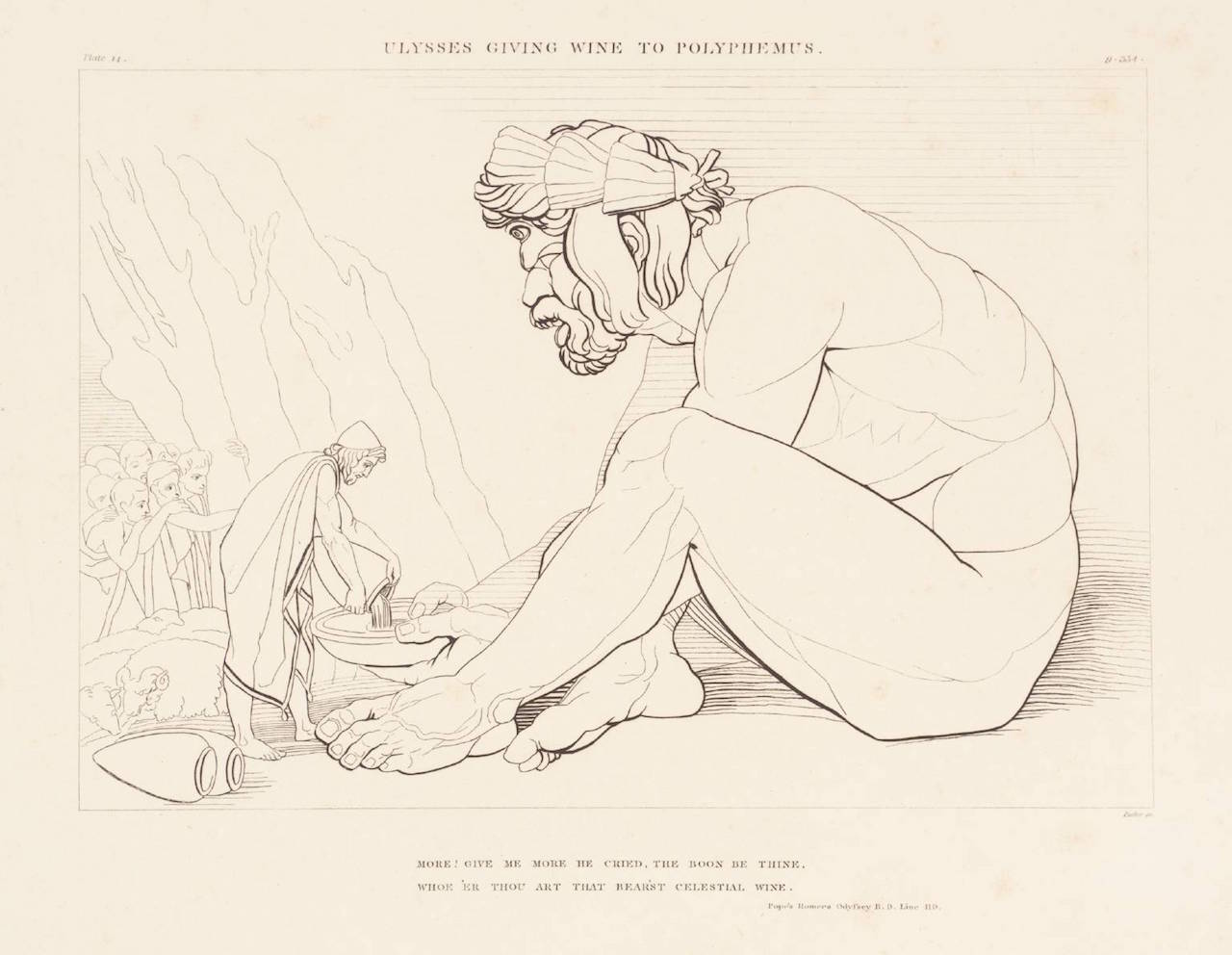 “Ulysses Giving Wine to Polyphemus” (1805). John Flaxman (1755–1826). Purchased as part of the Oppé Collection with assistance from the National Lottery through the Heritage Lottery Fund, 1996.
  “Circe Invidiosa,” (1892). J. W. Waterhouse (English, 1849–1917).
 “Teiresias appears to Ulysses during the sacrifice,” (1780–1785). Henry Fuseli (German, 1741–1825).
  “Ulysses and the Sirens” (ca. 1909). Herbert James Draper (English, 1863–1920).
 “Ulysses Asleep Laid on his Own Coast by the Phaeacian Sailors” (1805). John Flaxman (English, 1755–1826). Purchased as part of the Oppé Collection with assistance from the National Lottery through the Heritage Lottery Fund 1996.
  Minoan—probably Neopalatial—fresco commonly known as the “Lily Prince.” Whatever the exact type of this personage (perhaps a crowned acrobat, according to the interpretation of Maria Shaw), the Lily Prince is certainly a Minoan of elite standing. Public domain image based on a famous watercolor by Émile Gilliéron of a reconstruction by Arthur Evans.
 Detail from a fresco found at Hagia Triadha in Crete. Reconstruction by Mark Cameron, p. 96 of the catalogue Fresco: A Passport into the Past. Minoan Crete through the eyes of Mark Cameron. 1999. Catalogue curated by Doniert Evely. Athens: British School at Athens; and N. P. Goulandris Foundation, Museum of Cycladic Art. Reproduced with the permission of the British School at Athens. BSA Archive: Mark Cameron Personal Papers: CAM 1.
 “Minerva Restoring Ulysses to his Own Shape” (1805). John Flaxman (English, 1755–1826). Purchased as part of the Oppé Collection with assistance from the National Lottery through the Heritage Lottery Fund 1996.
 “Ulysses and his Dog” (1805). John Flaxman (English, 1755–1826). Purchased as part of the Oppé Collection with assistance from the National Lottery through the Heritage Lottery Fund 1996.
  “Ulysses Preparing to Fight with Irus” (1805). John Flaxman (English, 1755–1826) Purchased as part of the Oppé Collection with assistance from the National Lottery through the Heritage Lottery Fund 1996.
  “Euryclea Discovers Ulysses” (1805). John Flaxman (English, 1755–1826). Purchased as part of the Oppé Collection with assistance from the National Lottery through the Heritage Lottery Fund 1996.
  “The Harpies Going to Seize the Daughters of Pandareus” (1805). John Flaxman (English, 1755–1826). Purchased as part of the Oppé Collection with assistance from the National Lottery through the Heritage Lottery Fund 1996.
 Hēraklēs stringing a bow. Silver stater, c. 450–440 BCE, Thebes (Boeotia).
  Swallows, detail of the Spring Fresco at Thera, image via Flickr user
  Original artwork, by Flickr user
  Odysseus kiling Penelope’s suitors. Attic red-figure skyphos, ca. 440 BCE.
  Still life showing eggs, thrushes, napkin: from the House of Julia Felix, Pompeii.
  Eurykleia waking Penelope (1773). Print by Thomas Burke, after a painting by Angelika Kauffmann.
  Big Ed and Norma have just now broken free of the troublesome relationships that have kept these lovers apart for 27 years. Now at long last they can have a life together.
Still from
Big Ed and Norma have just now broken free of the troublesome relationships that have kept these lovers apart for 27 years. Now at long last they can have a life together.
Still from  “Mercury Conducting the Souls of the Suitors to the Infernal Regions” (1805). John Flaxman (English, 1755–1826). Purchased as part of the Oppé Collection with assistance from the National Lottery through the Heritage Lottery Fund 1996.
  “Ulysses Departing from Lacedaemon for Ithaca, with his Bride Penelope” (1805). John Flaxman (English, 1755–1826). Flaxman made this image the last in his Odyssey series, bringing the story of Penelope and Odysseus full circle. Purchased as part of the Oppé Collection with assistance from the National Lottery through the Heritage Lottery Fund 1996.


,_around_440_BC,_Altes_Museum_Berlin_(13718420225)_glare-reduced_white-bg.png)
