
View:
By Card
BOOK VI.
Pallas appearing in a dream to Nausicaa (the daughter of Alcinous, king of Phaeacia) commands her to descend to the river, and wash the robes of state, in preparation to her nuptials. Nausicaa goes with her hand-maids to the river; where, while the garments are spread on the bank, they divert themselves in sports. Their voices awake Ulysses, who, addressing himself to the princess, is by her relieved and clothed, and receives directions in what manner to apply to the king and queen of the island.
WHILE thus the weary wanderer sunk to rest,
1
And peaceful slumbers calm'd his anxious breast,
The martial maid from heaven's aërial height
Swift to Phaeacia wing'd her rapid flight.
In elder times the soft Phaeacian train
5
In ease possess'd the wide Hyperian plain;
1
Till the Cyclopean race in arms arose,
A lawless nation of gigantic foes;
Then great Nausithous from Hyperia far,
Through seas retreating from the sound of war,
10
The recreant nation to fair Scheria led,
2
Where never science rear'd her laurell'd head:
There round his tribes a strength of wall he rais'd;
To heav'n the glittering domes and temples blaz'd:
Just to his realms, he parted grounds from grounds,
15
And shar'd the lands, and gave the lands their bounds.
Now in the silent grave the monarch lay,
And wise Alcinoüs held the regal sway.
To his high palace through the fields of air
The goddess shot; Ulysses was her care.
20
There as the night in silence roll'd away,
A heaven of charms divine Nausicaa lay:
Through the thick gloom the shining portals blaze;
Two nymphs the portals guard, each nymph a Grace.
Light as the viewless air, the warrior-maid
25
Glides through the valves, and hovers round her head!
A favourite virgin's blooming form she took,
From Dymas sprung, and thus the vision spoke:
Vision
"Oh indolent! to waste thy hours away!
And sleep'st thou careless of the bridal day?
30
Thy spousal ornament neglected lies;
Arise, prepare the bridal train, arise!
A just applause the cares of dress impart,
And give soft transport to a parent's heart.
Haste, to the limpid stream direct thy way,
35
When the gay morn unveils her smiling ray:
Haste to the stream! companion of thy care,
Lo, I thy steps attend, thy labours share.
Virgin, awake! the marriage-hour is nigh,
See! from their thrones thy kindred monarchs
3
sigh!
40
The royal car at early dawn obtain,
And order mules obedient to the rein;
For rough the way, and distant rolls the wave,
Where their fair vests Phaeacian virgins lave.
In pomp ride forth; for pomp becomes the great,
45
And majesty derives a grace from state."
"Oh indolent! to waste thy hours away!
And sleep'st thou careless of the bridal day?
30
Thy spousal ornament neglected lies;
Arise, prepare the bridal train, arise!
A just applause the cares of dress impart,
And give soft transport to a parent's heart.
Haste, to the limpid stream direct thy way,
35
When the gay morn unveils her smiling ray:
Haste to the stream! companion of thy care,
Lo, I thy steps attend, thy labours share.
Virgin, awake! the marriage-hour is nigh,
See! from their thrones thy kindred monarchs
3
sigh!
40
The royal car at early dawn obtain,
And order mules obedient to the rein;
For rough the way, and distant rolls the wave,
Where their fair vests Phaeacian virgins lave.
In pomp ride forth; for pomp becomes the great,
45
And majesty derives a grace from state."
Then to the palaces of heaven she sails,
Incumbent on the wings of wafting gales;
The seat of gods; the regions mild of peace,
Full joy, and calm eternity of ease.
50
There no rude winds presume to shake the skies,
No rains descend, no snowy vapours rise;
But on immortal thrones the blest repose;
The firmament with living splendours glows.
Hither the goddess wing'd th' aërial way,
55
Through heaven's eternal gates that blaz'd with day.
Now from her rosy car Aurora shed
The dawn, and all the orient flam'd with red.
Up rose the virgin with the morning light,
Obedient to the vision of the night.
60
The queen she sought: the queen her hours bestow'd
In curious works; the whirling spindle glow'd
With crimson threads, while busy damsels cull
The snowy fleece, or twist the purpled wool.
4
Meanwhile Phaeacia's peers in council sate;
65
From his high dome the king descends in state,
Then with a filial awe the royal maid
Approach'd him passing, and submissive said:
Nausicaa
"Will my dread sire his ear regardful deign,
And may his child the royal car obtain?
70
Say, with thy garments shall I bend my way,
Where through the vales the mazy waters stray?
A dignity of dress adorns the great,
And kings draw lustre from the robe of state.
Five sons thou hast; three wait the bridal day,
75
And spotless robes become the young and gay:
So when with praise amid the dance they shine,
By these my cares adorn'd, that praise is mine."
"Will my dread sire his ear regardful deign,
And may his child the royal car obtain?
70
Say, with thy garments shall I bend my way,
Where through the vales the mazy waters stray?
A dignity of dress adorns the great,
And kings draw lustre from the robe of state.
Five sons thou hast; three wait the bridal day,
75
And spotless robes become the young and gay:
So when with praise amid the dance they shine,
By these my cares adorn'd, that praise is mine."
Thus she: but blushes ill-restrain'd betray
Her thoughts intentive on the bridal day:
80
The conscious sire the dawning blush survey'd,
And, smiling, thus bespoke the blooming maid:
Alcinous
"My child, my darling joy, the car receive;
That, and whate'er our daughter asks, we give."
"My child, my darling joy, the car receive;
That, and whate'er our daughter asks, we give."
Swift at the royal nod th' attending train
85
The car prepare, the mules incessant reign.
The blooming virgin with despatchful cares
Tunics, and stoles, and robes imperial, bears.
The queen, assiduous, to her train assigns
The sumptuous viands, and the flavorous wines.
90
The train prepare a cruse of curious mould,
A cruse of fragrance, form'd of burnish'd gold;
Odour divine! whose soft refreshing streams
Sleek the smooth skin, and scent the snowy limbs.
Now mounting the gay seat, the silken reins
95
Shine in her hand; along the sounding plains
Swift fly the mules: nor rode the nymph alone;
Around, a bevy of bright damsels shone.
They seek the cisterns where Phaeacian dames
Wash their fair garments in the limpid streams;
100
Where, gathering into depth from falling rills,
The lucid wave a spacious basin fills.
The mules unharness'd range beside the main,
Or crop the verdant herbage of the plain.
Then emulous the royal robes they lave,
105
And plunge the vestures in the cleansing wave;
(The vestures cleans'd o'erspread the shelly sand;
Their snowy lustre whitens all the strand ;)
Then with a short repast relieve their toil,
And o'er their limbs diffuse ambrosial oil;
110
And while the robes imbibe the solar ray,
O'er the green mead the sporting virgins play,
Their shining veils unbound. Along the skies
Toss'd, and retoss'd, the ball incessant flies.
They sport, they feast; Nausicaa lifts her voice,
115
And, warbling sweet, makes earth and heaven rejoice.
As when o'er Erymanth Diana roves,
Or wide Täygetus' resounding groves;
A sylvan train the huntress queen surrounds;
Her rattling quiver from her shoulder sounds:
120
Fierce in the sport, along the mountain's brow
They bay the boar, or chase the bounding roe;
High o'er the lawn, with more majestic pace,
Above the nymphs she treads with stately grace;
Distinguish'd excellence the goddess proves;
125
Exults Latona as the virgin moves.
With equal grace Nausicaa trod the plain,
And shone transcendent o'er the beauteous train.
Meantime (the care and favourite of the skies)
Wrapp'd in embowering shade, Ulysses lies,
130
His woes forgot! but Pallas now address'd
To break the bands of all-composing rest.
Forth from her snowy hand Nausicaa threw
The various ball;
5
the ball erroneous flew,
And swam the stream; loud shrieks the virgin train,
135
And the loud shriek redoubles from the main.
Waked by the shrilling sound, Ulysses rose,
And, to the deaf woods wailing, breath'd his woes.
Ulysses
"Ah me! on what inhospitable coast,
On what new region is Ulysses toss'd;
140
Possess'd by wild barbarians fierce in arms;
Or men, whose bosom tender pity warms?
What sounds are these that gather from the shores?
The voice of nymphs that haunt the sylvan bowers,
The fair-hair'd Dryads of the shady wood;
145
Or azure daughters of the silver flood;
Or human voice? but, issuing from the shades,
Why cease I straight to learn what sound invades?"
127
"Ah me! on what inhospitable coast,
On what new region is Ulysses toss'd;
140
Possess'd by wild barbarians fierce in arms;
Or men, whose bosom tender pity warms?
What sounds are these that gather from the shores?
The voice of nymphs that haunt the sylvan bowers,
The fair-hair'd Dryads of the shady wood;
145
Or azure daughters of the silver flood;
Or human voice? but, issuing from the shades,
Why cease I straight to learn what sound invades?"
Then, where the grove with leaves umbrageous bends,
With forceful strength a branch the hero rends;
150
Around his loins the verdant cincture spreads
A wreathy foliage and concealing shades.
As when a lion in the midnight hours,
Beat by rude blasts, and wet with wintry showers,
Descends terrific from the mountain's brow;
155
With living flames his rolling eye-balls glow;
With conscious strength elate, he bends his way,
Majestically fierce, to seize his prey
(The steer or stag); or, with keen hunger bold,
Springs o'er the fence, and dissipates the fold.
6
160
No less a terror, from the neighbouring groves
(Rough from the tossing surge) Ulysses moves;
Urg'd on by want, and recent from the storms;
The brackish ooze his manly grace deforms.
Wide o'er the shore with many a piercing cry
165
To rocks, to caves, the frighted virgins fly;
All but the nymph: the nymph stood fix'd alone,
By Pallas arm'd with boldness not her own.
Meantime in dubious thought the king awaits,
And, self-considering, as he stands, debates;
170
Distant his mournful story to declare,
Or prostrate at her knee address the prayer.
But fearful to offend, by wisdom sway'd,
At awful distance he accosts the maid:
Ulysses
"If from the skies a goddess, or if earth
175
(Imperial virgin) boast thy glorious birth,
To thee I bend! If in that bright disguise
Thou visit earth, a daughter of the skies,
Hail, Dian, hail! the huntress of the groves,
So shines majestic, and so stately moves,
180
So breathes an air divine! But if thy race
Be mortal, and this earth thy native place,
Blest is the father from whose loins you sprung,
Blest is the mother at whose breast you hung,
Blest are the brethren who thy blood divide,
185
To such a miracle of charms allied:
Joyful they see applauding princes gaze,
When stately in the dance you swim th' harmonious maze.
But blest o'er all, the youth with heavenly charms,
Who clasps the bright perfection in his arms!
190
Never, I never view'd till this blest hour
Such finish'd grace! I gaze, and I adore!
162
Thus seems the palm, with stately honours crown'd,
By Phœbus' altars; thus o'erlooks the ground;
The pride of Delos.
7
(By the Delian coast,
195
I voyag'd, leader of a warrior-host,
But ah, how changed! from thence my sorrow flows;
O fatal voyage, source of all my woes!)
Raptur'd I stood, and as this hour amaz'd,
With reverence at the lofty wonder gaz'd:
200
Raptur'd I stand! for earth ne'er knew to bear
A plant so stately, or a nymph so fair.
Aw'd from access, I lift my suppliant hands;
For Misery, O queen, before thee stands!
Twice ten tempestuous nights I roll'd, resign'd
205
To roaring billows, and the warring wind;
Heaven bade the deep to spare! but heaven, my foe,
Spares only to inflict some mightier woe!
Inur'd to cares, to death in all its forms;
Outcast I rove, familiar with the storms!
210
Once more I view the face of human kind:
Oh let soft pity touch thy generous mind!
Unconscious of what air I breathe, I stand
Naked, defenceless on a narrow land.
Propitious to my wants, a vest supply
215
To guard the wretched from th' inclement sky:
So may the gods, who heaven and earth control,
Crown the chaste wishes of thy virtuous soul;
On thy soft hours their choicest blessings shed;
Blest with a husband be thy bridal bed;
220
Blest be thy husband with a blooming race,
And lasting union crown your blissful days.
The gods, when they supremely bless, bestow
Firm union on their favourites below:
Then envy grieves, with inly-pining hate;
225
The good exult, and heaven is in our state."
"If from the skies a goddess, or if earth
175
(Imperial virgin) boast thy glorious birth,
To thee I bend! If in that bright disguise
Thou visit earth, a daughter of the skies,
Hail, Dian, hail! the huntress of the groves,
So shines majestic, and so stately moves,
180
So breathes an air divine! But if thy race
Be mortal, and this earth thy native place,
Blest is the father from whose loins you sprung,
Blest is the mother at whose breast you hung,
Blest are the brethren who thy blood divide,
185
To such a miracle of charms allied:
Joyful they see applauding princes gaze,
When stately in the dance you swim th' harmonious maze.
But blest o'er all, the youth with heavenly charms,
Who clasps the bright perfection in his arms!
190
Never, I never view'd till this blest hour
Such finish'd grace! I gaze, and I adore!
Thus seems the palm, with stately honours crown'd,
By Phœbus' altars; thus o'erlooks the ground;
The pride of Delos.
7
(By the Delian coast,
195
I voyag'd, leader of a warrior-host,
But ah, how changed! from thence my sorrow flows;
O fatal voyage, source of all my woes!)
Raptur'd I stood, and as this hour amaz'd,
With reverence at the lofty wonder gaz'd:
200
Raptur'd I stand! for earth ne'er knew to bear
A plant so stately, or a nymph so fair.
Aw'd from access, I lift my suppliant hands;
For Misery, O queen, before thee stands!
Twice ten tempestuous nights I roll'd, resign'd
205
To roaring billows, and the warring wind;
Heaven bade the deep to spare! but heaven, my foe,
Spares only to inflict some mightier woe!
Inur'd to cares, to death in all its forms;
Outcast I rove, familiar with the storms!
210
Once more I view the face of human kind:
Oh let soft pity touch thy generous mind!
Unconscious of what air I breathe, I stand
Naked, defenceless on a narrow land.
Propitious to my wants, a vest supply
215
To guard the wretched from th' inclement sky:
So may the gods, who heaven and earth control,
Crown the chaste wishes of thy virtuous soul;
On thy soft hours their choicest blessings shed;
Blest with a husband be thy bridal bed;
220
Blest be thy husband with a blooming race,
And lasting union crown your blissful days.
The gods, when they supremely bless, bestow
Firm union on their favourites below:
Then envy grieves, with inly-pining hate;
225
The good exult, and heaven is in our state."
Nausicaa
"O stranger, cease thy care;
Wise is thy soul, but man is born to bear:
Jove weighs affairs of earth in dubious scales,
And the good suffers, while the bad prevails.
230
Bear, with a soul resign'd, the will of Jove;
Who breathes, must mourn: thy woes are from above.
But since thou tread'st our hospitable shore,
'Tis mine to bid the wretched grieve no more,
To clothe the naked, and thy way to guide:
235
Know, the Phaeacian tribes this land divide;
From great Alcinoüs' royal loins I spring,
A happy nation, and a happy king."
Then to her maids: "Why, why, ye coward train,
These fears, this flight? ye fear, and fly in vain.
240
Dread ye a foe? dismiss that idle dread,
'Tis death with hostile step these shores to tread:
Safe in the love of heaven, an ocean flows
Around our realm, a barrier from the foes;
8
'Tis ours this son of sorrow to relieve,
245
Cheer the sad heart, nor let affliction grieve.
By Jove the stranger and the poor are sent;
And what to those we give, to Jove is lent.
Then food supply, and bathe his fainting limbs
Where waving shades obscure the mazy streams."
250
211
"O stranger, cease thy care;
Wise is thy soul, but man is born to bear:
Jove weighs affairs of earth in dubious scales,
And the good suffers, while the bad prevails.
230
Bear, with a soul resign'd, the will of Jove;
Who breathes, must mourn: thy woes are from above.
But since thou tread'st our hospitable shore,
'Tis mine to bid the wretched grieve no more,
To clothe the naked, and thy way to guide:
235
Know, the Phaeacian tribes this land divide;
From great Alcinoüs' royal loins I spring,
A happy nation, and a happy king."
Then to her maids: "Why, why, ye coward train,
These fears, this flight? ye fear, and fly in vain.
240
Dread ye a foe? dismiss that idle dread,
'Tis death with hostile step these shores to tread:
Safe in the love of heaven, an ocean flows
Around our realm, a barrier from the foes;
8
'Tis ours this son of sorrow to relieve,
245
Cheer the sad heart, nor let affliction grieve.
By Jove the stranger and the poor are sent;
And what to those we give, to Jove is lent.
Then food supply, and bathe his fainting limbs
Where waving shades obscure the mazy streams."
250
Obedient to the call, the chief they guide
To the calm current of the secret tide;
Close by the stream a royal dress they lay,
A vest and robe, with rich embroidery gay:
Then unguents in a vase of gold supply,
255
That breathed a fragrance through the balmy sky.
Ulysses
"No longer I detain
Your friendly care: retire, ye virgin train!
Retire, while from my wearied limbs I lave
The foul pollution of the briny wave.
260
Ye Gods! since this worn frame refection knew,
What scenes have I survey'd of dreadful view!
But, nymphs, recede! sage chastity denies
To raise the blush, or pain the modest eyes."
"No longer I detain
Your friendly care: retire, ye virgin train!
Retire, while from my wearied limbs I lave
The foul pollution of the briny wave.
260
Ye Gods! since this worn frame refection knew,
What scenes have I survey'd of dreadful view!
But, nymphs, recede! sage chastity denies
To raise the blush, or pain the modest eyes."
The nymphs withdrawn, at once into the tide
265
Active he bounds; the flashing waves divide:
O'er all his limbs his hands the wave diffuse,
And from his locks compress the weedy ooze;
The balmy oil, a fragrant shower, he sheds;
Then, dress'd, in pomp magnificently treads.
270
The warrior-goddess gives his frame to shine
With majesty enlarged, and air divine:
Back from his brows a length of hair unfurls,
His hyacinthine locks descend in wavy curls.
As by some artist, to whom Vulcan gives
275
His skill divine, a breathing statue lives;
By Pallas taught, he frames the wondrous mould,
And o'er the silver pours the fusile gold.
So Pallas his heroic frame improves
With heavenly bloom, and like a god he moves.
280
A fragrance breathes around; majestic grace
Attends his steps: th' astonish'd virgins gaze.
Soft he reclines along the murmuring seas,
Inhaling freshness from the fanning breeze.
The wondering nymph his glorious port survey'd,
285
And to her damsels, with amazement, said:
Nausicaa
"Not without care divine the stranger treads
This land of joy; his steps some godhead leads:
Would Jove destroy him, sure he had been driven
Far from this realm, the favourite isle of heaven.
290
Late a sad spectacle of woe, he trod
The desert sands, and now he looks a god.
Oh heaven! in my connubial hour decree
This man my spouse, or such a spouse as he!
9
But haste, the viands and the bowl provide."
295
"Not without care divine the stranger treads
This land of joy; his steps some godhead leads:
Would Jove destroy him, sure he had been driven
Far from this realm, the favourite isle of heaven.
290
Late a sad spectacle of woe, he trod
The desert sands, and now he looks a god.
Oh heaven! in my connubial hour decree
This man my spouse, or such a spouse as he!
9
But haste, the viands and the bowl provide."
295
The maids the viands and the bowl supplied:
Eager he fed, for keen his hunger raged,
And with the generous vintage thirst assuaged.
Now on return her care Nausicaa bends,
The robes resumes, the glittering car ascends,
300
Far blooming o'er the field; and as she press'd
The splendid seat, the listening chief address'd:
Nausicaa
"Stranger, arise! the sun rolls down the day,
Lo, to the palace I direct thy way;
Where in high state the nobles of the land
305
Attend my royal sire, a radiant band.
But hear, though wisdom in thy soul presides,
Speaks from thy tongue, and every action guides;
Advance at distance, while I pass the plain
Where o'er the furrows waves the golden grain:
310
Alone I reascend. With airy mounds
A strength of wall the guarded city bounds:
The jutting land two ample bays divides;
Full through the narrow mouths descend the tides;
The spacious basins arching rocks enclose,
315
A sure defence from every storm that blows.
Close to the bay great Neptune's fane adjoins;
And near, a forum flank'd with marble shines,
Where the bold youth, the numerous fleets to store,
Shape the broad sail, or smooth the taper oar:
320
For not the bow they bend, nor boast the skill
To give the feather'd arrow wings to kill;
But the tall mast above the vessel rear,
Or teach the fluttering sail to float in air.
They rush into the deep with eager joy,
325
Climb the steep surge, and through the tempest fly;
A proud, unpolish'd race. To me belongs
The care to shun the blast of slanderous tongues;
Lest malice, prone the virtuous to defame,
Thus with vile censure taint my spotless name:
330
'What stranger this, whom thus Nausicaa leads?
Heavens, with what graceful majesty he treads!
Perhaps a native of some distant shore,
The future consort of her bridal hour:
Or rather some descendant of the skies:
335
Won by her prayer, th' aërial bridegroom flies.
Heaven on that hour its choicest influence shed,
That gave a foreign spouse to crown her bed!
All, all the godlike worthies that adorn,
This realm, she flies: Phaeacia is her scorn.'
340
And just the blame; for female innocence
Not only flies the guilt, but shuns th' offence;
Th' unguarded virgin, as unchaste, I blame;
And the least freedom with the sex is shame,
Till our consenting sires a spouse provide,
345
And public nuptials justify the bride.
288
But wouldst thou soon review thy native plain?
Attend, and speedy thou shalt pass the main.
Nigh where a grove with verdant poplars crown'd,
To Pallas sacred, shades the holy ground,
350
We bend our way; a bubbling fount distils
A lucid lake, and thence descends in rills;
Around the grove, a mead with lively green
Falls by degrees, and forms a beauteous scene;
Here a rich juice the royal vineyard pours;
355
And there the garden yields a waste of flowers.
Hence lies the town, as far as to the ear
Floats a strong shout along the waves of air.
There wait embower'd, while I ascend alone
To great Alcinoüs on his royal throne.
360
Arriv'd, advance, impatient of delay,
And to the lofty palace bend thy way:
The lofty palace overlooks the town,
From every dome by pomp superior known:
A child may point the way. With earnest gait
365
Seek thou the queen along the rooms of state:
Her royal hand a wondrous work designs,
Around a circle of bright damsels shines,
Part twist the threads, and part the wool dispose,
While with the purple orb the spindle glows.
370
High on a throne, amid the Scherian powers,
My royal father shares the genial hours;
But to the queen thy mournful tale disclose,
With the prevailing eloquence of woes:
So shalt thou view with joy thy natal shore,
375
Though mountains rise between, and oceans roar."
"Stranger, arise! the sun rolls down the day,
Lo, to the palace I direct thy way;
Where in high state the nobles of the land
305
Attend my royal sire, a radiant band.
But hear, though wisdom in thy soul presides,
Speaks from thy tongue, and every action guides;
Advance at distance, while I pass the plain
Where o'er the furrows waves the golden grain:
310
Alone I reascend. With airy mounds
A strength of wall the guarded city bounds:
The jutting land two ample bays divides;
Full through the narrow mouths descend the tides;
The spacious basins arching rocks enclose,
315
A sure defence from every storm that blows.
Close to the bay great Neptune's fane adjoins;
And near, a forum flank'd with marble shines,
Where the bold youth, the numerous fleets to store,
Shape the broad sail, or smooth the taper oar:
320
For not the bow they bend, nor boast the skill
To give the feather'd arrow wings to kill;
But the tall mast above the vessel rear,
Or teach the fluttering sail to float in air.
They rush into the deep with eager joy,
325
Climb the steep surge, and through the tempest fly;
A proud, unpolish'd race. To me belongs
The care to shun the blast of slanderous tongues;
Lest malice, prone the virtuous to defame,
Thus with vile censure taint my spotless name:
330
'What stranger this, whom thus Nausicaa leads?
Heavens, with what graceful majesty he treads!
Perhaps a native of some distant shore,
The future consort of her bridal hour:
Or rather some descendant of the skies:
335
Won by her prayer, th' aërial bridegroom flies.
Heaven on that hour its choicest influence shed,
That gave a foreign spouse to crown her bed!
All, all the godlike worthies that adorn,
This realm, she flies: Phaeacia is her scorn.'
340
And just the blame; for female innocence
Not only flies the guilt, but shuns th' offence;
Th' unguarded virgin, as unchaste, I blame;
And the least freedom with the sex is shame,
Till our consenting sires a spouse provide,
345
And public nuptials justify the bride.
But wouldst thou soon review thy native plain?
Attend, and speedy thou shalt pass the main.
Nigh where a grove with verdant poplars crown'd,
To Pallas sacred, shades the holy ground,
350
We bend our way; a bubbling fount distils
A lucid lake, and thence descends in rills;
Around the grove, a mead with lively green
Falls by degrees, and forms a beauteous scene;
Here a rich juice the royal vineyard pours;
355
And there the garden yields a waste of flowers.
Hence lies the town, as far as to the ear
Floats a strong shout along the waves of air.
There wait embower'd, while I ascend alone
To great Alcinoüs on his royal throne.
360
Arriv'd, advance, impatient of delay,
And to the lofty palace bend thy way:
The lofty palace overlooks the town,
From every dome by pomp superior known:
A child may point the way. With earnest gait
365
Seek thou the queen along the rooms of state:
Her royal hand a wondrous work designs,
Around a circle of bright damsels shines,
Part twist the threads, and part the wool dispose,
While with the purple orb the spindle glows.
370
High on a throne, amid the Scherian powers,
My royal father shares the genial hours;
But to the queen thy mournful tale disclose,
With the prevailing eloquence of woes:
So shalt thou view with joy thy natal shore,
375
Though mountains rise between, and oceans roar."
She added not, but waving, as she wheel'd,
The silver scourge, it glitter'd o'er the field:
With skill the virgin guides th' embroider'd rein;
Slow rolls the car before th' attending train.
380
Now, whirling down the heavens, the golden day
Shot through the western clouds a dewy ray;
The grove they reach, where from the sacred shade
To Pallas thus the pensive hero pray'd:
Ulysses
"Daughter of Jove! whose arms in thunder wield
385
Th' avenging bolt, and shake the dreadful shield,
Forsook by thee, in vain I sought thy aid,
When booming billows clos'd above my head;
Attend, unconquer'd maid! accord my vows,
Bid the great hear, and pitying heal my woes."
390
"Daughter of Jove! whose arms in thunder wield
385
Th' avenging bolt, and shake the dreadful shield,
Forsook by thee, in vain I sought thy aid,
When booming billows clos'd above my head;
Attend, unconquer'd maid! accord my vows,
Bid the great hear, and pitying heal my woes."
390
This heard Minerva, but forbore to fly
(By Neptune aw'd) apparent from the sky;
Stern god! who raged with vengeance unrestrain'd,
Till great Ulysses hail'd his native land.
10
Odyssey. Homer. London. 1858.
Sponsored by Perseus Project, Tufts University.
 Zeus, Athena, and Hermes (1810). Drawing by John Flaxman.
 Athena (1810). Drawing by John Flaxman.
 Telemachus with Athena as Mentor (1810). Drawing by John Flaxman.
  Nestor’s Sacrifice (1805). Engraving after John Flaxman (1755-1826). Purchased as part of the Oppé Collection with assistance from the National Lottery through the Heritage Lottery Fund 1996.
  “The Fair Helen.” Willy Pogany (Hungarian, 1882–1955).
Image
“The Fair Helen.” Willy Pogany (Hungarian, 1882–1955).
Image  “Leucothea, the White Goddess, Preserving Ulysses” (1805). John Flaxman (1755–1826). Purchased as part of the Oppé Collection with assistance from the National Lottery through the Heritage Lottery Fund, 1996.
  “Nausicaa” (1878), Frederick Leighton (English, 1830–1896).
 Red-figured pyxis, picturing Nereids at home, “indoors”: the Nereid with her hair down is labeled as Thaleia.
 View of Garitsa, region right outside the northern walls of the city of Corfu, and according to the legend the site of Alcinous’s gardens (1867). Étienne Rey (French, 1789–1867).
  Blind Demodokos sings of the siege of Troy (1810), by John Flaxman (English, 1755–1826).
 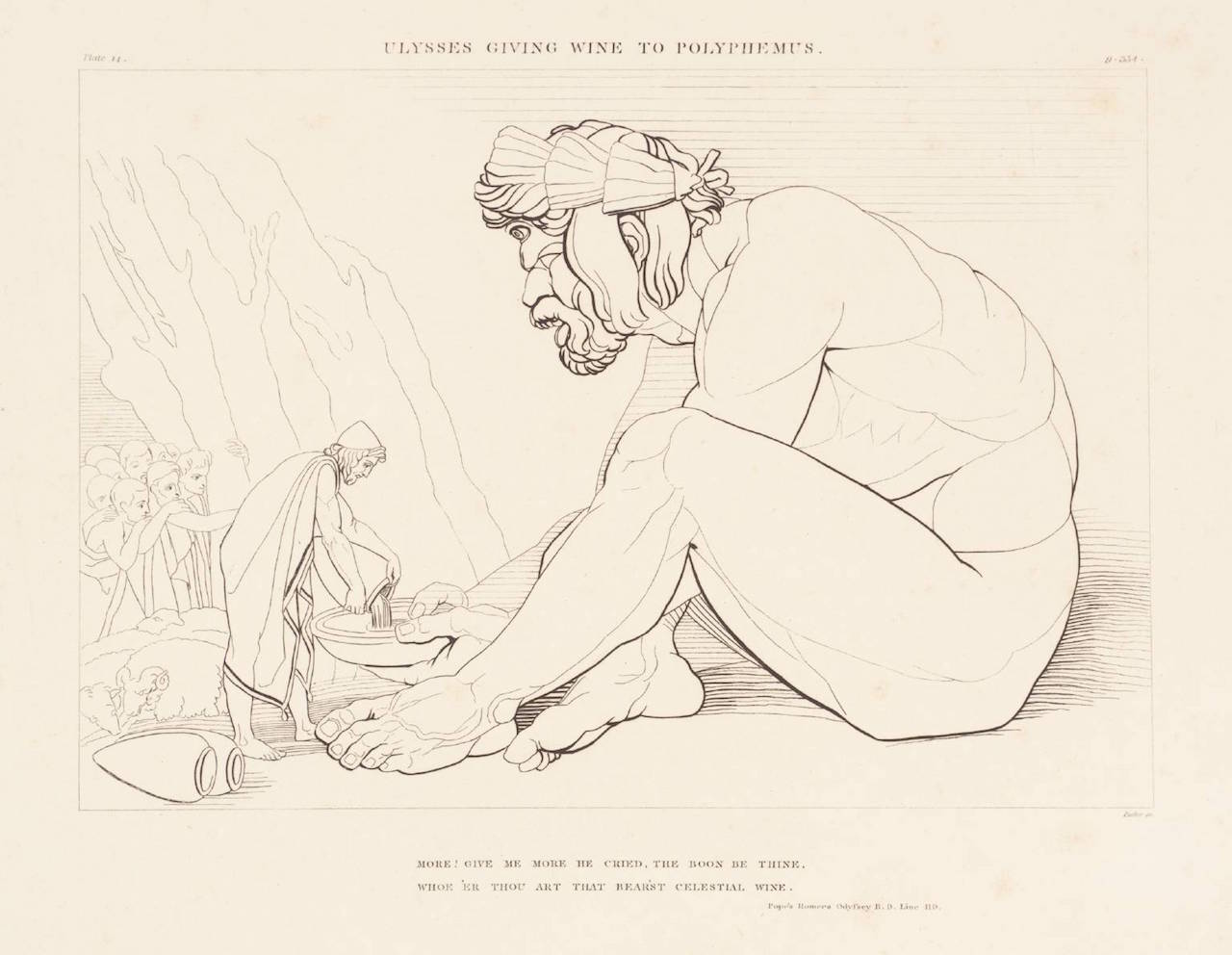 “Ulysses Giving Wine to Polyphemus” (1805). John Flaxman (1755–1826). Purchased as part of the Oppé Collection with assistance from the National Lottery through the Heritage Lottery Fund, 1996.
  “Circe Invidiosa,” (1892). J. W. Waterhouse (English, 1849–1917).
 “Teiresias appears to Ulysses during the sacrifice,” (1780–1785). Henry Fuseli (German, 1741–1825).
  “Ulysses and the Sirens” (ca. 1909). Herbert James Draper (English, 1863–1920).
 “Ulysses Asleep Laid on his Own Coast by the Phaeacian Sailors” (1805). John Flaxman (English, 1755–1826). Purchased as part of the Oppé Collection with assistance from the National Lottery through the Heritage Lottery Fund 1996.
  Minoan—probably Neopalatial—fresco commonly known as the “Lily Prince.” Whatever the exact type of this personage (perhaps a crowned acrobat, according to the interpretation of Maria Shaw), the Lily Prince is certainly a Minoan of elite standing. Public domain image based on a famous watercolor by Émile Gilliéron of a reconstruction by Arthur Evans.
 Detail from a fresco found at Hagia Triadha in Crete. Reconstruction by Mark Cameron, p. 96 of the catalogue Fresco: A Passport into the Past. Minoan Crete through the eyes of Mark Cameron. 1999. Catalogue curated by Doniert Evely. Athens: British School at Athens; and N. P. Goulandris Foundation, Museum of Cycladic Art. Reproduced with the permission of the British School at Athens. BSA Archive: Mark Cameron Personal Papers: CAM 1.
 “Minerva Restoring Ulysses to his Own Shape” (1805). John Flaxman (English, 1755–1826). Purchased as part of the Oppé Collection with assistance from the National Lottery through the Heritage Lottery Fund 1996.
 “Ulysses and his Dog” (1805). John Flaxman (English, 1755–1826). Purchased as part of the Oppé Collection with assistance from the National Lottery through the Heritage Lottery Fund 1996.
  “Ulysses Preparing to Fight with Irus” (1805). John Flaxman (English, 1755–1826) Purchased as part of the Oppé Collection with assistance from the National Lottery through the Heritage Lottery Fund 1996.
  “Euryclea Discovers Ulysses” (1805). John Flaxman (English, 1755–1826). Purchased as part of the Oppé Collection with assistance from the National Lottery through the Heritage Lottery Fund 1996.
  “The Harpies Going to Seize the Daughters of Pandareus” (1805). John Flaxman (English, 1755–1826). Purchased as part of the Oppé Collection with assistance from the National Lottery through the Heritage Lottery Fund 1996.
 Hēraklēs stringing a bow. Silver stater, c. 450–440 BCE, Thebes (Boeotia).
  Swallows, detail of the Spring Fresco at Thera, image via Flickr user
  Original artwork, by Flickr user
  Odysseus kiling Penelope’s suitors. Attic red-figure skyphos, ca. 440 BCE.
  Still life showing eggs, thrushes, napkin: from the House of Julia Felix, Pompeii.
  Eurykleia waking Penelope (1773). Print by Thomas Burke, after a painting by Angelika Kauffmann.
  Big Ed and Norma have just now broken free of the troublesome relationships that have kept these lovers apart for 27 years. Now at long last they can have a life together.
Still from
Big Ed and Norma have just now broken free of the troublesome relationships that have kept these lovers apart for 27 years. Now at long last they can have a life together.
Still from  “Mercury Conducting the Souls of the Suitors to the Infernal Regions” (1805). John Flaxman (English, 1755–1826). Purchased as part of the Oppé Collection with assistance from the National Lottery through the Heritage Lottery Fund 1996.
  “Ulysses Departing from Lacedaemon for Ithaca, with his Bride Penelope” (1805). John Flaxman (English, 1755–1826). Flaxman made this image the last in his Odyssey series, bringing the story of Penelope and Odysseus full circle. Purchased as part of the Oppé Collection with assistance from the National Lottery through the Heritage Lottery Fund 1996.


,_around_440_BC,_Altes_Museum_Berlin_(13718420225)_glare-reduced_white-bg.png)
