
View:
By Card
BOOK V.
ARGUMENT.
THE DEPARTURE OF ULYSSES FROM CALYPSO.
Pallas in a council of the gods complains of the detention of Ulysses in the island of Calypso; whereupon Mercury is sent to command his removal. The seat of Calypso described. She consents with much difficulty; and Ulysses builds a vessel with his own hands, on which he embarks. Neptune overtakes him with a terrible tempest, in which he is shipwrecked, and in the last danger of death; till Leucothea, a sea-goddess, assists him, and, after innumerable perils, he gets ashore on Phaeacia.
1
THE saffron morn, with early blushes spread,
1
Now rose refulgent from Tithonus' bed;
With new-born day to gladden mortal sight,
And gild the courts of heaven with sacred light.
Then met th' eternal synod of the sky,
5
Before the god, who thunders from on high,
Supreme in might, sublime in majesty.
Pallas, to these, deplores th' unequal fates
Of wise Ulysses, and his toils relates:
Her hero's danger touch'd the pitying power,
10
The nymph's seducements, and the magic bower.
MINERVA
Thus she began her plaint. 'Immortal Jove!
'And you who fill the blissful seats above!
'Let kings no more with gentle mercy sway,
'Or bless a people willing to obey,
15
'But crush the nations with an iron rod,
'And every monarch be the scourge of God;
'If from your thoughts Ulysses you remove,
'Who rul’d his subjects with a father's love.
'Sole in an isle, encircled by the main,
20
'Abandon'd, banish'd from his native reign,
'Unbless'd he sighs, detain'd by lawless charms,
'And press'd unwilling in Calypso's arms.
'Nor friends are there, nor vessels to convey,
'Nor oars to cut th' immeasurable way.
25
'And now fierce traitors, studious to destroy
'His only son, their ambush'd fraud employ;
'Who, pious, following his great father's fame,
'To sacred Pylos and to Sparta came.'
Thus she began her plaint. 'Immortal Jove!
'And you who fill the blissful seats above!
'Let kings no more with gentle mercy sway,
'Or bless a people willing to obey,
15
'But crush the nations with an iron rod,
'And every monarch be the scourge of God;
'If from your thoughts Ulysses you remove,
'Who rul’d his subjects with a father's love.
'Sole in an isle, encircled by the main,
20
'Abandon'd, banish'd from his native reign,
'Unbless'd he sighs, detain'd by lawless charms,
'And press'd unwilling in Calypso's arms.
'Nor friends are there, nor vessels to convey,
'Nor oars to cut th' immeasurable way.
25
'And now fierce traitors, studious to destroy
'His only son, their ambush'd fraud employ;
'Who, pious, following his great father's fame,
'To sacred Pylos and to Sparta came.'
JUPITER
'What words are these?' (replied the power who forms
30
'The clouds of night, and darkens heaven with storms;)
'Is not already in thy soul decreed,
'The chief's return shall make the guilty bleed?
'What cannot Wisdom do? Thou may'st restore
'The son in safety to his native shore;
35
'While the fell foes, who late in ambush lay,
'With fraud defeated measure back their way.'
'What words are these?' (replied the power who forms
30
'The clouds of night, and darkens heaven with storms;)
'Is not already in thy soul decreed,
'The chief's return shall make the guilty bleed?
'What cannot Wisdom do? Thou may'st restore
'The son in safety to his native shore;
35
'While the fell foes, who late in ambush lay,
'With fraud defeated measure back their way.'
Then thus to Hermes the command was given.
'Hermes, thou chosen messenger of heaven!
'Go, to the nymph be these our orders borne.
40
''Tis Jove's decree, Ulysses shall return:
'The patient man shall view his old abodes,
'Nor help'd by mortal hand, nor guiding gods:
'In twice ten days shall fertile Scheria find,
1
'Alone, and floating to the wave and wind.
45
'The bold Phaeacians there, whose haughty line
'Is mix'd with gods, half human, half divine,
'The chief shall honour as some heavenly guest,
'And swift transport him to his place of rest.
'His vessels loaded with a plenteous store
50
'Of brass, of vestures, and resplendent ore,
'(A richer prize than if his joyful isle
'Received him charged with Ilion's noble spoil,)
'His friends, his country, he shall see, though late;
'Such is our sovereign will, and such is fate.'
55
He spoke. The god who mounts the winged winds
Fast to his feet the golden pinions binds,
That high through fields of air his flight sustain
O'er the wide earth, and o'er the boundless main.
He grasps the wand that causes sleep to fly,
60
Or in soft slumber seals the wakeful eye:
Then shoots from heaven to high Pieria's steep,
And stoops incumbent on the rolling deep.
So watery fowl, that seek their fishy food,
With wings expanded o'er the foaming flood,
65
Now sailing smooth the level surface sweep,
Now dip their pinions in the briny deep.
Thus o'er the world of waters Hermes flew,
Till now the distant island rose in view:
Then, swift ascending from the azure wave,
70
He took the path that winded to the cave.
Large was the grot, in which the nymph he found,
(The fair-hair'd nymph with every beauty crown'd;)
She sate and sung; the rocks resound her lays;
The cave was brighten'd with a rising blaze;
75
Cedar and frankincense, an odorous pile,
Flam'd on the hearth and wide perfum'd the isle;
While she with work and song the time divides,
And through the loom the golden shuttle guides.
Without the grot a various sylvan scene
80
Appear'd around, and groves of living green;
Poplars and alders ever quivering play'd,
And nodding cypress form'd a fragrant shade;
On whose high branches, waving with the storm,
The birds of broadest wing their mansions form,
85
The chough, the sea-mew, the loquacious crow,
And scream aloft, and skim the deeps below.
Depending vines the shelving cavern screen,
With purple clusters blushing through the green.
Four limpid fountains from the clefts distil;
90
And every fountain pours a several rill,
In mazy windings wandering down the hill;
Where bloomy meads with vivid greens were crown'd,
And glowing violets threw odours round.
A scene, where if a god should cast his sight,
95
A god might gaze, and wander with delight!
Joy touch'd the messenger of heaven: he stay'd
Entranced, and all the blissful haunts survey'd.
Him, entering in the cave, Calypso knew;
For powers celestial to each other's view
100
Stand still confess'd, though distant far they lie
To habitants of earth, or sea, or sky.
But sad Ulysses, by himself apart,
Pour'd the big sorrows of his swelling heart;
All on the lonely shore he sate to weep,
105
And roll'd his eyes around the restless deep;
Toward his lov'd coast he roll'd his eyes in vain,
Till, dimm'd with rising grief, they stream'd again.
Now graceful seated on her shining throne,
To Hermes thus the nymph divine begun:
110
CALYPSO
'God of the golden wand! on what behest'
'Arriv'st thou here, an unexpected guest?
'Lov'd as thou art, thy free injunctions lay;
''Tis mine with joy and duty to obey.
'Till now a stranger, in a happy hour
115
'Approach, and taste the dainties of my bower.'
'God of the golden wand! on what behest'
'Arriv'st thou here, an unexpected guest?
'Lov'd as thou art, thy free injunctions lay;
''Tis mine with joy and duty to obey.
'Till now a stranger, in a happy hour
115
'Approach, and taste the dainties of my bower.'
92
Thus having spoke, the nymph the table spread;
(Ambrosial cates, with nectar rosy-red;)
Hermes the hospitable rite partook,
Divine refection! then, recruited, spoke:
120
MERCURY
'What mov'd this journey from my native sky,
'A goddess asks, nor can a god deny:
'Hear then the truth. By mighty Jove's command
'Unwilling have I trod this pleasing land;
'For who, self-mov'd, with weary wing would sweep
125
'Such length of ocean and unmeasur'd deep:
'A world of waters! far from all the ways
'Where men frequent, or sacred altars blaze?
'But to Jove's will submission we must pay;
'What power so great to dare to disobey?
130
'A man, he says, a man resides with thee,
'Of all his kind most worn with misery;
'The Greeks, (whose arms for nine long years employ'd
'Their force on Ilion, in the tenth destroy'd,)
'At length embarking in a luckless hour,
135
'With conquest proud, incens'd Minerva's power:
'Hence on the guilty race her vengeance hurl'd
'With storms pursued them through the liquid world.
'There all his vessels sunk beneath the wave!
'There all his dear companions found their grave!
140
'Sav'd from the jaws of death by Heaven's decree,
'The tempest drove him to these shores and thee.
'Him, Jove now orders to his native lands
'Straight to dismiss: so destiny commands:
'Impatient fate his near return attends,
145
'And calls him to his country, and his friends.'
'What mov'd this journey from my native sky,
'A goddess asks, nor can a god deny:
'Hear then the truth. By mighty Jove's command
'Unwilling have I trod this pleasing land;
'For who, self-mov'd, with weary wing would sweep
125
'Such length of ocean and unmeasur'd deep:
'A world of waters! far from all the ways
'Where men frequent, or sacred altars blaze?
'But to Jove's will submission we must pay;
'What power so great to dare to disobey?
130
'A man, he says, a man resides with thee,
'Of all his kind most worn with misery;
'The Greeks, (whose arms for nine long years employ'd
'Their force on Ilion, in the tenth destroy'd,)
'At length embarking in a luckless hour,
135
'With conquest proud, incens'd Minerva's power:
'Hence on the guilty race her vengeance hurl'd
'With storms pursued them through the liquid world.
'There all his vessels sunk beneath the wave!
'There all his dear companions found their grave!
140
'Sav'd from the jaws of death by Heaven's decree,
'The tempest drove him to these shores and thee.
'Him, Jove now orders to his native lands
'Straight to dismiss: so destiny commands:
'Impatient fate his near return attends,
145
'And calls him to his country, and his friends.'
Ev'n to her inmost soul the goddess shook;
Then thus her anguish and her passion broke:
CALYPSO
'Ungracious gods! with spite and envy curs'd!
'Still to your own ethereal race the worst!
150
'Ye envy mortal and immortal joy,
'And love, the only sweet of life, destroy.
'Did ever goddess by her charms engage
'A favour'd mortal, and not feel your rage ?
'Ungracious gods! with spite and envy curs'd!
'Still to your own ethereal race the worst!
150
'Ye envy mortal and immortal joy,
'And love, the only sweet of life, destroy.
'Did ever goddess by her charms engage
'A favour'd mortal, and not feel your rage ?
CALYPSO
'So when Aurora sought Orion's love,
155
'Her joys disturb'd your blissful hours above,
'Till, in Ortygia, Dian's winged dart
'Had pierced the hapless hunter to the heart.
'So when the covert of the thrice-ear'd field
'Saw stately Ceres to her passion yield,
160
'Scarce could Iasion
2
taste her heavenly charms,
'But Jove's swift lightning scorch'd him in her arms,
'And is it now my turn, ye mighty powers!
'Am I the envy of your blissful bowers?
'A man, an outcast to the storm and wave,
165
'It was my crime to pity and to save;
'When he who thunders rent his bark in twain,
'And sunk his brave companions in the main.
'Alone, abandon'd, in mid ocean toss'd,
'The sport of winds, and driven from every coast,
170
'Hither this man of miseries I led,
'Receiv'd the friendless, and the hungry fed;
'Nay, promis'd (vainly promis'd!) to bestow
'Immortal life, exempt from age and woe.
''Tis past-and Jove decrees he shall remove:
175
'Gods as we are, we are but slaves to Jove.
'Go then he may; (he must, if he ordain,
'Try all those dangers, all those deeps, again;)
'But never, never shall Calypso send
'To toils like these her husband and her friend.
180
'What ships have I, what sailors to convey,
'What oars to cut the long laborious way?
'Yet I'll direct the safest means to go;
'That last advice is all I can bestow.'
'So when Aurora sought Orion's love,
155
'Her joys disturb'd your blissful hours above,
'Till, in Ortygia, Dian's winged dart
'Had pierced the hapless hunter to the heart.
'So when the covert of the thrice-ear'd field
'Saw stately Ceres to her passion yield,
160
'Scarce could Iasion
2
taste her heavenly charms,
'But Jove's swift lightning scorch'd him in her arms,
'And is it now my turn, ye mighty powers!
'Am I the envy of your blissful bowers?
'A man, an outcast to the storm and wave,
165
'It was my crime to pity and to save;
'When he who thunders rent his bark in twain,
'And sunk his brave companions in the main.
'Alone, abandon'd, in mid ocean toss'd,
'The sport of winds, and driven from every coast,
170
'Hither this man of miseries I led,
'Receiv'd the friendless, and the hungry fed;
'Nay, promis'd (vainly promis'd!) to bestow
'Immortal life, exempt from age and woe.
''Tis past-and Jove decrees he shall remove:
175
'Gods as we are, we are but slaves to Jove.
'Go then he may; (he must, if he ordain,
'Try all those dangers, all those deeps, again;)
'But never, never shall Calypso send
'To toils like these her husband and her friend.
180
'What ships have I, what sailors to convey,
'What oars to cut the long laborious way?
'Yet I'll direct the safest means to go;
'That last advice is all I can bestow.'
MERCURY
145
To her the power who bears the charming rod:
185
'Dismiss the man, nor irritate the god;
'Prevent the rage of him who reigns above,
'For what so dreadful as the wrath of Jove?'
145
To her the power who bears the charming rod:
185
'Dismiss the man, nor irritate the god;
'Prevent the rage of him who reigns above,
'For what so dreadful as the wrath of Jove?'
Thus having said, he cut the cleaving sky,
And in a moment vanish'd from her eye.
190
The nymph, obedient to divine command,
To seek Ulysses paced along the sand,
Him pensive on the lonely beach she found,
With streaming eyes in briny torrents drown'd,
And inly pining for his native shore;
195
For now the soft enchantress pleas'd no more:
For now, reluctant, and constrain'd by charms,
Absent he lay in her desiring arms:
In slumber wore the heavy night away,
On rocks and shores consum'd the tedious day;
200
There sate all desolate, and sigh'd alone,
With echoing sorrows made the mountains groan,
And roll'd his eyes o'er all the restless main,
Till, dimm'd with rising grief, they stream'd again.
Here, on his musing mood the goddess press'd,
205
Approaching soft; and thus the chief address'd
CALYPSO
'Unhappy man! to wasting woes a prey,
'No more in sorrows languish life away:
'Free as the winds I give thee now to rove-
'Go, fell the timber of yon lofty grove,
210
'And form a raft, and build the rising ship,
'Sublime to bear thee o'er the gloomy deep.
'To store the vessel let the care be mine,
'With water from the rock, and rosy wine,
'And life-sustaining bread, and fair array,
215
'And prosperous gales to waft thee on the way.
'These, if the gods with my desire comply,
'(The gods, alas, more mighty far than I,
'And better skill'd in dark events to come,)
'In peace shall land thee at thy native home.'
220
'Unhappy man! to wasting woes a prey,
'No more in sorrows languish life away:
'Free as the winds I give thee now to rove-
'Go, fell the timber of yon lofty grove,
210
'And form a raft, and build the rising ship,
'Sublime to bear thee o'er the gloomy deep.
'To store the vessel let the care be mine,
'With water from the rock, and rosy wine,
'And life-sustaining bread, and fair array,
215
'And prosperous gales to waft thee on the way.
'These, if the gods with my desire comply,
'(The gods, alas, more mighty far than I,
'And better skill'd in dark events to come,)
'In peace shall land thee at thy native home.'
220
With sighs Ulysses heard the words she spoke,
Then thus his melancholy silence broke:
ULYSSES
'Some other motive, goddess! sways thy mind,
'(Some close design, or turn of womankind,)
'Nor my return the end, nor this the way,
3
225
'On a slight raft to pass the swelling sea,
'Huge, horrid, vast! where scarce in safety sails
'The best-built ship, though Jove inspire the gales.
'The bold proposal how shall I fulfil,
'Dark as I am, unconscious of thy will?
230
'Swear, then, thou mean'st not what my soul forebodes;
'Swear by the solemn oath that binds the gods.'
'Some other motive, goddess! sways thy mind,
'(Some close design, or turn of womankind,)
'Nor my return the end, nor this the way,
3
225
'On a slight raft to pass the swelling sea,
'Huge, horrid, vast! where scarce in safety sails
'The best-built ship, though Jove inspire the gales.
'The bold proposal how shall I fulfil,
'Dark as I am, unconscious of thy will?
230
'Swear, then, thou mean'st not what my soul forebodes;
'Swear by the solemn oath that binds the gods.'
Him, while he spoke, with smiles Calypso ey'd,
And gently grasp'd his hand, and thus replied:
CALYPSO
'This shows thee, friend, by old experience taught,
235
'And learn'd in all the wiles of human thought,
'How prone to doubt, how cautious are the wise!
'But hear, O earth, and hear, ye sacred skies!
'And thou, O Styx! whose formidable floods
'Glide through the shades, and bind th' attesting gods!
240
'No form'd design, no meditated end,
'Lurks in the council of thy faithful friend;
'Kind the persuasion, and sincere my aim;
'The same my practice, were my fate the same.
'Heaven has not cursed me with a heart of steel,
245
'But given the sense to pity and to feel.'
'This shows thee, friend, by old experience taught,
235
'And learn'd in all the wiles of human thought,
'How prone to doubt, how cautious are the wise!
'But hear, O earth, and hear, ye sacred skies!
'And thou, O Styx! whose formidable floods
'Glide through the shades, and bind th' attesting gods!
240
'No form'd design, no meditated end,
'Lurks in the council of thy faithful friend;
'Kind the persuasion, and sincere my aim;
'The same my practice, were my fate the same.
'Heaven has not cursed me with a heart of steel,
245
'But given the sense to pity and to feel.'
192
Thus having said, the goddess march'd before:
He trod her footsteps in the sandy shore.
At the cool cave arriv'd, they took their state;
250
He fill'd the throne where Mercury had sate.
For him the nymph a rich repast ordains,
Such as the mortal life of man sustains;
Before herself were placed the cates divine,
Ambrosial banquet, and celestial wine.
255
Their hunger satiate, and their thirst repress'd,
Thus spoke Calypso to her god-like guest:
CALYPSO
'Ulysses!' (with a sigh she thus began;)
'O sprung from gods! in wisdom more than man!
'Is then thy home the passion of thy heart?
260
'Thus wilt thou leave me, are we thus to part?
'Farewell! and ever joyful may'st thou be,
'Nor break the transport with one thought of me.
'But, ah, Ulysses! wert thou given to know
'What Fate yet dooms thee, yet, to undergo;
265
'Thy heart might settle in this scene of ease,
'And ev'n these slighted charms might learn to please.
'A willing goddess, and immortal life,
'Might banish from thy mind an absent wife.
'Am I inferior to a mortal dame?
270
'Less soft my feature, less august my frame?
'Ulysses!' (with a sigh she thus began;)
'O sprung from gods! in wisdom more than man!
'Is then thy home the passion of thy heart?
260
'Thus wilt thou leave me, are we thus to part?
'Farewell! and ever joyful may'st thou be,
'Nor break the transport with one thought of me.
'But, ah, Ulysses! wert thou given to know
'What Fate yet dooms thee, yet, to undergo;
265
'Thy heart might settle in this scene of ease,
'And ev'n these slighted charms might learn to please.
'A willing goddess, and immortal life,
'Might banish from thy mind an absent wife.
'Am I inferior to a mortal dame?
270
'Less soft my feature, less august my frame?
ULYSSES
'Or shall the daughters of mankind compare
'Their earth-born beauties with the heavenly fair?'
'Alas! for this' (the prudent man replies)
'Against Ulysses shall thy anger rise?
275
'Lov'd and ador'd, O goddess, as thou art,
'Forgive the weakness of a human heart.
'Though well I see thy graces far above
'The dear, though mortal, object of my love,
'Of youth eternal well the difference know,
280
'And the short date of fading charms below;
'Yet every day, while absent thus I roam,
'I languish to return and die at home.
4
'Whate'er the gods shall destine me to bear
'In the black ocean, or the watery war,
285
''Tis mine to master with a constant mind;
'Inur'd to perils, to the worst resign'd.
'By seas, by wars, so many dangers run;
'Still I can suffer: their high will be done!'
'Or shall the daughters of mankind compare
'Their earth-born beauties with the heavenly fair?'
'Alas! for this' (the prudent man replies)
'Against Ulysses shall thy anger rise?
275
'Lov'd and ador'd, O goddess, as thou art,
'Forgive the weakness of a human heart.
'Though well I see thy graces far above
'The dear, though mortal, object of my love,
'Of youth eternal well the difference know,
280
'And the short date of fading charms below;
'Yet every day, while absent thus I roam,
'I languish to return and die at home.
4
'Whate'er the gods shall destine me to bear
'In the black ocean, or the watery war,
285
''Tis mine to master with a constant mind;
'Inur'd to perils, to the worst resign'd.
'By seas, by wars, so many dangers run;
'Still I can suffer: their high will be done!'
Thus while he spoke, the beamy sun descends,
290
And rising night her friendly shade extends.
To the close grot the lonely pair remove,
And slept delighted with the gifts of love.
When rosy morning call'd them from their rest,
Ulysses robed him in the cloak and vest.
295
The nymph's fair head a veil transparent grac'd,
Her swelling loins a radiant zone embrac'd
With flowers of gold: an under robe, unbound,
In snowy waves flow'd glittering on the ground.
Forth issuing thus, she gave him first to wield
300
A weighty axe, with truest temper steel'd,
And double-edg'd; the handle smooth and plain,
Wrought of the clouded olive's easy grain;
And next, a wedge to drive with sweepy sway:
Then to the neighbouring forest led the way.
305
On the lone island's utmost verge there stood
Of poplars, pines, and firs, a lofty wood,
Whose leafless summits to the skies aspire,
Scorch'd by the sun, or sear'd by heavenly fire:
(Already dried.) These pointing out to view,
310
The nymph just show'd him, and with tears withdrew.
Now toils the hero: trees on trees o'erthrown
Fall crackling round him, and the forests groan:
Sudden, full twenty on the plain are strow'd,
And lopp'd and lighten'd of their branchy load.
315
At equal angles these disposed to join,
He smooth'd and squar'd them by the rule and line.
(The wimbles for the work Calypso found)
With those he pierced them, and with clinchers bound.
Long and capacious as a shipwright forms
320
Some bark's broad bottom to out-ride the storms,
So large he built the raft; then ribb'd it strong
From space to space, and nail'd the planks along;
These form'd the sides: the deck he fashion'd last;
Then o'er the vessel raised the taper mast,
325
With crossing sail-yards dancing in the wind;
And to the helm the guiding rudder join'd;
(With yielding osiers fenced, to break the force
Of surging waves, and steer the steady course.)
Thy loom, Calypso! for the future sails
330
Supplied the cloth, capacious of the gales.
With stays and cordage last he rigg'd the ship,
And, roll'd on levers, launch'd her in the deep.
Four days were past, and now, the work complete,
Shone the fifth morn, when from her sacred seat
335
The nymph dismiss'd him, (odorous garments given,
And bathed in fragrant oils that breath'd of heaven :)
Then fill'd two goat-skins with her hands divine,
With water one, and one with sable wine:
Of every kind provisions heav'd aboard;
340
And the full decks with copious viands stor'd.
The goddess, last, a gentle breeze supplies,
To curl old Ocean, and to warm the skies.
And now, rejoicing in the prosperous gales,
With beating heart Ulysses spreads his sails:
5
345
Placed at the helm he sate, and mark'd the skies,
Nor clos'd in sleep his ever-watchful eyes.
There view'd the Pleiads, and the Northern Team,
And great Orion's more refulgent beam,
To which, around the axle of the sky,
350
The Bear, revolving, points his golden eye:
Who shines exalted on th' ethereal plain,
Nor bathes his blazing forehead in the main.
Far on the left those radiant fires to keep
The nymph directed, as he sail'd the deep.
355
Full seventeen nights he cut the foamy way:
The distant land appear'd the following day:
Then swell'd to sight Phaeacia's dusky coast,
And woody mountains, half in vapours lost;
That lay before him indistinct and vast,
360
Like a broad shield amid the watery waste.
NEPTUNE
'Heavens! how uncertain are the powers on high!
'Is then revers'd the sentence of the sky,
'In one man's favour: while a distant guest
370
'I shar'd secure the Ethiopian feast?
'Behold how near Phaeacia's land he draws!
'The land affix'd by Fate's eternal laws
'To end his toils. Is then our anger vain ?
'No; if this sceptre yet commands the main.'
375
'Heavens! how uncertain are the powers on high!
'Is then revers'd the sentence of the sky,
'In one man's favour: while a distant guest
370
'I shar'd secure the Ethiopian feast?
'Behold how near Phaeacia's land he draws!
'The land affix'd by Fate's eternal laws
'To end his toils. Is then our anger vain ?
'No; if this sceptre yet commands the main.'
375
He spoke, and high the forky trident hurl'd,
Rolls clouds on clouds, and stirs the watery world,
At once the face of earth and sea deforms,
Swells all the winds, and rouses all the storms.
Down rush'd the night: east, west, together roar;
380
And south and north roll mountains to the shore:
Then shook the hero, to despair resign'd,
And question'd thus his yet unconquer'd mind:
ULYSSES
'Wretch that I am! what farther fates attend
'This life of toils, and what my destin'd end?
385
'Too well, alas! the island goddess knew
'On the black sea what perils should ensue.
'New horrors now this destin'd head enclose;
'Unfill'd is yet the measure of my woes:
'With what a cloud the brows of heaven are crown'd!
390
'What raging winds! what roaring waters round!
''Tis Jove himself the swelling tempest rears;
'Death, present death, on every side appears.
'Happy! thrice happy! who, in battle slain,
'Press'd, in Atrides' cause, the Trojan plain!
395
'Oh! had I died before that well-fought wall;
'Had some distinguish'd day renown'd my fall;
'(Such as was that when showers of javelins fled
'From conquering Troy around Achilles dead;)
'All Greece had paid me solemn funerals then,
400
'And spread my glory with the sons of men.
'A shameful fate now hides my hapless head,
'Unwept, unnoted, and for ever dead!"
8
'Wretch that I am! what farther fates attend
'This life of toils, and what my destin'd end?
385
'Too well, alas! the island goddess knew
'On the black sea what perils should ensue.
'New horrors now this destin'd head enclose;
'Unfill'd is yet the measure of my woes:
'With what a cloud the brows of heaven are crown'd!
390
'What raging winds! what roaring waters round!
''Tis Jove himself the swelling tempest rears;
'Death, present death, on every side appears.
'Happy! thrice happy! who, in battle slain,
'Press'd, in Atrides' cause, the Trojan plain!
395
'Oh! had I died before that well-fought wall;
'Had some distinguish'd day renown'd my fall;
'(Such as was that when showers of javelins fled
'From conquering Troy around Achilles dead;)
'All Greece had paid me solemn funerals then,
400
'And spread my glory with the sons of men.
'A shameful fate now hides my hapless head,
'Unwept, unnoted, and for ever dead!"
8
313
A mighty wave rush'd o'er him as he spoke,
The raft it cover'd, and the mast it broke:
405
Swept from the deck, and from the rudder torn,
Far on the swelling surge the chief was borne;
While by the howling tempest rent in twain
Flew sail and sail-yards rattling o'er the main.
Long-press'd, he heav'd beneath the weighty wave,
410
Clogg'd by the cumb'rous vest Calypso gave:
At length emerging, from his nostrils wide
And gushing mouth effus'd the briny tide;
Ev'n then, not mindless of his last retreat,
He seiz'd the raft, and leap'd into his seat,
415
Strong with the fear of death. The rolling flood
Now here, now there, impell'd the floating wood.
As when a heap of gather'd thorns is cast
Now to, now fro, before th' autumnal blast;
Together clung, it rolls around the field;
420
So roll'd the float, and so its texture held:
And now the south, and now the north, bear sway,
And now the east the foamy floods obey,
And now the west wind whirls it o'er the sea.
The wandering chief, with toils on toils oppress'd,
425
Leucothea saw, and pity touch'd her breast.
9
(Herself a mortal once, of Cadmus' strain,
But now an azure sister of the main.)
Swift as a sea-mew springing from the flood,
All radiant on the raft the goddess stood:
430
LEUCOTHEA
Then thus address'd him: 'Thou whom heaven decrees
'To Neptune's wrath, stern tyrant of the seas!
'(Unequal contest!) not his rage and power,
'Great as he is, such virtue shall devour.
'What I suggest, thy wisdom will perform:
435
'Forsake thy float, and leave it to the storm:
'Strip off thy garments; Neptune's fury brave
'With naked strength, and plunge into the wave.
'To reach Phaeacia all thy nerves extend,
'There Fate decrees thy miseries shall end.
440
'This heavenly scarf beneath thy bosom bind,
'And live; give all thy terrors to the wind.
'Soon as thy arms the happy shore shall gain,
'Return the gift, and cast it in the main;
'Observe my orders, and with heed obey,
445
'Cast it far off, and turn thy eyes away.'
Then thus address'd him: 'Thou whom heaven decrees
'To Neptune's wrath, stern tyrant of the seas!
'(Unequal contest!) not his rage and power,
'Great as he is, such virtue shall devour.
'What I suggest, thy wisdom will perform:
435
'Forsake thy float, and leave it to the storm:
'Strip off thy garments; Neptune's fury brave
'With naked strength, and plunge into the wave.
'To reach Phaeacia all thy nerves extend,
'There Fate decrees thy miseries shall end.
440
'This heavenly scarf beneath thy bosom bind,
'And live; give all thy terrors to the wind.
'Soon as thy arms the happy shore shall gain,
'Return the gift, and cast it in the main;
'Observe my orders, and with heed obey,
445
'Cast it far off, and turn thy eyes away.'
With that, her hand the sacred veil bestows,
Then down the deeps she dived from whence she rose;
A moment snatch'd the shining form away,
And all was cover'd with the curling sea.
450
ULYSSES
Struck with amaze, yet still to doubt inclin'd,
He stands suspended, and explores his mind.
'What shall I do? unhappy me! who knows
'But other gods intend me other woes?
'Whoe'er thou art, I shall not blindly join
455
'Thy pleaded reason, but consult with mine:
'For scarce in ken appears that distant isle
'Thy voice foretells me shall conclude my toil.
'Thus then I judge: while yet the planks sustain
'The wild waves' fury, here I fix'd remain:
460
'But when their texture to the tempest yields,
'I launch adventurous on the liquid fields,
'Join to the help of gods the strength of man,
'And take this method, since the best I can.'
Struck with amaze, yet still to doubt inclin'd,
He stands suspended, and explores his mind.
'What shall I do? unhappy me! who knows
'But other gods intend me other woes?
'Whoe'er thou art, I shall not blindly join
455
'Thy pleaded reason, but consult with mine:
'For scarce in ken appears that distant isle
'Thy voice foretells me shall conclude my toil.
'Thus then I judge: while yet the planks sustain
'The wild waves' fury, here I fix'd remain:
460
'But when their texture to the tempest yields,
'I launch adventurous on the liquid fields,
'Join to the help of gods the strength of man,
'And take this method, since the best I can.'
365
While thus his thoughts an anxious council hold,
465
The raging god a watery mountain roll'd;
Like a black sheet the whelming billows spread,
Burst o'er the float, and thunder'd on his head.
Planks, beams, disparted fly; the scatter'd wood
Rolls diverse, and in fragments strews the flood.
470
So the rude Boreas, o'er the field new-shorn,
Tosses and drives the scatter'd heaps of corn.
And now a single beam the chief bestrides :
There, pois'd awhile above the bounding tides,
His limbs discumbers of the clinging vest,
475
And binds the sacred cincture round his breast;
Then, prone on ocean in a moment flung,
Stretch'd wide his eager arms, and shot the seas along.
All naked now, on heaving billows laid,
Stern Neptune ey'd him, and contemptuous said:
480
NEPTUNE
'Go, learn'd in woes, and other foes essay!
'Go, wander helpless on the watery way:
'Thus, thus find out the destin'd shore, and then
'(If Jove ordains it) mix with happier men:
'Whate'er thy fate, the ills our wrath could raise
485
'Shall last remember'd in thy best of days.'
'Go, learn'd in woes, and other foes essay!
'Go, wander helpless on the watery way:
'Thus, thus find out the destin'd shore, and then
'(If Jove ordains it) mix with happier men:
'Whate'er thy fate, the ills our wrath could raise
485
'Shall last remember'd in thy best of days.'
This said, his sea-green steeds divide the foam,
And reach high Aegae
10
and the towery dome.
Now, scarce withdrawn the fierce earth-shaking power,
Jove's daughter Pallas watch'd the favouring hour;
490
Back to their caves she bade the winds to fly,
And hush'd the blustering brethren of the sky.
The drier blasts alone of Boreas sway,
And bear him soft on broken waves away;
With gentle force impelling to that shore,
495
Where Fate has destin'd he shall toil no more.
And now two nights and now two days were past,
Since wide he wander'd on the watery waste;
Heav'd on the surge with intermitting breath,
And hourly panting in the arms of death.
500
The third fair morn now blaz'd upon the main;
Then glassy smooth lay all the liquid plain;
The winds were hush'd, the billows scarcely curl'd,
And a dead silence still'd the watery world,
When, lifted on a ridgy wave, he spies
505
The land at distance, and with sharpen'd eyes.
As pious children joy with vast delight
When a lov'd sire revives before their sight,
(Who, lingering long, has call'd on death in vain,
Fix'd by some demon to his bed of pain,
510
Till Heaven by miracle his life restore;)
So joys Ulysses at th' appearing shore;
And sees (and labours onward as he sees)
The rising forests, and the tufted trees.
And now, as near approaching as the sound
515
Of human voice the listening ear may wound,
Amidst the rocks he hears a hollow roar
Of murmuring surges breaking on the shore:
Nor peaceful port was there, nor winding bay,
To shield the vessel from the rolling sea,
520
But cliffs, and shaggy shores, a dreadful sight!
All rough with rocks, with foamy billows white.
Fear seiz'd his slacken'd limbs and beating heart,
And thus he commun'd with his soul apart:
ULYSSES
408
'Ah me! when o'er a length of waters toss'd,
525
'These eyes at last behold th' unhop'd-for coast,
'No port receives me from the angry main,
'But the loud deeps demand me back again.
'Above sharp rocks forbid access; around
'Roar the wild waves; beneath is sea profound!
530
'No footing sure affords the faithless sand,
'To stem too rapid, and too deep to stand.
'If here I enter, my efforts are vain,
'Dash'd on the cliffs or heav'd into the main;
'Or round the island if my course I bend,
535
'Where the ports open, or the shores descend,
'Back to the seas the rolling surge may sweep,
'And bury all my hopes beneath the deep.
'Or some enormous whale the god may send;
'(For many such on Amphitrite attend;)
540
'Too well the turns of mortal chance I know,
'And hate relentless of my heavenly foe.'
408
'Ah me! when o'er a length of waters toss'd,
525
'These eyes at last behold th' unhop'd-for coast,
'No port receives me from the angry main,
'But the loud deeps demand me back again.
'Above sharp rocks forbid access; around
'Roar the wild waves; beneath is sea profound!
530
'No footing sure affords the faithless sand,
'To stem too rapid, and too deep to stand.
'If here I enter, my efforts are vain,
'Dash'd on the cliffs or heav'd into the main;
'Or round the island if my course I bend,
535
'Where the ports open, or the shores descend,
'Back to the seas the rolling surge may sweep,
'And bury all my hopes beneath the deep.
'Or some enormous whale the god may send;
'(For many such on Amphitrite attend;)
540
'Too well the turns of mortal chance I know,
'And hate relentless of my heavenly foe.'
While thus he thought, a monstrous wave upbore
The chief, and dash'd him on the craggy shore;
Torn was his skin, nor had the ribs been whole,
545
But instant Pallas enter'd in his soul.
Close to the cliff with both his hands he clung,
And stuck adherent, and suspended hung;
Till the huge surge roll'd off: then, backward sweep
The refluent tides, and plunge him in the deep.
550
As when the polypus, from forth his cave
Torn with full force, reluctant beats the wave;
His ragged claws are stuck with stones and sands;
So the rough rock had shagg'd Ulysses' hands.
And now had perish'd, whelm'd beneath the main,
555
Th' unhappy man; ev'n fate had been in vain;
But all-subduing Pallas lent her power,
And prudence sav'd him in the needful hour.
Beyond the beating surge his course he bore,
(A wider circle, but in sight of shore,)
560
With longing eyes, observing, to survey
Some smooth ascent, or safe sequester'd bay.
Between the parting rocks at length he spied
A falling stream with gentler waters glide;
Where to the seas the shelving shore declin'd,
565
And form'd a bay impervious to the wind.
To this calm port the glad Ulysses press'd,
And hail'd the river, and its god address'd :
ULYSSES
'Whoe'er thou art, before whose stream unknown
'I bend, a suppliant at thy watery throne,
570
'Hear, azure king! nor let me fly in vain
'To thee from Neptune and the raging main.
'Heaven hears and pities hapless men like me,
'For sacred ev'n to gods is misery:
11
'Whoe'er thou art, before whose stream unknown
'I bend, a suppliant at thy watery throne,
570
'Hear, azure king! nor let me fly in vain
'To thee from Neptune and the raging main.
'Heaven hears and pities hapless men like me,
'For sacred ev'n to gods is misery:
11
ULYSSES
'Let then thy waters give the weary rest,
575
'And save a suppliant, and a man distress'd.
'Let then thy waters give the weary rest,
575
'And save a suppliant, and a man distress'd.
451
He pray'd, and straight the gentle stream subsides,
Detains the rushing current of his tides,
Before the wanderer smooths the watery way,
And soft receives him from the rolling sea.
580
That moment, fainting as he touch'd the shore,
He dropp'd his sinewy arms; his knees no more
Perform'd their office, or his weight upheld;
His swoln heart heav'd; his bloated body swell'd;
From mouth and nose the briny torrent ran;
585
And lost in lassitude lay all the man,
Depriv'd of voice, of motion, and of breath;
The soul scarce waking in the arms of death.
Soon as warm life its wonted office found,
The mindful chief Leucothea's scarf unbound;
590
Observant of her word, he turn'd aside
His head, and cast it on the rolling tide.
Behind him far, upon the purple waves
The waters waft it, and the nymph receives.
Now parting from the stream, Ulysses found
595
A mossy bank with pliant rushes crown'd;
The bank he press'd, and gently kiss'd the ground;
Where on the flowery herb as soft he lay,
Thus to his soul the sage began to say:
ULYSSES
'What will ye next ordain, ye powers on high!
600
'And yet, ah yet, what fates are we to try?
'Here by the stream, if I the night out-wear,
'Thus spent already, how shall nature bear
'The dews descending, and nocturnal air?
'Or chilly vapours breathing from the flood
605
'When morning rises ?-If I take the wood,
'And in thick shelter of innumerous boughs
'Enjoy the comfort gentle sleep allows;
'Though fenced from cold, and though my toil be pass'd,
'What savage beasts may wander in the waste!
610
'Perhaps I yet may fall a bloody prey
'To prowling bears, or lions in the way.'
'What will ye next ordain, ye powers on high!
600
'And yet, ah yet, what fates are we to try?
'Here by the stream, if I the night out-wear,
'Thus spent already, how shall nature bear
'The dews descending, and nocturnal air?
'Or chilly vapours breathing from the flood
605
'When morning rises ?-If I take the wood,
'And in thick shelter of innumerous boughs
'Enjoy the comfort gentle sleep allows;
'Though fenced from cold, and though my toil be pass'd,
'What savage beasts may wander in the waste!
610
'Perhaps I yet may fall a bloody prey
'To prowling bears, or lions in the way.'
Thus long debating in himself he stood:
At length he took the passage to the wood,
Whose shady horrors on a rising brow
615
Wav'd high, and frown'd upon the stream below.
There grew two olives, closest of the grove,
With roots entwin'd, and branches interwove;
Alike their leaves, but not alike they smil'd
With sister-fruits; one fertile, one was wild.
620
Nor here the sun's meridian rays had power,
Nor wind sharp-piercing, nor the rushing shower;
The verdant arch so close its texture kept:
Beneath this covert great Ulysses crept.
Of gather'd leaves an ample bed he made;
625
(Thick strewn by tempest thro' the bowery shade;)
Where three at least might winter's cold defy,
Though Boreas rag'd along th' inclement sky.
This store with joy the patient hero found,
And, sunk amidst them, heap'd the leaves around.
630
As some poor peasant, fated to reside
Remote from neighbours in a forest wide,
Studious to save what human wants require,
In embers heap'd, preserves the seeds of fire:
Hid in dry foliage thus Ulysses lies,
635
Till Pallas pour'd soft slumbers on his eyes:
And golden dreams (the gift of sweet repose)
Lull'd all his cares, and banish'd all his woes.
12
Odyssey. Homer. London. 1858.
Sponsored by Perseus Project, Tufts University.
 Zeus, Athena, and Hermes (1810). Drawing by John Flaxman.
 Athena (1810). Drawing by John Flaxman.
 Telemachus with Athena as Mentor (1810). Drawing by John Flaxman.
  Nestor’s Sacrifice (1805). Engraving after John Flaxman (1755-1826). Purchased as part of the Oppé Collection with assistance from the National Lottery through the Heritage Lottery Fund 1996.
  “The Fair Helen.” Willy Pogany (Hungarian, 1882–1955).
Image
“The Fair Helen.” Willy Pogany (Hungarian, 1882–1955).
Image  “Leucothea, the White Goddess, Preserving Ulysses” (1805). John Flaxman (1755–1826). Purchased as part of the Oppé Collection with assistance from the National Lottery through the Heritage Lottery Fund, 1996.
  “Nausicaa” (1878), Frederick Leighton (English, 1830–1896).
 Red-figured pyxis, picturing Nereids at home, “indoors”: the Nereid with her hair down is labeled as Thaleia.
 View of Garitsa, region right outside the northern walls of the city of Corfu, and according to the legend the site of Alcinous’s gardens (1867). Étienne Rey (French, 1789–1867).
  Blind Demodokos sings of the siege of Troy (1810), by John Flaxman (English, 1755–1826).
 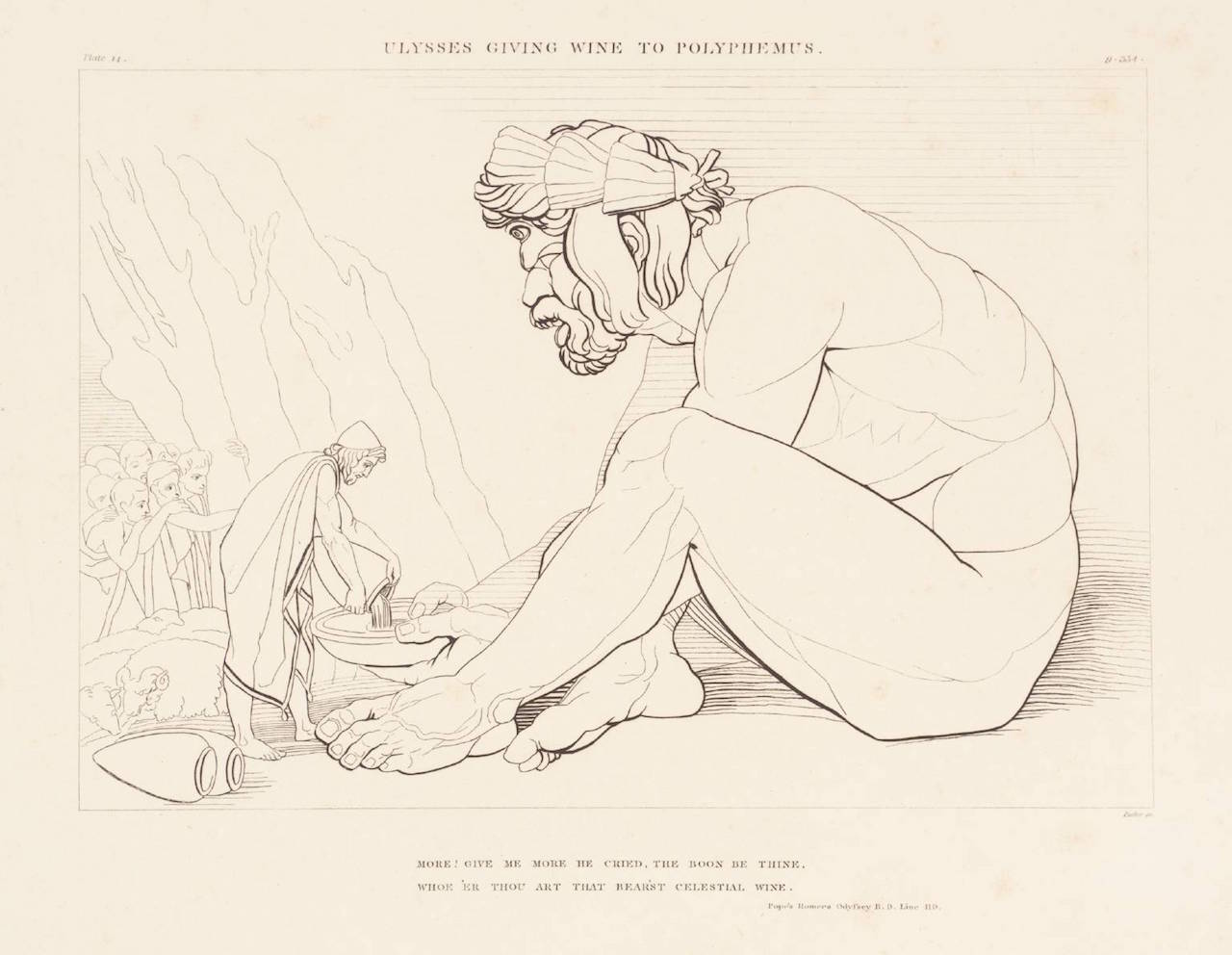 “Ulysses Giving Wine to Polyphemus” (1805). John Flaxman (1755–1826). Purchased as part of the Oppé Collection with assistance from the National Lottery through the Heritage Lottery Fund, 1996.
  “Circe Invidiosa,” (1892). J. W. Waterhouse (English, 1849–1917).
 “Teiresias appears to Ulysses during the sacrifice,” (1780–1785). Henry Fuseli (German, 1741–1825).
  “Ulysses and the Sirens” (ca. 1909). Herbert James Draper (English, 1863–1920).
 “Ulysses Asleep Laid on his Own Coast by the Phaeacian Sailors” (1805). John Flaxman (English, 1755–1826). Purchased as part of the Oppé Collection with assistance from the National Lottery through the Heritage Lottery Fund 1996.
  Minoan—probably Neopalatial—fresco commonly known as the “Lily Prince.” Whatever the exact type of this personage (perhaps a crowned acrobat, according to the interpretation of Maria Shaw), the Lily Prince is certainly a Minoan of elite standing. Public domain image based on a famous watercolor by Émile Gilliéron of a reconstruction by Arthur Evans.
 Detail from a fresco found at Hagia Triadha in Crete. Reconstruction by Mark Cameron, p. 96 of the catalogue Fresco: A Passport into the Past. Minoan Crete through the eyes of Mark Cameron. 1999. Catalogue curated by Doniert Evely. Athens: British School at Athens; and N. P. Goulandris Foundation, Museum of Cycladic Art. Reproduced with the permission of the British School at Athens. BSA Archive: Mark Cameron Personal Papers: CAM 1.
 “Minerva Restoring Ulysses to his Own Shape” (1805). John Flaxman (English, 1755–1826). Purchased as part of the Oppé Collection with assistance from the National Lottery through the Heritage Lottery Fund 1996.
 “Ulysses and his Dog” (1805). John Flaxman (English, 1755–1826). Purchased as part of the Oppé Collection with assistance from the National Lottery through the Heritage Lottery Fund 1996.
  “Ulysses Preparing to Fight with Irus” (1805). John Flaxman (English, 1755–1826) Purchased as part of the Oppé Collection with assistance from the National Lottery through the Heritage Lottery Fund 1996.
  “Euryclea Discovers Ulysses” (1805). John Flaxman (English, 1755–1826). Purchased as part of the Oppé Collection with assistance from the National Lottery through the Heritage Lottery Fund 1996.
  “The Harpies Going to Seize the Daughters of Pandareus” (1805). John Flaxman (English, 1755–1826). Purchased as part of the Oppé Collection with assistance from the National Lottery through the Heritage Lottery Fund 1996.
 Hēraklēs stringing a bow. Silver stater, c. 450–440 BCE, Thebes (Boeotia).
  Swallows, detail of the Spring Fresco at Thera, image via Flickr user
  Original artwork, by Flickr user
  Odysseus kiling Penelope’s suitors. Attic red-figure skyphos, ca. 440 BCE.
  Still life showing eggs, thrushes, napkin: from the House of Julia Felix, Pompeii.
  Eurykleia waking Penelope (1773). Print by Thomas Burke, after a painting by Angelika Kauffmann.
  Big Ed and Norma have just now broken free of the troublesome relationships that have kept these lovers apart for 27 years. Now at long last they can have a life together.
Still from
Big Ed and Norma have just now broken free of the troublesome relationships that have kept these lovers apart for 27 years. Now at long last they can have a life together.
Still from  “Mercury Conducting the Souls of the Suitors to the Infernal Regions” (1805). John Flaxman (English, 1755–1826). Purchased as part of the Oppé Collection with assistance from the National Lottery through the Heritage Lottery Fund 1996.
  “Ulysses Departing from Lacedaemon for Ithaca, with his Bride Penelope” (1805). John Flaxman (English, 1755–1826). Flaxman made this image the last in his Odyssey series, bringing the story of Penelope and Odysseus full circle. Purchased as part of the Oppé Collection with assistance from the National Lottery through the Heritage Lottery Fund 1996.


,_around_440_BC,_Altes_Museum_Berlin_(13718420225)_glare-reduced_white-bg.png)
