
View:
By Card
BOOK IX. 1
THE ADVENTURES OF THE CICONS, LOTOPHAGI, AND CYCLOPS.
Ulysses begins the relations of his adventures; how, after the destruction of Troy, he with his companions made an incursion on the Cicons, by whom they were repulsed; and meeting with a storm, were driven to the coast of the Lotophagi. From thence they sailed to the land of the Cyclops, whose manners and situation are particularly characterized. The giant Polyphemus and his cave described; the usage Ulysses and his companions met with there; and lastly, the method and artifice by which he escaped.
Ulysses
1
THEN thus Ulysses: "Thou whom first in sway,
1
As first in virtue, these thy realms obey;
How sweet the products of a peaceful reign!
The heaven-taught poet, and enchanting strain;
The well-fill'd palace, the perpetual feast,
5
A land rejoicing, and a people bless'd:
How goodly seems it ever to employ
Man's social days in union and in joy;
The plenteous board high-heap'd with cates divine,
And o'er the foaming bowl the laughing wine!
10
Amid these joys, why seeks thy mind to know
Th' unhappy series of a wanderer's woe?
Remembrance sad, whose image to review,
Alas! must open all my wounds anew!
And oh, what first, what last shall I relate,
15
Of woes unnumber'd sent by Heaven and Fate?
Know first the man (though now a wretch distress'd)
Who hopes thee, monarch, for his future guest:
Behold Ulysses! no ignoble name,
Earth sounds my wisdom, and high heaven my fame.
2
20
My native soil is Ithaca the fair,
Where high Neritus waves his woods in air;
Dulichium, Samè, and Zacynthus crown'd
With shady mountains, spread their isles around;
(These to the north and night's dark regions run,
25
Those to Aurora and the rising sun.)
Low lies our isle, yet bless'd in fruitful stores;
Strong are her sons, though rocky are her shores;
And none, ah none, so lovely to my sight,
Of all the lands that heaven o'erspreads with light!
30
In vain Calypso long constrain'd my stay,
With sweet, reluctant, amorous delay;
With all her charms as vainly Circe strove,
And added magic to secure my love.
In pomps or joys, the palace or the grot,
35
My country's image never was forgot,
My absent parents rose before my sight,
And distant lay contentment and delight.
Hear, then, the woes which mighty Jove ordain'd
To wait my passage from the Trojan land.
40
The winds from Ilion to the Cicons' shore,
3
Beneath cold Ismarus, our vessels bore.
We boldly landed on the hostile place,
And sack'd the city, and destroy'd the race,
Their wives made captive, their possessions shar'd,
45
And every soldier found a like reward.
I then advis'd to fly; not so the rest,
Who stay'd to revel, and prolong the feast:
The fatted sheep and sable bulls they slay,
And bowls flow round, and riot wastes the day.
50
47
Meantime the Cicons, to their holds retir'd,
Call on the Cicons, with new fury fir'd;
With early morn the gather'd country swarms,
And all the continent is bright with arms;
Thick as the budding leaves or rising flowers
55
O'erspread the land, when spring descends in showers:
All expert soldiers, skill'd on foot to dare,
Or from the bounding courser urge the war.
Now fortune changes (so the Fates ordain);
Our hour was come to taste our share of pain.
60
Close at the ships the bloody fight began,
Wounded they wound, and man expires on man.
Long as the morning sun increasing bright
O'er heaven's pure azure spread the growing light,
Promiscuous death the form of war confounds,
65
Each adverse battle gored with equal wounds;
But when his evening wheels o'erhung the main,
Then conquest crown'd the fierce Ciconian train.
Six brave companions from each ship we lost,
4
The rest escape in haste, and quit the coast.
70
With sails outspread we fly th' unequal strife,
Sad for their loss, but joyful of our life.
Yet as we fled, our fellows' rites we paid,
5
And thrice we call'd on each unhappy shade.
Meanwhile the god, whose hand the thunder forms,
75
Drives clouds on clouds, and blackens heaven with storms,
Wide o'er the waste the rage of Boreas sweeps,
And night rush'd headlong on the shaded deeps.
Now here, now there, the giddy ships are borne,
And all the rattling shrouds in fragments torn.
80
We furl'd the sail, we plied the labouring oar,
Took down our masts, and row'd our ships to shore.
Two tedious days, and two long nights we lay,
O'erwatch'd and batter'd in the naked bay.
But the third morning when Aurora brings,
85
We rear the masts, we spread the canvas wings;
Refresh'd and careless on the deck reclin'd,
We sit, and trust the pilot and the wind.
Then to my native country had I sail'd:
But, the cape doubled, adverse winds prevail'd.
90
Strong was the tide, which, by the northern blast
Impell'd, our vessels on Cythera cast.
82
Nine days our fleet th' uncertain tempest bore
Far in wide ocean, and from sight of shore:
The tenth we touch'd, by various errors toss'd,
95
The land of Lotus,
6
and the flowery coast.
We climb'd the beach, and springs of water found,
Then spread our hasty banquet on the ground.
Three men were sent, deputed from the crew
(A herald one) the dubious coast to view,
100
And learn what habitants possessed the place.
They went, and found a hospitable race:
Not prone to ill, nor strange to foreign guest,
They eat, they drink, and nature gives the feast:
The trees around them all their food produce;
105
Lotus the name: divine, nectareous juice!
(Thence called Lotophagi;) which whoso tastes,
Insatiate riots in the sweet repasts,
Nor other home nor other care intends,
But quits his house, his country, and his friends.
110
The three we sent, from off th' enchanting ground
We dragged reluctant, and by force we bound:
The rest in haste forsook the pleasing shore,
Or, the charm tasted, had return'd no more.
Now placed in order on their banks, they sweep
115
The sea's smooth face, and cleave the hoary deep;
With heavy hearts we labour through the tide,
To coasts unknown, and oceans yet untried.
The land of Cyclops
7
first, a savage kind,
Nor tam'd by manners, nor by laws confin'd:
120
Untaught to plant, to turn the glebe and sow;
They all their products to free nature owe.
The soil untill'd a ready harvest yields,
With wheat and barley wave the golden fields;
Spontaneous wines from weighty clusters pour,
125
And Jove descends in each prolific shower.
By these no statutes and no rights are known,
No council held, no monarch fills the throne,
But high on hills, or airy cliffs, they dwell,
Or deep in caves whose entrance leads to hell.
130
Each rules his race, his neighbour not his care,
Heedless of others, to his own severe.
116
Oppos'd to the Cyclopean coasts, there lay
An isle, whose hills their subject fields survey;
Its name Lachaea,
8
crown'd with many a grove,
135
Where savage goats through pathless thickets rove:
No needy mortals here, with hunger bold,
Or wretched hunters through the wintry cold
Pursue their flight; but leave them safe to bound
From hill to hill, o'er all the desert ground.
140
Nor knows the soil to feed the fleecy care,
Or feels the labours of the crooked share;
But uninhabited, untill'd, unsown
It lies, and breeds the bleating goat alone.
For there no vessel with vermilion prore,
145
Or bark of traffic, glides from shore to shore;
The rugged race of savages, unskill'd
The seas to traverse, or the ships to build,
Gaze on the coast, nor cultivate the soil,
Unlearn'd in all th' industrious arts of toil.
150
Yet here all products and all plants abound,
Sprung from the fruitful genius of the ground;
Fields waving high with heavy crops are seen,
And vines that flourish in eternal green,
Refreshing meads along the murmuring main,
155
And fountains streaming down the fruitful plain.
A port there is, inclos'd on either side,
Where ships may rest, unanchor'd and untied;
Till the glad mariners incline to sail,
And the sea whitens with the rising gale.
160
High at the head from out the cavern'd rock,
In living rills a gushing fountain broke:
Around it, and above, for ever green,
The bushy alders form'd a shady scene.
Hither some favouring god, beyond our thought,
165
Through all-surrounding shade our navy brought;
For gloomy night descended on the main,
Nor glimmer'd Phœbe in th' ethereal plain:
But all unseen the clouded island lay,
And all unseen the surge and rolling sea,
170
Till safe we anchor'd in the shelter'd bay:
Our sails we gather'd, cast our cables o'er,
And slept secure along the sandy shore.
Soon as again the rosy morning shone,
Reveal'd the landscape and the scene unknown,
175
With wonder seiz'd, we view the pleasing ground,
And walk delighted, and expatiate round.
Rous'd by the woodland nymphs at early dawn,
The mountain goats came bounding o'er the lawn:
In haste our fellows to the ships repair,
180
For arms and weapons of the sylvan war;
Straight in three squadrons all our crew we part,
And bend the bow, or wing the missile dart;
The bounteous gods afford a copious prey,
And nine fat goats each vessel bears away:
185
The royal bark had ten. Our ships complete
We thus supplied (for twelve were all the fleet).
161
Here, till the setting sun roll'd down the light,
We sat indulging in the genial rite:
Nor wines were wanting; those from ample jars
190
We drain'd, the prize of our Ciconian wars.
The land of Cyclops lay in prospect near;
The voice of goats and bleating flocks we hear,
And from their mountains rising smokes appear.
Now sunk the sun, and darkness cover'd o'er
195
The face of things: along the sea-beat shore
Satiate we slept; but when the sacred dawn
Arising glitter'd o'er the dewy lawn,
193
I call'd my fellows, and these words address'd:
"My dear associates here indulge your rest:
200
While, with my single ship, adventurous I
Go forth, the manners of yon men to try;
Whether a race unjust, of barbarous might,
Rude, and unconscious of a stranger's right;
Or such who harbour pity in their breast,
205
Revere the gods, and succour the distress'd."
This said, I climb'd my vessel's lofty side;
My train obey'd me, and the ship untied.
In order seated on their banks, they sweep
Neptune's smooth face, and cleave the yielding deep.
210
When to the nearest verge of land we drew,
Fast by the sea a lonely cave we view,
High, and with darkening laurels covered o'er;
Where sheep and goats lay slumbering round the shore.
Near this, a fence of marble from the rock,
215
Brown with o'erarching pine and spreading oak:
A giant shepherd here his flock maintains
Far from the rest, and solitary reigns,
In shelter thick of horrid shade reclin'd;
And gloomy mischiefs labour in his mind.
220
A form enormous! far unlike the race
Of human birth, in stature, or in face;
As some lone mountain's monstrous growth he stood,
Crown'd with rough thickets, and a nodding wood.
I left my vessel at the point of land,
225
And close to guard it gave our crew command:
With only twelve, the boldest and the best,
I seek th' adventure, and forsake the rest.
Then took a goatskin, fill'd with precious wine,
The gift of Maron of Evantheus' line;
230
(The priest of Phœbus at th' Ismarian shrine.
9
)
In sacred shade his honour'd mansion stood
Amidst Apollo's consecrated wood;
Him, and his house, heaven moved my mind to save,
And costly presents in return he gave;
235
Seven golden talents to perfection wrought,
A silver bowl that held a copious draught,
And twelve large vessels of unmingled wine,
Mellifluous, undecaying, and divine!
Which now, some ages from his race conceal'd,
240
The hoary sire in gratitude reveal'd.
Such was the wine: to quench whose fervent steam
Scarce twenty measures from the living stream
To cool one cup sufficed: the goblet crown'd
Breathed aromatic fragrances around.
245
Of this an ample vase we heav'd aboard,
And brought another with provisions stor'd.
My soul foreboded I should find the bower
Of some fell monster, fierce with barbarous power;
Some rustic wretch, who liv'd in heaven's despite,
250
Contemning laws, and trampling on the right.
The cave we found, but vacant all within;
(His flock the giant tended on the green:)
But round the grot we gaze; and all we view,
In order ranged, our admiration drew:
255
The bending shelves with loads of cheeses press'd,
The folded flocks each separate from the rest;
(The larger here, and there the lesser lambs,
The new-fall'n young here bleating for their dams;
The kid distinguish'd from the lambkin lies:)
260
The cavern echoes with responsive cries.
Capacious chargers all around were laid,
Full pails, and vessels of the milking trade.
With fresh provisions hence our fleet to store
My friends advise me, and to quit the shore;
265
Or drive a flock of sheep and goats away,
Consult our safety, and put off to sea.
The wholesome counsel rashly I declin'd,
Curious to view the man of monstrous kind,
And try what social rites a savage lends:
270
Dire rites, alas! and fatal to my friends!
231
Then first a fire we kindle, and prepare
For his return with sacrifice and prayer.
The loaden shelves afford us full repast;
We sit expecting. Lo! he comes at last.
275
Near half a forest on his back he bore,
And cast the ponderous burden at the door.
It thunder'd as it fell. We trembled then,
And sought the deep recesses of the den.
Now, driven before him through the arching rock,
280
Came tumbling, heaps on heaps, th' unnumber'd flock:
Big-udder'd ewes, and goats of female kind;
(The males were penn'd in outward courts behind;)
Then, heav'd on high, a rock's enormous weight
To the cave's mouth he roll'd, and clos'd the gate:
285
(Scarce twenty four-wheel'd cars, compact and strong,
The massy load could bear, or roll along.)
He next betakes him to his evening cares,
And, sitting down, to milk his flocks prepares;
Of half their udders eases first the dams,
290
Then to the mother's teat submits the lambs.
Half the white stream to hardening cheese he press'd,
And high in wicker-baskets heap'd: the rest,
Reserv'd in bowls, supplied his nightly feast.
His labour done, he fir'd the pile, that gave
295
A sudden blaze, and lighted all the cave.
We stand discover'd by the rising fires;
Askance the giant glares, and thus inquires:
THEN thus Ulysses: "Thou whom first in sway,
1
As first in virtue, these thy realms obey;
How sweet the products of a peaceful reign!
The heaven-taught poet, and enchanting strain;
The well-fill'd palace, the perpetual feast,
5
A land rejoicing, and a people bless'd:
How goodly seems it ever to employ
Man's social days in union and in joy;
The plenteous board high-heap'd with cates divine,
And o'er the foaming bowl the laughing wine!
10
Amid these joys, why seeks thy mind to know
Th' unhappy series of a wanderer's woe?
Remembrance sad, whose image to review,
Alas! must open all my wounds anew!
And oh, what first, what last shall I relate,
15
Of woes unnumber'd sent by Heaven and Fate?
Know first the man (though now a wretch distress'd)
Who hopes thee, monarch, for his future guest:
Behold Ulysses! no ignoble name,
Earth sounds my wisdom, and high heaven my fame.
2
20
My native soil is Ithaca the fair,
Where high Neritus waves his woods in air;
Dulichium, Samè, and Zacynthus crown'd
With shady mountains, spread their isles around;
(These to the north and night's dark regions run,
25
Those to Aurora and the rising sun.)
Low lies our isle, yet bless'd in fruitful stores;
Strong are her sons, though rocky are her shores;
And none, ah none, so lovely to my sight,
Of all the lands that heaven o'erspreads with light!
30
In vain Calypso long constrain'd my stay,
With sweet, reluctant, amorous delay;
With all her charms as vainly Circe strove,
And added magic to secure my love.
In pomps or joys, the palace or the grot,
35
My country's image never was forgot,
My absent parents rose before my sight,
And distant lay contentment and delight.
Hear, then, the woes which mighty Jove ordain'd
To wait my passage from the Trojan land.
40
The winds from Ilion to the Cicons' shore,
3
Beneath cold Ismarus, our vessels bore.
We boldly landed on the hostile place,
And sack'd the city, and destroy'd the race,
Their wives made captive, their possessions shar'd,
45
And every soldier found a like reward.
I then advis'd to fly; not so the rest,
Who stay'd to revel, and prolong the feast:
The fatted sheep and sable bulls they slay,
And bowls flow round, and riot wastes the day.
50
Meantime the Cicons, to their holds retir'd,
Call on the Cicons, with new fury fir'd;
With early morn the gather'd country swarms,
And all the continent is bright with arms;
Thick as the budding leaves or rising flowers
55
O'erspread the land, when spring descends in showers:
All expert soldiers, skill'd on foot to dare,
Or from the bounding courser urge the war.
Now fortune changes (so the Fates ordain);
Our hour was come to taste our share of pain.
60
Close at the ships the bloody fight began,
Wounded they wound, and man expires on man.
Long as the morning sun increasing bright
O'er heaven's pure azure spread the growing light,
Promiscuous death the form of war confounds,
65
Each adverse battle gored with equal wounds;
But when his evening wheels o'erhung the main,
Then conquest crown'd the fierce Ciconian train.
Six brave companions from each ship we lost,
4
The rest escape in haste, and quit the coast.
70
With sails outspread we fly th' unequal strife,
Sad for their loss, but joyful of our life.
Yet as we fled, our fellows' rites we paid,
5
And thrice we call'd on each unhappy shade.
Meanwhile the god, whose hand the thunder forms,
75
Drives clouds on clouds, and blackens heaven with storms,
Wide o'er the waste the rage of Boreas sweeps,
And night rush'd headlong on the shaded deeps.
Now here, now there, the giddy ships are borne,
And all the rattling shrouds in fragments torn.
80
We furl'd the sail, we plied the labouring oar,
Took down our masts, and row'd our ships to shore.
Two tedious days, and two long nights we lay,
O'erwatch'd and batter'd in the naked bay.
But the third morning when Aurora brings,
85
We rear the masts, we spread the canvas wings;
Refresh'd and careless on the deck reclin'd,
We sit, and trust the pilot and the wind.
Then to my native country had I sail'd:
But, the cape doubled, adverse winds prevail'd.
90
Strong was the tide, which, by the northern blast
Impell'd, our vessels on Cythera cast.
Nine days our fleet th' uncertain tempest bore
Far in wide ocean, and from sight of shore:
The tenth we touch'd, by various errors toss'd,
95
The land of Lotus,
6
and the flowery coast.
We climb'd the beach, and springs of water found,
Then spread our hasty banquet on the ground.
Three men were sent, deputed from the crew
(A herald one) the dubious coast to view,
100
And learn what habitants possessed the place.
They went, and found a hospitable race:
Not prone to ill, nor strange to foreign guest,
They eat, they drink, and nature gives the feast:
The trees around them all their food produce;
105
Lotus the name: divine, nectareous juice!
(Thence called Lotophagi;) which whoso tastes,
Insatiate riots in the sweet repasts,
Nor other home nor other care intends,
But quits his house, his country, and his friends.
110
The three we sent, from off th' enchanting ground
We dragged reluctant, and by force we bound:
The rest in haste forsook the pleasing shore,
Or, the charm tasted, had return'd no more.
Now placed in order on their banks, they sweep
115
The sea's smooth face, and cleave the hoary deep;
With heavy hearts we labour through the tide,
To coasts unknown, and oceans yet untried.
The land of Cyclops
7
first, a savage kind,
Nor tam'd by manners, nor by laws confin'd:
120
Untaught to plant, to turn the glebe and sow;
They all their products to free nature owe.
The soil untill'd a ready harvest yields,
With wheat and barley wave the golden fields;
Spontaneous wines from weighty clusters pour,
125
And Jove descends in each prolific shower.
By these no statutes and no rights are known,
No council held, no monarch fills the throne,
But high on hills, or airy cliffs, they dwell,
Or deep in caves whose entrance leads to hell.
130
Each rules his race, his neighbour not his care,
Heedless of others, to his own severe.
Oppos'd to the Cyclopean coasts, there lay
An isle, whose hills their subject fields survey;
Its name Lachaea,
8
crown'd with many a grove,
135
Where savage goats through pathless thickets rove:
No needy mortals here, with hunger bold,
Or wretched hunters through the wintry cold
Pursue their flight; but leave them safe to bound
From hill to hill, o'er all the desert ground.
140
Nor knows the soil to feed the fleecy care,
Or feels the labours of the crooked share;
But uninhabited, untill'd, unsown
It lies, and breeds the bleating goat alone.
For there no vessel with vermilion prore,
145
Or bark of traffic, glides from shore to shore;
The rugged race of savages, unskill'd
The seas to traverse, or the ships to build,
Gaze on the coast, nor cultivate the soil,
Unlearn'd in all th' industrious arts of toil.
150
Yet here all products and all plants abound,
Sprung from the fruitful genius of the ground;
Fields waving high with heavy crops are seen,
And vines that flourish in eternal green,
Refreshing meads along the murmuring main,
155
And fountains streaming down the fruitful plain.
A port there is, inclos'd on either side,
Where ships may rest, unanchor'd and untied;
Till the glad mariners incline to sail,
And the sea whitens with the rising gale.
160
High at the head from out the cavern'd rock,
In living rills a gushing fountain broke:
Around it, and above, for ever green,
The bushy alders form'd a shady scene.
Hither some favouring god, beyond our thought,
165
Through all-surrounding shade our navy brought;
For gloomy night descended on the main,
Nor glimmer'd Phœbe in th' ethereal plain:
But all unseen the clouded island lay,
And all unseen the surge and rolling sea,
170
Till safe we anchor'd in the shelter'd bay:
Our sails we gather'd, cast our cables o'er,
And slept secure along the sandy shore.
Soon as again the rosy morning shone,
Reveal'd the landscape and the scene unknown,
175
With wonder seiz'd, we view the pleasing ground,
And walk delighted, and expatiate round.
Rous'd by the woodland nymphs at early dawn,
The mountain goats came bounding o'er the lawn:
In haste our fellows to the ships repair,
180
For arms and weapons of the sylvan war;
Straight in three squadrons all our crew we part,
And bend the bow, or wing the missile dart;
The bounteous gods afford a copious prey,
And nine fat goats each vessel bears away:
185
The royal bark had ten. Our ships complete
We thus supplied (for twelve were all the fleet).
Here, till the setting sun roll'd down the light,
We sat indulging in the genial rite:
Nor wines were wanting; those from ample jars
190
We drain'd, the prize of our Ciconian wars.
The land of Cyclops lay in prospect near;
The voice of goats and bleating flocks we hear,
And from their mountains rising smokes appear.
Now sunk the sun, and darkness cover'd o'er
195
The face of things: along the sea-beat shore
Satiate we slept; but when the sacred dawn
Arising glitter'd o'er the dewy lawn,
I call'd my fellows, and these words address'd:
"My dear associates here indulge your rest:
200
While, with my single ship, adventurous I
Go forth, the manners of yon men to try;
Whether a race unjust, of barbarous might,
Rude, and unconscious of a stranger's right;
Or such who harbour pity in their breast,
205
Revere the gods, and succour the distress'd."
This said, I climb'd my vessel's lofty side;
My train obey'd me, and the ship untied.
In order seated on their banks, they sweep
Neptune's smooth face, and cleave the yielding deep.
210
When to the nearest verge of land we drew,
Fast by the sea a lonely cave we view,
High, and with darkening laurels covered o'er;
Where sheep and goats lay slumbering round the shore.
Near this, a fence of marble from the rock,
215
Brown with o'erarching pine and spreading oak:
A giant shepherd here his flock maintains
Far from the rest, and solitary reigns,
In shelter thick of horrid shade reclin'd;
And gloomy mischiefs labour in his mind.
220
A form enormous! far unlike the race
Of human birth, in stature, or in face;
As some lone mountain's monstrous growth he stood,
Crown'd with rough thickets, and a nodding wood.
I left my vessel at the point of land,
225
And close to guard it gave our crew command:
With only twelve, the boldest and the best,
I seek th' adventure, and forsake the rest.
Then took a goatskin, fill'd with precious wine,
The gift of Maron of Evantheus' line;
230
(The priest of Phœbus at th' Ismarian shrine.
9
)
In sacred shade his honour'd mansion stood
Amidst Apollo's consecrated wood;
Him, and his house, heaven moved my mind to save,
And costly presents in return he gave;
235
Seven golden talents to perfection wrought,
A silver bowl that held a copious draught,
And twelve large vessels of unmingled wine,
Mellifluous, undecaying, and divine!
Which now, some ages from his race conceal'd,
240
The hoary sire in gratitude reveal'd.
Such was the wine: to quench whose fervent steam
Scarce twenty measures from the living stream
To cool one cup sufficed: the goblet crown'd
Breathed aromatic fragrances around.
245
Of this an ample vase we heav'd aboard,
And brought another with provisions stor'd.
My soul foreboded I should find the bower
Of some fell monster, fierce with barbarous power;
Some rustic wretch, who liv'd in heaven's despite,
250
Contemning laws, and trampling on the right.
The cave we found, but vacant all within;
(His flock the giant tended on the green:)
But round the grot we gaze; and all we view,
In order ranged, our admiration drew:
255
The bending shelves with loads of cheeses press'd,
The folded flocks each separate from the rest;
(The larger here, and there the lesser lambs,
The new-fall'n young here bleating for their dams;
The kid distinguish'd from the lambkin lies:)
260
The cavern echoes with responsive cries.
Capacious chargers all around were laid,
Full pails, and vessels of the milking trade.
With fresh provisions hence our fleet to store
My friends advise me, and to quit the shore;
265
Or drive a flock of sheep and goats away,
Consult our safety, and put off to sea.
The wholesome counsel rashly I declin'd,
Curious to view the man of monstrous kind,
And try what social rites a savage lends:
270
Dire rites, alas! and fatal to my friends!
Then first a fire we kindle, and prepare
For his return with sacrifice and prayer.
The loaden shelves afford us full repast;
We sit expecting. Lo! he comes at last.
275
Near half a forest on his back he bore,
And cast the ponderous burden at the door.
It thunder'd as it fell. We trembled then,
And sought the deep recesses of the den.
Now, driven before him through the arching rock,
280
Came tumbling, heaps on heaps, th' unnumber'd flock:
Big-udder'd ewes, and goats of female kind;
(The males were penn'd in outward courts behind;)
Then, heav'd on high, a rock's enormous weight
To the cave's mouth he roll'd, and clos'd the gate:
285
(Scarce twenty four-wheel'd cars, compact and strong,
The massy load could bear, or roll along.)
He next betakes him to his evening cares,
And, sitting down, to milk his flocks prepares;
Of half their udders eases first the dams,
290
Then to the mother's teat submits the lambs.
Half the white stream to hardening cheese he press'd,
And high in wicker-baskets heap'd: the rest,
Reserv'd in bowls, supplied his nightly feast.
His labour done, he fir'd the pile, that gave
295
A sudden blaze, and lighted all the cave.
We stand discover'd by the rising fires;
Askance the giant glares, and thus inquires:
Polyphemus
"What are ye, guests? on what adventure, say,
Thus far ye wander through the watery way?
300
Pirates perhaps, who seek through seas unknown
The lives of others, and expose your own?"
"What are ye, guests? on what adventure, say,
Thus far ye wander through the watery way?
300
Pirates perhaps, who seek through seas unknown
The lives of others, and expose your own?"
His voice like thunder through the cavern sounds:
My bold companions thrilling fear confounds,
Appall'd at sight of more than mortal man!
305
At length, with heart recover'd, I began:
Ulysses
"From Troy's fam'd fields, sad wanderers o'er the main,
Behold the relics of the Grecian train!
Through various seas, by various perils, toss'd,
And forced by storms, unwilling, on your coast;
310
Far from our destin'd course and native land,
Such was our fate, and such high Jove's command!
Nor what we are befits us to disclaim,
Atrides' friends, (in arms a mighty name,)
Who taught proud Troy and all her sons to bow:
315
Victors of late, but humble suppliants now!
Low at thy knee thy succour we implore;
Respect us, human, and relieve us, poor.
At least, some hospitable gift bestow;
'Tis what the happy to th' unhappy owe:
320
'Tis what the gods require: those gods revere;
The poor and stranger are their constant care;
To Jove their cause, and their revenge belongs,
He wanders with them, and he feels their wrongs."
"From Troy's fam'd fields, sad wanderers o'er the main,
Behold the relics of the Grecian train!
Through various seas, by various perils, toss'd,
And forced by storms, unwilling, on your coast;
310
Far from our destin'd course and native land,
Such was our fate, and such high Jove's command!
Nor what we are befits us to disclaim,
Atrides' friends, (in arms a mighty name,)
Who taught proud Troy and all her sons to bow:
315
Victors of late, but humble suppliants now!
Low at thy knee thy succour we implore;
Respect us, human, and relieve us, poor.
At least, some hospitable gift bestow;
'Tis what the happy to th' unhappy owe:
320
'Tis what the gods require: those gods revere;
The poor and stranger are their constant care;
To Jove their cause, and their revenge belongs,
He wanders with them, and he feels their wrongs."
Polyphemus
"Fools that ye are," (the savage thus replies,
325
His inward fury blazing at his eyes,)
"Or strangers, distant far from our abodes,
To bid me reverence or regard the gods.
Know then, we Cyclops are a race above
Those air-bred people, and their goat-nurs'd Jove;
330
And learn, our power proceeds with thee and thine,
Not as he wills, but as ourselves incline.
10
But answer, the good ship that brought ye o'er,
Where lies she anchor'd? near or off the shore?"
"Fools that ye are," (the savage thus replies,
325
His inward fury blazing at his eyes,)
"Or strangers, distant far from our abodes,
To bid me reverence or regard the gods.
Know then, we Cyclops are a race above
Those air-bred people, and their goat-nurs'd Jove;
330
And learn, our power proceeds with thee and thine,
Not as he wills, but as ourselves incline.
10
But answer, the good ship that brought ye o'er,
Where lies she anchor'd? near or off the shore?"
281
318
360
Thus he. His meditated fraud I find,
335
(Vers'd in the turns of various human-kind,)
And, cautious, thus: "Against a dreadful rock,
Fast by your shore, the gallant vessel broke.
Scarce with these few I 'scap'd, of all my train:
Whom angry Neptune whelm'd beneath the main:
340
The scatter'd wreck the winds blew back again."
He answer'd with his deed: his bloody hand
Snatch'd two, unhappy! of my martial band;
And dash'd like dogs against the stony floor:
The pavement swims with brains and mingled gore.
345
Torn limb from limb, he spreads his horrid feast,
And fierce devours it like a mountain beast:
He sucks the marrow, and the blood he drains,
Nor entrails, flesh, nor solid bone remains.
We see the death from which we cannot move,
350
And humbled groan beneath the hand of Jove.
His ample maw with human carnage fill'd,
A milky deluge next the giant swill'd;
Then, stretch'd in length o'er half the cavern'd rock,
Lay senseless, and supine, amidst the flock.
355
To seize the time, and with a sudden wound
To fix the slumbering monster to the ground,
My soul impels me! and in act I stand
To draw the sword; but wisdom held my hand.
A deed so rash had finish'd all our fate,
360
No mortal forces from the lofty gate
Could roll the rock. In hopeless grief we lay,
And sigh, expecting the return of day.
Now did the rosy-finger'd morn arise,
And shed her sacred light along the skies.
365
He wakes, he lights the fires, he milks the dams,
And to the mothers' teats submits the lambs.
The task thus finish'd of his morning hours,
Two more he snatches, murders and devours.
Then pleas'd, and whistling, drives his flock before,
370
Removes the rocky mountain from the door,
And shuts again: with equal ease dispos'd
As a light quiver's lid is op'd and clos'd.
His giant voice the echoing region fills:
His flocks, obedient, spread o'er all the hills.
375
Thus left behind, even in the last despair
I thought, devis'd, and Pallas heard my prayer.
Revenge, and doubt, and caution, work'd my breast;
But this of many counsels seem'd the best:
The monster's club within the cave I spied,
380
A tree of stateliest growth, and yet undried,
Green from the wood: of height and bulk so vast,
The largest ship might claim it for a mast.
This shorten'd of its top, I gave my train
A fathom's length, to shape it and to plane:
385
The narrower end I sharpen'd to a spire;
Whose point we harden'd with the force of fire,
And hid it in the dust that strew'd the cave.
Then to my few companions, bold and brave,
Propos'd, who first the venturous deed should try,
390
In the broad orbit of his monstrous eye
To plunge the brand, and twirl the pointed wood,
When slumber next should tame the man of blood.
Just as I wish'd, the lots were cast on four:
Myself the fifth. We stand and wait the hour.
395
He comes with evening: all his fleecy flock
Before him march, and pour into the rock:
Not one, or male or female, stayed behind;
(So fortune chanced, or so some god design'd;)
Then heaving high the stone's unwieldy weight,
400
He roll'd it on the cave, and clos'd the gate.
First down he sits, to milk the woolly dams,
And then permits their udder to the lambs.
Next seiz'd two wretches more, and headlong cast,
Brain'd on the rock; his second dire repast.
405
I then approach'd him reeking with their gore,
And held the brimming goblet foaming o'er:
"Cyclop! since human flesh has been thy feast,
Now drain this goblet, potent to digest;
Know hence what treasures in our ship we lost,
410
And what rich liquors other climates boast.
We to thy shore the precious freight shall bear,
If home thou send us, and vouchsafe to spare.
But oh! thus furious, thirsting thus for gore,
The sons of men shall ne'er approach thy shore,
415
And never shalt thou taste this nectar more."
He heard, he took, and, pouring down his throat,
Delighted, swill'd the large luxurious draught.
"More! give me more," (he cried) "the boon be thine,
Whoe'er thou art that bear'st celestial wine!
420
Declare thy name: not mortal is this juice,
Such as th' unbless'd Cyclopean climes produce;
(Though sure our vine the largest cluster yields,
And Jove's scorn'd thunder serves to drench our fields;)
But this descended from the bless'd abodes,
425
A rill of nectar, streaming from the gods."
He said, and greedy grasp'd the heady bowl,
Thrice drain'd, and pour'd the deluge on his soul.
His sense lay cover'd with the dozy fume;
While thus my fraudful speech I reassume.
430
"Thy promised boon, O Cyclop! now I claim,
And plead my title; Noman
11
is my name.
By that distinguish'd from my tender years,
'Tis what my parents call me, and my peers."
The giant then: "Our promised grace receive,
435
The hospitable boon we mean to give:
When all thy wretched crew have felt my power,
Noman shall be the last I will devour."
He said: then, nodding with the fumes of wine,
Dropp'd his huge head, and snoring lay supine.
440
His neck obliquely o'er his shoulders hung,
Press'd with the weight of sleep, that tames the strong:
There belch'd the mingled streams of wine and blood,
And human flesh, his indigested food.
Sudden I stir the embers, and inspire
445
With animating breath the seeds of fire;
Each drooping spirit with bold words repair,
And urge my train the dreadful deed to dare:
The stake now glow'd beneath the burning bed
(Green as it was) and sparkled fiery red.
450
Then forth the vengeful instrument I bring;
With beating hearts my fellows form a ring.
Urged by some present god, they swift let fall
The pointed torment on his visual ball.
Myself above them from a rising ground
455
Guide the sharp stake, and twirl it round and round.
As when a shipwright stands his workmen o'er,
Who ply the wimble, some huge beam to bore;
Urged on all hands, it nimbly spins about,
The grain deep-piercing till it scoops it out:
460
In his broad eye so whirls the fiery wood;
From the pierced pupil spouts the boiling blood;
Singed are his brows; the scorching lids grow black;
The jelly bubbles, and the fibres crack.
And as when armourers temper in the ford
465
The keen-edg'd pole-axe, or the shining sword,
The red-hot metal hisses in the lake,
Thus in his eye-ball hiss'd the plunging stake.
He sends a dreadful groan, the rocks around
Through all their inmost winding caves resound.
470
Scar'd we receded. Forth with frantic hand,
He tore, and dash'd on earth the gory brand:
Then calls the Cyclops, all that round him dwell,
With voice like thunder, and a direful yell.
From all their dens the one-ey'd race repair,
475
From rifted rocks, and mountains bleak in air.
All haste, assembled at his well-known roar,
Inquire the cause, and crowd the cavern door.
Cyclops
"What hurts thee, Polypheme? what strange affright
Thus breaks our slumbers, and disturbs the night?
480
Does any mortal, in th' unguarded hour
Of sleep, oppress thee, or by fraud or power?
Or thieves insidious thy fair flock surprise?"
"What hurts thee, Polypheme? what strange affright
Thus breaks our slumbers, and disturbs the night?
480
Does any mortal, in th' unguarded hour
Of sleep, oppress thee, or by fraud or power?
Or thieves insidious thy fair flock surprise?"
Thus they the Cyclop from his den replies:
Polyphemus
"Friends, Noman kills me; Noman, in the hour
485
Of sleep, oppresses me with fraudful power."
"Friends, Noman kills me; Noman, in the hour
485
Of sleep, oppresses me with fraudful power."
Cyclops
409
"If no man hurt thee, but the hand divine
Inflict disease, it fits thee to resign:
To Jove or to thy father Neptune pray:"
"If no man hurt thee, but the hand divine
Inflict disease, it fits thee to resign:
To Jove or to thy father Neptune pray:"
The brethren cried, and instant strode away.
490
Joy touch'd my secret soul and conscious heart,
Pleas'd with th' effect of conduct and of art.
Meantime the Cyclop, raging with his wound,
Spreads his wide arms, and searches round and round:
At last, the stone removing from the gate,
495
With hands extended in the midst he sate:
And search'd each passing sheep, and felt it o'er,
Secure to seize us ere we reach'd the door;
(Such as his shallow wit he deem'd was mine;)
But secret I revolved the deep design:
500
'Twas for our lives my labouring bosom wrought;
Each scheme I turn'd, and sharpen'd every thought;
This way and that I cast to save my friends,
Till one resolve my varying counsel ends.
Strong were the rams, with native purple fair,
505
Well fed, and largest of the fleecy care.
These, three and three, with osier bands we tied;
(The twining bands the Cyclop's bed supplied;)
The midmost bore a man, the outward two
Secured each side: so bound we all the crew.
510
One ram remain'd, the leader of the flock;
In his deep fleece my grasping hands I lock,
And fast beneath, in woolly curls inwove,
There cling implicit, and confide in Jove.
When rosy morning glimmer'd o'er the dales,
515
He drove to pasture all the lusty males:
The ewes still folded, with distended thighs
Unmilk'd, lay bleating in distressful cries.
But heedless of those cares, with anguish stung,
He felt their fleeces as they pass'd along,
520
(Fool that he was,) and let them safely go,
All unsuspecting of their freight below.
The master ram at last approach'd the gate,
Charged with his wool, and with Ulysses' fate.
Him, while he pass'd, the monster blind bespoke:
525
Polyphemus
"What makes my ram the lag of all the flock?
First thou wert wont to crop the flowery mead,
First to the field and river's bank to lead;
And first with stately step at evening hour
Thy fleecy fellows usher to their bower.
530
Now far the last, with pensive pace and slow
Thou mov'st, as conscious of thy master's woe!
Seest thou these lids that now unfold in vain?
(The deed of Noman and his wicked train!)
Oh! didst thou feel for thy afflicted lord,
535
And would but Fate the power of speech afford,
Soon might'st thou tell me, where in secret here
The dastard lurks, all trembling with his fear:
Swung round and round, and dash'd from rock to rock,
His batter'd brains should on the pavement smoke.
540
No ease, no pleasure my sad heart receives,
While such a monster as vile Noman lives."
"What makes my ram the lag of all the flock?
First thou wert wont to crop the flowery mead,
First to the field and river's bank to lead;
And first with stately step at evening hour
Thy fleecy fellows usher to their bower.
530
Now far the last, with pensive pace and slow
Thou mov'st, as conscious of thy master's woe!
Seest thou these lids that now unfold in vain?
(The deed of Noman and his wicked train!)
Oh! didst thou feel for thy afflicted lord,
535
And would but Fate the power of speech afford,
Soon might'st thou tell me, where in secret here
The dastard lurks, all trembling with his fear:
Swung round and round, and dash'd from rock to rock,
His batter'd brains should on the pavement smoke.
540
No ease, no pleasure my sad heart receives,
While such a monster as vile Noman lives."
461
500
536
The giant spoke, and through the hollow rock
Dismiss'd the ram, the father of the flock.
No sooner freed, and through th' inclosure pass'd,
545
First I release myself, my fellows last:
Fat sheep and goats in throngs we drive before,
And reach our vessel on the winding shore.
With joy the sailors view their friends return'd,
And hail us living, whom as dead they mourn'd.
550
Big tears of transport stand in every eye:
I check their fondness, and command to fly.
Aboard in haste they heave the wealthy
12
sheep,
And snatch their oars, and rush into the deep.
Now off at sea, and from the shallows clear,
555
As far as human voice could reach the ear,
With taunts the distant giant I accost:
"Hear me, O Cyclop! hear, ungracious host!
'Twas on no coward, no ignoble slave,
Thou meditat'dst thy meal in yonder cave;
560
But one the vengeance fated from above
Doom'd to inflict; the instrument of Jove.
Thy barbarous breach of hospitable bands
The god, the god revenges by my hands."
These words the Cyclop's burning rage provoke;
565
From the tall hill he rends a pointed rock;
High o'er the billows flew the massy load,
And near the ship came thundering on the flood.
It almost brush'd the helm, and fell before:
13
The whole sea shook, and refluent beat the shore.
570
The strong concussion on the heaving tide
Roll'd back the vessel to the island's side:
Again I shov'd her off; our fate to fly,
Each nerve we stretch, and every oar we ply.
Just 'scaped impending death, when now again
575
We twice as far had furrow'd back the main,
Once more I raise my voice; my friends, afraid,
With mild entreaties my design dissuade:
"What boots the godless giant to provoke,
Whose arm may sink us at a single stroke?
580
Already, when the dreadful rock he threw,
Old Ocean shook, and back his surges flew.
The sounding voice directs his aim again;
The rock o'erwhelms us, and we 'scaped in vain."
But I, of mind elate, and scorning fear,
585
Thus with new taunts insult the monster's ear:
"Cyclop! if any, pitying thy disgrace,
Ask who disfigur'd thus that eyeless face?
Say 'twas Ulysses; 'twas his deed, declare,
Laërtes' son, of Ithaca the fair;
590
Ulysses, far in fighting fields renown'd,
Before whose arm Troy tumbled to the ground."
Th' astonish'd savage with a roar replies:
"Oh heavens! oh faith of ancient prophecies!
This Telemus Eurymedes foretold:
595
(The mighty seer who on these hills grew old;
Skill'd the dark fates of mortals to declare,
And learn'd in all wing'd omens of the air;)
Long since he menaced, such was Fate's command;
And nam'd Ulysses as the destin'd hand.
600
I deem'd some godlike giant to behold,
Or lofty hero, haughty, brave, and bold;
Not this weak pigmy-wretch, of mean design,
Who not by strength subdued me, but by wine.
But come, accept our gifts, and join to pray
605
Great Neptune's blessing on the watery way;
For his I am, and I the lineage own;
Th' immortal father no less boasts the son.
His power can heal me, and re-light my eye;
And only his, of all the gods on high."
610
"Oh! could this arm" (I thus aloud rejoin'd)
"From that vast bulk dislodge thy bloody mind,
And send thee howling to the realms of night,
As sure as Neptune cannot give thee sight!"
Thus I; while raging he repeats his cries,
615
With hands uplifted to the starry skies:
"Hear me, O Neptune; thou whose arms are hurl'd
From shore to shore, and gird the solid world.
If thine I am, nor thou my birth disown,
And if th' unhappy Cyclop be thy son,
620
Let not Ulysses breathe his native air,
Laërtes' son, of Ithaca the fair!
If to review his country be his fate,
Be it through toils and sufferings, long and late;
His lost companions let him first deplore;
625
Some vessel, not his own, transport him o'er;
And when at home from foreign sufferings freed,
More near and deep, domestic woes succeed!"
With imprecations thus he fill'd the air,
And angry Neptune heard th' unrighteous prayer.
630
A larger rock then heaving from the plain,
He whirl'd it round; it sung across the main;
It fell, and brush'd the stern: the billows roar,
Shake at the weight, and refluent beat the shore.
With all our force we kept aloof to sea,
635
And gain'd the island where our vessels lay.
Our sight the whole collected navy cheer'd,
Who, waiting long, by turns had hop'd and fear'd.
There, disembarking on the green sea side,
We land our cattle, and the spoil divide:
640
Of these due shares to every sailor fall;
The master ram was voted mine by all:
And him (the guardian of Ulysses' fate)
With pious mind to Heaven I consecrate.
But the great god, whose thunder rends the skies,
645
Averse, beholds the smoking sacrifice;
And sees me wandering still from coast to coast:
And all my vessels, all my people, lost!
While thoughtless we indulge the genial rite,
As plenteous cates and flowing bowls invite;
650
Till evening Phœbus roll'd away the light:
Stretch'd on the shores in careless ease we rest,
Till ruddy morning purpled o'er the east;
Then from their anchors all our ships unbind,
And mount the decks, and call the willing wind.
655
Now rang'd in order on our banks, we sweep
With hasty strokes the hoarse resounding deep;
Blind to the future, pensive with our fears,
Glad for the living, for the dead in tears."
Odyssey. Homer. London. 1858.
Sponsored by Perseus Project, Tufts University.
 Zeus, Athena, and Hermes (1810). Drawing by John Flaxman.
 Athena (1810). Drawing by John Flaxman.
 Telemachus with Athena as Mentor (1810). Drawing by John Flaxman.
  Nestor’s Sacrifice (1805). Engraving after John Flaxman (1755-1826). Purchased as part of the Oppé Collection with assistance from the National Lottery through the Heritage Lottery Fund 1996.
  “The Fair Helen.” Willy Pogany (Hungarian, 1882–1955).
Image
“The Fair Helen.” Willy Pogany (Hungarian, 1882–1955).
Image  “Leucothea, the White Goddess, Preserving Ulysses” (1805). John Flaxman (1755–1826). Purchased as part of the Oppé Collection with assistance from the National Lottery through the Heritage Lottery Fund, 1996.
  “Nausicaa” (1878), Frederick Leighton (English, 1830–1896).
 Red-figured pyxis, picturing Nereids at home, “indoors”: the Nereid with her hair down is labeled as Thaleia.
 View of Garitsa, region right outside the northern walls of the city of Corfu, and according to the legend the site of Alcinous’s gardens (1867). Étienne Rey (French, 1789–1867).
  Blind Demodokos sings of the siege of Troy (1810), by John Flaxman (English, 1755–1826).
 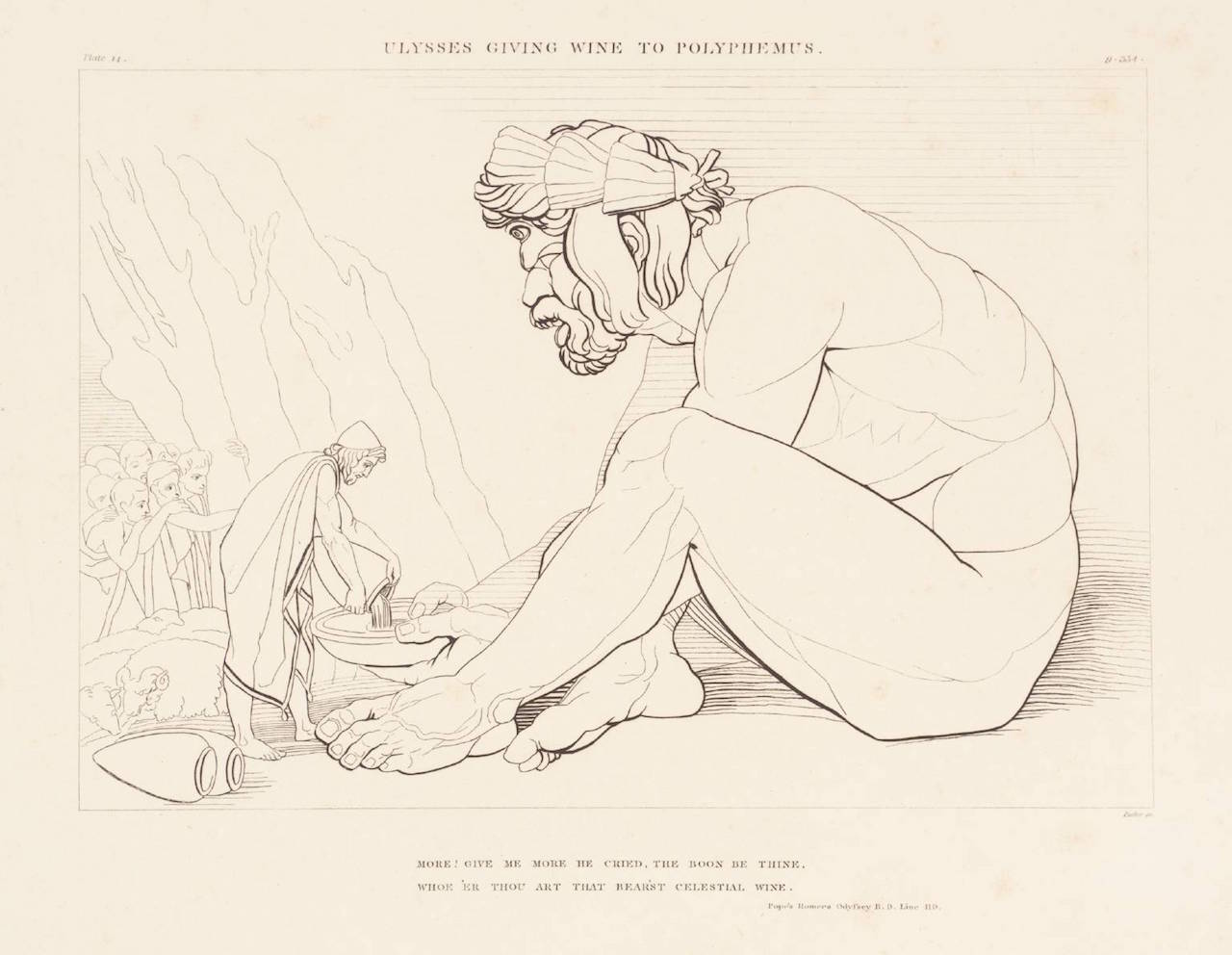 “Ulysses Giving Wine to Polyphemus” (1805). John Flaxman (1755–1826). Purchased as part of the Oppé Collection with assistance from the National Lottery through the Heritage Lottery Fund, 1996.
  “Circe Invidiosa,” (1892). J. W. Waterhouse (English, 1849–1917).
 “Teiresias appears to Ulysses during the sacrifice,” (1780–1785). Henry Fuseli (German, 1741–1825).
  “Ulysses and the Sirens” (ca. 1909). Herbert James Draper (English, 1863–1920).
 “Ulysses Asleep Laid on his Own Coast by the Phaeacian Sailors” (1805). John Flaxman (English, 1755–1826). Purchased as part of the Oppé Collection with assistance from the National Lottery through the Heritage Lottery Fund 1996.
  Minoan—probably Neopalatial—fresco commonly known as the “Lily Prince.” Whatever the exact type of this personage (perhaps a crowned acrobat, according to the interpretation of Maria Shaw), the Lily Prince is certainly a Minoan of elite standing. Public domain image based on a famous watercolor by Émile Gilliéron of a reconstruction by Arthur Evans.
 Detail from a fresco found at Hagia Triadha in Crete. Reconstruction by Mark Cameron, p. 96 of the catalogue Fresco: A Passport into the Past. Minoan Crete through the eyes of Mark Cameron. 1999. Catalogue curated by Doniert Evely. Athens: British School at Athens; and N. P. Goulandris Foundation, Museum of Cycladic Art. Reproduced with the permission of the British School at Athens. BSA Archive: Mark Cameron Personal Papers: CAM 1.
 “Minerva Restoring Ulysses to his Own Shape” (1805). John Flaxman (English, 1755–1826). Purchased as part of the Oppé Collection with assistance from the National Lottery through the Heritage Lottery Fund 1996.
 “Ulysses and his Dog” (1805). John Flaxman (English, 1755–1826). Purchased as part of the Oppé Collection with assistance from the National Lottery through the Heritage Lottery Fund 1996.
  “Ulysses Preparing to Fight with Irus” (1805). John Flaxman (English, 1755–1826) Purchased as part of the Oppé Collection with assistance from the National Lottery through the Heritage Lottery Fund 1996.
  “Euryclea Discovers Ulysses” (1805). John Flaxman (English, 1755–1826). Purchased as part of the Oppé Collection with assistance from the National Lottery through the Heritage Lottery Fund 1996.
  “The Harpies Going to Seize the Daughters of Pandareus” (1805). John Flaxman (English, 1755–1826). Purchased as part of the Oppé Collection with assistance from the National Lottery through the Heritage Lottery Fund 1996.
 Hēraklēs stringing a bow. Silver stater, c. 450–440 BCE, Thebes (Boeotia).
  Swallows, detail of the Spring Fresco at Thera, image via Flickr user
  Original artwork, by Flickr user
  Odysseus kiling Penelope’s suitors. Attic red-figure skyphos, ca. 440 BCE.
  Still life showing eggs, thrushes, napkin: from the House of Julia Felix, Pompeii.
  Eurykleia waking Penelope (1773). Print by Thomas Burke, after a painting by Angelika Kauffmann.
  Big Ed and Norma have just now broken free of the troublesome relationships that have kept these lovers apart for 27 years. Now at long last they can have a life together.
Still from
Big Ed and Norma have just now broken free of the troublesome relationships that have kept these lovers apart for 27 years. Now at long last they can have a life together.
Still from  “Mercury Conducting the Souls of the Suitors to the Infernal Regions” (1805). John Flaxman (English, 1755–1826). Purchased as part of the Oppé Collection with assistance from the National Lottery through the Heritage Lottery Fund 1996.
  “Ulysses Departing from Lacedaemon for Ithaca, with his Bride Penelope” (1805). John Flaxman (English, 1755–1826). Flaxman made this image the last in his Odyssey series, bringing the story of Penelope and Odysseus full circle. Purchased as part of the Oppé Collection with assistance from the National Lottery through the Heritage Lottery Fund 1996.


,_around_440_BC,_Altes_Museum_Berlin_(13718420225)_glare-reduced_white-bg.png)
