
View:
By Card
BOOK XVII.
Telemachus, returning to the city, relates to Penelope the sum of his travels. Ulysses is conducted by Eumaeus to the palace, where his old dog Argus acknowledges his master, after an absence of twenty years, and dies with joy. Eumaeus returns into the country, and Ulysses remains among the suitors, whose behaviour is described.
SOON as Aurora, daughter of the dawn,
1
Sprinkled with roseate light the dewy lawn,
In haste the prince arose, prepar'd to part;
His hand impatient grasps the pointed dart;
Fair on his feet the polish'd sandals shine,
5
And thus he greets the master of the swine:
Telemachus
'My friend, adieu! let this short stay suffice;
'I haste to meet my mother's longing eyes,
'And end her tears, her sorrows, and her sighs,
'But thou, attentive, what we order heed:
10
'This hapless stranger to the city lead:
"By public bounty let him there be fed,
'And bless the hand that stretches forth the bread,
'To wipe the tears from all afflicted eyes,
'My will may covet, but my power denies.
15
'If this raise anger in the stranger's thought,
"The pain of anger punishes the fault:
'The very truth I undisguis'd declare;
'For what so easy as to be sincere?'
'My friend, adieu! let this short stay suffice;
'I haste to meet my mother's longing eyes,
'And end her tears, her sorrows, and her sighs,
'But thou, attentive, what we order heed:
10
'This hapless stranger to the city lead:
"By public bounty let him there be fed,
'And bless the hand that stretches forth the bread,
'To wipe the tears from all afflicted eyes,
'My will may covet, but my power denies.
15
'If this raise anger in the stranger's thought,
"The pain of anger punishes the fault:
'The very truth I undisguis'd declare;
'For what so easy as to be sincere?'
Ulysses
To this Ulysses: 'What the prince requires
20
'Of swift removal, seconds my desires.
'To want like mine the peopled town can yield
'More hopes of comfort than the lonely field:
'Nor fits my age to till the labour'd lands,
'Or stoop to tasks a rural lord demands.
25
'Adieu! but since this ragged garb can bear
'So ill th' inclemencies of morning air,
'A few hours' space permit me here to stay:
'My steps Eumaeus shall to town convey,
'With riper beams when Phœbus warms the day.'
30
To this Ulysses: 'What the prince requires
20
'Of swift removal, seconds my desires.
'To want like mine the peopled town can yield
'More hopes of comfort than the lonely field:
'Nor fits my age to till the labour'd lands,
'Or stoop to tasks a rural lord demands.
25
'Adieu! but since this ragged garb can bear
'So ill th' inclemencies of morning air,
'A few hours' space permit me here to stay:
'My steps Eumaeus shall to town convey,
'With riper beams when Phœbus warms the day.'
30
Thus he; nor aught Telemachus replied,
But left the mansion with a lofty stride:
Schemes of revenge his pondering breast elate,
Revolving deep the suitors' sudden fate.
Arriving now before th' imperial hall,
35
He props his spear against the pillar'd wall;
Then like a lion o'er the threshold bounds;
The marble pavement with his step resounds;
His eye first glanced where Euryclea spreads
With furry spoils of beasts the splendid beds:
40
She saw, she wept, she ran with eager pace,
And reach'd her master with a long embrace.
All crowded round the family appears
With wild entrancement, and ecstatic tears.
Swift from above descends the royal fair
45
(Her beauteous cheeks the blush of Venus wear,
Chasten'd with coy Diana's pensive air;)
Hangs o'er her son, in his embraces dies;
Rains kisses on his neck, his face, his eyes:
Few words she spoke, though much she had to say:
50
And scarce those few, for tears, could force their way.
Penelope
'Light of my eyes! he comes! unhoped-for joy!
'Has Heaven from Pylos brought my lovely boy?
'So snatch'd from all our cares!-Tell, hast thou known
'Thy father's fate, and tell me all thy own?'
55
'Light of my eyes! he comes! unhoped-for joy!
'Has Heaven from Pylos brought my lovely boy?
'So snatch'd from all our cares!-Tell, hast thou known
'Thy father's fate, and tell me all thy own?'
55
Telemachus
45
'Oh dearest! most revered of womankind!
'Cease with those tears to melt a manly mind
(Replied the prince ;) 'nor be our fates deplor'd,
'From death and treason to thy arms restor'd.
'Go, bathe, and robed in white ascend the towers;
60
"With all thy handmaids thank th' immortal powers:
'To every god vow hecatombs to bleed,
'And call Jove's vengeance on their guilty deed.
'While to th' assembled council I repair;
'A stranger sent by Heaven attends me there;
65
'My new accepted guest I haste to find,
'Now to Peiraeus' honour'd charge consign'd.'
'Oh dearest! most revered of womankind!
'Cease with those tears to melt a manly mind
(Replied the prince ;) 'nor be our fates deplor'd,
'From death and treason to thy arms restor'd.
'Go, bathe, and robed in white ascend the towers;
60
"With all thy handmaids thank th' immortal powers:
'To every god vow hecatombs to bleed,
'And call Jove's vengeance on their guilty deed.
'While to th' assembled council I repair;
'A stranger sent by Heaven attends me there;
65
'My new accepted guest I haste to find,
'Now to Peiraeus' honour'd charge consign'd.'
The matron heard, nor was his word in vain.
She bathed; and, robed in white, with all her train,
To every god vow'd hecatombs to bleed,
70
And call'd Jove's vengeance on the guilty deed.
Arm'd with his lance, the prince then pass'd the gate;
Two dogs behind, a faithful guard, await;
Pallas his form with grace divine improves:
The gazing crowd admires him as he moves:
75
Him, gathering round, the haughty suitors greet
With semblance fair, but inward deep deceit.
Their false addresses generous he denied,
Pass'd on, and sate by faithful Mentor's side;
With Antiphus, and Halitherses sage,
80
His father's counsellors, revered for age.
Of his own fortunes, and Ulysses' fame,
Much ask'd the seniors; till Peiraeus came.
The stranger-guest pursued him close behind;
Whom when Telemachus beheld, he join'd.
85
He (when Peiraeus ask'd for slaves to bring
The gifts and treasures of the Spartan king)
Thus thoughtful answer'd: 'Those we shall not move,
'Dark and unconscious of the will of Jove:
'We know not yet the full event of all;
90
'Stabb'd in his palace if your prince must fall.
'Us, and our house, if treason must o'erthrow,
'Better a friend possess them than a foe;
'If death to these, and vengeance, Heaven decree,
'Riches are welcome then, not else, to me.
95
'Till then retain the gifts.'—The hero said,
And in his hand the willing stranger led.
Then, disarray'd, the shining bath they sought
(With unguents smooth) of polish'd marble wrought;
Obedient handmaids with assistant toil
100
Supply the limpid wave, and fragrant oil;
Then o'er their limbs refulgent robes they threw,
And fresh from bathing to their seats withdrew.
The golden ewer a nymph attendant brings,
Replenish'd from the pure translucent springs:
105
With copious streams that golden ewer supplies
A silver laver of capacious size.
They wash: the table, in fair order spread,
Is piled with viands and the strength of bread.
Full opposite, before the folding gate,
110
The pensive mother sits in humble state;
Lowly she sate, and with dejected view
The fleecy threads her ivory fingers drew.
The prince and stranger shar'd the genial feast,
Till now the rage of thirst and hunger ceas'd.
115
Penelope
When thus the queen: 'My son! my only friend!
'Say, to my mournful couch shall I ascend?
'(The couch deserted now a length of years;
'The couch for ever water'd with my tears;)
'Say, wilt thou not, (ere yet the suitor crew
120
'Return, and riot shakes our walls anew,)
"Say, wilt thou not the least account afford?
'The least glad tidings of my absent lord?'
When thus the queen: 'My son! my only friend!
'Say, to my mournful couch shall I ascend?
'(The couch deserted now a length of years;
'The couch for ever water'd with my tears;)
'Say, wilt thou not, (ere yet the suitor crew
120
'Return, and riot shakes our walls anew,)
"Say, wilt thou not the least account afford?
'The least glad tidings of my absent lord?'
Telemachus
To her the youth: 'We reach'd the Pylian plains,
'Where Nestor, shepherd of his people, reigns.
125
'All arts of tenderness to him are known,
'Kind to Ulysses' race as to his own:
'No father with a fonder grasp of joy
'Strains to his bosom his long-absent boy.
'But all unknown, if yet Ulysses breathe,
130
'Or glide a spectre in the realms beneath:
'For farther search, his rapid steeds transport
'My lengthen'd journey to the Spartan court.
'There Argive Helen I beheld, whose charms
'(So heaven decreed) engaged the great in arms.
135
120
'My cause of coming told, he thus rejoin'd;
'And still his words live perfect in my mind:
"Heavens! would a soft, inglorious, dastard train
"An absent hero's nuptial joys profane!
"So with her young, amid the woodland shades,
140
"A timorous hind the lion's court invades,
"Leaves in that fatal lair her tender fawns,
"And climbs the cliffs, or feeds along the lawns;
"Meantime returning, with remorseless sway
"The monarch savage rends the panting prey:
145
"With equal fury, and with equal fame,
"Shall great Ulysses reassert his claim.
"O Jove! supreme! whom men and gods revere;
"And thou, whose lustre gilds the rolling sphere!
"With power congenial join'd, propitious aid
150
"The chief adopted by the martial maid!
"Such to our wish the warrior soon restore,
"As when, contending on the Lesbian shore,
"His prowess Philomelides confess'd,
"And loud acclaiming Greeks the victor bless'd:
155
"Then soon th' invaders of his bed, and throne,
"Their love presumptuous shall by death atone.
"Now what you question of my ancient friend,
"With truth I answer; thou the truth attend.
"Learn what I heard the sea-born seer
1
relate,
160
"Whose eye can pierce the dark recess of fate.
"Sole in an isle, imprison'd by the main,
"The sad survivor of his numerous train,
"Ulysses lies; detain'd by magic charms,
"And press'd unwilling in Calypso's arms.
165
"No sailors there, no vessels to convey,
"No oars to cut th' immeasurable way."
"This told Atrides, and he told no more.
'Then safe I voyag'd to my native shore.'
To her the youth: 'We reach'd the Pylian plains,
'Where Nestor, shepherd of his people, reigns.
125
'All arts of tenderness to him are known,
'Kind to Ulysses' race as to his own:
'No father with a fonder grasp of joy
'Strains to his bosom his long-absent boy.
'But all unknown, if yet Ulysses breathe,
130
'Or glide a spectre in the realms beneath:
'For farther search, his rapid steeds transport
'My lengthen'd journey to the Spartan court.
'There Argive Helen I beheld, whose charms
'(So heaven decreed) engaged the great in arms.
135
'My cause of coming told, he thus rejoin'd;
'And still his words live perfect in my mind:
"Heavens! would a soft, inglorious, dastard train
"An absent hero's nuptial joys profane!
"So with her young, amid the woodland shades,
140
"A timorous hind the lion's court invades,
"Leaves in that fatal lair her tender fawns,
"And climbs the cliffs, or feeds along the lawns;
"Meantime returning, with remorseless sway
"The monarch savage rends the panting prey:
145
"With equal fury, and with equal fame,
"Shall great Ulysses reassert his claim.
"O Jove! supreme! whom men and gods revere;
"And thou, whose lustre gilds the rolling sphere!
"With power congenial join'd, propitious aid
150
"The chief adopted by the martial maid!
"Such to our wish the warrior soon restore,
"As when, contending on the Lesbian shore,
"His prowess Philomelides confess'd,
"And loud acclaiming Greeks the victor bless'd:
155
"Then soon th' invaders of his bed, and throne,
"Their love presumptuous shall by death atone.
"Now what you question of my ancient friend,
"With truth I answer; thou the truth attend.
"Learn what I heard the sea-born seer
1
relate,
160
"Whose eye can pierce the dark recess of fate.
"Sole in an isle, imprison'd by the main,
"The sad survivor of his numerous train,
"Ulysses lies; detain'd by magic charms,
"And press'd unwilling in Calypso's arms.
165
"No sailors there, no vessels to convey,
"No oars to cut th' immeasurable way."
"This told Atrides, and he told no more.
'Then safe I voyag'd to my native shore.'
He ceas'd; nor made the pensive queen reply,
170
But droop'd her head, and drew a secret sigh.
When Theoclymenus the seer began:
Theoclymenus
'O suffering consort of the suffering man!
'What human knowledge could, those kings might tell,
'But I the secrets of high heaven reveal.
175
'Before the first of gods be this declar'd,
'Before the board whose blessings we have shar'd;
'Witness the genial rites, and witness all
'This house holds sacred in her ample wall!
'Even now, this instant, great Ulysses, laid
180
'At rest, or wandering in his country's shade,
'Their guilty deeds, in hearing, and in view,
'Secret revolves; and plans the vengeance due.
'Of this sure auguries the gods bestow'd,
'When first our vessel anchor'd in your road.'
185
'O suffering consort of the suffering man!
'What human knowledge could, those kings might tell,
'But I the secrets of high heaven reveal.
175
'Before the first of gods be this declar'd,
'Before the board whose blessings we have shar'd;
'Witness the genial rites, and witness all
'This house holds sacred in her ample wall!
'Even now, this instant, great Ulysses, laid
180
'At rest, or wandering in his country's shade,
'Their guilty deeds, in hearing, and in view,
'Secret revolves; and plans the vengeance due.
'Of this sure auguries the gods bestow'd,
'When first our vessel anchor'd in your road.'
185
Penelope
'Succeed those omens, heaven!' (the queen rejoin'd)
'So shall our bounties speak a grateful mind:
'And every envied happiness attend
'The man who calls Penelope his friend.'
166
'Succeed those omens, heaven!' (the queen rejoin'd)
'So shall our bounties speak a grateful mind:
'And every envied happiness attend
'The man who calls Penelope his friend.'
Thus commun'd they: while in the marble court
190
(Scene of their insolence) the lords resort;
Athwart the spacious square each tries his art,
To whirl the disk, or aim the missile dart.
Now did the hour of sweet repast arrive,
And from the field the victim flocks they drive:
195
Medon the herald, (one who pleas'd them best,
And honour'd with a portion of their feast,)
To bid the banquet, interrupts their play:
Swift to the hall they haste; aside they lay
Their garments, and succinct the victims slay.
200
Then sheep, and goats, and bristly porkers bled,
And the proud steer was o'er the marble spread.
While thus the copious banquet they provide;
Along the road, conversing side by side,
Proceed Ulysses and the faithful swain:
205
When thus Eumaeus, generous and humane:
Eumaeus
'To town, observant of our lord's behest,
'Now let us speed: my friend, no more my guest!
'Yet like myself I wish thee here preferr'd,
'Guard of the flock, or keeper of the herd.
210
'But much to raise my master's wrath I fear;
'The wrath of princes ever is severe.
'Then heed his will, and be our journey made
'While the broad beams of Phœbus are display'd,
'Or ere brown evening spreads her chilly shade.'
215
'To town, observant of our lord's behest,
'Now let us speed: my friend, no more my guest!
'Yet like myself I wish thee here preferr'd,
'Guard of the flock, or keeper of the herd.
210
'But much to raise my master's wrath I fear;
'The wrath of princes ever is severe.
'Then heed his will, and be our journey made
'While the broad beams of Phœbus are display'd,
'Or ere brown evening spreads her chilly shade.'
215
Ulysses
'Just thy advice,' (the prudent chief rejoin'd,)
'And such as suits the dictate of my mind.
'Lead on: but help me to some staff to stay
'My feeble step, since rugged is the way.'
'Just thy advice,' (the prudent chief rejoin'd,)
'And such as suits the dictate of my mind.
'Lead on: but help me to some staff to stay
'My feeble step, since rugged is the way.'
Across his shoulders then the scrip he flung,
220
Wide-patch'd, and fasten'd by a twisted thong.
A staff Eumaeus gave. Along the way
Cheerly they fare: behind, the keepers stay;
These with their watchful dogs (a constant guard)
Supply his absence, and attend the herd.
225
And now his city strikes the monarch's eyes,
Alas! how changed! a man of miseries;
Propp'd on a staff, a beggar old and bare,
In rags dishonest fluttering with the air!
Now, pass'd the rugged road, they journey down
230
The cavern'd way descending to the town,
Where, from the rock, with liquid drops distils
A limpid fount; that, spread in parting rills,
Its current thence to serve the city brings;
A useful work, adorn'd by ancient kings,
235
Neritus, Ithacus, Polyctor, there,
In sculptur'd stone immortaliz'd their care;
In marble urns receiv'd it from above,
And shaded with a green surrounding grove;
Where silver alders, in high arches twin'd,
240
Drink the cool stream, and tremble to the wind.
Beneath, sequester'd to the nymphs, is seen
A mossy altar, deep embower'd in green;
Where constant vows by travellers are paid,
And holy horrors solemnize the shade.
245
Here, with his goats, (not vow'd to sacred flame,
But pamper'd luxury,) Melanthius
2
came:
Two grooms attend him. With an envious look
He ey'd the stranger, and imperious spoke:
Melanthius
'The good old proverb how this pair fulfil!
250
'One rogue is usher to another still.
'Heaven with a secret principle endued
'Mankind, to seek their own similitude.
'Where goes the swineherd with that ill-look'd guest?
'That giant glutton, dreadful at a feast!
255
'Full many a post have those broad shoulders worn,
'From every great man's gate repuls'd with scorn:
'To no brave prize aspir'd the worthless swain,
'Twas but for scraps he ask'd, and ask'd in vain.
'To beg, than work, he better understands;
260
'Or we perhaps might take him off thy hands.
'For any office could the slave be good,
'To cleanse the fold, or help the kids to food,
'If any labour those big joints could learn,
'Some whey, to wash his bowels, he might earn.
265
'To cringe, to whine, his idle hands to spread,
'Is all by which that graceless maw is fed.
'Yet hear me! if thy impudence but dare
'Approach yon walls, I prophesy thy fare:
'Dearly, full dearly, shalt thou buy thy bread
270
'With many a footstool thundering at thy head.'
'The good old proverb how this pair fulfil!
250
'One rogue is usher to another still.
'Heaven with a secret principle endued
'Mankind, to seek their own similitude.
'Where goes the swineherd with that ill-look'd guest?
'That giant glutton, dreadful at a feast!
255
'Full many a post have those broad shoulders worn,
'From every great man's gate repuls'd with scorn:
'To no brave prize aspir'd the worthless swain,
'Twas but for scraps he ask'd, and ask'd in vain.
'To beg, than work, he better understands;
260
'Or we perhaps might take him off thy hands.
'For any office could the slave be good,
'To cleanse the fold, or help the kids to food,
'If any labour those big joints could learn,
'Some whey, to wash his bowels, he might earn.
265
'To cringe, to whine, his idle hands to spread,
'Is all by which that graceless maw is fed.
'Yet hear me! if thy impudence but dare
'Approach yon walls, I prophesy thy fare:
'Dearly, full dearly, shalt thou buy thy bread
270
'With many a footstool thundering at thy head.'
He thus: nor insolent of word alone,
Spurn'd with his rustic heel his king unknown;
Spurn'd, but not mov'd: he like a pillar stood,
Nor stirr'd an inch, contemptuous, from the road:
275
Doubtful, or with his staff to strike him dead,
Or greet the pavement with his worthless head.
Short was that doubt; to quell his rage inur'd,
The hero stood self-conquer'd, and endur'd.
But hateful of the wretch, Eumaeus heav'd
280
His hands obtesting, and this prayer conceiv'd:
Eumaeus
'Daughters of Jove! who from the ethereal bowers
'Descend to swell the springs, and feed the flowers!
'Nymphs of this fountain! to whose sacred names
'Our rural victims mount in blazing flames!
285
'To whom Ulysses' piety preferr'd
'The yearly firstlings of his flock, and herd;
'Succeed my wish, your votary restore:
'Oh, be some god his convoy to our shore!
'Due pains shall punish then this slave's offence,
290
'And humble all his airs of insolence,
'Who, proudly stalking, leaves the herds at large,
'Commences courtier, and neglects his charge.'
'Daughters of Jove! who from the ethereal bowers
'Descend to swell the springs, and feed the flowers!
'Nymphs of this fountain! to whose sacred names
'Our rural victims mount in blazing flames!
285
'To whom Ulysses' piety preferr'd
'The yearly firstlings of his flock, and herd;
'Succeed my wish, your votary restore:
'Oh, be some god his convoy to our shore!
'Due pains shall punish then this slave's offence,
290
'And humble all his airs of insolence,
'Who, proudly stalking, leaves the herds at large,
'Commences courtier, and neglects his charge.'
Melanthius
247
'What mutters he?' (Melanthius sharp rejoins,)
'This crafty miscreant big with dark designs?
295
'The day shall come; nay, 'tis already near,
'When, slave! to sell thee at a price too dear
'Must be my care; and hence transport thee o'er,
'A load and scandal to this happy shore.
'Oh that as surely great Apollo's dart,
300
'Or some brave suitor's sword, might pierce the heart
'Of the proud son, as that we stand this hour
'In lasting safety from the father's power!'
'What mutters he?' (Melanthius sharp rejoins,)
'This crafty miscreant big with dark designs?
295
'The day shall come; nay, 'tis already near,
'When, slave! to sell thee at a price too dear
'Must be my care; and hence transport thee o'er,
'A load and scandal to this happy shore.
'Oh that as surely great Apollo's dart,
300
'Or some brave suitor's sword, might pierce the heart
'Of the proud son, as that we stand this hour
'In lasting safety from the father's power!'
So spoke the wretch, but, shunning farther fray,
Turn'd his proud step, and left them on their way.
305
Straight to the feastful palace he repair'd,
Familiar enter'd, and the banquet shar'd;
Beneath Eurymachus, his patron lord,
He took his place, and plenty heap'd the board.
Meantime they heard, soft-circling in the sky,
310
Sweet airs ascend, and heavenly minstrelsy:
(For Phemius to the lyre attun'd the strain:)
Ulysses hearken'd, then addressed the swain:
Ulysses
'Well may this palace admiration claim,
3
'Great, and respondent to the master's fame!
315
'Stage above stage th' imperial structure stands,
'Holds the chief honours, and the town commands:
'High walls and battlements the courts inclose,
'And the strong gates defy a host of foes.
'Far other cares its dwellers now employ;
320
'The throng'd assembly and the feast of joy:
'I see the smokes of sacrifice aspire,
'And hear (what graces every feast) the lyre.'
'Well may this palace admiration claim,
3
'Great, and respondent to the master's fame!
315
'Stage above stage th' imperial structure stands,
'Holds the chief honours, and the town commands:
'High walls and battlements the courts inclose,
'And the strong gates defy a host of foes.
'Far other cares its dwellers now employ;
320
'The throng'd assembly and the feast of joy:
'I see the smokes of sacrifice aspire,
'And hear (what graces every feast) the lyre.'
Eumaeus
Then thus Eumaeus: 'Judge we which were best:
'Amidst yon revellers a sudden guest
325
'Choose you to mingle, while behind I stay?
'Or I first entering introduce the way?
'Wait for a space without, but wait not long;
'This is the house of violence and wrong:
'Some rude insult thy reverend age may bear;
330
'For like their lawless lords the servants are.'
Then thus Eumaeus: 'Judge we which were best:
'Amidst yon revellers a sudden guest
325
'Choose you to mingle, while behind I stay?
'Or I first entering introduce the way?
'Wait for a space without, but wait not long;
'This is the house of violence and wrong:
'Some rude insult thy reverend age may bear;
330
'For like their lawless lords the servants are.'
Ulysses
'Just is, O friend! thy caution, and address'd'
(Replied the chief) 'to no unheedful breast:
'The wrongs and injuries of base mankind
'Fresh to my sense, and always in my mind.
335
"The bravely-patient to no fortune yields:
'On rolling oceans, and in fighting fields,
'Storms have I pass'd, and many a stern debate;
'And now in humbler scene submit to fate.
'What cannot want? The best she will expose,
340
'And I am learn'd in all her train of woes;
'She fills with navies, hosts, and loud alarms
'The sea, the land, and shakes the world with arms!'
290
'Just is, O friend! thy caution, and address'd'
(Replied the chief) 'to no unheedful breast:
'The wrongs and injuries of base mankind
'Fresh to my sense, and always in my mind.
335
"The bravely-patient to no fortune yields:
'On rolling oceans, and in fighting fields,
'Storms have I pass'd, and many a stern debate;
'And now in humbler scene submit to fate.
'What cannot want? The best she will expose,
340
'And I am learn'd in all her train of woes;
'She fills with navies, hosts, and loud alarms
'The sea, the land, and shakes the world with arms!'
Thus near the gates conferring as they drew,
Argus, the dog, his ancient master knew;
345
He, not unconscious of the voice and tread,
Lifts to the sound his ear, and rears his head;
Bred by Ulysses, nourish'd at his board,
But ah! not fated long to please his lord!
To him, his swiftness and his strength were vain;
350
The voice of glory call'd him o'er the main.
Till then in every sylvan chase renown'd,
With Argus, Argus, rung the woods around:
With him the youth pursued the goat or fawn,
Or traced the mazy leveret o'er the lawn.
355
Now left to man's ingratitude he lay,
Unhous'd, neglected in the public way;
And where on heaps the rich manure was spread,
Obscene with reptiles, took his sordid bed.
He knew his lord; he knew, and strove to meet;
360
In vain he strove, to crawl, and kiss his feet;
Yet (all he could) his tail, his ears, his eyes
Salute his master, and confess his joys.
Soft pity touch'd the mighty master's soul;
Adown his cheek a tear unbidden stole,
365
Stole unperceiv'd; he turn'd his head and dried
The drop humane; then thus impassion'd cried:
Ulysses
"What noble beast in this abandon'd state
'Lies here all helpless at Ulysses' gate?
'His bulk and beauty speak no vulgar praise:
370
'If, as he seems, he was in better days,
'Some care his age deserves; or was he priz'd
'For worthless beauty? therefore now despis'd:
'Such dogs and men there are, mere things of state:
'And always cherish'd by their friends, the great.'
375
"What noble beast in this abandon'd state
'Lies here all helpless at Ulysses' gate?
'His bulk and beauty speak no vulgar praise:
370
'If, as he seems, he was in better days,
'Some care his age deserves; or was he priz'd
'For worthless beauty? therefore now despis'd:
'Such dogs and men there are, mere things of state:
'And always cherish'd by their friends, the great.'
375
Eumaeus
'Not Argus so,' (Eumaeus thus rejoin'd,)
'But serv'd a master of a nobler kind,
'Who never, never shall behold him more!
'Long, long since perish'd on a distant shore!
'Oh had you seen him, vigorous, bold, and young,
380
'Swift as a stag, and as a lion strong:
'Him no fell savage on the plain withstood,
'None 'scaped him bosom'd in the gloomy wood:
'His eye how piercing, and his scent how true,
'To wind the vapour in the tainted dew!
385
"Such, when Ulysses left his natal coast;
"Now years unnerve him, and his lord is lost!
'The women keep the generous creature bare,
'A sleek and idle race is all their care:
'The master gone, the servants what restrains?
390
'Or dwells humanity where riot reigns?
'Jove fix'd it certain, that whatever day
'Makes man a slave, takes half his worth away.'
'Not Argus so,' (Eumaeus thus rejoin'd,)
'But serv'd a master of a nobler kind,
'Who never, never shall behold him more!
'Long, long since perish'd on a distant shore!
'Oh had you seen him, vigorous, bold, and young,
380
'Swift as a stag, and as a lion strong:
'Him no fell savage on the plain withstood,
'None 'scaped him bosom'd in the gloomy wood:
'His eye how piercing, and his scent how true,
'To wind the vapour in the tainted dew!
385
"Such, when Ulysses left his natal coast;
"Now years unnerve him, and his lord is lost!
'The women keep the generous creature bare,
'A sleek and idle race is all their care:
'The master gone, the servants what restrains?
390
'Or dwells humanity where riot reigns?
'Jove fix'd it certain, that whatever day
'Makes man a slave, takes half his worth away.'
This said, the honest herdsman strode before:
The musing monarch pauses at the door:
395
The dog, whom fate had granted to behold
His lord, when twenty tedious years had roll'd,
Takes a last look, and, having seen him, dies:
So closed for ever faithful Argus' eyes!
4
And now Telemachus, the first of all,
400
Observ'd Eumaeus entering in the hall;
Distant he saw, across the shady dome;
Then gave a sign, and beckon'd him to come.
There stood an empty seat, where late was placed,
In order due, the steward of the feast,
405
(Who now was busied carving round the board,)
Eumaeus took, and placed it near his lord.
Before him instant was the banquet spread,
And the bright basket piled with loaves of bread.
Next came Ulysses lowly at the door,
410
A figure despicable, old, and poor,
In squalid vests, with many a gaping rent,
Propp'd on a staff, and trembling as he went.
Then resting on the threshold of the gate,
Against a cypress pillar lean'd his weight;
415
(Smooth'd by the workman to a polish'd plane;)
The thoughtful son beheld, and call'd his swain:
Telemachus
'These viands, and this bread, Eumaeus! bear,
'And let yon mendicant our plenty share:
'Then let him circle round the suitors' board,
420
'And try the bounty of each gracious lord.
'Bold let him ask, encouraged thus by me;
'How ill, alas! do want and shame agree!'
'These viands, and this bread, Eumaeus! bear,
'And let yon mendicant our plenty share:
'Then let him circle round the suitors' board,
420
'And try the bounty of each gracious lord.
'Bold let him ask, encouraged thus by me;
'How ill, alas! do want and shame agree!'
His lord's command the faithful servant bears:
The seeming beggar answers with his prayers:
425
Ulysses
'Bless'd be Telemachus! in every deed
'Inspire him, Jove! in every wish succeed!'
'Bless'd be Telemachus! in every deed
'Inspire him, Jove! in every wish succeed!'
This said, the portion from his son convey'd
With smiles receiving on his scrip he laid.
Long as the minstrel swept the sounding wire,
430
He fed, and ceas'd when silence held the lyre.
Soon as the suitors from the banquet rose,
Minerva prompts the man of mighty woes
To tempt their bounties with a suppliant's art,
And learn the generous from th' ignoble heart;
435
(Not but his soul, resentful as humane,
Dooms to full vengeance all th' offending train;)
With speaking eyes, and voice of plaintive sound,
Humble he moves, imploring all around.
The proud feel pity, and relief bestow,
440
With such an image touch'd of human woe;
Inquiring all, their wonder they confess,
And eye the man, majestic in distress.
While thus they gaze and question with their eyes,
The bold Melanthius to their thought replies:
445
Melanthius
'My lords! this stranger of gigantic port
'The good Eumaeus usher'd to your court.
'Full well I mark'd the features of his face,
'Though all unknown his clime, or noble race.'
'My lords! this stranger of gigantic port
'The good Eumaeus usher'd to your court.
'Full well I mark'd the features of his face,
'Though all unknown his clime, or noble race.'
Antinoüs
'And is this present, swineherd! of thy hand?
450
'Bring'st thou these vagrants to infest the land?'
(Returns Antinoüs with retorted eye)
'Objects uncouth, to check the genial joy?
'Enough of these our court already grace,
'Of giant stomach, and of famish'd face.
455
'Such guests Eumaeus to his country brings,
'To share our feast, and lead the life of kings.'
380
'And is this present, swineherd! of thy hand?
450
'Bring'st thou these vagrants to infest the land?'
(Returns Antinoüs with retorted eye)
'Objects uncouth, to check the genial joy?
'Enough of these our court already grace,
'Of giant stomach, and of famish'd face.
455
'Such guests Eumaeus to his country brings,
'To share our feast, and lead the life of kings.'
To whom the hospitable swain rejoin'd:
Eumaeus
'Thy passion, prince, belies thy knowing mind.
'Who calls, from distant nations to his own,
460
'The poor, distinguish'd by their wants alone?
'Round the wide world are sought those men divine
'Who public structures raise, or who design;
'Those to whose eyes the gods their ways reveal,
'Or bless with salutary arts to heal;
465
'But chief to poets such respect belongs,
'By rival nations courted for their songs:
'These states invite, and mighty kings admire,
'Wide as the sun displays his vital fire.
'It is not so with want! how few that feed
470
'A wretch unhappy, merely for his need!
'Unjust to me, and all that serve the state,
'To love Ulysses is to raise thy hate.
'For me, suffice the approbation won
'Of my great mistress, and her god-like son.'
475
'Thy passion, prince, belies thy knowing mind.
'Who calls, from distant nations to his own,
460
'The poor, distinguish'd by their wants alone?
'Round the wide world are sought those men divine
'Who public structures raise, or who design;
'Those to whose eyes the gods their ways reveal,
'Or bless with salutary arts to heal;
465
'But chief to poets such respect belongs,
'By rival nations courted for their songs:
'These states invite, and mighty kings admire,
'Wide as the sun displays his vital fire.
'It is not so with want! how few that feed
470
'A wretch unhappy, merely for his need!
'Unjust to me, and all that serve the state,
'To love Ulysses is to raise thy hate.
'For me, suffice the approbation won
'Of my great mistress, and her god-like son.'
475
Telemachus
To him Telemachus: 'No more incense
'The man by nature prone to insolence;
'Injurious minds just answers but provoke:'
Then, turning to Antinoüs, thus he spoke:
'Thanks to thy care! whose absolute command
480
'Thus drives the stranger from our court and land.
'Heaven bless its owner with a better mind!
'From envy free, to charity inclin'd.
'This both Penelope and I afford:
'Then, prince! be bounteous of Ulysses' board.
485
'To give another's is thy hand so slow?
'So much more sweet to spoil than to bestow?'
To him Telemachus: 'No more incense
'The man by nature prone to insolence;
'Injurious minds just answers but provoke:'
Then, turning to Antinoüs, thus he spoke:
'Thanks to thy care! whose absolute command
480
'Thus drives the stranger from our court and land.
'Heaven bless its owner with a better mind!
'From envy free, to charity inclin'd.
'This both Penelope and I afford:
'Then, prince! be bounteous of Ulysses' board.
485
'To give another's is thy hand so slow?
'So much more sweet to spoil than to bestow?'
Antinoüs
'Whence, great Telemachus! this lofty strain?'
(Antinoüs cries with insolent disdain;)
'Portions like mine if every suitor gave,
490
'Our walls this twelvemonth should not see the slave.'
'Whence, great Telemachus! this lofty strain?'
(Antinoüs cries with insolent disdain;)
'Portions like mine if every suitor gave,
490
'Our walls this twelvemonth should not see the slave.'
He spoke, and lifting high above the board
His ponderous footstool, shook it at his lord.
The rest with equal hand conferr'd the bread;
He fill'd his scrip, and to the threshold sped;
495
But first before Antinoüs stopp'd, and said:
5
Ulysses
'Bestow, my friend! thou dost not seem the worst
'Of all the Greeks, but prince-like and the first;
'Then, as in dignity, be first in worth,
'And I shall praise thee through the boundless earth.
500
'Once I enjoy'd in luxury of state
'Whate'er gives man the envied name of great;
'Wealth, servants, friends, were mine in better days;
'And hospitality was then my praise;
'In every sorrowing soul I pour'd delight,
505
'And Poverty stood smiling in my sight.
424
'But Jove, all-governing, whose only will
'Determines fate, and mingles good with ill,
'Sent me (to punish my pursuit of gain)
'With roving pirates o'er th' Egyptian main:
510
'By Egypt's silver flood our ships we moor;
'Our spies commission'd straight the coast explore;
'But, impotent of mind, with lawless will
'The country ravage and the natives kill.
'The spreading clamour to their city flies,
515
'And horse and foot in mingled tumult rise:
'The reddening dawn reveals the hostile fields
'Horrid with bristly spears, and gleaming shields:
'Jove thunder'd on their side: our guilty head
'We turn'd to flight; the gathering vengeance spread
520
'On all parts round, and heaps on heaps lay dead.
'Some few the foe in servitude detain;
'Death ill-exchang'd for bondage and for pain!
'Unhappy me a Cyprian took aboard,
'And gave to Dmetor, Cyprus' haughty lord:
525
'Hither, to 'scape his chains, my course I steer,
'Still curs'd by fortune, and insulted here!'
'Bestow, my friend! thou dost not seem the worst
'Of all the Greeks, but prince-like and the first;
'Then, as in dignity, be first in worth,
'And I shall praise thee through the boundless earth.
500
'Once I enjoy'd in luxury of state
'Whate'er gives man the envied name of great;
'Wealth, servants, friends, were mine in better days;
'And hospitality was then my praise;
'In every sorrowing soul I pour'd delight,
505
'And Poverty stood smiling in my sight.
'But Jove, all-governing, whose only will
'Determines fate, and mingles good with ill,
'Sent me (to punish my pursuit of gain)
'With roving pirates o'er th' Egyptian main:
510
'By Egypt's silver flood our ships we moor;
'Our spies commission'd straight the coast explore;
'But, impotent of mind, with lawless will
'The country ravage and the natives kill.
'The spreading clamour to their city flies,
515
'And horse and foot in mingled tumult rise:
'The reddening dawn reveals the hostile fields
'Horrid with bristly spears, and gleaming shields:
'Jove thunder'd on their side: our guilty head
'We turn'd to flight; the gathering vengeance spread
520
'On all parts round, and heaps on heaps lay dead.
'Some few the foe in servitude detain;
'Death ill-exchang'd for bondage and for pain!
'Unhappy me a Cyprian took aboard,
'And gave to Dmetor, Cyprus' haughty lord:
525
'Hither, to 'scape his chains, my course I steer,
'Still curs'd by fortune, and insulted here!'
To whom Antinoüs thus his rage express'd:
Antinoüs
'What god has plagued us with this gormand guest?
'Unless at distance, wretch! thou keep behind,
530
'Another isle, than Cyprus more unkind,
'Another Egypt, shalt thou quickly find.
'From all thou begg'st, a bold audacious slave;
'Nor all can give so much as thou canst crave.
'Nor wonder I at such profusion shown;
535
'Shameless they give, who give what's not their own.'
'What god has plagued us with this gormand guest?
'Unless at distance, wretch! thou keep behind,
530
'Another isle, than Cyprus more unkind,
'Another Egypt, shalt thou quickly find.
'From all thou begg'st, a bold audacious slave;
'Nor all can give so much as thou canst crave.
'Nor wonder I at such profusion shown;
535
'Shameless they give, who give what's not their own.'
The chief, retiring, 'Souls, like that in thee,
'Ill suit such forms of grace and dignity.
'Nor will that hand to utmost need afford
'The smallest portion of a wasteful board,
540
'Whose luxury whole patrimonies sweeps,
'Yet starving want, amidst the riot, weeps.'
The haughty suitor with resentment burns,
And, sourly smiling, this reply returns:
Antinoüs
'Take that, ere yet thou quit this princely throng;
545
'And dumb for ever be thy slanderous tongue!'
462
'Take that, ere yet thou quit this princely throng;
545
'And dumb for ever be thy slanderous tongue!'
He said, and high the whirling tripod flung.
His shoulder-blade receiv'd th' ungentle shock:
He stood, and moved not, like a marble rock;
But shook his thoughtful head, nor more complain'd,
550
Sedate of soul, his character sustain'd,
And inly form'd revenge: then back withdrew:
Before his feet the well-fill'd scrip he threw,
And thus with semblance mild address'd the crew:
Ulysses
'May what I speak your princely minds approve,
555
'Ye peers and rivals in this noble love!
'Not for the hurt I grieve, but for the cause.
'If, when the sword our country's quarrel draws,
'Or if, defending what is justly dear,
'From Mars impartial some broad wound we bear,
560
'The generous motive dignifies the scar.
'But for mere want, how hard to suffer wrong!
'Want brings enough of other ills along!
'Yet, if unjustice never be secure,
'If fiends revenge, and gods assert the poor,
565
'Death shall lay low the proud aggressor's head,
'And make the dust Antinoüs' bridal bed.'
'May what I speak your princely minds approve,
555
'Ye peers and rivals in this noble love!
'Not for the hurt I grieve, but for the cause.
'If, when the sword our country's quarrel draws,
'Or if, defending what is justly dear,
'From Mars impartial some broad wound we bear,
560
'The generous motive dignifies the scar.
'But for mere want, how hard to suffer wrong!
'Want brings enough of other ills along!
'Yet, if unjustice never be secure,
'If fiends revenge, and gods assert the poor,
565
'Death shall lay low the proud aggressor's head,
'And make the dust Antinoüs' bridal bed.'
Antinoüs
'Peace, wretch! and eat thy bread without offence,
'(The suitor cried,) 'or force shall drag thee hence,
'Scourge through the public street, and cast thee there,
570
'A mangled carcass for the hounds to tear.'
'Peace, wretch! and eat thy bread without offence,
'(The suitor cried,) 'or force shall drag thee hence,
'Scourge through the public street, and cast thee there,
570
'A mangled carcass for the hounds to tear.'
His furious deed the general anger mov'd;
All, even the worst, condemn'd: and some reprov'd.
'Was ever chief for wars like these renown'd?
'Ill fits the stranger and the poor to wound.
575
'Unbless'd thy hand, if, in this low disguise,
'Wander, perhaps, some inmate of the skies:
'They (curious oft of mortal actions) deign
'In forms like these to round the earth and main.
'Just and unjust recording in their mind,
580
'And with sure eyes inspecting all mankind.'
Telemachus, absorb'd in thought severe,
Nourish'd deep anguish, though he shed no tear;
But the dark brow of silent sorrow shook:
While thus his mother to her virgins spoke:
585
Penelope
'On him and his may the bright god of day
'That base inhospitable blow repay!'
'On him and his may the bright god of day
'That base inhospitable blow repay!'
Euryclea
The nurse replies: 'If Jove receives my prayer,
'Not one survives to breathe to-morrow's air.'
The nurse replies: 'If Jove receives my prayer,
'Not one survives to breathe to-morrow's air.'
Penelope
'All, all are foes, and mischief is their end;
590
'Antinoüs most to gloomy death a friend:
'(Replies the queen :) 'the stranger begg'd their grace,
'And melting pity soften'd every face;
'From every other hand redress he found,
'But fell Antinoüs answer'd with a wound.'
595
505
'All, all are foes, and mischief is their end;
590
'Antinoüs most to gloomy death a friend:
'(Replies the queen :) 'the stranger begg'd their grace,
'And melting pity soften'd every face;
'From every other hand redress he found,
'But fell Antinoüs answer'd with a wound.'
595
Amidst her maids thus spoke the prudent queen,
Then bade Eumaeus call the pilgrim in.
Penelope
'Much of th' experienced man I long to hear,
'If or his certain eye, or listening ear,
'Have learn'd the fortunes of my wandering lord?'
600
'Much of th' experienced man I long to hear,
'If or his certain eye, or listening ear,
'Have learn'd the fortunes of my wandering lord?'
600
Thus she, and good Eumaeus took the word:
Eumaeus
'A private audience if thy grace impart,
'The stranger's words may ease the royal heart.
'His sacred eloquence in balm distils,
'And the sooth'd heart with secret pleasure fills.
605
'Three days have spent their beams, three nights have run
'Their silent journey since his tale begun,
'Unfinish'd yet; and yet I thirst to hear!
'As when some heaven-taught poet charms the ear,
'(Suspending sorrow with celestial strain
610
'Breath'd from the gods to soften human pain,)
'Time steals away with unregarded wing,
'And the soul hears him, though he cease to sing.
'Ulysses late he saw, on Cretan ground,
'(His father's guest,) for Minos' birth renown'd.
615
'He now but waits the wind, to waft him o'er,
'With boundless treasure, from Thesprotia's shore.'
'A private audience if thy grace impart,
'The stranger's words may ease the royal heart.
'His sacred eloquence in balm distils,
'And the sooth'd heart with secret pleasure fills.
605
'Three days have spent their beams, three nights have run
'Their silent journey since his tale begun,
'Unfinish'd yet; and yet I thirst to hear!
'As when some heaven-taught poet charms the ear,
'(Suspending sorrow with celestial strain
610
'Breath'd from the gods to soften human pain,)
'Time steals away with unregarded wing,
'And the soul hears him, though he cease to sing.
'Ulysses late he saw, on Cretan ground,
'(His father's guest,) for Minos' birth renown'd.
615
'He now but waits the wind, to waft him o'er,
'With boundless treasure, from Thesprotia's shore.'
Penelope
To this the queen; 'The wanderer let me hear,
'While yon luxurious race indulge their cheer,
'Devour the grazing ox, and browsing goat,
620
'And turn my generous vintage down their throat.
'For where's an arm, like thine, Ulysses! strong,
'To curb wild riot, and to punish wrong?'
To this the queen; 'The wanderer let me hear,
'While yon luxurious race indulge their cheer,
'Devour the grazing ox, and browsing goat,
620
'And turn my generous vintage down their throat.
'For where's an arm, like thine, Ulysses! strong,
'To curb wild riot, and to punish wrong?'
She spoke. Telemachus then sneezed aloud;
6
Constrain'd, his nostril echoed through the crowd.
625
The smiling queen the happy omen bless'd:
Penelope
'So may these impious fall, by Fate oppress'd!'
'Then to Eumaeus: 'Bring the stranger, fly!
'And if my questions meet a true reply,
'Graced with a decent robe he shall retire,
630
'A gift in season which his wants require.'
'So may these impious fall, by Fate oppress'd!'
'Then to Eumaeus: 'Bring the stranger, fly!
'And if my questions meet a true reply,
'Graced with a decent robe he shall retire,
630
'A gift in season which his wants require.'
Thus spoke Penelope. Eumaeus flies
In duteous haste, and to Ulysses cries:
Eumaeus
'The queen invites thee, venerable guest!
'A secret instinct moves her troubled breast,
635
'Of her long absent lord from thee to gain
'Some light, and soothe her soul's eternal pain.
'If true, if faithful thou, her grateful mind
'Of decent robes a present has design'd:
'So finding favour in the royal eye,
640
'Thy other wants her subjects shall supply.'
'The queen invites thee, venerable guest!
'A secret instinct moves her troubled breast,
635
'Of her long absent lord from thee to gain
'Some light, and soothe her soul's eternal pain.
'If true, if faithful thou, her grateful mind
'Of decent robes a present has design'd:
'So finding favour in the royal eye,
640
'Thy other wants her subjects shall supply.'
Ulysses
560
'Fair truth alone' (the patient man replied)
'My words shall dictate, and my lips shall guide.
'To him, to me, one common lot was given,
'In equal woes, alas! involv'd by heaven.
645
'Much of his fates I know: but check'd by fear
'I stand; the hand of violence is here:
'Here boundless wrongs the starry skies invade,
'And injur'd suppliants seek in vain for aid.
'Let for a space the pensive queen attend,
650
'Nor claim my story till the sun descend;
'Then in such robes as suppliants may require,
'Compos'd and cheerful by the genial fire,
'When loud uproar and lawless riot cease,
'Shall her pleas'd ear receive my words in peace.'
655
'Fair truth alone' (the patient man replied)
'My words shall dictate, and my lips shall guide.
'To him, to me, one common lot was given,
'In equal woes, alas! involv'd by heaven.
645
'Much of his fates I know: but check'd by fear
'I stand; the hand of violence is here:
'Here boundless wrongs the starry skies invade,
'And injur'd suppliants seek in vain for aid.
'Let for a space the pensive queen attend,
650
'Nor claim my story till the sun descend;
'Then in such robes as suppliants may require,
'Compos'd and cheerful by the genial fire,
'When loud uproar and lawless riot cease,
'Shall her pleas'd ear receive my words in peace.'
655
Swift to the queen returns the gentle swain:
Penelope
'And say,' (she cries,) 'does fear, or shame, detain
'The cautious stranger? With the begging kind
'Shame suits but ill.'
'And say,' (she cries,) 'does fear, or shame, detain
'The cautious stranger? With the begging kind
'Shame suits but ill.'
Eumaeus
Eumaeus thus rejoin'd:
'He only asks a more propitious hour,
660
'And shuns (who would not?) wicked men in power;
'At evening mild, (meet season to confer)
'By turns to question, and by turns to hear.'
Eumaeus thus rejoin'd:
'He only asks a more propitious hour,
660
'And shuns (who would not?) wicked men in power;
'At evening mild, (meet season to confer)
'By turns to question, and by turns to hear.'
Penelope
'Whoe'er this guest,' (the prudent queen replies,)
'His every step and every thought is wise.
665
'For men like these on earth he shall not find
'In all the miscreant race of human kind.'
'Whoe'er this guest,' (the prudent queen replies,)
'His every step and every thought is wise.
665
'For men like these on earth he shall not find
'In all the miscreant race of human kind.'
Thus she. Eumaeus all her words attends,
And, parting, to the suitor powers descends;
There seeks Telemachus, and thus apart
670
In whispers breathes the fondness of his heart:
Eumaeus
'The time, my lord, invites me to repair
'Hence to the lodge; my charge demands my care.
'These sons of murder thirst thy life to take;
'O guard it, guard it, for thy servant's sake!'
675
'The time, my lord, invites me to repair
'Hence to the lodge; my charge demands my care.
'These sons of murder thirst thy life to take;
'O guard it, guard it, for thy servant's sake!'
675
Telemachus
'Thanks to my friend,' (he cries;) 'but now the hour
'Of night draws on; go seek the rural bower:
'But first refresh; and at the dawn of day
'Hither a victim to the gods convey.
'Our life to Heaven's immortal powers we trust,
680
'Safe in their care, for Heaven protects the just.'
'Thanks to my friend,' (he cries;) 'but now the hour
'Of night draws on; go seek the rural bower:
'But first refresh; and at the dawn of day
'Hither a victim to the gods convey.
'Our life to Heaven's immortal powers we trust,
680
'Safe in their care, for Heaven protects the just.'
Observant of his voice, Eumaeus sate,
And fed recumbent on a chair of state.
Then instant rose, and, as he mov'd along,
'Twas riot all amid the suitor throng:
685
They feast, they dance, and raise the mirthful song.
Till now, declining toward the close of day,
The sun obliquely shot his dewy ray.
7
Odyssey. Homer. London. 1858.
Sponsored by Perseus Project, Tufts University.
 Zeus, Athena, and Hermes (1810). Drawing by John Flaxman.
 Athena (1810). Drawing by John Flaxman.
 Telemachus with Athena as Mentor (1810). Drawing by John Flaxman.
  Nestor’s Sacrifice (1805). Engraving after John Flaxman (1755-1826). Purchased as part of the Oppé Collection with assistance from the National Lottery through the Heritage Lottery Fund 1996.
  “The Fair Helen.” Willy Pogany (Hungarian, 1882–1955).
Image
“The Fair Helen.” Willy Pogany (Hungarian, 1882–1955).
Image  “Leucothea, the White Goddess, Preserving Ulysses” (1805). John Flaxman (1755–1826). Purchased as part of the Oppé Collection with assistance from the National Lottery through the Heritage Lottery Fund, 1996.
  “Nausicaa” (1878), Frederick Leighton (English, 1830–1896).
 Red-figured pyxis, picturing Nereids at home, “indoors”: the Nereid with her hair down is labeled as Thaleia.
 View of Garitsa, region right outside the northern walls of the city of Corfu, and according to the legend the site of Alcinous’s gardens (1867). Étienne Rey (French, 1789–1867).
  Blind Demodokos sings of the siege of Troy (1810), by John Flaxman (English, 1755–1826).
 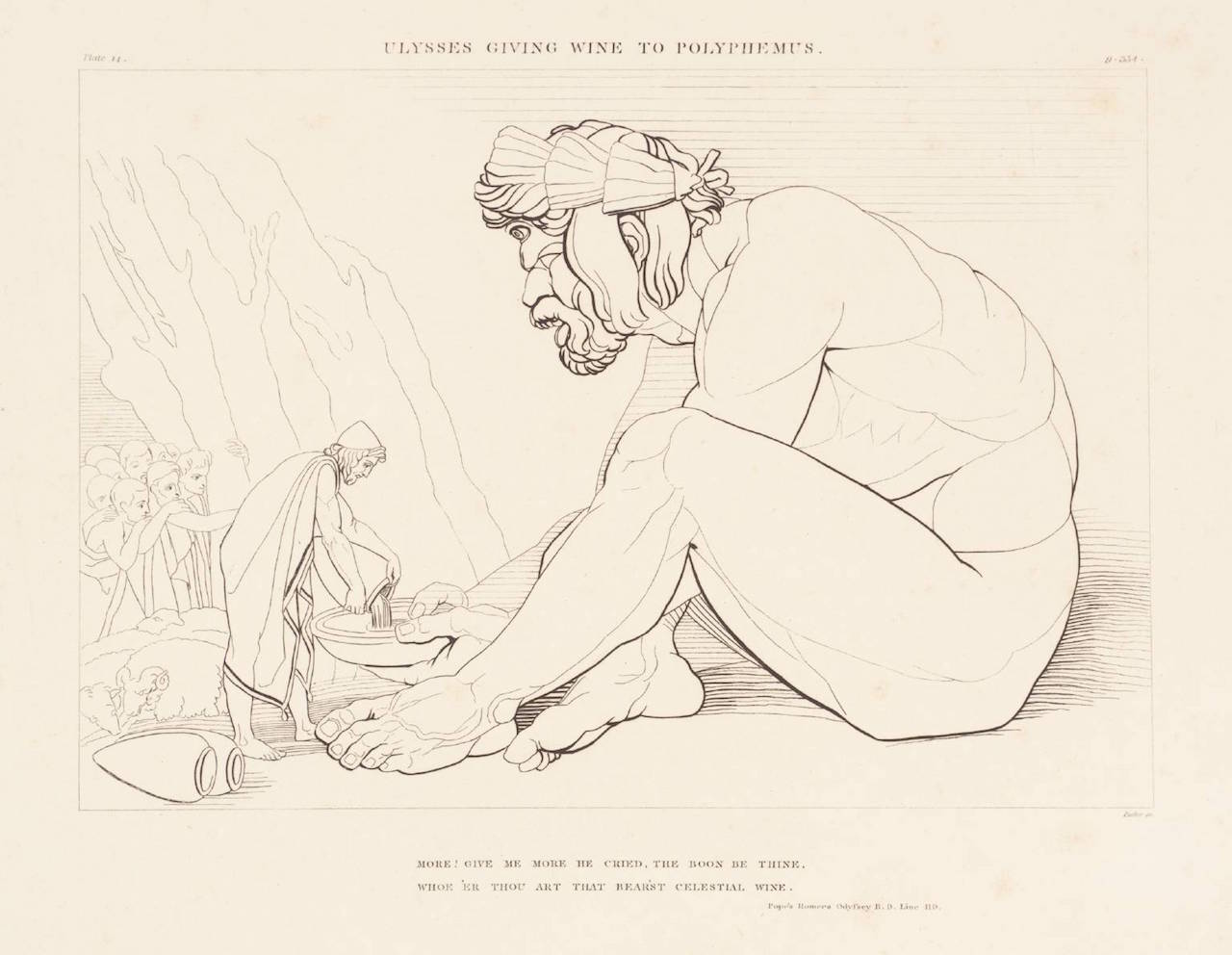 “Ulysses Giving Wine to Polyphemus” (1805). John Flaxman (1755–1826). Purchased as part of the Oppé Collection with assistance from the National Lottery through the Heritage Lottery Fund, 1996.
  “Circe Invidiosa,” (1892). J. W. Waterhouse (English, 1849–1917).
 “Teiresias appears to Ulysses during the sacrifice,” (1780–1785). Henry Fuseli (German, 1741–1825).
  “Ulysses and the Sirens” (ca. 1909). Herbert James Draper (English, 1863–1920).
 “Ulysses Asleep Laid on his Own Coast by the Phaeacian Sailors” (1805). John Flaxman (English, 1755–1826). Purchased as part of the Oppé Collection with assistance from the National Lottery through the Heritage Lottery Fund 1996.
  Minoan—probably Neopalatial—fresco commonly known as the “Lily Prince.” Whatever the exact type of this personage (perhaps a crowned acrobat, according to the interpretation of Maria Shaw), the Lily Prince is certainly a Minoan of elite standing. Public domain image based on a famous watercolor by Émile Gilliéron of a reconstruction by Arthur Evans.
 Detail from a fresco found at Hagia Triadha in Crete. Reconstruction by Mark Cameron, p. 96 of the catalogue Fresco: A Passport into the Past. Minoan Crete through the eyes of Mark Cameron. 1999. Catalogue curated by Doniert Evely. Athens: British School at Athens; and N. P. Goulandris Foundation, Museum of Cycladic Art. Reproduced with the permission of the British School at Athens. BSA Archive: Mark Cameron Personal Papers: CAM 1.
 “Minerva Restoring Ulysses to his Own Shape” (1805). John Flaxman (English, 1755–1826). Purchased as part of the Oppé Collection with assistance from the National Lottery through the Heritage Lottery Fund 1996.
 “Ulysses and his Dog” (1805). John Flaxman (English, 1755–1826). Purchased as part of the Oppé Collection with assistance from the National Lottery through the Heritage Lottery Fund 1996.
  “Ulysses Preparing to Fight with Irus” (1805). John Flaxman (English, 1755–1826) Purchased as part of the Oppé Collection with assistance from the National Lottery through the Heritage Lottery Fund 1996.
  “Euryclea Discovers Ulysses” (1805). John Flaxman (English, 1755–1826). Purchased as part of the Oppé Collection with assistance from the National Lottery through the Heritage Lottery Fund 1996.
  “The Harpies Going to Seize the Daughters of Pandareus” (1805). John Flaxman (English, 1755–1826). Purchased as part of the Oppé Collection with assistance from the National Lottery through the Heritage Lottery Fund 1996.
 Hēraklēs stringing a bow. Silver stater, c. 450–440 BCE, Thebes (Boeotia).
  Swallows, detail of the Spring Fresco at Thera, image via Flickr user
  Original artwork, by Flickr user
  Odysseus kiling Penelope’s suitors. Attic red-figure skyphos, ca. 440 BCE.
  Still life showing eggs, thrushes, napkin: from the House of Julia Felix, Pompeii.
  Eurykleia waking Penelope (1773). Print by Thomas Burke, after a painting by Angelika Kauffmann.
  Big Ed and Norma have just now broken free of the troublesome relationships that have kept these lovers apart for 27 years. Now at long last they can have a life together.
Still from
Big Ed and Norma have just now broken free of the troublesome relationships that have kept these lovers apart for 27 years. Now at long last they can have a life together.
Still from  “Mercury Conducting the Souls of the Suitors to the Infernal Regions” (1805). John Flaxman (English, 1755–1826). Purchased as part of the Oppé Collection with assistance from the National Lottery through the Heritage Lottery Fund 1996.
  “Ulysses Departing from Lacedaemon for Ithaca, with his Bride Penelope” (1805). John Flaxman (English, 1755–1826). Flaxman made this image the last in his Odyssey series, bringing the story of Penelope and Odysseus full circle. Purchased as part of the Oppé Collection with assistance from the National Lottery through the Heritage Lottery Fund 1996.


,_around_440_BC,_Altes_Museum_Berlin_(13718420225)_glare-reduced_white-bg.png)
