
View:
By Card
BOOK XVIII.
ARGUMENT.
THE FIGHT OF ULYSSES AND IRUS.
The beggar Irus insults Ulysses; the suitors promote the quarrel, in which Irus is worsted, and miserably handled. Penelope descends, and receives the presents of the suitors. The dialogue of Ulysses with Eurymachus.
1
WHILE fix'd in thought the pensive hero sate,
1
A mendicant approach'd the royal gate;
A surly vagrant of the giant kind,
The stain of manhood, of a coward mind:
From feast to feast, insatiate to devour,
5
He flew, attendant on the genial hour.
Him on his mother's knees, when babe he lay,
She named Arnaeus on his natal day :
1
But Irus his associates call'd the boy,
Practis'd the common messenger to fly:
10
Irus, a name expressive of th' employ.
From his own roof, with meditated blows,
He strove to drive the man of mighty woes:
IRUS
'Hence, dotard! hence, and timely speed thy way,
'Lest, dragg'd in vengeance, thou repent thy stay;
15
'See how with nods assent yon princely train!
'But, honouring age, in mercy I refrain;
'In peace away! lest, if persuasions fail,
'This arm with blows more eloquent prevail.'
'Hence, dotard! hence, and timely speed thy way,
'Lest, dragg'd in vengeance, thou repent thy stay;
15
'See how with nods assent yon princely train!
'But, honouring age, in mercy I refrain;
'In peace away! lest, if persuasions fail,
'This arm with blows more eloquent prevail.'
To whom, with stern regard: 'O insolence,
20
'Indecently to rail without offence !
ULYSSES
'What bounty gives, without a rival share;
'I ask, what harms not thee, to breathe this air:
'Alike on alms we both precarious live :
'And canst thou envy when the great relieve?
25
'Know, from the bounteous heavens all riches flow,
'And what man gives, the gods by man bestow;
'Proud as thou art, henceforth no more be proud,
'Lest I imprint my vengeance in thy blood;
'Old as I am, should once my fury burn,
30
'How would'st thou fly, nor even in thought return!'
'What bounty gives, without a rival share;
'I ask, what harms not thee, to breathe this air:
'Alike on alms we both precarious live :
'And canst thou envy when the great relieve?
25
'Know, from the bounteous heavens all riches flow,
'And what man gives, the gods by man bestow;
'Proud as thou art, henceforth no more be proud,
'Lest I imprint my vengeance in thy blood;
'Old as I am, should once my fury burn,
30
'How would'st thou fly, nor even in thought return!'
IRUS
'Mere woman-glutton!' (thus the churl replied,)
'A tongue so flippant, with a throat so wide!
'Why cease I, gods! to dash those teeth away,
'Like some wild boar's, that, greedy of his prey,
35
'Uproots the bearded corn ?
2
Rise, try the fight,
'Gird well thy loins, approach, and feel my might :
'Sure of defeat, before the peers engage:
'Unequal fight! when youth contends with age!'
'Mere woman-glutton!' (thus the churl replied,)
'A tongue so flippant, with a throat so wide!
'Why cease I, gods! to dash those teeth away,
'Like some wild boar's, that, greedy of his prey,
35
'Uproots the bearded corn ?
2
Rise, try the fight,
'Gird well thy loins, approach, and feel my might :
'Sure of defeat, before the peers engage:
'Unequal fight! when youth contends with age!'
Thus in a wordy war their tongues display
40
More fierce intents, preluding to the fray;
Antinoüs hears, and, in a jovial vein,
Thus with loud laughter to the suitor-train :
ANTINOUS
'This happy day in mirth, my friends, employ,
'And lo! the gods conspire to crown our joy.
45
'See, ready for the fight, and hand to hand,
'Yon surly mendicants contentious stand:
'Why urge we not to blows?' Well pleas'd they spring
Swift from their seats, and thickening form a ring.
50
To whom Antinous: 'Lo! enrich'd with blood,
50
'A kid's well-fatted entrails (tasteful food)
'On glowing embers lie; on him bestow
The choicest portion who subdues his foe;
'Grant him unrivall'd in these walls to stay,
'The sole attendant on the genial day.'
55
'This happy day in mirth, my friends, employ,
'And lo! the gods conspire to crown our joy.
45
'See, ready for the fight, and hand to hand,
'Yon surly mendicants contentious stand:
'Why urge we not to blows?' Well pleas'd they spring
Swift from their seats, and thickening form a ring.
To whom Antinous: 'Lo! enrich'd with blood,
50
'A kid's well-fatted entrails (tasteful food)
'On glowing embers lie; on him bestow
The choicest portion who subdues his foe;
'Grant him unrivall'd in these walls to stay,
'The sole attendant on the genial day.'
55
The lords applaud: Ulysses then with art,
And fears well-feign'd, disguis'd his dauntless heart:
ULYSSES
'Worn as I am with age, decay'd with woe;
'Say, is it baseness to decline the foe?
'Hard conflict! when calamity and age
60
'With vigorous youth, unknown to cares, engage!
'Yet, fearful of disgrace, to try the day
'Imperious hunger bids, and I obey :
'But swear, impartial arbiters of right,
'Swear to stand neutral, while we cope in fight.'
65
'Worn as I am with age, decay'd with woe;
'Say, is it baseness to decline the foe?
'Hard conflict! when calamity and age
60
'With vigorous youth, unknown to cares, engage!
'Yet, fearful of disgrace, to try the day
'Imperious hunger bids, and I obey :
'But swear, impartial arbiters of right,
'Swear to stand neutral, while we cope in fight.'
65
The peers assent: when straight his sacred head
Telemachus uprais'd, and sternly said:
TELEMACHUS
'Stranger, if prompted to chastise the wrong
'Of this bold insolent, confide, be strong!
'Th' injurious Greek that dares attempt a blow,
70
'That instant makes Telemachus his foe;
'And these my friends
3
shall guard the sacred ties
'Of hospitality, for they are wise.'
'Stranger, if prompted to chastise the wrong
'Of this bold insolent, confide, be strong!
'Th' injurious Greek that dares attempt a blow,
70
'That instant makes Telemachus his foe;
'And these my friends
3
shall guard the sacred ties
'Of hospitality, for they are wise.'
Then, girding his strong loins, the king prepares
To close in combat, and his body bares;
75
Broad spread his shoulders, and his nervous thighs
By just degrees, like well-turn'd columns, rise:
Ample his chest, his arms are round and long,
And each strong joint Minerva knits more strong,
(Attendant on her chief:) the suitor-crowd
80
With wonder gaze, and gazing speak aloud :
'Irus! alas! shall Irus be no more?
'Black fate impends, and this th' avenging hour!
'Gods! how his nerves a matchless strength proclaim,
'Swell o'er his well-strung limbs, and brace his frame!'
85
Then pale with fears, and sickening at the sight,
They dragg'd th' unwilling Irus to the fight;
From his blank visage fled the coward blood,
And his flesh trembled as aghast he stood.
O that such baseness should disgrace the light!
90
'O hide it, death, in everlasting night!'
(Exclaims Antinoüs ;)
ANTINOUS
'can a vigorous foe
'Meanly decline to combat age and woe ?
'But hear me, wretch! if, recreant in the fray,
95
That huge bulk yield this ill-contested day,
'Instant thou sail'st, to Echetus
4
resign'd;
'A tyrant, fiercest of the tyrant kind,
'Who casts thy mangled ears and nose a prey
'To hungry dogs, and lops the man away.'
100
'can a vigorous foe
'Meanly decline to combat age and woe ?
'But hear me, wretch! if, recreant in the fray,
95
That huge bulk yield this ill-contested day,
'Instant thou sail'st, to Echetus
4
resign'd;
'A tyrant, fiercest of the tyrant kind,
'Who casts thy mangled ears and nose a prey
'To hungry dogs, and lops the man away.'
100
While with indignant scorn he sternly spoke,
In every joint the trembling Irus shook.
Now front to front each frowning champion stands,
And poises high in air his adverse hands.
The chief yet doubts, or to the shades below
105
To fell the giant at one vengeful blow,
Or save his life; and soon his life to save
The king resolves, for mercy sways the brave.
That instant Irus his huge arm extends,
Full on his shoulder the rude weight descends:
110
The sage Ulysses, fearful to disclose
The hero latent in the man of woes,
Check'd half his might; yet, rising to the stroke,
His jaw-bone dash'd, the crashing jaw-bone broke :
Down dropp'd he stupid from the stunning wound;
115
His feet extended, quivering, beat the ground;
His mouth and nostrils spout a purple flood;
His teeth, all shatter'd, rush immix'd with blood.
The peers transported, as outstretch'd he lies,
With bursts of laughter rend the vaulted skies;
120
Then dragg'd along, all bleeding from the wound,
His length of carcass trailing prints the ground;
Rais'd on his feet, again he reels, he falls,
Till propp'd, reclining on the palace walls :
Then to his hand a staff the victor gave,
125
And thus with just reproach address'd the slave:
ULYSSES
'There terrible affright the dogs, and reign
'A dreaded tyrant o'er the bestial train !
'But mercy to the poor and stranger show,
'Lest Heaven in vengeance send some mightier woe.'
130
'There terrible affright the dogs, and reign
'A dreaded tyrant o'er the bestial train !
'But mercy to the poor and stranger show,
'Lest Heaven in vengeance send some mightier woe.'
130
Scornful he spoke, and o'er his shoulder flung
The broad-patch'd scrip; the scrip in tatters hung
Ill join'd, and knotted to a twisted thong.
Then, turning short, disdaind a further stay;
But to the palace measur'd back the way.
135
There as he rested, gathering in a ring,
The peers with smiles address'd their unknown king:
'Stranger, may Jove and all th' aërial powers
'With every blessing crown thy happy hours!
'Our freedom to thy prowess'd arm we owe
140
'From bold intrusion of thy coward foe;
'Instant the flying sail the slave shall wing
'To Echetus, the monster of a king.'
While pleas'd he hears, Antinoüs bears the food,
A kid's well-fatted entrails, rich with blood :
145
The bread from canisters of shining mould
Amphinomus; and wines that laugh in gold:
'And oh!' (he mildly cries) 'may Heaven display
'A beam of glory o'er thy future day!'
AMPHINOMUS
'Alas, the brave too oft is doom'd to bear
150
'The gripes of poverty, and stings of care.'
'Alas, the brave too oft is doom'd to bear
150
'The gripes of poverty, and stings of care.'
124
To whom with thought mature the king replies :
ULYSSES
'The tongue speaks wisely, when the soul is wise;
'Such was thy father! in imperial state,
'Great without vice, that oft attends the great :
155
'Nor from the sire art thou, the son, declin'd;
'Then hear my words, and grave them in thy mind!
'Of all that breathes, or grov'ling creeps on earth,
'Most vain is man! calamitous by birth:
'To-day, with power elate, in strength he blooms;
160
'The haughty creature on that power presumes:
'Anon from Heaven a sad reverse he feels;
'Untaught to bear, 'gainst Heaven the wretch rebels.
'For man is changeful, as his bliss or woe;
'Too high when prosperous, when distress'd too low.
165
'There was a day, when with the scornful great
'I swell'd in pomp and arrogance of state;
'Proud of the power that to high birth belongs;
'And used that power to justify my wrongs.
'Then let not man be proud; but firm of mind,
170
'Bear the best humbly, and the worst resign'd;
'Be dumb when Heaven afflicts! unlike yon train
'Of haughty spoilers, insolently vain;
'Who make their queen and all her wealth a prey:
'But vengeance and Ulysses wing their way.
175
'O may'st thou, favour'd by some guardian power,
'Far, far be distant in that deathful hour!
'For sure I am, if stern Ulysses breathe,
'These lawless riots end in blood and death.'
'The tongue speaks wisely, when the soul is wise;
'Such was thy father! in imperial state,
'Great without vice, that oft attends the great :
155
'Nor from the sire art thou, the son, declin'd;
'Then hear my words, and grave them in thy mind!
'Of all that breathes, or grov'ling creeps on earth,
'Most vain is man! calamitous by birth:
'To-day, with power elate, in strength he blooms;
160
'The haughty creature on that power presumes:
'Anon from Heaven a sad reverse he feels;
'Untaught to bear, 'gainst Heaven the wretch rebels.
'For man is changeful, as his bliss or woe;
'Too high when prosperous, when distress'd too low.
165
'There was a day, when with the scornful great
'I swell'd in pomp and arrogance of state;
'Proud of the power that to high birth belongs;
'And used that power to justify my wrongs.
'Then let not man be proud; but firm of mind,
170
'Bear the best humbly, and the worst resign'd;
'Be dumb when Heaven afflicts! unlike yon train
'Of haughty spoilers, insolently vain;
'Who make their queen and all her wealth a prey:
'But vengeance and Ulysses wing their way.
175
'O may'st thou, favour'd by some guardian power,
'Far, far be distant in that deathful hour!
'For sure I am, if stern Ulysses breathe,
'These lawless riots end in blood and death.'
Then to the gods the rosy juice he pours,
180
And the drain'd goblet to the chief restores.
Stung to the soul, o'ercast with holy dread,
He shook the graceful honours of his head;
His boding mind the future woe forestalls;
In vain! by great Telemachus he falls,
185
For Pallas seals his doom: all sad he turns
To join the peers; resumes his throne, and mourns.
Meanwhile Minerva with instinctive fires
Thy soul, Penelope, from Heaven inspires :
With flattering hopes the suitors to betray,
190
And seem to meet, yet fly, the bridal day :
Thy husband's wonder and thy son's to raise;
And crown the mother and the wife with praise.
Then, while the streaming sorrow dims her eyes,
Thus with a transient smile the matron cries:
195
PENELOPE
'Eurynomè! to go where riot reigns
'I feel an impulse, though my soul disdains;
'To my lov'd son the snares of death to show,
'And in the traitor-friend unmask the foe;
'Who, smooth of tongue, in purpose insincere,
200
'Hides fraud in smiles, while death is ambush'd there.'
'Eurynomè! to go where riot reigns
'I feel an impulse, though my soul disdains;
'To my lov'd son the snares of death to show,
'And in the traitor-friend unmask the foe;
'Who, smooth of tongue, in purpose insincere,
200
'Hides fraud in smiles, while death is ambush'd there.'
169
'Go, warn thy son, nor be the warning vain,'
(Replied the sagest of the royal train ;)
EURYNOME
'But bath'd, anointed, and adorn'd, descend;
'Powerful of charms, bid every grace attend;
205
'The tide of flowing tears awhile suppress :
'Tears but indulge the sorrow, not repress.
'Some joy remains: to thee a son is given,
'Such as, in fondness, parents ask of Heaven.'
'But bath'd, anointed, and adorn'd, descend;
'Powerful of charms, bid every grace attend;
205
'The tide of flowing tears awhile suppress :
'Tears but indulge the sorrow, not repress.
'Some joy remains: to thee a son is given,
'Such as, in fondness, parents ask of Heaven.'
PENELOPE
'Ah me! forbear!' returns the queen, 'forbear,
210
'Oh! talk not, talk not of vain beauty's care;
'No more I bathe, since he no longer sees
'Those charms, for whom alone I wish to please.
'The day that bore Ulysses from this coast
'Blasted the little bloom these cheeks could boast.
215
'But instant bid Autonoë descend,
'Instant Hippodamè our steps attend:
'Ill suits it female virtue, to be seen
'Alone, indecent, in the walks of men.'
'Ah me! forbear!' returns the queen, 'forbear,
210
'Oh! talk not, talk not of vain beauty's care;
'No more I bathe, since he no longer sees
'Those charms, for whom alone I wish to please.
'The day that bore Ulysses from this coast
'Blasted the little bloom these cheeks could boast.
215
'But instant bid Autonoë descend,
'Instant Hippodamè our steps attend:
'Ill suits it female virtue, to be seen
'Alone, indecent, in the walks of men.'
Then, while Eurynomè the mandate bears,
220
From heaven Minerva shoots with guardian cares;
O'er all her senses, as the couch she press'd,
She pours a pleasing, deep, and death-like rest,
With every beauty every feature arms,
Bids her cheeks glow, and lights up all her charms,
225
In her love-darting eyes awakes the fires,
(Immortal gifts! to kindle soft desires ;)
From limb to limb an air majestic sheds,
And the pure ivory o'er her bosom spreads.
Such Venus shines, when, with a measur'd bound,
230
She smoothly gliding swims th' harmonious round,
When with the Graces in the dance she moves,
And fires the gazing gods with ardent loves.
Then to the skies her flight Minerva bends,
And to the queen the damsel train descends:
235
Waked at their steps, her flowing eyes unclose;
The tears she wipes, and thus renews her woes:
'Howe'er, 'tis well that sleep awhile can free
'With soft forgetfulness, a wretch like me;
'Oh! were it given to yield this transient breath,
240
'Send, O Diana,
5
send the sleep of death!
'Why must I waste a tedious life in tears,
'Nor bury in the silent grave my cares?
'O my Ulysses! ever-honour'd name!
'For thee I mourn till death dissolves my frame.'
245
Thus wailing, slow and sadly she descends;
On either hand a damsel train attends :
Full where the dome its shining valves expands,
Radiant before the gazing peers she stands;
A veil translucent, o'er her brow display'd,
250
Her beauty seems, and only seems, to shade:
Sudden she lightens in their dazzled eyes,
And sudden flames in every bosom rise;
They send their eager souls with every look,
Till silence thus th' imperial matron broke:
255
PENELOPE
'O why! my son, why now no more appears
'That warmth of soul that urged thy younger years?
'Thy riper days no growing worth impart,
'A man in stature, still a boy in heart!
'Thy well-knit frame unprofitably strong,
260
'Speaks thee a hero, from a hero sprung:
'But the just gods in vain those gifts bestow,
'O wise alone in form, and brave in show!
'Heavens! could a stranger feel oppression's hand
'Beneath thy roof, and could'st thou tamely stand?
265
'If thou the stranger's righteous cause decline,
'His is the sufferance, but the shame is thine.'
'O why! my son, why now no more appears
'That warmth of soul that urged thy younger years?
'Thy riper days no growing worth impart,
'A man in stature, still a boy in heart!
'Thy well-knit frame unprofitably strong,
260
'Speaks thee a hero, from a hero sprung:
'But the just gods in vain those gifts bestow,
'O wise alone in form, and brave in show!
'Heavens! could a stranger feel oppression's hand
'Beneath thy roof, and could'st thou tamely stand?
265
'If thou the stranger's righteous cause decline,
'His is the sufferance, but the shame is thine.'
TELEMACHUS
To whom, with filial awe, the prince returns:
'That generous soul with just resentment burns;
'Yet, taught by time, my heart has learn'd to glow
'For others' good, and melt at others' woe;
270
'But, impotent these riots to repel,
'I bear their outrage, though my soul rebel;
'Helpless amid the snares of death I tread,
'And numbers leagued in impious union dread;
'But now no crime is theirs: this wrong proceeds
275
'From Irus, and the guilty Irus bleeds.
'Oh would to Jove! or her whose arms display
'The shield of Jove, or him who rules the day,
'That yon proud suitors, who licentious tread
'These courts, within these courts like Irus bled!
280
'Whose loose head tottering, as with wine oppress'd,
'Obliquely drops, and nodding knocks his breast;
'Powerless to move, his staggering feet deny
'The coward wretch the privilege to fly.'
To whom, with filial awe, the prince returns:
'That generous soul with just resentment burns;
'Yet, taught by time, my heart has learn'd to glow
'For others' good, and melt at others' woe;
270
'But, impotent these riots to repel,
'I bear their outrage, though my soul rebel;
'Helpless amid the snares of death I tread,
'And numbers leagued in impious union dread;
'But now no crime is theirs: this wrong proceeds
275
'From Irus, and the guilty Irus bleeds.
'Oh would to Jove! or her whose arms display
'The shield of Jove, or him who rules the day,
'That yon proud suitors, who licentious tread
'These courts, within these courts like Irus bled!
280
'Whose loose head tottering, as with wine oppress'd,
'Obliquely drops, and nodding knocks his breast;
'Powerless to move, his staggering feet deny
'The coward wretch the privilege to fly.'
Then to the queen Eurymachus replies :
285
EURYMACHUS
'O justly lov'd, and not more fair than wise!
'Should Greece through all her hundred states survey
'Thy finish'd charms, all Greece would own thy sway,
'In rivals crowds contest the glorious prize,
'Dispeopling realms to gaze upon thy eyes:
290
'O woman! loveliest of the lovely kind,
'In body perfect, and complete in mind.'
'O justly lov'd, and not more fair than wise!
'Should Greece through all her hundred states survey
'Thy finish'd charms, all Greece would own thy sway,
'In rivals crowds contest the glorious prize,
'Dispeopling realms to gaze upon thy eyes:
290
'O woman! loveliest of the lovely kind,
'In body perfect, and complete in mind.'
PENELOPE
250
'Ah me!' (returns the queen) 'when from this shore
'Ulysses sail'd, then beauty was no more!
'The gods decreed these eyes no more should keep
295
'Their wonted grace, but only serve to weep.
'Should he return, whate'er my beauties prove,
'My virtues last;
6
my brightest charm is love.
'Now, grief, thou all art mine! the gods o'ercast
'My soul with woes, that long, ah long must last!
300
'Too faithfully my heart retains the day
'That sadly tore my royal lord away :
'He grasp'd my hand, and, O my spouse! I leave
'Thy arms, he cried, perhaps to find a grave:
'Fame speaks the Trojans bold; they boast the skill
305
'To give the feather'd arrow wings to kill,
'To dart the spear and guide the rushing car
'With dreadful inroad through the walks of war.
'My sentence is gone forth, and 'tis decreed
'Perhaps by righteous Heaven that I must bleed!
310
'My father, mother, all I trust to thee;
'To them, to them transfer the love of me:
'But, when my son grows man, the royal sway
'Resign, and happy be thy bridal day!
'Such were his words; and Hymen now prepares
315
'To light his torch, and give me up to cares;
'Th' afflictive hand of wrathful Jove to bear,
'A wretch the most complete that breathes the air!
'Fall'n even below the rights to woman due!
'Careless to please, with insolence ye woo!
320
'The generous lovers, studious to succeed,
'Bid their whole herds and flocks in banquets bleed;
'By precious gifts the vow sincere display:
'You, only you, make her ye love your prey.'
250
'Ah me!' (returns the queen) 'when from this shore
'Ulysses sail'd, then beauty was no more!
'The gods decreed these eyes no more should keep
295
'Their wonted grace, but only serve to weep.
'Should he return, whate'er my beauties prove,
'My virtues last;
6
my brightest charm is love.
'Now, grief, thou all art mine! the gods o'ercast
'My soul with woes, that long, ah long must last!
300
'Too faithfully my heart retains the day
'That sadly tore my royal lord away :
'He grasp'd my hand, and, O my spouse! I leave
'Thy arms, he cried, perhaps to find a grave:
'Fame speaks the Trojans bold; they boast the skill
305
'To give the feather'd arrow wings to kill,
'To dart the spear and guide the rushing car
'With dreadful inroad through the walks of war.
'My sentence is gone forth, and 'tis decreed
'Perhaps by righteous Heaven that I must bleed!
310
'My father, mother, all I trust to thee;
'To them, to them transfer the love of me:
'But, when my son grows man, the royal sway
'Resign, and happy be thy bridal day!
'Such were his words; and Hymen now prepares
315
'To light his torch, and give me up to cares;
'Th' afflictive hand of wrathful Jove to bear,
'A wretch the most complete that breathes the air!
'Fall'n even below the rights to woman due!
'Careless to please, with insolence ye woo!
320
'The generous lovers, studious to succeed,
'Bid their whole herds and flocks in banquets bleed;
'By precious gifts the vow sincere display:
'You, only you, make her ye love your prey.'
Well-pleas'd Ulysses hears his queen deceive
325
The suitor-train, and raise a thirst to give :
False hopes she kindles, but those hopes betray,
And promise, yet elude, the bridal day.
While yet she speaks, the gay Antinoüs cries :
ANTINOUS
'Offspring of kings, and more than woman wise!
330
''Tis right; 'tis man's prerogative to give :
'And custom bids thee without shame receive;
'Yet never, never, from thy dome we move,
'Till Hymen lights the torch of spousal love.'
'Offspring of kings, and more than woman wise!
330
''Tis right; 'tis man's prerogative to give :
'And custom bids thee without shame receive;
'Yet never, never, from thy dome we move,
'Till Hymen lights the torch of spousal love.'
290
The peers despatch'd their heralds to convey
335
The gifts of love; with speed they take the way.
A robe Antinoüs gives of shining dyes;
The varying hues in gay confusion rise
Rich from the artist's hand! twelve clasps of gold
Close to the lessening waist the vest infold;
340
Down from the swelling loins the vest unbound
Floats in bright waves redundant o'er the ground.
A bracelet rich with gold, with amber gay,
That shot effulgence like the solar ray,
Eurymachus presents: and ear-rings bright,
345
With triple stars, that cast a trembling light.
Pisander bears a necklace wrought with art:
And every peer, expressive of his heart,
A gift bestows: this done, the queen ascends,
And slow behind her damsel train attends.
350
Then to the dance they form the vocal strain,
Till Hesperus leads forth the starry train;
And now he raises, as the daylight fades,
His golden circlet in the deepening shades:
Three vases heap'd with copious fires display
355
O'er all the palace a fictitious day;
From space to space the torch wide-beaming burns,
And sprightly damsels trim the rays by turns.
To whom the king: 'Ill suits your sex to stay
'Alone with men! ye modest maids, away!
360
ULYSSES
'Go, with the queen the spindle guide; or cull
'(The partners of her cares) the silver wool;
'Be it my task the torches to supply,
'Even till the morning lamp adorns the sky;
'Even till the morning, with unwearied care,
365
'Sleepless I watch; for I have learn'd to bear.'
'Go, with the queen the spindle guide; or cull
'(The partners of her cares) the silver wool;
'Be it my task the torches to supply,
'Even till the morning lamp adorns the sky;
'Even till the morning, with unwearied care,
365
'Sleepless I watch; for I have learn'd to bear.'
Scornful they heard: Melantho, fair and young,
(Melantho, from the loins of Dolius sprung,
Who with the queen her years an infant led,
With the soft fondness of a daughter bred,)
370
Chiefly derides: regardless of the cares
Her queen endures, polluted joys she shares
Nocturnal with Eurymachus
7
: with eyes
That speak disdain, the wanton thus replies :
MELANTHO
'Oh! whither wanders thy distemper'd brain,
375
'Thou bold intruder on a princely train ?
'Hence to the vagrants' rendezvous repair;
'Or shun in some black forge the midnight air.
'Proceeds this boldness from a turn of soul,
'Or flows licentious from the copious bowl?
380
'Is it that vanquish'd Irus swells thy mind?
'A foe may meet thee of a braver kind,
'Who, shortening with a storm of blows thy stay,
'Shall send thee howling all in blood away!'
'Oh! whither wanders thy distemper'd brain,
375
'Thou bold intruder on a princely train ?
'Hence to the vagrants' rendezvous repair;
'Or shun in some black forge the midnight air.
'Proceeds this boldness from a turn of soul,
'Or flows licentious from the copious bowl?
380
'Is it that vanquish'd Irus swells thy mind?
'A foe may meet thee of a braver kind,
'Who, shortening with a storm of blows thy stay,
'Shall send thee howling all in blood away!'
337
To whom with frowns: 'O impudent in wrong!
385
ULYSSES
'Thy lord shall curb that insolence of tongue ;
'Know, to Telemachus I tell th' offence;
'The scourge, the scourge shall lash thee into sense.'
'Thy lord shall curb that insolence of tongue ;
'Know, to Telemachus I tell th' offence;
'The scourge, the scourge shall lash thee into sense.'
With conscious shame they hear the stern rebuke,
Nor longer durst sustain the sovereign look.
390
Then to the servile task the monarch turns
His royal hands: each torch refulgent burns
With added day: meanwhile in museful mood,
Absorb'd in thought, on vengeance fix'd he stood.
And now the martial maid, by deeper wrongs
395
To rouse Ulysses, points the suitors' tongues :
Scornful of age, to taunt the virtuous man,
Thoughtless and gay, Eurymachus began :
EURYMACHUS
'Hear me,' (he cries,) 'confederates and friends!
'Some god, no doubt, this stranger kindly sends;
400
'The shining baldness of his head survey,
'It aids our torch-light, and reflects the ray.'
Then to the king that levell'd haughty Troy:
'Say, if large hire can tempt thee to employ
'Those hands in work; to tend the rural trade,
405
'To dress the walk, and form th' embowering shade.
'So food and raiment constant will I give :
'But idly thus thy soul prefers to live,
'And starve by strolling, not by work to thrive.'
'Hear me,' (he cries,) 'confederates and friends!
'Some god, no doubt, this stranger kindly sends;
400
'The shining baldness of his head survey,
'It aids our torch-light, and reflects the ray.'
Then to the king that levell'd haughty Troy:
'Say, if large hire can tempt thee to employ
'Those hands in work; to tend the rural trade,
405
'To dress the walk, and form th' embowering shade.
'So food and raiment constant will I give :
'But idly thus thy soul prefers to live,
'And starve by strolling, not by work to thrive.'
365
To whom incens'd: 'Should we, O prince, engage
410
ULYSSES
'In rival tasks beneath the burning rage
'Of summer suns; were both constrain'd to wield
'Foodless the scythe along the burden'd field;
'Or should we labour while the ploughshare wounds,
'With steers of equal strength, th' allotted grounds:
415
'Beneath my labours, how thy wondering eyes
'Might see the sable field at once arise!
'Should Jove dire war unloose, with spear and shield,
'And nodding helm, I tread th' ensanguin's field,
'Fierce in the van: then would'st thou, would'st thou, say,
420
'Misname me glutton, in that glorious day ?
'No, thy ill-judging thoughts the brave disgrace;
''Tis thou injurious art, not I am base.
'Proud to seem brave among a coward train!
'But know, thou art not valorous, but vain.
425
'Gods! should the stern Ulysses rise in might,
'These gates would seem too narrow for thy flight.'
'In rival tasks beneath the burning rage
'Of summer suns; were both constrain'd to wield
'Foodless the scythe along the burden'd field;
'Or should we labour while the ploughshare wounds,
'With steers of equal strength, th' allotted grounds:
415
'Beneath my labours, how thy wondering eyes
'Might see the sable field at once arise!
'Should Jove dire war unloose, with spear and shield,
'And nodding helm, I tread th' ensanguin's field,
'Fierce in the van: then would'st thou, would'st thou, say,
420
'Misname me glutton, in that glorious day ?
'No, thy ill-judging thoughts the brave disgrace;
''Tis thou injurious art, not I am base.
'Proud to seem brave among a coward train!
'But know, thou art not valorous, but vain.
425
'Gods! should the stern Ulysses rise in might,
'These gates would seem too narrow for thy flight.'
While yet he speaks Eurymachus replies,
With indignation flashing from his eyes :
EURYMACHUS
'Slave, I with justice might deserve the wrong,
430
'Should I not punish that opprobrious tongue.
'Irreverent to the great, and uncontroll'd,
'Art thou from wine, or innate folly, bold?
'Perhaps these outrages from Irus flow,
'A worthless triumph o'er a worthless foe!'
435
'Slave, I with justice might deserve the wrong,
430
'Should I not punish that opprobrious tongue.
'Irreverent to the great, and uncontroll'd,
'Art thou from wine, or innate folly, bold?
'Perhaps these outrages from Irus flow,
'A worthless triumph o'er a worthless foe!'
435
394
He said, and with full force a footstool threw :
Whirl'd from his arm, with erring rage it flew :
Ulysses, cautious of the vengeful foe,
Stoops to the ground, and disappoints the blow.
Not so a youth who deals the goblet round;
440
Full on his shoulder it inflicts a wound:
Dash'd from his hand the sounding goblet flies,
He shrieks, he reels, he falls, and breathless lies.
Then wild uproar and clamour mount the sky,
Till mutual thus the peers indignant cry :
445
'Oh had this stranger sunk to realms beneath,
'To the black realms of darkness and of death,
'Ere yet he trod these shores! to strife he draws
'Peer against peer; and what the weighty cause ?
'A vagabond! for him the great destroy,
450
'In vile ignoble jars, the feast of joy.'
To whom the stern Telemachus uprose:
TELEMACHUS
'Gods! what wild folly from the goblet flows!
'Whence this unguarded openness of soul,
'But from the licence of the copious bowl?
455
'Or Heaven delusion sends: but hence, away!
'Force I forbear, and without force obey.'
'Gods! what wild folly from the goblet flows!
'Whence this unguarded openness of soul,
'But from the licence of the copious bowl?
455
'Or Heaven delusion sends: but hence, away!
'Force I forbear, and without force obey.'
Silent, abash'd, they hear the stern rebuke,
Till thus Amphinomus the silence broke:
AMPHINOMUS
'True are his words, and he whom truth offends,
460
'Not with Telemachus, but truth contends;
'Let not the hand of violence invade
'The reverend stranger, or the spotless maid;
'Retire we hence! but crown with rosy wine
'The flowing goblet to the powers divine!
465
'Guard he his guest beneath whose roof he stands :
'This justice, this the social rite demands.'
'True are his words, and he whom truth offends,
460
'Not with Telemachus, but truth contends;
'Let not the hand of violence invade
'The reverend stranger, or the spotless maid;
'Retire we hence! but crown with rosy wine
'The flowing goblet to the powers divine!
465
'Guard he his guest beneath whose roof he stands :
'This justice, this the social rite demands.'
The peers assent: the goblet Mulius crown'd
With purple juice, and bore in order round:
Each peer successive his libation pours
470
To the blest gods who fill th' ethereal bowers
8
:
Then, swill'd with wine, with noise the crowds obey,
And, rushing forth, tumultuous reel away.
9
Odyssey. Homer. London. 1858.
Sponsored by Perseus Project, Tufts University.
 Zeus, Athena, and Hermes (1810). Drawing by John Flaxman.
 Athena (1810). Drawing by John Flaxman.
 Telemachus with Athena as Mentor (1810). Drawing by John Flaxman.
  Nestor’s Sacrifice (1805). Engraving after John Flaxman (1755-1826). Purchased as part of the Oppé Collection with assistance from the National Lottery through the Heritage Lottery Fund 1996.
  “The Fair Helen.” Willy Pogany (Hungarian, 1882–1955).
Image
“The Fair Helen.” Willy Pogany (Hungarian, 1882–1955).
Image  “Leucothea, the White Goddess, Preserving Ulysses” (1805). John Flaxman (1755–1826). Purchased as part of the Oppé Collection with assistance from the National Lottery through the Heritage Lottery Fund, 1996.
  “Nausicaa” (1878), Frederick Leighton (English, 1830–1896).
 Red-figured pyxis, picturing Nereids at home, “indoors”: the Nereid with her hair down is labeled as Thaleia.
 View of Garitsa, region right outside the northern walls of the city of Corfu, and according to the legend the site of Alcinous’s gardens (1867). Étienne Rey (French, 1789–1867).
  Blind Demodokos sings of the siege of Troy (1810), by John Flaxman (English, 1755–1826).
 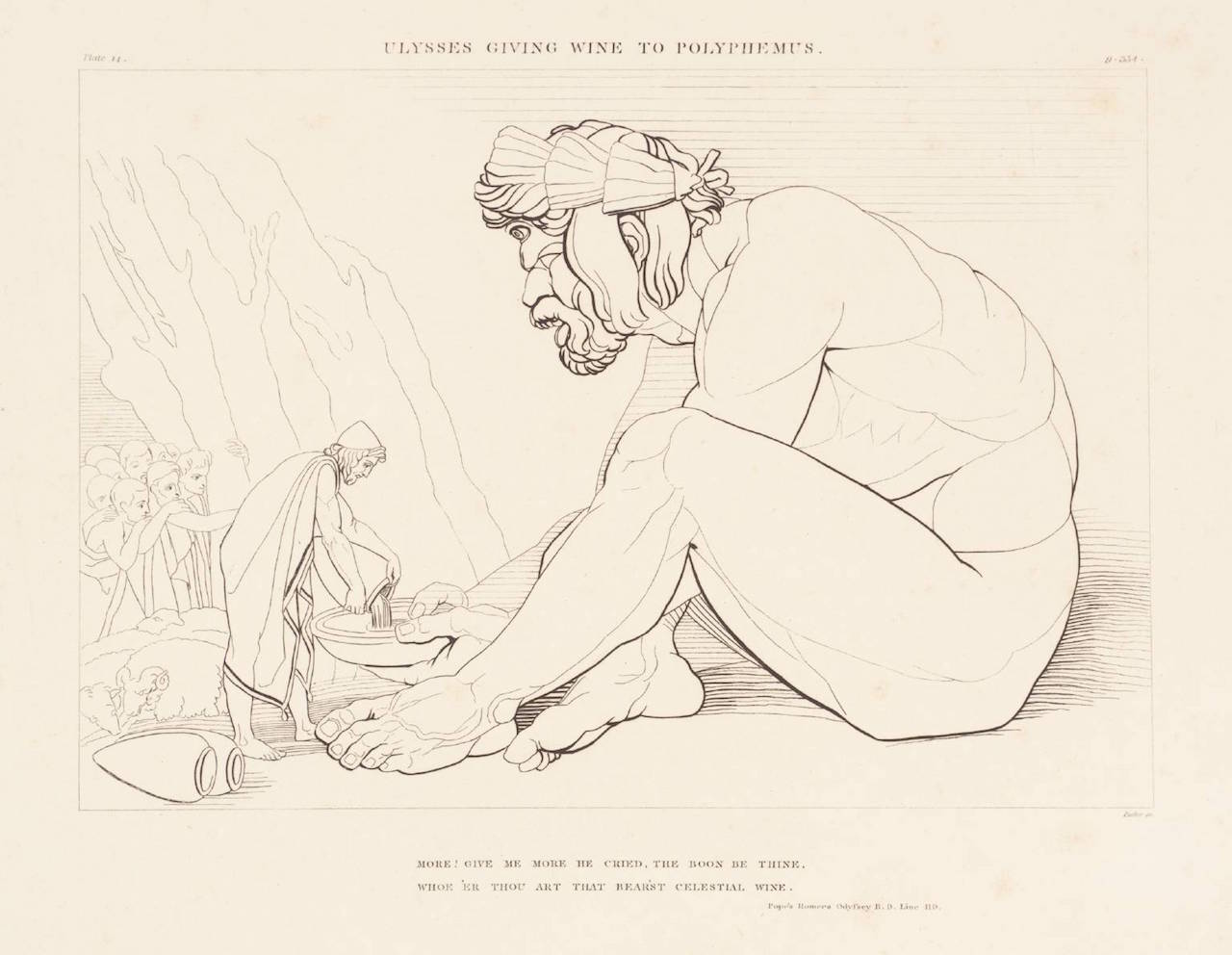 “Ulysses Giving Wine to Polyphemus” (1805). John Flaxman (1755–1826). Purchased as part of the Oppé Collection with assistance from the National Lottery through the Heritage Lottery Fund, 1996.
  “Circe Invidiosa,” (1892). J. W. Waterhouse (English, 1849–1917).
 “Teiresias appears to Ulysses during the sacrifice,” (1780–1785). Henry Fuseli (German, 1741–1825).
  “Ulysses and the Sirens” (ca. 1909). Herbert James Draper (English, 1863–1920).
 “Ulysses Asleep Laid on his Own Coast by the Phaeacian Sailors” (1805). John Flaxman (English, 1755–1826). Purchased as part of the Oppé Collection with assistance from the National Lottery through the Heritage Lottery Fund 1996.
  Minoan—probably Neopalatial—fresco commonly known as the “Lily Prince.” Whatever the exact type of this personage (perhaps a crowned acrobat, according to the interpretation of Maria Shaw), the Lily Prince is certainly a Minoan of elite standing. Public domain image based on a famous watercolor by Émile Gilliéron of a reconstruction by Arthur Evans.
 Detail from a fresco found at Hagia Triadha in Crete. Reconstruction by Mark Cameron, p. 96 of the catalogue Fresco: A Passport into the Past. Minoan Crete through the eyes of Mark Cameron. 1999. Catalogue curated by Doniert Evely. Athens: British School at Athens; and N. P. Goulandris Foundation, Museum of Cycladic Art. Reproduced with the permission of the British School at Athens. BSA Archive: Mark Cameron Personal Papers: CAM 1.
 “Minerva Restoring Ulysses to his Own Shape” (1805). John Flaxman (English, 1755–1826). Purchased as part of the Oppé Collection with assistance from the National Lottery through the Heritage Lottery Fund 1996.
 “Ulysses and his Dog” (1805). John Flaxman (English, 1755–1826). Purchased as part of the Oppé Collection with assistance from the National Lottery through the Heritage Lottery Fund 1996.
  “Ulysses Preparing to Fight with Irus” (1805). John Flaxman (English, 1755–1826) Purchased as part of the Oppé Collection with assistance from the National Lottery through the Heritage Lottery Fund 1996.
  “Euryclea Discovers Ulysses” (1805). John Flaxman (English, 1755–1826). Purchased as part of the Oppé Collection with assistance from the National Lottery through the Heritage Lottery Fund 1996.
  “The Harpies Going to Seize the Daughters of Pandareus” (1805). John Flaxman (English, 1755–1826). Purchased as part of the Oppé Collection with assistance from the National Lottery through the Heritage Lottery Fund 1996.
 Hēraklēs stringing a bow. Silver stater, c. 450–440 BCE, Thebes (Boeotia).
  Swallows, detail of the Spring Fresco at Thera, image via Flickr user
  Original artwork, by Flickr user
  Odysseus kiling Penelope’s suitors. Attic red-figure skyphos, ca. 440 BCE.
  Still life showing eggs, thrushes, napkin: from the House of Julia Felix, Pompeii.
  Eurykleia waking Penelope (1773). Print by Thomas Burke, after a painting by Angelika Kauffmann.
  Big Ed and Norma have just now broken free of the troublesome relationships that have kept these lovers apart for 27 years. Now at long last they can have a life together.
Still from
Big Ed and Norma have just now broken free of the troublesome relationships that have kept these lovers apart for 27 years. Now at long last they can have a life together.
Still from  “Mercury Conducting the Souls of the Suitors to the Infernal Regions” (1805). John Flaxman (English, 1755–1826). Purchased as part of the Oppé Collection with assistance from the National Lottery through the Heritage Lottery Fund 1996.
  “Ulysses Departing from Lacedaemon for Ithaca, with his Bride Penelope” (1805). John Flaxman (English, 1755–1826). Flaxman made this image the last in his Odyssey series, bringing the story of Penelope and Odysseus full circle. Purchased as part of the Oppé Collection with assistance from the National Lottery through the Heritage Lottery Fund 1996.


,_around_440_BC,_Altes_Museum_Berlin_(13718420225)_glare-reduced_white-bg.png)
