
View:
By Card
BOOK XVI.
THE DISCOVERY OF ULYSSES TO TELEMACHUS.
Telemachus, arriving at the lodge of Eumaeus, sends him to carry Penelope the news of his return. Minerva, appearing to Ulysses, commands him to discover himself to his son. The princes, who had lain in ambush to intercept Telemachus in his way, their project being defeated, return to Ithaca.
SOON as the morning blush'd along the plains,
1
Ulysses, and the monarch of the swains,
Awake the sleeping fires, their meals prepare,
And forth to pasture send the bristly care.
The prince's near approach the dogs descry,
5
And, fawning round his feet, confess their joy.
Their gentle blandishment the king survey'd,
Heard his resounding step, and instant said:
Ulysses
'Some well-known friend, Eumaeus, bends this way;
'His steps I hear; the dogs familiar play.'
10
'Some well-known friend, Eumaeus, bends this way;
'His steps I hear; the dogs familiar play.'
10
While yet he spoke, the prince advancing drew
Nigh to the lodge, and now appear'd in view.
Transported from his seat Eumaeus sprung,
Dropp'd the full bowl, and round his bosom hung;
Kissing his cheek, his hand, while from his eye
15
The tears rain'd copious in a shower of joy.
As some fond sire who ten long winters grieves,
From foreign climes an only son receives,
(Child of his age,) with strong paternal joy,
Forward he springs, and clasps the favourite boy:
20
So round the youth his arms Eumaeus spread,
As if the grave had given him from the dead:
Eumaeus
'And is it thou? my ever-dear delight!
'Oh, art thou come to bless my longing sight?
'Never, I never hoped to view this day,
25
'When o'er the waves you plough'd the desperate way.
'Enter, my child! Beyond my hopes restor'd,
'Oh give these eyes to feast upon their lord.
'Enter, O seldom seen! for lawless powers
'Too much detain thee from these sylvan bowers.'
30
'And is it thou? my ever-dear delight!
'Oh, art thou come to bless my longing sight?
'Never, I never hoped to view this day,
25
'When o'er the waves you plough'd the desperate way.
'Enter, my child! Beyond my hopes restor'd,
'Oh give these eyes to feast upon their lord.
'Enter, O seldom seen! for lawless powers
'Too much detain thee from these sylvan bowers.'
30
Telemachus
The prince replied: 'Eumaeus, I obey;
'To seek thee, friend, I hither took my way.
'But say, if in the court the queen reside
'Severely chaste, or if commenc'd a bride?'
The prince replied: 'Eumaeus, I obey;
'To seek thee, friend, I hither took my way.
'But say, if in the court the queen reside
'Severely chaste, or if commenc'd a bride?'
Thus he; and thus the monarch of the swains:
35
Eumaeus
'Severely chaste Penelope remains;
'But, lost to every joy, she wastes the day
'In tedious cares, and weeps the night away.'
'Severely chaste Penelope remains;
'But, lost to every joy, she wastes the day
'In tedious cares, and weeps the night away.'
He ended, and (receiving as they pass
The javelin, pointed with a star of brass,)
40
They reach'd the dome: the dome with marble shin'd.
His seat Ulysses to the prince resign'd.
Telemachus
'Not so,' (exclaims the prince with decent grace,)
'For me, this house shall find a humbler place:
'T' usurp the honours due to silver hairs
45
'And reverend strangers modest youth forbears.'
46
'Not so,' (exclaims the prince with decent grace,)
'For me, this house shall find a humbler place:
'T' usurp the honours due to silver hairs
45
'And reverend strangers modest youth forbears.'
Instant the swain the spoils of beasts supplies,
And bids the rural throne with osiers rise.
There sate the prince: the feast Eumaeus spread,
And heap'd the shining canisters with bread.
50
Thick o'er the board the plenteous viands lay,
The frugal remnants of the former day.
Then in a bowl he tempers generous wines,
Around whose verge a mimic ivy twines.
And now, the rage of thirst and hunger fled,
55
Thus young Ulysses to Eumaeus said:
Telemachus
'Whence, father, from what shore this stranger, say?
'What vessel bore him o'er the watery way?
'To human step our land impervious lies,
'And round the coast circumfluent oceans rise.'
60
'Whence, father, from what shore this stranger, say?
'What vessel bore him o'er the watery way?
'To human step our land impervious lies,
'And round the coast circumfluent oceans rise.'
60
Eumaeus
The swain returns: 'A tale of sorrows hear:
'In spacious Crete he drew his natal air;
'Long doom'd to wander o'er the land and main,
'For Heaven has wove his thread of life with pain.
'Half breathless 'scaping to the land he flew
65
'From Thesprot' mariners, a murderous crew.
'To thee, my son, the suppliant I resign;
'I gave him my protection, grant him thine.'
The swain returns: 'A tale of sorrows hear:
'In spacious Crete he drew his natal air;
'Long doom'd to wander o'er the land and main,
'For Heaven has wove his thread of life with pain.
'Half breathless 'scaping to the land he flew
65
'From Thesprot' mariners, a murderous crew.
'To thee, my son, the suppliant I resign;
'I gave him my protection, grant him thine.'
Telemachus
'Hard task' (he cries) 'thy virtue gives thy friend,
'Willing to aid, unable to defend.
70
'Can strangers safely in the court reside,
''Midst the swill'd insolence of lust and pride?
'Even I unsafe: the queen in doubt to wed,
'Or pay due honours to the nuptial bed.
'Perhaps she weds regardless of her fame,
75
'Deaf to the mighty Ulyssean name.
'However, stranger! from our grace receive
'Such honours as befit a prince to give;
'Sandals, a sword and robes, respect to prove,
'And safe to sail with ornaments of love.
80
'Till then, thy guest amid the rural train,
'Far from the court, from danger far, detain.
''Tis mine with food the hungry to supply,
'And clothe the naked from th' inclement sky.
'Here dwell in safety from the suitors' wrongs,
85
'And the rude insults of ungovern'd tongues.
'For, should'st thou suffer, powerless to relieve,
'I must behold it, and can only grieve.
'The brave encompass'd by an hostile train,
'O'erpower'd by numbers, is but brave in vain.'
90
90
'Hard task' (he cries) 'thy virtue gives thy friend,
'Willing to aid, unable to defend.
70
'Can strangers safely in the court reside,
''Midst the swill'd insolence of lust and pride?
'Even I unsafe: the queen in doubt to wed,
'Or pay due honours to the nuptial bed.
'Perhaps she weds regardless of her fame,
75
'Deaf to the mighty Ulyssean name.
'However, stranger! from our grace receive
'Such honours as befit a prince to give;
'Sandals, a sword and robes, respect to prove,
'And safe to sail with ornaments of love.
80
'Till then, thy guest amid the rural train,
'Far from the court, from danger far, detain.
''Tis mine with food the hungry to supply,
'And clothe the naked from th' inclement sky.
'Here dwell in safety from the suitors' wrongs,
85
'And the rude insults of ungovern'd tongues.
'For, should'st thou suffer, powerless to relieve,
'I must behold it, and can only grieve.
'The brave encompass'd by an hostile train,
'O'erpower'd by numbers, is but brave in vain.'
90
To whom, while anger in his bosom glows,
With warmth replies the man of mighty woes:
Ulysses
'Since audience mild is deign'd, permit my tongue
'At once to pity and resent thy wrong.
'My heart weeps blood to see a soul so brave
95
'Live to base insolence of power a slave.
'But tell me, dost thou, prince, dost thou behold,
'And hear their midnight revels uncontroll'd?
'Say, do thy subjects in bold faction rise,
'Or priests in fabled oracles advise?
100
'Or are thy brothers, who should aid thy power,
'Turn'd mean deserters in the needful hour?
'Oh that I were from great Ulysses sprung,
'Or that these wither'd nerves like thine were strung!
'Or, heavens! might he return! (and soon appear
105
'He shall, I trust; a hero scorns despair;)
'Might he return, I yield my life a prey
'To my worst foe, if that avenging day
'Be not their last: but should I lose my life,
'Oppress'd by numbers in the glorious strife,
110
'I choose the nobler part, and yield my breath,
'Rather than bear dishonour, worse than death;
'Than see the hand of violence invade
'The reverend stranger, and the spotless maid;
'Than see the wealth of kings consum'd in waste,
115
'The drunkards' revel, and the gluttons' feast.'
'Since audience mild is deign'd, permit my tongue
'At once to pity and resent thy wrong.
'My heart weeps blood to see a soul so brave
95
'Live to base insolence of power a slave.
'But tell me, dost thou, prince, dost thou behold,
'And hear their midnight revels uncontroll'd?
'Say, do thy subjects in bold faction rise,
'Or priests in fabled oracles advise?
100
'Or are thy brothers, who should aid thy power,
'Turn'd mean deserters in the needful hour?
'Oh that I were from great Ulysses sprung,
'Or that these wither'd nerves like thine were strung!
'Or, heavens! might he return! (and soon appear
105
'He shall, I trust; a hero scorns despair;)
'Might he return, I yield my life a prey
'To my worst foe, if that avenging day
'Be not their last: but should I lose my life,
'Oppress'd by numbers in the glorious strife,
110
'I choose the nobler part, and yield my breath,
'Rather than bear dishonour, worse than death;
'Than see the hand of violence invade
'The reverend stranger, and the spotless maid;
'Than see the wealth of kings consum'd in waste,
115
'The drunkards' revel, and the gluttons' feast.'
Thus he, with anger flashing from his eye;
Sincere the youthful hero made reply:
Telemachus
'Nor leagued in factious arms my subjects rise,
'Nor priests in fabled oracles advise;
120
'Nor are my brothers, who should aid my power,
'Turn'd mean deserters in the needful hour.
'Ah me! I boast no brother; heaven's dread king
'Gives from our stock an only branch to spring:
'Alone Laërtes reign'd Arcesius' heir,
125
'Alone Ulysses drew the vital air,
'And I alone the bed connubial graced,
'An unbless'd offspring of a sire unbless'd!
'Each neighbouring realm, conducive to our woe,
'Sends forth her peers, and every peer a foe:
130
'The court proud Samos and Dulichium fills,
'And lofty Zacynth crown'd with shady hills.
'Even Ithaca and all her lords invade
'Th' imperial sceptre, and the regal bed:
'The queen, averse to love, yet aw'd by power,
135
'Seems half to yield, yet flies the bridal hour:
'Meantime their licence uncontroll'd I bear;
'Even now they envy me the vital air:
'But Heaven will sure revenge, and gods there are.
'But go, Eumaeus! to the queen impart
140
'Our safe return, and ease a mother's heart.
'Yet secret go; for numerous are my foes,
'And here at least I may in peace repose.'
'Nor leagued in factious arms my subjects rise,
'Nor priests in fabled oracles advise;
120
'Nor are my brothers, who should aid my power,
'Turn'd mean deserters in the needful hour.
'Ah me! I boast no brother; heaven's dread king
'Gives from our stock an only branch to spring:
'Alone Laërtes reign'd Arcesius' heir,
125
'Alone Ulysses drew the vital air,
'And I alone the bed connubial graced,
'An unbless'd offspring of a sire unbless'd!
'Each neighbouring realm, conducive to our woe,
'Sends forth her peers, and every peer a foe:
130
'The court proud Samos and Dulichium fills,
'And lofty Zacynth crown'd with shady hills.
'Even Ithaca and all her lords invade
'Th' imperial sceptre, and the regal bed:
'The queen, averse to love, yet aw'd by power,
135
'Seems half to yield, yet flies the bridal hour:
'Meantime their licence uncontroll'd I bear;
'Even now they envy me the vital air:
'But Heaven will sure revenge, and gods there are.
'But go, Eumaeus! to the queen impart
140
'Our safe return, and ease a mother's heart.
'Yet secret go; for numerous are my foes,
'And here at least I may in peace repose.'
Eumaeus
135
To whom the swain: 'I hear and I obey:
'But old Laërtes weeps his life away,
145
'And deems thee lost: shall I my speed employ
'To bless his age; a messenger of joy?
'The mournful hour that tore his son away
'Sent the sad sire in solitude to stray;
'Yet, busied with his slaves, to ease his woe,
150
'He dress'd the vine, and bade the garden blow,
'Nor food nor wine refused; but, since the day
'That you to Pylos plough'd the watery way,
'Nor wine nor food he tastes; but, sunk in woes,
'Wild springs the vine, no more the garden blows.
155
'Shut from the walks of men, to pleasure lost,
'Pensive and pale he wanders, half a ghost.'
To whom the swain: 'I hear and I obey:
'But old Laërtes weeps his life away,
145
'And deems thee lost: shall I my speed employ
'To bless his age; a messenger of joy?
'The mournful hour that tore his son away
'Sent the sad sire in solitude to stray;
'Yet, busied with his slaves, to ease his woe,
150
'He dress'd the vine, and bade the garden blow,
'Nor food nor wine refused; but, since the day
'That you to Pylos plough'd the watery way,
'Nor wine nor food he tastes; but, sunk in woes,
'Wild springs the vine, no more the garden blows.
155
'Shut from the walks of men, to pleasure lost,
'Pensive and pale he wanders, half a ghost.'
Telemachus
'Wretched old man!' (with tears the prince returns)
'Yet cease to go-what man so blest but mourns?
'Were every wish indulged by favouring skies,
160
'This hour should give Ulysses to my eyes.
'But to the queen with speed despatchful bear
'Our safe return, and back with speed repair;
'And let some handmaid of her train resort
'To good Laërtes in his rural court.'
165
'Wretched old man!' (with tears the prince returns)
'Yet cease to go-what man so blest but mourns?
'Were every wish indulged by favouring skies,
160
'This hour should give Ulysses to my eyes.
'But to the queen with speed despatchful bear
'Our safe return, and back with speed repair;
'And let some handmaid of her train resort
'To good Laërtes in his rural court.'
165
While yet he spoke, impatient of delay,
He braced his sandals on, and strode away:
Then from the heavens the martial goddess flies
Through the wide fields of air, and cleaves the skies:
In form, a virgin in soft beauty's bloom,
170
Skill'd in th' illustrious labours of the loom.
Alone to Ithacus she stood display'd,
But, unapparent as a viewless shade,
Escap'd Telemachus: (the powers above,
Seen or unseen, o'er earth at pleasure move:)
175
The dogs intelligent confess'd the tread
Of power divine, and howling, trembling,
1
fled.
The goddess, beckoning, waves her deathless hands:
Dauntless the king before the goddess stands.
Minerva
Then, 'Why' (she said,) 'O favour'd of the skies!
180
'Why to thy godlike son this long disguise?
'Stand forth reveal'd; with him thy cares employ
'Against thy foes; be valiant, and destroy!
'Lo! I descend in that avenging hour,
'To combat by thy side, the guardian power.'
185
Then, 'Why' (she said,) 'O favour'd of the skies!
180
'Why to thy godlike son this long disguise?
'Stand forth reveal'd; with him thy cares employ
'Against thy foes; be valiant, and destroy!
'Lo! I descend in that avenging hour,
'To combat by thy side, the guardian power.'
185
She said, and o'er him waves her wand of gold:
Imperial robes his manly limbs enfold;
At once with grace divine his frame improves;
At once with majesty enlarged he moves:
Youth flush'd his reddening cheek, and from his brows
190
A length of hair in sable ringlets flows;
His blackening chin receives a deeper shade;
Then from his eyes upsprung the warrior-maid.
The hero re-ascends:
2
the prince o'eraw'd
Scarce lifts his eyes, and bows as to a god.
195
Then with surprise, (surprise chastis'd by fears:)
Telemachus
'How art thou changed!' (he cried)—' a god appears!
'Far other vests thy limbs majestic grace,
'Far other glories lighten from thy face!
'If heaven be thy abode, with pious care
200
'Lo! I the ready sacrifice prepare:
'Lo! gifts of labour'd gold adorn thy shrine,
'To win thy grace: O save us, power divine!'
'How art thou changed!' (he cried)—' a god appears!
'Far other vests thy limbs majestic grace,
'Far other glories lighten from thy face!
'If heaven be thy abode, with pious care
200
'Lo! I the ready sacrifice prepare:
'Lo! gifts of labour'd gold adorn thy shrine,
'To win thy grace: O save us, power divine!'
Ulysses
186
'Few are my days,' (Ulysses made reply,)
'Nor I, alas! descendant of the sky.
205
'I am thy father. O my son! my son!
'That father, for whose sake thy days have run
'One scene of woe! to endless cares consign'd,
'And outraged by the wrongs of base mankind.'
'Few are my days,' (Ulysses made reply,)
'Nor I, alas! descendant of the sky.
205
'I am thy father. O my son! my son!
'That father, for whose sake thy days have run
'One scene of woe! to endless cares consign'd,
'And outraged by the wrongs of base mankind.'
Then, rushing to his arms, he kiss'd his boy
210
With the strong raptures of a parent's joy.
Tears bathe his cheek, and tears the ground bedew:
He strain'd him close, as to his breast he grew.
Telemachus
'Ah me!' (exclaims the prince with fond desire,)
'Thou art not-no, thou canst not be my sire.
215
'Heaven such illusion only can impose,
'By the false joy to aggravate my woes.
'Who but a god can change the general doom,
'And give to wither'd age a youthful bloom?
'Late, worn with years, in weeds obscene you trod:
220
'Now, clothed in majesty, you move a god!'
'Ah me!' (exclaims the prince with fond desire,)
'Thou art not-no, thou canst not be my sire.
215
'Heaven such illusion only can impose,
'By the false joy to aggravate my woes.
'Who but a god can change the general doom,
'And give to wither'd age a youthful bloom?
'Late, worn with years, in weeds obscene you trod:
220
'Now, clothed in majesty, you move a god!'
Ulysses
'Forbear,' (he cried,) 'for Heaven reserve that name;
'Give to thy father but a father's claim:
'Other Ulysses shalt thou never see;
'I am Ulysses, I (my son) am he.
225
'Twice ten sad years o'er earth and ocean toss'd,
''Tis given at length to view my native coast.
'Pallas, unconquer'd maid, my frame surrounds
'With grace divine: her power admits no bounds:
'She o'er my limbs old age and wrinkles shed;
230
'Now, strong as youth, magnificent I tread.
'The gods with ease frail man depress or raise,
'Exalt the lowly, or the proud debase.'
'Forbear,' (he cried,) 'for Heaven reserve that name;
'Give to thy father but a father's claim:
'Other Ulysses shalt thou never see;
'I am Ulysses, I (my son) am he.
225
'Twice ten sad years o'er earth and ocean toss'd,
''Tis given at length to view my native coast.
'Pallas, unconquer'd maid, my frame surrounds
'With grace divine: her power admits no bounds:
'She o'er my limbs old age and wrinkles shed;
230
'Now, strong as youth, magnificent I tread.
'The gods with ease frail man depress or raise,
'Exalt the lowly, or the proud debase.'
He spoke and sate. The prince with transport flew,
Hung round his neck, while tears his cheek bedew:
235
Nor less the father pour'd a social flood;
They wept abundant, and they wept aloud.
As the bold eagle, with fierce sorrow stung,
Or parent vulture, mourns her ravish'd young:
They cry, they scream, their unfledged brood a prey
240
To some rude churl, and borne by stealth away:
So they aloud: and tears in tides had run,
Their grief unfinish'd with the setting sun;
But, checking the full torrent in its flow,
The prince thus interrupts the solemn woe:
245
Telemachus
'What ship transported thee, O father, say;
'And what bless'd hands have oar'd thee on the way?'
'What ship transported thee, O father, say;
'And what bless'd hands have oar'd thee on the way?'
Ulysses
225
'All, all,' (Ulysses instant made reply,)
'I tell thee all, my child, my only joy!
'Phaeacians bore me to the port assign'd,
250
'A nation ever to the stranger kind:
'Wrapp'd in th' embrace of sleep, the faithful train
'O'er seas convey'd me to my native reign:
'Embroider'd vestures, gold, and brass, are laid
'Conceal'd in caverns in the sylvan shade.
255
'Hither, intent the rival rout to slay,
'And plan the scene of death, I bend my way;
'So Pallas wills-but thou, my son, explain
'The names and numbers of th' audacious train;
''Tis mine to judge if better to employ
260
'Assistant force, or singly to destroy.'
'All, all,' (Ulysses instant made reply,)
'I tell thee all, my child, my only joy!
'Phaeacians bore me to the port assign'd,
250
'A nation ever to the stranger kind:
'Wrapp'd in th' embrace of sleep, the faithful train
'O'er seas convey'd me to my native reign:
'Embroider'd vestures, gold, and brass, are laid
'Conceal'd in caverns in the sylvan shade.
255
'Hither, intent the rival rout to slay,
'And plan the scene of death, I bend my way;
'So Pallas wills-but thou, my son, explain
'The names and numbers of th' audacious train;
''Tis mine to judge if better to employ
260
'Assistant force, or singly to destroy.'
Telemachus
'O'er earth' (returns the prince) 'resounds thy name,
'Thy well-tried wisdom, and thy martial fame:
'Yet at thy words I start, in wonder lost;
'Can we engage, not decads, but an host;
265
'Can we alone in furious battle stand,
'Against that numerous and determin'd band?
'Hear then their numbers. From Dulichium came
'Twice twenty-six, all peers of mighty name.
'Six are their menial train: twice twelve the boast
270
'Of Samos; twenty from Zacynthus' coast;
'And twelve our country's pride; to these belong
'Medon and Phemius, skill'd in heavenly song.
'Two sewers from day to day the revels wait,
'Exact of taste, and serve the feast in state.
3
275
'With such a foe th' unequal fight to try,
'Were by false courage unrevenged to die.
'Then what assistant powers you boast relate,
'Ere yet we mingle in the stern debate.'
'O'er earth' (returns the prince) 'resounds thy name,
'Thy well-tried wisdom, and thy martial fame:
'Yet at thy words I start, in wonder lost;
'Can we engage, not decads, but an host;
265
'Can we alone in furious battle stand,
'Against that numerous and determin'd band?
'Hear then their numbers. From Dulichium came
'Twice twenty-six, all peers of mighty name.
'Six are their menial train: twice twelve the boast
270
'Of Samos; twenty from Zacynthus' coast;
'And twelve our country's pride; to these belong
'Medon and Phemius, skill'd in heavenly song.
'Two sewers from day to day the revels wait,
'Exact of taste, and serve the feast in state.
3
275
'With such a foe th' unequal fight to try,
'Were by false courage unrevenged to die.
'Then what assistant powers you boast relate,
'Ere yet we mingle in the stern debate.'
Ulysses
266
'Mark well my voice,' (Ulysses straight replies,)
280
'What need of aids, if favour'd by the skies?
'If shielded to the dreadful fight we move,
'By mighty Pallas, and by thundering Jove?'
'Mark well my voice,' (Ulysses straight replies,)
280
'What need of aids, if favour'd by the skies?
'If shielded to the dreadful fight we move,
'By mighty Pallas, and by thundering Jove?'
Telemachus
'Sufficient they' (Telemachus rejoin'd)
'Against the banded powers of all mankind:
285
'They, high enthron'd above the rolling clouds,
'Wither the strength of man, and awe the gods.'
'Sufficient they' (Telemachus rejoin'd)
'Against the banded powers of all mankind:
285
'They, high enthron'd above the rolling clouds,
'Wither the strength of man, and awe the gods.'
Ulysses
'Such aids expect,' (he cries,) 'when, strong in might,
'We rise terrific to the task of fight.
'But thou, when morn salutes the aërial plain,
290
'The court revisit and the lawless train:
'Me thither in disguise Eumaeus leads,
'An aged mendicant in tatter'd weeds.
'There, if base scorn insult my reverend age,
'Bear it, my son! repress thy rising rage.
295
'If outraged, cease that outrage to repel;
'Bear it, my son! howe'er thy heart rebel.
'Yet strive by prayer and counsel to restrain
'Their lawless insults, though thou strive in vain:
'For wicked ears are deaf to wisdom's call,
300
'And vengeance strikes whom Heaven has doom'd to fall.
'Once more attend: when she whose power inspires
4
'The thinking mind, my soul to vengeance fires,
'I give the sign: that instant, from beneath,
'Aloft convey the instruments of death,
305
'Armour and arms; and, if mistrust arise,
'Thus veil the truth in plausible disguise:
"These glittering weapons, ere he sail'd to Troy,
"Ulysses view'd with stern heroic joy;
"Then, beaming o'er th' illumin'd wall they shone;
310
"Now dust dishonours, all their lustre gone.
"I bear them hence, (so Jove my soul inspires,)
"From the pollution of the fuming fires;
"Lest when the bowl inflames, in vengeful mood
"Ye rush to arms, and stain the feast with blood:
315
"Oft ready swords in luckless hour incite
"The hand of wrath, and arm it for the fight."
'Such be the plea, and by the plea deceive:
'For Jove infatuates all, and all believe.
'Yet leave for each of us a sword to wield,
320
'A pointed javelin, and a fenceful shield.
'But, by my blood that in thy bosom glows,
'By that regard a son his father owes,
'The secret, that thy father lives, retain
'Lock'd in thy bosom from the household train;
325
'Hide it from all; ev'n from Eumaeus hide,
'From my dear father, and my dearer bride.
'One care remains, to note the loyal few
'Whose faith yet lasts among the menial crew;
'And noting, ere we rise in vengeance, prove
330
'Who loves his prince; for sure you merit love.'
'Such aids expect,' (he cries,) 'when, strong in might,
'We rise terrific to the task of fight.
'But thou, when morn salutes the aërial plain,
290
'The court revisit and the lawless train:
'Me thither in disguise Eumaeus leads,
'An aged mendicant in tatter'd weeds.
'There, if base scorn insult my reverend age,
'Bear it, my son! repress thy rising rage.
295
'If outraged, cease that outrage to repel;
'Bear it, my son! howe'er thy heart rebel.
'Yet strive by prayer and counsel to restrain
'Their lawless insults, though thou strive in vain:
'For wicked ears are deaf to wisdom's call,
300
'And vengeance strikes whom Heaven has doom'd to fall.
'Once more attend: when she whose power inspires
4
'The thinking mind, my soul to vengeance fires,
'I give the sign: that instant, from beneath,
'Aloft convey the instruments of death,
305
'Armour and arms; and, if mistrust arise,
'Thus veil the truth in plausible disguise:
"These glittering weapons, ere he sail'd to Troy,
"Ulysses view'd with stern heroic joy;
"Then, beaming o'er th' illumin'd wall they shone;
310
"Now dust dishonours, all their lustre gone.
"I bear them hence, (so Jove my soul inspires,)
"From the pollution of the fuming fires;
"Lest when the bowl inflames, in vengeful mood
"Ye rush to arms, and stain the feast with blood:
315
"Oft ready swords in luckless hour incite
"The hand of wrath, and arm it for the fight."
'Such be the plea, and by the plea deceive:
'For Jove infatuates all, and all believe.
'Yet leave for each of us a sword to wield,
320
'A pointed javelin, and a fenceful shield.
'But, by my blood that in thy bosom glows,
'By that regard a son his father owes,
'The secret, that thy father lives, retain
'Lock'd in thy bosom from the household train;
325
'Hide it from all; ev'n from Eumaeus hide,
'From my dear father, and my dearer bride.
'One care remains, to note the loyal few
'Whose faith yet lasts among the menial crew;
'And noting, ere we rise in vengeance, prove
330
'Who loves his prince; for sure you merit love.'
Telemachus
308
To whom the youth: 'To emulate, I aim,
'The brave and wise, and my great father's fame.
'But reconsider, since the wisest err:
'Vengeance resolv'd, 'tis dangerous to defer.
335
'What length of time must we consume in vain,
'Too curious to explore the menial train!
'While the proud foes, industrious to destroy
'Thy wealth, in riot the delay enjoy.
'Suffice it in this exigence alone
340
'To mark the damsels that attend the throne:
'Dispers'd the youth reside; their faith to prove
'Jove grants henceforth, if thou hast spoke from Jove.'
To whom the youth: 'To emulate, I aim,
'The brave and wise, and my great father's fame.
'But reconsider, since the wisest err:
'Vengeance resolv'd, 'tis dangerous to defer.
335
'What length of time must we consume in vain,
'Too curious to explore the menial train!
'While the proud foes, industrious to destroy
'Thy wealth, in riot the delay enjoy.
'Suffice it in this exigence alone
340
'To mark the damsels that attend the throne:
'Dispers'd the youth reside; their faith to prove
'Jove grants henceforth, if thou hast spoke from Jove.'
While in debate they waste the hours away,
Th' associates of the prince repass'd the bay:
345
With speed they guide the vessel to the shores;
5
With speed debarking land the naval stores:
Then, faithful to their charge, to Clytius bear,
And trust the presents to his friendly care.
Swift to the queen a herald flies t' impart
350
Her son's return, and ease a parent's heart;
Lest, a sad prey to ever-musing cares,
Pale grief destroy what time awhile forbears.
Th' incautious herald with impatience burns,
And cries aloud, 'Thy son, O queen, returns:'
355
Eumaeus sage approach'd th' imperial throne,
And breath'd his mandate to her ear alone,
Then measur'd back the way. The suitor band,
Stung to the soul, abash'd, confounded stand;
And issuing from the dome, before the gate,
360
With clouded looks, a pale assembly sate.
At length Eurymachus: 'Our hopes are vain;
'Telemachus in triumph sails the main.
'Haste, rear the mast, the swelling shroud display;
'Haste, to our ambush'd friends the news convey!
365
Scarce had he spoke, when, turning to the strand,
Amphinomus survey'd th' associate band;
Full to the bay within the winding shores
With gather'd sails they stood, and lifted oars.
Amphinomus
'O friends!' he cried, elate with rising joy,
370
'See to the port secure the vessel fly!
'Some god has told them, or themselves survey
'The bark escap'd; and measure back their way."
'O friends!' he cried, elate with rising joy,
370
'See to the port secure the vessel fly!
'Some god has told them, or themselves survey
'The bark escap'd; and measure back their way."
Swift at the word, descending to the shores,
They moor the vessel and unlade the stores:
375
Then, moving from the strand, apart they sate,
And full and frequent form'd a dire debate.
Antinoüs
'Lives then the boy? he lives' (Antinoüs cries)
'The care of gods and favourite of the skies.
'All night we watch'd, till with her orient wheels
380
'Aurora flamed above the eastern hills,
'And from the lofty brow of rocks by day
'Took in the ocean with a broad survey:
'Yet safe he sails! the powers celestial give
'To shun the hidden snares of death, and live.
385
'But die he shall, and, thus condemn'd to bleed,
'Be now the scene of instant death decreed.
'Hope ye success? undaunted crush the foe.
'Is he not wise? know this, and strike the blow.
'Wait ye, till he to arms in council draws
390
'The Greeks, averse too justly to our cause?
'Strike, ere, the states conven'd, the foe betray
'Our murderous ambush on the watery way.
'Or choose ye vagrant from their rage to fly,
'Outcasts of earth, to breathe an unknown sky?
395
'The brave prevent misfortune; then be brave,
'And bury future danger in his grave.
'Returns he? ambush'd we'll his walk invade,
'Or where he hides in solitude and shade:
'And give the palace to the queen a dower,
400
'Or him she blesses in the bridal hour.
'But if submissive you resign the sway,
'Slaves to a boy, go, flatter and obey.
'Retire we instant to our native reign,
'Nor be the wealth of kings consum'd in vain;
405
'Then wed whom choice approves: the queen be given
'To some blest prince, the prince decreed by heaven.'
393
'Lives then the boy? he lives' (Antinoüs cries)
'The care of gods and favourite of the skies.
'All night we watch'd, till with her orient wheels
380
'Aurora flamed above the eastern hills,
'And from the lofty brow of rocks by day
'Took in the ocean with a broad survey:
'Yet safe he sails! the powers celestial give
'To shun the hidden snares of death, and live.
385
'But die he shall, and, thus condemn'd to bleed,
'Be now the scene of instant death decreed.
'Hope ye success? undaunted crush the foe.
'Is he not wise? know this, and strike the blow.
'Wait ye, till he to arms in council draws
390
'The Greeks, averse too justly to our cause?
'Strike, ere, the states conven'd, the foe betray
'Our murderous ambush on the watery way.
'Or choose ye vagrant from their rage to fly,
'Outcasts of earth, to breathe an unknown sky?
395
'The brave prevent misfortune; then be brave,
'And bury future danger in his grave.
'Returns he? ambush'd we'll his walk invade,
'Or where he hides in solitude and shade:
'And give the palace to the queen a dower,
400
'Or him she blesses in the bridal hour.
'But if submissive you resign the sway,
'Slaves to a boy, go, flatter and obey.
'Retire we instant to our native reign,
'Nor be the wealth of kings consum'd in vain;
405
'Then wed whom choice approves: the queen be given
'To some blest prince, the prince decreed by heaven.'
Abash'd, the suitor train his voice attends;
Till from his throne Amphinomus ascends,
6
Who o'er Dulichium stretch'd his spacious reign,
410
A land of plenty, bless'd with every grain:
Chief of the numbers who the queen address'd,
And, though displeasing, yet displeasing least.
Soft were his words; his actions wisdom sway'd;
Graceful awhile he paus'd, then mildly said:
415
Amphinomus
'O friends, forbear! and be the thought withstood:
''Tis horrible to shed imperial blood!
'Consult we first th' all-seeing powers above,
'And the sure oracles of righteous Jove.
'If they assent, even by this hand he dies;
420
'If they forbid, I war not with the skies.'
'O friends, forbear! and be the thought withstood:
''Tis horrible to shed imperial blood!
'Consult we first th' all-seeing powers above,
'And the sure oracles of righteous Jove.
'If they assent, even by this hand he dies;
420
'If they forbid, I war not with the skies.'
He said. The rival train his voice approv'd,
And rising instant to the palace mov'd.
Arriv'd, with wild tumultuous noise they sate,
Recumbent on the shining thrones of state.
425
Then Medon, conscious of their dire debates,
The murderous counsel to the queen relates.
Touch'd at the dreadful story, she descends:
Her hasty steps a damsel train attends.
Full where the dome its shining valves expands,
430
Sudden before the rival powers she stands;
And, veiling, decent, with a modest shade
Her cheek, indignant to Antinoüs said:
Penelope
'O void of faith! of all bad men the worst!
'Renown'd for wisdom, by th' abuse accurs'd!
435
'Mistaking fame proclaims thy generous mind:
'Thy deeds denote thee of the basest kind.
'Wretch! to destroy a prince that friendship gives,
'While in his guest his murderer he receives;
'Nor dread superior Jove, to whom belong
440
'The cause of suppliants, and revenge of wrong.
'Hast thou forgot (ungrateful as thou art)
'Who sav'd thy father with a friendly part?
'Lawless he ravaged with his martial powers
'The Taphian pirates on Thesprotia's shores;
445
'Enraged, his life, his treasures they demand;
'Ulysses sav'd him from th' avenger's hand.
'And would'st thou evil for his good repay?
'His bed dishonour, and his house betray?
'Afflict his queen, and with a murderous hand
450
'Destroy his heir?-but cease, 'tis I command.'
'O void of faith! of all bad men the worst!
'Renown'd for wisdom, by th' abuse accurs'd!
435
'Mistaking fame proclaims thy generous mind:
'Thy deeds denote thee of the basest kind.
'Wretch! to destroy a prince that friendship gives,
'While in his guest his murderer he receives;
'Nor dread superior Jove, to whom belong
440
'The cause of suppliants, and revenge of wrong.
'Hast thou forgot (ungrateful as thou art)
'Who sav'd thy father with a friendly part?
'Lawless he ravaged with his martial powers
'The Taphian pirates on Thesprotia's shores;
445
'Enraged, his life, his treasures they demand;
'Ulysses sav'd him from th' avenger's hand.
'And would'st thou evil for his good repay?
'His bed dishonour, and his house betray?
'Afflict his queen, and with a murderous hand
450
'Destroy his heir?-but cease, 'tis I command.'
Eurymachus
434
'Far hence those fears,' (Eurymachus replied,)
'O prudent princess! bid thy soul confide.
7
'Breathes there a man who dares that hero slay,
'While I behold the golden light of day?
455
'No: by the righteous powers of heaven I swear,
'His blood in vengeance smokes upon my spear.
'Ulysses, when my infant days I led,
'With wine sufficed me, and with dainties fed:
'My generous soul abhors th' ungrateful part,
460
'And my friend's son lives dearest to my heart.
'Then fear no mortal arm; if heaven destroy,
'We must resign: for man is born to die.'
'Far hence those fears,' (Eurymachus replied,)
'O prudent princess! bid thy soul confide.
7
'Breathes there a man who dares that hero slay,
'While I behold the golden light of day?
455
'No: by the righteous powers of heaven I swear,
'His blood in vengeance smokes upon my spear.
'Ulysses, when my infant days I led,
'With wine sufficed me, and with dainties fed:
'My generous soul abhors th' ungrateful part,
460
'And my friend's son lives dearest to my heart.
'Then fear no mortal arm; if heaven destroy,
'We must resign: for man is born to die.'
Thus smooth he ended, yet his death conspir'd:
Then, sorrowing, with sad step the queen retir'd;
465
With streaming eyes all comfortless deplor'd,
Touch'd with the dear remembrance of her lord:
Nor ceas'd till Pallas bid her sorrows fly,
And in soft slumber seal'd her flowing eye.
And now Eumaeus, at the evening hour,
470
Came late returning to his sylvan bower.
Ulysses and his son had dress'd with art
A yearling boar, and gave the gods their part,
Holy repast! That instant from the skies
The martial goddess to Ulysses flies:
475
She waves her golden wand, and reassumes
From every feature every grace that blooms;
At once his vestures change: at once she sheds
Age o'er his limbs, that tremble as he treads:
Lest to the queen the swain with transport fly,
480
Unable to contain th' unruly joy.
When near he drew, the prince breaks forth; 'Proclaim
'What tidings, friend? what speaks the voice of fame?
'Say, if the suitors measure back the main,
'Or still in ambush thirst for blood in vain?'
485
Eumaeus
'Whether' (he cries) 'they measure back the flood,
'Or still in ambush thirst in vain for blood,
'Escap'd my care: where lawless suitors sway,
'Thy mandate borne, my soul disdain'd to stay.
'But from th' Hermaean height I cast a view,
490
'Where to the port a bark high-bounding flew;
'Her freight a shining band: with martial air
'Each pois'd his shield, and each advanc'd his spear;
'And, if aright these searching eyes survey,
'Th' eluded suitors stem the watery way.'
495
'Whether' (he cries) 'they measure back the flood,
'Or still in ambush thirst in vain for blood,
'Escap'd my care: where lawless suitors sway,
'Thy mandate borne, my soul disdain'd to stay.
'But from th' Hermaean height I cast a view,
490
'Where to the port a bark high-bounding flew;
'Her freight a shining band: with martial air
'Each pois'd his shield, and each advanc'd his spear;
'And, if aright these searching eyes survey,
'Th' eluded suitors stem the watery way.'
495
The prince, well pleas'd to disappoint their wiles,
Steals on his sire a glance, and secret smiles.
And now, a short repast prepar'd, they fed
Till the keen rage of craving hunger fled:
Then, to repose withdrawn, apart they lay,
500
And in soft sleep forgot the cares of day.
8
Odyssey. Homer. London. 1858.
Sponsored by Perseus Project, Tufts University.
 Zeus, Athena, and Hermes (1810). Drawing by John Flaxman.
 Athena (1810). Drawing by John Flaxman.
 Telemachus with Athena as Mentor (1810). Drawing by John Flaxman.
  Nestor’s Sacrifice (1805). Engraving after John Flaxman (1755-1826). Purchased as part of the Oppé Collection with assistance from the National Lottery through the Heritage Lottery Fund 1996.
  “The Fair Helen.” Willy Pogany (Hungarian, 1882–1955).
Image
“The Fair Helen.” Willy Pogany (Hungarian, 1882–1955).
Image  “Leucothea, the White Goddess, Preserving Ulysses” (1805). John Flaxman (1755–1826). Purchased as part of the Oppé Collection with assistance from the National Lottery through the Heritage Lottery Fund, 1996.
  “Nausicaa” (1878), Frederick Leighton (English, 1830–1896).
 Red-figured pyxis, picturing Nereids at home, “indoors”: the Nereid with her hair down is labeled as Thaleia.
 View of Garitsa, region right outside the northern walls of the city of Corfu, and according to the legend the site of Alcinous’s gardens (1867). Étienne Rey (French, 1789–1867).
  Blind Demodokos sings of the siege of Troy (1810), by John Flaxman (English, 1755–1826).
 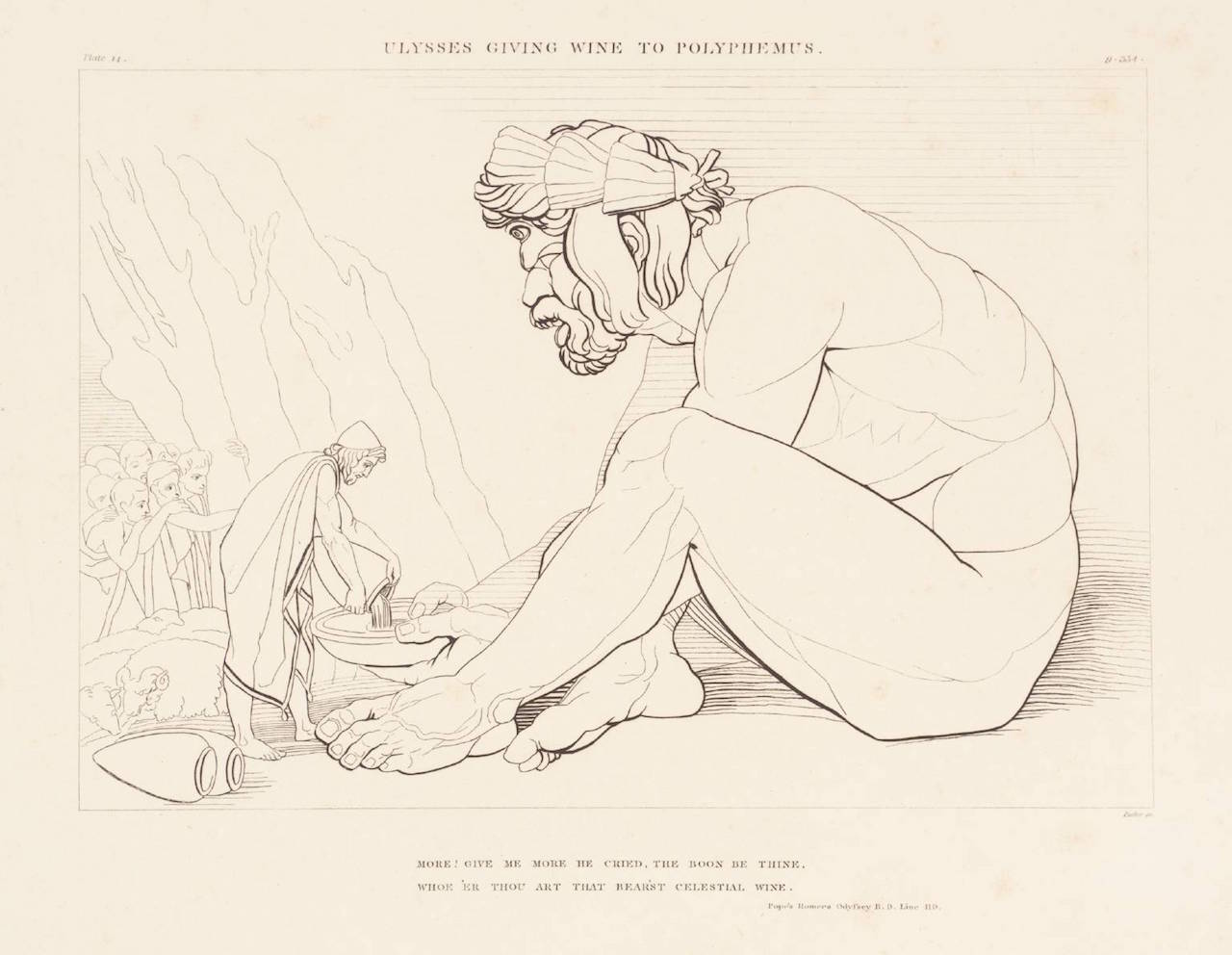 “Ulysses Giving Wine to Polyphemus” (1805). John Flaxman (1755–1826). Purchased as part of the Oppé Collection with assistance from the National Lottery through the Heritage Lottery Fund, 1996.
  “Circe Invidiosa,” (1892). J. W. Waterhouse (English, 1849–1917).
 “Teiresias appears to Ulysses during the sacrifice,” (1780–1785). Henry Fuseli (German, 1741–1825).
  “Ulysses and the Sirens” (ca. 1909). Herbert James Draper (English, 1863–1920).
 “Ulysses Asleep Laid on his Own Coast by the Phaeacian Sailors” (1805). John Flaxman (English, 1755–1826). Purchased as part of the Oppé Collection with assistance from the National Lottery through the Heritage Lottery Fund 1996.
  Minoan—probably Neopalatial—fresco commonly known as the “Lily Prince.” Whatever the exact type of this personage (perhaps a crowned acrobat, according to the interpretation of Maria Shaw), the Lily Prince is certainly a Minoan of elite standing. Public domain image based on a famous watercolor by Émile Gilliéron of a reconstruction by Arthur Evans.
 Detail from a fresco found at Hagia Triadha in Crete. Reconstruction by Mark Cameron, p. 96 of the catalogue Fresco: A Passport into the Past. Minoan Crete through the eyes of Mark Cameron. 1999. Catalogue curated by Doniert Evely. Athens: British School at Athens; and N. P. Goulandris Foundation, Museum of Cycladic Art. Reproduced with the permission of the British School at Athens. BSA Archive: Mark Cameron Personal Papers: CAM 1.
 “Minerva Restoring Ulysses to his Own Shape” (1805). John Flaxman (English, 1755–1826). Purchased as part of the Oppé Collection with assistance from the National Lottery through the Heritage Lottery Fund 1996.
 “Ulysses and his Dog” (1805). John Flaxman (English, 1755–1826). Purchased as part of the Oppé Collection with assistance from the National Lottery through the Heritage Lottery Fund 1996.
  “Ulysses Preparing to Fight with Irus” (1805). John Flaxman (English, 1755–1826) Purchased as part of the Oppé Collection with assistance from the National Lottery through the Heritage Lottery Fund 1996.
  “Euryclea Discovers Ulysses” (1805). John Flaxman (English, 1755–1826). Purchased as part of the Oppé Collection with assistance from the National Lottery through the Heritage Lottery Fund 1996.
  “The Harpies Going to Seize the Daughters of Pandareus” (1805). John Flaxman (English, 1755–1826). Purchased as part of the Oppé Collection with assistance from the National Lottery through the Heritage Lottery Fund 1996.
 Hēraklēs stringing a bow. Silver stater, c. 450–440 BCE, Thebes (Boeotia).
  Swallows, detail of the Spring Fresco at Thera, image via Flickr user
  Original artwork, by Flickr user
  Odysseus kiling Penelope’s suitors. Attic red-figure skyphos, ca. 440 BCE.
  Still life showing eggs, thrushes, napkin: from the House of Julia Felix, Pompeii.
  Eurykleia waking Penelope (1773). Print by Thomas Burke, after a painting by Angelika Kauffmann.
  Big Ed and Norma have just now broken free of the troublesome relationships that have kept these lovers apart for 27 years. Now at long last they can have a life together.
Still from
Big Ed and Norma have just now broken free of the troublesome relationships that have kept these lovers apart for 27 years. Now at long last they can have a life together.
Still from  “Mercury Conducting the Souls of the Suitors to the Infernal Regions” (1805). John Flaxman (English, 1755–1826). Purchased as part of the Oppé Collection with assistance from the National Lottery through the Heritage Lottery Fund 1996.
  “Ulysses Departing from Lacedaemon for Ithaca, with his Bride Penelope” (1805). John Flaxman (English, 1755–1826). Flaxman made this image the last in his Odyssey series, bringing the story of Penelope and Odysseus full circle. Purchased as part of the Oppé Collection with assistance from the National Lottery through the Heritage Lottery Fund 1996.


,_around_440_BC,_Altes_Museum_Berlin_(13718420225)_glare-reduced_white-bg.png)
