
View:
By Card
BOOK XV.
THE RETURN OF TELEMACHUS.
The goddess Minerva commands Telemachus in a vision to return to Ithaca. Pisistratus and he take leave of Menelaüs, and arrive at Pylos, where they part; Telemachus sets sail, after having received on board Theocly- menus the soothsayer. The scene then changes to the cottage of Eumaeus, who entertains Ulysses with a recital of his adventures. In the mean- time Telemachus arrives on the coast, and, sending the vessel to the town, proceeds by himself to the lodge of Eumaeus.
Now had Minerva
1
reach'd those ample plains,
1
Fam'd for the dance, where Menelaüs reigns;
Anxious she flies to great Ulysses' heir,
His instant voyage challenged all her care.
Beneath the royal portico display'd,
5
With Nestor's son Telemachus was laid;
In sleep profound the son of Nestor lies;
Not thine, Ulysses! Care unseal'd his eyes:
2
Restless he griev'd, with various fears oppress'd,
And all thy fortunes roll'd within his breast.
10
Minerva
When, 'O Telemachus!' (the goddess said)
'Too long in vain, too widely hast thou stray'd,
'Thus leaving careless thy paternal right
'The robbers' prize, the prey to lawless might.
'On fond pursuits neglectful while you roam,
15
'Even now the hand of rapine sacks the dome.
'Hence to Atrides; and his leave implore
'To launch thy vessel for thy natal shore:
'Fly, whilst thy mother virtuous yet withstands
'Her kindred's wishes, and her sire's commands;
20
'Through both, Eurymachus pursues the dame,
'And with the noblest gifts asserts his claim.
'Hence therefore, while thy stores thy own remain;
'Thou know'st the practice of the female train;
'Lost in the children of the present spouse,
25
'They slight the pledges of their former vows;
'Their love is always with the lover past;
'Still the succeeding flame expels the last.
'Let o'er thy house some chosen maid preside,
'Till heaven decrees to bless thee in a bride.
30
'But now thy more attentive ears incline,
'Observe the warnings of a power divine;
'For thee their snares the suitor lords shall lay
'In Samos' sands, or straits of Ithaca;
'To seize thy life shall lurk the murderous band,
35
'Ere yet thy footsteps press thy native land.
'No-sooner far their riot and their lust
'All-covering earth shall bury deep in dust!
'Then distant from the scatter'd islands steer,
'Nor let the night retard thy full career;
40
'Thy heavenly guardian shall instruct the gales
'To smooth thy passage and supply thy sails:
'And when at Ithaca thy labour ends,
'Send to the town the vessel with thy friends;
'But seek thou first the master of the swine,
45
'(For still to thee his loyal thoughts incline;)
'There pass the night; while he his course pursues
'To bring Penelope the wish'd-for news,
'That thou, safe sailing from the Pylian strand,
'Art come to bless her in thy native land.'
50
When, 'O Telemachus!' (the goddess said)
'Too long in vain, too widely hast thou stray'd,
'Thus leaving careless thy paternal right
'The robbers' prize, the prey to lawless might.
'On fond pursuits neglectful while you roam,
15
'Even now the hand of rapine sacks the dome.
'Hence to Atrides; and his leave implore
'To launch thy vessel for thy natal shore:
'Fly, whilst thy mother virtuous yet withstands
'Her kindred's wishes, and her sire's commands;
20
'Through both, Eurymachus pursues the dame,
'And with the noblest gifts asserts his claim.
'Hence therefore, while thy stores thy own remain;
'Thou know'st the practice of the female train;
'Lost in the children of the present spouse,
25
'They slight the pledges of their former vows;
'Their love is always with the lover past;
'Still the succeeding flame expels the last.
'Let o'er thy house some chosen maid preside,
'Till heaven decrees to bless thee in a bride.
30
'But now thy more attentive ears incline,
'Observe the warnings of a power divine;
'For thee their snares the suitor lords shall lay
'In Samos' sands, or straits of Ithaca;
'To seize thy life shall lurk the murderous band,
35
'Ere yet thy footsteps press thy native land.
'No-sooner far their riot and their lust
'All-covering earth shall bury deep in dust!
'Then distant from the scatter'd islands steer,
'Nor let the night retard thy full career;
40
'Thy heavenly guardian shall instruct the gales
'To smooth thy passage and supply thy sails:
'And when at Ithaca thy labour ends,
'Send to the town the vessel with thy friends;
'But seek thou first the master of the swine,
45
'(For still to thee his loyal thoughts incline;)
'There pass the night; while he his course pursues
'To bring Penelope the wish'd-for news,
'That thou, safe sailing from the Pylian strand,
'Art come to bless her in thy native land.'
50
Thus spoke the goddess, and resum'd her flight
To the pure regions of eternal light.
Meanwhile Pisistratus he gently shakes,
And with these words the slumbering youth awakes:
Telemachus
'Rise, son of Nestor; for the road prepare,
55
'And join the harness'd coursers to the car.'
'Rise, son of Nestor; for the road prepare,
55
'And join the harness'd coursers to the car.'
Pisistratus
48
'What cause,' he cried, 'can justify our flight
'To tempt the dangers of forbidding night?
'Here wait we rather, till approaching day
'Shall prompt our speed, and point the ready way.
60
'Nor think of flight before the Spartan king
'Shall bid farewell, and bounteous presents bring;
'Gifts, which to distant ages safely stor'd,
'The sacred act of friendship shall record.'
'What cause,' he cried, 'can justify our flight
'To tempt the dangers of forbidding night?
'Here wait we rather, till approaching day
'Shall prompt our speed, and point the ready way.
60
'Nor think of flight before the Spartan king
'Shall bid farewell, and bounteous presents bring;
'Gifts, which to distant ages safely stor'd,
'The sacred act of friendship shall record.'
Thus he. But when the dawn bestreak'd the east,
65
The king from Helen rose, and sought his guest.
As soon as his approach the hero knew,
The splendid mantle round him first he threw,
Then o'er his ample shoulders whirl'd the cloak,
Respectful met the monarch, and bespoke:
70
Telemachus
'Hail, great Atrides, favour'd of high Jove!
'Let not thy friends in vain for licence move.
'Swift let us measure back the watery way,
'Nor check our speed, impatient of delay.'
'Hail, great Atrides, favour'd of high Jove!
'Let not thy friends in vain for licence move.
'Swift let us measure back the watery way,
'Nor check our speed, impatient of delay.'
Menelaüs
'If with desire so strong thy bosom glows,
75
'Ill,' said the king, 'should I thy wish oppose:
'For oft in others freely I reprove
'The ill-tim'd efforts of officious love;
'Who love too much, hate in the like extreme,
'And both the golden mean alike condemn.
80
'Alike he thwarts the hospitable end,
'Who drives the free, or stays the hasty friend:
'True friendship's laws are by this rule express'd,
'Welcome the coming, speed the parting guest.
'Yet stay, my friends, and in your chariot take
85
'The noblest presents that our love can make;
'Meantime commit we to our women's care
'Some choice domestic viands to prepare;
'The traveller, rising from the banquet gay,
'Eludes the labours of the tedious way.
90
'Then if a wider course shall rather please
'Through spacious Argos and the realms of Greece,
'Atrides in his chariot shall attend;
'Himself thy convoy to each royal friend.
'No prince will let Ulysses' heir remove
95
'Without some pledge, some monument of love:
'These will the cauldron, these the tripod give;
'From those the well-pair'd mules we shall receive,
'Or bowl emboss'd whose golden figures live.'
'If with desire so strong thy bosom glows,
75
'Ill,' said the king, 'should I thy wish oppose:
'For oft in others freely I reprove
'The ill-tim'd efforts of officious love;
'Who love too much, hate in the like extreme,
'And both the golden mean alike condemn.
80
'Alike he thwarts the hospitable end,
'Who drives the free, or stays the hasty friend:
'True friendship's laws are by this rule express'd,
'Welcome the coming, speed the parting guest.
'Yet stay, my friends, and in your chariot take
85
'The noblest presents that our love can make;
'Meantime commit we to our women's care
'Some choice domestic viands to prepare;
'The traveller, rising from the banquet gay,
'Eludes the labours of the tedious way.
90
'Then if a wider course shall rather please
'Through spacious Argos and the realms of Greece,
'Atrides in his chariot shall attend;
'Himself thy convoy to each royal friend.
'No prince will let Ulysses' heir remove
95
'Without some pledge, some monument of love:
'These will the cauldron, these the tripod give;
'From those the well-pair'd mules we shall receive,
'Or bowl emboss'd whose golden figures live.'
Telemachus
To whom the youth, for prudence fam'd, replied:
100
'O monarch, care of heaven! thy people's pride!
'No friend in Ithaca my place supplies,
'No powerful hands are there, no watchful eyes:
'My stores expos'd and fenceless house demand
'The speediest succour from my guardian hand;
105
'Lest, in a search too anxious and too vain
'Of one lost joy, I lose what yet remain.'
92
To whom the youth, for prudence fam'd, replied:
100
'O monarch, care of heaven! thy people's pride!
'No friend in Ithaca my place supplies,
'No powerful hands are there, no watchful eyes:
'My stores expos'd and fenceless house demand
'The speediest succour from my guardian hand;
105
'Lest, in a search too anxious and too vain
'Of one lost joy, I lose what yet remain.'
His purpose when the generous warrior heard,
He charged the household cates to be prepar'd.
Now with the dawn, from his adjoining home,
110
Was Boethœdes Eteoneus
3
come;
Swift at the word he forms the rising blaze,
And o'er the coals the smoking fragments lays.
Meantime the king, his son, and Helen went
Where the rich wardrobe breathed a costly scent.
115
The king selected from the glittering rows
A bowl; the prince a silver beaker chose.
The beauteous queen revolv'd with careful eyes
Her various textures of unnumber'd dyes,
And chose the largest; with no vulgar art
120
Her own fair hands embroider'd every part:
Beneath the rest it lay divinely bright,
Like radiant Hesper o'er the gems of night.
Then with each gift they hastened to their guest,
And thus the king Ulysses' heir address'd:
125
Menelaüs
'Since fix'd are thy resolves, may thundering Jove
'With happiest omens thy desires approve!
'This silver bowl, whose costly margins shine
'Enchas'd with gold, this valued gift be thine;
'To me this present, of Vulcanian frame,
130
'From Sidon's hospitable monarch came;
'To thee we now consign the precious load,
'The pride of kings, and labour of a god.'
'Since fix'd are thy resolves, may thundering Jove
'With happiest omens thy desires approve!
'This silver bowl, whose costly margins shine
'Enchas'd with gold, this valued gift be thine;
'To me this present, of Vulcanian frame,
130
'From Sidon's hospitable monarch came;
'To thee we now consign the precious load,
'The pride of kings, and labour of a god.'
Then gave the cup, while Megapenthe brought
The silver vase with living sculpture wrought.
135
The beauteous queen, advancing next, display'd
The shining veil, and thus endearing said:
Helen
'Accept, dear youth, this monument of love,
'Long since, in better days, by Helen wove:
'Safe in thy mother's care the vesture lay,
140
'To deck thy bride, and grace thy nuptial day.
'Meantime may'st thou with happiest speed regain
'Thy stately palace, and thy wide domain.'
130
'Accept, dear youth, this monument of love,
'Long since, in better days, by Helen wove:
'Safe in thy mother's care the vesture lay,
140
'To deck thy bride, and grace thy nuptial day.
'Meantime may'st thou with happiest speed regain
'Thy stately palace, and thy wide domain.'
She said, and gave the veil; with grateful look
The prince the variegated present took.
145
And now, when through the royal dome they pass'd,
High on a throne the king each stranger placed.
A golden ewer th' attendant damsel brings,
Replete with water from the crystal springs;
With copious streams the shining vase supplies
150
A silver laver of capacious size.
They wash. The tables in fair order spread,
The glittering canisters are crown'd with bread;
Viands of various kinds allure the taste,
Of choicest sort and savour; rich repast!
155
Whilst Eteoneus portions out the shares,
Atrides' son the purple draught prepares.
And now, (each sated with the genial feast,
And the short rage of thirst and hunger ceas'd,)
Ulysses' son, with his illustrious friend,
160
The horses join, the polish'd car ascend.
Along the court the fiery steeds rebound,
And the wide portal echoes to the sound.
The king precedes; a bowl with fragrant wine
(Libation destin'd to the powers divine)
165
His right hand held: before the steeds he stands,
Then, mix'd with prayers, he utters these commands:
Menelaüs
'Farewell, and prosper, youths! let Nestor know
'What grateful thoughts still in this bosom glow,
'For all the proofs of his paternal care,
170
'Through the long dangers of the ten years' war.'
'Farewell, and prosper, youths! let Nestor know
'What grateful thoughts still in this bosom glow,
'For all the proofs of his paternal care,
170
'Through the long dangers of the ten years' war.'
Telemachus
'Ah! doubt not our report' (the prince rejoin'd)
"Of all the virtues of thy generous mind.
'And oh! return'd might we Ulysses meet!
'To him thy presents show, thy words repeat:
175
'How will each speech his grateful wonder raise!
'How will each gift indulge us in thy praise!'
'Ah! doubt not our report' (the prince rejoin'd)
"Of all the virtues of thy generous mind.
'And oh! return'd might we Ulysses meet!
'To him thy presents show, thy words repeat:
175
'How will each speech his grateful wonder raise!
'How will each gift indulge us in thy praise!'
Scarce ended thus the prince, when on the right
Advanced the bird of Jove: auspicious sight!
A milk-white fowl his clinching talons bore,
180
With care domestic pamper'd at the floor.
Peasants in vain with threatening cries pursue,
In solemn speed the bird majestic flew
Full dexter to the car: the prosperous sight
Fill'd every breast with wonder and delight.
185
But Nestor's son the cheerful silence broke,
And in these words the Spartan chief bespoke:
Pisistratus
"Say if to us the gods these omens send,
'Or fates peculiar to thyself portend?'
"Say if to us the gods these omens send,
'Or fates peculiar to thyself portend?'
Whilst yet the monarch paus'd, with doubts oppress'd,
190
The beauteous queen reliev'd his labouring breast:
Helen
'Hear me,' (she cried,) 'to whom the gods have given
'To read this sign, and mystic sense of heaven.
'As thus the plumy sovereign of the air
'Left on the mountain's brow his callow care,
195
'And wander'd through the wide ethereal way
'To pour his wrath on yon luxurious prey;
'So shall thy godlike father, toss'd in vain
'Through all the dangers of the boundless main,
'Arrive, (or is perchance already come,)
200
'From slaughter'd gluttons to release the dome.'
'Hear me,' (she cried,) 'to whom the gods have given
'To read this sign, and mystic sense of heaven.
'As thus the plumy sovereign of the air
'Left on the mountain's brow his callow care,
195
'And wander'd through the wide ethereal way
'To pour his wrath on yon luxurious prey;
'So shall thy godlike father, toss'd in vain
'Through all the dangers of the boundless main,
'Arrive, (or is perchance already come,)
200
'From slaughter'd gluttons to release the dome.'
Telemachus
179
'Oh! if this promis'd bliss by thundering Jove'
'(The prince replied) 'stand fix'd in fate above;
'To thee, as to some god, I'll temples raise,
'And crown thy altars with the costly blaze.'
205
'Oh! if this promis'd bliss by thundering Jove'
'(The prince replied) 'stand fix'd in fate above;
'To thee, as to some god, I'll temples raise,
'And crown thy altars with the costly blaze.'
205
He said; and, bending o'er his chariot, flung
Athwart the fiery steeds the smarting thong;
The bounding shafts upon the harness play,
Till night descending intercepts the way.
To Diocles at Pherae they repair,
210
Whose boasted sire was sacred Alpheus' heir;
With him all night the youthful strangers stay'd,
Nor found the hospitable rites unpaid.
But soon as morning from her orient bed
Had tinged the mountains with her earliest red,
215
They join'd the steeds, and on the chariot sprung;
The brazen portals in their passage rung.
To Pylos soon they came; when thus begun
To Nestor's heir Ulysses' godlike son:
Telemachus
'Let not Pisistratus in vain be press'd,
220
'Nor unconsenting hear his friend's request;
'His friend by long hereditary claim,
'In toils his equal, and in years the same.
'No farther from our vessel, I implore,
'The coursers drive; but lash them to the shore.
225
'Too long thy father would his friend detain;
'I dread his proffer'd kindness urg'd in vain.'
'Let not Pisistratus in vain be press'd,
220
'Nor unconsenting hear his friend's request;
'His friend by long hereditary claim,
'In toils his equal, and in years the same.
'No farther from our vessel, I implore,
'The coursers drive; but lash them to the shore.
225
'Too long thy father would his friend detain;
'I dread his proffer'd kindness urg'd in vain.'
The hero paus'd, and ponder'd this request,
While love and duty warr'd within his breast.
At length resolv'd, he turn'd his ready hand,
230
And lash'd his panting coursers to the strand.
There, while within the poop with care he stor'd
The regal presents of the Spartan lord,
Pisistratus
'With speed begone,' (said he;) 'call every mate,
'Ere yet to Nestor I the tale relate:
235
"'Tis true, the fervour of his generous heart
'Brooks no repulse, nor couldst thou soon depart:
'Himself will seek thee here, nor wilt thou find,
'In words alone, the Pylian monarch kind.
'But when, arriv'd, he thy return shall know,
240
'How will his breast with honest fury glow!'
'With speed begone,' (said he;) 'call every mate,
'Ere yet to Nestor I the tale relate:
235
"'Tis true, the fervour of his generous heart
'Brooks no repulse, nor couldst thou soon depart:
'Himself will seek thee here, nor wilt thou find,
'In words alone, the Pylian monarch kind.
'But when, arriv'd, he thy return shall know,
240
'How will his breast with honest fury glow!'
This said, the sounding strokes his horses fire,
And soon he reach'd the palace of his sire.
Telemachus
'Now' (cried Telemachus) 'with speedy care
'Hoist every sail, and every oar prepare.'
245
'Now' (cried Telemachus) 'with speedy care
'Hoist every sail, and every oar prepare.'
245
Swift as the word his willing mates obey,
And seize their seats, impatient for the sea.
Meantime the prince with sacrifice adores
Minerva, and her guardian aid implores;
When lo! a wretch
4
ran breathless to the shore,
250
New from his crime; and reeking yet with gore.
A seer he was, from great Melampus sprung.
5
Melampus, who in Pylos flourished long,
Till, urged by wrongs, a foreign realm he chose,
Far from the hateful cause of all his woes.
255
Neleus his treasures one long year detains:
As long he groan'd in Phylacus's chains:
Meantime, what anguish and what rage combin'd,
For lovely Pero rack'd his labouring mind!
Yet 'scap'd he death: and, vengeful of his wrong,
260
To Pylos drove the lowing herds along:
Then (Neleus vanquish'd, and consign'd the fair
To Bias' arms) he sought a foreign air;
Argos the rich for his retreat he chose;
There form'd his empire: there his palace rose.
265
From him Antiphates and Mantius came;
The first begot Oïcleus great in fame,
And he Amphiaraüs, immortal name!
The people's saviour, and divinely wise,
Belov'd by Jove, and him who gilds the skies;
270
Yet short his date of life! by female pride he dies.
6
From Mantius Clitus,
7
whom Aurora's love
Snatch'd for his beauty to the thrones above;
And Polyphides, on whom Phœbus shone
With fullest rays, Amphiaraus now gone;
275
In Hyperesia's groves he
8
made abode,
And taught mankind the counsels of the god.
From him sprung Theoclymenus, who found
(The sacred wine yet foaming on the ground)
Telemachus: whom, as to Heaven he press'd
280
His ardent vows, the stranger thus address'd:
Theoclymenus
'O thou! that dost thy happy course prepare
'With pure libations and with solemn prayer;
'By that dread power to whom thy vows are paid;
'By all the lives of these; thy own dear head,
285
'Declare sincerely to no foe's demand
'Thy name, thy lineage, and paternal land.'
'O thou! that dost thy happy course prepare
'With pure libations and with solemn prayer;
'By that dread power to whom thy vows are paid;
'By all the lives of these; thy own dear head,
285
'Declare sincerely to no foe's demand
'Thy name, thy lineage, and paternal land.'
Telemachus
265
'Prepare, then,' said Telemachus, 'to know
'A tale from falsehood free, not free from woe.
'From Ithaca, of royal birth I came,
290
'And great Ulysses (ever-honour'd name!)
'Once was my sire, though now, for ever lost,
'In Stygian gloom he glides a pensive ghost!
'Whose fate inquiring through the world we rove:
'The last, the wretched proof of filial love.'
295
'Prepare, then,' said Telemachus, 'to know
'A tale from falsehood free, not free from woe.
'From Ithaca, of royal birth I came,
290
'And great Ulysses (ever-honour'd name!)
'Once was my sire, though now, for ever lost,
'In Stygian gloom he glides a pensive ghost!
'Whose fate inquiring through the world we rove:
'The last, the wretched proof of filial love.'
295
Theoclymenus
The stranger then: 'Nor shall I aught conceal,
'But the dire secret of my fate reveal.
'Of my own tribe an Argive wretch I slew;
'Whose powerful friends the luckless deed pursue
'With unrelenting rage, and force from home
300
'The blood-stain'd exile, ever doom'd to roam.
'But bear, oh bear me o'er yon azure flood;
'Receive the suppliant! spare my destin'd blood!'
The stranger then: 'Nor shall I aught conceal,
'But the dire secret of my fate reveal.
'Of my own tribe an Argive wretch I slew;
'Whose powerful friends the luckless deed pursue
'With unrelenting rage, and force from home
300
'The blood-stain'd exile, ever doom'd to roam.
'But bear, oh bear me o'er yon azure flood;
'Receive the suppliant! spare my destin'd blood!'
Telemachus
'Stranger,' (replied the prince,) 'securely rest
'Affianced in our faith; henceforth our guest.'
305
'Stranger,' (replied the prince,) 'securely rest
'Affianced in our faith; henceforth our guest.'
305
Thus affable, Ulysses' godlike heir
Takes from the stranger's hand the glittering spear:
9
He climbs the ship, ascends the stern with haste,
And by his side the guest accepted placed.
The chief his order gives: th' obedient band
310
With due observance wait the chief's command;
With speed the mast they rear, with speed unbind
The spacious sheet, and stretch it to the wind.
Minerva calls; the ready gales obey
With rapid speed to whirl them o'er the sea.
315
Crunus they pass'd, next Chalcis'
10
roll'd away,
When thickening darkness clos'd the doubtful day;
The silver Phaea's
11
glittering rills they lost,
And skimm'd along by Elis' sacred coast.
Then cautious through the rocky reaches wind,
320
And, turning sudden, shun the death design'd.
Meantime, the king, Eumaeus, and the rest,
Sate in the cottage, at their rural feast:
The banquet pass'd, and satiate every man,
To try his host, Ulysses thus began:
325
Ulysses
'Yet one night more, my friends, indulge your guest;
'The last I purpose in your walls to rest;
'To-morrow for myself I must provide,
'And only ask your counsel, and a guide;
'Patient to roam the street, by hunger led,
330
'And bless the friendly hand that gives me bread.
'There in Ulysses' roof I may relate
'Ulysses' wanderings to his royal mate;
'Or, mingling with the suitors' haughty train,
'Not undeserving some support obtain.
335
'Hermes to me his various gifts imparts,
'Patron of industry and manual arts:
'Few can with me in dexterous works contend,
'The pyre to build, the stubborn oak to rend;
'To turn the tasteful viand o'er the flame;
340
'Or foam the goblet with a purple stream.
'Such are the tasks of men of mean estate,
'Whom fortune dooms to serve the rich and great.'
'Yet one night more, my friends, indulge your guest;
'The last I purpose in your walls to rest;
'To-morrow for myself I must provide,
'And only ask your counsel, and a guide;
'Patient to roam the street, by hunger led,
330
'And bless the friendly hand that gives me bread.
'There in Ulysses' roof I may relate
'Ulysses' wanderings to his royal mate;
'Or, mingling with the suitors' haughty train,
'Not undeserving some support obtain.
335
'Hermes to me his various gifts imparts,
'Patron of industry and manual arts:
'Few can with me in dexterous works contend,
'The pyre to build, the stubborn oak to rend;
'To turn the tasteful viand o'er the flame;
340
'Or foam the goblet with a purple stream.
'Such are the tasks of men of mean estate,
'Whom fortune dooms to serve the rich and great.'
Eumaeus
'Alas!' (Eumaeus with a sigh rejoin'd)
'How sprung a thought so monstrous in thy mind?
345
'If on that godless race thou would'st attend,
'Fate owes thee sure a miserable end!
'Their wrongs and blasphemies ascend the sky,
'And pull descending vengeance from on high.
'Not such, my friend, the servants of their feast;
350
'A blooming train in rich embroidery dress'd!
'With earth's whole tribute the bright table bends,
'And smiling round celestial youth attends.
'Stay, then; no eye askance beholds thee here;
'Sweet is thy converse to each social ear:
355
'Well pleased, and pleasing, in our cottage rest,
'Till good Telemachus accepts his guest
'With genial gifts, and change of fair attires,
'And safe conveys thee where thy soul desires.'
'Alas!' (Eumaeus with a sigh rejoin'd)
'How sprung a thought so monstrous in thy mind?
345
'If on that godless race thou would'st attend,
'Fate owes thee sure a miserable end!
'Their wrongs and blasphemies ascend the sky,
'And pull descending vengeance from on high.
'Not such, my friend, the servants of their feast;
350
'A blooming train in rich embroidery dress'd!
'With earth's whole tribute the bright table bends,
'And smiling round celestial youth attends.
'Stay, then; no eye askance beholds thee here;
'Sweet is thy converse to each social ear:
355
'Well pleased, and pleasing, in our cottage rest,
'Till good Telemachus accepts his guest
'With genial gifts, and change of fair attires,
'And safe conveys thee where thy soul desires.'
Ulysses
340
To him the man of woes: 'O gracious Jove!
360
'Reward this stranger's hospitable love!
'Who knows the son of sorrow to relieve,
'Cheers the sad heart, nor lets affliction grieve
'Of all the ills unhappy mortals know,
'A life of wanderings is the greatest woe:
365
'On all their weary ways wait Care and Pain,
'And Pine and Penury, a meagre train.
'To such a man since harbour you afford,
'Relate the farther fortunes of your lord;
'What cares his mother's tender breast engage,
370
'And sire forsaken on the verge of age;
'Beneath the sun prolong they yet their breath,
'Or range the house of darkness and of death?'
To him the man of woes: 'O gracious Jove!
360
'Reward this stranger's hospitable love!
'Who knows the son of sorrow to relieve,
'Cheers the sad heart, nor lets affliction grieve
'Of all the ills unhappy mortals know,
'A life of wanderings is the greatest woe:
365
'On all their weary ways wait Care and Pain,
'And Pine and Penury, a meagre train.
'To such a man since harbour you afford,
'Relate the farther fortunes of your lord;
'What cares his mother's tender breast engage,
370
'And sire forsaken on the verge of age;
'Beneath the sun prolong they yet their breath,
'Or range the house of darkness and of death?'
Eumaeus
To whom the swain: 'Attend what you inquire;
'Laërtes lives, the miserable sire;
375
'Lives, but implores of every power to lay
'The burden down, and wishes for the day.
'Torn from his offspring in the eve of life,
'Torn from th' embraces of his tender wife,
'Sole, and all comfortless, he wastes away
380
'Old age, untimely posting ere his day.
'She too, sad mother! for Ulysses lost
'Pin'd out her bloom, and vanish'd to a ghost:
'(So dire a fate, ye righteous gods! avert
'From every friendly, every feeling heart;)
385
'While yet she was, though clouded o'er with grief,
'Her pleasing converse minister'd relief:
'With Ctimene, her youngest daughter, bred,
'One roof contain'd us, and one table fed.
'But when the softly-stealing pace of time
390
'Crept on from childhood into youthful prime,
'To Samos isle she sent the wedded fair;
'Me to the fields, to tend the rural care;
'Array'd in garments her own hands had wove,
'Nor less the darling object of her love.
395
'Her hapless death my brighter days o'ercast,
'Yet Providence deserts me not at last:
'My present labours food and drink procure,
'And more, the pleasure to relieve the poor.
'Small is the comfort from the queen to hear
400
'Unwelcome news, or vex the royal ear;
'Blank and discountenanced the servants stand,
'Nor dare to question where the proud command:
'No profit springs beneath usurping powers;
'Want feeds not there, where Luxury devours,
405
'Nor harbours charity where riot reigns:
'Proud are the lords, and wretched are the swains.'
380
To whom the swain: 'Attend what you inquire;
'Laërtes lives, the miserable sire;
375
'Lives, but implores of every power to lay
'The burden down, and wishes for the day.
'Torn from his offspring in the eve of life,
'Torn from th' embraces of his tender wife,
'Sole, and all comfortless, he wastes away
380
'Old age, untimely posting ere his day.
'She too, sad mother! for Ulysses lost
'Pin'd out her bloom, and vanish'd to a ghost:
'(So dire a fate, ye righteous gods! avert
'From every friendly, every feeling heart;)
385
'While yet she was, though clouded o'er with grief,
'Her pleasing converse minister'd relief:
'With Ctimene, her youngest daughter, bred,
'One roof contain'd us, and one table fed.
'But when the softly-stealing pace of time
390
'Crept on from childhood into youthful prime,
'To Samos isle she sent the wedded fair;
'Me to the fields, to tend the rural care;
'Array'd in garments her own hands had wove,
'Nor less the darling object of her love.
395
'Her hapless death my brighter days o'ercast,
'Yet Providence deserts me not at last:
'My present labours food and drink procure,
'And more, the pleasure to relieve the poor.
'Small is the comfort from the queen to hear
400
'Unwelcome news, or vex the royal ear;
'Blank and discountenanced the servants stand,
'Nor dare to question where the proud command:
'No profit springs beneath usurping powers;
'Want feeds not there, where Luxury devours,
405
'Nor harbours charity where riot reigns:
'Proud are the lords, and wretched are the swains.'
The suffering chief at this began to melt;
And, 'O Eumaeus! thou' (he cries) 'hast felt
'The spite of fortune too! her cruel hand
410
'Snatch'd thee an infant from thy native land!
'Snatch'd from thy parents' arms, thy parents' eyes,
'To early wants! a man of miseries!
'The whole sad story, from its first, declare:
'Sunk the fair city by the rage of war,
415
'Where once thy parents dwelt? or did they keep
'In humbler life, the lowing herds and sheep?
'So left perhaps to tend the fleecy train,
'Rude pirates seiz'd, and shipp'd thee o'er the main?'
'Doom'd a fair prize to grace some prince's board,
420
'The worthy purchase of a foreign lord.'
Eumaeus
'If then my fortunes can delight my friend,
'A story fruitful of events attend:
'Another's sorrow may thy ear enjoy,
'And wine the lengthen'd intervals employ.
425
'Long nights the now declining year bestows;
'A part we consecrate to soft repose,
'A part in pleasing talk we entertain;
'For too much rest itself becomes a pain.
'Let those, whom sleep invites, the call obey,
430
'Their cares resuming with the dawning day:
'Here let us feast, and to the feast be join'd
'Discourse, the sweeter banquet of the mind;
'Review the series of our lives, and taste
'The melancholy joy of evils pass'd:
435
'For he who much has suffer'd, much will know,
'And pleas'd remembrance builds delight on woe.
'Above Ortygia lies an isle of fame,
'Far hence remote, and Syria
12
is the name;
"(There curious eyes inscribed with wonder trace
440
'The sun's diurnal, and his annual race;)
13
'Not large, but fruitful; stored with grass, to keep
"The bellowing oxen and the bleating sheep;
'Her sloping hills the mantling vines adorn,
'And her rich valleys wave with golden corn.
445
'No want, no famine, the glad natives know,
'Nor sink by sickness to the shades below;
'But when a length of years unnerves the strong,
'Apollo comes, and Cynthia comes along.
'They bend the silver bow with tender skill,
450
'And, void of pain, the silent arrows kill.
14
'Two equal tribes this fertile land divide,
'Where two fair cities rise with equal pride,
'But both in constant peace one prince obey,
'And Ctesius there, my father, holds the sway.
455
415
'Freighted, it seems, with toys of every sort,
'A ship of Sidon anchor'd in our port;
'What time it chanced the palace entertain'd,
'Skill'd in rich works, a woman of their land:
'This nymph, where anchor'd the Phœnician train,
460
'To wash her robes descending to the main,
'A smooth-tongued sailor won her to his mind;
"(For love deceives the best of womankind).
'A sudden trust from sudden liking grew;
'She told her name, her race, and all she knew.
465
"I too' (she cried) 'from glorious Sidon came,
"My father Arybas, of wealthy fame;
"But, snatch'd by pirates from my native place,
"The Taphians sold me to this man's embrace.'
"Haste then,' (the false designing youth replied,)
470
"Haste to thy country; love shall be thy guide;
"Haste to thy father's house, thy father's breast,
"For still he lives, and lives with riches blest.'
"Swear first,' (she cried), 'ye sailors! to restore
'A wretch in safety to her native shore.'
475
'Swift as she ask'd, the ready sailors swore.
'She then proceeds: 'Now let our compact made
"Be nor by signal nor by word betray'd,
"Nor near me any of your crew descried,
"By road frequented, or by fountain side:
480
"Be silence still our guard. The monarch's spies
"(For watchful age is ready to surmise)
"Are still at hand; and this reveal'd, must be
"Death to yourselves, eternal chains to me.
"Your vessel loaded, and your traffic pass'd,
485
"Despatch a wary messenger with haste;
"Then gold and costly treasures will I bring,
"And more, the infant-offspring of the king.
"Him, child-like wandering forth, I'll lead away,
"(A noble prize!) and to your ship convey.'
490
454
Thus spoke the dame, and homeward took the road.
'A year they traffic, and their vessel load.
"Their stores complete, and ready now to weigh,
'A spy was sent their summons to convey:
'An artist to my father's palace came,
495
'With gold and amber chains, elaborate frame:
'Each female eye the glittering links employ;
'They turn, review, and cheapen every toy.
'He took th' occasion, as they stood intent,
'Gave her the sign, and to his vessel went.
500
'She straight pursu'd, and seiz'd my willing arm;
'I follow'd smiling, innocent of harm.
'Three golden goblets in the porch she found,
'(The guests not enter'd, but the table crown'd;)
'Hid in her fraudful bosom these she bore:
505
'Now set the sun, and darken'd all the shore.
'Arriving then, where, tilting on the tides,
'Prepar'd to launch the freighted vessel rides,
'Aboard they heave us, mount their decks, and sweep
'With level oar along the glassy deep.
510
'Six calmy days and six smooth nights we sail,
'And constant Jove supplied the gentle gale.
'The seventh, the fraudful wretch, (no cause descried,)
'Touch'd by Diana's vengeful arrow, died.
'Down dropp'd the caitiff-corse, a worthless load,
515
'Down to the deep; there roll'd, the future food
'Of fierce sea-wolves, and monsters of the flood.
'A helpless infant I remain'd behind;
'Thence borne to Ithaca by wave and wind;
'Sold to Laërtes by divine command,
520
'And now adopted to a foreign land.'
'If then my fortunes can delight my friend,
'A story fruitful of events attend:
'Another's sorrow may thy ear enjoy,
'And wine the lengthen'd intervals employ.
425
'Long nights the now declining year bestows;
'A part we consecrate to soft repose,
'A part in pleasing talk we entertain;
'For too much rest itself becomes a pain.
'Let those, whom sleep invites, the call obey,
430
'Their cares resuming with the dawning day:
'Here let us feast, and to the feast be join'd
'Discourse, the sweeter banquet of the mind;
'Review the series of our lives, and taste
'The melancholy joy of evils pass'd:
435
'For he who much has suffer'd, much will know,
'And pleas'd remembrance builds delight on woe.
'Above Ortygia lies an isle of fame,
'Far hence remote, and Syria
12
is the name;
"(There curious eyes inscribed with wonder trace
440
'The sun's diurnal, and his annual race;)
13
'Not large, but fruitful; stored with grass, to keep
"The bellowing oxen and the bleating sheep;
'Her sloping hills the mantling vines adorn,
'And her rich valleys wave with golden corn.
445
'No want, no famine, the glad natives know,
'Nor sink by sickness to the shades below;
'But when a length of years unnerves the strong,
'Apollo comes, and Cynthia comes along.
'They bend the silver bow with tender skill,
450
'And, void of pain, the silent arrows kill.
14
'Two equal tribes this fertile land divide,
'Where two fair cities rise with equal pride,
'But both in constant peace one prince obey,
'And Ctesius there, my father, holds the sway.
455
'Freighted, it seems, with toys of every sort,
'A ship of Sidon anchor'd in our port;
'What time it chanced the palace entertain'd,
'Skill'd in rich works, a woman of their land:
'This nymph, where anchor'd the Phœnician train,
460
'To wash her robes descending to the main,
'A smooth-tongued sailor won her to his mind;
"(For love deceives the best of womankind).
'A sudden trust from sudden liking grew;
'She told her name, her race, and all she knew.
465
"I too' (she cried) 'from glorious Sidon came,
"My father Arybas, of wealthy fame;
"But, snatch'd by pirates from my native place,
"The Taphians sold me to this man's embrace.'
"Haste then,' (the false designing youth replied,)
470
"Haste to thy country; love shall be thy guide;
"Haste to thy father's house, thy father's breast,
"For still he lives, and lives with riches blest.'
"Swear first,' (she cried), 'ye sailors! to restore
'A wretch in safety to her native shore.'
475
'Swift as she ask'd, the ready sailors swore.
'She then proceeds: 'Now let our compact made
"Be nor by signal nor by word betray'd,
"Nor near me any of your crew descried,
"By road frequented, or by fountain side:
480
"Be silence still our guard. The monarch's spies
"(For watchful age is ready to surmise)
"Are still at hand; and this reveal'd, must be
"Death to yourselves, eternal chains to me.
"Your vessel loaded, and your traffic pass'd,
485
"Despatch a wary messenger with haste;
"Then gold and costly treasures will I bring,
"And more, the infant-offspring of the king.
"Him, child-like wandering forth, I'll lead away,
"(A noble prize!) and to your ship convey.'
490
Thus spoke the dame, and homeward took the road.
'A year they traffic, and their vessel load.
"Their stores complete, and ready now to weigh,
'A spy was sent their summons to convey:
'An artist to my father's palace came,
495
'With gold and amber chains, elaborate frame:
'Each female eye the glittering links employ;
'They turn, review, and cheapen every toy.
'He took th' occasion, as they stood intent,
'Gave her the sign, and to his vessel went.
500
'She straight pursu'd, and seiz'd my willing arm;
'I follow'd smiling, innocent of harm.
'Three golden goblets in the porch she found,
'(The guests not enter'd, but the table crown'd;)
'Hid in her fraudful bosom these she bore:
505
'Now set the sun, and darken'd all the shore.
'Arriving then, where, tilting on the tides,
'Prepar'd to launch the freighted vessel rides,
'Aboard they heave us, mount their decks, and sweep
'With level oar along the glassy deep.
510
'Six calmy days and six smooth nights we sail,
'And constant Jove supplied the gentle gale.
'The seventh, the fraudful wretch, (no cause descried,)
'Touch'd by Diana's vengeful arrow, died.
'Down dropp'd the caitiff-corse, a worthless load,
515
'Down to the deep; there roll'd, the future food
'Of fierce sea-wolves, and monsters of the flood.
'A helpless infant I remain'd behind;
'Thence borne to Ithaca by wave and wind;
'Sold to Laërtes by divine command,
520
'And now adopted to a foreign land.'
Ulysses
To him the king: 'Reciting thus thy cares,
'My secret soul in all thy sorrow shares;
'But one choice blessing (such is Jove's high will)
'Has sweeten'd all thy bitter draught of ill:
525
'Torn from thy country to no hapless end,
'The gods have, in a master, given a friend.
'Whatever frugal nature needs is thine,
'(For she needs little,) daily bread and wine.
'While I, so many wanderings past and woes,
530
'Live but on what thy poverty bestows.'
493
To him the king: 'Reciting thus thy cares,
'My secret soul in all thy sorrow shares;
'But one choice blessing (such is Jove's high will)
'Has sweeten'd all thy bitter draught of ill:
525
'Torn from thy country to no hapless end,
'The gods have, in a master, given a friend.
'Whatever frugal nature needs is thine,
'(For she needs little,) daily bread and wine.
'While I, so many wanderings past and woes,
530
'Live but on what thy poverty bestows.'
So pass'd in pleasing dialogue away
The night; then down to short repose they lay;
Till radiant rose the messenger of day.
15
While in the port of Ithaca, the band
535
Of young Telemachus approach'd the land;
Their sails they loos'd, they lash'd the mast aside,
And cast their anchors, and the cables tied:
Then on the breezy shore, descending, join
In grateful banquet o'er the rosy wine.
540
When thus the prince: 'Now each his course pursue:
'I to the fields, and to the city you.
'Long absent hence, I dedicate this day
'My swains to visit, and the works survey.
'Expect me with the morn, to pay the skies
545
'Our debt of safe return in feast and sacrifice.'
Then Theoclymenus: 'But who shall lend,
'Meantime, protection to thy stranger friend?
'Straight to the queen and palace shall I fly,
'Or, yet more distant, to some lord apply?'
550
The prince return'd: 'Renown'd in days of yore
'Has stood our father's hospitable door;
'No other roof a stranger should receive,
'No other hands than ours the welcome give.
'But in my absence riot fills the place,
555
'Nor bears the modest queen a stranger's face;
'From noiseful revel far remote she flies,
'But rarely seen, or seen with weeping eyes.
'No-let Eurymachus receive my guest,
'Of nature courteous, and by far the best;
560
'He woos the queen with more respectful flame,
'And emulates her former husband's fame:
'With what success, 'tis Jove's alone to know,
'And the hop'd nuptials turn to joy or woe.'
Thus speaking, on the right up-soar'd in air
565
The hawk, Apollo's swift-wing'd messenger:
His deathful pounces tore a trembling dove;
The clotted feathers, scatter'd from above,
Between the hero and the vessel pour
Thick plumage, mingled with a sanguine shower.
570
Th' observing augur took the prince aside,
Seiz'd by the hand, and thus prophetic cried:
Theoclymenus
'Yon bird, that dexter cuts th' aërial road,
'Rose ominous, nor flies without a god:
'No race but thine shall Ithaca obey;
575
'To thine, for ages, heaven decrees the sway.'
'Yon bird, that dexter cuts th' aërial road,
'Rose ominous, nor flies without a god:
'No race but thine shall Ithaca obey;
575
'To thine, for ages, heaven decrees the sway.'
Telemachus
'Succeed the omens, gods!' (the youth rejoin'd:)
'Soon shall my bounties speak a grateful mind,
'And soon each envied happiness attend
'The man who calls Telemachus his friend.'
580
Then to Peiraeus:
16
'Thou whom time has prov'd
'A faithful servant, by thy prince belov'd!
'Till we returning shall our guest demand,
'Accept this charge with honour, at our hand.'
'Succeed the omens, gods!' (the youth rejoin'd:)
'Soon shall my bounties speak a grateful mind,
'And soon each envied happiness attend
'The man who calls Telemachus his friend.'
580
Then to Peiraeus:
16
'Thou whom time has prov'd
'A faithful servant, by thy prince belov'd!
'Till we returning shall our guest demand,
'Accept this charge with honour, at our hand.'
Peiraeus
To this Peiraeus: 'Joyful I obey,
585
'Well pleas'd the hospitable rites to pay.
'The presence of thy guest shall best reward
'(If long thy stay) the absence of my lord.'
To this Peiraeus: 'Joyful I obey,
585
'Well pleas'd the hospitable rites to pay.
'The presence of thy guest shall best reward
'(If long thy stay) the absence of my lord.'
With that, their anchors he commands to weigh,
Mount the tall bark, and launch into the sea.
590
All with obedient haste forsake the shores,
And, placed in order, spread their equal oars.
Then from the deck the prince his sandals takes;
Pois'd in his hand the pointed javelin shakes.
They part; while, lessening from the hero's view,
595
Swift to the town the well-row'd galley flew:
The hero trod the margin of the main,
And reach'd the mansion of his faithful swain.
Odyssey. Homer. London. 1858.
Sponsored by Perseus Project, Tufts University.
 Zeus, Athena, and Hermes (1810). Drawing by John Flaxman.
 Athena (1810). Drawing by John Flaxman.
 Telemachus with Athena as Mentor (1810). Drawing by John Flaxman.
  Nestor’s Sacrifice (1805). Engraving after John Flaxman (1755-1826). Purchased as part of the Oppé Collection with assistance from the National Lottery through the Heritage Lottery Fund 1996.
  “The Fair Helen.” Willy Pogany (Hungarian, 1882–1955).
Image
“The Fair Helen.” Willy Pogany (Hungarian, 1882–1955).
Image  “Leucothea, the White Goddess, Preserving Ulysses” (1805). John Flaxman (1755–1826). Purchased as part of the Oppé Collection with assistance from the National Lottery through the Heritage Lottery Fund, 1996.
  “Nausicaa” (1878), Frederick Leighton (English, 1830–1896).
 Red-figured pyxis, picturing Nereids at home, “indoors”: the Nereid with her hair down is labeled as Thaleia.
 View of Garitsa, region right outside the northern walls of the city of Corfu, and according to the legend the site of Alcinous’s gardens (1867). Étienne Rey (French, 1789–1867).
  Blind Demodokos sings of the siege of Troy (1810), by John Flaxman (English, 1755–1826).
 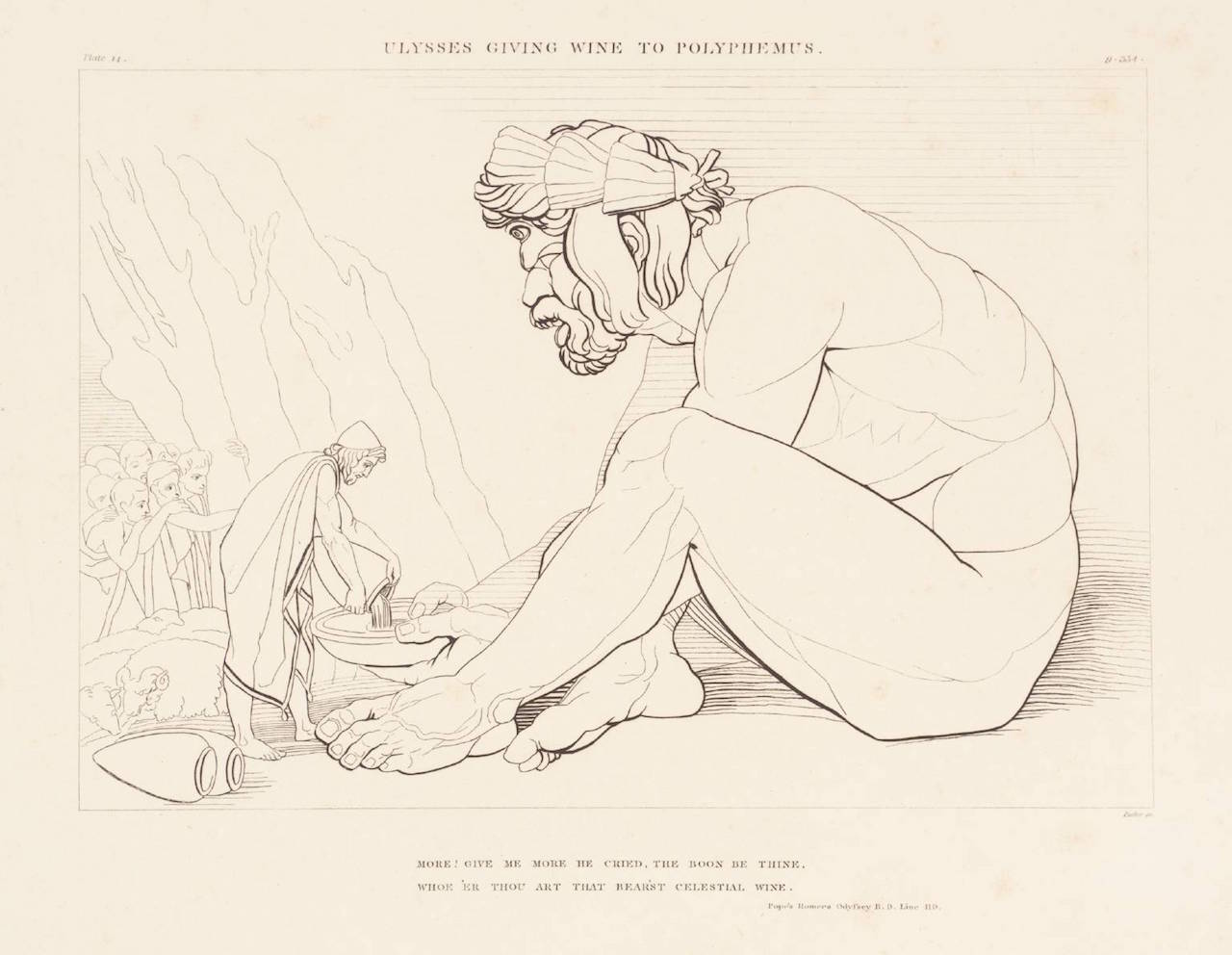 “Ulysses Giving Wine to Polyphemus” (1805). John Flaxman (1755–1826). Purchased as part of the Oppé Collection with assistance from the National Lottery through the Heritage Lottery Fund, 1996.
  “Circe Invidiosa,” (1892). J. W. Waterhouse (English, 1849–1917).
 “Teiresias appears to Ulysses during the sacrifice,” (1780–1785). Henry Fuseli (German, 1741–1825).
  “Ulysses and the Sirens” (ca. 1909). Herbert James Draper (English, 1863–1920).
 “Ulysses Asleep Laid on his Own Coast by the Phaeacian Sailors” (1805). John Flaxman (English, 1755–1826). Purchased as part of the Oppé Collection with assistance from the National Lottery through the Heritage Lottery Fund 1996.
  Minoan—probably Neopalatial—fresco commonly known as the “Lily Prince.” Whatever the exact type of this personage (perhaps a crowned acrobat, according to the interpretation of Maria Shaw), the Lily Prince is certainly a Minoan of elite standing. Public domain image based on a famous watercolor by Émile Gilliéron of a reconstruction by Arthur Evans.
 Detail from a fresco found at Hagia Triadha in Crete. Reconstruction by Mark Cameron, p. 96 of the catalogue Fresco: A Passport into the Past. Minoan Crete through the eyes of Mark Cameron. 1999. Catalogue curated by Doniert Evely. Athens: British School at Athens; and N. P. Goulandris Foundation, Museum of Cycladic Art. Reproduced with the permission of the British School at Athens. BSA Archive: Mark Cameron Personal Papers: CAM 1.
 “Minerva Restoring Ulysses to his Own Shape” (1805). John Flaxman (English, 1755–1826). Purchased as part of the Oppé Collection with assistance from the National Lottery through the Heritage Lottery Fund 1996.
 “Ulysses and his Dog” (1805). John Flaxman (English, 1755–1826). Purchased as part of the Oppé Collection with assistance from the National Lottery through the Heritage Lottery Fund 1996.
  “Ulysses Preparing to Fight with Irus” (1805). John Flaxman (English, 1755–1826) Purchased as part of the Oppé Collection with assistance from the National Lottery through the Heritage Lottery Fund 1996.
  “Euryclea Discovers Ulysses” (1805). John Flaxman (English, 1755–1826). Purchased as part of the Oppé Collection with assistance from the National Lottery through the Heritage Lottery Fund 1996.
  “The Harpies Going to Seize the Daughters of Pandareus” (1805). John Flaxman (English, 1755–1826). Purchased as part of the Oppé Collection with assistance from the National Lottery through the Heritage Lottery Fund 1996.
 Hēraklēs stringing a bow. Silver stater, c. 450–440 BCE, Thebes (Boeotia).
  Swallows, detail of the Spring Fresco at Thera, image via Flickr user
  Original artwork, by Flickr user
  Odysseus kiling Penelope’s suitors. Attic red-figure skyphos, ca. 440 BCE.
  Still life showing eggs, thrushes, napkin: from the House of Julia Felix, Pompeii.
  Eurykleia waking Penelope (1773). Print by Thomas Burke, after a painting by Angelika Kauffmann.
  Big Ed and Norma have just now broken free of the troublesome relationships that have kept these lovers apart for 27 years. Now at long last they can have a life together.
Still from
Big Ed and Norma have just now broken free of the troublesome relationships that have kept these lovers apart for 27 years. Now at long last they can have a life together.
Still from  “Mercury Conducting the Souls of the Suitors to the Infernal Regions” (1805). John Flaxman (English, 1755–1826). Purchased as part of the Oppé Collection with assistance from the National Lottery through the Heritage Lottery Fund 1996.
  “Ulysses Departing from Lacedaemon for Ithaca, with his Bride Penelope” (1805). John Flaxman (English, 1755–1826). Flaxman made this image the last in his Odyssey series, bringing the story of Penelope and Odysseus full circle. Purchased as part of the Oppé Collection with assistance from the National Lottery through the Heritage Lottery Fund 1996.


,_around_440_BC,_Altes_Museum_Berlin_(13718420225)_glare-reduced_white-bg.png)
