
View:
By Card
BOOK XIV.
THE CONVERSATION WITH EUMAEUS.
Ulysses arrives in disguise at the house of Eumaeus, where he is received, entertained, and lodged with the utmost hospitality. The several dis- courses of that faithful old servant, with the feigned story told by Ulys- ses to conceal himself, and other conversations on various subjects, take up this entire book.
BUT he, deep-musing, o'er the mountains stray'd
1
Through mazy thickets of the woodland shade,
And cavern'd ways, the shaggy coast along,
With cliffs and nodding forests overhung.
Eumaeus at his sylvan lodge he sought,
5
A faithful servant, and without a fault.
Ulysses found him busied, as he sate
Before the threshold of his rustic gate;
Around, the mansion in a circle shone,
A rural portico of rugged stone;
10
(In absence of his lord, with honest toil
His own industrious hands had rais'd the pile,)
The wall was stone from neighbouring quarries borne,
Encircled with a fence of native thorn,
And strong with pales, by many a weary stroke
15
Of stubborn labour hewn from heart of oak;
Frequent and thick. Within the space were rear'd
Twelve ample cells, the lodgments of his herd.
Full fifty pregnant females each contain'd:
The males without (a smaller race) remain'd;
20
Doom'd to supply the suitors' wasteful feast,
A stock by daily luxury decreas'd;
Now scarce four hundred left. These to defend,
Four savage dogs, a watchful guard, attend.
Here sat Eumaeus, and his cares applied
25
To form strong buskins of well-season'd hide.
Of four assistants who his labour share,
Three now were absent on the rural care:
The fourth drove victims to the suitor train:
But he, of ancient faith, a simple swain,
30
Sigh'd, while he furnish'd the luxurious board,
And wearied Heaven with wishes for his lord.
Soon as Ulysses near th' inclosure drew,
With open mouths the furious mastiffs flew:
Down sate the sage, and, cautious to withstand,
35
Let fall th' offensive truncheon from his hand.
1
Sudden, the master runs: aloud he calls;
And from his hasty hand the leather
2
falls;
With showers of stones he drives them far away;
The scattering dogs around at distance bay.
40
Eumaeus
'Unhappy stranger!' (thus the faithful swain
Began with accent gracious and humane,)
'What sorrow had been mine, if at my gate
'Thy reverend age had met a shameful fate!
'Enough of woes already have I known:
45
'Enough my master's sorrows and my own.
'While here (ungrateful task!) his herds I feed,
'Ordain'd for lawless rioters to bleed!
'Perhaps, supported at another's board,
'Far from his country roams my hapless lord!
50
'Or sigh'd in exile forth his latest breath,
'Now cover'd with th' eternal shade of death!
'But enter this my homely roof, and see
'Our woods not void of hospitality.
'Then tell me whence thou art, and what the share
55
'Of woes and wanderings thou wert born to bear.'
48
'Unhappy stranger!' (thus the faithful swain
Began with accent gracious and humane,)
'What sorrow had been mine, if at my gate
'Thy reverend age had met a shameful fate!
'Enough of woes already have I known:
45
'Enough my master's sorrows and my own.
'While here (ungrateful task!) his herds I feed,
'Ordain'd for lawless rioters to bleed!
'Perhaps, supported at another's board,
'Far from his country roams my hapless lord!
50
'Or sigh'd in exile forth his latest breath,
'Now cover'd with th' eternal shade of death!
'But enter this my homely roof, and see
'Our woods not void of hospitality.
'Then tell me whence thou art, and what the share
55
'Of woes and wanderings thou wert born to bear.'
He said, and, seconding the kind request,
With friendly step precedes his unknown guest.
A shaggy goat's soft hide beneath him spread,
And with fresh rushes heap'd an ample bed:
60
Joy touch'd the hero's tender soul, to find
So just reception from a heart so kind;
And 'Oh, ye gods! with all your blessings grace'
(He thus broke forth) 'this friend of human race!'
Eumaeus
The swain replied: 'It never was our guise
65
'To slight the poor, or aught humane despise:
'For Jove unfolds our hospitable door,
''Tis Jove that sends the stranger and the poor.
'Little, alas! is all the good I can;
'A man oppress'd, dependent, yet a man:
70
'Accept such treatment as a swain affords,
'Slave to the insolence of youthful lords!
'Far hence is by unequal gods remov'd
'That man of bounties, loving and belov'd!
'To whom whate'er his slave enjoys is ow'd,
75
'And more, had Fate allow'd, had been bestow'd:
'But Fate comdemn'd him to a foreign shore;
'Much have I sorrow'd, but my master more.
'Now cold he lies, to death's embrace resign'd:
'Ah, perish Helen! perish all her kind!
80
'For whose curs'd cause, in Agamemnon's name,
'He trod so fatally the paths of Fame.'
72
The swain replied: 'It never was our guise
65
'To slight the poor, or aught humane despise:
'For Jove unfolds our hospitable door,
''Tis Jove that sends the stranger and the poor.
'Little, alas! is all the good I can;
'A man oppress'd, dependent, yet a man:
70
'Accept such treatment as a swain affords,
'Slave to the insolence of youthful lords!
'Far hence is by unequal gods remov'd
'That man of bounties, loving and belov'd!
'To whom whate'er his slave enjoys is ow'd,
75
'And more, had Fate allow'd, had been bestow'd:
'But Fate comdemn'd him to a foreign shore;
'Much have I sorrow'd, but my master more.
'Now cold he lies, to death's embrace resign'd:
'Ah, perish Helen! perish all her kind!
80
'For whose curs'd cause, in Agamemnon's name,
'He trod so fatally the paths of Fame.'
His vest succinct then girding round his waist,
Forth rush'd the swain with hospitable haste;
Straight to the lodgments of his herd he run,
85
Where the fat porkers slept beneath the sun;
Of two, his cutlass launch'd the spouting blood;
These, quarter'd, singed, and fix'd on forks of wood.
All hasty on the hissing coals he threw;
And, smoking, back the tasteful viands drew,
90
Broachers and all; then on the board display'd
The ready meal, before Ulysses laid
With flour imbrown'd; next mingled wine yet new,
And luscious as the bees' nectareous dew:
Then sate, companion of the friendly feast,
95
With open look; and thus bespoke his guest:
Eumaeus
'Take with free welcome what our hands prepare,
'Such food as falls to simple servants' share;
'The best our lords consume; those thoughtless peers,
'Rich without bounty, guilty without fears.
100
'Yet sure the gods their impious acts detest,
'And honour justice and the righteous breast.
'Pirates and conquerors of harden'd mind,
'The foes of peace, and scourges of mankind,
'To whom offending men are made a prey
105
'When Jove in vengeance gives a land away;
'Ev'n these, when of their ill-got spoils possess'd,
'Find sure tormentors in the guilty breast:
'Some voice of God close whispering from within,
"'Wretch! this is villany, and this is sin.'
110
'But these, no doubt, some oracle explore,
'That tells, the great Ulysses is no more.
'Hence springs their confidence, and from our sighs
'Their rapine strengthens, and their riots rise:
'Constant as Jove the night and day bestows,
115
'Bleeds a whole hecatomb, a vintage flows.
'None match'd this hero's wealth, of all who reign
'O'er the fair islands of the neighbouring main.
'Nor all the monarchs whose far-dreaded sway
'The wide-extended continents obey:
120
'First, on the mainland,
3
of Ulysses' breed
'Twelve herds, twelve flocks, on ocean's margin feed;
'As many stalls for shaggy goats are rear'd;
'As many lodgments for the tusky herd;
'Those, foreign keepers guard: and here are seen
125
'Twelve herds of goats that graze our utmost green;
'To native pastors is their charge assign'd,
'And mine the care to feed the bristly kind:
'Each day the fattest bleeds of either herd,
'All to the suitors' wasteful board preferr'd.'
130
109
'Take with free welcome what our hands prepare,
'Such food as falls to simple servants' share;
'The best our lords consume; those thoughtless peers,
'Rich without bounty, guilty without fears.
100
'Yet sure the gods their impious acts detest,
'And honour justice and the righteous breast.
'Pirates and conquerors of harden'd mind,
'The foes of peace, and scourges of mankind,
'To whom offending men are made a prey
105
'When Jove in vengeance gives a land away;
'Ev'n these, when of their ill-got spoils possess'd,
'Find sure tormentors in the guilty breast:
'Some voice of God close whispering from within,
"'Wretch! this is villany, and this is sin.'
110
'But these, no doubt, some oracle explore,
'That tells, the great Ulysses is no more.
'Hence springs their confidence, and from our sighs
'Their rapine strengthens, and their riots rise:
'Constant as Jove the night and day bestows,
115
'Bleeds a whole hecatomb, a vintage flows.
'None match'd this hero's wealth, of all who reign
'O'er the fair islands of the neighbouring main.
'Nor all the monarchs whose far-dreaded sway
'The wide-extended continents obey:
120
'First, on the mainland,
3
of Ulysses' breed
'Twelve herds, twelve flocks, on ocean's margin feed;
'As many stalls for shaggy goats are rear'd;
'As many lodgments for the tusky herd;
'Those, foreign keepers guard: and here are seen
125
'Twelve herds of goats that graze our utmost green;
'To native pastors is their charge assign'd,
'And mine the care to feed the bristly kind:
'Each day the fattest bleeds of either herd,
'All to the suitors' wasteful board preferr'd.'
130
Thus he, benevolent: his unknown guest
With hunger keen devours the savoury feast;
While schemes of vengeance ripen in his breast.
Silent and thoughtful while the board he ey'd,
Eumaeus pours on high the purple tide;
135
The king with smiling looks his joy express'd,
And thus the kind inviting host address'd:
Ulysses
'Say now, what man is he, the man deplor'd,
'So rich, so potent, whom you style your lord?
'Late with such affluence and possessions bless'd,
140
'And now in honour's glorious bed at rest.
'Whoever was the warrior, he must be
'To fame no stranger, nor perhaps to me;
'Who (so the gods and so the Fates ordain'd)
'Have wander'd many a sea and many a land.'
145
'Say now, what man is he, the man deplor'd,
'So rich, so potent, whom you style your lord?
'Late with such affluence and possessions bless'd,
140
'And now in honour's glorious bed at rest.
'Whoever was the warrior, he must be
'To fame no stranger, nor perhaps to me;
'Who (so the gods and so the Fates ordain'd)
'Have wander'd many a sea and many a land.'
145
Eumaeus
'Small is the faith the prince and queen ascribe'
'(Replied Eumaeus) 'to the wandering tribe.
'For needy strangers still to flattery fly,
'And want too oft betrays the tongue to lie.
'Each vagrant traveller, that touches here,
150
'Deludes with fallacies the royal ear,
'To dear remembrance makes his image rise,
'And calls the springing sorrows from her eyes.
'Such thou may'st be. But he whose name you crave
'Moulders in earth, or welters on the wave
155
'Or food for fish or dogs his relics lie,
'Or torn by birds are scatter'd through the sky.
'So perish'd he and left (for ever lost)
'Much woe to all, but sure to me the most.
'So mild a master never shall I find;
160
'Less dear the parents whom I left behind,
'Less soft my mother, less my father kind.
'Not with such transport would my eyes run o'er,
'Again to hail them in their native shore;
'As lov'd Ulysses once more to embrace,
165
'Restor'd and breathing in his natal place.
'That name for ever dread, yet ever dear,
'Even in his absence I pronounce with fear:
'In my respect, he bears a prince's part;
'But lives a very brother in my heart.'
170
148
'Small is the faith the prince and queen ascribe'
'(Replied Eumaeus) 'to the wandering tribe.
'For needy strangers still to flattery fly,
'And want too oft betrays the tongue to lie.
'Each vagrant traveller, that touches here,
150
'Deludes with fallacies the royal ear,
'To dear remembrance makes his image rise,
'And calls the springing sorrows from her eyes.
'Such thou may'st be. But he whose name you crave
'Moulders in earth, or welters on the wave
155
'Or food for fish or dogs his relics lie,
'Or torn by birds are scatter'd through the sky.
'So perish'd he and left (for ever lost)
'Much woe to all, but sure to me the most.
'So mild a master never shall I find;
160
'Less dear the parents whom I left behind,
'Less soft my mother, less my father kind.
'Not with such transport would my eyes run o'er,
'Again to hail them in their native shore;
'As lov'd Ulysses once more to embrace,
165
'Restor'd and breathing in his natal place.
'That name for ever dread, yet ever dear,
'Even in his absence I pronounce with fear:
'In my respect, he bears a prince's part;
'But lives a very brother in my heart.'
170
Thus spoke the faithful swain, and thus rejoin'd
The master of his grief, the man of patient mind:
Ulysses
'Ulysses' friend! shall view his old abodes,
'(Distrustful as thou art,) nor doubt the gods.
'Nor speak I rashly, but with faith averr'd,
175
'And what I speak attesting Heaven has heard.
'If so, a cloak and vesture be my meed;
'Till his return, no title shall I plead,
'Though certain be my news, and great my need;
'Whom want itself can force untruths to tell,
180
'My soul detests him as the gates of hell.
'Thou first be witness, hospitable Jove!
'And every god inspiring social love!
'And witness every household power that waits,
'Guard of these fires, and angel of these gates!
185
'Ere the next moon increase, or this decay,
'His ancient realms Ulysses shall survey,
'In blood and dust each proud oppressor mourn,
'And the lost glories of his house return.'
'Ulysses' friend! shall view his old abodes,
'(Distrustful as thou art,) nor doubt the gods.
'Nor speak I rashly, but with faith averr'd,
175
'And what I speak attesting Heaven has heard.
'If so, a cloak and vesture be my meed;
'Till his return, no title shall I plead,
'Though certain be my news, and great my need;
'Whom want itself can force untruths to tell,
180
'My soul detests him as the gates of hell.
'Thou first be witness, hospitable Jove!
'And every god inspiring social love!
'And witness every household power that waits,
'Guard of these fires, and angel of these gates!
185
'Ere the next moon increase, or this decay,
'His ancient realms Ulysses shall survey,
'In blood and dust each proud oppressor mourn,
'And the lost glories of his house return.'
Eumaeus
'Nor shall that meed be thine, nor evermore
190
'Shall lov'd Ulysses hail this happy shore:
'(Replied Eumaeus :) to the present hour
'Now turn thy thought, and joys within our power.
'From sad reflection let my soul repose;
'The name of him awakes a thousand woes.
195
'But guard him, gods! and to these arms restore!
'Not his true consort can desire him more;
'Not old Laërtes, broken with despair;
'Not young Telemachus, his blooming heir.
'Alas, Telemachus! my sorrows flow
200
'Afresh for thee, my second cause of woe!
'Like some fair plant set by a heavenly hand,
'He grew, he flourish'd, and he bless'd the land;
'In all the youth his father's image shin'd,
'Bright in his person, brighter in his mind.
205
'What man, or god, deceiv'd his better sense,
'Far on the swelling seas to wander hence?
'To distant Pylos hapless is he gone,
'To seek his father's fate, and find his own!
'For traitors wait his way, with dire design
210
'To end at once the great Arcesian
4
line.
'But let us leave him to their wills above;
'The fates of men are in the hand of Jove.
'And now, my venerable guest! declare
'Your name, your parents, and your native air:
215
'Sincere from whence begun your course relate,
'And to what ship I owe the friendly freight?'
191
'Nor shall that meed be thine, nor evermore
190
'Shall lov'd Ulysses hail this happy shore:
'(Replied Eumaeus :) to the present hour
'Now turn thy thought, and joys within our power.
'From sad reflection let my soul repose;
'The name of him awakes a thousand woes.
195
'But guard him, gods! and to these arms restore!
'Not his true consort can desire him more;
'Not old Laërtes, broken with despair;
'Not young Telemachus, his blooming heir.
'Alas, Telemachus! my sorrows flow
200
'Afresh for thee, my second cause of woe!
'Like some fair plant set by a heavenly hand,
'He grew, he flourish'd, and he bless'd the land;
'In all the youth his father's image shin'd,
'Bright in his person, brighter in his mind.
205
'What man, or god, deceiv'd his better sense,
'Far on the swelling seas to wander hence?
'To distant Pylos hapless is he gone,
'To seek his father's fate, and find his own!
'For traitors wait his way, with dire design
210
'To end at once the great Arcesian
4
line.
'But let us leave him to their wills above;
'The fates of men are in the hand of Jove.
'And now, my venerable guest! declare
'Your name, your parents, and your native air:
215
'Sincere from whence begun your course relate,
'And to what ship I owe the friendly freight?'
Thus he: and thus (with prompt invention bold)
The cautious chief his ready story told:
5
Ulysses
'On dark reserve what better can prevail,
220
'Or from the fluent tongue produce the tale,
'Than when two friends, alone, in peaceful place
'Confer, and wines and cates the table grace;
'But most, the kind inviter's cheerful face?
'Thus might we sit, with social goblets crown'd,
225
'Till the whole circle of the year goes round;
'Not the whole circle of the year would close
'My long narration of a life of woes.
'But such was Heaven's high will! Know then, I came
'From sacred Crete, and from a sire of fame;
230
'Castor Hylacides, (that name he bore,)
'Belov'd and honour'd in his native shore;
'Bless'd in his riches, in his children more.
'Sprung of a handmaid, from a bought embrace,
'I shar'd his kindness with his lawful race:
235
'But when that fate, which all must undergo,
'From earth remov'd him to the shades below,
'The large domain his greedy sons divide,
'And each was portion'd as the lots decide.
'Little, alas! was left my wretched share,
240
'Except a house, a covert from the air:
'But what by niggard fortune was denied,
'A willing widow's copious wealth supplied.
'My valour was my plea, a gallant mind
'That, true to honour, never lagg'd behind,
245
'(The sex is ever to a soldier kind.)
'Now wasting years my former strength confound,
'And added woes have bow'd me to the ground;
'Yet by the stubble you may guess the grain,
'And mark the ruins of no vulgar man.
250
'Me, Pallas gave to lead the martial storm,
'And the fair ranks of battle to deform;
'Me, Mars inspir'd to turn the foe to flight,
'And tempt the secret ambush of the night.
'Let ghastly Death in all his forms appear,
255
'I saw him not, it was not mine to fear.
'Before the rest I rais'd my ready steel;
'The first I met, he yielded, or he fell.
'But works of peace my soul disdain'd to bear,
'The rural labour, or domestic care.
260
'To raise the mast, the missile dart to wing,
'And send swift arrows from the bounding string,
'Were arts the gods made grateful to my mind;
'Those gods, who turn (to various ends design'd)
'The various thoughts and talents of mankind.
265
'Before the Grecians touch'd the Trojan plain,
'Nine times commander or by land or main,
'In foreign fields I spread my glory far,
'Great in the praise, rich in the spoils of war:
'Thence, charged with riches, as increas'd in fame,
270
'To Crete return'd, an honourable name.
235
'But when great Jove that direful war decreed,
'Which roused all Greece, and made the mighty bleed;
'Our states myself and Idomen employ
'To lead their fleets, and carry death to Troy.
275
'Nine years we warr'd; the tenth saw Ilion fall;
'Homeward we sail'd, but heaven dispers'd us all.
6
'One only month my wife enjoy'd my stay;
'So will'd the god who gives and takes away.
'Nine ships I mann'd, equipp'd with ready stores,
280
'Intent to voyage to th' Aegyptian shores;
'In feast and sacrifice my chosen train
'Six days consum'd; the seventh we plough'd the main.
'Crete's ample fields diminish to our eye;
'Before the Boreal blast the vessels fly;
285
'Safe through the level seas we sweep our way;
'The steersman governs, and the ships obey.
'The fifth fair morn we stem th' Aegyptian tide,
'And tilting o'er the bay the vessels ride:
'To anchor there my fellows I command,
290
'And spies commission to explore the land.
'But, sway'd by lust of gain, and headlong will,
'The coasts they ravage, and the natives kill.
'The spreading clamour to their city flies,
'And horse and foot in mingled tumult rise.
295
'The reddening dawn reveals the circling fields,
'Horrid with bristly spears, and glancing shields.
'Jove thunder'd on their side. Our guilty head
'We turn'd to flight; the gathering vengeance spread
'On all parts round, and heaps on heaps lie dead.
300
'I then explor'd my thought, what course to prove:
'(And sure the thought was dictated by Jove;)
'Oh, had he left me to that happier doom,
'And sav'd a life of miseries to come!
'The radiant helmet from my brows unlaced,
305
'And low on earth my shield and javelin cast,
'I meet the monarch with a suppliant's face,
'Approach his chariot, and his knees embrace.
'He heard, he sav'd, he placed me at his side;
'My state he pitied, and my tears he dried,
310
'Restrain'd the rage the vengeful foe express'd,
'And turn'd the deadly weapons from my breast.
'Pious! to guard the hospitable rite,
'And fearing Jove, whom mercy's works delight.
285
'In Aegypt thus with peace and plenty bless'd,
315
'I liv'd (and happy still had liv'd) a guest.
'On seven bright years successive blessings wait;
'The next chang'd all the colour of my fate.
'A false Phœnician, of insidious mind,
'Vers'd in vile arts, and foe to humankind,
320
'With semblance fair invites me to his home
'I seiz'd the proffer (ever fond to roam):
'Domestic in his faithless roof I stay'd,
'Till the swift sun his annual circle made.
'To Libya then he meditates the way;
325
'With guileful art a stranger to betray,
'And sell to bondage in a foreign land:
'Much doubting, yet compell'd, I quit the strand.
'Through the mid seas the nimble pinnace sails,
'Aloof from Crete, before the northern gales:
330
'But when remote her chalky cliffs we lost,
'And far from ken of any other coast,
'When all was wild expanse of sea and air,
'Then doom'd high Jove due vengeance to prepare.
'He hung a night of horrors o'er their head;
335
'(The shaded ocean blacken'd as it spread;)
'He launch'd the fiery bolt; from pole to pole
'Broad burst the lightnings, deep the thunders roll;
'In giddy rounds the whirling ship is toss'd,
'And all in clouds of smothering sulphur lost.
340
'As from a hanging rock's tremendous height,
'The sable crows with intercepted flight
'Drop endlong; scarr'd and black with sulphurous hue,
'So from the deck are hurl'd the ghastly crew.
'Such end the wicked found! but Jove's intent
345
'Was yet to save th' oppress'd and innocent.
'Placed on the mast, (the last resource of life,)
'With winds and waves I held unequal strife;
'For nine long days the billows tilting o'er,
'The tenth soft wafts me to Thesprotia's
7
shore.
350
'The monarch's son a shipwreck'd wretch reliev'd,
'The sire with hospitable rites receiv'd,
'And in his palace like a brother placed,
'With gifts of price and gorgeous garments graced.
321
'While here I sojourn'd, oft I heard the fame
355
'How late Ulysses to the country came,
'How lov'd, how honour'd, in this court he stay'd,
'And here his whole collected treasure laid;
'I saw myself the vast unnumber'd store
'Of steel elaborate, and refulgent ore,
360
'And brass high heap'd amidst the regal dome;
'Immense supplies for ages yet to come!
'Meantime he voyaged to explore the will
'Of Jove, on high Dodona's holy hill,
'What means might best his safe return avail,
365
'To come in pomp, or bear a secret sail?
'Full oft has Phidon,
8
whilst he pour'd the wine,
'Attesting solemn all the powers divine,
'That soon Ulysses would return, declar'd,
'The sailors waiting, and the ships prepar'd.
370
'But first the king dismiss'd me from his shores,
'For fair Dulichium
9
crown'd with fruitful stores;
'To good Acastus's
10
friendly care consign'd:
'But other counsels pleas'd the sailors' mind:
'New frauds were plotted by the faithless train,
375
'And misery demands me once again.
'Soon as remote from shore they plough the wave,
'With ready hands they rush to seize their slave;
'Then with these tatter'd rags they wrapp'd me round
'(Stripp'd of my own,) and to the vessel bound.
380
'At eve, at Ithaca's delightful land
'The ship arriv'd: forth issuing on the sand,
'They sought repast: while, to th' unhappy kind,
'The pitying gods themselves my chains unbind.
'Soft I descended, to the sea applied
385
'My naked breast, and shot along the tide.
'Soon pass'd beyond their sight, I left the flood,
'And took the spreading shelter of the wood.
'Their prize escap'd the faithless pirates mourn'd;
'But deem'd inquiry vain, and to their ships return'd.
390
'Screen'd by protecting gods from hostile eyes,
'They led me to a good man and a wise,
'To live beneath thy hospitable care,
'And wait the woes heaven dooms me yet to bear.'
'On dark reserve what better can prevail,
220
'Or from the fluent tongue produce the tale,
'Than when two friends, alone, in peaceful place
'Confer, and wines and cates the table grace;
'But most, the kind inviter's cheerful face?
'Thus might we sit, with social goblets crown'd,
225
'Till the whole circle of the year goes round;
'Not the whole circle of the year would close
'My long narration of a life of woes.
'But such was Heaven's high will! Know then, I came
'From sacred Crete, and from a sire of fame;
230
'Castor Hylacides, (that name he bore,)
'Belov'd and honour'd in his native shore;
'Bless'd in his riches, in his children more.
'Sprung of a handmaid, from a bought embrace,
'I shar'd his kindness with his lawful race:
235
'But when that fate, which all must undergo,
'From earth remov'd him to the shades below,
'The large domain his greedy sons divide,
'And each was portion'd as the lots decide.
'Little, alas! was left my wretched share,
240
'Except a house, a covert from the air:
'But what by niggard fortune was denied,
'A willing widow's copious wealth supplied.
'My valour was my plea, a gallant mind
'That, true to honour, never lagg'd behind,
245
'(The sex is ever to a soldier kind.)
'Now wasting years my former strength confound,
'And added woes have bow'd me to the ground;
'Yet by the stubble you may guess the grain,
'And mark the ruins of no vulgar man.
250
'Me, Pallas gave to lead the martial storm,
'And the fair ranks of battle to deform;
'Me, Mars inspir'd to turn the foe to flight,
'And tempt the secret ambush of the night.
'Let ghastly Death in all his forms appear,
255
'I saw him not, it was not mine to fear.
'Before the rest I rais'd my ready steel;
'The first I met, he yielded, or he fell.
'But works of peace my soul disdain'd to bear,
'The rural labour, or domestic care.
260
'To raise the mast, the missile dart to wing,
'And send swift arrows from the bounding string,
'Were arts the gods made grateful to my mind;
'Those gods, who turn (to various ends design'd)
'The various thoughts and talents of mankind.
265
'Before the Grecians touch'd the Trojan plain,
'Nine times commander or by land or main,
'In foreign fields I spread my glory far,
'Great in the praise, rich in the spoils of war:
'Thence, charged with riches, as increas'd in fame,
270
'To Crete return'd, an honourable name.
'But when great Jove that direful war decreed,
'Which roused all Greece, and made the mighty bleed;
'Our states myself and Idomen employ
'To lead their fleets, and carry death to Troy.
275
'Nine years we warr'd; the tenth saw Ilion fall;
'Homeward we sail'd, but heaven dispers'd us all.
6
'One only month my wife enjoy'd my stay;
'So will'd the god who gives and takes away.
'Nine ships I mann'd, equipp'd with ready stores,
280
'Intent to voyage to th' Aegyptian shores;
'In feast and sacrifice my chosen train
'Six days consum'd; the seventh we plough'd the main.
'Crete's ample fields diminish to our eye;
'Before the Boreal blast the vessels fly;
285
'Safe through the level seas we sweep our way;
'The steersman governs, and the ships obey.
'The fifth fair morn we stem th' Aegyptian tide,
'And tilting o'er the bay the vessels ride:
'To anchor there my fellows I command,
290
'And spies commission to explore the land.
'But, sway'd by lust of gain, and headlong will,
'The coasts they ravage, and the natives kill.
'The spreading clamour to their city flies,
'And horse and foot in mingled tumult rise.
295
'The reddening dawn reveals the circling fields,
'Horrid with bristly spears, and glancing shields.
'Jove thunder'd on their side. Our guilty head
'We turn'd to flight; the gathering vengeance spread
'On all parts round, and heaps on heaps lie dead.
300
'I then explor'd my thought, what course to prove:
'(And sure the thought was dictated by Jove;)
'Oh, had he left me to that happier doom,
'And sav'd a life of miseries to come!
'The radiant helmet from my brows unlaced,
305
'And low on earth my shield and javelin cast,
'I meet the monarch with a suppliant's face,
'Approach his chariot, and his knees embrace.
'He heard, he sav'd, he placed me at his side;
'My state he pitied, and my tears he dried,
310
'Restrain'd the rage the vengeful foe express'd,
'And turn'd the deadly weapons from my breast.
'Pious! to guard the hospitable rite,
'And fearing Jove, whom mercy's works delight.
'In Aegypt thus with peace and plenty bless'd,
315
'I liv'd (and happy still had liv'd) a guest.
'On seven bright years successive blessings wait;
'The next chang'd all the colour of my fate.
'A false Phœnician, of insidious mind,
'Vers'd in vile arts, and foe to humankind,
320
'With semblance fair invites me to his home
'I seiz'd the proffer (ever fond to roam):
'Domestic in his faithless roof I stay'd,
'Till the swift sun his annual circle made.
'To Libya then he meditates the way;
325
'With guileful art a stranger to betray,
'And sell to bondage in a foreign land:
'Much doubting, yet compell'd, I quit the strand.
'Through the mid seas the nimble pinnace sails,
'Aloof from Crete, before the northern gales:
330
'But when remote her chalky cliffs we lost,
'And far from ken of any other coast,
'When all was wild expanse of sea and air,
'Then doom'd high Jove due vengeance to prepare.
'He hung a night of horrors o'er their head;
335
'(The shaded ocean blacken'd as it spread;)
'He launch'd the fiery bolt; from pole to pole
'Broad burst the lightnings, deep the thunders roll;
'In giddy rounds the whirling ship is toss'd,
'And all in clouds of smothering sulphur lost.
340
'As from a hanging rock's tremendous height,
'The sable crows with intercepted flight
'Drop endlong; scarr'd and black with sulphurous hue,
'So from the deck are hurl'd the ghastly crew.
'Such end the wicked found! but Jove's intent
345
'Was yet to save th' oppress'd and innocent.
'Placed on the mast, (the last resource of life,)
'With winds and waves I held unequal strife;
'For nine long days the billows tilting o'er,
'The tenth soft wafts me to Thesprotia's
7
shore.
350
'The monarch's son a shipwreck'd wretch reliev'd,
'The sire with hospitable rites receiv'd,
'And in his palace like a brother placed,
'With gifts of price and gorgeous garments graced.
'While here I sojourn'd, oft I heard the fame
355
'How late Ulysses to the country came,
'How lov'd, how honour'd, in this court he stay'd,
'And here his whole collected treasure laid;
'I saw myself the vast unnumber'd store
'Of steel elaborate, and refulgent ore,
360
'And brass high heap'd amidst the regal dome;
'Immense supplies for ages yet to come!
'Meantime he voyaged to explore the will
'Of Jove, on high Dodona's holy hill,
'What means might best his safe return avail,
365
'To come in pomp, or bear a secret sail?
'Full oft has Phidon,
8
whilst he pour'd the wine,
'Attesting solemn all the powers divine,
'That soon Ulysses would return, declar'd,
'The sailors waiting, and the ships prepar'd.
370
'But first the king dismiss'd me from his shores,
'For fair Dulichium
9
crown'd with fruitful stores;
'To good Acastus's
10
friendly care consign'd:
'But other counsels pleas'd the sailors' mind:
'New frauds were plotted by the faithless train,
375
'And misery demands me once again.
'Soon as remote from shore they plough the wave,
'With ready hands they rush to seize their slave;
'Then with these tatter'd rags they wrapp'd me round
'(Stripp'd of my own,) and to the vessel bound.
380
'At eve, at Ithaca's delightful land
'The ship arriv'd: forth issuing on the sand,
'They sought repast: while, to th' unhappy kind,
'The pitying gods themselves my chains unbind.
'Soft I descended, to the sea applied
385
'My naked breast, and shot along the tide.
'Soon pass'd beyond their sight, I left the flood,
'And took the spreading shelter of the wood.
'Their prize escap'd the faithless pirates mourn'd;
'But deem'd inquiry vain, and to their ships return'd.
390
'Screen'd by protecting gods from hostile eyes,
'They led me to a good man and a wise,
'To live beneath thy hospitable care,
'And wait the woes heaven dooms me yet to bear.'
Eumaeus
360
'Unhappy guest! whose sorrows touch my mind!'
395
'(Thus good Eumaeus with a sigh rejoin'd,)
'For real sufferings since I grieve sincere,
'Check not with fallacies the springing tear:
'Nor turn the passion into groundless joy
'For him, whom heaven has destin'd to destroy.
400
'Oh! had he perish'd on some well-fought day,
'Or in his friend's embraces died away!
'That grateful Greece with streaming eyes might raise
'Historic marbles to record his praise;
'His praise, eternal on the faithful stone,
405
'Had with transmissive honours graced his son.
'Now, snatch'd by harpies to the dreary coast,
'Sunk is the hero, and his glory lost!
'While pensive in this solitary den,
'Far from gay cities and the ways of men,
410
'I linger life; nor to the court repair,
'But when my constant queen commands my care;
'Or when, to taste her hospitable board,
'Some guest arrives, with rumours of her lord;
'And these indulge their want, and those their woe,
415
'And here the tears, and there the goblets flow.
'By many such have I been warn'd; but chief
'By one Aetolian robb'd of all belief,
'Whose hap it was to this our roof to roam,
'For murder banish'd from his native home.
420
'He swore, Ulysses on the coast of Crete
'Stay'd but a season to refit his fleet;
'A few revolving months should waft him o'er,
'Fraught with bold warriors, and a boundless store
'O thou! whom age has taught to understand,
425
'And heaven has guided with a favouring hand!
'On god or mortal to obtrude a lie
'Forbear, and dread to flatter, as to die.
'Not for such ends my house and heart are free,
'But dear respect to Jove, and charity.'
430
'Unhappy guest! whose sorrows touch my mind!'
395
'(Thus good Eumaeus with a sigh rejoin'd,)
'For real sufferings since I grieve sincere,
'Check not with fallacies the springing tear:
'Nor turn the passion into groundless joy
'For him, whom heaven has destin'd to destroy.
400
'Oh! had he perish'd on some well-fought day,
'Or in his friend's embraces died away!
'That grateful Greece with streaming eyes might raise
'Historic marbles to record his praise;
'His praise, eternal on the faithful stone,
405
'Had with transmissive honours graced his son.
'Now, snatch'd by harpies to the dreary coast,
'Sunk is the hero, and his glory lost!
'While pensive in this solitary den,
'Far from gay cities and the ways of men,
410
'I linger life; nor to the court repair,
'But when my constant queen commands my care;
'Or when, to taste her hospitable board,
'Some guest arrives, with rumours of her lord;
'And these indulge their want, and those their woe,
415
'And here the tears, and there the goblets flow.
'By many such have I been warn'd; but chief
'By one Aetolian robb'd of all belief,
'Whose hap it was to this our roof to roam,
'For murder banish'd from his native home.
420
'He swore, Ulysses on the coast of Crete
'Stay'd but a season to refit his fleet;
'A few revolving months should waft him o'er,
'Fraught with bold warriors, and a boundless store
'O thou! whom age has taught to understand,
425
'And heaven has guided with a favouring hand!
'On god or mortal to obtrude a lie
'Forbear, and dread to flatter, as to die.
'Not for such ends my house and heart are free,
'But dear respect to Jove, and charity.'
430
Ulysses
'And why, O swain of unbelieving mind!'
'(Thus quick replied the wisest of mankind)
'Doubt you my oath? yet more my faith to try,
'A solemn compact let us ratify,
'And witness every power that rules the sky!
435
'If here Ulysses from his labours rest,
'Be then my prize a tunic and a vest;
'And, where my hopes invite me, straight transport
'In safety to Dulichium's friendly court.
'But if he greets not thy desiring eye,
440
'Hurl me from yon dread precipice on high;
'The due reward of fraud and perjury.'
'And why, O swain of unbelieving mind!'
'(Thus quick replied the wisest of mankind)
'Doubt you my oath? yet more my faith to try,
'A solemn compact let us ratify,
'And witness every power that rules the sky!
435
'If here Ulysses from his labours rest,
'Be then my prize a tunic and a vest;
'And, where my hopes invite me, straight transport
'In safety to Dulichium's friendly court.
'But if he greets not thy desiring eye,
440
'Hurl me from yon dread precipice on high;
'The due reward of fraud and perjury.'
Eumaeus
401
'Doubtless, O guest! great laud and praise were mine,'
'(Replied the swain,) 'for spotless faith divine,
'If, after social rites and gifts bestow'd,
445
'I stain'd my hospitable hearth with blood.
'How would the gods my righteous toils succeed,
'And bless the hand that made a stranger bleed?
'No more-th' approaching hours of silent night
'First claim refection, then to rest invite;
450
'Beneath our humble cottage let us haste,
'And here, unenvied, rural dainties taste.'
'Doubtless, O guest! great laud and praise were mine,'
'(Replied the swain,) 'for spotless faith divine,
'If, after social rites and gifts bestow'd,
445
'I stain'd my hospitable hearth with blood.
'How would the gods my righteous toils succeed,
'And bless the hand that made a stranger bleed?
'No more-th' approaching hours of silent night
'First claim refection, then to rest invite;
450
'Beneath our humble cottage let us haste,
'And here, unenvied, rural dainties taste.'
Thus commun'd these; while to their lowly dome
The full-fed swine return'd with evening home:
Compell'd, reluctant, to their several sties,
455
With din obstreperous, and ungrateful cries.
Then to the slaves: 'Now from the herd the best
'Select, in honour of our foreign guest:
'With him let us the genial banquet share,
'For great and many are the griefs we bear;
460
'While those who from our labours heap their board
'Blaspheme their feeder, and forget their lord.'
Thus speaking, with despatchful hand he took
A weighty axe, and cleft the solid oak;
This on the earth he pil'd; a boar full fed,
465
Of five years' age, before the pile was led:
The swain, whom acts of piety delight,
Observant of the gods, begins the rite;
11
First shears the forehead of the bristly boar,
And suppliant stands, invoking every power
470
To speed Ulysses to his native shore.
A knotty stake then aiming at his head,
Down dropp'd he groaning, and the spirit fled.
The scorching flames climb round on every side:
Then the singed members they with skill divide;
475
On these, in rolls of fat involved with art,
The choicest morsels lay from every part.
Some in the flames bestrew'd with flour they threw;
Some cut in fragments from the forks they drew:
These, while on several tables they dispose,
480
A priest himself, the blameless rustic rose;
Expert the destined victim to dispart
In seven just portions, pure of hand and heart.
One sacred to the nymphs apart they lay;
Another to the winged son of May:
12
485
The rural tribe in common share the rest,
The king, the chine, the honour of the feast,
Who sate delighted at his servant's board;
The faithful servant joy'd his unknown lord.
Ulysses
'O be thou dear' (Ulysses cried) 'to Jove,
490
'As well thou claim'st a grateful stranger's love!'
'O be thou dear' (Ulysses cried) 'to Jove,
490
'As well thou claim'st a grateful stranger's love!'
Eumaeus
'Be then thy thanks' (the bounteous swain replied)
'Enjoyment of the good the gods provide.
'From God's own hand descend our joys and woes;
'These he decrees, and he but suffers those:
495
'All power is his, and whatsoe'er he wills,
'The will itself, omnipotent, fulfils.'
446
'Be then thy thanks' (the bounteous swain replied)
'Enjoyment of the good the gods provide.
'From God's own hand descend our joys and woes;
'These he decrees, and he but suffers those:
495
'All power is his, and whatsoe'er he wills,
'The will itself, omnipotent, fulfils.'
This said, the first-fruits to the gods he gave;
Then pour'd of offer'd wine the sable wave:
In great Ulysses' hand he placed the bowl;
500
He sate, and sweet refection cheer'd his soul.
The bread from canisters Mesaulius gave;
(Eumaeus' proper treasure bought this slave,
And led from Taphos, to attend his board,
A servant added to his absent lord;)
505
His task it was the wheaten loaves to lay,
And from the banquet take the bowls away.
And now the rage of hunger was repress'd,
And each betakes him to his couch to rest.
Now came the night, and darkness cover'd o'er
510
The face of things; the winds began to roar;
The driving storm the watery west-wind pours,
And Jove descends in deluges of showers.
Studious of rest and warmth, Ulysses lies,
Foreseeing from the first the storm would rise;
515
In mere necessity of coat and cloak,
With artful preface to his host he spoke:
Ulysses
'Hear me, my friends, who this good banquet grace;
''Tis sweet to play the fool in time and place,
'And wine can of their wits the wise beguile,
520
'Make the sage frolic, and the serious smile,
'The grave in merry measures frisk about,
'And many a long repented word bring out.
'Since to be talkative I now commence,
'Let wit cast off the sullen yoke of sense.
525
'Once I was strong, (would Heaven restore those days!)
'And with my betters claim'd a share of praise.
'Ulysses, Menelaus, led forth a band,
'And join'd me with them ('twas their own command);
'A deathful ambush for the foe to lay,
530
'Beneath Troy walls by night we took our way;
'There, clad in arms, along the marshes spread,
'We made the ozier-fringed bank our bed.
'Full soon th' inclemency of heaven I feel,
'Nor had these shoulders covering, but of steel.
535
'Sharp blew the north; snow whitening all the fields
'Froze with the blast, and, gathering, glazed our shields.
'There all but I, well-fenced with cloak and vest,
'Lay cover'd by their ample shields at rest.
'Fool that I was! I left behind my own,
13
540
'The skill of weather and of winds unknown,
14
'And trusted to my coat and shield alone!
'When now was wasted more than half the night,
'And the stars faded at approaching light,
'Sudden I jogg'd Ulysses, who was laid
545
'Fast by my side, and shivering thus I said:
"Here longer in this field I cannot lie;
"The winter pinches, and with cold I die;
"And die ashamed, (O wisest of mankind,)
"The only fool who left his cloak behind.'
550
'He thought and answer'd; hardly waking yet,
'Sprung in his mind the momentary wit:
'(That wit which, or in council or in fight,
'Still met th' emergence, and determin'd right.)
"Hush thee,' (he cried, soft whispering in my ear,)
555
"Speak not a word, lest any Greek may hear'—
'And then, (supporting on his arm his head,)
"Hear me, companions!' (thus aloud he said :)
"Methinks too distant from the fleet we lie:
"Even now a vision stood before my eye,
560
"And sure the warning vision was from high:
"Let from among us some swift courier rise,
"Haste to the general, and demand supplies.'
'Up started Thoas straight, Andraemon's son,
'Nimbly he rose, and cast his garment down;
565
'Instant, the racer vanish'd off the ground;
'That instant in his cloak I wrapp'd me round;
'And safe I slept, till, brightly dawning, shone
'The morn conspicuous on her golden throne.
'Oh were my strength as then, as then my age!
570
'Some friend would fence me from the winter's rage.
'Yet, tatter'd as I look, I challeng'd then
'The honours and the offices of men:
'Some master, or some servant would allow
'A cloak and vest-but I am nothing now!'
575
'Hear me, my friends, who this good banquet grace;
''Tis sweet to play the fool in time and place,
'And wine can of their wits the wise beguile,
520
'Make the sage frolic, and the serious smile,
'The grave in merry measures frisk about,
'And many a long repented word bring out.
'Since to be talkative I now commence,
'Let wit cast off the sullen yoke of sense.
525
'Once I was strong, (would Heaven restore those days!)
'And with my betters claim'd a share of praise.
'Ulysses, Menelaus, led forth a band,
'And join'd me with them ('twas their own command);
'A deathful ambush for the foe to lay,
530
'Beneath Troy walls by night we took our way;
'There, clad in arms, along the marshes spread,
'We made the ozier-fringed bank our bed.
'Full soon th' inclemency of heaven I feel,
'Nor had these shoulders covering, but of steel.
535
'Sharp blew the north; snow whitening all the fields
'Froze with the blast, and, gathering, glazed our shields.
'There all but I, well-fenced with cloak and vest,
'Lay cover'd by their ample shields at rest.
'Fool that I was! I left behind my own,
13
540
'The skill of weather and of winds unknown,
14
'And trusted to my coat and shield alone!
'When now was wasted more than half the night,
'And the stars faded at approaching light,
'Sudden I jogg'd Ulysses, who was laid
545
'Fast by my side, and shivering thus I said:
"Here longer in this field I cannot lie;
"The winter pinches, and with cold I die;
"And die ashamed, (O wisest of mankind,)
"The only fool who left his cloak behind.'
550
'He thought and answer'd; hardly waking yet,
'Sprung in his mind the momentary wit:
'(That wit which, or in council or in fight,
'Still met th' emergence, and determin'd right.)
"Hush thee,' (he cried, soft whispering in my ear,)
555
"Speak not a word, lest any Greek may hear'—
'And then, (supporting on his arm his head,)
"Hear me, companions!' (thus aloud he said :)
"Methinks too distant from the fleet we lie:
"Even now a vision stood before my eye,
560
"And sure the warning vision was from high:
"Let from among us some swift courier rise,
"Haste to the general, and demand supplies.'
'Up started Thoas straight, Andraemon's son,
'Nimbly he rose, and cast his garment down;
565
'Instant, the racer vanish'd off the ground;
'That instant in his cloak I wrapp'd me round;
'And safe I slept, till, brightly dawning, shone
'The morn conspicuous on her golden throne.
'Oh were my strength as then, as then my age!
570
'Some friend would fence me from the winter's rage.
'Yet, tatter'd as I look, I challeng'd then
'The honours and the offices of men:
'Some master, or some servant would allow
'A cloak and vest-but I am nothing now!'
575
Eumaeus
'Well hast thou spoke,' (rejoin'd th' attentive swain);
'Thy lips let fall no idle word or vain!
'Nor garment shall thou want, nor aught beside,
'Meet for the wandering suppliant to provide.
'But in the morning take thy clothes
15
again,
580
'For here one vest suffices every swain;
'No change of garments to our hinds is known;
'But when return'd, the good Ulysses' son
'With better hand shall grace with fit attires
'His guest, and send thee where thy soul desires.'
585
'Well hast thou spoke,' (rejoin'd th' attentive swain);
'Thy lips let fall no idle word or vain!
'Nor garment shall thou want, nor aught beside,
'Meet for the wandering suppliant to provide.
'But in the morning take thy clothes
15
again,
580
'For here one vest suffices every swain;
'No change of garments to our hinds is known;
'But when return'd, the good Ulysses' son
'With better hand shall grace with fit attires
'His guest, and send thee where thy soul desires.'
585
The honest herdsman rose, as this he said,
And drew before the hearth the stranger's bed;
The fleecy spoils of sheep, a goat's rough hide
He spreads: and adds a mantle thick and wide:
With store to heap above him, and below,
590
And guard each quarter as the tempests blow.
There lay the king, and all the rest supine;
All, but the careful master of the swine:
Forth hasted he to tend his bristly care;
Well arm'd, and fenced against nocturnal air:
595
His weighty faulchion o'er his shoulder tied;
His shaggy cloak a mountain goat supplied:
With his broad spear, the dread of dogs and men,
He seeks his lodging in the rocky den.
There to the tusky herd he bends his way,
600
Where, screen'd from Boreas, high o'erarch'd they lay.
16
Odyssey. Homer. London. 1858.
Sponsored by Perseus Project, Tufts University.
 Zeus, Athena, and Hermes (1810). Drawing by John Flaxman.
 Athena (1810). Drawing by John Flaxman.
 Telemachus with Athena as Mentor (1810). Drawing by John Flaxman.
  Nestor’s Sacrifice (1805). Engraving after John Flaxman (1755-1826). Purchased as part of the Oppé Collection with assistance from the National Lottery through the Heritage Lottery Fund 1996.
  “The Fair Helen.” Willy Pogany (Hungarian, 1882–1955).
Image
“The Fair Helen.” Willy Pogany (Hungarian, 1882–1955).
Image  “Leucothea, the White Goddess, Preserving Ulysses” (1805). John Flaxman (1755–1826). Purchased as part of the Oppé Collection with assistance from the National Lottery through the Heritage Lottery Fund, 1996.
  “Nausicaa” (1878), Frederick Leighton (English, 1830–1896).
 Red-figured pyxis, picturing Nereids at home, “indoors”: the Nereid with her hair down is labeled as Thaleia.
 View of Garitsa, region right outside the northern walls of the city of Corfu, and according to the legend the site of Alcinous’s gardens (1867). Étienne Rey (French, 1789–1867).
  Blind Demodokos sings of the siege of Troy (1810), by John Flaxman (English, 1755–1826).
 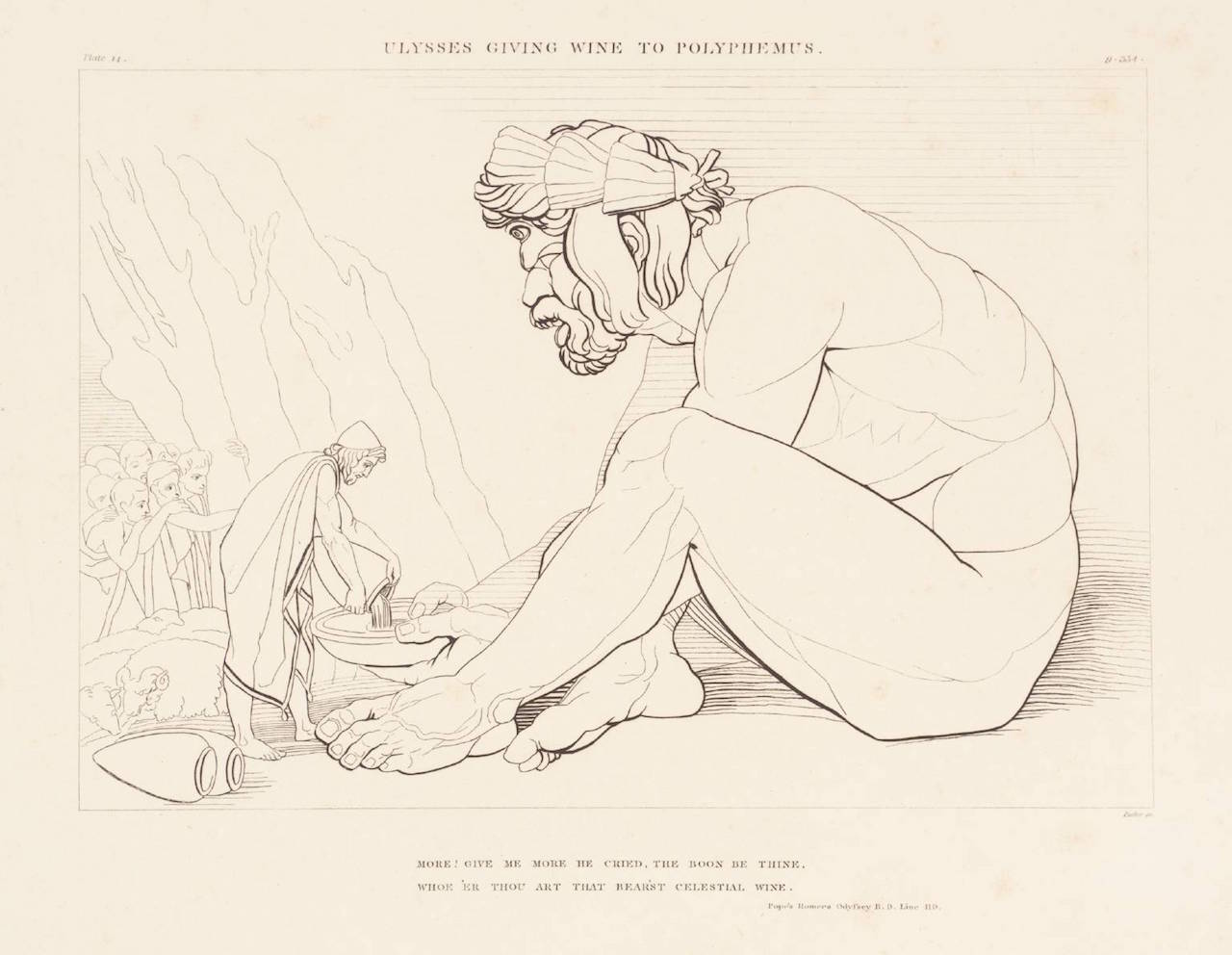 “Ulysses Giving Wine to Polyphemus” (1805). John Flaxman (1755–1826). Purchased as part of the Oppé Collection with assistance from the National Lottery through the Heritage Lottery Fund, 1996.
  “Circe Invidiosa,” (1892). J. W. Waterhouse (English, 1849–1917).
 “Teiresias appears to Ulysses during the sacrifice,” (1780–1785). Henry Fuseli (German, 1741–1825).
  “Ulysses and the Sirens” (ca. 1909). Herbert James Draper (English, 1863–1920).
 “Ulysses Asleep Laid on his Own Coast by the Phaeacian Sailors” (1805). John Flaxman (English, 1755–1826). Purchased as part of the Oppé Collection with assistance from the National Lottery through the Heritage Lottery Fund 1996.
  Minoan—probably Neopalatial—fresco commonly known as the “Lily Prince.” Whatever the exact type of this personage (perhaps a crowned acrobat, according to the interpretation of Maria Shaw), the Lily Prince is certainly a Minoan of elite standing. Public domain image based on a famous watercolor by Émile Gilliéron of a reconstruction by Arthur Evans.
 Detail from a fresco found at Hagia Triadha in Crete. Reconstruction by Mark Cameron, p. 96 of the catalogue Fresco: A Passport into the Past. Minoan Crete through the eyes of Mark Cameron. 1999. Catalogue curated by Doniert Evely. Athens: British School at Athens; and N. P. Goulandris Foundation, Museum of Cycladic Art. Reproduced with the permission of the British School at Athens. BSA Archive: Mark Cameron Personal Papers: CAM 1.
 “Minerva Restoring Ulysses to his Own Shape” (1805). John Flaxman (English, 1755–1826). Purchased as part of the Oppé Collection with assistance from the National Lottery through the Heritage Lottery Fund 1996.
 “Ulysses and his Dog” (1805). John Flaxman (English, 1755–1826). Purchased as part of the Oppé Collection with assistance from the National Lottery through the Heritage Lottery Fund 1996.
  “Ulysses Preparing to Fight with Irus” (1805). John Flaxman (English, 1755–1826) Purchased as part of the Oppé Collection with assistance from the National Lottery through the Heritage Lottery Fund 1996.
  “Euryclea Discovers Ulysses” (1805). John Flaxman (English, 1755–1826). Purchased as part of the Oppé Collection with assistance from the National Lottery through the Heritage Lottery Fund 1996.
  “The Harpies Going to Seize the Daughters of Pandareus” (1805). John Flaxman (English, 1755–1826). Purchased as part of the Oppé Collection with assistance from the National Lottery through the Heritage Lottery Fund 1996.
 Hēraklēs stringing a bow. Silver stater, c. 450–440 BCE, Thebes (Boeotia).
  Swallows, detail of the Spring Fresco at Thera, image via Flickr user
  Original artwork, by Flickr user
  Odysseus kiling Penelope’s suitors. Attic red-figure skyphos, ca. 440 BCE.
  Still life showing eggs, thrushes, napkin: from the House of Julia Felix, Pompeii.
  Eurykleia waking Penelope (1773). Print by Thomas Burke, after a painting by Angelika Kauffmann.
  Big Ed and Norma have just now broken free of the troublesome relationships that have kept these lovers apart for 27 years. Now at long last they can have a life together.
Still from
Big Ed and Norma have just now broken free of the troublesome relationships that have kept these lovers apart for 27 years. Now at long last they can have a life together.
Still from  “Mercury Conducting the Souls of the Suitors to the Infernal Regions” (1805). John Flaxman (English, 1755–1826). Purchased as part of the Oppé Collection with assistance from the National Lottery through the Heritage Lottery Fund 1996.
  “Ulysses Departing from Lacedaemon for Ithaca, with his Bride Penelope” (1805). John Flaxman (English, 1755–1826). Flaxman made this image the last in his Odyssey series, bringing the story of Penelope and Odysseus full circle. Purchased as part of the Oppé Collection with assistance from the National Lottery through the Heritage Lottery Fund 1996.


,_around_440_BC,_Altes_Museum_Berlin_(13718420225)_glare-reduced_white-bg.png)
