
View:
By Card
BOOK XIII.
THE ARRIVAL OF ULYSSES IN ITHACA.
Ulysses takes his leave of Alcinoüs and Arete, and embarks in the evening. Next morning the ship arrives at Ithaca; where the sailors, as Ulysses is yet sleeping, lay him on the shore with all his treasures. On their re- turn, Neptune changes their ship into a rock. In the mean time, Ulysses awaking, knows not his native Ithaca, by reason of a mist which Pallas had cast round him. He breaks into loud lamentations; till the god- dess appearing to him in the form of a shepherd, discovers the country to him, and points out the particular places. He then tells a feigned story of his adventures, upon which she manifests herself, and they consult together on the measures to be taken to destroy the suitors. To conceal his return, and disguise his person the more effectually, she changes him into the figure of an old beggar.
HE ceas'd; but left so pleasing on their ear
1
His voice, that listening still they seem'd to hear.
A pause of silence hush'd the shady rooms:
The grateful conference then the king resumes:
Alcinoüs
'Whatever toils the great Ulysses pass'd,
5
'Beneath this happy roof they end at last;
'No longer now from shore to shore to roam,
'Smooth seas and gentle winds invite him home.
'But hear me, princes! whom these walls enclose,
'For whom my chanter sings, and goblet flows
10
'With wine unmix'd (an honour due to age,
'To cheer the grave, and warm the poet's rage,)
'Though labour'd gold, and many a dazzling vest
'Lie heap'd already for our godlike guest:
'Without new treasures let him not remove,
15
'Large, and expressive of the public love:
'Each peer a tripod, each a vase bestow,
'A general tribute, which the state shall owe.'
'Whatever toils the great Ulysses pass'd,
5
'Beneath this happy roof they end at last;
'No longer now from shore to shore to roam,
'Smooth seas and gentle winds invite him home.
'But hear me, princes! whom these walls enclose,
'For whom my chanter sings, and goblet flows
10
'With wine unmix'd (an honour due to age,
'To cheer the grave, and warm the poet's rage,)
'Though labour'd gold, and many a dazzling vest
'Lie heap'd already for our godlike guest:
'Without new treasures let him not remove,
15
'Large, and expressive of the public love:
'Each peer a tripod, each a vase bestow,
'A general tribute, which the state shall owe.'
This sentence pleas'd: then all their steps address'd
To separate mansions, and retired to rest.
20
Now did the rosy-finger'd morn arise,
And shed her sacred light along the skies.
Down to the haven and the ships in haste
They bore the treasures, and in safety plac'd.
The king himself the vases ranged with care;
25
Then bade his followers to the feast repair.
A victim ox beneath the sacred hand
Of great Alcinoüs falls, and stains the sand.
To Jove th' Eternal, (power above all powers!
Who wings the winds, and darkens heaven with showers,)
30
The flames ascend: till evening they prolong
The rites, more sacred made by heavenly song:
For in the midst, with public honours graced,
Thy lyre, divine Demodocus! was placed.
All, but Ulysses, heard with fix'd delight:
35
He sate, and ey'd the sun, and wish'd the night:
Slow seem'd the sun to move, the hours to roll,
His native home deep-imaged in his soul.
As the tir'd ploughman spent with stubborn toil,
Whose oxen long have torn the furrow'd soil,
40
Sees with delight the sun's declining ray,
When home with feeble knees he bends his way
To late repast, (the day's hard labour done,)
So to Ulysses welcome set the sun;
Then instant to Alcinoüs and the rest
45
(The Scherian
1
states) he turn'd, and thus address'd:
Ulysses
47
'O thou, the first in merit and command!
'And you the peers and princes of the land!
'May every joy be yours! nor this the least,
'When due libation shall have crown'd the feast,
50
'Safe to my home to send your happy guest.
'Complete are now the bounties you have given,
'Be all those bounties but confirm'd by Heaven!
'So may I find, when all my wanderings cease,
'My consort blameless, and my friends in peace.
55
'On you be every bliss; and every day,
'In home-felt joys, delighted roll away:
'Yourselves, your wives, your long-descending race,
'May every god enrich with every grace!
'Sure fix'd on virtue may your nation stand,
60
'And public evil never touch the land!'
'O thou, the first in merit and command!
'And you the peers and princes of the land!
'May every joy be yours! nor this the least,
'When due libation shall have crown'd the feast,
50
'Safe to my home to send your happy guest.
'Complete are now the bounties you have given,
'Be all those bounties but confirm'd by Heaven!
'So may I find, when all my wanderings cease,
'My consort blameless, and my friends in peace.
55
'On you be every bliss; and every day,
'In home-felt joys, delighted roll away:
'Yourselves, your wives, your long-descending race,
'May every god enrich with every grace!
'Sure fix'd on virtue may your nation stand,
60
'And public evil never touch the land!'
His words well weigh'd, the general voice approv'd
Benign, and instant his dismission mov'd.
The monarch to Pontonoüs gave the sign,
To fill the goblet high with rosy wine:
65
Alcinoüs
'Great Jove the Father first' (he cried) 'implore;
'Then send the stranger to his native shore.'
'Great Jove the Father first' (he cried) 'implore;
'Then send the stranger to his native shore.'
The luscious wine th' obedient herald brought;
Around the mansion flow'd the purple draught;
Each from his seat to each immortal pours,
70
Whom glory circles in the Olympian bowers.
Ulysses sole with air majestic stands,
The bowl presenting to Aretè's hands;
Then thus: 'O queen, farewell! be still possess'd
'Of dear remembrance, blessing still and bless'd!
75
'Till age and death shall gently call thee hence,
'(Sure fate of every mortal excellence!)
'Farewell! and joys successive ever spring
'To thee, to thine, the people and the king!'
Thus he: then parting prints the sandy shore
80
To the fair port: a herald march'd before,
Sent by Alcinoüs; of Aretè's train
Three chosen maids attend him to the main:
This does a tunic and white vest convey,
A various casket that, of rich inlay,
85
And bread and wine the third. The cheerful mates
Safe in the hollow poop dispose the cates:
Upon the deck soft painted robes they spread,
With linen cover'd, for the hero's bed.
He climb'd the lofty stern; then gently press'd
90
The swelling couch, and lay compos'd to rest.
Now placed in order, the Phaeacian train
Their cables loose, and launch into the main:
At once they bend, and strike their equal oars,
And leave the sinking hills and lessening shores.
95
While on the deck the chief in silence lies,
And pleasing slumbers steal upon his eyes.
As fiery coursers in the rapid race
Urged by fierce drivers through the dusty space,
Toss their high heads, and scour along the plain;
100
So mounts the bounding vessel o'er the main.
Back to the stern the parted billows flow,
And the black ocean foams and roars below.
Thus with spread sails the winged galley flies;
Less swift an eagle cuts the liquid skies;
105
Divine Ulysses was her sacred load,
A man in wisdom equal to a god!
Much danger, long and mighty toils he bore,
In storms by sea, and combats on the shore:
All which soft sleep now banish'd from his breast,
110
Wrapp'd in a pleasing, deep, and death-like rest.
But when the morning-star with early ray
2
Flam'd in the front of heaven, and promis'd day;
Like distant clouds the mariner descries
Fair Ithaca's emerging hills arise.
115
Far from the town a spacious port appears,
Sacred to Phorcys' power, whose name it bears:
3
Two craggy rocks, projecting to the main,
The roaring wind's tempestuous rage restrain,
Within, the waves in softer murmurs glide,
120
And ships secure without their halsers ride.
High at the head a branching olive grows,
And crowns the pointed cliffs with shady boughs.
Beneath, a gloomy grotto's cool recess
Delights the Nereids of the neighbouring seas,
125
Where bowls and urns were form'd of living stone,
And massy beams in native marble shone:
On which the labours of the nymphs were roll'd,
Their webs divine of purple mix'd with gold.
Within the cave the clustering bees attend
130
Their waxen works, or from the roof depend.
Perpetual waters o'er the pavement glide;
Two marble doors
4
unfold on either side;
Sacred the south, by which the gods descend;
But mortals enter at the northern end.
135
Thither they bent, and haul'd their ship to land;
(The crooked keel divides the yellow sand;)
Ulysses sleeping on his couch they bore,
5
And gently placed him on the rocky shore.
His treasures next, Alcinoüs' gifts, they laid
140
In the wild olive's unfrequented shade,
Secure from theft; then launch'd the bark again,
Resum'd their oars, and measur'd back the main.
6
Nor yet forgot old Ocean's dread Supreme,
The vengeance vow'd for eyeless Polypheme.
145
Before the throne of mighty Jove he stood;
And sought the secret counsels of the god.
Neptune
'Shall then no more, O sire of gods! be mine
'The rights and honours of a power divine?
'Scorn'd e'en by man, and (oh severe disgrace!)
150
'By soft Phaeacians, my degenerate race!
'Against yon destin'd head in vain I swore,
'And menaced vengeance, ere he reach'd his shore;
'To reach his natal shore was thy decree;
'Mild I obey'd, for who shall war with thee?
155
'Behold him landed, careless and asleep,
'From all th' eluded dangers of the deep;
'Lo where he lies, amidst a shining store
'Of brass, rich garments, and refulgent ore;
'And bears triumphant to his native isle
160
'A prize more worth than Ilion's noble spoil.'
139
'Shall then no more, O sire of gods! be mine
'The rights and honours of a power divine?
'Scorn'd e'en by man, and (oh severe disgrace!)
150
'By soft Phaeacians, my degenerate race!
'Against yon destin'd head in vain I swore,
'And menaced vengeance, ere he reach'd his shore;
'To reach his natal shore was thy decree;
'Mild I obey'd, for who shall war with thee?
155
'Behold him landed, careless and asleep,
'From all th' eluded dangers of the deep;
'Lo where he lies, amidst a shining store
'Of brass, rich garments, and refulgent ore;
'And bears triumphant to his native isle
160
'A prize more worth than Ilion's noble spoil.'
To whom the Father of th' immortal powers,
Who swells the clouds, and gladdens earth with showers:
Jove
'Can mighty Neptune thus of man complain?
'Neptune, tremendous o'er the boundless main!
165
'Rever'd and awful e'en in heaven's abodes,
'Ancient and great! a god above the gods!
'If that low race offend thy power divine,
'(Weak, daring creatures!) is not vengeance thine?
'Go then, the guilty at thy will chastise.'
170
'Can mighty Neptune thus of man complain?
'Neptune, tremendous o'er the boundless main!
165
'Rever'd and awful e'en in heaven's abodes,
'Ancient and great! a god above the gods!
'If that low race offend thy power divine,
'(Weak, daring creatures!) is not vengeance thine?
'Go then, the guilty at thy will chastise.'
170
He said. The shaker of the earth replies:
Neptune
'This then I doom: to fix the gallant ship
'A mark of vengeance on the sable deep;
'To warn the thoughtless self-confiding train,
'No more unlicens'd thus to brave the main.
175
'Full in their port a shady hill shall rise,
'If such thy will.'—' We will it,' Jove replies.
'This then I doom: to fix the gallant ship
'A mark of vengeance on the sable deep;
'To warn the thoughtless self-confiding train,
'No more unlicens'd thus to brave the main.
175
'Full in their port a shady hill shall rise,
'If such thy will.'—' We will it,' Jove replies.
Jove
'E'en when with transport, blackening all the strand,
'The swarming people hail their ship to land,
'Fix her for ever, a memorial stone:
180
'Still let her seem to sail, and seem alone.
'The trembling crowds shall see the sudden shade
'Of whelming mountains overhang their head!'
'E'en when with transport, blackening all the strand,
'The swarming people hail their ship to land,
'Fix her for ever, a memorial stone:
180
'Still let her seem to sail, and seem alone.
'The trembling crowds shall see the sudden shade
'Of whelming mountains overhang their head!'
With that the god whose earthquakes rock the ground
Fierce to Phaeacia cross'd the vast profound.
185
Swift as a swallow sweeps the liquid way,
The winged pinnace shot along the sea.
The god arrests her with a sudden stroke,
And roots her down an everlasting rock.
Aghast the Scherians stand in deep surprise;
190
All press to speak, all question with their eyes.
What hands unseen the rapid bark restrain?
'And yet it swims, or seems to swim, the main!'
Thus they, unconscious of the deed divine:
Till great Alcinoüs, rising, own'd the sign.
195
Alcinoüs
'Behold the long-predestin'd day!' (he cries;)
'O certain faith of ancient prophecies!
'These ears have heard my royal sire disclose
'A dreadful story, big with future woes:
'How, mov'd with wrath, that careless we convey
200
'Promiscuous every guest to every bay,
'Stern Neptune raged; and how by his command
'Firm rooted in the surge a ship should stand,
'(A monument of wrath;) and mound on mound
'Should hide our walls, or whelm beneath the ground.
205
'The Fates have follow'd as declar'd the seer:
'Be humbled, nations! and your monarch hear.
'No more unlicens'd brave the deeps, no more
'With every stranger pass from shore to shore:
'On angry Neptune now for mercy call;
210
'To his high name let twelve black oxen fall.
'So may the god reverse his purpos'd will,
'Nor o'er our city hang the dreadful hill.'
7
184
'Behold the long-predestin'd day!' (he cries;)
'O certain faith of ancient prophecies!
'These ears have heard my royal sire disclose
'A dreadful story, big with future woes:
'How, mov'd with wrath, that careless we convey
200
'Promiscuous every guest to every bay,
'Stern Neptune raged; and how by his command
'Firm rooted in the surge a ship should stand,
'(A monument of wrath;) and mound on mound
'Should hide our walls, or whelm beneath the ground.
205
'The Fates have follow'd as declar'd the seer:
'Be humbled, nations! and your monarch hear.
'No more unlicens'd brave the deeps, no more
'With every stranger pass from shore to shore:
'On angry Neptune now for mercy call;
210
'To his high name let twelve black oxen fall.
'So may the god reverse his purpos'd will,
'Nor o'er our city hang the dreadful hill.'
7
The monarch spoke: they trembled and obey'd,
Forth on the sands the victim oxen led:
215
The gather'd tribes before the altars stand,
And chiefs and rulers, a majestic band.
The king of ocean all the tribes implore;
The blazing altars redden all the shore.
Meanwhile Ulysses in his country lay,
220
Releas'd from sleep, and round him might survey
The solitary shore and rolling sea.
Yet had his mind through tedious absence lost
The dear resemblance of his native coast.
Besides, Minerva, to secure her care
225
Diffus'd around a veil of thicken'd air.
For so the gods ordain'd, to keep unseen
His royal person from his friends and queen:
Till the proud suitors for their crimes afford
An ample vengeance to their injur'd lord.
230
Now all the land another prospect bore,
Another port appear'd, another shore.
And long-continued ways, and winding floods,
And unknown mountains, crown'd with unknown woods.
Pensive and slow, with sudden grief oppress'd,
235
The king arose, and beat his careful breast,
Cast a long look o'er all the coast and main,
And sought, around, his native realm in vain:
Then with erected eyes stood fix'd in woe,
And, as he spoke, the tears began to flow:
240
Ulysses
'Ye Gods,' (he cried,) 'upon what barren coast,
'In what new region, is Ulysses toss'd?
'Possess'd by wild barbarians, fierce in arms?
'Or men whose bosom tender pity warms?
'Where shall this treasure now in safety lie?
245
'And whither, whither its sad owner fly?
'Ah why did I Alcinoüs' grace implore?
'Ah why forsake Phaeacia's happy shore?
'Some juster prince perhaps had entertain'd,
'And safe restor'd me to my native land.
250
'Is this the promis'd, long-expected coast,
'And this the faith Phaeacia's rulers boast?
'O righteous gods! of all the great, how few
'Are just to Heaven, and to their promise true!
'But he, the power to whose all-seeing eyes
255
'The deeds of men appear without disguise,
''Tis his alone t' avenge the wrongs I bear:
'For still th' oppress'd are his peculiar care.
'To count these presents, and from thence to prove
'Their faith,
8
is mine: the rest belongs to Jove.'
260
217
'Ye Gods,' (he cried,) 'upon what barren coast,
'In what new region, is Ulysses toss'd?
'Possess'd by wild barbarians, fierce in arms?
'Or men whose bosom tender pity warms?
'Where shall this treasure now in safety lie?
245
'And whither, whither its sad owner fly?
'Ah why did I Alcinoüs' grace implore?
'Ah why forsake Phaeacia's happy shore?
'Some juster prince perhaps had entertain'd,
'And safe restor'd me to my native land.
250
'Is this the promis'd, long-expected coast,
'And this the faith Phaeacia's rulers boast?
'O righteous gods! of all the great, how few
'Are just to Heaven, and to their promise true!
'But he, the power to whose all-seeing eyes
255
'The deeds of men appear without disguise,
''Tis his alone t' avenge the wrongs I bear:
'For still th' oppress'd are his peculiar care.
'To count these presents, and from thence to prove
'Their faith,
8
is mine: the rest belongs to Jove.'
260
Then on the sands he rang'd his wealthy store,
The gold, the vests, the tripods number'd o'er:
All these he found; but still, in error lost,
Disconsolate he wanders on the coast,
Sighs for his country, and laments again
265
To the deaf rocks, and hoarse resounding main.
When lo! the guardian goddess of the wise,
Celestial Pallas, stood before his eyes;
In show a youthful swain, of form divine,
Who seem'd descended from some princely line.
270
A graceful robe her slender body dress'd;
Around her shoulders flew the waving vest;
Her decent hand a shining javelin bore,
And painted sandals on her feet she wore.
To whom the king: 'Whoe'er of human race
275
'Thou art, that wander'st in this desert place,
'With joy to thee, as to some god, I bend,
'To thee my treasures and myself commend.
'O tell a wretch in exile doom'd to stray,
'What air I breathe, what country I survey?
280
'The fruitful continent's extremest bound,
'Or some fair isle which Neptune's arms surround?'
Minerva
'From what far clime,' (said she,) 'remote from fame,
'Arriv'st thou here, a stranger to our name?
'Thou seest an island, not to those unknown
285
'Whose hills are brighten'd by the rising sun,
'Nor those that placed beneath his utmost reign
'Behold him sinking in the western main.
'The rugged soil allows no level space
'For flying chariots, or the rapid race;
290
'Yet, not ungrateful to the peasant's pain,
'Suffices fulness to the swelling grain:
'The loaded trees their various fruits produce,
'And clustering grapes afford a generous juice;
'Woods crown our mountains, and in every grove
295
'The bounding goats and frisking heifers rove:
'Soft rains and kindly dews refresh the field,
'And rising springs eternal verdure yield:
'Ev'n to those shores is Ithaca renown'd,
'Where Troy's majestic ruins strew the ground.'
300
250
'From what far clime,' (said she,) 'remote from fame,
'Arriv'st thou here, a stranger to our name?
'Thou seest an island, not to those unknown
285
'Whose hills are brighten'd by the rising sun,
'Nor those that placed beneath his utmost reign
'Behold him sinking in the western main.
'The rugged soil allows no level space
'For flying chariots, or the rapid race;
290
'Yet, not ungrateful to the peasant's pain,
'Suffices fulness to the swelling grain:
'The loaded trees their various fruits produce,
'And clustering grapes afford a generous juice;
'Woods crown our mountains, and in every grove
295
'The bounding goats and frisking heifers rove:
'Soft rains and kindly dews refresh the field,
'And rising springs eternal verdure yield:
'Ev'n to those shores is Ithaca renown'd,
'Where Troy's majestic ruins strew the ground.'
300
At this, the chief with transport was possess'd;
His panting heart exulted in his breast:
Yet, well dissembling his untimely joys,
And veiling truth in plausible disguise,
Thus, with an air sincere, in fiction bold,
305
His ready tale th' inventive hero told:
Ulysses
'Oft have I heard in Crete this island's name;
'For 'twas from Crete, my native soil, I came,
'Self-banish'd thence. I sail'd before the wind,
'And left my children and my friends behind.
310
'From fierce Idomeneus' revenge I flew,
'Whose son, the swift Orsilochus, I slew:
'(With brutal force he seiz'd my Trojan prey,
'Due to the toils of many a bloody day.)
'Unseen I 'scaped, and, favour'd by the night,
315
'In a Phœnician vessel took my flight,
'For Pyle or Elis bound: but tempests toss'd
'And raging billows drove us on your coast.
'In dead of night an unknown port we gain'd,
'Spent with fatigue, and slept secure on land.
320
'But ere the rosy morn renew'd the day,
'While in th' embrace of pleasing sleep I lay,
'Sudden, invited by auspicious gales,
'They land my goods, and hoist their flying sails.
'Abandon'd here, my fortune I deplore,
325
'A hapless exile on a foreign shore.'
287
'Oft have I heard in Crete this island's name;
'For 'twas from Crete, my native soil, I came,
'Self-banish'd thence. I sail'd before the wind,
'And left my children and my friends behind.
310
'From fierce Idomeneus' revenge I flew,
'Whose son, the swift Orsilochus, I slew:
'(With brutal force he seiz'd my Trojan prey,
'Due to the toils of many a bloody day.)
'Unseen I 'scaped, and, favour'd by the night,
315
'In a Phœnician vessel took my flight,
'For Pyle or Elis bound: but tempests toss'd
'And raging billows drove us on your coast.
'In dead of night an unknown port we gain'd,
'Spent with fatigue, and slept secure on land.
320
'But ere the rosy morn renew'd the day,
'While in th' embrace of pleasing sleep I lay,
'Sudden, invited by auspicious gales,
'They land my goods, and hoist their flying sails.
'Abandon'd here, my fortune I deplore,
325
'A hapless exile on a foreign shore.'
Thus while he spoke, the blue-eyed maid began
With pleasing smiles to view the godlike man:
Then chang'd her form: and now, divinely bright,
Jove's heavenly daughter stood confess'd to sight:
330
Like a fair virgin in her beauty's bloom,
Skill'd in th' illustrious labours of the loom.
Minerva
'O still the same Ulysses!' (she rejoin'd,)
'In useful craft successfully refin'd!
'Artful in speech, in action, and in mind!
335
'Sufficed it not, that, thy long labours pass'd,
'Secure thou seest thy native shores at last?
'But this to me? who, like thyself, excel
'In arts of counsel, and dissembling well;
'To me? whose wit exceeds the powers divine,
340
'No less than mortals are surpass'd by thine.
'Know'st thou not me? who made thy life my care,
'Through ten years' wandering, and through ten years' war,
'Who taught thee arts, Alcinoüs to persuade,
'To raise his wonder, and engage his aid;
345
'And now appear, thy treasures to protect,
'Conceal thy person, thy designs direct,
'And tell what more thou must from Fate expect;
'Domestic woes far heavier to be borne!
'The pride of fools, and slaves' insulting scorn!
350
'But thou be silent, nor reveal thy state;
'Yield to the force of unresisted Fate,
'And bear unmov'd the wrongs of base mankind,
'The last, and hardest, conquest of the mind.'
'O still the same Ulysses!' (she rejoin'd,)
'In useful craft successfully refin'd!
'Artful in speech, in action, and in mind!
335
'Sufficed it not, that, thy long labours pass'd,
'Secure thou seest thy native shores at last?
'But this to me? who, like thyself, excel
'In arts of counsel, and dissembling well;
'To me? whose wit exceeds the powers divine,
340
'No less than mortals are surpass'd by thine.
'Know'st thou not me? who made thy life my care,
'Through ten years' wandering, and through ten years' war,
'Who taught thee arts, Alcinoüs to persuade,
'To raise his wonder, and engage his aid;
345
'And now appear, thy treasures to protect,
'Conceal thy person, thy designs direct,
'And tell what more thou must from Fate expect;
'Domestic woes far heavier to be borne!
'The pride of fools, and slaves' insulting scorn!
350
'But thou be silent, nor reveal thy state;
'Yield to the force of unresisted Fate,
'And bear unmov'd the wrongs of base mankind,
'The last, and hardest, conquest of the mind.'
Ulysses
'Goddess of wisdom!' (Ithacus replies,)
355
'He who discerns thee must be truly wise,
'So seldom view'd, and ever in disguise!
'When the bold Argives led their warring powers
'Against proud Ilion's well-defended towers,
'Ulysses was thy care, celestial maid!
360
'Graced with thy sight, and favour'd with thy aid.
'But when the Trojan piles in ashes lay,
'And bound for Greece we plough'd the watery way,
'Our fleet dispers'd and driven from coast to coast,
'Thy sacred presence from that hour I lost;
365
'Till I beheld thy radiant form once more,
'And heard thy counsels on Phaeacia's shore.
'But, by th' almighty author of thy race,
'Tell me, oh tell, is this my native place?
'For much I fear, long tracts of land and sea
370
'Divide this coast from distant Ithaca;
'The sweet delusion kindly you impose,
'To soothe my hopes, and mitigate my woes.'
9
329
'Goddess of wisdom!' (Ithacus replies,)
355
'He who discerns thee must be truly wise,
'So seldom view'd, and ever in disguise!
'When the bold Argives led their warring powers
'Against proud Ilion's well-defended towers,
'Ulysses was thy care, celestial maid!
360
'Graced with thy sight, and favour'd with thy aid.
'But when the Trojan piles in ashes lay,
'And bound for Greece we plough'd the watery way,
'Our fleet dispers'd and driven from coast to coast,
'Thy sacred presence from that hour I lost;
365
'Till I beheld thy radiant form once more,
'And heard thy counsels on Phaeacia's shore.
'But, by th' almighty author of thy race,
'Tell me, oh tell, is this my native place?
'For much I fear, long tracts of land and sea
370
'Divide this coast from distant Ithaca;
'The sweet delusion kindly you impose,
'To soothe my hopes, and mitigate my woes.'
9
Thus he. The blue-ey'd goddess thus replies:
Minerva
'How prone to doubt, how cautious are the wise!
375
'Who, vers'd in fortune, fear the flattering show,
'And taste not half the bliss the gods bestow.
'The more shall Pallas aid thy just desires,
'And guard the wisdom which herself inspires.
'Others, long absent from their native place,
380
'Straight seek their home, and fly with eager pace
'To their wives' arms, and children's dear embrace.
'Not thus Ulysses: he decrees to prove
'His subjects' faith, and queen's suspected love;
'Who mourn'd her lord twice ten revolving years,
385
'And wastes the days in grief, the nights in tears.
'But Pallas knew (thy friends and navy lost)
'Once more 'twas given thee to behold thy coast:
'Yet how could I with adverse Fate engage,
'And mighty Neptune's unrelenting rage?
390
'Now lift thy longing eyes, while I restore
'The pleasing prospect of thy native shore.
'Behold the port of Phorcys! fenced around
'With rocky mountains, and with olives crown'd.
'Behold the gloomy grot! whose cool recess
395
'Delights the Nereids of the neighbouring seas:
'Whose now neglected altars, in thy reign,
'Blush'd with the blood of sheep and oxen slain.
'Behold! where Neritus the clouds divides,
'And shakes the waving forests on his sides.'
400
'How prone to doubt, how cautious are the wise!
375
'Who, vers'd in fortune, fear the flattering show,
'And taste not half the bliss the gods bestow.
'The more shall Pallas aid thy just desires,
'And guard the wisdom which herself inspires.
'Others, long absent from their native place,
380
'Straight seek their home, and fly with eager pace
'To their wives' arms, and children's dear embrace.
'Not thus Ulysses: he decrees to prove
'His subjects' faith, and queen's suspected love;
'Who mourn'd her lord twice ten revolving years,
385
'And wastes the days in grief, the nights in tears.
'But Pallas knew (thy friends and navy lost)
'Once more 'twas given thee to behold thy coast:
'Yet how could I with adverse Fate engage,
'And mighty Neptune's unrelenting rage?
390
'Now lift thy longing eyes, while I restore
'The pleasing prospect of thy native shore.
'Behold the port of Phorcys! fenced around
'With rocky mountains, and with olives crown'd.
'Behold the gloomy grot! whose cool recess
395
'Delights the Nereids of the neighbouring seas:
'Whose now neglected altars, in thy reign,
'Blush'd with the blood of sheep and oxen slain.
'Behold! where Neritus the clouds divides,
'And shakes the waving forests on his sides.'
400
So spake the goddess, and the prospect clear'd;
The mists dispers'd, and all the coast appear'd.
The king with joy confess'd his place of birth,
And on his knees salutes his mother earth:
Then, with his suppliant hands upheld in air,
405
Thus to the sea-green sisters sends his prayer:
Ulysses
'All hail! ye virgin daughters of the main!
'Ye streams, beyond my hopes beheld again!
'To you once more your own Ulysses bows;
'Attend his transports, and receive his vows!
410
'If Jove prolong my days, and Pallas crown
'The growing virtues of my youthful son,
'To you shall rites divine be ever paid,
'And grateful offerings on your altars laid.'
'All hail! ye virgin daughters of the main!
'Ye streams, beyond my hopes beheld again!
'To you once more your own Ulysses bows;
'Attend his transports, and receive his vows!
410
'If Jove prolong my days, and Pallas crown
'The growing virtues of my youthful son,
'To you shall rites divine be ever paid,
'And grateful offerings on your altars laid.'
Minerva
Thus then Minerva: 'From that anxious breast
415
'Dismiss those cares, and leave to heaven the rest.
'Our task be now thy treasur'd stores to save,
'Deep in the close recesses of the cave:
'Then future means consult.'
366
Thus then Minerva: 'From that anxious breast
415
'Dismiss those cares, and leave to heaven the rest.
'Our task be now thy treasur'd stores to save,
'Deep in the close recesses of the cave:
'Then future means consult.'
She spoke, and trod
The shady grot, that brighten'd with the god.
10
420
The closest caverns of the grot she sought;
The gold, the brass, the robes, Ulysses brought;
These in the secret gloom the chief dispos'd;
The entrance with a rock the goddess clos'd.
Now, seated in the olive's sacred shade,
425
Confer the hero and the martial maid.
The goddess of the azure eyes began:
Minerva
'Son of Laërtes! much-experienced man!
'The suitor-train thy earliest care demand,
'Of that luxurious race to rid the land:
430
'Three years thy house their lawless rule has seen,
'And proud addresses to the matchless queen.
'But she thy absence mourns from day to day,
'And inly bleeds, and silent wastes away:
'Elusive of the bridal hour, she gives
435
'Fond hopes to all, and all with hopes deceives.'
'Son of Laërtes! much-experienced man!
'The suitor-train thy earliest care demand,
'Of that luxurious race to rid the land:
430
'Three years thy house their lawless rule has seen,
'And proud addresses to the matchless queen.
'But she thy absence mourns from day to day,
'And inly bleeds, and silent wastes away:
'Elusive of the bridal hour, she gives
435
'Fond hopes to all, and all with hopes deceives.'
Ulysses
To this Ulysses: 'O celestial maid!
'Prais'd be thy counsel, and thy timely aid:
'Else had I seen my native walls in vain,
'Like great Atrides, just restor'd and slain.
440
'Vouchsafe the means of vengeance to debate,
'And plan with all thy arts the scene of fate.
'Then, then be present, and my soul inspire,
'As when we wrapp'd Troy's heaven-built walls in fire.
'Though leagued against me hundred heroes stand,
445
'Hundreds shall fall, if Pallas aid my hand.'
To this Ulysses: 'O celestial maid!
'Prais'd be thy counsel, and thy timely aid:
'Else had I seen my native walls in vain,
'Like great Atrides, just restor'd and slain.
440
'Vouchsafe the means of vengeance to debate,
'And plan with all thy arts the scene of fate.
'Then, then be present, and my soul inspire,
'As when we wrapp'd Troy's heaven-built walls in fire.
'Though leagued against me hundred heroes stand,
445
'Hundreds shall fall, if Pallas aid my hand.'
Minerva
She answer'd: 'In the dreadful day of fight
'Know I am with thee, strong in all my might.
'If thou but equal to thyself be found,
'What gasping numbers then shall press the ground!
11
450
'What human victims stain the feastful floor!
'How wide the pavements float with guilty gore!
"It fits thee now to wear a dark disguise,
'And secret walk unknown to mortal eyes.
'For this, my hand shall wither every grace,
455
'And every elegance of form and face;
'O'er thy smooth skin a bark of wrinkles spread,
'Turn hoar the auburn honours of thy head;
'Disfigure every limb with coarse attire,
'And in thy eyes extinguish all the fire;
460
'Add all the wants and the decays of life;
'Estrange thee from thy own; thy son, thy wife:
'From the loathed object every sight shall turn,
'And the blind suitors their destruction scorn.
'Go first the master of thy herds to find,
465
'True to his charge, a loyal swain and kind:
12
'For thee he sighs; and to the royal heir
'And chaste Penelope extends his care.
'At the Coracian rock he now resides,
13
'Where Arethusa's sable water glides;
470
'The sable water and the copious mast
'Swell the fat herd; luxuriant, large repast!
'With him rest peaceful in the rural cell,
'And all you ask his faithful tongue shall tell.
'Me into other realms my cares convey,
475
'To Sparta, still with female beauty gay:
'For know, to Sparta thy lov'd offspring came,
'To learn thy fortunes from the voice of Fame.'
416
She answer'd: 'In the dreadful day of fight
'Know I am with thee, strong in all my might.
'If thou but equal to thyself be found,
'What gasping numbers then shall press the ground!
11
450
'What human victims stain the feastful floor!
'How wide the pavements float with guilty gore!
"It fits thee now to wear a dark disguise,
'And secret walk unknown to mortal eyes.
'For this, my hand shall wither every grace,
455
'And every elegance of form and face;
'O'er thy smooth skin a bark of wrinkles spread,
'Turn hoar the auburn honours of thy head;
'Disfigure every limb with coarse attire,
'And in thy eyes extinguish all the fire;
460
'Add all the wants and the decays of life;
'Estrange thee from thy own; thy son, thy wife:
'From the loathed object every sight shall turn,
'And the blind suitors their destruction scorn.
'Go first the master of thy herds to find,
465
'True to his charge, a loyal swain and kind:
12
'For thee he sighs; and to the royal heir
'And chaste Penelope extends his care.
'At the Coracian rock he now resides,
13
'Where Arethusa's sable water glides;
470
'The sable water and the copious mast
'Swell the fat herd; luxuriant, large repast!
'With him rest peaceful in the rural cell,
'And all you ask his faithful tongue shall tell.
'Me into other realms my cares convey,
475
'To Sparta, still with female beauty gay:
'For know, to Sparta thy lov'd offspring came,
'To learn thy fortunes from the voice of Fame.'
At this the father, with a father's care:
Ulysses
'Must he too suffer? he, O goddess! bear
480
'Of wanderings and of woes a wretched share?
'Through the wild ocean plough the dangerous way,
'And leave his fortunes and his house a prey?
'Why would'st not thou, O all-enlighten'd mind!
'Inform him certain, and protect him, kind?'
485
'Must he too suffer? he, O goddess! bear
480
'Of wanderings and of woes a wretched share?
'Through the wild ocean plough the dangerous way,
'And leave his fortunes and his house a prey?
'Why would'st not thou, O all-enlighten'd mind!
'Inform him certain, and protect him, kind?'
485
Minerva
To whom Minerva: 'Be thy soul at rest:
'And know, whatever Heaven ordains is best.
'To fame I sent him, to acquire renown;
'To other regions is his virtue known:
'Secure he sits, near great Atrides placed:
490
'With friendships strengthen'd, and with honours graced.
'But lo! an ambush waits his passage o'er;
'Fierce foes insidious intercept the shore:
'In vain; far sooner all the murderous brood
'This injur'd land shall fatten with their blood.'
495
To whom Minerva: 'Be thy soul at rest:
'And know, whatever Heaven ordains is best.
'To fame I sent him, to acquire renown;
'To other regions is his virtue known:
'Secure he sits, near great Atrides placed:
490
'With friendships strengthen'd, and with honours graced.
'But lo! an ambush waits his passage o'er;
'Fierce foes insidious intercept the shore:
'In vain; far sooner all the murderous brood
'This injur'd land shall fatten with their blood.'
495
She spake, then touch'd him with her powerful wand:
The skin shrunk up, and wither'd at her hand:
A swift old age o'er all his members spread;
A sudden frost was sprinkled on his head;
Nor longer in the heavy eye-ball shined
500
The glance divine, forth-beaming from the mind.
His robe, which spots indelible besmear,
In rags dishonest flutters with the air:
A stag's torn hide is lapp'd around his reins;
A rugged staff his trembling hand sustains;
505
And at his side a wretched scrip was hung,
Wide-patch'd, and knotted to a twisted thong.
So look'd the chief, so mov'd; to mortal eyes
Object uncouth! a man of miseries!
While Pallas, cleaving the wide fields of air,
510
To Sparta flies, Telemachus her care.
Odyssey. Homer. London. 1858.
Sponsored by Perseus Project, Tufts University.
 Zeus, Athena, and Hermes (1810). Drawing by John Flaxman.
 Athena (1810). Drawing by John Flaxman.
 Telemachus with Athena as Mentor (1810). Drawing by John Flaxman.
  Nestor’s Sacrifice (1805). Engraving after John Flaxman (1755-1826). Purchased as part of the Oppé Collection with assistance from the National Lottery through the Heritage Lottery Fund 1996.
  “The Fair Helen.” Willy Pogany (Hungarian, 1882–1955).
Image
“The Fair Helen.” Willy Pogany (Hungarian, 1882–1955).
Image  “Leucothea, the White Goddess, Preserving Ulysses” (1805). John Flaxman (1755–1826). Purchased as part of the Oppé Collection with assistance from the National Lottery through the Heritage Lottery Fund, 1996.
  “Nausicaa” (1878), Frederick Leighton (English, 1830–1896).
 Red-figured pyxis, picturing Nereids at home, “indoors”: the Nereid with her hair down is labeled as Thaleia.
 View of Garitsa, region right outside the northern walls of the city of Corfu, and according to the legend the site of Alcinous’s gardens (1867). Étienne Rey (French, 1789–1867).
  Blind Demodokos sings of the siege of Troy (1810), by John Flaxman (English, 1755–1826).
 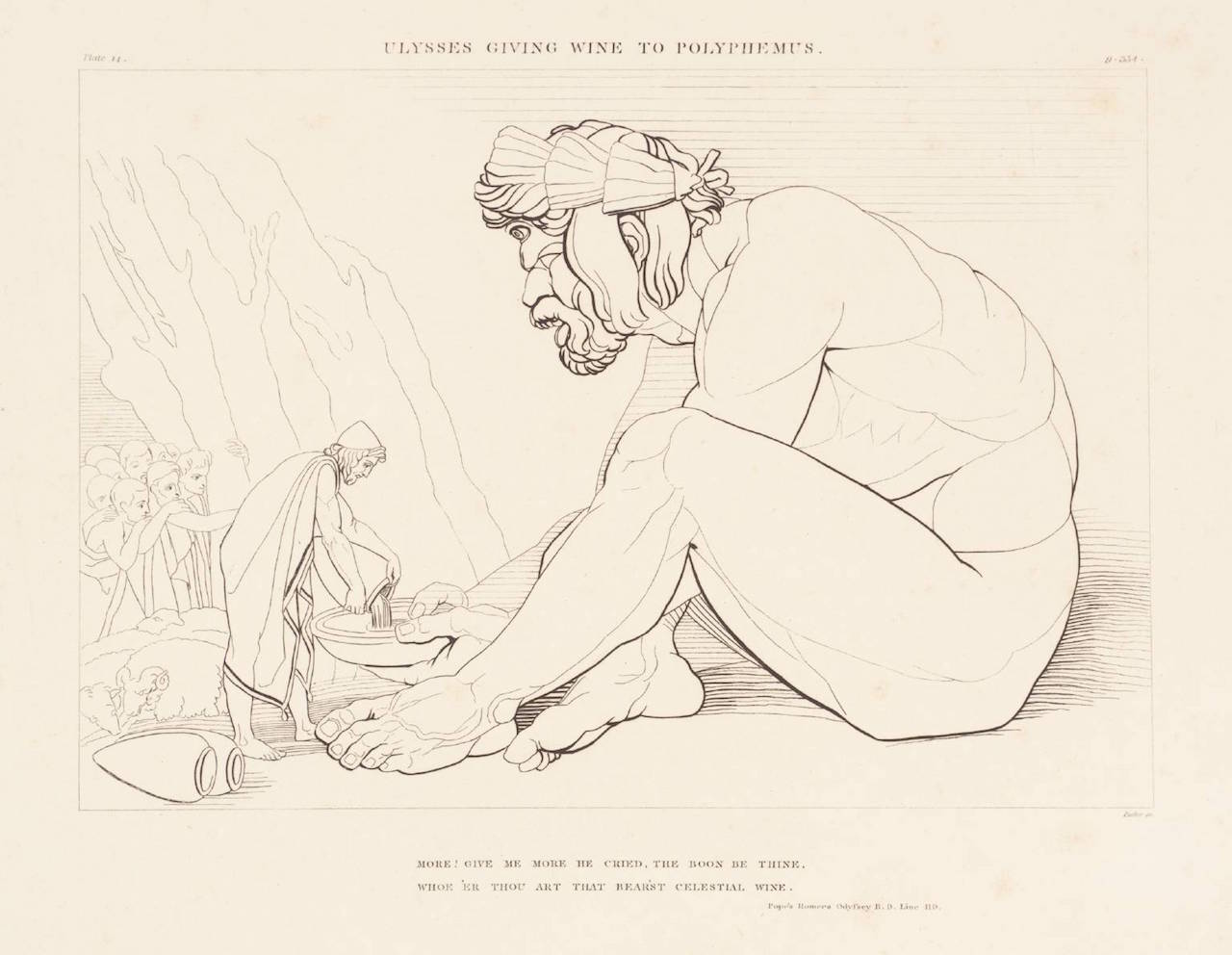 “Ulysses Giving Wine to Polyphemus” (1805). John Flaxman (1755–1826). Purchased as part of the Oppé Collection with assistance from the National Lottery through the Heritage Lottery Fund, 1996.
  “Circe Invidiosa,” (1892). J. W. Waterhouse (English, 1849–1917).
 “Teiresias appears to Ulysses during the sacrifice,” (1780–1785). Henry Fuseli (German, 1741–1825).
  “Ulysses and the Sirens” (ca. 1909). Herbert James Draper (English, 1863–1920).
 “Ulysses Asleep Laid on his Own Coast by the Phaeacian Sailors” (1805). John Flaxman (English, 1755–1826). Purchased as part of the Oppé Collection with assistance from the National Lottery through the Heritage Lottery Fund 1996.
  Minoan—probably Neopalatial—fresco commonly known as the “Lily Prince.” Whatever the exact type of this personage (perhaps a crowned acrobat, according to the interpretation of Maria Shaw), the Lily Prince is certainly a Minoan of elite standing. Public domain image based on a famous watercolor by Émile Gilliéron of a reconstruction by Arthur Evans.
 Detail from a fresco found at Hagia Triadha in Crete. Reconstruction by Mark Cameron, p. 96 of the catalogue Fresco: A Passport into the Past. Minoan Crete through the eyes of Mark Cameron. 1999. Catalogue curated by Doniert Evely. Athens: British School at Athens; and N. P. Goulandris Foundation, Museum of Cycladic Art. Reproduced with the permission of the British School at Athens. BSA Archive: Mark Cameron Personal Papers: CAM 1.
 “Minerva Restoring Ulysses to his Own Shape” (1805). John Flaxman (English, 1755–1826). Purchased as part of the Oppé Collection with assistance from the National Lottery through the Heritage Lottery Fund 1996.
 “Ulysses and his Dog” (1805). John Flaxman (English, 1755–1826). Purchased as part of the Oppé Collection with assistance from the National Lottery through the Heritage Lottery Fund 1996.
  “Ulysses Preparing to Fight with Irus” (1805). John Flaxman (English, 1755–1826) Purchased as part of the Oppé Collection with assistance from the National Lottery through the Heritage Lottery Fund 1996.
  “Euryclea Discovers Ulysses” (1805). John Flaxman (English, 1755–1826). Purchased as part of the Oppé Collection with assistance from the National Lottery through the Heritage Lottery Fund 1996.
  “The Harpies Going to Seize the Daughters of Pandareus” (1805). John Flaxman (English, 1755–1826). Purchased as part of the Oppé Collection with assistance from the National Lottery through the Heritage Lottery Fund 1996.
 Hēraklēs stringing a bow. Silver stater, c. 450–440 BCE, Thebes (Boeotia).
  Swallows, detail of the Spring Fresco at Thera, image via Flickr user
  Original artwork, by Flickr user
  Odysseus kiling Penelope’s suitors. Attic red-figure skyphos, ca. 440 BCE.
  Still life showing eggs, thrushes, napkin: from the House of Julia Felix, Pompeii.
  Eurykleia waking Penelope (1773). Print by Thomas Burke, after a painting by Angelika Kauffmann.
  Big Ed and Norma have just now broken free of the troublesome relationships that have kept these lovers apart for 27 years. Now at long last they can have a life together.
Still from
Big Ed and Norma have just now broken free of the troublesome relationships that have kept these lovers apart for 27 years. Now at long last they can have a life together.
Still from  “Mercury Conducting the Souls of the Suitors to the Infernal Regions” (1805). John Flaxman (English, 1755–1826). Purchased as part of the Oppé Collection with assistance from the National Lottery through the Heritage Lottery Fund 1996.
  “Ulysses Departing from Lacedaemon for Ithaca, with his Bride Penelope” (1805). John Flaxman (English, 1755–1826). Flaxman made this image the last in his Odyssey series, bringing the story of Penelope and Odysseus full circle. Purchased as part of the Oppé Collection with assistance from the National Lottery through the Heritage Lottery Fund 1996.


,_around_440_BC,_Altes_Museum_Berlin_(13718420225)_glare-reduced_white-bg.png)
