Scroll I. Attica
subject heading(s): Theseus; Ariadne; Dionysus
The myth about the abandonment of Ariadne by Theseus while she is asleep
is illustrated most strikingly in this vase painting.
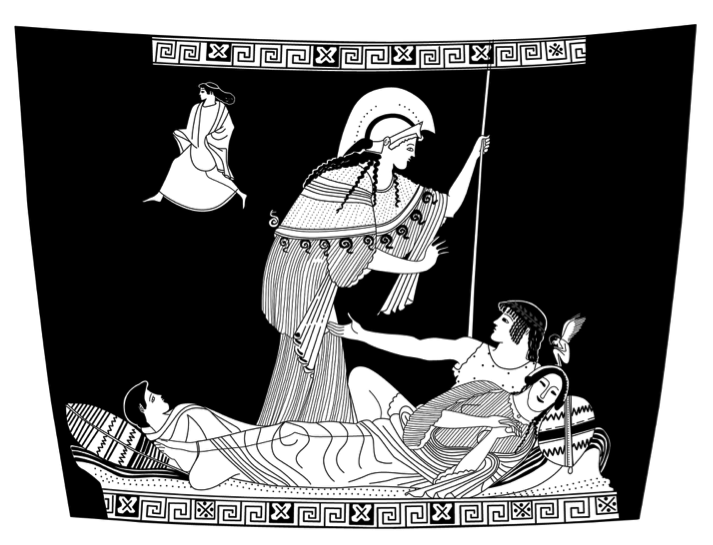
[Painting on a lekythos attributed to the Pan Painter, dated around 470
BCE (Taranto IG 4545). The line drawing, presented in rollout mode, is
by Tina Ross.]
The themes in this painting are analyzed at length in Nagy 2013,
“Virgil’s verse invitus, regina … and its poetic antecedents.” Also
relevant is another article: Nagy,
G. 2017.06.10,
“Diachronic Homer and a Cretan Odyssey.” I epitomize what I have to say
about this painting there at 5§§7–10:
{5§7.} This picture captures the moment when Athena appears to Theseus
after he has made love with Ariadne. The couple has fallen asleep after
the lovemaking, but Athena awakens Theseus, gently gesturing for him to
be quiet and not to awaken Ariadne, who is held fast in her sleep by a
little figure of Hypnos perched on top of her head. The details have
been described this way (Oakley and Sinos 1993:37):
Here we see the couple at the moment of separation. Athena has just
wakened Theseus, and as she bends over him he begins to rise, bending
one leg and sitting up from the pillow on which he has lain next to
Ariadne. Athena tries to quiet him as he stretches out his arm, a
gesture of remonstration or inquiry. In the upper left hand corner is a
small female figure flying into the night.
{5§8.} I note that the small female figure who is “flying into the
night” is disheveled, with her hair flying in the wind and with her
clothing in disarray. I interpret this figure as a prefiguring of
Ariadne herself at a later moment, the morning after, when she wakes up
to find that she has been abandoned by Theseus. I recall here the verse
in Catullus 64.63 where the headdress that had held the hair of Ariadne
together has now come undone, and she looks like a bacchant, a frenzied
devotee of Bacchus, that is, of the god Dionysus. And it is this same
Bacchic frenzy, signaled by her disheveled hair, that will now attract
Dionysus to her.
{5§9.} In contrast to the morning after, when Ariadne in her Bacchic
frenzy will come undone, the picture of Ariadne in the present is eerily
peaceful (Nagy 2013b:161–162):
Ariadne faces us directly, an unusual pose that points to her oblivion
to what is happening behind her as well as allowing us a clear view of
the peaceful contentment registered on her face. Her eyes are closed
tight, and she will not awaken as Theseus departs, for the figure of
Hypnos, Sleep, sits on her head with legs drawn up as he sleeps.
{5§10.} Continuing to look at the picture painted on the lekythos, I
draw attention to another figure. Besides the sleeping Ariadne and the
little sleeping Hypnos perched on top of her head, we see also the
figure of a wakeful boy reclining on the farther side of the bed, to our
left, whose head is positioned directly below the miniature figure of
the hovering girl with the disheveled hair. In my interpretation, this
boy is Eros, who had instigated a night of intense lovemaking between
Ariadne and Theseus.
