
View:
By Card
BOOK XI.
THE DESCENT INTO HELL.
Ulysses continues his narration. How he arrived at the land of the Cimmerians, and what ceremonies he performed to invoke the dead. The manner of his descent, and the apparition of the shades: his conversation with Elpenor, and with Tiresias, who informs him in a prophetic manner of his fortunes to come. He meets his mother Anticlea, from whom he learns the state of his family. He sees the shades of the ancient heroines, afterwards of the heroes, and converses in particular with Agamemnon and Achilles. Ajax keeps at a sullen distance, and disdains to answer him. He then beholds Tityus, Tantalus, Sisyphus, Hercules; till he is deterred from further curiosity by the apparition of horrid spectres, and the cries of the wicked in torments.
Ulysses
1
"NOW to the shores we bend, a mournful train,
1
Climb the tall bark, and launch into the main:
At once the mast we rear, at once unbind
The spacious sheet, and stretch it to the wind:
Then pale and pensive stand, with cares oppress'd,
5
And solemn horror saddens every breast.
A freshening breeze the magic power supplied,
1
While the wing'd vessel flew along the tide;
Our oars we shipp'd: all day the swelling sails
Full from the guiding pilot catch'd the gales.
10
Now sunk the sun from his aërial height,
And o'er the shaded billows rushed the night;
When lo! we reach'd old Ocean's utmost bounds,
Where rocks control his waves with ever-during mounds.
There, in a lonely land, and gloomy cells,
15
The dusky nation of Cimmeria dwells;
2
The sun ne'er views th' uncomfortable seats,
When radiant he advances, or retreats:
Unhappy race! whom endless night invades,
Clouds the dull air, and wraps them round in shades.
20
The ship we moor on these obscure abodes;
Disbark the sheep, an offering to the gods;
And, hellward bending, o'er the beach descry
The doleful passage to th' infernal sky.
The victims, vow'd to each Tartarean power,
25
Eurylochus and Perimedes bore.
Here open'd hell, all hell I here implor'd,
And from the scabbard drew the shining sword:
And, trenching the black earth on every side,
A cavern form'd, a cubit long and wide.
30
New wine, with honey-temper'd milk, we bring,
Then living waters from the crystal spring:
O'er these was strew'd the consecrated flour,
And on the surface shone the holy store.
Now the wan shades we hail, th' infernal gods,
35
To speed our course, and waft us o'er the floods:
So shall a barren heifer from the stall
Beneath the knife upon your altars fall;
So in our palace, at our safe return,
Rich with unnumber'd gifts the pile shall burn:
40
So shall a ram, the largest of the breed,
Black as these regions, to Tiresias bleed.
3
Thus solemn rites and holy vows we paid
To all the phantom-nations of the dead.
Then died the sheep: a purple torrent flow'd,
45
And all the caverns smok'd with streaming blood.
When lo! appear'd along the dusky coasts,
Thin airy shoals of visionary ghosts:
Fair, pensive youths, and soft enamour'd maids;
And wither'd elders, pale and wrinkled shades;
50
Ghastly with wounds, the forms of warriors slain
Stalk'd with majestic port, a martial train:
These and a thousand more swarm'd o'er the ground,
And all the dire assembly shriek'd around.
Astonish'd at the sight, aghast I stood,
55
And a cold fear ran shivering through my blood;
Straight I command the sacrifice to haste,
Straight the flay'd victims to the flames are cast,
And mutter'd vows, and mystic song applied
To grisly Pluto, and his gloomy bride.
60
Now swift I wav'd my faulchion o'er the blood;
Back started the pale throngs, and trembling stood.
Round the black trench the gore untasted flows,
Till awful from the shades Tiresias rose.
51
There, wandering through the gloom, I first survey'd,
65
New to the realms of death, Elpenor's
4
shade:
His cold remains all naked to the sky
On distant shores unwept, unburied, lie.
Sad at the sight I stand, deep fix'd in woe,
And ere I spoke the tears began to flow.
70
"NOW to the shores we bend, a mournful train,
1
Climb the tall bark, and launch into the main:
At once the mast we rear, at once unbind
The spacious sheet, and stretch it to the wind:
Then pale and pensive stand, with cares oppress'd,
5
And solemn horror saddens every breast.
A freshening breeze the magic power supplied,
1
While the wing'd vessel flew along the tide;
Our oars we shipp'd: all day the swelling sails
Full from the guiding pilot catch'd the gales.
10
Now sunk the sun from his aërial height,
And o'er the shaded billows rushed the night;
When lo! we reach'd old Ocean's utmost bounds,
Where rocks control his waves with ever-during mounds.
There, in a lonely land, and gloomy cells,
15
The dusky nation of Cimmeria dwells;
2
The sun ne'er views th' uncomfortable seats,
When radiant he advances, or retreats:
Unhappy race! whom endless night invades,
Clouds the dull air, and wraps them round in shades.
20
The ship we moor on these obscure abodes;
Disbark the sheep, an offering to the gods;
And, hellward bending, o'er the beach descry
The doleful passage to th' infernal sky.
The victims, vow'd to each Tartarean power,
25
Eurylochus and Perimedes bore.
Here open'd hell, all hell I here implor'd,
And from the scabbard drew the shining sword:
And, trenching the black earth on every side,
A cavern form'd, a cubit long and wide.
30
New wine, with honey-temper'd milk, we bring,
Then living waters from the crystal spring:
O'er these was strew'd the consecrated flour,
And on the surface shone the holy store.
Now the wan shades we hail, th' infernal gods,
35
To speed our course, and waft us o'er the floods:
So shall a barren heifer from the stall
Beneath the knife upon your altars fall;
So in our palace, at our safe return,
Rich with unnumber'd gifts the pile shall burn:
40
So shall a ram, the largest of the breed,
Black as these regions, to Tiresias bleed.
3
Thus solemn rites and holy vows we paid
To all the phantom-nations of the dead.
Then died the sheep: a purple torrent flow'd,
45
And all the caverns smok'd with streaming blood.
When lo! appear'd along the dusky coasts,
Thin airy shoals of visionary ghosts:
Fair, pensive youths, and soft enamour'd maids;
And wither'd elders, pale and wrinkled shades;
50
Ghastly with wounds, the forms of warriors slain
Stalk'd with majestic port, a martial train:
These and a thousand more swarm'd o'er the ground,
And all the dire assembly shriek'd around.
Astonish'd at the sight, aghast I stood,
55
And a cold fear ran shivering through my blood;
Straight I command the sacrifice to haste,
Straight the flay'd victims to the flames are cast,
And mutter'd vows, and mystic song applied
To grisly Pluto, and his gloomy bride.
60
Now swift I wav'd my faulchion o'er the blood;
Back started the pale throngs, and trembling stood.
Round the black trench the gore untasted flows,
Till awful from the shades Tiresias rose.
There, wandering through the gloom, I first survey'd,
65
New to the realms of death, Elpenor's
4
shade:
His cold remains all naked to the sky
On distant shores unwept, unburied, lie.
Sad at the sight I stand, deep fix'd in woe,
And ere I spoke the tears began to flow.
70
Ulysses
"O say what angry power Elpenor led
To glide in shades, and wander with the dead?
How could thy soul, by realms and seas disjoin'd,
Outfly the nimble sail, and leave the lagging wind?'
"O say what angry power Elpenor led
To glide in shades, and wander with the dead?
How could thy soul, by realms and seas disjoin'd,
Outfly the nimble sail, and leave the lagging wind?'
Elpenor
The ghost replied: "To hell my doom I owe,
75
Demons accurs'd, dire ministers of woe!
My feet, through wine unfaithful to their weight,
Betray'd me tumbling from a towery height;
Staggering I reel'd, and as I reel'd I fell;
Lux'd the neck-joint—my soul descends to hell.
80
But lend me aid, I now conjure thee, lend,
By the soft tie and sacred name of friend!
By thy fond consort! by thy father's cares!
By lov'd Telemachus's blooming years!
For well I know that soon the heavenly powers
85
Will give thee back to day, and Circe's shores:
There pious on my cold remains attend,
There call to mind thy poor departed friend.
The tribute of a tear is all I crave,
And the possession of a peaceful grave.
90
The ghost replied: "To hell my doom I owe,
75
Demons accurs'd, dire ministers of woe!
My feet, through wine unfaithful to their weight,
Betray'd me tumbling from a towery height;
Staggering I reel'd, and as I reel'd I fell;
Lux'd the neck-joint—my soul descends to hell.
80
But lend me aid, I now conjure thee, lend,
By the soft tie and sacred name of friend!
By thy fond consort! by thy father's cares!
By lov'd Telemachus's blooming years!
For well I know that soon the heavenly powers
85
Will give thee back to day, and Circe's shores:
There pious on my cold remains attend,
There call to mind thy poor departed friend.
The tribute of a tear is all I crave,
And the possession of a peaceful grave.
90
Elpenor
"But if, unheard, in vain compassion plead,
Revere the gods, the gods avenge the dead!
A tomb along the watery margin raise,
The tomb with manly arms and trophies grace,
To show posterity Elpenor was.
95
There, high in air, memorial of my name,
Fix the smooth oar,
5
and bid me live to fame."
"But if, unheard, in vain compassion plead,
Revere the gods, the gods avenge the dead!
A tomb along the watery margin raise,
The tomb with manly arms and trophies grace,
To show posterity Elpenor was.
95
There, high in air, memorial of my name,
Fix the smooth oar,
5
and bid me live to fame."
Ulysses
To whom with tears: "These rites, O mournful shade,
Due to thy ghost, shall to thy ghost be paid."
To whom with tears: "These rites, O mournful shade,
Due to thy ghost, shall to thy ghost be paid."
Still, as I spoke, the phantom seem'd to moan,
100
Tear follow'd tear, and groan succeeded groan.
But, as my waving sword the blood surrounds,
The shade withdrew, and mutter'd empty sounds.
There as the wondrous visions I survey'd,
All pale ascends my royal mother's shade:
105
A queen, to Troy she saw our legions pass;
Now a thin form is all Anticlea was!
Struck at the sight I melt with filial woe,
And down my cheek the pious sorrows flow;
Yet as I shook my faulchion o'er the blood,
110
Regardless of her son the parent stood.
When lo! the mighty Theban I behold;
To guide his steps he bore a staff of gold;
Awful he trod! majestic was his look!
And from his holy lips these accents broke:
115
Tiresias
"Why, mortal, wanderest thou from cheerful day,
To tread the downward, melancholy way?
What angry gods to these dark regions led
Thee, yet alive, companion of the dead?
But sheathe thy poniard, while my tongue relates
120
Heaven's steadfast purpose, and thy future fates."
"Why, mortal, wanderest thou from cheerful day,
To tread the downward, melancholy way?
What angry gods to these dark regions led
Thee, yet alive, companion of the dead?
But sheathe thy poniard, while my tongue relates
120
Heaven's steadfast purpose, and thy future fates."
97
While yet he spoke, the prophet I obey'd,
And in the scabbard plunged the glittering blade:
Eager he quaff'd the gore, and then express'd
Dark things to come, the counsels of his breast.
125
Tiresias
"Weary of light, Ulysses here explores
A prosperous voyage to his native shores;
But, know, by me unerring Fates disclose
New trains of dangers, and new scenes of woes.
I see, I see, thy bark by Neptune toss'd
130
For injur'd Cyclops, and his eyeball lost!
Yet to thy woes the gods decree an end,
If Heaven thou please; and how to please attend!
Where on Trinacrian
6
rocks the ocean roars,
Graze numerous herds along the verdant shores;
135
Though hunger press, yet fly the dangerous prey;
The herds are sacred to the god of day,
Who all surveys with his extensive eye,
Above, below, on earth, and in the sky!
Rob not the god; and so propitious gales
140
Attend thy voyage, and impel thy sails:
But, if his herds ye seize, beneath the waves
I see thy friends o'erwhelm'd in liquid graves!
The direful wreck Ulysses scarce survives!
Ulysses at his country scarce arrives!
145
Strangers thy guides! nor there thy labours end,
New foes arise, domestic ills attend!
There foul adulterers to thy bride resort,
And lordly gluttons riot in thy court.
But vengeance hastes amain! These eyes behold
150
The deathful scene, princes on princes roll'd!
That done, a people far from sea explore,
Who ne'er knew salt, or heard the billows roar,
Or saw gay vessel stem the watery plain,
A painted wonder flying on the main!
155
Bear on thy back an oar: with strange amaze
A shepherd meeting thee, the oar surveys,
And names a van:
7
there fix it on the plain,
To calm the god that holds the watery reign;
A threefold offering to his altar bring,
160
A bull, a ram, a boar; and hail the ocean-king.
But home return'd, to each ethereal power
Slay the due victim in the genial hour:
So peaceful shalt thou end thy blissful days,
And steal thyself from life by slow decays:
165
Unknown to pain, in age resign thy breath,
When late stern Neptune points the shaft with death:
8
To the dark grave retiring as to rest,
Thy people blessing, by thy people bless'd!
Unerring truths, O man, my lips relate!
170
This is thy life to come, and this is fate."
"Weary of light, Ulysses here explores
A prosperous voyage to his native shores;
But, know, by me unerring Fates disclose
New trains of dangers, and new scenes of woes.
I see, I see, thy bark by Neptune toss'd
130
For injur'd Cyclops, and his eyeball lost!
Yet to thy woes the gods decree an end,
If Heaven thou please; and how to please attend!
Where on Trinacrian
6
rocks the ocean roars,
Graze numerous herds along the verdant shores;
135
Though hunger press, yet fly the dangerous prey;
The herds are sacred to the god of day,
Who all surveys with his extensive eye,
Above, below, on earth, and in the sky!
Rob not the god; and so propitious gales
140
Attend thy voyage, and impel thy sails:
But, if his herds ye seize, beneath the waves
I see thy friends o'erwhelm'd in liquid graves!
The direful wreck Ulysses scarce survives!
Ulysses at his country scarce arrives!
145
Strangers thy guides! nor there thy labours end,
New foes arise, domestic ills attend!
There foul adulterers to thy bride resort,
And lordly gluttons riot in thy court.
But vengeance hastes amain! These eyes behold
150
The deathful scene, princes on princes roll'd!
That done, a people far from sea explore,
Who ne'er knew salt, or heard the billows roar,
Or saw gay vessel stem the watery plain,
A painted wonder flying on the main!
155
Bear on thy back an oar: with strange amaze
A shepherd meeting thee, the oar surveys,
And names a van:
7
there fix it on the plain,
To calm the god that holds the watery reign;
A threefold offering to his altar bring,
160
A bull, a ram, a boar; and hail the ocean-king.
But home return'd, to each ethereal power
Slay the due victim in the genial hour:
So peaceful shalt thou end thy blissful days,
And steal thyself from life by slow decays:
165
Unknown to pain, in age resign thy breath,
When late stern Neptune points the shaft with death:
8
To the dark grave retiring as to rest,
Thy people blessing, by thy people bless'd!
Unerring truths, O man, my lips relate!
170
This is thy life to come, and this is fate."
Ulysses
138
To whom unmoved: "If this the gods prepare,
What Heaven ordains the wise with courage bear.
But say, why yonder on the lonely strands,
Unmindful of her son, Anticlea stands?
175
Why to the ground she bends her downcast eye?
Why is she silent, while her son is nigh?
The latent cause, O sacred seer, reveal!"
To whom unmoved: "If this the gods prepare,
What Heaven ordains the wise with courage bear.
But say, why yonder on the lonely strands,
Unmindful of her son, Anticlea stands?
175
Why to the ground she bends her downcast eye?
Why is she silent, while her son is nigh?
The latent cause, O sacred seer, reveal!"
Tiresias
"Nor this," (replies the seer,) "will I conceal!
Know, to the spectres that thy beverage taste,
180
The scenes of life recur, and actions past:
They, seal'd with truth, return the sure reply:
The rest, repell'd, a train oblivious fly."
"Nor this," (replies the seer,) "will I conceal!
Know, to the spectres that thy beverage taste,
180
The scenes of life recur, and actions past:
They, seal'd with truth, return the sure reply:
The rest, repell'd, a train oblivious fly."
The phantom-prophet ceas'd, and sunk from sight
To the black palace of eternal night.
185
Still in the dark abodes of death I stood,
When near Anticlea mov'd, and drank the blood.
Straight all the mother in her soul awakes,
And, owning her Ulysses, thus she speaks:
Anticlea
"Com'st thou, my son, alive, to realms beneath,
190
The dolesome realms of darkness and of death?
Com'st thou alive from pure, ethereal day?
Dire is the region, dismal is the way!
"Com'st thou, my son, alive, to realms beneath,
190
The dolesome realms of darkness and of death?
Com'st thou alive from pure, ethereal day?
Dire is the region, dismal is the way!
Anticlea
Here lakes profound, there floods oppose their waves,
There the wide sea with all his billows raves!
195
Or, (since to dust proud Troy submits her towers,)
Com'st thou a wanderer from the Phrygian shores?
Or say, since honour call'd thee to the field,
Hast thou thy Ithaca, thy bride, beheld?'
Here lakes profound, there floods oppose their waves,
There the wide sea with all his billows raves!
195
Or, (since to dust proud Troy submits her towers,)
Com'st thou a wanderer from the Phrygian shores?
Or say, since honour call'd thee to the field,
Hast thou thy Ithaca, thy bride, beheld?'
Ulysses
"Source of my life," I cried, "from earth I fly
200
To seek Tiresias in the nether sky,
To learn my doom; for, toss'd from woe to woe,
In every land Ulysses finds a foe:
Nor have these eyes beheld my native shores,
Since in the dust proud Troy submits her towers.
205
But, when thy soul from her sweet mansion fled,
Say, what distemper gave thee to the dead?
Has life's fair lamp declin'd by slow decays,
Or swift expir'd it in a sudden blaze?
Say, if my sire, good old Laërtes, lives?
210
If yet Telemachus, my son, survives?
Say, by his rule is my dominion aw'd,
Or crush'd by traitors with an iron rod?
Say, if my spouse maintains her royal trust;
Though tempted, chaste, and obstinately just?
215
Or if no more her absent lord she wails,
But the false woman o'er the wife prevails?'
180
"Source of my life," I cried, "from earth I fly
200
To seek Tiresias in the nether sky,
To learn my doom; for, toss'd from woe to woe,
In every land Ulysses finds a foe:
Nor have these eyes beheld my native shores,
Since in the dust proud Troy submits her towers.
205
But, when thy soul from her sweet mansion fled,
Say, what distemper gave thee to the dead?
Has life's fair lamp declin'd by slow decays,
Or swift expir'd it in a sudden blaze?
Say, if my sire, good old Laërtes, lives?
210
If yet Telemachus, my son, survives?
Say, by his rule is my dominion aw'd,
Or crush'd by traitors with an iron rod?
Say, if my spouse maintains her royal trust;
Though tempted, chaste, and obstinately just?
215
Or if no more her absent lord she wails,
But the false woman o'er the wife prevails?'
Thus I, and thus the parent-shade returns:
Anticlea
"Thee, ever thee, thy faithful consort mourns:
Whether the night descends or day prevails,
220
Thee she by night, and thee by day bewails.
Thee in Telemachus thy realm obeys;
In sacred groves celestial rites he pays,
And shares the banquet in superior state,
Graced with such honours as become the great.
225
Thy sire in solitude foments his care:
The court is joyless, for thou art not there!
No costly carpets raise his hoary head,
No rich embroidery shines to grace his bed
Ev'n when keen winter freezes in the skies,
230
Rank'd with his slaves, on earth the monarch lies:
Deep are his sighs, his visage pale, his dress
The garb of woe and habit of distress.
And when the autumn takes his annual round,
The leafy honours scattering on the ground,
235
Regardless of his years, abroad he lies,
His bed the leaves, his canopy the skies.
Thus cares on cares his painful days consume,
And bow his age with sorrow to the tomb!
For thee, my son, I wept my life away;
240
For thee through hell's eternal dungeons stray:
Nor came my fate by lingering pains and slow,
Nor bent the silver-shafted queen her bow;
No dire disease bereav'd me of my breath;
Thou, thou, my son, wert my disease and death;
245
Unkindly with my love my son conspir'd,
For thee I lived, for absent thee expir'd.'
"Thee, ever thee, thy faithful consort mourns:
Whether the night descends or day prevails,
220
Thee she by night, and thee by day bewails.
Thee in Telemachus thy realm obeys;
In sacred groves celestial rites he pays,
And shares the banquet in superior state,
Graced with such honours as become the great.
225
Thy sire in solitude foments his care:
The court is joyless, for thou art not there!
No costly carpets raise his hoary head,
No rich embroidery shines to grace his bed
Ev'n when keen winter freezes in the skies,
230
Rank'd with his slaves, on earth the monarch lies:
Deep are his sighs, his visage pale, his dress
The garb of woe and habit of distress.
And when the autumn takes his annual round,
The leafy honours scattering on the ground,
235
Regardless of his years, abroad he lies,
His bed the leaves, his canopy the skies.
Thus cares on cares his painful days consume,
And bow his age with sorrow to the tomb!
For thee, my son, I wept my life away;
240
For thee through hell's eternal dungeons stray:
Nor came my fate by lingering pains and slow,
Nor bent the silver-shafted queen her bow;
No dire disease bereav'd me of my breath;
Thou, thou, my son, wert my disease and death;
245
Unkindly with my love my son conspir'd,
For thee I lived, for absent thee expir'd.'
Thrice in my arms I strove her shade to bind,
Thrice through my arms she slipp'd like empty wind,
Or dreams, the vain illusions of the mind.
250
Wild with despair, I shed a copious tide
Of flowing tears, and thus with sighs replied:
Ulysses
"Fliest thou, lov'd shade, while I thus fondly mourn?
Turn to my arms, to my embraces turn!
Is it, ye powers that smile at human harms!
255
Too great a bliss to weep within her arms?
Or has hell's queen an empty image sent,
That wretched I might ev'n my joys lament?"
"Fliest thou, lov'd shade, while I thus fondly mourn?
Turn to my arms, to my embraces turn!
Is it, ye powers that smile at human harms!
255
Too great a bliss to weep within her arms?
Or has hell's queen an empty image sent,
That wretched I might ev'n my joys lament?"
Anticlea
"O son of woe," the pensive shade rejoin'd;
"O most inur'd to grief of all mankind!
260
'Tis not the queen of hell who thee deceives;
All, all are such, when life the body leaves:
No more the substance of the man remains,
Nor bounds the blood along the purple veins:
These the funereal flames in atoms bear,
265
To wander with the wind in empty air:
While the impassive soul reluctant flies,
Like a vain dream, to these infernal skies.
But from the dark dominions speed thy way,
And climb the steep ascent to upper day;
270
To thy chaste bride the wondrous story tell,
The woes, the horrors, and the laws of hell."
"O son of woe," the pensive shade rejoin'd;
"O most inur'd to grief of all mankind!
260
'Tis not the queen of hell who thee deceives;
All, all are such, when life the body leaves:
No more the substance of the man remains,
Nor bounds the blood along the purple veins:
These the funereal flames in atoms bear,
265
To wander with the wind in empty air:
While the impassive soul reluctant flies,
Like a vain dream, to these infernal skies.
But from the dark dominions speed thy way,
And climb the steep ascent to upper day;
270
To thy chaste bride the wondrous story tell,
The woes, the horrors, and the laws of hell."
225
271
321
Thus while she spoke, in swarms hell's empress brings
Daughters and wives of heroes and of kings;
Thick and more thick they gather round the blood,
275
Ghost throng'd on ghost (a dire assembly) stood!
Dauntless my sword I seize; the airy crew,
Swift as it flash'd along the gloom, withdrew;
Then shade to shade in mutual
9
forms succeeds,
Her
10
race recounts, and their illustrious deeds.
280
Tyro began, whom great Salmoneus
11
bred;
The royal partner of famed Cretheus' bed.
For fair Enipeus, as from fruitful urns
He pours his watery store, the virgin burns;
Smooth flows the gentle stream with wanton pride,
285
And in soft mazes rolls a silver tide.
12
As on his banks the maid enamour'd roves,
The monarch of the deep beholds and loves;
In her Enipeus' form and borrow'd charms
The amorous god descends into her arms:
290
Around, a spacious arch of waves he throws,
And high in air the liquid mountain rose;
Thus in surrounding floods conceal'd he proves
The pleasing transport, and completes his loves.
Then softly sighing, he the fair address'd,
295
And as he spoke her tender hand he press'd:
"Hail, happy nymph! no vulgar births are ow'd
To the prolific raptures of a god:
Lo! when nine times the moon renews her horn,
Two brother heroes shall from thee be born;
300
Thy early care the future worthies claim,
To point them to the arduous paths of fame;
But in thy breast th' important truth conceal,
Nor dare the secret of a god reveal:
For know, thou Neptune view'st! and at my nod
305
Earth trembles, and the waves confess their god."
He added not, but mounting spurn'd the plain,
Then plunged into the chambers of the main.
Now in the time's full process forth she brings
Jove's dread vicegerents in two future kings;
310
O'er proud Iolcos Pelias stretch'd his reign,
And godlike Neleus rul'd the Pylian plain:
Then fruitful, to her Cretheus' royal bed
She gallant Pheres and famed Aeson bred:
From the same fountain Amythaon rose,
315
Pleas'd with the din of war, and noble shout of foes.
There mov'd Antiopè,
13
with haughty charms,
Who bless'd th' almighty Thunderer in her arms:
Hence sprung Amphion, hence brave Zethus came,
Founders of Thebes, and men of mighty name;
320
Though bold in open field, they yet surround
The town with walls, and mound inject on mound;
Here ramparts stood, there towers rose high in air,
And here through seven wide portals rush'd the war.
There with soft step the fair Alcmena trod,
325
Who bore Alcides to the thundering god:
And Megara, who charm'd the son of Jove,
14
And soften'd his stern soul to tender love.
Sullen and sour, with discontented mien
Jocasta frown'd, th' incestuous Theban queen;
330
With her own son
15
she join'd in nuptial bands,
Though father's blood imbrued his murderous hands:
The gods and men the dire offence detest,
The gods with all their furies rend his breast;
In lofty Thebes he wore th' imperial crown,
335
A pompous wretch! accurs'd upon a throne.
The wife self-murder'd from a beam depends,
And her foul soul to blackest hell descends;
Thence to her son the choicest plagues she brings,
And the fiends haunt him with a thousand stings.
340
And now the beauteous Chloris I descry,
A lovely shade, Amphion's youngest joy!
With gifts unnumber'd Neleus sought her arms,
Nor paid too dearly for unequall'd charms;
Great in Orchomenos, in Pylos great,
345
He sway'd the sceptre with imperial state.
Three gallant sons the joyful monarch told,
Sage Nestor, Periclymenus the bold,
And Chromius last; but of the softer race,
One nymph alone, a miracle of grace.
350
Kings on their thrones for lovely Pero burn;
The sire denies, and kings rejected mourn.
To him alone the beauteous prize he yields,
Whose arm should ravish from Phylacian fields
The herds of Iphiclus, detain'd in wrong;
355
Wild, furious herds, unconquerably strong!
This dares a seer,
16
but nought the seer prevails,
In beauty's cause illustriously he fails;
Twelve moons the foe the captive youth detains
In painful dungeons, and coercive chains;
360
The foe at last, from durance where he lay,
His heart revering, gave him back to day;
Won by prophetic knowledge, to fulfil
The steadfast purpose of th' Almighty will.
With graceful port advancing now I spied
365
Leda the fair, the godlike Tyndar's bride:
Hence Pollux sprung, who wields with furious sway
The deathful gauntlet, matchless in the fray;
And Castor, glorious on th' embattled plain,
Curbs the proud steeds, reluctant to the rein:
370
By turns they visit this ethereal sky,
And live alternate, and alternate die:
In hell beneath, on earth, in heaven above,
Reign the twin-gods, the favourite sons of Jove.
There Iphimedia trod the gloomy plain,
375
Who charm'd the monarch of the boundless main;
Hence Ephialtes, hence stern Otus sprung,
More fierce than giants, more than giants strong;
The earth o'erburden'd groan'd beneath their weight,
None but Orion e'er surpass'd their height:
380
The wondrous youths had scarce nine winters told,
When high in air, tremendous to behold,
Nine ells aloft they rear'd their towering head,
And full nine cubits broad their shoulders spread.
Proud of their strength, and more than mortal size,
385
The gods they challenge, and affect the skies:
Heav'd on Olympus tottering Ossa stood;
On Ossa, Pelion nods with all his wood.
Such were they youths! had they to manhood grown,
Almighty Jove had trembled on his throne:
390
But, ere the harvest of the beard began
To bristle on the chin, and promise man,
His shafts Apollo aim'd; at once they sound,
And stretch the giant monsters o'er the ground.
Both beauteous shades, both hapless in their loves;
And near them walk'd, with solemn pace and slow,
Sad Ariadne, partner of their woe:
The royal Minos Ariadne bred,
She Theseus lov'd, from Crete with Theseus fled:
400
Swift to the Dian isle the hero flies,
And tow'rds his Athens bears the lovely prize;
There Bacchus with fierce rage Diana fires,
The goddess aims her shaft, the nymph expires.
There Eriphylè
21
weeps, who loosely sold
Her lord, her honour, for the lust of gold.
But should I all recount, the night would fail,
Unequal to the melancholy tale:
And all-composing rest my nature craves,
410
Here in the court, or yonder on the waves;
In you I trust, and in the heavenly powers,
To land Ulysses on his native shores."
He ceas'd; but left so charming on their ear
His voice, that listening still they seem'd to hear.
415
Till, rising up, Aretè silence broke,
Stretch'd out her snowy hand, and thus she spoke:
Arete
"What wondrous man heaven sends us in our guest!
Through all his woes the hero shines confess'd;
His comely port, his ample frame express
420
A manly air, majestic in distress.
He, as my guest, is my peculiar care:
You share the pleasure, then in bounty share;
To worth in misery a reverence pay,
And with a generous hand reward his stay;
425
For since kind heaven with wealth our realm has bless'd,
Give it to heaven, by aiding the distress'd."
"What wondrous man heaven sends us in our guest!
Through all his woes the hero shines confess'd;
His comely port, his ample frame express
420
A manly air, majestic in distress.
He, as my guest, is my peculiar care:
You share the pleasure, then in bounty share;
To worth in misery a reverence pay,
And with a generous hand reward his stay;
425
For since kind heaven with wealth our realm has bless'd,
Give it to heaven, by aiding the distress'd."
Then sage Echeneus, whose grave reverend brow
The hand of time had silver'd o'er with snow,
Mature in wisdom rose: "Your words" (he cries)
430
"Demand obedience, for your words are wise.
But let our king direct the glorious way
To generous acts; our part is to obey."
Alcinous
"While life informs these limbs," (the king replied,)
"Well to deserve, be all my cares employ'd:
435
But here this night the royal guest detain,
Till the sun flames along th' ethereal plain.
Be it my task to send with ample stores
The stranger from our hospitable shores:
Tread you my steps! 'Tis mine to lead the race,
440
The first in glory, as the first in place."
"While life informs these limbs," (the king replied,)
"Well to deserve, be all my cares employ'd:
435
But here this night the royal guest detain,
Till the sun flames along th' ethereal plain.
Be it my task to send with ample stores
The stranger from our hospitable shores:
Tread you my steps! 'Tis mine to lead the race,
440
The first in glory, as the first in place."
Ulysses
To whom the prince: "This night with joy I stay;
O monarch great in virtue as in sway!
If thou the circling year my stay control,
To raise a bounty noble as thy soul,
445
The circling year I wait, with ampler stores
And fitter pomp to hail my native shores:
Then by my realms due homage would be paid;
For wealthy kings are loyally obey'd!"
To whom the prince: "This night with joy I stay;
O monarch great in virtue as in sway!
If thou the circling year my stay control,
To raise a bounty noble as thy soul,
445
The circling year I wait, with ampler stores
And fitter pomp to hail my native shores:
Then by my realms due homage would be paid;
For wealthy kings are loyally obey'd!"
Alcinous
361
"O king! for such thou art, and sure thy blood
450
Through veins" (he cried) "of royal fathers flow'd;
Unlike those vagrants who on falsehood live,
Skill'd in smooth tales, and artful to deceive;
Thy better soul abhors the liar's part,
Wise is thy voice, and noble is thy heart.
455
Thy words like music every breast control,
Steal through the ear, and win upon the soul;
Soft, as some song divine, thy story flows,
Nor better could the Muse record thy woes.
But say, upon the dark and dismal coast,
460
Saw'st thou the worthies of the Grecian host?
The godlike leaders who, in battle slain,
Fell before Troy, and nobly press'd the plain?
And lo! a length of night behind remains,
The evening stars still mount th' ethereal plains.
465
Thy tale with raptures I could hear thee tell,
Thy woes on earth, the wondrous scenes in hell,
Till in the vault of heaven the stars decay,
And the sky reddens with the rising day."
"O king! for such thou art, and sure thy blood
450
Through veins" (he cried) "of royal fathers flow'd;
Unlike those vagrants who on falsehood live,
Skill'd in smooth tales, and artful to deceive;
Thy better soul abhors the liar's part,
Wise is thy voice, and noble is thy heart.
455
Thy words like music every breast control,
Steal through the ear, and win upon the soul;
Soft, as some song divine, thy story flows,
Nor better could the Muse record thy woes.
But say, upon the dark and dismal coast,
460
Saw'st thou the worthies of the Grecian host?
The godlike leaders who, in battle slain,
Fell before Troy, and nobly press'd the plain?
And lo! a length of night behind remains,
The evening stars still mount th' ethereal plains.
465
Thy tale with raptures I could hear thee tell,
Thy woes on earth, the wondrous scenes in hell,
Till in the vault of heaven the stars decay,
And the sky reddens with the rising day."
Ulysses
"O worthy of the power the gods assign'd,"
470
(Ulysses thus replies,) "a king in mind!
Since yet the early hour of night allows
Time for discourse, and time for soft repose,
If scenes of misery can entertain,
Woes I unfold, of woes a dismal train.
475
Prepare to hear of murder and of blood;
Of godlike heroes who uninjur'd stood
Amidst a war of spears in foreign lands,
Yet bled at home, and bled by female hands.
Now summon'd Proserpine to hell's black hall
480
The heroine shades: they vanish'd at her call.
When lo! advanced the forms of heroes slain
By stern Aegisthus, a majestic train;
And high above the rest, Atrides press'd the plain.
He quaff'd the gore; and straight his shade I knew,
485
And from his eyes pour'd down the tender dew:
His arms he stretch'd; his arms the touch deceive,
Nor in the fond embrace, embraces give:
His substance vanish'd, and his strength decay'd,
Now all Atrides is an empty shade.
490
Mov'd at the sight, I for a space resign'd
To soft affliction all my manly mind;
At last with tears: "O what relentless doom,
Imperial phantom, bow'd thee to the tomb?
Say, while the sea, and while the tempest raves,
495
Has Fate oppress'd thee in the roaring waves,
Or nobly seiz'd thee in the dire alarms
Of war and slaughter, and the clash of arms?"'
404
The ghost returns: "O chief of humankind
For active courage and a patient mind;
500
Nor while the sea, nor while the tempest raves,
Has Fate oppress'd me on the roaring waves!
Nor nobly seiz'd me in the dire alarms
Of war and slaughter, and the clash of arms.
Stabb'd by a murderous hand Atrides died,
505
A foul adulterer and a faithless bride;
Ev'n in my mirth, and at the friendly feast,
O'er the full bowl, the traitor stabb'd his guest;
Thus by the gory arm of slaughter falls
The stately ox, and bleeds within the stalls.
510
But not with me the direful murder ends,
These, these expir'd! their crime, they were my friends:
Thick as the boars, which some luxurious lord
Kills for the feast, to crown the nuptial board.
When war has thunder'd with its loudest storms,
515
Death thou hast seen in all her ghastly forms;
In duel met her on the listed ground,
When hand to hand they wound return for wound;
But never have thy eyes astonish'd view'd
So vile a deed, so dire a scene of blood.
520
Ev'n in the flow of joy, when now the bowl
Glows in our veins, and opens every soul,
We groan, we faint; with blood the dome is dyed,
And o'er the pavement floats the dreadful tide:
Her breast all gore, with lamentable cries,
525
The bleeding innocent Cassandra dies!
Then, though pale death froze cold in every vein,
My sword I strive to wield, but strive in vain;
Nor did my traitress wife these eyelids close,
Or decently in death my limbs compose.
530
O woman, woman, when to ill thy mind
Is bent, all hell contains no fouler fiend:
And such was mine! who basely plunged her sword
Through the fond bosom where she reign'd ador'd!
Alas! I hop'd, the toils of war o'ercome,
535
To meet soft quiet and repose at home;
Delusive hope! O wife, thy deeds disgrace
The perjur'd sex, and blacken all the race;
And should posterity one virtuous find,
Name Clytemnestra, they will curse the kind.'
540
"O injur'd shade," (I cried), "what mighty woes
To thy imperial race from woman rose!
22
By woman here thou tread'st this mournful strand,
And Greece by woman lies a desert land."
440
"Warn'd by my ills beware," (the shade replies,)
545
"Nor trust the sex that is so rarely wise:
When earnest to explore thy secret breast,
Unfold some trifle, but conceal the rest.
But in thy consort cease to fear a foe,
For thee she feels sincerity of woe:
550
When Troy first bled beneath the Grecian arms,
She shone unrivall'd with a blaze of charms:
Thy infant son her fragrant bosom press'd,
Hung at her knee, or wanton'd at her breast;
But now the years a numerous train have ran:
555
The blooming boy is ripen'd into man:
Thy eyes shall see him burn with noble fire,
The sire shall bless his son, the son his sire:
But my Orestes never met these eyes,
Without one look the murder'd father dies;
560
Then from a wretched friend this wisdom learn,
Even to thy queen disguis'd, unknown, return;
For since of womankind so few are just,
Think all are false, nor even the faithful trust.
But say, resides my son in royal port,
565
In rich Orchomenos, or Sparta's court?
Or say in Pyle? for yet he views the light,
Nor glides a phantom through the realms of night.'
Then I: "Thy suit is vain, nor can I say
If yet he breathes in realms of cheerful day;
570
Or pale or wan beholds these nether skies:
Truth I revere, for wisdom never lies."
Thus in a tide of tears our sorrows flow,
And add new horror to the realms of woe;
Till, side by side, along the dreary coast
575
Advanced Achilles' and Patroclus' ghost,
A friendly pair! near these the Pylian stray'd,
23
And towering Ajax, an illustrious shade!
War was his joy, and, pleas'd with loud alarms,
None but Pelides brighter shone in arms.
580
Through the thick gloom his friend Achilles knew,
And as he speaks the tears descend in dew.
"O worthy of the power the gods assign'd,"
470
(Ulysses thus replies,) "a king in mind!
Since yet the early hour of night allows
Time for discourse, and time for soft repose,
If scenes of misery can entertain,
Woes I unfold, of woes a dismal train.
475
Prepare to hear of murder and of blood;
Of godlike heroes who uninjur'd stood
Amidst a war of spears in foreign lands,
Yet bled at home, and bled by female hands.
Now summon'd Proserpine to hell's black hall
480
The heroine shades: they vanish'd at her call.
When lo! advanced the forms of heroes slain
By stern Aegisthus, a majestic train;
And high above the rest, Atrides press'd the plain.
He quaff'd the gore; and straight his shade I knew,
485
And from his eyes pour'd down the tender dew:
His arms he stretch'd; his arms the touch deceive,
Nor in the fond embrace, embraces give:
His substance vanish'd, and his strength decay'd,
Now all Atrides is an empty shade.
490
Mov'd at the sight, I for a space resign'd
To soft affliction all my manly mind;
At last with tears: "O what relentless doom,
Imperial phantom, bow'd thee to the tomb?
Say, while the sea, and while the tempest raves,
495
Has Fate oppress'd thee in the roaring waves,
Or nobly seiz'd thee in the dire alarms
Of war and slaughter, and the clash of arms?"'
The ghost returns: "O chief of humankind
For active courage and a patient mind;
500
Nor while the sea, nor while the tempest raves,
Has Fate oppress'd me on the roaring waves!
Nor nobly seiz'd me in the dire alarms
Of war and slaughter, and the clash of arms.
Stabb'd by a murderous hand Atrides died,
505
A foul adulterer and a faithless bride;
Ev'n in my mirth, and at the friendly feast,
O'er the full bowl, the traitor stabb'd his guest;
Thus by the gory arm of slaughter falls
The stately ox, and bleeds within the stalls.
510
But not with me the direful murder ends,
These, these expir'd! their crime, they were my friends:
Thick as the boars, which some luxurious lord
Kills for the feast, to crown the nuptial board.
When war has thunder'd with its loudest storms,
515
Death thou hast seen in all her ghastly forms;
In duel met her on the listed ground,
When hand to hand they wound return for wound;
But never have thy eyes astonish'd view'd
So vile a deed, so dire a scene of blood.
520
Ev'n in the flow of joy, when now the bowl
Glows in our veins, and opens every soul,
We groan, we faint; with blood the dome is dyed,
And o'er the pavement floats the dreadful tide:
Her breast all gore, with lamentable cries,
525
The bleeding innocent Cassandra dies!
Then, though pale death froze cold in every vein,
My sword I strive to wield, but strive in vain;
Nor did my traitress wife these eyelids close,
Or decently in death my limbs compose.
530
O woman, woman, when to ill thy mind
Is bent, all hell contains no fouler fiend:
And such was mine! who basely plunged her sword
Through the fond bosom where she reign'd ador'd!
Alas! I hop'd, the toils of war o'ercome,
535
To meet soft quiet and repose at home;
Delusive hope! O wife, thy deeds disgrace
The perjur'd sex, and blacken all the race;
And should posterity one virtuous find,
Name Clytemnestra, they will curse the kind.'
540
"O injur'd shade," (I cried), "what mighty woes
To thy imperial race from woman rose!
22
By woman here thou tread'st this mournful strand,
And Greece by woman lies a desert land."
"Warn'd by my ills beware," (the shade replies,)
545
"Nor trust the sex that is so rarely wise:
When earnest to explore thy secret breast,
Unfold some trifle, but conceal the rest.
But in thy consort cease to fear a foe,
For thee she feels sincerity of woe:
550
When Troy first bled beneath the Grecian arms,
She shone unrivall'd with a blaze of charms:
Thy infant son her fragrant bosom press'd,
Hung at her knee, or wanton'd at her breast;
But now the years a numerous train have ran:
555
The blooming boy is ripen'd into man:
Thy eyes shall see him burn with noble fire,
The sire shall bless his son, the son his sire:
But my Orestes never met these eyes,
Without one look the murder'd father dies;
560
Then from a wretched friend this wisdom learn,
Even to thy queen disguis'd, unknown, return;
For since of womankind so few are just,
Think all are false, nor even the faithful trust.
But say, resides my son in royal port,
565
In rich Orchomenos, or Sparta's court?
Or say in Pyle? for yet he views the light,
Nor glides a phantom through the realms of night.'
Then I: "Thy suit is vain, nor can I say
If yet he breathes in realms of cheerful day;
570
Or pale or wan beholds these nether skies:
Truth I revere, for wisdom never lies."
Thus in a tide of tears our sorrows flow,
And add new horror to the realms of woe;
Till, side by side, along the dreary coast
575
Advanced Achilles' and Patroclus' ghost,
A friendly pair! near these the Pylian stray'd,
23
And towering Ajax, an illustrious shade!
War was his joy, and, pleas'd with loud alarms,
None but Pelides brighter shone in arms.
580
Through the thick gloom his friend Achilles knew,
And as he speaks the tears descend in dew.
Achilles
"Com'st thou alive to view the Stygian bounds,
Where the wan spectres walk eternal rounds;
Nor fear'st the dark and dismal waste to tread,
585
Throng'd with pale ghosts, familiar with the dead?"'
"Com'st thou alive to view the Stygian bounds,
Where the wan spectres walk eternal rounds;
Nor fear'st the dark and dismal waste to tread,
585
Throng'd with pale ghosts, familiar with the dead?"'
Ulysses
To whom with sighs: "I pass these dreadful gates
To seek the Theban, and consult the Fates:
For still, distress'd, I rove from coast to coast,
Lost to my friends, and to my country lost.
590
But sure the eye of Time beholds no name
So bless'd as thine in all the rolls of fame;
Alive we hail'd thee with our guardian gods,
And dead thou rul'st a king in these abodes."
To whom with sighs: "I pass these dreadful gates
To seek the Theban, and consult the Fates:
For still, distress'd, I rove from coast to coast,
Lost to my friends, and to my country lost.
590
But sure the eye of Time beholds no name
So bless'd as thine in all the rolls of fame;
Alive we hail'd thee with our guardian gods,
And dead thou rul'st a king in these abodes."
Achilles
486
"Talk not of ruling in this dolorous gloom,
595
Nor think vain words" (he cried) "can ease my doom.
Rather I choose
24
laboriously to bear
A weight of woes, and breathe the vital air,
A slave to some poor hind that toils for bread,
Than reign the sceptred monarch of the dead.
600
But say, if in my steps my son
25
proceeds,
And emulates his godlike father's deeds?
If at the clash of arms, and shout of foes,
Swells his bold heart, his bosom nobly glows?
Say, if my sire, the reverend Peleus, reigns,
605
Great in his Phthia, and his throne maintains;
Or, weak and old, my youthful arm demands,
To fix the sceptre steadfast in his hands?
"Talk not of ruling in this dolorous gloom,
595
Nor think vain words" (he cried) "can ease my doom.
Rather I choose
24
laboriously to bear
A weight of woes, and breathe the vital air,
A slave to some poor hind that toils for bread,
Than reign the sceptred monarch of the dead.
600
But say, if in my steps my son
25
proceeds,
And emulates his godlike father's deeds?
If at the clash of arms, and shout of foes,
Swells his bold heart, his bosom nobly glows?
Say, if my sire, the reverend Peleus, reigns,
605
Great in his Phthia, and his throne maintains;
Or, weak and old, my youthful arm demands,
To fix the sceptre steadfast in his hands?
Achilles
O might the lamp of life rekindled burn,
And death release me from the silent urn:
610
This arm, that thunder'd o'er the Phrygian plain,
And swell'd the ground with mountains of the slain,
Should vindicate my injur'd father's fame,
Crush the proud rebel, and assert his claim."
26
O might the lamp of life rekindled burn,
And death release me from the silent urn:
610
This arm, that thunder'd o'er the Phrygian plain,
And swell'd the ground with mountains of the slain,
Should vindicate my injur'd father's fame,
Crush the proud rebel, and assert his claim."
26
Ulysses
"Illustrious shade" (I cried) "of Peleus' fates
615
No circumstance the voice of Fame relates:
But hear with pleas'd attention the renown,
The wars and wisdom of thy gallant son.
With me from Scyros to the field of fame,
Radiant in arms, the blooming hero came.
620
When Greece assembled all her hundred states,
To ripen counsels, and decide debates,
Heavens! how he charm'd us with a flow of sense,
And won the heart with manly eloquence!
He first was seen of all the peers to rise,
625
The third
27
in wisdom, where they all were wise!
But when, to try the fortune of the day,
Host mov'd toward host in terrible array,
Before the van, impatient for the fight,
With martial port he strode, and stern delight:
630
Heaps strew'd on heaps beneath his faulchion groan'd,
And monuments of dead deform'd the ground.
The time would fail, should I in order tell
What foes were vanquish'd, and what numbers fell:
How, lost through love, Eurypylus
28
was slain,
635
And round him bled his bold Cetaan train.
To Troy no hero came of nobler line,
Or if of nobler, Memnon,
29
it was thine.
When Ilion in the horse receiv'd her doom,
And unseen armies ambush'd in its womb,
640
Greece gave her latent warriors to my care,
'Twas mine on Troy to pour th' imprison'd war:
"Illustrious shade" (I cried) "of Peleus' fates
615
No circumstance the voice of Fame relates:
But hear with pleas'd attention the renown,
The wars and wisdom of thy gallant son.
With me from Scyros to the field of fame,
Radiant in arms, the blooming hero came.
620
When Greece assembled all her hundred states,
To ripen counsels, and decide debates,
Heavens! how he charm'd us with a flow of sense,
And won the heart with manly eloquence!
He first was seen of all the peers to rise,
625
The third
27
in wisdom, where they all were wise!
But when, to try the fortune of the day,
Host mov'd toward host in terrible array,
Before the van, impatient for the fight,
With martial port he strode, and stern delight:
630
Heaps strew'd on heaps beneath his faulchion groan'd,
And monuments of dead deform'd the ground.
The time would fail, should I in order tell
What foes were vanquish'd, and what numbers fell:
How, lost through love, Eurypylus
28
was slain,
635
And round him bled his bold Cetaan train.
To Troy no hero came of nobler line,
Or if of nobler, Memnon,
29
it was thine.
When Ilion in the horse receiv'd her doom,
And unseen armies ambush'd in its womb,
640
Greece gave her latent warriors to my care,
'Twas mine on Troy to pour th' imprison'd war:
Ulysses
Then, when the boldest bosom beat with fear,
When the stern eyes of heroes dropp'd a tear,
Fierce in his look his ardent valour glow'd,
645
Flush'd in his cheek, or sallied in his blood;
Indignant in the dark recess he stands,
Pants for the battle, and the war demands:
His voice breath'd death, and with a martial air
He grasp'd his sword, and shook his glittering spear.
650
And when the gods our arms with conquest crown'd,
When Troy's proud bulwarks smok'd upon the ground,
Greece, to reward her soldier's gallant toils,
Heap'd high his navy with unnumber'd spoils.
Thus great in glory, from the din of war
655
Safe he return'd, without one hostile scar;
Though spears in iron tempests rain'd around,
Yet innocent they play'd, and guiltless of a wound."'
538
Then, when the boldest bosom beat with fear,
When the stern eyes of heroes dropp'd a tear,
Fierce in his look his ardent valour glow'd,
645
Flush'd in his cheek, or sallied in his blood;
Indignant in the dark recess he stands,
Pants for the battle, and the war demands:
His voice breath'd death, and with a martial air
He grasp'd his sword, and shook his glittering spear.
650
And when the gods our arms with conquest crown'd,
When Troy's proud bulwarks smok'd upon the ground,
Greece, to reward her soldier's gallant toils,
Heap'd high his navy with unnumber'd spoils.
Thus great in glory, from the din of war
655
Safe he return'd, without one hostile scar;
Though spears in iron tempests rain'd around,
Yet innocent they play'd, and guiltless of a wound."'
While yet I spoke, the shade with transport glow'd,
Rose in his majesty and nobler trod;
660
With haughty stalk he sought the distant glades
Of warrior kings, and join'd the illustrious shades.
Now without number ghost by ghost arose,
All wailing with unutterable woes.
Alone, apart, in discontented mood,
665
A gloomy shade, the sullen Ajax stood;
For ever sad, with proud disdain he pin'd,
And the lost arms for ever stung his mind;
Though to the contest Thetis gave the laws,
And Pallas, by the Trojans,
30
judg'd the cause.
670
"O why was I victorious in the strife?
O dear-bought honour with so brave a life!
With him the strength of war, the soldier's pride,
Our second hope to great Achilles, died!
Touch'd at the sight from tears I scarce refrain,
675
And tender sorrow thrills in every vein;
Pensive and sad I stand, at length accost
With accents mild th' inexorable ghost:
Ulysses
"Still burns thy rage? and can brave souls resent
Ev'n after death? Relent, great shade, relent!
680
Perish those arms which by the gods' decree
Accurs'd our army with the loss of thee!
With thee we fell; Greece wept thy hapless fates,
And shook astonish'd through her hundred states;
Not more when great Achilles press'd the ground,
685
And breathed his manly spirit through the wound.
O deem thy fall not ow'd to man's decree,
Jove hated Greece, and punish'd Greece in thee!
Turn then, oh peaceful turn, thy wrath control,
And calm the raging tempest of thy soul."
690
"Still burns thy rage? and can brave souls resent
Ev'n after death? Relent, great shade, relent!
680
Perish those arms which by the gods' decree
Accurs'd our army with the loss of thee!
With thee we fell; Greece wept thy hapless fates,
And shook astonish'd through her hundred states;
Not more when great Achilles press'd the ground,
685
And breathed his manly spirit through the wound.
O deem thy fall not ow'd to man's decree,
Jove hated Greece, and punish'd Greece in thee!
Turn then, oh peaceful turn, thy wrath control,
And calm the raging tempest of thy soul."
690
While yet I speak, the shade disdains to stay,
In silence turns, and sullen stalks away.
Touch'd at his sour retreat, through deepest night,
Through hell's black bounds, I had pursued his flight,
And forced the stubborn spectre to reply;
695
But wondrous visions drew my curious eye.
High on a throne, tremendous to behold,
Stern Minos waves a mace of burnish'd gold;
Around ten thousand thousand spectres stand
Through the wild dome of Dis, a trembling band.
700
Still as they plead, the fatal lots he rolls,
Absolves the just, and dooms the guilty souls.
The huge Orion, of portentous size,
Swift through the gloom a giant-hunter flies;
A ponderous mace of brass with direful sway
705
Aloft he whirls, to crush the savage prey!
Stern beasts in trains that by his truncheon fell,
Now grisly forms, shoot o'er the lawns of hell.
There Tityus large and long, in fetters bound,
O'erspreads nine acres of infernal ground;
710
Two ravenous vultures, furious for their food,
Scream o'er the fiend, and riot in his blood,
Incessant gore the liver in his breast,
Th' immortal liver grows, and gives th' immortal feast.
For as o'er Panopè's enamell'd plains
715
Latona journey'd to the Pythian fanes,
With haughty love th' audacious monster strove
To force the goddess, and to rival Jove.
There Tantalus along the Stygian bounds
Pours out deep groans; (with groans all hell resounds;)
720
Ev'n in the circling floods refreshment craves,
And pines with thirst amidst a sea of waves;
When to the water he his lip applies,
Back from his lip the treacherous water flies.
Above, beneath, around his hapless head,
725
Trees of all kinds delicious fruitage spread;
There figs, sky-dyed, a purple hue disclose,
Green looks the olive, the pomegranate glows;
There dangling pears exalted scents unfold,
And yellow apples ripen into gold;
730
The fruit he strives to seize; but blasts arise,
Toss it on high, and whirl it to the skies.
I turn'd my eye, and as I turn'd survey'd
A mournful vision! the Sisyphian shade;
With many a weary step, and many a groan,
735
Up the high hill he heaves a huge round stone;
The huge round stone, resulting with a bound,
Thunders impetuous down, and smokes along the ground.
Again the restless orb his toil renews,
Dust mounts in clouds, and sweat descends in dews.
740
Now I the strength of Hercules behold,
A towering spectre of gigantic mould,
A shadowy form! for high in heaven's abodes
Himself resides, a god among the gods;
31
There, in the bright assemblies of the skies,
745
He nectar quaffs, and Hebè crowns his joys.
Here hovering ghosts, like fowl, his shade surround,
And clang their pinions with terrific sound;
Gloomy as night he stands, in act to throw
Th' aërial arrow from the twanging bow.
750
Around his breast a wondrous zone is roll'd,
Where woodland monsters grin in fretted gold:
There sullen lions sternly seem to roar,
The bear to growl, to foam the tusky boar;
There war and havoc and destruction stood,
755
And vengeful murder red with human blood.
Thus terribly adorn'd the figures shine,
Inimitably wrought with skill divine.
The mighty ghost advanced with awful look,
And, turning his grim visage, sternly spoke:
760
Hercules
"O exercis'd in grief! by arts refin'd!
O taught to bear the wrong of base mankind!
Such, such was I! still toss'd from care to care,
While in your world I drew the vital air!
Ev'n I, who from the Lord of Thunders rose,
765
Bore toils and dangers, and a weight of woes:
To a base monarch still a slave confin'd,
(The hardest bondage to a generous mind!)
Down to these worlds I trod the dismal way,
And dragg'd the three-mouth'd dog to upper day;
770
Ev'n hell I conquer'd, through the friendly aid
Of Maia's offspring,
32
and the martial maid."
"O exercis'd in grief! by arts refin'd!
O taught to bear the wrong of base mankind!
Such, such was I! still toss'd from care to care,
While in your world I drew the vital air!
Ev'n I, who from the Lord of Thunders rose,
765
Bore toils and dangers, and a weight of woes:
To a base monarch still a slave confin'd,
(The hardest bondage to a generous mind!)
Down to these worlds I trod the dismal way,
And dragg'd the three-mouth'd dog to upper day;
770
Ev'n hell I conquer'd, through the friendly aid
Of Maia's offspring,
32
and the martial maid."
Thus he, nor deign'd for our reply to stay,
But, turning, stalk'd with giant-strides away.
Curious to view the kings of ancient days,
775
The mighty dead that live in endless praise,
Resolv'd I stand; and haply had survey'd
The godlike Theseus, and Pirithous' shade;
But swarms of spectres rose from deepest hell,
With bloodless visage, and with hideous yell.
780
They scream, they shriek; and groans and dismal sounds
Stun my scar'd ears, and pierce hell's utmost bounds.
No more my heart the dismal din sustains,
And my cold blood hangs shivering in my veins;
Lest Gorgon, rising from th' infernal lakes,
785
With horrors arm'd, and curls of hissing snakes,
Should fix me, stiffen'd at the monstrous sight,
A stony image, in eternal night!
Straight from the direful coast to purer air
I speed my flight, and to my mates repair.
790
My mates ascend the ship; they strike their oars;
The mountains lessen, and retreat the shores;
Swift o'er the waves we fly; the freshening gales
Sing through the shrouds, and stretch the swelling sails."
Odyssey. Homer. London. 1858.
Sponsored by Perseus Project, Tufts University.
 Zeus, Athena, and Hermes (1810). Drawing by John Flaxman.
 Athena (1810). Drawing by John Flaxman.
 Telemachus with Athena as Mentor (1810). Drawing by John Flaxman.
  Nestor’s Sacrifice (1805). Engraving after John Flaxman (1755-1826). Purchased as part of the Oppé Collection with assistance from the National Lottery through the Heritage Lottery Fund 1996.
  “The Fair Helen.” Willy Pogany (Hungarian, 1882–1955).
Image
“The Fair Helen.” Willy Pogany (Hungarian, 1882–1955).
Image  “Leucothea, the White Goddess, Preserving Ulysses” (1805). John Flaxman (1755–1826). Purchased as part of the Oppé Collection with assistance from the National Lottery through the Heritage Lottery Fund, 1996.
  “Nausicaa” (1878), Frederick Leighton (English, 1830–1896).
 Red-figured pyxis, picturing Nereids at home, “indoors”: the Nereid with her hair down is labeled as Thaleia.
 View of Garitsa, region right outside the northern walls of the city of Corfu, and according to the legend the site of Alcinous’s gardens (1867). Étienne Rey (French, 1789–1867).
  Blind Demodokos sings of the siege of Troy (1810), by John Flaxman (English, 1755–1826).
 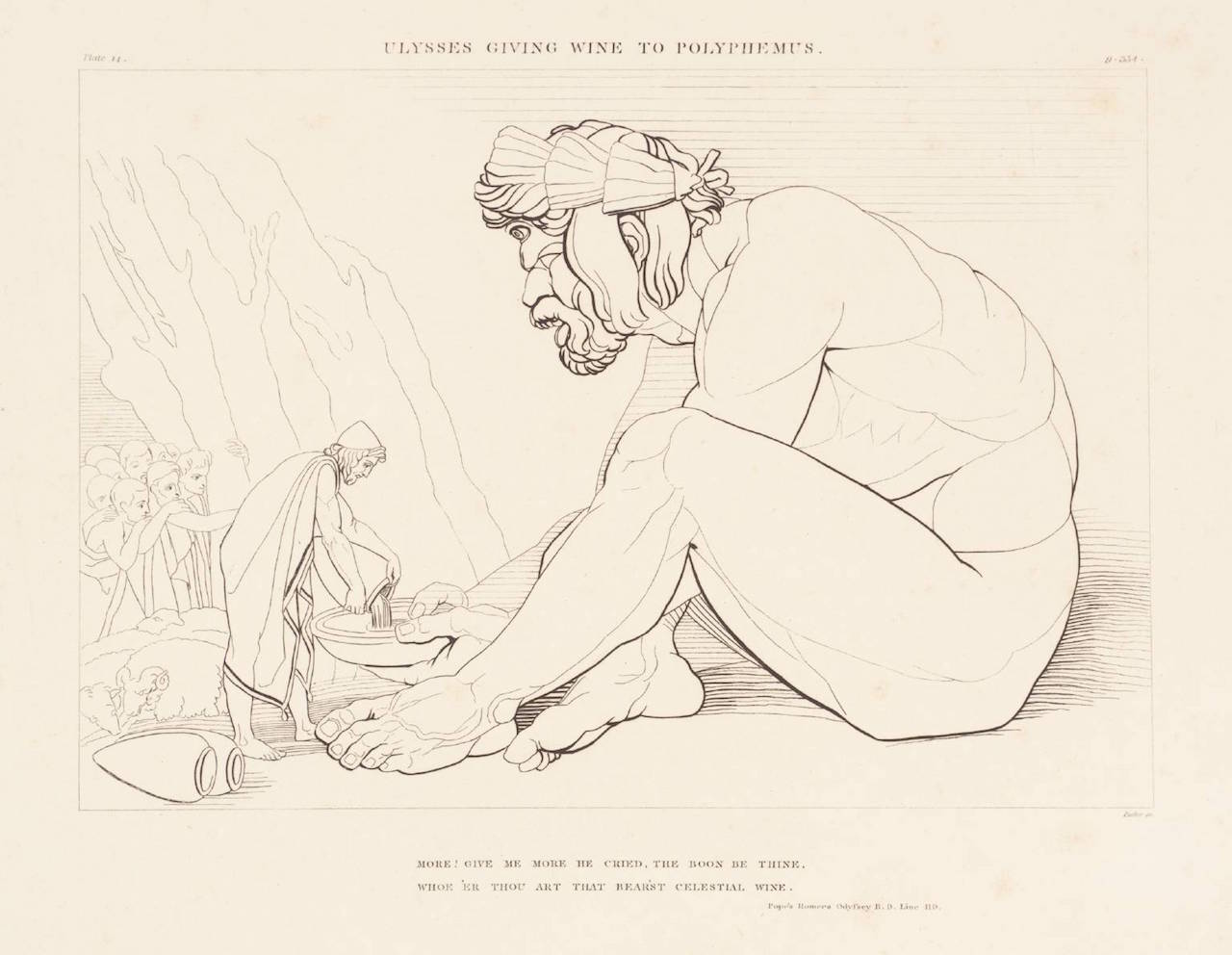 “Ulysses Giving Wine to Polyphemus” (1805). John Flaxman (1755–1826). Purchased as part of the Oppé Collection with assistance from the National Lottery through the Heritage Lottery Fund, 1996.
  “Circe Invidiosa,” (1892). J. W. Waterhouse (English, 1849–1917).
 “Teiresias appears to Ulysses during the sacrifice,” (1780–1785). Henry Fuseli (German, 1741–1825).
  “Ulysses and the Sirens” (ca. 1909). Herbert James Draper (English, 1863–1920).
 “Ulysses Asleep Laid on his Own Coast by the Phaeacian Sailors” (1805). John Flaxman (English, 1755–1826). Purchased as part of the Oppé Collection with assistance from the National Lottery through the Heritage Lottery Fund 1996.
  Minoan—probably Neopalatial—fresco commonly known as the “Lily Prince.” Whatever the exact type of this personage (perhaps a crowned acrobat, according to the interpretation of Maria Shaw), the Lily Prince is certainly a Minoan of elite standing. Public domain image based on a famous watercolor by Émile Gilliéron of a reconstruction by Arthur Evans.
 Detail from a fresco found at Hagia Triadha in Crete. Reconstruction by Mark Cameron, p. 96 of the catalogue Fresco: A Passport into the Past. Minoan Crete through the eyes of Mark Cameron. 1999. Catalogue curated by Doniert Evely. Athens: British School at Athens; and N. P. Goulandris Foundation, Museum of Cycladic Art. Reproduced with the permission of the British School at Athens. BSA Archive: Mark Cameron Personal Papers: CAM 1.
 “Minerva Restoring Ulysses to his Own Shape” (1805). John Flaxman (English, 1755–1826). Purchased as part of the Oppé Collection with assistance from the National Lottery through the Heritage Lottery Fund 1996.
 “Ulysses and his Dog” (1805). John Flaxman (English, 1755–1826). Purchased as part of the Oppé Collection with assistance from the National Lottery through the Heritage Lottery Fund 1996.
  “Ulysses Preparing to Fight with Irus” (1805). John Flaxman (English, 1755–1826) Purchased as part of the Oppé Collection with assistance from the National Lottery through the Heritage Lottery Fund 1996.
  “Euryclea Discovers Ulysses” (1805). John Flaxman (English, 1755–1826). Purchased as part of the Oppé Collection with assistance from the National Lottery through the Heritage Lottery Fund 1996.
  “The Harpies Going to Seize the Daughters of Pandareus” (1805). John Flaxman (English, 1755–1826). Purchased as part of the Oppé Collection with assistance from the National Lottery through the Heritage Lottery Fund 1996.
 Hēraklēs stringing a bow. Silver stater, c. 450–440 BCE, Thebes (Boeotia).
  Swallows, detail of the Spring Fresco at Thera, image via Flickr user
  Original artwork, by Flickr user
  Odysseus kiling Penelope’s suitors. Attic red-figure skyphos, ca. 440 BCE.
  Still life showing eggs, thrushes, napkin: from the House of Julia Felix, Pompeii.
  Eurykleia waking Penelope (1773). Print by Thomas Burke, after a painting by Angelika Kauffmann.
  Big Ed and Norma have just now broken free of the troublesome relationships that have kept these lovers apart for 27 years. Now at long last they can have a life together.
Still from
Big Ed and Norma have just now broken free of the troublesome relationships that have kept these lovers apart for 27 years. Now at long last they can have a life together.
Still from  “Mercury Conducting the Souls of the Suitors to the Infernal Regions” (1805). John Flaxman (English, 1755–1826). Purchased as part of the Oppé Collection with assistance from the National Lottery through the Heritage Lottery Fund 1996.
  “Ulysses Departing from Lacedaemon for Ithaca, with his Bride Penelope” (1805). John Flaxman (English, 1755–1826). Flaxman made this image the last in his Odyssey series, bringing the story of Penelope and Odysseus full circle. Purchased as part of the Oppé Collection with assistance from the National Lottery through the Heritage Lottery Fund 1996.


,_around_440_BC,_Altes_Museum_Berlin_(13718420225)_glare-reduced_white-bg.png)
