BOOK VI
So the grim battlecry was left
to Troians and Achaians.
1
This way and that, across the plain,
diversely rush'd the struggle,
While either host against the foe
its brazen spears directed,
Midway betwixt the Simoïs
and currents of Scamander.
First Ajax, son of Telamon,
a bulwark of the Achaians,
5
Breaking the line of Troïans,
gave comfort to his comrades.
For he a hero struck, who mid
the Thracians was noblest,
Goodly and mighty; Acamas,
the son of Eüsorus.
The spear upon his helmet's ridge
with horsetail bushy lighted;
Reach'd to the forehead, pierc'd the bone;
—and darkness veil'd his eyes.
10
Then did Diomedes, good at need,
Axylus slaughter,
The son of Teuthras, who his dwelling
held in nobly-built Arisba,
A man of substance plentiful,
and dear was he to all men;
For-that he dwelt beside the road,
and all, who came, befriended.
15
Yet none of those who lov'd him well
then stood in front, and warded
The ruesome fate; but two at once
fell by the son of Tydeus,
Axylus, with Calesius,
his minister and driver.
Then did Euryalus despoil
Opheltius and Dresus.
20
Aisepus next and Pedasus
he chas'd; whom erst a Naïd,
The nymph Abarbareia, bare
to spotless Bucoleion,
Who boasted in a lordly sire
Laomedon; and truly,
His eldest child he was, but base;
by stealth his mother bare him.
Tending his sheep he met the nymph,
and won her for his bridal,
25
And she from his embrace bestow'd
twin children on their father.
And now Mekisteus' son unstrung
their gallant limbs, and ravish'd
Their living spirit, and despoil'd
the armour from their shoulders.
War-biding Polypoetes slew
Astyalus: Ulysses
With brazen weapon pierc'd to death
Percosian Pidytes;
30
Teucer did Aretaon slay;
Antilochus, Ablerus.
But Agamemnon, prince of men,
to Elatus was fatal,
Who, by the side of Satnious,
that smoothly-flowing river,
Dwelt in the lofty Pedasus.—
Eurypylus too slaughter'd
35
Melanthius: while Leïtus
o'ertook the fleeing Phylax.
But Menelaus, good at need,
meanwhile Adrastus captur'd
Alive; for o'er the plain his steeds
had gallop'd wild with terror,
Till in the boughs of tamarisk
the crooked car was tangled.
Then snapping short the pole, themselves
career'd without a driver
40
Back to the city, where the rest
had hurried, struck with panic.
For he, their lord, beside the wheel
from out the car was tossed,
Into the dust face-forward hurl'd,
helpless: and lo! beside him
Stood Menelaüs, Atreus' son,
with spear of lengthy shadow.
Adrastus then his knees embrac'd,
in lowly supplication:
45
"Save me alive, O Atreus' son!
and take a worthy ransom:
For in my wealthy father's home
are large possessions treasur'd,
Many and costly; brass and gold
and varied forms of iron:
From these my sire would speedily
with boundless ransom please thee,
Soon as he learns of me alive
beside the Achaian galleys."
50
When thus he spake, his argument
the hero's heart was winning:
Shortly had he the captive sent,
by hand of his attendant,
Unto the sharp Achaian ships,
in rear; but Agamemnon
Against him quickly running came,
and utter'd words of menace:
"O Meneläus! gentle heart!
and why this care so fruitless
55
For lives of men? troth! thou at home
hast met delightsome fortune
From Troians. Then, let none of them
evade, from hands of Argives,
Headlong destruction. Show not e'en
to unborn children mercy;
But vanish all of Ilium,
unwept, unknown, unburied."
60
He spake; and by well-reason'd words
his brother's mind persuaded;
Who thrust Adrastus off from him:
and royal Agamemnon
By a side-stab the foe o'erthrew.
Thereat the son of Atreus,
Stepping with heel upon his breast,
pull'd out the ashen weapon.
65
Then Nestor rais'd his voice aloft,
and charg'd the Argive army:
"Friends, heroes of the Danaï,
and ministers of Ares,
Think not of spoil, nor stay behind,
each to increase his booty;
But slay the men; then tranquilly
shall ye despoil the corpses."
70
He, by such words, in every breast
spirit and strength excited.
Then surely would the Troïans
beneath the Achaian heroes
Again have enter'd Ilium,
in martial strength defeated;
But Helenus Priamides,
of all the Troian augurs
75
The wisest, came and spake a word
to Hector and Æneias.
"O Hector and Æneias! sith
of Lycians and Troians
On you supremely resteth toil;
for-that ye are the bravest
For every deed of enterprize,
and first in every counsel;
Patrol the army, form the lines,
before the gates array them,
80
Ere in their wives' embrace they fall,
and yield the foe a triumph.
When ye have strengthen'd all the bands,
we at our posts abiding
Against the Danaï will fight,
—perforce, if sore the labour.
85
But Hector, thou the city seek;
and bid our common mother
Unto greyey'd Athene's fane
upon the city's summit
The aged women to collect;
and with her key to open
Her sacred closet's door, and choose
the robe, which in her palace
90
Largest and loveliest may be,
and to herself the dearest:
This let her place upon the knees
of ample-hair'd Athene:
And pledge the vow to consecrate
twelve heifers in her temple,
Yearlings, unknowing of the goad,
if-that she deign to pity
The city of the Troïans,
their wives and infant offspring;
95
If she from sacred Ilium
may ward the son of Tydeus,
That spearman wild and truculent,
stout counsellor of terror:
Whom I in sooth affirm to be
the stoutest of the Achaians.
Not even from Achilles' self,
chiefest of heroes, felt we
So much affright, altho' (they say)
a goddess mother bare him.
100
But this man rageth wondrously,
and none his might may equal."
He spake; and Hector willing show'd
compliance to his brother,
And from his chariot straightway leapt
to the ground in armour.
Two pointed jav'lins brandishing,
thro' all the army went he,
Enheartening his men, and rous'd
the deadly cry of battle.
105
Then did they gather to a ball,
and stood against the Achaians;
And back the Argives drew themselves,
and respite made of carnage.
For some immortal seem'd to them
down from the starry heaven
With aid among the Troïans
to drop; so quick they rallied.
Then Hector rais'd his voice aloft,
and charg'd the Troian army:
110
"Ye high-soul'd Troïans, and ye
allies from distance summon'd!
Be men, my friends! nor negligent
of furious encounter,
Whilst Ilium I seek, and urge
our counsellors and consorts
Unto the deities to pray
and hecatombs to promise."
115
Then Hector of the motley helm
with such address departed.
His bossy shield (so vast its orb)
with its black rim of leather
Rattled alternate, as he mov'd,
against his neck and ankles.
Then in the midst, between the hosts,
did Tydeus' son and Glaucus,
The offspring of Hippolochus,
meet eager for the combat.
120
When they to shorter distance came,
advancing each on other,
Him Diomedes, good at need,
first with salute accosted:
"Bravest of men, what name is thine
among the race of mortals?
For never have I look'd on thee
in man-ennobling combat
On former days; but now by far
surpassest thou in boldness
125
All men,—who darest to await
my spear with lengthy shadow:
And troth! unhappy are the sires,
whose sons my force encounter.
But if from heaven thou art come,
and art a god immortal,
Not lightly into stern debate
with such would I adventure.
No, truly! for Lycurgus too,
the hardy son of Dryas,
130
Lasted not long, who strove against
the habitants of heaven.
For he of yore the nurses chas'd
of frantic Dionysus
Along the heav'nly Nysa's cliff:
they, with an ox-goad wounded
By murderous Lycurgus' hands,
did all in wild disorder
Shed on the ground their sacred gear;
but Dionysus, frighten'd,
135
Into the briny billow plung'd:
and Thetis in her bosom
Caught him all shuddering:
for dread from the man's raving seiz'd him.
Therefore the gods who live at ease
hated the man Lycurgus,
And Saturn's child his sight destroy'd:
nor lasted he much longer,
When into enmity he rush'd
with all the gods immortal.
140
Wherefore against the blessed ones
fain would I shun to battle.
But if a mortal man thou art,
and earthly viands eatest,
Come nearer; so thou earlier
destruction's goal shalt compass."
To him the gallant offspring of
Hippolochus responded:
"Why askest thou my origin,
high-hearted son of Tydeus?
145
As leaves upon the trees are born,
such is the birth of mortals.
Of leaves one brood before the wind
on earth is shed; but others
Soon from the budding forest rise,
in hour of spring succeeding:
So too the courses of mankind
grow up and fail, successive.
But if it please thee this to learn,
then straight will I inform thee,
150
Who are our parents:——and with this
are many men acquainted.
A city dwelleth in a nook
of courser-feeding Argos,
Ephyra, town of Sisyphus,
the craftiest of mortals:
Father to him was Æolus,
but Glaucus was his offspring:
And Glaucus in his turn begat
spotless Bellerophontes,
155
On whom the heav'nly gods bestow'd
beauty and lovely courage.
But Proetus, who was mightier
(for Jove beneath his sceptre
Subdued the Argives), hated him,
and drave him from the people.
For Proetus' wife, divine Anteia,
burn'd for him with frenzy,
160
Yet might not win the righteous heart
of sage Bellerophontes.
Then she with false and wicked words
king Proetus thus accosted:—
O Proetus! either die thyself,
or slay Bellerophontes,
Who tried, in service of his lust,
my will to overmaster.—
165
When from his spouse such tale he heard,
the prince was seiz'd with anger,
To slay his rival he forbore
(for boding thoughts withheld him),
But sent him forth to Lycia,
and gave him baleful tokens,
Engraving many a deadly mark
within a folded tablet,
To show unto his consort's sire
and work his sure destruction.
170
So went he forth to Lycia
by blameless heav'nly escort.
But when to Lycia he came
and to the streaming Xanthus,
The prince of wide-spread Lycia
gave to him friendly welcome:
Nine days he entertain'd the guest,
nine oxen did he offer.
But when the rosyfinger'd Morn
a tenth time dawn'd upon him,
175
Then did he question put to him
and ask to see the token,
Which by Bellerophontes' hand
his daughter's lord might send him.
But when the evil marks he saw,
and knew the mind of Proetus,
First sent he him with charge to kill
the infuriate Chimæra,
Who came not from the world of men,
but was a brood unearthly,
180
With lion's front and serpent's tail,
a goat in centre only,
From whom the direful might of fire
came blazing thro' the nostrils:
Yet her he slew, obedient
to prodigies from heaven.
Next, with the famous Solymi
did he engage in combat,
And deem'd, that never fight of men
a hardier he enter'd.
185
Then Amazons, a match for men,
in third emprize he conquer'd.
But for his backward path the king
wove new device of danger:
From the broad land of Lycia
he pick'd the bravest heroes,
And laid an ambush;——yet of these
not one his home regained;
For all of them the spotless man
Bellerophontes slaughter'd.
190
But when the king at length in him
discern'd the goodly offspring
Of heaven, he detain'd him there,
and tendered his daughter,
And eke, imparted half to him
of all his royal honour.
Also for him the Lycians
apportioned a portion,
Select, for his enrichment; fair
with orchards and with tillage.
195
That marriage yielded children three
to sage Bellerophontes,
Isander and Hippolochus
and fair Laodameia.
And Jove the Counsellor desir'd
Laodameia's beauty,
Who bare to him that match for gods,
Sarpedon brazen-helmed.
But, when at length the spotless chief
by all the gods was hated,
200
Over the plain of Wandering
then wandered he lonely,—
Devouring his own heart and soul,—
the track of man avoiding.
For by the famous Solymi,
in new array of battle,
Ares, insatiate of blood,
had slain his son Isander:
And golden-bridled Artemis
in anger slew his daughter.
205
But me Hippolochus begat,
and him I claim as parent.
He into Troas sent me forth,
and many charges gave me,
Alway to be preeminent,
and play the chief to others,
Nor to misgrace my fathers' breed,
who foremost were in valour
Alike in Argive Ephyra
and Lycia's expanses.
210
Such is the parentage, and such
the blood, in which I glory."
Then Diomedes, good at need,
hearing his speech, was joyful.
Upon the many-feeding earth,
upright his spear he planted,
And thus with kindliness address'd
the shepherd of the people:
"Troth! thou a stranger-friend to me
art by ancestral title.
215
For godlike Oeneus formerly
for twenty days detained,
And banqueted within his halls,
spotless Bellerophontes.
Fair gifts of hospitality
then each with other changed.
Oeneus a girdle gave to him
with Punic dye resplendent:
To him Bellerophontes gave
a golden double-goblet;
220
And I, departing for the war,
left it within my palace.
But Tydeus I remember not:
for still was I an infant
At home remaining, when at Thebes
the Achaian host was ruin'd.
Therefore to thee a friendly host
am I in midmost Argos,
And thou to me in Lycia,
when I their people visit.
225
But let us, each amid the throng,
with spear avoid the other.
Enough I find of Troïans
and brave allies, to slaughter,
Whom God to me may grant, and whom
I overhend in fleetness:
Thou too enough of Argives hast
to slay, if thou be able.
But let us, each with other, change
our arms; that all who see us
230
May know, that, to be stranger-friends
is our ancestral glory."
On such alternate argument,
they from their cars descending
Each of the other seiz'd the hand
and pledges gave of friendship.
Thereat did Jove Saturnius
the wit of Glaucus cripple,
Who with Tydides Diomed
exchange of arms accepted,
235
And gave his gold for common brass,
for nine a hundred oxen.
Meanwhile retiring, Hector reach'd
the Skæan gates and beech tree,
And all around him flock'd the wives
and daughters of the Troians,
To make inquiry for their sons,
their brothers and their kinsmen,
And for their husbands. He, in turn,
with solemn train commanded
240
All to entreat the gods: but grief
was held in store for many.
But when at Priam's gorgeous house,
with shining porches builded,
He had arriv'd, wherein were rang'd
fifty bright marble bowers,
All side by side; where Priam's sons
slept with their wedded consorts;
245
But opposite, within the court,
were twelve bright marble bowers,
Under the roof, all side by side,
abode of Priam's daughters,
Where slept, beside their wives august,
the sons-in-law of Priam:——
250
Just then, benign in tenderness,
his mother came across him,
Leading with her Laodike,
the fairest of her daughters;
And closely did she press his hand,
and spake, his name pronouncing;
"And why, my child, thus comest thou,
leaving the hardy battle?
Achaia's children (luckless name!)
around the city warring,
255
Sorely, I guess, outwear the folk;
and thee thy mind commanded
To come and raise thy hands to Jove
upon the city's summit.
But stay, and let me bring thee wine.
With wine, as honey pleasant,
Shalt thou libations make to Jove
and other gods immortal,
Firstly; and afterward thyself
shalt by the draught be strengthen'd.
260
Wine to a man allwearièd
increaseth mighty vigour;
As wearièd art thou, my son,
thy kinsmen's lives defending."
Great Hector of the motley helm
then spake to her responsive:
"Raise not to me heart-soothing wine,
O venerable mother,
Lest thou my limbs unnerve, and steal
my memory of valour.
265
It shameth me, the sparkling wine
to pour with hands unwashen
1
2
3
4
5
6
To Jupiter; nor may a man
with gore and filth bespatter'd,
To Saturn's gloomy-clouded son
offer a seemly worship.
But thou with gifts of incense seek
Athene booty-driving
Within her temple, gathering
the aged women round thee.
270
Out of thy sacred closet choose
the robe, which in thy palace
Largest and loveliest may be,
and to herself the dearest:
This do thou place upon the knees
of amplehair'd Athene:
And pledge thy vow to consecrate
twelve heifers in her temple,
Yearlings, unknowing of the goad,
if that she deign to pity
275
The city of the Troïans,
their wives and infant offspring:
If she from sacred Ilium
may ward the son of Tydeus,
That spearman wild and truculent,
stout counsellor of terror.
Do thou, within her fane, approach
Athene booty-driving:
But I must Alexander seek,
and summon him, if haply
280
He will to feel reproaches. Oh!
that Earth might yawn to gulp him!
For troth! a grievous pestilence
to mighty-hearted Priam
And all his sons and all his folk
the Olympian hath rear'd him.
If to the house of Aïdes
him I beheld descending,
Seemeth, my mind would then be rid
of misery's remembrance."
285
He spake. Then she, unto her halls
departing, gave commandment
To her attendants: they forthwith
about the city gather'd
The aged women. She herself
went to her perfum'd chamber,
Where robes of curious broidery,
many and large, were treasur'd,
Wrought by Sidonian women, whom
the godlike Alexander
290
Himself from Sidon brought to her,
over the broad flood sailing
In that emprize of voyage, which
bare off the highborn Helen.
Of these did Hecuba take one,
for honour to Athene,
Which was in varied broideries
most beautiful and largest:
Like to a star its brilliance was;
and undermost she found it.
295
Then forth she hied; and after her
pour'd many aged women.
But when Athene's fane they reach'd
upon the city's summit,
To them the doors were opened by
dainty-cheek'd Theano,
Whose sire was Kisseus, but her lord
Antenor coursertaming;
For-that the Troians her had set
to be Athene's priestess.
300
Then all, with trilling cry, their hands
uplifted to Athene.
Thereat, the robe all gorgeous
did dainty-cheek'd Theäno
Place reverent upon the knees
of amplehair'd Athene;
And to the imp of mighty Jove
spake vow and supplication:
"Lady Athene, maiden-queen,
defendress of the city,
305
Divine of goddesses! break thou
the spear of Diomedes,
And cast before the Skæan gates
himself the hero headlong:
So do we vow to consecrate
twelve heifers in thy temple
Yearlings, unknowing of the goad,
if that thou deign to pity
The city of the Troïans,
their wives and infant offspring."
310
So utter'd she the vow; nor gain'd
assent from maid Athene.
Thus to the child of mighty Jove
did they their worship offer;
But Hector, he meanwhile had reach'd
the house of Alexander,
All-splendid, which himself had built
by men, who then were counted
Of all in loamy Troas' land
the craftiest of workmen;
315
Who built for him a spacious hall,
a court and secret bower,
To Priam's self and Hector near,
upon the city's summit.
There enter'd Hector, Jove-belov'd;
and in his hand he wielded
A lengthy spear, which measur'd ells
eleven; and before him
Glitter'd its brazen head, whose neck
a golden ring surmounted.
320
But he his brother found, employ'd
about his beauteous armour
Within his bower; handling shield
and crooked bow and corslet:
And Argive Helen sat amidst
her own domestic women,
Giving to every hand its task
of glorious achievement.
Hector look'd on, and bitterly
with words of blame address'd him.
325
"O elf-possessed wight! 'tis ill
such gloomy bile to foster.
The people, round the lofty wall
and o'er the plain contending,
Perish. On score of thee, behold!
clamour and battle blazeth
Abroad on every side; and thou
wouldest assail another,
If any thou didst haply see
relax'd from hateful warfare.
330
But up and act; lest soon the town
by foeman's fire be warmed."
But thus responsively to him
spake godlike Alexander:
"With right, and not beyond the right,
hast thou reproach'd me, Hector!
To thee then will I speak: but thou,
promise to me to listen!
Within my bower here sat I,
no gloomy bile indulging
335
Nor scorn of Troians; but, I wish'd
to yield myself to sorrow.
But now by force of gentle words
my wife hath me persuaded
Into the war to hurry: yea,
myself I deem it better,
So to determine.——Victory
her champions exchangeth.
But wait thou at my side, while I
put on my martial armour;
340
Or go, and I will follow thee,
and think I shall o'ertake thee."
He spake, but no reply came back
from motley-helmed Hector;
To whom with soothing accents spake
Helen, divine of women:
"O, brother thou of me, who am
a mischiefworking vixen,
A numbing horror,——better far
deserv'd I, when my mother
345
First gave me light, an evil squall
of rushing wind had borne me
Into the dells of mountain beasts,
or through the brawling billows:
There would the wave have swept me off,
ere deeds of woe were compass'd.
But tho' it pleas'd the gods above
these miseries to destine,
I might have chosen me at least
some braver man as partner,
350
Able to suffer from contempt
and mockeries of mortals.
But as for this one, neither now
his mind is firm, nor ever
(I deem) will reap disaster.
Hereafter will be therefore he
But enter now, and in this chair
take thou a seat beside me,
My brother! since on thee in chief
hath toil and sorrow crowded,
355
For me, the vixen of my sex,
and Alexander's frenzy;
On both of whom hath Jupiter
laid evil fate, which alway
To men of aftertime shall yield
a theme of song unfailing."
Great Hector of the motley helm
then spake to her responsive:
"O loving Helen, stay me not:
nor may I be persuaded:
360
My heart already o'er the field
rusheth abroad, to succour
The Troïans, who sorely feel
the absence of their leader.
Rather, do thou thy husband rouse,
and let himself be active,
That me he shortly may rejoin,
ere-that I quit the city.
For to my home must I too go,
to look upon its inmates,
365
My loved wife and infant boy:
for none can know the future,
Whether, returning safe, again
I yet may see their faces,
Or whether, by Achaian hands,
the gods may lay me prostrate."
Then Hector of the motley helm
with such discourse departed.
Unto his mansion's goodly site
he speedily was carried,
370
Nor found whitearm'd Andromache
still in her halls abiding,
But to a tower gone was she,
with a fullrob'd attendant
Bearing her infant: there she stood,
melted in tears and plaining.
But Hector, soon as he within
found not his spotless consort,
Stept backward to the threshold:
thence, he call'd to the domestics:
375
"Hearken, ye women of my house,
and answer to me truly,
Whither whitearm'd Andromache
went forth from out the palace.
Doth she the mansion haply seek
of fullrob'd female kindred?
Or went she to Athene's fane,
where other Troian women,
Comely with matron-tresses, crave
the dreadful goddess' favour?"
380
To him the keeper of his house,
discreet of women, answer'd:
"Hector! sith thou commandest us
the very truth to tell thee,
Neither doth she the mansion seek
of fullrob'd female kindred,
Nor went she to Athene's fane,
where other Troian women,
Comely with matron tresses, crave
the dreadful goddess' favour:
385
But to a tower forth she went
through Ilium, on hearing
The Troians worsted were, and great
the puissance of the Achaians.
So she unto the outmost wall
to see the war hath hurried,
In frantic fashion; and the nurse
her infant beareth with her."
So spake the chief domestic; then
forth from his house did Hector
390
Haste on the selfsame path again,
along the streets well-builded.
When at the gates he was arriv'd,
through the great city passing,
The Skæan gates;——for there would he
pass out to join the army;——
Here did his richly-dowed wife
come hurrying to meet him,
Andromache, whose father was
Eëtion great-hearted,
395
Eëtion, who held his home
beneath the woody Placus,
And to Cilicians was prince
in Hypo-Placan Thebe:
His daughter was in wedlock held
by brazenhelmed Hector,
And met him now: along with her
went the fullrob'd attendant
Bearing within her arms the child,
a tenderminded infant,
400
Like to a brightly twinkling star,
the darling son of Hector,
Whom Hector call'd Scamandrius,
but all the other Troians
Astyanax: for Ilium
was sav'd by Hector only.
7
8
9
10
11
The father cast upon his boy
a glance, and smil'd in silence:
But by his side Andromache
stood, all in sorrow melted,
405
And closely did she press his hand,
and spake, his name pronouncing:
"Oh elf-possess'd in hardihood,
thy very might will kill thee;
Nor pitiest thy infant child,
nor me thy wife ill-fated,
Who soon shall be despoil'd of thee:
for, rallying together,
Soon shall the Achaians slay thee:
but, for me, of thee bereaved,
410
Better were it, below the earth
to sink: for other comfort
None will remain, if thou by fate
shalt once be overhended,
But only griefs: for, father none
have I, nor queenly mother:
For Achileus, a match for gods,
slaughter'd my sire, and ravag'd
The city of Cilicians,
the loftygated Thebe,
415
Planted upon a goodly lot:
but when he slew their chieftain,
The bloody corpse despoil'd he not
(for boding thoughts withheld him),
But burn'd it, even as it was,
in all the curious armour,
And rais'd a barrowmound above;
and round it elms were planted
By mountain-damsels, heav'nly imps
of Jove the ægisholder.
420
But those who in my father's halls
were rear'd, my brothers seven,
They in a single day went all
down to the house of Pluto;
For all of them divine Achilles
foot-reliant slaughter'd,
When they the snowy sheep would guard
and clumsyfooted oxen.
And for my mother; queen was she,
beneath the woody Placus,
425
And her he brought away with him,
along with other booty,
Then for a splendid ransom-price
releas'd her; but she perish'd
By arrow-pouring Artemis
within my father's chambers.
But Hector, thou my father art
and thou my queenly mother,
Thou art to me for mother's son,
and thou my blooming consort.
430
But come now, pity me; and here
abide upon the tower,
Nor doom thy child to orphanhood,
and make thy wife a widow.
By the wild figtree post the bands
in firm array; where chiefly
Accessible the city is,
and where the wall was mounted.
For thrice have here the bravest foes
assay'd to force an entrance,
435
Around the two Ajaces, and
Idomeneus the famous,
Around the Atridæ, and around
the doughty son of Tydeus;
Whether-that one gave hint to them,
with oracles acquainted,
Or-that their proper notion hath
imagin'd and enjoin'd it."
Great Hector of the motley helm
then spake to her responsive:
440
"O lady, all this argument
by me too is regarded:
But direfully abash'd were I
before the men of Troas
And Troian women trailing-rob'd,
if, skulking like a coward,
I shunn'd the war: nor doth my heart
allow it; but hath taught me
Mid foremost Troïans to fight
and show a chieftain's virtue,
445
And guard my father's great renown
and lift myself to glory.
For this, in heart and soul, full sure
I know; a day is coming,
A day, when sacred Ilium
for overthrow is destin'd,
And Priam's self, and all the folk
of ashen-speared Priam.
But not so much for Troïans,
hereafter, feel I sorrow,
450
Nor e'en for Hecuba herself,
and for the royal Priam,
Or for my many brothers brave,
who, by the hands of foemen,
Slaughter'd will fall in dust:——for
none of these doth anguish rend me,
So, as for thee: whom haply one
of brazencloak'd Achaians,
Despite thy tears, shall lead away
spoil'd of thy day of freedom:
455
Then for a foreign mistress thou
wouldst weave, in Argos dwelling,
Or from Thessalian Messés
or Argive Hypereia
Bear water; sore against thy will:
but stern constraint will force thee.
And haply one may say, who sees
a tear from thee to trickle ;——
'This is the wife of Hector, who,
of courser-taming Troians,
460
When rag'd the war round Ilium,
held primacy in battle.'
So may one say hereafter; then,
in lack of such a husband
To ward the day of slavery,
on thee will fall new sorrow.
But oh, may death my senses shut,
and piles of earth conceal me,
Ere-that I see thee dragg'd away
and hear thy shriek of anguish."
465
Thus saying, gallant Hector stretch'd
his arms toward his infant.
But back into the bosom of
the nurse with dapper girdle
The child recoil'd with wailing, scar'd
by his dear father's aspect,
In terror dazzled to behold
the brass, and crest of horsehair,
Which from the helmet's topmost ridge
terrific o'er him nodded.
470
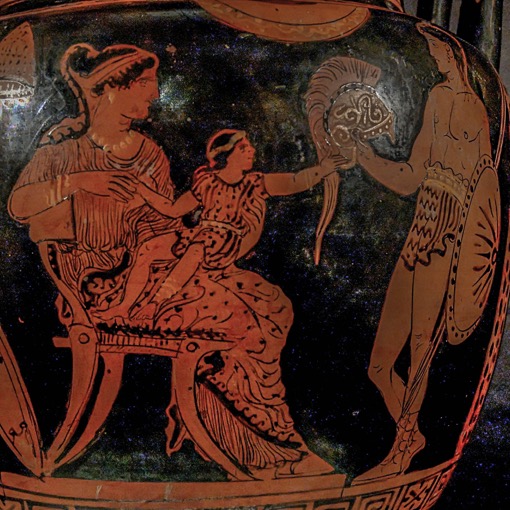
Then did his tender father laugh,
and laugh'd his queenly mother,
And gallant Hector instantly
beneath his chin the helmet
Unfasten'd; so upon the ground
he laid it all resplendent :
Then pois'd his little son aloft,
and dandled him, and kiss'd him,
And rais'd a pray'r to Jupiter
and other gods immortal:
475
"O Jupiter, and other gods,
grant ye, that this my infant
Mighty to reign in Ilium,
soon may become his father's like,
Among the Trojans signal,
and terrible in prowess.
And when from battle he returns,
may some one say hereafter,——
'Far greater than his sire is he';
and may he with him carry
480
The gory trophies of a foe,
his mother's heart to gladden."
Thus saying, in the mother's arms
he plac'd the tender infant;
And she her own dear child receiv'd
within her fragrant bosom,
Laughing amid her tears: the which
her husband saw, and pitied;
And soothing her with hand and voice,
he spake, her name pronouncing:
485
"Oh elf-possessed! let not grief
extravagant betoss thee.
No man, o'erpassing fate's decree,
shall hurry me to Pluto:
But Destiny, I well aver,
no mortal wight hath scaped,
From the first day he saw the light,
—nor noble heart nor coward.
But thou, returning to thy house,
to thine own work betake thee,
490
The loom and distaff,——diligent;
and see that thy attendants
Their tasks appointed duly ply;
but men must care for battle,——
All, who in Ilium are born,
and I, thy Hector, chiefly."
So gallant Hector spake, and took
his horsetail-crested helmet.
But his dear partner, leaving him,
unto her home departed,
495
With many a turn and lingering,
and gaze by tears beclouded.
Soon at the mansion nobly plac'd
of hero-slaying Hector
Did she arrive, and found within
a gather'd crowd of handmaids,
Aged and young; and in them all
she wak'd a love of sorrow.
So they, for Hector still alive,
in his own home were wailing.
500
For, sooth, they counted not that he,
out of the war returning,
Would look on them again, escap'd
from hands and might of Argos.
Nor long did Paris stay behind
within his lofty mansion;
But he his glorious armour donn'd,
inwrought with brass, and hurried
Along the spacious Ilium,
on rapid feet reliant.
505
As when a charger, closely kept,
highpamper'd at the manger,
Bursting his halter, o'er the plain
with prance and gambol trampleth,
Accustom'd in the flood to bathe
of some fair-streaming river,
Wild glorying; and holdeth high
his head, and off his shoulders
Rusheth the mane abroad; and he
in his brave beauty trusteth;
510
Lightly his knees then carry him
to horses' haunts and pastures :
So from the highth of Pergamus
did Paris, son of Priam,
All radiant in armour, speed,
like to the amber day-god,
Laughing in brilliant grandeur:
him his rushing feet escorted.
Thus speedily he overtook
his godlike brother Hector,
515
Who there still linger'd, where with him
his own beloved commun'd.
Then Alexander, peer of gods,
to him began discourses :
"My gracious sir, thou hastenest,
and I in sooth detain thee
By tarrying; nor duteous
arriv'd I, as thou badest."
Him Hector of the motley helm
responsively accosted:
520
"O elf-possessed wight! no man,
who rightful is of spirit,
Thy deeds of battle may despise;
for doughty is thy valour.
But wilfully dost thou relax,
refusing war: and sorrow
My inmost heart possesseth, when
reproachful words against thee
I hear from Troians, who endure
on score of thee much travail.
525
But go we: afterward will we
these things arrange, if haply
Jove grant, that we unto the gods
of heav'nly birth eternal
Hereafter in the palace crown
with wine the bowl of freedom,
When we from Troas have expell'd
the dapper-greav'd Achaians."
12

 Apulian red-figure column-crater (ca. 370–360 BCE) depicting an intimate family scene: Hector removes his helmet as he says his final farewell to his wife Andromache and to their child Astyanax. Public domain image by Jastrow via Wikimieda Commons