BOOK XXII.
THE ARGUMENT. THE DEATH OF HECTOR.Iliad. Homer. London. 1863.
Sponsored by Perseus Project, Tufts University.
Iliad. Homer. London. 1863.
Sponsored by Perseus Project, Tufts University.
English (Alexander Pope, 1720, ed. Watson, 1857) (OCR draft) (English) (English (Alexander Pope, 1720, ed. Watson, 1857))
Provisional text from uncorrected OCR; expect errors.
Iliad
Here and some fifty lines later (23.193) are the only two occurrences in the Iliad of the ἔνθ᾽ αὖτ᾽ ἄλλ᾽ ἐνόησε (“then he/she thought of other things”) formula, which occurs with much greater frequency in the Odyssey. In that poem, the formula functions as a marker of a more or less significant discontinuity: a change of scene or a turn of the plot in a substantially new direction (see Odyssey 2.382). In this instance, there is no such discontinuity, at least in terms of the scene or the forward movement of the action. Instead of a sudden departure in a new direction, we find a ‘zooming in’ on the goal of the action, from the Myrmidons as they march in Patroklos’ funeral procession to Achilles standing at the pyre. The discontinuity consists rather in the transition to a ritual act of special significance: Achilles’ dedication of the lock of hair that Peleus had vowed would be offered to the river Sperkheios on Achilles’ return to Phthia. The subsequent occurrence of the formula likewise marks the shift to an especially significant ritual act, namely, the lighting of Patroklos’ funeral pyre. The formulaic marker of discontinuity thus serves to highlight the most critical ritual moments in the otherwise continuous narrative of Patroklos’ funeral. Comparison with the usage of the formula in the Odyssey suggests further layers of possible meaning. At Odyssey 23.242, a variant of the formula occurs in a context in which, again, there is no immediately apparent discontinuity. And, again, this occurrence is followed by another a short while later (23.344). These two instances enclose what is arguably the most significant moment in the Odyssey: the reunion of Odysseus and Penelope, which Aristophanes of Byzantium and Aristarchus identified as the poem’s τέλος (see Odyssey 23.242). One might similarly view the ritual act enclosed by the Iliad’s two occurrences of the formula as the τέλος of that poem, for, by shearing the lock of hair he had saved for Sperkheios, Achilles ritually formalizes his destiny to die at Troy. In the Odyssey, furthermore, the ἄλλ᾽ ἐνόησε formula, which is used most often with Athena as subject, serves as an index of narrative control: it highlights the fact that Athena prompts and guides the action (see Odyssey 2.382). In Iliad 23, Achilles emerges as a comparable director of the action. Not only does he dictate the ritual procedures of Patroklos’ funeral; during the subsequent games he directs contests that restage, in various ways, many of the poem’s principal themes. Finally, it is tempting to draw some connection between the fact that, in the Odyssey, the formula is restricted to female subjects (Athena, Helen, Nausikaa, Penelope) and the fact that, in the Iliad, it refers exclusively to Achilles’ involvement in funerary ritual. As a mourner, Achilles participates in a sphere of action that is typically dominated by women (see Alexiou 2002 and Dué 2006: ch. 1). The application to Achilles of a formula that is otherwise associated with female actors may serve to highlight his assumption of a very different social role than he has hitherto occupied.
Bibliographical References
Alexiou, M. 2002. The Ritual Lament in Greek Tradition. Rev. ed. Lanham, MD.
Dué, C. 2006. The Captive Woman’s Lament in Greek Tragedy. Austin.
evidence for contention that Od. XVIII.265 is very old, as ἤ κεν and ἢ κεν is likely older than ἠέ κεν and ἢε κεν.
in a list of occurrences of the phrase thanatoi…halōnai in Homer, in the context of analyzing the meaning of the phrase in contrast with me nesei
analysis of original notion of verb halṓō, “to be seized by death”
example of opposition between verbs pheúgein and halonai. Compare to Il. XIV.81
example of laos as referring to one’s own even with ōlese
in the context of analyzing the apobatēs race invented by Erichthonios
evidence for contention that Od. XVIII.265 is very old, as ἤ κεν and ἢ κεν is likely older than ἠέ κεν and ἢε κεν.
analysis of meaning of halonai, “to be killed” as a genuine opposite of hairéō
in a list of passages where theōi hōs is used
in a list of passages where mortals are compared to gods (in the context of analyzing Arete’s comparison to a god/Athena Polias)
analysis of Achilles’ address to the river Spercheius. The juxtaposition of Peleus’ intention with the theme of Achilles’ return underscores the latent connection of loss of “mind” with Achilles’ loss of “return”
in the context of discussing ērato and Arētē
analysis of Achilles’ acknowledgement of fate, which suggests that Achilles’ resolve to die is also a result of his own lack of “mind”
analysis of allusions/references to traditions outside of the Homeric epics, here by Iliad to other epic traditions regarding the death of Achilles and his killing Memnon (Kakridis’ argument)
in the context of discussing ērato and Arētē
reference in the context of analyzing names in -tōr, here regarding Stentōr
comment on Eumelos’ “eagerness” as not being the same fault as in Nestor’s case, in the context of comparing Eumelos’ race with Nestor’s race with the twins
analysis of the interconnections of Menelaus’ chariot race in this passage and the success of his (and Agamemnon’s) nostos
analysis of the role of noos in Antilochus’ victory in the chariot race
analysis of the differences between Nestor at his chariot race against the twins and Antilochus at the race in Iliad 23, here, knowledge and skill in horsemanship
comment on the purpose of Nestor’s speech on tactics for rounding the turning post, when it does not feature in the description of the race itself (evoking Nestor’s own race against the twins)
comparison of Nestor and Antilochus, and the latter’s representation as similar to old, experienced Nestor in Nestor’s speech
analysis of the differences between Nestor at his chariot race against the twins and Antilochus at the race in Iliad 23, here, slow and old horses
example of Nestor as symbol of “intelligence”
analysis of the role of mētis and noos in Antilochus’ race
analysis of mētis and noos of characteristic of Odysseus and Nestor, respectively, but also used of the other, and the connections of noos with nostos and Nestor
example of Nestor as the symbol of “intelligence,” here exemplified by his connection with mêtis
analysis of the opposition of mētis and biē
comparison of the charioteer(s) in Nestor’s speech with himself and Antilochus (and others)
analysis of Antilochus’ mētis and comparison of this verse with I.23.515
comparison of the charioteer(s) in Nestor’s speech with himself and Antilochus (and others)
comparison of Antilochus with the skilled charioteer in Nestor’s speech
comparison of the charioteer(s) in Nestor’s speech with himself and Antilochus (and others)
analysis of the phrase oude se lēsei/he lēthei in Nestor’s speech to Antilochus (and the entire chariot race sequence)
analysis of the chariot race and turning point in terms of the twin myth, with the turning point/grave as the point of death and from whence the immortal twin initiates the return to life
comparison of Nestor’s advice to Antilochus regarding the balance between inciting and restraining his horses and that of the Epeian twins
comparison of Nestor’s advice to Antilochus regarding the balance between inciting and restraining his horses and that of the Epeian twins, and the irony in Nestor’s advice (his own crash)
comment on the immediacy of the race after Nestor’s speech of advice to Antilochus (analysis of the motivation of the speech)
analysis of the motivation of Nestor’s speech of advice to Antilochus – evoking Nestor’s own earlier race (the turning post, on which Nestor spends so much time, is ignored in the description of the race)
comparison of the language of turning for home after routing the Epeians in Nestor’s story in I.11 and the language of rounding the turning post in the chariot race for Patroclus
comparison of the language of turning for home after routing the Epeians in Nestor’s story in I.11 and the language of rounding the turning post in the chariot race for Patroclus (Nestor’s account of the battle as cast in terms of a chariot race)
analysis of the motivation of Nestor’s speech of advice to Antilochus – evoking Nestor’s own earlier race (the turning post, on which Nestor spends so much time, is ignored in the description of the race)
comparison of the language of turning for home after routing the Epeians in Nestor’s story in I.11 and the language of rounding the turning post in the chariot race for Patroclus
analysis of the motivation of Nestor’s speech of advice to Antilochus – evoking Nestor’s own earlier race (the turning post, on which Nestor spends so much time, is ignored in the description of the race)
analysis of the attitude towards, and the reality of, the ability of female horses in chariot races
analysis of the differences between Diomedes’ (with Athena’s help) and the Epeian twins’ chariot races
analysis of Diomedes’ chariot racing, with Athena’s help (returning the whip and putting strength into his horses), in terms of the Indo-European twin myth, where the whip belongs to the immortal twin
comparison of Eumelos’ and Nestor’s chariot racing (lack of restraint in letting fly of the reins and the yoke breaking for Nestor and Eumelos, respectively, and crashing the chariot)
analysis of the symbolism of the whip and the yoke in Diomedes’ race
analysis of the differences between Nestor at his chariot race against the twins and Antilochus at the race in Iliad 23, here, slow and old horses
analysis of the symbolism of the whip and the yoke in Diomedes’ race
analysis of the interconnections of Menelaus’ chariot race in this passage and the success of his (and Agamemnon’s) nostos
analysis of the differences between Nestor at his chariot race against the twins and Antilochus at the race in Iliad 23, here, slow and old horses
comparison of Antilochus with the skilled charioteer in Nestor’s speech and Antilochus’ taking to heart what Nestor says (oude me lēsei/he lēthei)
analysis of the role of noos in Antilochus’ race (contra Menelaus’ words regarding Antilochus’ noos)
comparison of Antilochus’ and Menelaus’ race with Nestor’s against the Epeian twins, in terms of incitement and (not) crashing
comparison of Antilochus’ heedless incitement to Nestor’s state of mind when he crashed, and Patroclus’ when the gods call him to death (I.16.693)
comparison of Antilochus’ and Menelaus’ race with Nestor’s against the Epeian twins, in terms of incitement and (not) crashing
analysis of Menelaus’ characterization as a follower in his relationship with Agamemnon, here in particular the use of the verb methiēmi of him in these verses and in I.10.121
analysis of Antilochus’ and Menelaus’ dispute over the second prize in the chariot race
analysis of Eumelos’ virtual race (as surmised by Idomeneus) and comparison with Nestor’s race in his youth
Eumelos’ virtual race as a description of Nestor’s youthful race, in the context of analyzing Nestor and Diomedes as charioteers in I.08 and Nestor’s dropping the reins
analysis of Eumelos’ virtual race (as surmised by Idomeneus) and comparison with Nestor’s race in his youth
analysis of the symbolism of the whip and the yoke in Diomedes’ race
analysis of Antilochus’ mētis and comparison of this verse with I.23.322
analysis of the attitude towards, and the reality of, the ability of female horses in chariot races
analysis of Antilochus’ and Menelaus’ dispute over the second prize in the chariot race
analysis of the role of mētis and noos in Antilochus’ race, and specifically the significance of the verse 590 on noos and mētis
analysis of the role of mētis and noos in Antilochus’ race, and specifically Antilochus’ uncharacteristically unbalanced mind during the race, according to Menelaus
analysis of Antilochus’ and Menelaus’ dispute over the second prize in the chariot race
analysis of the role of mētis and noos in Antilochus’ race, argument that Antilochus’ victory is a victory of noos, and the name of Noēmōn in these verses corroborating this interpretation
analysis of Nestor’s role in the chariot race and the relevance of Nestor’s youthful crash to Patroclus, with reference to Nestor’s story to him in I.11
traces of solar myth in Nestor’s traditions, here the funeral games of Amarunkeus
analysis of Nestor’s chariot race against the Aktorione in terms of the Indo-European twin myth, interpreting the twin’s and Nestor’s functions accordingly
analysis of the two levels of significance in Achilles’ awarding Nestor the last price in the chariot race
analysis of the secrecy/irony in Nestor’s role in the Iliad as exemplified (here) by his saying oude se lēthō in his speech to Achilles at receiving the last prize in the chariot race
analysis of Nestor’s story as (designated as) ainos, a coded message
comment on traditions of Oedipus according to which he remained in Thebes until his death, in context of discussing the expanded reference to him and Epikaste in O.11
comparison of the language of turning for home after routing the Epeians in Nestor’s story in I.11 and the language of rounding the turning post in the chariot race for Patroclus, with a phrase also shared by the second half to the footrace in this verse
comparison of the footrace with the nostoi of Achaeans (specifically, Odysseus and Ajax)
the need to consider the footrace and the chariot race together to see the connection between the games in I.23 and the nostoi, here specifically Antilochus’ case, where it is his footrace that counts for his nostos, not his chariot race, which has primarily to do with Nestor’s former race
analysis of the significance of nóos and néomai in the speech of Diomedes
brief analysis of the importance of ‘returning’ in this scene
cited as evidence for the well recognized notion that Priam’s ransom of Hector in Iliad XXIV is represented as a journey to the underworld and a consequent “return to life”
reference to same lines in similar thematic connection in Il. XXIV.328
reference to location and time (sunset) of Herme’s meeting with Priam, the tomb if Ilus. Indication of Priam’s ransom of Hector as a to the underworld and consequent ‘return to life’ [MRBTP: 'ff']
quoted and translated; analysis of the role of nóos in the encounter between Priam and Hermes
brief analysis of the importance of ‘returning’ in this scene, as indicated by Athena’s words to Diomedes, nóstou dḕmnēsat
analysis of Solon’s familiarity with the Homeric epics and their correspondence in language and theme with Solon fr. 4 West
reference to the connection between the captured horses of Diomedes and Odysseus and the ‘the rays of the sun’
reference to time (sunrise) of Priam’s return from the ransom of Hector. Indication of a journey to the underworld and consequent ‘return to life’ [MRBTP: 'ff']
analysis of the meaning of names in -tōr, here specifically Hector as “protector,” as exemplified in Andromache’s lament
The momentum of Achilles continues to heat up. The Trojans are now retreating as fast as they can, heading back toward Troy to find safety there within the sacred walls of that ancient citadel. In their hurry to get away from the field of battle, their hasty retreat has quickly turned into a chaotic and humiliating rout. Achilles is right behind them, in hot pursuit, slaughtering left and right the fleeing Trojans. The hero seems unstoppable. But Achilles meets his match when he provokes the river god Scamander, whose clear streams he has polluted with the gore of countless Trojans that he slaughters while they are desperately attempting to ford the god’s river.
Copperplate etching (1795) by Tommaso Piroli, after a drawing (1793) by John Flaxman.
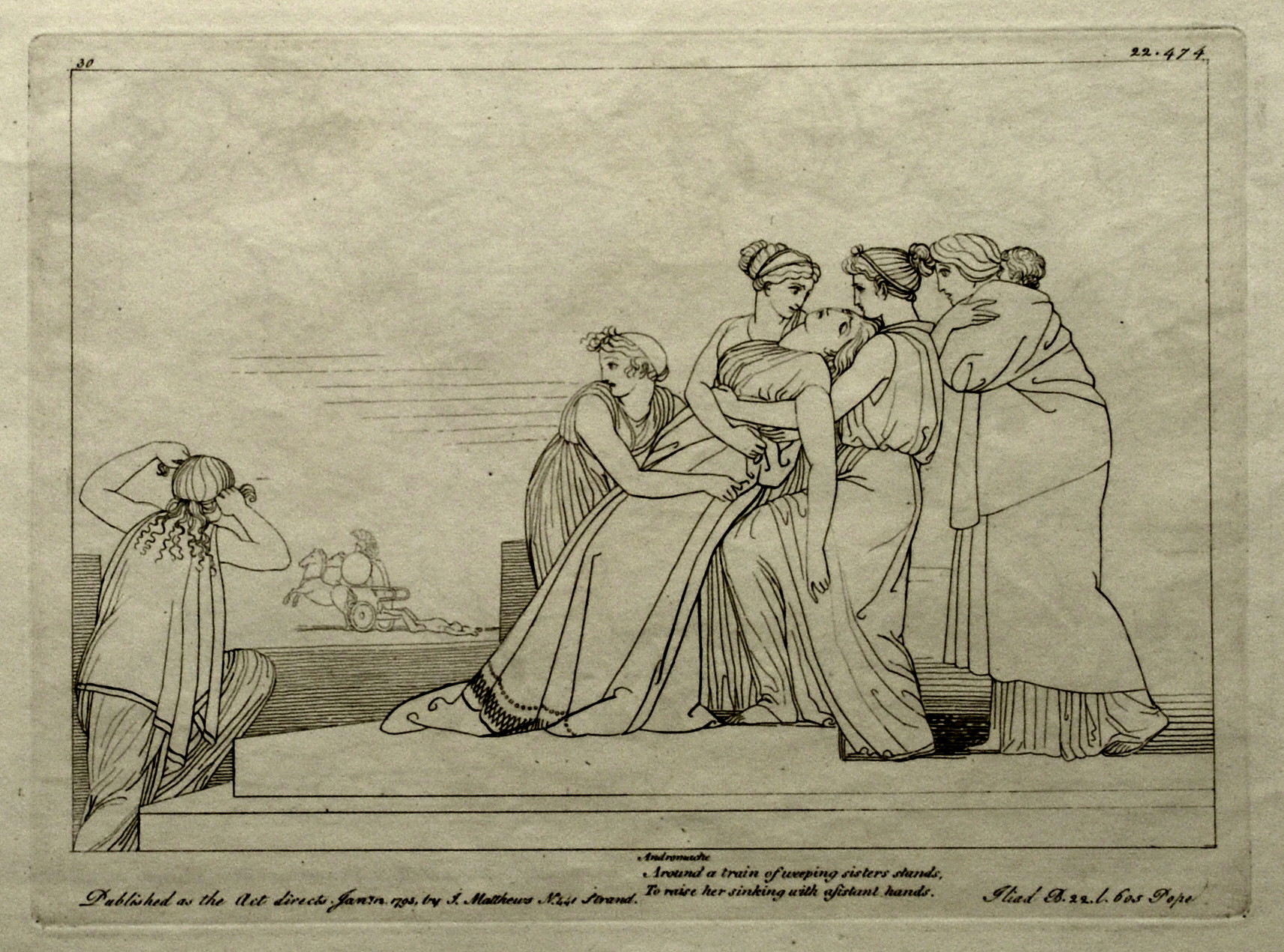
Image via Wikimedia Commons.
We see here a retrospective reference to the loigos ‘devastation’, I.21.134, suffered by the Achaeans because of the absence of Achilles.
In this speech of Achilles, the hero is boasting, as expressed by way of the solemn word eukhesthai ‘claim’, I.21.187, about his genealogy as son of Peleus son of Aiakos son of Zeus himself, I.21.188–189. The point of the boast that Achilles makes here is that his genealogy is superior to that of the hero Asteropaios, whom he has just killed, I.21.139–183. This hero of the Trojans, as we learn at I.21.130–143, is the grandson of the river god Axios. Provocatively, Achilles is boasting that the lineage of Zeus, from which he is descended, is superior to the lineage of any river god, I.21.193–199, and, in this context, Achilles mentions by name two of the mightiest river gods: Akhelōios at I.21.194 and Ōkeanos at I.21.195. Even the Ōkeanos, Achilles goes on to say, would be defeated by Zeus in a one-on-one combat of cosmic proportions, I.21.196–199. This whole speech of Achilles is of course a direct provocation to the river Scamander, I.21.136–138. As we saw previously at I.20.74, the name of this river Scamander, Skamandros in Greek, is also the name of the river god who embodies the river, and that is how mortals address the god of the river, as Scamander, while Xanthos is the name that the gods themselves give to him. See the comment on I.20.001–074. Thus the river god Scamander can take it personally that Achilles here is insulting not only the river god Axios, from whom his dead enemy Asteropaios was descended, but also all river gods. And Achilles goes even further: he insults Scamander directly, declaring earlier at I.21.130-132 that the river god had failed to rescue the Trojans— despite the fact that they would customarily offer sacrifices of bulls and stallions to Scamander, I.21.131-132.
In his edition of Homer, Zenodotus athetized—that is, he rejected as non-Homeric—the verse at I.21.195, as we know from the scholia for this verse in the Geneva manuscript of the Iliad. (On Zenodotus and on athetesis, see the inventory of Words and Ideas.) At I.21.195, Ōkeanos is named as the referent of the relative clause at I.21.196–197, where Ōkeanos is described as a cosmic river that has always been the ultimate source for all the water in the world. If this verse at I.21.195 were omitted, then the referent for this description of the ultimate source for all water would shift from the river Ōkeanos to the river Akhelōios, which is named at verse 194. Zenodotus’ rejection of verse 195 was not the result of some arbitrary editorial decision: there is external evidence for an alternative textual tradition of the Iliad where this verse 195 was in fact missing, and there is also external evidence for an alternative oral poetic tradition where Akhelōios rather than Ōkeanos figures as the primal stream that generates all other streams (HC 2§196; also D’Alessio 2004). For example, Pausanias 8.38.10 follows a version of I.21.194–197 that does not include the verse we know as I.21.195. Similarly, at I.18.483–608 in his edition of Homer, Zenodotus athetized the entire sequence of verses that narrated the images displayed on the Shield of Achilles. By dissociating the world of the Shield from the world of Homer, Zenodotus also dissociated the Ōkeanos, the cosmic river that ever encircles and defines the Shield at I.18.607-608. See the comment on I.18.483–608. Unlike Zenodotus, however, Aristarchus in his edition of Homer refrained from athetizing the verses describing the images on the Shield at I.18.483–608 (HC 2§198, with reference to primary and secondary sources). So, he did not athetize the verses about the Ōkeanos at I.18.607–608; nor did he athetize the verse about Ōkeanos at I.21.195 (again, HC 2§198, with reference to primary and secondary sources). Here we have the clearest indication that all these verses were conventionally thought to belong to the Homeric tradition—even in the age of Aristarchus. (On Aristarchus, see the inventory of Words and Ideas.) Viewing the differences between Zenodotus and Aristarchus in their editorial treatment of Homeric passages involving the Ōkeanos, we can see that Zenodotus was more extreme than Aristarchus in his efforts to purge Homeric poetry from what he considered to be Orphic elements. At the other extreme was Crates, whose edition of Homer did not treat the supposedly Orphic elements as extraneous to Homeric poetry (HC 2§199). For more on Orphic elements in Homeric poetry and on the occasional preservation of such elements in the edition of Homer by Crates, see the comment on I.14.245–246–246a. (On Crates in general, see under Crates in the inventory of Words and Ideas.) In view of what we know, then, about the textual transmission of I.21.194–197, I argue that both the longer version, featuring Akhelōios and Ōkeanos, and the shorter version, featuring only Akhelōios, are authentic multiforms. On multiform, see the inventory of Words and Ideas. And, what is more, Homeric poetry recognizes both versions as multiforms. Here I return to the comment on I.20.001–074, where I noted that Ōkeanos is ostentatiously singled out at I.20.007 as the only river god who did not attend the council of divinities that Zeus had assembled in his divine plan to allow those attending to intervene in the ongoing struggle between the Achaeans and the Trojans. Just as this river god Ōkeanos is ostentatiously present in the story by way of being specially marked as absent at I.20.007, so also now he can continue to be ostentatiously present at I.21.195 by not being marked as absent in the longer version—or he can continue to be present by being ostentatiously absent from the words of insult formulated by Achilles in the shorter version, just as he was absent also from the original council of the divinities. The river god Scamander, by contrast, was not absent but present at that council, and he did intervene in the war, since he was provoked to fight Achilles not only by that hero’s actions when he was slaughtering droves of Trojans in the waters of the river but also by that earlier boast where Achilles claimed to be superior in genealogy to heroes who were descended from river gods. It was in the context of that boast, as I noted in the comment on I.21.184–199, that Achilles had insulted Scamander. But he also insulted Ōkeanos and Akhelōios in one version of I.21.194–197. Or at least, according to the other version, he also insulted Akhelōios. Considering that Achilles was almost destroyed by Scamander, we may infer an even worse outcome for the hero if he had faced in combat not this local river god but rather the cosmic river gods Akhelōios or Ōkeanos. By implication, Akhelōios chose not to intervene, though he was present, whereas Ōkeanos could not intervene, since he was absent. Through its multiformity, then, the Homeric tradition acknowledges both a potential presence and a potential absence for Ōkeanos.
Janko’s analysis of the origin of the references to Okeanos and Tethys in this verse
Outraged by all the carnage caused by Achilles as that hero relentlessly keeps slaughtering droves of Trojans and clogs the river with their bloody corpses, Scamander as the divine embodiment of the river rises up with all his watery might and proceeds to fight Achilles one-on-one. What follows is an epitome from HQ 145–146. We know that ancient Greek narratives about hostile encounters between heroes and river gods can traditionally picture the river as taking the shape of a ferocious beast: a prime example is Archilochus F 286-287 (ed. West), where the hero Hēraklēs fights with the river god Akhelōios, who has taken on the shape of a raging bull. We may contrast the treatment of the fight between the hero Achilles and the river god Scamander here in Iliad 21, where the river Scamander does not take the shape of a bull and is not even theriomorphic: rather, the narrative opts for a variant tradition highlighting the elemental aspect of the river, as water personified, struggling with a hero whose ally, as we are about to see, will be the god Hephaistos in his role as fire personified. It has been argued, partly on the authority of the scholia for I.21.237, that the Archilochean representation is pre-Homeric. But it is enough for now to say that the Archilochean representation stems from a tradition that is independent of Homer. And the Homeric narrative goes out of its way to make an indirect reference to the other tradition. The river god Scamander, in the heat of battle with the hero Achilles, is described at I.21.237 as ‘bellowing like a bull’ (μεμυκὼς ἠύτε ταῦρος). The simile amounts to a conscious acknowledgment of a variant tradition. Finally the river god, after a lengthy struggle, is starting to overwhelm Achilles, and now this main hero of the Iliad finds himself in danger of getting swept away, cut off from all epic memory, in the flooding streams of the enraged Scamander.
reference to Reeve’s contention that Aristarchus’ use of perissós could have rested on documentary evidence (Reeve 1972.250). These three lines are examples of athetesis that rests on documentary evidence
passage adduced by Socrates at Protagoras 340a
In order to save the endangered Achilles, Hērā now induces her son Hephaistos to join the fray and to fight actively against the river god Scamander. Since Hephaistos is god of fire, he is the elemental antithesis of Scamander as god of water, that is, as the local god who embodies the principal river that waters the plain of Troy. So now the fight between fiery hero and streaming god escalates into a cosmic conflict between the elements of fire and water. In the end, then, fire wins over water, but now Hērā induces Hephaistos to stop his fight with Scamander.
one of Watkin’s three passages where menos is used as a functional equivalent of mēnis
Following up on the combat between Hephaistos and Scamander, other gods now also join in the fight, and, the next thing you know, the cosmic conflict between the elemental forces of fire and water is transformed into a personalized brawl between divine partisans of Trojans and Achaeans. The personalization intensifies to the point of becoming ludicrous, and, once such a point is reached, the whole scene becomes an exquisite exercise in divine burlesque. As Walter Burkert (1960:132) has observed, however, such a comic form is not innovative but archaizing, and there are numerous parallels to be found in the myths and rituals of ancient Near Eastern civilizations; this observation applies also to the divine burlesque that characterizes other narrative sequences Homeric poetry, most notably in Odyssey 8 and in Iliad 1 as well as here in Iliad 21—and in the Homeric Hymns.
comment on the evidence of the scholia for how to read eason/heason in this verse [MRBTP: scholia]
The time has come for Hector to die at the hands of Achilles, and his final moments of life are singularly grim. Achilles shows him no mercy, expressing the most brutal thoughts even before he vengefully finishes off the killer of Patroklos. Hector is forced to know in advance, before he loses consciousness to the death blow from Achilles, that his executioner intends to mutilate his corpse instead of allowing for a proper funeral. And the form of this mutilation is particularly horrific and morally shocking: attaching the body of Hector to the back of his chariot, Achilles will drag it around the walls of Troy for all to see the humiliation of his hated enemy. Is there any hope, then, for transcending such degradation? Only divine intervention, in the story yet to be told, could prevent the disfigurement of a heroic body’s beauty in death. But the story of transcendence must wait. For now, the focus is on the horror and the sorrow of a heroic death as seen through the eyes of Hector’s lamenting widow Andromache.
Copperplate etching (1795) by Tommaso Piroli, after a drawing (1793) by John Flaxman.
Image via Wikimedia Commons.
analysis of semantic overlap between perfect oida and aorist eidon
application of the epithet ōmēstēs to Achilles alone among Homeric heroes, otherwise to beasts, as in this verse
Hector is well aware that he may die at the hands of Achilles, but he wishes to die in a way that will assure him of having the kleos ‘glory’ of poetry, and such ‘genuine’ glory, as marked by the prefix eü- of the adverb eü-kleiōs ‘with the genuine glory [kleos] (of poetry)’, is simultaneously ‘good’ glory, as also in the case of the adjective esthlon ‘genuine, good’, which applies as the epithet of kleos at I.18.121. See the comment on I.18.121. The overarching ambition of Hector to achieve the genuine kleos ‘glory’ of poetry is recognized at the end of Andromache’s second lament, I.22.514. See the comment on I.22.514.
On this proverb about the oak and the rock, see the comment at O.19.162–163.
In this speech, Hector finally understands that he has been delusional all along in thinking that he could possibly defeat Achilles. Athena has actively contributed to the hero’s tragic delusion, and now Hector sees clearly that his death at the hands of Achilles is near. Hector’s delusion is already signaled at I.18.243–314, where the assembly of the Trojans approves of Hector’s plan to stay on the offensive against the Achaeans—even after Achilles has already re-entered the Trojan War. The Master Narrator had commented at I.18.311: this was a bad decision by the assembly, to approve the strategy of Hector, since the goddess Athena had taken away from them their senses, phrenes. If the assembly had been sensible, they would have recognized that Hector’s mētis ‘mind, intelligence’ had failed him, I.18.312. As noted in the comment on I.18.243–314 as also in the earlier comments on I.06.286–311, I.07.017–061, I.08.538–541, I.10.043–052, I.11.200, and I.13.825–829, there is a pattern of personal hostility felt by the goddess Athena toward Hector as a hero who aspires to some of the same qualities that Athena herself exemplifies. Like the goddess, Hector can be seen as an exponent of (1) defensive tactics in the warfare of protecting a citadel from sieges and (2) mētis ‘mind, intelligence’—two qualities that were tragically taken away from him when he most needed to have them.
Hector is now quite certain that he will in fact die at the hands of Achilles, but he wishes all the more to die in a way that will assure him of having the kleos ‘glory’ of poetry, and such ‘genuine’ glory is marked here by the negation of the adverb a-kleiōs ‘without the genuine glory [kleos] (of poetry)’. What he is saying, then, is that he wishes not to die without being assured of the kleos ‘glory’ of poetry. He has already been saying that at I.22.110. See also the comment on I.22.110, where it is already noted that the overarching ambition of Hector to achieve the genuine kleos ‘glory’ of poetry is recognized at the end of Andromache’s second lament, I.22.514. See the comment on I.22.514.
After wounding Hector mortally at I.22.326–330, Achilles now declares to his enemy his intention to expose Hector’s corpse as prey for dogs and birds to devour while Patroklos will be getting a proper funeral, I.22.335–336. In response, the dying Hector begs to be spared the horror of exposition to dogs and birds, offering ransom if his sōma ‘body’ is restored safely to his family, I.22.342, who can give him a proper funeral that features the all-important ritual of cremation, I.22.342–343. But Achilles rejects the offer, I.22.344–354, and he declares again his intention to deprive Hector of cremation and to subject his enemy’s corpse to the horrors of exposition, I.22.354.
Achilles declares to the dying Hector how certain he is about his ghastly intent to expose the corpse of his hated enemy for dogs and birds to devour, I.22.248 (also I.22.354). This certainly is linked to an even more ghastly uncertainty, expressed as a wish: if only the thūmos and the menos of Achilles, I.22.346, which can be translated here as his ‘heart’ and his ‘mind’ respectively, could bring him to do something that would otherwise be unthinkable, which is, to cut up the body of Hector and eat it raw, I.22.346–347. The use of the two words thūmos and menos here at I.22.346 is relevant to a comparison made earlier by Achilles at I.22.262: Hector is to Achilles as men are to lions. Elsewhere in Homeric diction, Achilles is in fact described as thūmoleōn ‘having the heart of a lion’, at I.07.228. As for the noun menos, which can be translated more literally as ‘mental power’ in contexts where it applies to heroes, it is used at I.20.174 in collocation with thūmos ‘heart’ in describing the impetus of Achilles as an elemental force of nature, comparable to the impetus of an attacking lion, I.20.171.
Achilles strips the armor from the corpse of Hector, I.22.368–369, who is lying there naked on the battleground while the companions of Achilles are jeering at him and taking turns at inflicting further wounds on his dead body, I.22.369–375. Such mistreatment of the corpse can be seen as a form of degradation that anticipates an even more horrific form of degradation that is still waiting to happen, which is, the dreaded exposition of Hector’s body to dogs and birds.
Further degradation awaits the naked corpse of Hector. Here at I.22.395–405, Achilles proceeds to subject the body of Hector to an act that is meant to disfigure it, and the Master Narrator hints at his own moral disapproval by referring to this act as aeikea . . . erga ‘things unseemly’, I.22.395. The generalized idea of ugliness as conveyed by aeikea ‘unseemly’ and other such words in Homeric diction is reciprocal: when you do something ugly to someone, making that someone look ugly, you are thereby making yourself look ugly as well. To be specific, I describe here in detail the ugly things that Achilles will now do to Hector. First, he pierces a hole between the ankle and the heel of Hector’s two feet, and then he threads through these two holes a leather strip that he attaches to the back of his chariot, I.22.396–398. Then he will drag the corpse through the dust and grime of the battleground as he mounts the chariot and drives off at top speed, with Hector in tow. At this horrific moment in the Homeric narrative, feelings of pity are prompted by the narrative itself at I.22.401–403. The Master Narrator prompts his listeners by focusing here on Hector’s hair, once so beautifully groomed but now all disheveled, and then on his head, with a face that was once so charming to look at—but now you expect this beautiful head to be mutilated beyond recognition, once it gets dragged over the harsh and scraping surface of the battleground. The Master Narrator concludes ruefully: the god Zeus himself is allowing all this to happen, I.22.403–404. But what is the god really allowing to happen? So far, there has been a mistreatment and even degradation of Hector’s body, yes. But, at least so far, there has been no disfigurement to be seen. As the Master Narrator takes one last look here at the corpse of Hector, the hero’s head is shrouded in a swirl of dust, I.22.405, and so his face is not visible. The next time the Master Narrator looks at the corpse of Hector, Achilles is displaying the body lying face down in the dust, I.23.024–026, near the stand where the dead body of Patroklos is lying in state, obviously face up. For a preview of this later moment, see the comment on 1.23.1–64. Even there at 1.23.1–64, though, it cannot be known whether the body that Achilles is intending to degrade has in fact already been disfigured. Once again, the face is not visible. At a later point, however, at I.23.184–191, it will become clear that the face and the head and in fact the whole body of Hector cannot be disfigured. The body is saved. In the anchor comment at I.23.184–191, there will be an analysis of this vision of salvation for Hector’s body.
Although Priam and Hecuba, the parents of Hector, have already seen with horror and sorrow what has happened to him at the hands of Achilles, Andromache does not yet know, I.22.437–439. She is in her private quarters, weaving, I.22.440–441, and she calls out to her handmaidens to prepare a bath for Hector’s expected arrival, I.22.442–444, not knowing what has already happened to him, I.22.445–446. Then and only then does she hear the sound of wailing, I.22.447, and now she starts to feel emotionally and physically undone, as her legs and arms start shaking and her weaving pin drops from her trembling hand, I.22.448. She calls out to her handmaidens, telling them to accompany her to the walls of Troy, so that she may see for herself what is happening, I.22.449–450, and then she starts to express her premonitions about the fate of Hector, which are already becoming a part of the lament that formally gets underway only at I.22.477, lasting all the way to I.22.515. While she expresses her premonitions, she is feeling more and more undone, I.22.450–459. Now her heart is in her throat, I.22.451–452. As she rushes up to the walls of Troy, where she will see what has happened, Andromache is compared to a mainás or ‘maenad’, that is, a frenzied woman possessed by Dionysus, I.22.460. Then, finally, she and her handmaidens get to see the grim scene, I.22.261–265: Hector is dead, and his corpse is being dragged behind the speeding chariot of Achilles. At the ghastly sight, Andromache faints, I.22.466–467, and her elaborate headdress comes undone, falling to the ground, I.22.468–472. The women of her immediate family surround her as she comes out of her swoon, I.22.473–475, and now she begins her lament in earnest, I.22.476–515.
Like Helen at I.03.125–128, Andromache is shown here at I.22.440–441 in the act of pattern-weaving. And, like Helen, she is not pictured as singing while weaving: rather, she weaves her song into the web that she pattern-weaves. The song that she weaves into her web is pictured as throna, which can mean ‘flower patterns’ or ‘love charms’. It can be argued that both meanings apply in the present context. A similar argument can be made in the case of the epithet poikilo-thronos applied to the goddess Aphrodite in Sappho Song 1.1: this word can mean either ‘with varied [poikilo-] flower patterns [that are pattern-woven on your robe]’ or ‘with varied [poikilo-] love charms’. I have more to say about these details in MoM 2§76 (also PasP 101n40). Further, at I.22.441, there exists a variant epithet for the web that Andromache weaves: this diplax ‘pattern-woven fabric that folds in two’ is described in some medieval manuscripts as porphureē ‘purple’ but in others as marmareē ‘gleaming’. And we find the same variation of epithets for the web that Helen weaves at I.03.126: this diplax too is described in some medieval manuscripts as porphureē ‘purple’ but in others as marmareē ‘gleaming’. Similarly, the antux ‘rim’ that is being made for the Shield of Achilles at I.18.479 is described as triplax ‘threefold’ and marmareē ‘gleaming’ at I.18.480. In Eustathius Commentary on the Iliad vol. 4 p. 218 lines 14–17, the commentator draws attention to the morphological parallelism of triplax ‘threefold’ with diplax ‘twofold’. So, Eustathius recognizes here a crossover between the artistic worlds of metalwork and weaving. See the comment on I.18.479–480. See also the comment on I.09.130, where it is argued that the craft of pattern-weaving by Aeolian women is linked with the power of the craft of Homeric poetry to make contact with the Bronze Age. Finally, in the case of the two textual variants porphureē ‘purple’ and marmareē ‘gleaming’ as applied to the web of Helen at I.03.126 and to the web of Andromache at I.22.441, we learn from the scholia for I.03.126 that porphureē ‘purple’ happened to be the reading preferred by all three major Alexandrian editors of Homer—Zenodotus, Aristophanes, Aristarchus (see also HPC 274nn3, 4).
This word en-passein ‘sprinkle’ conveys a metaphor for the process of pattern-weaving. As we learn from the AT scholia for I.22.441, (en-)passein in the Cypriote dialect means poikillein ‘pattern-weave’. Metaphorically, Andromache is sprinkling flowers as love charms into her story by way of pattern-weaving floral patterns into a web that tells her story of love. By extension, the metaphorical world of pattern-weaving applies also to the process of making the kind of poetry that tells about the pattern-weaving of Andromache.
The wording here at I.22.444 is part of the lead-up to the lament of Andromache, which formally gets underway only at I.22.476. And the wording in this part of the lead-up, I.22.444, is prefigured by the wording of Zeus himself at I.17.207 in expressing the Will of Zeus regarding the sorrows of Andromache. To say it another way: the narrative arc represented by the Will of Zeus extends from the wording of the god’s plan all the way to the wording of the widow’s lament, I.22.476–515. See the comment on I.17.194–214.
At I.22.460, just as she is about to see with her own eyes the corpse of Hector, the distraught Andromache is already pictured as īsē ‘equal’ to a mainás ‘maenad’ (μαινάδι ἴση), that is, she is being compared to a woman possessed by Dionysus. Earlier, in an analogous context at I.06.389, Andromache is pictured as ‘looking like a woman possessed’ (μαινομένῃ ἐϊκυῖα) when she rushes toward the walls of Troy to see for herself the fate of the Trojans on the battlefield. In the case of the present context, I.22.460, the comparison of Andromache to a maenad is relevant to the undoing of her hair when her elaborate headdress falls from her head at the moment when she goes into a swoon, I.22.468–472. The undoing of a maenad’s hair is a traditional Dionysiac theme, as we see for example in a painting on a vase made in Athens sometime in the decade of 480–470 BCE (Munich, Antikensammlungen no. 2416): this painting shows a maenad transfixed by the gaze of Dionysus, who is looking directly into her eyes, and the maenad’s loose strands of flowing curls of hair are seen cascading down from behind her ears at either side of her head garlanded with the ivy of Dionysus. As we look at the maenad’s hair coming undone, we see a distinctive sign of her starting to lose control to Dionysus, of becoming possessed by Dionysus, of surrendering the self to Dionysus. See also Nagy 2007c:252–253, citing further examples from the visual arts. Andromache looks similarly maenadic when she falls into a swoon, I.22.466–467, while at the same time letting her elaborate headdress fall from her head to the ground, I.22.468–470. What follows is an epitome of further analysis in Nagy 2007c:249–251. In the dramatic context of Andromache’s swoon, I draw attention to the evocative word krēdemnon ‘headdress’, I.22.470. It refers to the overall ornamental hair-binding that holds together three separate kinds of ornamental hair-binding that serve to keep Andromache’s hair in place, under control, I.22.469: in this verse, the three separate terms for ornamental hair-bindings are ampux ‘frontlet’, kekruphalos ‘snood’, and anadesmē ‘headband’. The overall hair-binding or ‘headdress’ that keeps it all in place is the krēdemnon, I.22.470. Similarly, Varro (On the Latin language 5.130) speaks of three separate terms for ornamental hair-bindings traditionally used by Roman matrons: lanea ‘woolen ribbon’, reticulum ‘net-cap’ or ‘snood’, and capital ‘headband’. To these three words Varro (7.44) adds a fourth, tutulus (derived from the adjective tutus ‘providing safety’), which seems to be an overall term for the generic headdress worn by brides and Vestal Virgins as well as matrons. When Andromache lets drop from her head her elaborate krēdemnon ‘headdress’, I.22.470, thus causing her hair to come completely undone, she is ritually miming her complete loss of control over her own fate as linked with the fate of her husband: we see here a ritually eroticized gesture that expresses her extreme sexual vulnerability as linked with the violent death and degradation of her husband. For Andromache to do violence to her own krēdemnon is to express the anticipated violence of her future sexual humiliation at the hands of the enemy. Pointedly, the goddess Aphrodite herself had given this krēdemnon to Andromache on her wedding day, I.22.470–471 (further analysis by Dué 2006:4, 78). Another example of such ritual miming is the moment in the Homeric Hymn to Demeter, verses 40–42, when Demeter tears off her krēdemnon in reacting to the violation of her daughter Persephone by Hādēs. The explicit association of the krēdemnon with Aphrodite reveals its erotic properties. The undoing of a woman’s hair, caused by the undoing of her krēdemnon, produces what I will call an Aphrodisiac effect. So long as a woman’s krēdemnon is in place, her sexuality is under control just as her hair is under control. When the krēdemnon is out of place, however, her sexuality threatens to get out of control. This ritual symbolism is part of a “cultural grammar of hair” (Levine 1995:95). Such a “grammar” helps explain why the virginal Nausikaa would not think of going out in public without first putting on her krēdemnon, O.06.100. She won’t leave home without wearing her headdress. Her gesture here is hardly a signal of being married. Clearly, she is unmarried. So, we see that unmarried women as well as married women like Andromache wear the krēdemnon in public. The gesture is simply a signal of propriety. Such a “grammar” is in fact typical of the Mediterranean world in general. A striking point of comparison is the figure of the sotah ‘errant woman’ in Hebrew Bible traditions, who is marked by the ritual dishevelment of her hair (Numbers 5:11–31). In this case, the ‘errant woman’ is a foil for the properly married woman.
In the first lament of Andromache for Hector, as we saw in the anchor comment at I.06.407–439, she was already lamenting the death of Hector before he was even dead. As for her second lament, here at I.22.476–515, she sings it when she sees the corpse of Hector for the first time. As for her third lament, to be featured at I.24.723–746, Andromache will sing it on the occasion of Hector’s funeral. The second lament here is in some ways a preview of the third, which as we will see is technically the most formal of Andromache’s three laments. The beginning of Andromache’s second lament is signaled here at I.22.476 by the technical poetic term amblēdēn, an adverb that means ‘making a start [in performance]’ just as the adverb hupoblēdēn at I.01.292 means ‘continuing [in response]’. As Andromache starts to sing her second lament, the word that refers here at I.22.476 to the form of her singing is the verb goân ‘make lament’, corresponding to the noun góos ‘lament’. We have already seen the noun góos at I.18.051, with reference to the lament sung by Thetis for the future death of Achilles. This form of lament, góos, is conventionally sung by female members of the bereaved family, and there will be more to say about this form in the comment on I.24.720–776. For the moment, however, I focus on what happens after Andromache has finished singing her lament at I.22.476–514. Now the Trojan women who are attending her respond to her lament by continuing it with their own lament, in antiphonal performance, at I.22.515: ‘So she [= Andromache] spoke, and the women wailed in response’ (ὣς ἔφατο κλαίουσ’, ἐπὶ δὲ στενάχοντο γυναῖκες). The antiphonal refrain here at I.22.515 is signaled by the verb epi–stenakhesthai ‘wail in response’, matching the antiphonal refrain at I.19.301 in response to the lament of Briseis. See the anchor comment at I.19.282–302. So, the second lament of Andromache, as we see it come to a conclusion at I.22.515, is a classic example of a group performance as rounded out by way of an antiphonal refrain. For more on such group performance, see again the anchor comment on I.19.282–302, where it is emphasized that Briseis the Aeolian is featured as a distinctly choral personality, analogous to the personality of Sappho herself in the choral songs attributed to that Aeolian prima donna of a later era. See also anchor comment at I.06.407–439 on: three laments by Andromache, part 1; and anchor comment at I.24.723–746 on: three laments by Andromache, part 3.
In the lament of Andromache, she refers here at I.22.483 to the penthos ‘grief’ that the death of Hector has caused her. This word penthos ‘grief’ is a programmatic marker of lament, as we have already seen at I.09.562–564, where a songbird is pictured as singing a song of lament: that songbird is the halkúōn ‘halcyon’, described in that context as polupenthēs ‘having much grief’, I.09.563. See the relevant comment on I.09.561–564.
On the naming of the son of Hector, Astyanax, see the comment on I.22.506–507.
Here at I.22.506–507, the meaning of the name of Hector is made explicit. As noted already in the comment on I.06.402–403, the first of two names given to the son of Hector, Astyanax [Astuanax], I.06.403, means ‘king [anax] of the city [astu]’. This meaning is relevant to the heroic role of the father as protecting a citadel from sieges. This role is expressed by the “speaking name” (nomen loquens) of Hector, Héktōr, which is an agent noun meaning ‘one who holds [ekhein]’. The translation ‘hold’ here conveys the sense of ‘uphold, protect, guard’: so Hector’s name destines him to be the ‘protector’ of the city of Troy. See the comment on I.05.473–474. The name of Hector is relevant to the fact that Hector’s son is named after him. More than that, Hector’s son is named after the primary function of Hector as signaled by the father’s name, and the rationale for that naming is made explicit at I.22.506–507: as Andromache says to her dead husband here, Astyanax is named Astyanax or ‘king of the city’ precisely because his father was protector of the city. Here is the wording at I.22.507: ‘because you [= Héktōr], all by yourself, protected [eruesthai] for them [= the Trojans] the gates and the walls [of their city]’ (οἶος γάρ σφιν ἔρυσο πύλας καὶ τείχεα μακρά). We see at work here the mythological convention of naming a son after a primary heroic trait of the father, as in the case of the son of Ajax, whose name Eurusakēs means ‘the one with the wide shield [sakos]’; this meaning is made explicit in the wording of Sophocles Ajax 574–578. In the case of Hector’s name as Hék-tōr or ‘protector’, there is a serious danger portended by his function as protector of the citadel of Troy: this heroic function of Hector makes him a rival of the goddess Athena in her own divine function as protector of the same citadel of Troy. See the comment on I.06.286–311, especially with reference to the epithet of Athena as erusi-ptolis ‘protector of the citadel [p(t)olis]’ at I.06.305.
Reaching the end of her lament for Hector, Andromache declares ruefully: all that Hector cares about is whether the men and women of Troy will in the end think of him as a hero who deserves to have the kleos ‘glory’ of poetry. Even in defeat, Hector hopes to be worthy of epic. See already the comment on I.22.110.
The lament of Andromache, as we see it come to a conclusion here at I.22.515, is a classic example of a group performance as rounded out here at I.22.515 by way of an antiphonal refrain. For more on such group performance, see the anchor comment on I.19.282–302, where Briseis the Aeolian is featured as a distinctly choral personality, analogous to the personality of Sappho herself in the choral songs attributed to that Aeolian prima donna of a later era.
analysis of en-passein as native Cypriote term for poikillein, in the context of the analysis of the metaphor of pattern-weaving for Homeric narrative, as exemplified by Andromache’s weaving
While the Trojans are mourning Hector in Troy, I.23.001, Achilles and his fellow Achaeans have all returned to the ships beached at the Hellespont, I.23.001–002, and the hero now calls on the Myrmidons, whose leader he is, to perform special funerary rituals in mourning for Patroklos. The Myrmidon warriors are to mourn Patroklos while driving their chariots around his dead body three times, I.23.007–009, I.23.013–014, after which they are to unharness the chariots and join in a funeral feast arranged by Achilles. The ritual act of mourning while driving, as performed by the Myrmidons, is described overall as a góos ‘lament’, I.23.010, for which Achilles himself is the principal performer, as signaled by the verb arkhein ‘lead off [in performing]’, I.23.012. The words of his lead-off lament are quoted at I.23.019–023. In this lament, Achilles addresses the dead Patroklos and repeats to him at I.23.20–23 the two deeds that he had promised at I.18.334–337 to perform before the funeral could take place. First, Achilles had promised to bring back, together with the dead body of Hector, the armor that Hector had stripped from the dead body of Patroklos, and now he reiterates that promise, adding two ghastly details about the dead body of Hector: he has dragged the corpse behind his chariot and intends to feed it to the dogs, I.23.021. And, second, Achilles had also promised to slaughter twelve captive Trojan youths on the funeral pyre of Patroklos and then to cremate their bodies together with the body of Patroklos himself, I.23.022–23. After repeating these promises to Patroklos within the wording of his quoted lament, I.23.020–023, Achilles now prepares for the funeral feast—but not before displaying the dead body of Hector, lying face down in the dust, I.23.024–026, next to the stand where the dead body of Patroklos is lying in state. Then, after the Myrmidons unharness their chariots, I.23.026–027, they sit down next to the ship of Achilles in order to partake of the feast, I.23.028, and the slaughter of the sacrificial animals to be eaten at the funeral feast gets underway, I.23.029–034. Nothing is said here about cooking the meat. Instead, the last thing said about this funeral feast of the Myrmidons is that the blood flowing from the mass slaughter of sacrificial animals is streaming all around the corpse of Patroklos, I.23.034. It seems as if the Myrmidons were feasting on raw meat, just as their leader Achilles had expressed the ghastly desire to cut up the mortally wounded Hector and to eat him raw, I.22.346–347. See the comment on I.22.346–348. Meanwhile, the leaders of the Achaeans come to the ship of Achilles and persuade him, with some difficulty, to leave behind the funeral feast of the Myrmidons and to come along with them to the headquarters of Agamemnon, I.23.035–038, where the order is given to prepare for Achilles some hot water for him to wash off all the blood that still covers him, I.23.039–041. Evidently, Agamemnon is preparing for an all-Achaean feast to be attended by Achilles, who is now expected to wash up before the feast begins. And it is only at this moment that we see for the first time that Achilles is still covered in gore. The blood of all the Trojans he has slaughtered on the battlefield is still on him and with him. Already before, Achilles must have been covered in gore when he had hosted the feast for that sub-set of Achaeans who were his own people, the Myrmidons. Back then, neither Achilles nor any of his Myrmidons had washed off the human blood of the killing fields before the shedding of the animal blood at the sacrifice that preceded their funeral feast. But now, for the all-Achaean feast, Achilles is expected to wash up. Not surprisingly, Achilles refuses, declaring at I.23.043–044 that he will remain covered with gore and will refrain from washing off the blood until he performs three sacred tasks. He now names these tasks at I.23.045–046: first, he will cremate Patroklos, I.23.045, and, second, he will make a tumulus that will be a sēma ‘tomb’ for Patroklos, I.23.045, and, third, he will at an earlier point cut off a long lock of his own hair as a sacrifice to be burned on the funeral pyre of his friend, I.23.046. That said, however, Achilles goes on to urge Agamemnon to continue with the plan for an all-Achaean feast, I.23.048—provided that the Achaeans follow up on their nighttime feasting by going out next morning in order to gather firewood for constructing the funeral pyre that will be used for the cremation of Patroklos, I.23.049–053. The Achaeans proceed to indulge in their feasting and then return to their shelters for a night’s sleep, I.23.054–058, while Achilles goes off without having had anything to eat, mourning Patroklos, and he finds a solitary spot on the beach, where he lies down, exhausted, and falls into a deep sleep, I.23.059–064. What will happen next, at I.23.071-076, is the apparition of the spirit of Patroklos. Before commenting on the apparition scene, however, I must pause to note that the narrative has already indicated five salient points of dysfunctionality in the preparations of Achilles for the funeral of Patroklos:
Point 1. The intent of Achilles to slaughter twelve captive Trojan youths as a human sacrifice is understood to be ritually incorrect. See the comment on I.23.163–183. And the fact that he will go through with it and will actually perform the deed will in retrospect be understood to be morally incorrect as well. See the comment on I.23.163–183. In myth, human sacrifice is a pollution, both ritually and morally. And such pollution is typical of what can perhaps best be described as a traditional pattern of dysfunctionality in myth—as opposed to functionality in ritual, where animal sacrifice is understood to be a salvific replacement of human sacrifice. As we see from the myth of Pelops as narrated in Pindar’s Olympian 1, for example, the slaughtering of Pelops is a dysfunctional sacrifice in the heroic world of myth, but it becomes an aetiology for the functional sacrifice of rams in the post-heroic world of ritual as practiced in Olympia during the archaic and Classical periods and beyond (detailed analysis in PH 116–135). In this connection, I offer a working definition of aetiology (background in PH 118, 125–130; 141–142; 386; 395–397; also Nagy 2011a§68): an aetiology focuses on a foundational catastrophe in the mythologized past that explains and thus motivates continuing success in the ritualized present and future.
Point 2. The dragging of Hector’s corpse by Achilles is likewise understood to be ritually incorrect, and such incorrectness is in this case noted by Homeric poetry, which signals also the moral incorrectness of mistreating a corpse. See the comment on I.23.163–183. Here I invoke a general principle at work in myths about ancient Greek heroes: whenever heroes commit deeds that clearly violate moral codes, such deeds are not condoned by the heroic narrative. See H24H 1§52, where I work out an analysis of such a principle, to be summarized in this formulation: the pollution of a hero in myth is relevant to the worship of that hero in ritual. Especially relevant to this formulation, as we will see in later comments, are myths that aetiologize rituals of seasonally recurring athletic competitions: the ritual of competing in an athletic event is thought to purify the original pollution of the hero in myth (analysis in H24H 7a§14).
Point 3. The intent of Achilles to feed Hector’s corpse to dogs and birds is clearly understood to be a blatant abomination both ritually and morally. In this case, however, Achilles will never get to perform such a horrific deed.
Point 4. There is something wrong about the funeral feast of the Myrmidons as arranged by Achilles. The blood of sacrifice is not offset here by any mention of cooking the meat to be eaten.
Point 5. Achilles is ritually incorrect in not purifying himself of human blood before he undertakes the three ritually correct actions of cutting his hair, cremating the body of Patroklos, and entombing his bones.
All five of these points, as we will see retrospectively in the anchor comment at I.23.184–191, are examples of pollution.
The funeral that Achilles arranges here for Patroklos in the Iliad is in some ways a preview of the funeral that the Achaeans will arrange for Achilles himself beyond the time-frame of the Iliad. A high point of the funeral in Iliad 23 is a spectacular chariot race arranged by Achilles to honor his dead comrade Patroklos. But an earlier high point is a comparably spectacular cremation of his friend’s body. But this cremation of Patroklos, as a ritual, is far from perfect: it is in fact polluted, and the pollution will make Achilles look bad, at least for the moment. The polluted thoughts of the hero, as evidenced by his dragging the corpse of Hector behind his speeding chariot, will drive him to extremes that will challenge the cosmic order. But the Master Narrator of the Iliad will remedy the pollution, and the remedy will take the form of actually narrating the grim story. In the process of this narration, a great lesson will be learned about life, death, and a hoped-for recovery of life.
Achilles dragging the body of Hector. Copperplate etching (1795) by Tommaso Piroli, after a drawing (1793) by John Flaxman.
Image via Wikimedia Commons.
This word arkhein ‘lead off [in performing]’ refers here to the performance of lament as song correlated with dance, and Achilles is the lead performer here. The stylized dance that is correlated here with the singing of lament includes the choreographed parading of Myrmidons riding in their chariots around the corpse of Patroklos.
The Myrmidons, led by Achilles, ‘feel a longing’ for Patroklos as they mourn him here in lament, and this ‘longing’ is expressed by way of the verb potheîn ‘long for, desire’. The wording here evokes the feelings of those who worship cult heroes, as we see especially at I.02.703 and I.02.709: see the comments on I.02.695–709 and also on I.17.685–690.
The word ex-arkhein ‘lead off [in performing]’ refers here to the same performance that was signaled at I.23.07, and Achilles remains the lead performer of lament as sung and danced by the Myrmidons. The specific form of ‘lament’ here is specified as góos.
The sēma ‘tomb’ that will be made for Patroklos is visualized as a tumulus.
The word akhos ‘grief’ here at I.23.047, indicative of lament, is embedded in the actual words of lamentation performed by Achilles at I.23.043–053. The grief that Achilles feels for Patroklos, he says, will never go away: Achilles is now a man of constant sorrow. See especially the comment on I.18.015–073; also the comment on I.09.249–250.
At I.23.065, the psūkhē ‘spirit’ of the dead Patroklos appears to Achilles while the hero sleeps. Achilles is instructed by the ghostly spirit of Patroklos to cremate his corpse, I.23.070–071 / I.23.076, and to construct a tomb that will be shared by the two heroes after Achilles too is dead, I.23.083–084, 091–092.
On the surface, what the psūkhē ‘spirit’ of Patroklos wants is a proper funeral for the corpse of Patroklos. But what does the psūkhē really want for itself? I ask the question this way in order to highlight a basic fact about the use of the word psūkhē in Homeric diction: as a disembodied conveyor of identity after death, the psūkhē is distinct from the body once the body is no longer alive. In view of this distinction, the answer to the question I just posed is partly evident—but also partly mystical. Here is my formulation of the answer: what the psūkhē really wants for itself is to be reunited with the body, and such a reunion must be achieved by way of a proper funeral. The part that is mystical about this formulation is the fact that the very idea of a proper funeral is a ritual construct that fits the mythological construct of the psūkhē. The ritual must be done right, and then the myth of the psūkhē will turn out to be right. So, it is imperative for Achilles to get things right in preparing a proper funeral for Patroklos. And how will Achilles make sure that the funeral of Patroklos is a proper funeral? Most important, there must be a ritually correct entombment, I.23.071, and a vital part of this entombment will be the actual cremation of the corpse, I.23.070–071 / I.23.076. Before cremation of the corpse, the psūkhē as a ‘spirit’ that used to belong to the body will be haunting the world of the living, but, after cremation, there will be no more haunting, I.23.075–076. So, what will happen to the psūkhē after cremation of the body? It is often assumed by readers of these verses at I.23.071-076 that the psūkhē as ‘spirit’, once the body is cremated, will now simply join the other psūkhai or ‘spirits’ who are already in Hādēs, and that will be the end of that. But the original Greek wording does not say that. In my opinion, what it really says gets misunderstood. What follows is a reinterpretation of I.23.071–076, divided into ten points:
Point 1. I start with evidence from Homeric poetry about the underworld known as Hādēs. I argue that Hādēs is a zone of transition for the psūkhē ‘spirit’ as it journeys from the Far West to the Far East. In this mystical zone, psūkhai can get lost along the underworld pathways leading from west to east, and then they will wander around, but they can also find the way, and, from the very start, the right way can be achieved by way of cremation. There will be much more to say about Hādēs in comments on the Odyssey. For now, however, it is enough to say at least this much more on the basis of the internal evidence of I.23.071–076: without a proper cremation and entombment, the psūkhē of Patroklos will not achieve safe passage through Hādēs. I make a special point here of saying through Hādēs and not to Hādēs. As I will argue further in comments on the Odyssey, Homeric poetry treats Hādēs as something that is transitional, not eschatological. In the Iliadic passage that is now being analyzed, I.23.071–076, even the psūkhē ‘spirit’ is something that is ultimately transitional in its own right.
Point 2. At I.23.073, it is said that the psūkhē ‘spirit’ of Patroklos is not allowed by the other psūkhai ‘spirits’ to join them ‘on-the-other-side-of [huper] the river [potamos]’ (ὑπὲρ ποταμοῖο), and that is why it is then said at I.23.074 that the psūkhē of Patroklos is left to wander all over the realm of Hādēs. The point is, the psūkhē of Patroklos is already in Hādēs, wandering around, and thus his psūkhē is not being excluded from Hādēs by the other psūkhai. Rather, as I argue here, the psūkhē of Patroklos is being excluded from joining other psūkhai who are no longer wandering around in Hādēs.
Point 3. And why are these other psūkhai no longer wandering around? It is because they have already found the way to get to the other side of the potamos ‘river’, I.23.073. And what is ‘the river’ here? In terms of Homeric poetry, this river must be the world-enclircling fresh-water stream named Ōkeanos, which as we saw in the comment on I.07.421–423 is a boundary delimiting light from darkness, wakefulness from sleep, life from death. The sun rises from the Ōkeanos at sunrise in the Far East, as we see at I.07.421–423, just as it sets into it at sunset in the Far West, as we see at I.08.485–486. And the movement of the sun both into and out from the Ōkeanos in the Far West and in the Far East respectively is envisioned as a cosmic model for an alternation between darkness and light, between sleep and awakening, between death and revival from death.
Point 4. This model is most relevant to what is meant when the psūkhē ‘spirit’ of Patroklos says at I.23.073 that the other psūkhai ‘spirits’ do not allow his spirit to join them ‘on-the-other-side-of [huper] the river [potamos]’ (ὑπὲρ ποταμοῖο). In this case, I argue, the circular cosmic river Ōkeanos is imagined as separating the dead from the living in the Far East, where the sun rises, not in the Far West, where the sun sets.
Point 5. Correspondingly, the pulai ‘gates’ of Hādēs mentioned at I.23.071 are situated in the Far East, where the sun rises, not only in the Far West, where the sun sets. In support of this interpretation, I note that the pulai ‘gates’ of Hādēs at I.23.071 can be seen as a by-form of the pulai ‘gates’ of Hēlios the Sun, mentioned at I.24.012. See also the anchor comment at I.08.367 on: Gates of Hādēs. (Further analysis in GMP 225–226.)
Point 6. If, then, the Gates of Hādēs are the Gates of the Sun, then I can make more sense of what the psūkhē ‘spirit’of Patroklos is saying at I.23.071, where this spirit expresses its desire to pass through the Gates of Hādēs. I argue that the psūkhē of Patroklos here is seeking passage through the gates of Hādēs that are situated in the Far East, where the sun rises, not through the gates that are situated in the Far West, where the son sets. See also the anchor comment at I.08.367 on: Gates of Hādēs.
Point 7. Similarly, the psūkhē ‘spirit’ of Patroklos seeks to cross the world-encircling cosmic river in the Far East, not in the Far West. Whereas the other side of the river in the Far West is the zone of Hādēs from the standpoint of the living, the other side of the same river in the Far East is a mystical place beyond the zone of Hādēs—from the standpoint of the dead who are still wandering around in Hādēs but who seek a renewal of life. As the psūkhē of Patroklos says at I.23.074, his spirit is still wandering around in the zone of Hādēs. And that is because his body has not yet received the ritual of cremation, which as we will now see will lead to a recovery of life after death.
Point 8. The scenario that I have put together here is based not only on the internal evidence of the wording at I.23.071–076 and elsewhere in Homeric poetry. It is based also on the comparative evidence of cognate Indic traditions centering on rituals of cremation as correlated with myths about a recovery of life after death. There is a detailed survey in the essay “Patroklos, Concepts of Afterlife, and the Indic Triple Fire,” GMP 85–121 (the essentials can be found at pp. 87, 115–121). In terms of Indic ritual and myth, cremation leads to a reunion: once the cremation takes place, the spirit without body and the body without spirit can now be reunited, and, this way, the dead can now be revived after death. Further, such a revival results in the reunion of the revived dead with the already revived pítṛ-s or ‘ancestors’. It is most relevant to note here that the Indic word pítṛ- ‘ancestor’ is cognate with the Greek word Patro- in the name Patrokléēs, which means ‘he who has the glory [kleos] of the ancestors [pateres]’: thus the role of Patroklos in instructing Achilles about the vital importance of cremation is in and of itself a deeply traditional theme.
Point 9. On the basis of both the internal and the comparative evidence that I have assembled so far, my formulation about the the ritual of cremation as visualized in myth can now be extended. In this extended formulation, I start with a scenario that reconstructs the initial phase of what happens to the psūkhē after the body is successfully cremated:
After a successful cremation, the psūkhē will cease wandering around in Hādēs and will now find its way out. The psūkhē will cross the world- encircling river in the Far East and pass through the Gates of Hādēs, which are the Gates of the Sun, just as the sun passes through these same gates when it rises at sunrise.
Point 10. I now continue with a scenario that reconstructs the next phase of what happens to the psūkhē after the body is successfully cremated. In this case, I find no internal evidence in Homeric poetry, and so I turn to the comparative evidence of Vedic poetry in Indic traditions, which show at least the broad outlines. From here on, since I now rely primarily on the Indic comparanda, I will no longer say psūkhē but simply ‘spirit’, which can serve as an adequate translation for both the Greek word and the corresponding Indic word, mánas-. This Indic word refers to the breath of life that leaves the body at death and is destined to be mystically reintegrated with the body after cremation. That said, I resume the scenario:
After finding its way out of the lower world, the spirit follows the path of the sun and joins the rising sun at sunrise, ascending into the skies and seeking to be reunited there with the body. Meanwhile, the body has already been vaporized by way of cremation, and its fumes ascend into the skies, seeking to be reunited there with the spirit.
Such a prospective reunion of spirit and body is the secret of immortalization after death, and the key to that secret is the ritual of cremation.
reference to Citti’s recognition of the fact that Aeschines Against Timarchus 149 contains a variant οὐ γὰρ ἔτι, which is shared by some of the city-editions of Homer (politikaí) (Citti 1966.30)
The spirit of the dead Patroklos is recounting how Peleus had entrusted Patroklos as a therapōn to Achilles. On the adverb endukéōs ‘continuously, uninterruptedly’, see the anchor comment at O.07.256. Here the adverb may be highlighting an idea of continuity, linked with the ritual process of serving as a therapōn.
Achilles responds to the apparition in his dream, I.23.094–096, declaring to the spirit of Patroklos that he intends to do exactly what this spirit has instructed him to do. But the hero’s declaration here is interwoven with a question that he asks of the spirit: why do you appear to me and instruct me to do things that I already intended to do? This interwoven question at I.23.094–096 is most curious, since it is patently unjustifiable. I argue that the things intended by Achilles fail in more than one way to match the things intended by the psūkhē of Patroklos. There are two main reasons for making this argument:
First, Achilles intends to do more than the two things that Patroklos instructs him to do. As we saw at I.23.045–046, Achilles intends not only to cremate Patroklos and to entomb him but also to cut off a long lock of his own hair as a sacrifice to be burned on the funeral pyre of his friend. And he intends to do even more than that. As we saw in the lament of Achilles where he addressed the dead Patroklos, he repeats to him there at I.23.20–23 the two deeds that he had promised at I.18.334–337 to perform before the funeral could take place: first, Achilles had promised to bring back, together with the dead body of Hector, the armor that Hector had stripped from the dead body of Patroklos, and, second, he had also promised to slaughter twelve captive Trojan youths on the funeral pyre of Patroklos and then to cremate their bodies together with the body of Patroklos himself. And there is even more: as we have seen at I.22.326–330, at I.22.354, and at I.22.248 (together with I.22.354), Achilles intends to expose the body of Hector to be devoured by dogs and birds, after having degraded the corpse by dragging it behind his chariot. But the fact is, the spirit of Patroklos had not spoken to Achilles about any of these other things.
And here is the second reason for arguing that the interwoven question of Achilles at I.23.094–096 is not justifiable: the fact is, Achilles had never spoken about any intent to have himself entombed together with Patroklos when the time comes for his own funeral. The idea of such a double entombment came from the psūkhē of Patroklos.
While Achilles is still dreaming, he asks Patroklos to embrace him, I.23.097–098. With these words, Achilles finishes his speech to the spirit of Patroklos. Now the Master Narrator can take over, and he narrates how Achilles, having finished speaking to Patroklos, then reaches out to embrace him, I.23.099. But no contact can be made, since Patroklos is merely a psūkhē ‘spirit’, I.23.100, which recedes like a wisp of smoke and disappears beneath the earth, I.23.100–101. Now Achilles is jolted out of sleep, and he reflects ruefully on what he just experienced, I.23.101–106: this psūkhē ‘spirit’—he now refers to Patroklos this way at I.23.104 and I.23.106—is just an eidōlon ‘likeness’ of Patroklos and is devoid of any phrenes ‘senses’, and yet he looked just like the real Patroklos, I.23.107. The surprise expressed by Achilles here in reacting to the realistic appearance of Patroklos recalls an earlier point in the narrative: when the psūkhē of Patroklos is first sighted at I.23.065, already in that first moment of its apparition, it is pictured as life-size, I.23.066—so, it is not a miniature version of the self. In other traditions, as reflected in vase-paintings dated mostly to the late sixth century BCE, the size of such a psūkhē ‘spirit’ is in fact miniaturized. See the comment on I.24.014–121.
Now that the spirit of Patroklos has departed and Achilles has reacted to the evanescence of this spirit, morning comes. It is time for the Achaeans to gather the firewood that will be used to construct the funeral pyre for the cremation of Patroklos.
Meriones is consistently marked as the therapōn of Idomeneus, just as Patroklos is the therapōn of Achilles. Though Meriones as a therapōn of Idomeneus is a ritual substitute for that king of all the Cretans, this recessive member of the pair does not die for that dominant member. We see here a radical contrast with Patroklos, who does in fact die for Achilles. Meriones stays alive, destined to become a dominant hero in his own right. And a dress-rehearsal, as it were, for this status of eventual dominance is the role of Meriones as a competing chariot driver in the chariot race of Iliad 23. It is Meriones who competes in that race, not Idomeneus.
See anchor comment at I.23.113 on Meriones as therapōn of Idomeneus.
The anchor comment here at I.23.125–126, combined with the anchor comments at I.23.245–248…256–257 and at O.24.076–084, add up to an overall commentary on the three direct references that are made to the tomb of Achilles in Homeric poetry. In the first reference here, at I.23.125–126, it is already made clear that the place for constructing the funeral pyre that will cremate the corpse of Patroklos will be the same place where the tomb for Patroklos will also be constructed—and that this tomb will ultimately enclose not only the bones of Patroklos but also the bones of Achilles. This place is described as a lofty aktē ‘promontory’, I.23.125, and ērion is the word for the ‘tomb’ that will be prepared after the cremation, I.23.126. It is specified that this tomb is intended for entombing not only Patroklos but also Achilles, when the time comes for his own funeral, I.23.126. So, we now see that Achilles has heeded the instructions of Patroklos to make a tomb for the two heroes to share. And, as we will see when we reach the anchor comment at I.23.245–248…256–257, this tomb will be incomplete until Achilles is entombed together with Patroklos. Ultimately, this tomb will belong primarily to Achilles. See also anchor comment at I.23.245–248…256–257 on: tomb of Achilles, part 2; and anchor comment at O.24.076–084 on: tomb of Achilles, part 3.
At the place where the firewood is gathered for the funeral pyre, Achilles organizes a funeral procession of the Myrmidons in honor of Patroklos. The Myrmidons are in in full battle gear as they make their appearance at the event: in the forefront are their chariot drivers and chariot riders, parading in their chariots, followed by the masses of infantry, I.23.132–134. Then they all cut their hair, placing the sheared locks on the body of Patroklos, lying in state, I.23.135–136. Achilles presides over the entire event as the chief mourner, I.23.136–137.
ritual form of the akhos of Achilles for Patroklos given by the proceedings at the Funeral Games (comparison with Cypriot tradition of dancing the purrhikē at funerals of kings)
Now the making of the funeral pyre may begin. And, in preparation, Achilles will cut his own golden-blond hair, I.23.141, placing into the lifeless hands of Patroklos the long lock that he shears off, I.23.152–153. (What follows is epitomized from H24H 12§26a.) The long unshorn hair of Achilles had ostentatiously signaled his pre-adult status. Once his hair is cut short, he can become an adult. In this Homeric scene, as we see Achilles standing on the heights of the promontory that will become the setting for the tumulus that encloses his own body, he wistfully looks out over the seas of the outer Hellespont, fixing his gaze toward the far west, in the direction of his native land of Thessaly, and longing for the river Sperkheios that flows through that distant land: it was to the waters of that river, which he will never live to see again, that he had hoped to sacrifice his long hair after he came of age and was ready to cut it, I.23.142-153. But now Achilles cuts his long hair prematurely and unseasonally as he stands there on the promontory, I.23.142. Meanwhile, the Myrmidons led by Achilles will anticipate his example, likewise cutting their hair, I.23.135-136. (At H24H 14§26a, I need to clarify what I say about I.23.135–136: it is only the Myrmidons, not the Achaeans en masse, who cut their hair here.) This ritual gesture of cutting the hair in mourning for Patroklos will later be extended after Achilles himself is killed: what then happens at his own funeral is that all the Achaeans, not only the Myrmidons, will join in the same gesture: as we learn at O.24.046, all the Danaoi=Achaeans will cut their hair for Achilles. But now, at I.23.138–153, Achilles himself will show the way by cutting his own hair, thus prefiguring what all the Achaeans will do en masse at his own funeral. Do as I do. Achilles shows the way to mourn him later by now cutting his own hair in mourning for his other self Patroklos. Moreover, this same ritual gesture of cutting the hair in response to the death of Achilles becomes an aetiology for explaining why it is that Greek men of the post-heroic age customarily wear their hair short, not long—except for such notable counter-examples as the Spartans. In a work of Philostratus, On Heroes (51.13), we read the following succinct formulation of an aetiology for this generalized Greek custom: ‘no longer could they [= the Achaeans] consider it a beautiful thing to grow their hair long, in the time after Achilles’ (οὐδὲ κομᾶν ἔτι μετὰ τὸν Ἀχιλλέα καλὸν ἡγούμενοι). In the wording of this aetiology, it is as if the death of Achilles were the single reason that explains why adult men of the post-heroic age no longer wore their hair long. It is as if all the ‘sons of the Achaeans’ were now ready to shift from pre-adult to adult status—once Achilles was dead and buried. The term ‘sons of the Achaeans’—as the Achaean warriors are conventionally described in the Iliad (I.01.162 and so on)—implies a pre-adult status for all those ‘boys’ who fought in the Trojan War. But now those fighting ‘boys’ of the heroic age have reached a post-heroic maturity that inaugurates a post-heroic age.
thematic and formal convergences of Achilles and Apollo (here, Apollo’s epithet akersekomēs as at I.20.039 and Achilles’ hairshearing in these verses)
commentary on xanthos in the context of immortalization
So far, the preparations for cremation, with all the preliminary rituals, have been open to all the Achaeans. But now Achilles urges Agamemnon to send them away to their dinners. So, attendance at the cremation will be restricted. Only the kind of person who was a kēdeos ‘mourning-relation’ for Patroklos may attend the event, I.23.160. Other than these men, only the agoi ‘leaders’ of the Achaeans are also allowed to attend, I.23.160. But there is something odd about the exclusion of the Achaean masses from participating in the cremation. This exclusion, as we are about to see, can be connected with five signs indicating that the ritual of cremation for Patroklos was about to be somehow compromised, even polluted.
Now the cremation proceeds to the finish. The kēdemones or ‘mourning-relations’ who stayed behind may now complete the task of making a mighty funeral pyre, I.23.163–164, and then they place the corpse of Patroklos on top of the pyre, I.23.165. What follows next is a spectacular array of sacrificial offerings that are also placed on the pyre, to be burned together with Patroklos, I.166–178. The offerings include sacrificial animals that are ritually slaughtered before being placed on the pyre: included are sheep and cattle at I.23.166, horses at I.23.171–172, and dogs at I.23.173–174. And then, the last and most important of the sacrificial offerings are the twelve Trojan youths that Achilles had already promised to slaughter as a human sacrifice: Achilles will now personally cut their throats and leave their bodies to be cremated alongside Patroklos, I.23.175–178. Then, to finish off the ritual of cremation, Achilles addresses Patroklos, picturing him in the realm of Hādēs, I.23.179. Achilles boasts again, as he had done before, that he has done everything that he has promised to do, I.23.180—but the only one of those things that he now mentions here specifically is the sacrifice of the Trojan youths, I.23.181–182. There is something very wrong here, and the Master Narrator knows it. Already at I.23.176, where he highlights the moment when the Trojan youths are killed before being cremated, the Master Narrator says about Achilles: ‘and he had bad intentions in in his mind’ (κακὰ δὲ φρεσὶ μήδετο ἔργα). By intending things that look bad for his victims, he is making himself look bad. See also the comment on I.22.395–405, with reference to I.22.395. So, what makes Achilles look bad here? For an answer, I repeat what I already said at Point 1 in the comment on 1.23.01–064: the killing of the Trojan youths as a form of human sacrifice is in retrospect understood to be morally wrong. In myth, human sacrifice is a pollution. And such pollution is an instance of dysfunctionality in myth as opposed to functionality in ritual, where animal sacrifice is understood to be a salvific replacement of human sacrifice. And the idea that something is polluted in the thinking of Achilles when he slaughters the youths is linked to something else in his train of thought as he goes on to say one more thing about this killing: at least the bodies of the youths were devoured by the fire of cremation, I.23.183. But then he adds in the same train of thought: by contrast, the body of Hector will be devoured by dogs, I.23.183. So, Achilles expresses here once again a ghastly intention that he has expressed so many times before. But, this time, the expression becomes the final moment in the ritual of cremation for Patroklos. And to bring the whole ritual of cremation to such a conclusion is I think a sign of pollution. Here I find it relevant to epitomize what I already said at Points 2 and 3 in the comment on 1.23.01–064 about the mistreatment of Hector’s corpse by Achilles: both the dragging of the corpse and the intent to feed it to dogs and birds are signs of pollution.
analysis of the evidence of hero cult in the Iliad and the Odyssey (here, offering of honey with oil)
As we will now see, the gods are well aware of the ongoing pollution, and they counteract it by way of purification, which takes the form of preserving the body of Hector from the mistreatment intended by Achilles. Right after Achilles declares once again at I.23.183 that he will expose his enemy’s body as prey to be devoured by dogs, the Master Narrator firmly contradicts him at I.23.184: no, the dogs will not be devouring the body of Hector. And why? Because the gods will not allow it. Aphrodite herself is keeping the hellish hounds away from the corpse, I.23.185–186. And the goddess is applying to Hector’s skin a salve that is ambrosio- ‘immortalizing’, thus keeping it intact and saving the beautiful flesh from any disfigurement—no matter how many times Achilles will drag the corpse behind his speeding chariot, I.23.186–187. (On the word ambroto-/ambrosio- in the sense of ‘immortalizing’, not ‘immortal’, see the relevant comment on I.16.670.) So, the goddess of sexual beauty has kept the naked body of Hector beautiful to the point of becoming sexually attractive: Hector is now the definitive beau mort, the beautiful corpse, since his dead body has been made beautiful by way of a beautiful death, une belle mort. (See HC 4§266, with bibliography on the French terminology; see also the relevant comment on I.17.050–060.) For the first time here at I.23.184–191, we see that the body of Hector was never even disfigured—despite the horrific visions of disfigurement that the Master Narrator allowed to be imagined at I.22.395–405 and even later at 1.23.1–64. (See especially the comment on I.22.395–405.) Now, all those darkly horrific visions of ugliness recede in the beautiful light of divine intervention. Not only does Aphrodite apply her immortalizing salve to Hector’s flesh, I.23.186–187, but Apollo does even more, enveloping the hero’s entire body in a divine glow that will shield it from all decay and pollution, I.23.188–191. And by now we can see that the action of the gods in perfectly preserving the dead body of Hector is an act of perfect purification that counteracts the self-pollution of Achilles in mistreating the corpse. We have already seen that the polluted thoughts of Achilles had even compromised the ritual of cremation for Patroklos. But now we will see that the saving of Hector’s body by the gods will lead to an overall purification that will in the course of time counteract not only the specific pollution of mistreating the corpse of Hector but also the overall pollution that has compromised the ritual of cremating the corpse of Patroklos. And the gods will accomplish this overall purification by saving Hector’s body as a ritually idealized corpse that is worthy of a ritually ideal cremation—which will actually take place in Iliad 24. Even before we reach the narration of that ideal cremation in Iliad 24, eight points need to be made already now about the picturing of Hector’s body as a ritually idealized corpse here at I.23.184–191:
Point 1. The etymology of the noun sōma, conventionally translated as ‘body’, is relevant to the ritual idealization of Hector’s corpse in Iliad 23. To make this argument, I start by returning here to the basic idea that Hector’s corpse is ideal because it was saved for a ritually ideal cremation—and thus saved from the horrors of exposition to dogs and birds.
Point 2. That said, I propose that this idea of something that is saved matches the etymology of sōma, which I explain as an action-noun derived from a verb that survives as sōzein in classical Greek prose, meaning ‘save’. This relatively late form of the verb, sōzein, is already attested in Homeric poetry (as at O.05.490: σώζων), though the dominant use of the same verb in this poetry preserves an uncontracted (and thus older) shape of the root, which is sa(w)o- (as at I.24.035: σαῶσαι). The contracted (and thus newer) shape of the root, which is sō-, occurs normally in the “weak” metrical positions of the Homeric hexameter (that is, in the second long of a sequence long-long, which derives from a sequence long-short-short), but there is already an attestation of this same shape in a “strong” metrical position (that is, in the first long of a sequence long-long or in the long of a sequence long-short-short): in this case, the root is attested in the adjective sōs, meaning ‘safe or ‘saved’, at I.22.332 (σῶς ἔσσεσθ’). Similarly, the root of the noun sōma is attested in a “strong” metrical position throughout its occurrences in Homeric hexameter. In terms of my proposal, then, sōma was an action-noun derived from a contracted form of its verb-root: so, from sō-, not from sao-. As an action-noun derived from a verb meaning ‘save’, it would have originally meant ‘saving’ —and then later became concretized to mean ‘the thing saved’. Here is a semantic parallel: the action-noun sperma, derived from the verb-root sper- meaning ‘sow’, originally meant ‘sowing’—and then later become concretized to mean ‘a thing that is sown’, that is, ‘seed’. An ideal corpse, then, in terms of the etymology I propose, is a thing that is saved.
Point 3. In Homeric diction, this word sōma as applied to heroes refers to a ‘body’ that is already dead but needs to be saved from mistreatment or from dangers in general. The clearest example is at I.22.342: Hector, mortally wounded by Achilles and already on the verge of death, is making a final plea to Achilles, asking him to show mercy not to the dying Hector but to the dead Hector that he will be after he has died, and this dead Hector is called here the sōma of Hector. To say it another way, Achilles is asked to show mercy to the sōma of Hector after Hector is already dead and his body is already a corpse. That is why Hector is pleading for his sōma to be returned to Troy, where the Trojans can arrange for it to have the proper ritual of cremation, I.22.342–343. Such an arrangement is anticipated already at I.07.079–080.
Point 4. By making this plea, Hector is at the same time pleading for his body not to be exposed as prey for dogs to devour, I.22.339: ‘don’t let the dogs at the ships of the Achaeans ravage me’ (μή με ἔα παρὰ νηυσὶ κύνας καταδάψαι Ἀχαιῶν). Here the future corpse of Hector is starkly equated with the present self of Hector. He is not even saying here, ‘don't let the dogs devour my body’, but instead he says more simply, ‘don't let the dogs devour me’. This idea of the dead body as the self has already been highlighted in the comment at I.01.003–005.
Point 5. As for the outcome of Hector’s plea here, I have already analyzed in the comment on I.22.346–348 the savage response of Achilles, who declares his certaintly that, yes, he will expose Hector’s corpse as prey for dogs and birds to devour, I.22.248 (also I.22.354). But I concentrate here only on the wording of the original plea that provoked the response. In terms of this wording, the sōma is something that needs to be saved for cremation and thus saved from harm. The sōma must be saved. It needs salvation. And, ideally, the sōma is in fact saved. That is the ritualized ideal that we see reflected in the etymology, to be interpreted as ‘the thing that is saved’.
Point 6. I find it relevant to add, however, that Homeric diction can also turn the meaning of sōma upside down: in two contexts, I.03.023 and I.18.161, sōma refers to a carcass that is being devoured by a ravenous lion that holds on to it and won’t let go. For wild animals, then, the sōma is something that must be saved for devouring. For humans, by contrast, the sōma is something that must be saved from being devoured by wild animals—and thus saved for cremation.
Point 7. In Homeric poetry, the saving of the corpse for cremation translates into a salvation of the self by way of cremation. Hector’s cremation in the heroic age, as we will see it described in Iliad 24, will become a model for all cremations in the post-heroic age. And this cremation of Hector in Iliad 24 will undo the pollutions that had compromised the cremation of Patroklos in Iliad 23. These pollutions will be purified by way of narrating the cremation of Hector, which will be done right and which will therefore be free of pollution. In the future, as the cremation of Hector demonstrates, there will be no more polluting of cremation as a ritual, as there had been at the cremation of Patroklos. No longer will there by any human sacrifices. No longer will the mistreatment of corpses be condoned. The polluting of rituals like cremation in the heroic age of myth will be superseded by the purifying of these same rituals in the post-heroic age of ritual, which is the era of the Homeric present, when rituals can be done right.
Point 8. The rituals of the post-heroic age include not only the aristocratic and vastly expensive practice of cremation. They include also the wildly popular medium of epic performance as exemplified by the Homeric poetry of the Iliad. If epic performance is ritualized, which is what I argue, then the actual narration of all the events that supposedly took place in the heroic age is a ritual in and of itself. And, as a ritual, epic performance can be a form of purification in its own right. Whatever events are narrated in Homeric poetry, the performance of these events, good or bad, is purified simply by way of being narrated. It is in this context that we can view the five salient points of dysfunctionality in the preparations of Achilles for the funeral of Patroklos, as listed in the comment on 1.23.01–064. In retrospect, all five of these points show examples of pollution. And all five of these examples can ultimately be counteracted by the purifying power of narration in epic performance. Epic narration can purify pollution.
analysis of the theme of biē as elemental, and here specifically the representation of Achilles’ biē as parallel to that of the cosmic aspect of biē (as manifested in the thunderstorm of Zeus/Hephaistos’ fire/winds as violent storm)
Memnon’s ideal suitability for the theme of immortalization and the role of Eos/Dios thugatēr in the preservation of the hero in the afterlife
location of the land of Aithiopes and Olympians’ habitually going there to receive sacrifice
analysis of the evidence of hero cult in the Iliad and the Odyssey (here, wine libation)
reference to the mixing of the ashes of Achilles and Patroklos in O.24.077 as not a duplication of references to the same mixing in the Iliad (here and 23.091-092), therefore not violating Munro’s law, in the context of analyzing a traditional suppression of anything overtly Iliadic in the Odyssey
The tomb of Patroklos, called tumbos here at I.I.23.245, will also become the tomb of Achilles when his time comes to die. It is to be built on a small scale until Achilles is entombed there as well, I.23.245–246. But then, with the entombment of Achilles together with Patroklos, the size of the tomb will become spectacular in both height and width, I.23.246–247. So, this tomb will be incomplete until Achilles is entombed together with Patroklos—at which point it becomes truly the tomb of Achilles. So, instead of saying here that the tomb of Patroklos will also become the tomb of Achilles, it would be more accurate to say that the tomb of Patroklos will simply belong to Achilles. The spirit of Patroklos, when he appeared to Achilles and instructed him to construct a tomb for the two of them, was really pointing the way for Achilles to have a tomb of his own. There now follows at I.23.248 a pointed reference to the Achaeans of the future who will be sailing past the promontory on top of which the tomb is located and marveling at the sight of the structure, which is called a sēma ‘tomb at I.23.257. This visualization, as we will see in the anchor comment at O.24.076–084, makes it all the more clear that the tomb of Patroklos will in fact turn into the tomb of Achilles. See also anchor comment at I.23.125–126 on: tomb of Achilles, part 1; and anchor comment at O.24.076–084 on: tomb of Achilles, part 3.
An agōn, as here at I.23.258, is literally a ‘coming together’ for competition; so, by extension, the word comes to mean ‘competition’. For more on the meaning and the etymology, see H24H 21§1. Here at I.23.257–258 is where the so-called Funeral Games for Patroklos will commence. And they will end at I.24.001. See the comment on that verse. The ritual practice of athletic competition as a compensation for death is amply attested in Greek traditions: see H24H 8a§§1–14. Here at I.23.258 the agōn can now begin to compensate for the death of Patroklos.
|326 σῆμα δέ τοι ἐρέω μάλ’ ἀριφραδές, οὐδέ σε λήσει. |327 ἕστηκε ξύλον αὖον ὅσον τ’ ὄργυι’ ὑπὲρ αἴης |328 ἢ δρυὸς ἢ πεύκης· τὸ μὲν οὐ καταπύθεται ὄμβρῳ, |329 λᾶε δὲ τοῦ ἑκάτερθεν ἐρηρέδαται δύο λευκὼ |330 ἐν ξυνοχῇσιν ὁδοῦ, λεῖος δ’ ἱππόδρομος ἀμφὶς |331 ἤ τευ σῆμα βροτοῖο πάλαι κατατεθνηῶτος, |332 ἢ τό γε νύσσα τέτυκτο ἐπὶ προτέρων ἀνθρώπων, |333 καὶ νῦν τέρματ’ ἔθηκε ποδάρκης δῖος Ἀχιλλεύς. |334 τῷ σὺ μάλ’ ἐγχρίμψας ἐλάαν σχεδὸν ἅρμα καὶ ἵππους, |335 αὐτὸς δὲ κλινθῆναι ἐϋπλέκτῳ ἐνὶ δίφρῳ |336 ἦκ’ ἐπ’ ἀριστερὰ τοῖιν· ἀτὰρ τὸν δεξιὸν ἵππον |337 κένσαι ὁμοκλήσας, εἶξαί τέ οἱ ἡνία χερσίν. |338 ἐν νύσσῃ δέ τοι ἵππος ἀριστερὸς ἐγχριμφθήτω. |339 ὡς ἄν τοι πλήμνη γε δοάσσεται ἄκρον ἱκέσθαι |340 κύκλου ποιητοῖο· λίθου δ’ ἀλέασθαι ἐπαυρεῖν, |341 μή πως ἵππους τε τρώσῃς κατά θ’ ἅρματα ἄξῃς· |342 χάρμα δὲ τοῖς ἄλλοισιν, ἐλεγχείη δὲ σοὶ αὐτῷ |343 ἔσσεται· ἀλλὰ φίλος φρονέων πεφυλαγμένος εἶναι.
|326 I [= Nestor] will tell you [= Antilokhos] a sign [sēma], a very clear one, which will not get lost in your thinking. |327 Standing over there is a stump of deadwood, a good reach above ground level. |328 It had been either an oak or a pine. And it hasn’t rotted away from the rains. |329 There are two white rocks propped against either side of it. |330 There it is, standing at a point where two roadways meet, and it has a smooth track on both sides of it for driving a chariot. |331 It is either the tomb [sēma] of some mortal who died a long time ago |332 or was a turning point [nussa] in the times of earlier men. |333 Now swift-footed radiant Achilles has set it up as a turning point [terma plural]. |334 Get as close to it as you can when you drive your chariot horses toward it, |335 and keep leaning toward one side as you stand on the platform of your well-built chariot, |336 leaning to the left as you drive your horses. Your right-side horse |337 you must goad, calling out to it, and give that horse some slack as you hold its reins, |338 while you make your left-side horse get as close as possible [to the turning point], |339 so that the hub will seem to be almost grazing the post |340 - the hub of your well-made chariot wheel. But be careful not to touch the stone [of the turning point], |341 or else you will get your horses hurt badly and break your chariot in pieces. |342 That would make other people happy, but for you it would be a shame, |343 yes it would. So, near and dear [philos] as you are to me, you must be sound in your thinking and be careful.
(Epitomized from H24H 7§§3–6.) I concentrate here on the use of the word sēma in two verses, I.23.326 and I.23.331, concerning the sēma or ‘sign’ given by the hero Nestor to his son, the hero Antilokhos, about the sēma or ‘tomb’ of an unnamed hero. I divide my analysis into four parts:
Part 1. The two verses come from a passage where Nestor gives instructions to Antilokhos about the driving skills required for a charioteer to make a left turn around a landmark. As we will now learn from the context, this landmark is meant to be used as a turning point in the course of a chariot race that is being planned as the culminating athletic event of the Funeral Games for Patroklos in Iliad 23. In the words of Nestor, this landmark is either a sēma, ‘tomb’, of an unnamed hero of the distant past, I.23.331, or it was once upon a time a ‘turning point’, a nussa, I.23.332, used for chariot races that must have taken place in such a distant past. As I will argue, the master narrative of the Iliad shows that this sēma or ‘tomb’ is to be understood as the tomb of Patroklos himself, which he will share with Achilles once Achilles too is dead. To understand this is to understand the sēma or ‘sign’ given by the hero Nestor.
Part 2. The sēma that is the ‘tomb’ of the unnamed hero at I.23.331 is also a ‘sign’ of that hero’s cult, as signaled by the sēma or ‘sign’ that is conveyed by the speaker at I.23.326. That is what I once argued in an essay entitled “Sēma and Noēsis: The Hero’s Tomb and the ‘Reading’ of Symbols in Homer and Hesiod” (GM 202-222). As I pointed out in that essay, we know from evidence external to Homeric poetry that the tomb of a cult hero could be used as the actual turning point of a chariot race: in the historical period, starting with the adoption of chariot racing in the athletic program of the Olympics (this adoption has been dated at around 680 BCE), the turning-point of chariot-races could be conceptualized as the tomb of a hero, whose restless spirit was capable of “spooking” the horses at the most dangerous moment of the chariot-race, the left turn around the turning point. (GMP 215-216, with reference to Pausanias 6.20.15-19).
Part 3. According to the wording of Nestor, however, there seem at first to be two different interpretations of the landmark that he is showing to Antilokhos: what is being visualized is either a tomb of a cult hero from the distant past or it is a turning point for chariot races that must have taken place in such a distant past. The landmark is an ambivalent sign. At least, it seems ambivalent, short range, on the basis of Nestor’s wording in this passage. Long range, however, on the basis of the overall plot of the Iliad, this wording will lead to a fusion of interpretations. And the sign that seemed at first to be ambivalent will become clear. Long range, the tomb of the unnamed hero from the distant past becomes the same landmark as the turning point of a chariot race from the distant past. That is because the unnamed hero from the distant past becomes a named hero from the immediate present of the Iliad. That hero is Patroklos, and he died just now, as it were, in Iliad 16.
Part 4. But Patroklos dies not only in the present time of the Iliad. He also did die a long time ago, from the standpoint of later generations who are listening to the story of the Iliad. So, the storytelling of the Iliad makes it possible for the athletic event of a chariot race from the distant past to become the same thing as the athletic event of a chariot race that is being held right now, in the same immediate present time of the story, in Iliad 23. And, as I argue, this race is intended to honor Patroklos as a future cult hero. See also the comment on O.11.119–137.
reference to exegetical problem discussed in Aristotle Sophistici Elenchi chapters 18, 19
reference to the fact Plato and Xenophon each report variant readings that are not found in the manuscript tradition (Labarbe 1949.415-416)
analysis of kúklos as a metaphor for the sum total of Homeric poetry and the craft of the carpenter to the art of the poet. See Pindar Pythian 3.112-114, Il. IV.110, Il. XXIII.712. This traditional pattern of thinking explains the classification of the aoidós and the téktōn under the category of dēmiourgós (Od. XVII.381-385)
blame as kharma to others and elenkheiē to the one to experience it, in the context of analyzing blame poetry
analysis of the applications of phrase “best of the Achaeans,” here restrictions to the way others besides Diomedes, Agamemnon, Ajax, and Achilles may be best, in particular, various heroes being the best at given events at the Funeral Games (Diomedes at chariot driving in this verse)
one of the two attestations of histor in the Iliad or the Odyssey
Here we see an example of pherein and agein in a construction that corresponds to what we find in Cato's De agri cultura 141.1-2, where we read circum-ferō and circus-agō in a ritual context.
See anchor comment at I.23.113 on Meriones as therapōn of Idomeneus.
the funeral of a hero as the primary occasion for athletic contests in Homeric narrative, in the context of the analysis of the evidence of hero cult in the Iliad and the Odyssey
analysis of the applications of phrase “best of the Achaeans,” here restrictions to the way others besides Diomedes, Agamemnon, Ajax, and Achilles may be best, in particular, various heroes being the best at given events at the Funeral Games (Epeios at boxing in this verse)
analysis of connection between the metaphor of the master carpenter and the art of the poet and of kúklos as a metaphor for the sum total of Homeric poetry. See Il. XXIII.340, Il. V.722
analysis of ar- (ars, arariskein) and tek(s)- (tekhnē, texō) as applied to poetry and carpentry
analysis of the theme of biē, specifically in its elemental dimension, here the power of winds as designated by it or its synonym is (as in this verse)
analysis of Eustathius’ notion (1.9) of the ancient rationale of distinct color schemes
as an epithet, kratero- as a variant of hiero- in combinations with is + gen. of the hero’s name
analysis of krataiis ‘whose is has kratos’ and Akhaioi
analysis of Zeus’ role in awarding nikē as primary and Athena’s as secondary
as an epithet, kratero- as a variant of hiero- in combinations with is + gen. of the hero’s name, here note on krateron menos (cp. hieron menos)
See anchor comment at I.12.188.
See anchor comment at I.23.113 on Meriones as therapōn of Idomeneus.
analysis of the applications of phrase “best of the Achaeans,” here restrictions to the way others besides Diomedes, Agamemnon, Ajax, and Achilles may be best, in particular, various heroes being the best at given events at the Funeral Games (Agamemnon at spear throwing in this verse)
evidence for non-Koine versions still in the time of Plato
The agōn ‘competition’, that is, the ‘coming together’ for the sake of competition, is now over. Or, to say it in Greek, the coming-together is now undone, as expressed by the verb luein ‘undo’. Now all the participants disperse, returning to their beached ships. See the comment on I.23.257–258.
The Iliad ends with the funeral of Hector, not of Achilles. And it is Hector, not Achilles, who is lamented at the end. But it is Achilles who makes it all happen, since he has transcended his rage and has shown mercy to an old father. The tears of Priam had made Achilles think of his own old father, of his own ancestors—and of Patroklos, who embodied the glories of the ancestors. Achilles was looking bad at the beginning of Iliad 23 and even at the beginning of Iliad 24, but he looks very good by the time Iliad 24 comes to a close.
Mourners lament as Hector’s corpse is laid out in preparation for the funeral that closes Iliad Rhapsody 24. Copperplate etching (1795) by Tommaso Piroli, after a drawing (1793) by John Flaxman.
Image via Wikimedia Commons.
While the others sleep, Achilles is awake and restless, and he sorely misses Patroklos, as expressed by the verb potheîn ‘long for’. This verb potheîn ‘long for’, like the noun pothē ‘longing’, evokes the feelings of those who worship cult heroes: see especially the comment on I.17.685–690.
In these four verses, there is a compressed narration of what Achilles does over and over again during a sleepless night. He harnesses his chariot and drives it around the tomb of Patroklos three times while dragging the corpse of Hector. The tomb is called the sēma at I.24.16. The Master Narrator states here that this tomb belongs to Patroklos, as if the ultimate ownership of the tomb by Achilles were still in doubt. But the statement is justified, since the size of the tomb has not yet been adjusted to fit the prestige of Achilles himself: on this point see the anchor comment at I.23.245–248 and 256–257. Achilles drives his chariot around the tomb three times, then rests in his klisiē ‘shelter’, I.24.017, and then drives around three times again, and so on. Each time he rests inside his shelter, he leaves the body outside, lying prone in the dust, face down, I.24.017–018. The body has been shown before in this same degraded state: see the comment on I.22.395–405. Once again here, it is left to the imagination whether the body is horribly disfigured. It cannot be known, however, whether the body that Achilles is intending to degrade has in fact already been disfigured. Once again, the face is not visible. But, once again, it will become clear that the face and the head and in fact the whole body of Hector cannot be disfigured. This time, the clarification happens immediately, in the verses that follow.
Once again, divine intervention prevents the disfigurement of Hector’s body. The intervention starts midline at I.24.018, and the narrative of the intervention extends through I.24.018: the god Apollo will not allow any aeikeiē ‘unseemliness’ to happen to the body of Hector, I.24.019. Apollo focuses here on Hector’s khrōs ‘complexion’, I.24.019, worrying that the hero’s skin will be grotesquely scraped away by the harsh surface over which it is being dragged behind the speeding chariot of Achilles, I.24.021. This time, the protective covering that is granted by the gods is not an enveloping glow, as it was at I.23.188–191 (see the anchor comment at I.23.184–191), but rather a mystical aigis ‘skin-shield’, I.24.020. Then, at I.24.022, by way of ring-composition, the thinking returns to the horrors of mutilation by way of ‘disfiguring’ the body, as expressed here by the verb aeikizein. But the disfigurement is canceled. Once again, the body is saved. See again the anchor comment at I.23.184–191, where the vision of salvation for Hector’s body is fully analyzed.
The gods pity Hector and are on the verge of sending Hermes to hide the corpse of Hector, but this plan is vetoed by Hērā and Poseidon, in that order. They bear a grudge against Troy and Priam because of an atē ‘aberration’ of Paris=Alexandros. But the narrative concentrates only on Hērā, since the atē ‘aberration’ that the Master Narrator has in mind involves a direct insult to that goddess. On the story of that insult, see the comment on the verses that immediately follow.
In the story about the Judgment of Paris, as we read in the plot-summary of the Cypria, Proclus 102.14–19 (ed. Allen 1912), Paris=Alexandros has to choose from among three goddesses, Hērā, Athena, and Aphrodite, Cypria/Proclus 102.14–19. Which of the three is supreme? Paris chooses Aphrodite, who rewards him by arranging his love affair with Helen. The story of the Judgment of Paris is recapitulated, in a most compressed form, here at I.24.025–030. And the story is told in terms of a contrast between positive and negative words. The fact that Paris chose Aphrodite means that he aimed negative words at Hērā and Athena, as expressed by the verb neikeîn ‘quarrel with’ at I.24.029 (νείκεσσε), while he aimed positive words at Aphrodite, as expressed by the verb aineîn ‘praise’ at I.24.030 (ᾔνησ᾽). As noted in the comment on I.03.100, the verbs aineîn ‘praise’ and neikeîn ‘quarrel with’ express both the social and the poetic significance of praise and blame respectively.
In the speech of Apollo here, Ι.24.032–054, there is a compressed retelling of unseemly deeds committed by Achilles. At Ι.24.050–052, the god condemns especially the violence of Achilles, and he points to the hero’s dragging the corpse of Hector, I.24.050–052, around the sēma ‘tomb’ of Patroklos, I.24.051. In this context of condemning the hero’s violence, the god compares him to a ravenous lion at I.24.041–043. The wild beast is driven by its wild instincts, described here as its biē ‘force, violence, strength’ and its thūmos ‘heart’, I.24.042, as it lunges to devour the sheep that it is attacking, and here the word dais ‘portion (of meat)’ is used in referring to the meat of its prey, I.24.43. There is an irony here in the use of the word dais, since this word is closely connected to stories about Achilles: see the comments on I.07.319–322, I.19.044, I.19.179–180. The picturing of a ravenous lion that is lunging for the meat of its prey is comparable to the use of the word sōma at I.03.023 and I.18.161: what is pictured in both these contexts is a carcass that is being devoured by a ravenous lion that holds on to it and won’t let go. Here is what I said about such contexts in Point 6 of the anchor comment for I.23.184–191: for wild animals, the sōma is something that must be saved for devouring, while for humans the sōma is something that must be saved from being devoured by wild animals. See also the comment on I.22.346–348, where I analyze other comparisons of Achilles to lions.
evidence for Zenodotus’ alternate reading οἰωνοῖσι τε δαῖτα (Athenaeus Epitome 12f) at Il. I.5
In the speech of Hērā here, Ι.24.055–063, we see a reference to a primal story that is connected to the Judgment of Paris. It is the story about the wedding of Peleus and Thetis, the mortal and immortal parents-to-be of Achilles. As we read in the plot-summary of the Cypria in Proclus 102.13–19 (ed. Allen 1912), there was eris ‘strife’ at the feast celebrating the marriage of Thetis and Peleus. It was the Will of Zeus that Eris ‘Strife’ personified would bring about a neikos ‘quarrel’ among the gods that would ultimately result in the Trojan War (Proclus 102.14/15 on Eris/neikos). Hērā notes that even Apollo attended the wedding, singing at the feast, Ι.24.062–063.
In the speech of Zeus here, Ι.24.064–076, an elaborate plan leads to a most elaborate plot for the conclusion of the Iliad.
Köhnken’s argument for inclusion of Odysseus in the dual construction preceding I.09.192, citing this passage and criticism of it
On this expression, see the comment at O.01.342.
Zeus tells Thetis to tell Achilles that the gods are angry at him and want him to release to Priam the body of Hector. In this case, the Will of Zeus becomes an unambiguous moral force for the maintenance of ritual correctness in the post-heroic age.
Thetis conveys the Will of Zeus to her son. Her role here in Iliad 24 is symmetrical with her role in Iliad 1.
See the anchor comment at O.07.256.
In speaking to Priam, the god Hermes disguises himself as a therapōn of Achilles. It is as if he were the spirit of the dead Patroklos, the other self of Achilles himself.
See again the comment on I.24.393.
See the anchor comment at O.07.256.
Here it is Alkimos who is called ozos Arēos ‘attendant of Ares’. See the anchor comment at I.12.188.
While Priam mourns for his own son Hector, Achilles alternates in mourning for his own father Priam and for Patroklos as his own other self. By mourning for both his father and for Patroklos, Achilles shows the way—showing how to mourn for ancestors. Do as I do. Relevant is what the “speaking name” (nomen loquens) of Patroklos means: ‘he who has the glory [kleos] of the ancestors [pateres]’. See the comments on I.01.345, I.06.209, I.09.185–191. Such a meaning signals the basic fact that one’s father is one’s most immediate ancestor. The kleos ‘glory’ of Achilles is thus linked, for all time to come, with a poetic glory that originates from the ancestors.
verses matching these quoted in the Derveni Papyrus and considered by the commentator as Orphic (Obbink 1997:41n4)
The two heroes Automedon and Alkimos are both marked as therapontes of Achilles, I.24.573, by virtue of this detail: Achilles honored the two of them more than anyone else after the death of Patroklos, I.24.574–575 (tīein ‘honor’ at I.24.575). Here they are acting as the attendants of Achilles, I.24.576–580.
analysis of petrified characters, here in Niobe’s story, and Aristarchus’ analysis of 611 in the passage as Homeric but 614-617 as non-Homeric
analysis and comparison of the different traditions about the children of Niobe, here the Iliadic one according to which they all were killed (contra an Argive one, according to which two were saved by Leto), in the context of analyzing Pausanias
analysis of locating the realm of Tantalos in Pausanias and comparison with the Iliad
reference to the fact that númphē can mean not only “goddess,” as here, but also “bride.” See Il. XVIII.492
analysis of EPEISE read as epei sé (non-enclitic) as opposed to epei se (enclitic), according to Herodian
The funeral of Hector may now begin. A funeral procession takes Hector to his bier, where the laments can begin.
The word penthos ‘grief’ here at I.24.708 refers to the context for performing laments, I.24.720–776, on the occasion of Hector’s funeral. The word recurs in the actual words of the lament sung by Andromache at Ι.24.741, where she says that Hector, by dying, has caused penthos ‘grief’ and góos ‘lament’ for his parents.
The laments for Hector at his funeral can be divided into two main parts, the second of which can be subdivided into three sub-parts. The first main part is at I.24.720–722, where professional aoidoi ‘singers’ who are men, I.24.720, perform thrēnoi ‘laments’, I.24.721; as they perform, the word that refers to their performance is thrēneîn ‘make lament’, I.24.722, which is a verb derived from the noun thrēnos ‘lament’. Following up on the laments performed by the professional singers are laments performed by the gunaikes ‘women’ of Troy, I.24.722. These women, as women singers, are of course non-professionals, and their role as singers is subordinated to the role of the professional singers, as we see from the use of the verb epi-stenakhesthai ‘wail in response’ at I.24.722 in referring to their performance. This act of wailing-in-response is treated here as an antiphonal complement to the singing of the professional singers, who are described as ex-arkhoi ‘lead singers’ of the thrēnoi ‘laments’ that they sing, I.24.721. By now we have reached the end of the narrative about the first main part of the laments performed at the funeral of Hector. Now the narrative about the second part of the laments can begin, and this part, as noted already, can be subdivided into three sub-parts. The Master Narrator now quotes, as it were, three laments, to be performed by Andromache at I.24.725–745, by Hecuba at I.24.748–759, and by Helen at I.24.762–775. But the two main parts in this overall scheme are not kept separate here, since the same women who sang at I.24.722 their responses to the laments sung by men who were lead singers will now perform responses to the three women who will now be singing their own laments, and these three will now be singing as lead singers in their own right, as expressed by the verb arkhein / ex-arkhein / ex-arkhein ‘lead off [in performing]’ in the case of Andromache / Hecuba / Helen at I.24.723 / I.24.747 / I.24.761. These three singing women are not professionals, but nevertheless they hold positions of great social status, since they all belong to Hector’s immediate family: as family members, they sing a form of lament that qualifies as a góos, not as a thrēnos. This word góos ‘lament’ is applied to the singing of Andromache / Hecuba / Helen at I.24.723 / I.24.747 (also at I.24.760) / I. 24.761. Of these three, the most important performer of lament here is Andromache, since she gets to cradle the head of Hector from behind while she sings her song of lament over his corpse, I.24.724. The special importance of Andromache is also signaled by the fact that the verb epi-stenakhesthai ‘wail in response’, which had signaled at I.24.722 the antiphonal singing of the women of Troy in response to the thrēnoi ‘laments’, I.24.721, that were sung by the professional lead singers, is also used at I.24.746 to signal the antiphonal singing of the women of Troy in response to the góos ‘lament’, I.24.723, that is sung by Andromache as the non-professional lead singer. The general response at I.24.746 by the women of Troy to the lament of Andromache is an intensification of the more specific response at I.22.515 by the women who attended her when she previously sang her second lament, though the wording is exactly the same at I.24.746 as at I.22.515: ‘So she [= Andromache] spoke, and the women wailed in response’ (ὣς ἔφατο κλαίουσ’, ἐπὶ δὲ στενάχοντο γυναῖκες). An even more general response, however, occurs at I.24.776, where not just the women of Troy but the entire dēmos or ‘populace’ of the city joins the antiphonal singing, as signaled here by the verb epi-stenein ‘wail in response’: ‘So she [= Helen] spoke, and the vast populace [dēmos] wailed in response’ (ὣς ἔφατο κλαίουσ’, ἐπὶ δ’ ἔστενε δῆμος ἀπείρων). Now the whole community is lamenting in response to the góos ‘lament’ as re-started at I.24.761 by Helen as the last of the three women who sing here as lead singers.
In the first of the three laments performed by Andromache, as quoted by the Master Narrator at I.06.407–439, she is already lamenting the death of Hector before he is even dead. As for the second lament, as quoted at I.22.476–515, she sings it when she sees the corpse of Hector for the first time. As for her third lament, here at I.24.723–746, she sings it on the occasion of Hector’s funeral. As Andromache starts her song of lament at I.24.723, the verb arkhein in the sense of ‘lead off [in performing]’ signals that she is leading off as a lead singer, and the song that she sings is called here a góos ‘lament’. Then, as Andromache finishes her lead song at I.24.746, the women of Troy sing an antiphonal refrain as signaled by the verb epi-stenakhizesthai ‘wail in response’. See also anchor comment at I.06.407–439 on: three laments by Andromache, part 1; and anchor comment at I.22.476–515 on: three laments by Andromache, part 2.
example in support of the argument that whereas a performer performs for an audience, a group can perform together for a group. Here, it is as if the lamenting woman were addressing not only her group but also the audience that is listening to the performer as the singer re-enacts the woman singing her lament
See the anchor comment at I.24.720–776.
comment on the antiphonal response to Helen’s lament as performed not by a stylized chorus of women but the whole dēmos of Trojans (in the context of the analysis of Briseis, Andromache and Chryseis as Aeolian choral personalities)
It takes ten days inclusively for the people of Troy to gather the firewood needed to construct the funeral pyre for the cremation of Hector, I.24.784. See the comment on I.24.785–804 on the archaeological evidence showing the vast volume of firewood needed for a funeral pyre.
The corpse of Hector is placed on top of the funeral pyre, and then the pyre is lit, Ι.24.786–787. The next morning, the fires of the cremation are extinguished and the bones of Hector are gathered, Ι.24.792–795, to be placed into a larnax ‘repository’, Ι.24.795. A tumulus is heaped over the remains, I.24.799, and the tumulus itself is called a sēma ‘tomb’, I.24.799/801. What we see here in Iliad 24, in the conclusion to the entire epic narrative, is a perfect description of a perfect entombment after a perfect cremation—to be contrasted with the ritually flawed cremation of Patroklos as described in Iliad 23. Here I find it relevant to cite the archaeological background on the practice of cremation in the Mycenaean era. I quote a brief summary in Nagy 2015.07.22§31:
When I last considered the practices of cremation in a Mycenaean context [in 1990: GMP 85–86], those practices were barely attested archaeologically. But now, with the discovery of nine cremations at the site of Chánia, some three kilometers southwest of the acropolis of Mycenae [Palaiologou 2013], the picture has changed. I note with special interest the splendor of the tumulus that contained these cremations, dated to the 12th century BCE [Palaiologou 2013.274]. The archeologist of record describes as “monumental” the stone tumulus with its circular “cyclopean” enclosure, and she notes that the ritual moment of the actual cremation, which required vast pilings of firewood, must have been “spectacular” [Palaiologou 2013.251]. This splendid tumulus, situated on a plain contiguous with Argos, was most visible to all: “it served as a landmark for the control of the commercial route to Argos and the cultivated area simultaneously” [Palaiologou 2013:275]. By this time, in the 12th century BCE, the glory days of Mycenae and of its Achaean realm were becoming evanescent, but the vitality of Mycenaean culture was still a forceful presence, acknowledged and respected by the local population.
[epitome from HC 4§267]
The focus of the Iliad on Hector as the ultimate beau mort is evident at the conclusion of this epic. The Iliad as we know it ends with the funeral of Hector, not of Achilles. It is Hector, not Achilles, who is lamented at the end. Even the very last word of the Iliad as we have it is a signature for Hector: it is his ornamental epithet hippodamos, the ‘horse-tamer’, I.24.804 (Sacks 1987). So, the Homeric Iliad evolved in such a way as to highlight Hector as the primary point of interest in the poetics of terror and pity. To be contrasted is an alternative epic like the Aithiopis, attributed to Arctinus of Miletus, where the focus at the end is evidently on Achilles as the primary beau mort. Pindar’s reference to the dead Achilles in Isthmian 8 (56-60) alludes to this alternative epic tradition (PH 204–206). In the Iliad, the doomed figure of Hector has been substituted for the equally doomed figure of Achilles, who is the ultimate beau mort of epic. Hector in the Iliad prefigures Achilles as that ultimate beau mort. See also anchor comment at I.23.184–194.
[epitome from HC 4§268]
This foregrounding of Hector in the Iliad as we know it is a matter of politics as well as esthetics. The beautiful death of Hector, his belle mort, is for Athenians an expression of their empire. See the comment on I.15.494–499, where I made an epitome from HC 4§268. In what follows, I repeat the relevant parts of that epitome. The Athenian statesman Lycurgus says it best when he refers to the willingness of Athenian citizens to die in war not only for their own patris ‘fatherland’ but also for all of Hellas as a patris ‘fatherland’ that is koinē ‘common’ to all Hellenes (Against Leokrates 104). Lycurgus invokes as his prime example the belle mort of the Athenian citizen-warriors who fought at Marathon and who thereby won for Hellas a freedom from terror, an adeia ‘security’ that is koinē ‘common’ to all Hellenes (104). The Athenian statesman is making this reference to the imperial interests of Athens in the context of actually quoting the words of Hector in the Iliad, who says that he is willing to die for his fatherland in order to protect it against the Achaeans (Lycurgus Against Leokrates 103 lines 4-9). These heroic words of Hector correspond to I.15.494–499, and Lycurgus quotes them in the larger context of saying that the Homeric Iliad and Odyssey, as performed at the quadrennial Athenian festival of the Panathenaia, are the ancestral heritage of the Athenians and the primary source of their education as citizen-warriors (Against Leokrates 102). In this invocation of Homeric poetry as the most sublime expression of the Athenian empire, the statesman is quoting the words of a Trojan, not the words of an Achaean. It is the belle mort of Hector that motivates the Athenians to live up to the heroic legacy they learn from Homer.
contrasting of the narrative in the Iliad with Aeolian, Ionian and Dorian versions, here regarding the death/survival of Astyanax/Scamandrius
analysis of petrified characters, here in Niobe’s story, and Aristarchus’ analysis of 611 in the passage as Homeric but 614-617 as non-Homeric [MRBTP: scholia]
analysis of the attestations of eukhesthai + aorist infinitive (and the series to which this verse belongs)
analysis of Achilles’ clarity on the connection between Patroklos’ death and his awareness of the reality of his own death, solidarity arising from a death in the community, kēdos, and Achilles’ progress towards philotēs and away from mēnis
example of the pairing of question and answer regarding identity (between man and god) in Ancient Greek that matches the Avestan model, here with eukhesthai replaced by phanai
example of an elaborated speech about one’s geneē (Asteropaios’), in the context of analyzing the more common short genos eukhesthai einai formulas [MRBTP: 'ff']
example of the pairing of question and answer regarding identity (between man and god) in Ancient Greek that matches the Avestan model, here with eukhesthai replaced by phanai
in a list of examples of the functional relationship between eukhesthai and phanai (in the context of analyzing genos eukhesthai einai formulas)
in a list of parallels to the opening of formula (A) hōs ephat’ eukhomenos… occurring in the last 9 books of the Iliad (with participles after phanai categorizing the speech, here as threat), in the context of analyzing formula (A) and the meaning of eukhesthai
analysis of the associative process by which eukhesthai no longer designates a hero’s own birth but that of another hero’s death – still an assertion of one’s identity and superiority
in a list of occurrences of the figura etymologica ‘eukhomenos epos ēuda’ in Homeric Greek (in comparison of the figure in Indo-Iranian)
in a list of secular eukhesthai indicating direct speech (introducing speech)
demonstration that there is no gap between statements of superiority in age and statements of superiority in prestige, physical prowess, and physical beauty (in the context of demonstrating the contextual unity of eukhesthai einai + superlative/comparative formulas and their relationship with genos eukhesthai einai formulas)
analysis of phanai as contrasting with and substituting for eukhomai, in the context of analyzing the meaning of eukhesthai in genos eukhesthai einai formulas (eukhesthai for oneself to assert superiority/intimidating vs. phanai for opponent)
in a list of attestations of genos eukhesthai einai and its transformations
analysis of the formula daimoni isos used of heroes in their aristeia only, and in the context of hero-god antagonism
examples of the identical contexts in which eukhos and kudos occur
in a list of passages exemplifying the complementary metrical distribution of eukhos and kudos
comparison of eukhos and kudos, and here specifically analysis of the phraseology surrounding them that is paralleled by only kleos
analysis of the meaning and uses of piphauskesthai (in the context of analyzing the semantic and formal confusion of piphaskein and piphauskesthai), in this verse as ‘show, reveal’
in a list of examples of eukhesthai einai + comparative/superlative (regarding physical prowess, physical beauty, prestige), and analysis of the lexical change in the eukhesthai einai formula in these verses
analysis of the reason for Poseidon’s hatred against Trojans as different from that of Hera and Athena (although listed together in I.24.025-030)
an example of eukhos associated with secular eukhesthai
analysis of the sacral-secular split in formulas with akouein and eukhesthai and where these words occur not in the same verse but with enjambment
one of Corlu’s examples of eukhesthai referring to past actions
in a list of secular eukhesthai reporting speech (absolute usage)
in a list of usages contextually parallel to the death-eukhesthai usage, in the context of the analysis of section II attestations, i.e. secular eukhesthai reporting speech (absolute usage)
analysis of the simile of the devastation Achilles wreaks, where the hero with mēnis is a hero like mēnis
analysis of the theme of biē as elemental, and here specifically the representation of Achilles’ biē as parallel to that of the cosmic aspect of biē (as manifested in the thunderstorm of Zeus/affected by the anger of gods)
analysis of the similarity of the language and syntax of the simile and the description of Achilles’ mēnis in the prologue to the Iliad
in a list of passages exemplifying the complementary metrical distribution of eukhos and kudos
examples of the identical contexts in which eukhos and kudos occur
comparison of this verse with I.05.654, 11.445, and 16.625, where kudos could fit the metric just as well as eukhos, and the analysis of the meaning of eukhos in this verse
analysis of the formulaic references to atasthaliai as indicating the responsibility of a whole group for what it suffers in the Iliad vs. the differentiation of blame in the Odyssey
in a list of passages exemplifying the complementary metrical distribution of eukhos and kudos
examples of the identical contexts in which eukhos and kudos occur
analysis of the formula daimoni isos used of heroes in their aristeia only, and in the context of hero-god antagonism
comment on mythopoeic exchange of attributes, here Hektor’s becoming swift-footed when wearing the armor of Patroklos, formerly Achilles’
analysis of the meaning of epidōsometh’ in I.10.463 and its variant reading epibōsometh’
in a list of examples of formulas for introducing a speech by an eukhomenos warrior, which Paris’ name-epithet formulas do not fit (in the context of analyzing I.11.379)
analysis of the equal power and danger accruing to the character who wields mēnis and to the one transgressing [MRBTP: 'ff']
in the list of offenses that (threaten to) incur mēnis
analysis of kēla theoio (as at I.01.053), here, through comparison with puri kēleōi
in the context of analyzing the only place in the Homeric corpus where a dative noun after eukhesthai is not a god/gods (but Hektor, and these verses among references to his ‘godhead’)
comparison of variant formulas with eukhetasthai for eukhomai in formulas with enjambed, present tense, sacral eukhesthai, in the context of analyzing Allen’s text of I.08.526
in a list of parallels to the opening of formula (A) hōs ephat’ eukhomenos… occurring in the last 9 books of the Iliad (with participles after phanai categorizing the speech, here as lament), in the context of analyzing formula (A) and the meaning of eukhesthai
analysis of the development of Greek posis compared with Vedic pati-
in a list of parallels to the opening of formula (A) hōs ephat’ eukhomenos… occurring in the last 9 books of the Iliad (with participles after phanai categorizing the speech, here as lament), in the context of analyzing formula (A) and the meaning of eukhesthai
comment on the distinction between two-footed (humans) and four-footed (animals) movable property/life
example of formal divergence between phrases which are functionally parallel but occur in spoken dialogue as against narrative
in a list of parallels to the opening of formula (A) hōs ephat’ eukhomenos… occurring in the last 9 books of the Iliad (with participles after phanai categorizing the speech, here as threat), in the context of analyzing formula (A) and the meaning of eukhesthai
the need of gods to intervene in Achilles’ mistreatment of Hektor’s corpse, given the principle that mēnis against Achilles has been suspended in the Iliad
analysis of the motivation of Nestor’s speech of advice to Antilochus – evoking Nestor’s own earlier race (the turning post, on which Nestor spends so much time, is ignored in the description of the race)
in a list of examples of eukhesthai + dative (formulas which report prayers)
analysis of the enjambed attestations of #[eukh– –] with dative
in a list of examples of eukhesthai einai + comparative/superlative (secular contexts)
analysis of the versatility of poetic technique to report prayers (invocation, grant of favor, request of favor)
example of a very compressed prayer, in the context of the analysis of composition by theme in prayers, which can be amplified or minimized according to circumstances
Apollo’s name-epithet formulas which have the same metrical shape as the divine names in the dative in the eukhomai + dative formulas, but which are not used in this system because, unlike the others, they begin with a vowel (here, words occurring before Apollo’s two dative formulas that always end with a consonant)
the need of gods to intervene in Achilles’ mistreatment of Hektor’s corpse, given the principle that mēnis against Achilles has been suspended in the Iliad
Poseidon, Hera, and Athena’s persistence in their hatred of Trojans even when other gods decide Hermes should steal Hektor’s body back
comment of the workings of the principle of closure in the Iliad (esp. I.24), here regarding the Judgment of Paris
analysis of Apollo’s words on Achilles as echoing earlier lines concerning persons whose actions incur mēnis
comment on blood-relatives as more philoi than friends (as in this line) in the context of analyzing Ajax’s speech to Achilles in I.09, assuming that friends are more valuable than blood-relatives
Achilles’ apparent continuing of his antisocial behavior and refusal to let go after losing and mourning someone philos (comparison with situation in I.09.) vs. his immediate acquiescence to Thetis’ request (from Zeus)
comment of the workings of the principle of closure in the Iliad (esp. I.24), here regarding the Marriage of Peleus and Thetis
analysis of philotēs and timē going together with this passage as an example [MRBTP: 'ff']
analysis of Thetis’ speech to Achilles for the three things (food, sex, and death) that are central to his philotēs/solidarity with his fellow humans
Achilles’ apparent continuing of his antisocial behavior and refusal to let go after losing and mourning someone philos (comparison with situation in I.09.) vs. his immediate acquiescence to Thetis’ request (from Zeus)
analysis of Achilles’ decision to ransom Hektor as a reconfirmation of his solidarity with Zeus
analysis of the language affirming the rules of reciprocal exchange in Achilles’ ransoming Hektor/receiving Priam (Zeus’ words), with particular comment on endukeōs
analysis of thuoskoos as not a particularly prestigious occupation, in the context of analyzing Odysseus’ response to Leodes in O.22.321
postulation of the preservation, only in connection with Hector, of a phrase which might have once been hieratic (posis eukhomai/Vedic pátir … ohase), in the context of the analysis of the development of Greek posis compared with Vedic pati-
in a list of passages with eukhesthai + infinitive (aorist)
analysis of the attestations of eukhesthai + aorist infinitive (and the series to which this verse belongs)
analysis of the traditionality of the collocation of eukhesthai and spendein
analysis of the ambiguity in the meaning of eukhesthai in this verse (‘make a wish,’ ‘pledge, promise,’ ‘boast’), discussion of Benveniste’s analysis of the collocations of spendein and eukhesthai
analysis of the versatility of poetic technique to report prayers (invocation, grant of favor, request of favor)
analysis of the section I of the classification of the attestations of eukhesthai + dative (consistent inflection but apparently irregular metrical position of eukhesthai)
in a list of examples of eukhesthai + dative (sacral)
analysis of the development of the meaning of Latin spendō, in the context of analyzing the development of uoueō/eukhesthai
example of a transformation of the themes in a prayer, in the context of the analysis of composition by theme in prayers, which can be amplified or minimized according to circumstances
comment on eukhomenos and epos being traditionally and syntactically bound together, despite the separate existence of epos ēuda# as in this verse
example of a transformation of the themes in a prayer, in the context of the analysis of composition by theme in prayers, which can be amplified or minimized according to circumstances
comment on overlap between Hermes and Athena (here, Athena’s wearing Hermes’ sandals), in the context of analyzing her reminding of Hermes in O.13.221ff.
comparison of Greek formulas for asking a person’s identity with Avestan and Indic parallels, as well as genos eukhesthai einai formulas
analysis of the emotional claim Priam makes on Achilles as effective in turning each of them toward his own pain
comment on Priam’s exceptional behavior in kissing the hands of Achilles
analysis of the emotional claim Priam makes on Achilles as effective in turning each of them toward his own pain
analysis of Achilles’ extension of the notion of philotēs and seeing their encounter through Priam’s eyes
analysis of the delicacy of the situation and the exchange between Achilles and Priam nearly not succeeding
analysis of the exchange between Achilles and Priam nearly not succeeding and the difference in the perspectives of Achilles and Priam
analysis of the delicacy of the situation and the exchange between Achilles and Priam nearly not succeeding
analysis of the teleology of Achilles’ mēnis and enacting his humanness in Achilles’ partaking of food (here), sleeping with a woman, and sharing in kēdea (Hektor’s funeral)
the difficulty of exchange in I.24 (in contrast to that proposed by Chryses in I.01) and need for the divine intervention of Hermes, here especially to avoid being noticed by Agamemnon
analysis of the teleology of Achilles’ mēnis and enacting his humanness in Achilles’ partaking of food, sleeping with a woman (here), and sharing in kēdea (Hektor’s funeral)
the difficulty of exchange in I.24 (in contrast to that proposed by Chryses in I.01) and need for the divine intervention of Hermes, here especially to avoid being noticed by Agamemnon
At 21.121-35, Achilles speaks winged words to Lykaon. Like Hektor, Achilles seeks to stun his victim and vent his rage with a vivid description of the enemy's defilement. But whereas Hektor condenses this narration to a half-line (16.836), Achilles expands it to six (21.122-27). Furthermore, Achilles begins this full version of the motif with an explicit directive in the form of an imperative—"There now, lie with the fishes"—only then reverting to future verbs, predicting that Lykaon will be unmourned, his corpse whirled in the river, and his flesh eaten by fish (Martin 1993:34).
At 21.286, Athena and Poseidon pledge faith to Achilles: "Taking hand in hand they pledged faith by means of words (epeessin)." The focus is on speech as a social bonding mechanism, the equivalent of a handshake—an affirmation between helping divinities and Achilles. The parallel between verbal and physical gesture is highlighted in this instance of the hand-and-word formula (Martin 1993:19).
The word epos consistently applies to what the addressee hears: Andromakhe says she wants to be out of hearing of Hektor's death—"May the epos be away from my ear" (22.454). The vocal quality of epos also underlies the phrase at 17.695: amphasiē epeō (Martin 1993:16).
Zeus' directive for Thetis to transmit to Achilles (24.75) is the third of four instances of pukinon epos in the Iliad (7.375, 11.788, 24.75, 24.744). When applied to speech, the adjective pukinon carries the sense of language that is dense with meaning and filled with urgency (Martin 1993:35).
Achilles' words to Priam as the poem ends (24.518-51) are a mixture of reproach, pity, and encouragement: Priam is a "wretch" and foolish, with an "iron heart," to have dared approach the Achaean camp alone. Achilles directs him gently, however, to sit, mourn, and ultimately endure (line 549, anskheo forming a ring-composition with line 518, anskheo). These words are introduced as winged words. The triumph of this conclusion is tonal: enemies can exchange winged words without a killing (Martin 1993:34).
The last of the four instances of pukinon epos in the Iliad (7.375, 11.788, 24.75, 24.744) makes clear the special quality of this sort of speech: "For you did not die on a bed and stretch out to me your hands, nor say to me any close-set word (pukinon epos), one I could recall, shedding a tear for days and nights." The word Andromakhe wanted from Hektor would have been enduring through time, unassailable in the way of well-constructed, solid, or dense-packed objects in the poem that are called pukinon. If epos generally is speech as product, then this particularized form of speech is the paradigm for the best kind of epos, speech that has become a lasting possession for its hearer, the "last word" to remain with an intimate (Achilles, Andromakhe) or to put an end to strife (the truce in Book 7, the ransom in Book 24) (Martin 1993:35).
The address that Hekabe makes to Priam as he leaves for Achilles' tent is explicitly presented in the language of lament ("she wailed [kōkusen], and answered with a muthos," 24.200). The speech starts with desperate rebukes of Priam's folly in going—a tone comparable to Andromakhe's lament at 24.743-45, chiding Hektor for not consoling her. Even more explicit is the call for others to join in her mourning, a theme found in Greek lament tradition. Hekabe concludes with a dramatization of her anger and grief: she could eat the liver of Achilles; only such violence would offer requital. In sum, the speech laments both her son, now dead, and her husband, whom she does not expect to see alive again (Martin 1993:87-88).
Given the male, heroic in-group orientation of the word muthos and its association with powerful self-presentation, it would seem to be a social taboo for women to employ this kind of speech. But both Hekabe and Helen, who also addresses Priam with a muthos at 3.166-80, are in fact enacting laments in the speeches labeled with this word. They fulfill an expected performance role, using a recognized genre of muthos as memory, but they are presented as doing so at unexpected times, to create dramatic effect (Martin 1993:87).
Helen's use is equally marked. When Priam on the wall asks her to name a hero below (3.166), she delays this identification and in her reply uses the language of lament, recalling her former home and wishing she had died when she followed Paris to Troy (3.171-80). The poet's use of the line Τὸν δ' Ελένη μύθοισιν ἀμείβετο, δῖα γυναικῶν keys an audience by the use of the word muthos to a graceful enactment of desire in the context of lament (Martin 1993:88).
These lamentations by Helen and Hekabe fulfill the conditions for performance found throughout the analysis of the three muthos genres: they are acts of self-presentation with an emphasis on extension and detail, in a public setting. It is, as well, the genre of lament in the context of larger memories that finally unites Achilles in thought with Priam and effects the closure of the Iliad, both men remembering their losses (Martin 1993:87).
Martin, R. P. 1993. The Language of Heroes: Speech and Performance in the Iliad. Ithaca.
Three exchanges between gods in Book 21 illustrate the versatile social function of remembering and reminding within the context of rebukes. Spoken in a tone of defiance, the words "Don't you remember" introduce a threat. Ares, in a flyting muthos (21.393), asks Athena, "Don't you recall when you drove Diomedes, son of Tydeus, to wounding, and yourself thrust at me, grasping the spear all could see?" (21.396-98). Ares turns his earlier injury into a cause for action, in language resembling a legal formulation: "Therefore I now think you will repay me as much as you have done" (21.399). A short while later, Poseidon rebukes Apollo with this phrase in a gentler manner, leading Apollo by the reminder of Laomedon's treachery to offer an elegiac dismissal of fighting for humankind (21.441-45). And Artemis deploys a third memory to say threateningly, "May I never hear you boasting—as you did before among immortal gods—that you fight face-to-face Poseidon" (21.471). To deny that an addressee has been consistently heroic is to constrain his further fame (Martin 1993:83).
For the broader analysis of memory as a muthos genre, see the comment on Iliad 1.259-274.
Martin, R. P. 1993. The Language of Heroes: Speech and Performance in the Iliad. Ithaca.
Achilles' words to Hektor at 22.268-69, "order Hektor to 'remember every sort of excellence: now you must be spearman and intrepid fighter,'" deploy the formulaic "remember strength" phrase in a radically changed way. As the analysis of battle formulas shows, it is always the commander urging on his own troops who uses this turn of phrase. By throwing this familiar encouragement at Hektor, Achilles violates a linguistic constraint with precisely the same tonal effect as when he uses "winged words" to an enemy. The ultimate rhetorical insult to a warrior is to be infantilized or feminized: if Achilles can "remind" Hektor how to fight, he has already negated Hektor's ability to win. This is a strategy Hektor knows as well, since he used a direct "quotation" to Patroklos (the alleged "order" of Achilles, 16.838-41) in order to reduce his adversary to the status of an unthinking, obedient follower of directions. Here the rhetoric of recollection comes full circle: a commander's persuasive power depends on an ability to construct memories, and so does a warrior's attack on the enemy (Martin 1993:83-85).
For the broader analysis of memory as a muthos genre, see the comment on Iliad 1.259-274.
Martin, R. P. 1993. The Language of Heroes: Speech and Performance in the Iliad. Ithaca.
The dispute between Ajax and Idomeneus at the Funeral Games (23.457-98) illustrates several features of the flyting genre in sequence. Idomeneus' muthos is an attempt to gain authority by the suggestion that he alone has the ability to discern the race results before it is over (23.457-72), and also gives him an opportunity to single out Diomedes for praise (23.471-73). Ajax recognizes the move for what it is and criticizes the older hero's style: "Why are you blustering beforehand?" (labreueai, 23.474). Ajax then denigrates Idomeneus not only for the content of his speech but for his proficiency at this abased speech form itself: "You are always blustering with muthoi. You mustn't be a blustering speaker. There are better ones present" (23.479-80). Idomeneus springs on Ajax the same rhetorical trap seen elsewhere (Agamemnon at 4.399-400), implicitly conceding the honor of best flyting speaker to Ajax while suggesting that prowess in flyting is accompanied by incompetence at all else (23.483-84). Achilles interrupts the escalating flyting match with a command to focus attention on nikē rather than neikos (23.496), deflecting blame onto those who would use the genre: "Get angry at another, whoever would do such things" (23.494) (Martin 1993:75-76).
For the broader analysis of the flyting genre, see the comment on Iliad 4.336-421.
Martin, R. P. 1993. The Language of Heroes: Speech and Performance in the Iliad. Ithaca.
Zeus' full divine rhetoric shows itself in the muthos he makes to Thetis at 24.104-19. The subservience of the other Olympians emerges in details that contrast with the scene in Book 1: Hera serves Thetis now, instead of being a distant dissenter (contrast Hephaistos' service to her at 1.585-94). Zeus begins gently, recalling Thetis' anguish, something he himself knows. If the audience has been prepared to accept Zeus' sympathy as authentic, they have also been privileged to hear his earlier motives for summoning Thetis: he cannot let Hermes steal the corpse because the nymph is night and day beside her son (24.71-73), so he must convince her to persuade Achilles. When Zeus faces Thetis, he explains his motives much differently: "They urge the keen-sighted slayer of Argos to steal, but I grant this glory to Achilles, keeping safe your respect and affection in later time" (24.109-10). The audience is left wondering which version is more like the truth—who is being kept in the dark, Hera or Thetis? This is a paradigm for heroic rhetoric as well: through the depiction of muthos speeches among the gods, Homer illustrates the role of politic fiction in the poetics of power (Martin 1993:58-59).
For the ideal of Zeus' muthos commands, see the comment on Iliad 8.5-27.
Martin, R. P. 1993. The Language of Heroes: Speech and Performance in the Iliad. Ithaca.
The poem's final scene presents a full-scale lamentation with performances by women close to Hektor. Andromakhe mourns for his early death, praises his protection of the city, and predicts the suffering she will face as a widow with a young child (24.725-45). Hekabe, his mother, dwells on the fine condition of his corpse as a sign of divine favor (24.748-59). Helen makes a dramatically fitting third mourner, as she has unwittingly caused Hektor's death: even though she may have expected abuse, Hektor never reviled her, and in fact protected her from the remarks of others (24.762-75). These lamentations fulfill the conditions for muthos performance found throughout the analysis: they are acts of self-presentation with an emphasis on extension and detail, in a public setting. The genius of the Iliad lies in having captured such acts within the medium of epic and used them to humanize archaic figures of myth (Martin 1993:88).
For the broader analysis of lament as a muthos genre of memory, and the specific discussion of Hekabe's and Helen's speeches earlier in the poem, see the comment on Iliad 24.200-217.
Martin, R. P. 1993. The Language of Heroes: Speech and Performance in the Iliad. Ithaca.
By the final quotation he makes, just before his death, even Hektor can see that he has prematurely placed himself within the wrong poetic tradition: he now imagines a snippet of blame-discourse that will make him infamous: "Hektor trusting in his strength destroyed the fighting-troop (laon)" (22.107). In an ironic touch, soon after this Homer quotes, in the style of Hektor, anonymous Achaeans as they take turns stabbing his corpse: "Much softer to handle, really, is Hektor, indeed, than when he burnt the ships with fire" (22.374) (Martin 1993:137-38).
As Hektor nears death, he twice uses the rare figure of epanastrophe, as in his last long monologue (22.126-28), where the immediate repetition of a phrase sounds either like hesitancy in the speaker or an attempt to test out the appropriateness of his own formulation, to get it right. In Hektor's case, these amount to the same thing: his concern with style is ultimately too involuted to win him the universal fame—among Greeks and Trojans—that he envisioned (7.300). He is bested by a hero capable of the most expansive expression (Martin 1993:138).
For Hektor's distinctive quotation strategy throughout the poem, see the comment on Iliad 6.459-461.
Martin, R. P. 1993. The Language of Heroes: Speech and Performance in the Iliad. Ithaca.
An observance of the role of speech in combat marks Hektor's later flyting speeches. He vows that Achilles will not complete his words (muthois, 20.365), and later attempts to insult his opponent with the conventional "words not deeds" tactic: "You were somewhat glib with words (artiepēs) and thieving about speeches (epiklopos muthōn)," he says when Achilles has missed him with the spear (22.281). The insult makes a global stylistic comment because it implies that Achilles' form was good at the level of utterance (epos), but his authority to speak, based on warring skill, was lacking—he only stole others' muthoi. Yet Hektor is upstaged as a critic of flyting language by Aeneas, whose long discourse on insults delivered to Achilles (20.200-58) is one Hektor can only manage a fraction of, and which strikes us as a borrowing from his cousin at that (20.431-33 = 20.200-202). As Hektor nears his death, he begins to lose confidence not only as a fighter but as one who creatively manipulates the language of war (Martin 1993:135-36).
For the broader analysis of Hektor's flyting style, see the comment on Iliad 4.336-421.
Martin, R. P. 1993. The Language of Heroes: Speech and Performance in the Iliad. Ithaca.
Nestor's directions to his son Antilokhos before the chariot race aim at reminding him of the role of "cunning intelligence" in driving. The speech begins with praise: "Zeus and Poseidon have loved you and taught all types of horsemanship, so I do not have to teach you very much" (23.306-7). The disclaimer of speaking seriously is a well-known device, a sign that this is to be an extended and important performance by Nestor. This is confirmed by the next lines, taken up by the longest block of gnomic utterances in any speech in the Iliad (23.315-25). At the end, an allusion to loss of general praise ("there will be shame for you," 23.342) forms the transition between the exact instructions of Nestor and the closure, another warning by reference to famous examples (23.346-48). As one rereads Nestor's speeches, the repetitions that may have seemed gratuitous now make sense as reflexes of Nestor's consistent praise function in the poem (Martin 1993:107-8).
For the broader analysis of Nestor as the ideal speaker whose rhetoric rests on eulogy, see the comment on Iliad 1.253-284.
Martin, R. P. 1993. The Language of Heroes: Speech and Performance in the Iliad. Ithaca.
It is not surprising that Achilles' style in commanding should appear more formal as the poem ends. His role as manager of his companion's funeral demands this, but Achilles' speech did not have to be dramatized; that it is formalized reinforces our earliest idea of his style, gained from seeing him follow convention in proposing the traditional causes for the plague (1.65-67) and calling for an official interpretation. The authoritative quality of Achilles' speech strikes us as a refrain in Book 23. Five times the poet introduces Achilles' speech with the line "He stood up and spoke a muthos among the Argives" (23.657, 706, 752, 801, 830). The performances thus prefaced are official proclamations of contest and prize, often no more than a line or two. Through these speeches, which seem generic enough to be spoken by anyone, a voice finally accords with Achilles' status. No one else says such things in the Iliad; only Achilles rates high enough to be able to evaluate and reward the competitive style of his peers (Martin 1993:140-41).
For the broader analysis of Achilles' distinctive speech style, see the comment on Iliad 9.646-647.
Martin, R. P. 1993. The Language of Heroes: Speech and Performance in the Iliad. Ithaca.
Memory plays the pivotal role in the final scene of the poem, as Achilles recalls Peleus on seeing Priam, and joins the old man in weeping (24.518-51). The jars of Zeus and Niobe's grief arise in his recollection as transparent myths, nor do we feel (as with Diomedes) that these are stories meant to sway Priam. Memory bonds them, rather—except in one disturbing moment. Priam, hurrying Achilles to bring the corpse of Hektor, mentions the many gifts brought as ransom. If any piece of evidence is needed to confirm that Achilles had heard Agamemnon's offer in Book 9, it is here. For the words of Priam spark a dangerous shift in Achilles' mood precisely because Agamemnon had made the same mistake, as if mere goods could persuade Achilles. Achilles responds in language ironically echoing Agamemnon's original refusal to honor another old man's request (compare 24.560 and 1.32, mēketi m'erethize / mē m'erethize). Unlike Agamemnon, he relents. But this final touch of characterization by discourse style tells an audience that Achilles has full mastery of the genre of recollections, whether of injury or grief (Martin 1993:144-45).
For the broader analysis of Achilles' strategy of rebuking by recollection, see the comment on Iliad 9.646-647.
Martin, R. P. 1993. The Language of Heroes: Speech and Performance in the Iliad. Ithaca.
A depiction of a 'dog at table' appears on a fragment of black-figure pottery, dated to the first half of the 6th c., discovered in the excavations of the Athenian agora (Athens, Agora Museum, P22330). This remains a popular mitif throughout the 6th c. (cf. BAPD 12585, 16042, 14936, 10180. 5723, 310128).
