Scroll I. Attica
subject heading(s): graphē ‘painting’; Battle of Athenians and Amazons
I have already noted the passing reference made by Pausanias here at
1.17.2 to the Amazonomachy. And I have also already noted the previous
references made by Pausanias, at 1.2.1 and at 1.15.2, to the fighting
between the Amazons and the Athenians as led by their prototypical king
and primary cult hero, Theseus. Here at 1.17.2, Pausanias is referring
to the Amazonomachy as pictured in two different media of the visual
arts. One of these media is monumental
wall painting, while the other
is monumental metalwork. At
1.15.2, Pausanias had said that he saw a monumental wall painting that
pictured the Amazonomachy, and that the painting was housed in the Stoā
Poikilē. Here at 1.17.2, Pausanias is saying that he saw another such
monumental wall painting that pictures the battle—and, in this case, the
painting was housed in the sanctuary of Theseus. Then, in practically
the same breath, Pausanias now mentions yet another picturing of the
battle. But here the medium is
not monumental wall
painting but monumental
metalwork, and, as we know from the wording of Pausanias, the
person who created this work of art was none other than the great
Athenian artist Pheidias. In this case, the creation of Pheidias was a
gigantic Shield of Athena, which was positioned at the side of a
gigantic gold-and-ivory statue of a standing Athena Parthenos, likewise
a creation of Pheidias, which dominated the interior of the Parthenon.
This Shield of Athena will be mentioned one more time by Pausanias, in
passing, at 1.24.7.
From other ancient sources, we can learn more about the Shield of
Athena, this celebrated masterpiece of metalwork created by Pheidias
himself. I have studied one of these sources in HC 4§§213–215, and here
I give an epitome of what I said there:
{4§213.} As we see from the description of Pliny the Elder, the convex
exterior of the gigantic Shield of Athena, positioned at the side of the
gigantic gold-and-ivory statue of Athena herself in the Parthenon,
featured a pictorial narrative of the Amazonomachy; as for the concave
interior, it featured a pictorial narrative of the Gigantomachy
(*Gigantomakhiā*), that is, the primal conflict between the gods and the
giants (*gigantes*). Here is the wording of Pliny
(Natural
History 36.18): in scuto eius
Amazonum proelium caelavit intumescente ambitu, \ parmae eiusdem
concava parte deorum et Gigantum dimicationes ‘on her \[=
Athena’s\] Shield he \[= Pheidias\] chased
\[caelāre\] the Battle of the
Amazons in the convex part, while he chased in the concave part of the
same shield the conflicts of gods and giants’.
{4§214.} The pictorial narratives featured on the two sides of the
Shield of Athena were not painted by Pheidias, as had once been thought;
rather, the Shield was a masterpiece of metalwork. Here is a useful
formulation by an expert (Leipen 1971:49): “the interior as well as the
exterior of Athena’s Shield
was chased, not painted.” Pliny
the Elder, in the statement I quoted just a moment ago
(Natural History 36.18), says
explicitly that Pheidias
‘chased’, caelavit, the surface of
the Shield: that is, he worked it in metal
(verb caelāre ‘chase’). Another
expert has this to say about the testimony of Pliny (Thompson
1939:297–298):
“caelavit means chased and
is commonly used for metalwork in relief, certainly not for painting
\[…;\] the shield of the great Athena, being of gold, had no reason
whatsoever for being painted inside or out.” Following the lead of these
expert formulations I conclude that the metalwork of the Shield was in
bronze, with a gilded surface.
{4§215.} I propose that there is a mythological symbolism inherent in
combining the Amazonomachy on the convex surface of the Shield with the
Gigantomachy on the concave surface. The exterior narrative of the
Shield, about the Amazonomachy, celebrates the dominance of male over
female, which corresponds to the dominance of Athena’s male exterior
over her female interior. As for the interior narrative, it celebrates
the dominance of the Olympian over the earthbound or “chthonic,” which
corresponds to the dominance of Athena’s affinities with the Olympians
gods over her affinities with the goddess Earth and the Giants that
Earth generated in revolt against the Sky. Besides the mythological
text, as it were, of these two narratives, there was also a political
subtext: sub-narratives that were worked into the Shield may have evoked
indirectly the prestige of Pericles and even of Pheidias himself
(Life of Pericles 31.3–4).
Here in my comments on the monumental metalwork of the Shield of Athena
as created by Pheidias, I concentrate not on any political subtext but
rather on the mythological agenda inherent in the narrative of the
Amazonomachy as paired with the narrative of the Gigantomachy. Such
agenda, I argue, must be primarily relevant to the identity of the
goddess Athena herself as an exteriorization of Athenian men and as an
interiorization of Athenian women. Although it is disturbing for us to
contemplate the idea of subordinating women to men in the picturing of
foreign female warriors being defeated by Athenian male warriors, that
idea is relevant, in terms of my argument, to the identity of Athena
herself. I have presented such an argument in HC 4§§216–236
(supplemented in MoM Chapter 3), where I connected a scene showing the
Presentation of the Peplos or Robe as pictured in Block 5 of the
Parthenon Marble Frieze that wraps around the inside of the Parthenon
with another scene showing the Birth of Pandora as pictured on a Bronze
Frieze, again created by Pheidias, which adorns the base of the
gold-and-ivory statue of Athena Parthenos. There is not enough space for
me here to analyze the interconnectivity of the visual narratives that
were sculpted into the Marble Frieze and metalworked into the Bronze
Frieze, but I do need to offer a brief summary of what I argue about the
interconnectivity of the visual narratives metalworked into the Shield
and sculpted into the marble metopes of the Parthenon. The summary that
follows is an epitome of a lengthier argument as presented in HC 4§224:
The marble metopes adorning the exterior of the Parthenon show the
Battle of the Gods and Giants on the east side, the battle of the
Athenians and Amazons on the west, the battle of the Lapiths and
Centaurs on the south, and the battle of the Achaeans and Trojans on the
north. In this case, the Gigantomachy that is sculpted into the east
metopes balances the Amazonomachy sculpted into the west metopes.
Similarly, the Gigantomachy that is metalworked into the concave
interior of the Shield of Athena balances the Amazonomachy that is
metalworked into the convex exterior. So, the contents of the east and
the west metopes of the Parthenon’s exterior correspond respectively to
the contents of the concave interior and convex exterior of the Shield
of Athena.
From this brief summary of my argumentation, I hope I have made it clear
that the narrative of the Amazonomachy needs to be treated as a myth
that is interconnected with other myths that are relevant to the goddess
Athena and to her city of Athens. And we cannot afford to lose sight of
the more basic fact that the narrative of the Amazonomachy is a myth. I
find it most unhelpful, therefore, to ignore the semantics at work in
this myth by trivializing its narrative as if it were some kind of
pseudo-modern fiction—or, maybe even worse, some kind of ancient
pseudo-history. I am convinced that this myth cannot be analyzed without
an anthropological perspective, and, for such an analysis to be
successful, we need to compare other myths that are traditionally
correlated with the Amazonomachy, such as the myth of the Gigantomachy.
This kind of comparison is what I have attempted here, however briefly.
I should add that the correlation of the Battle of Athenians and Amazons
with the Battle of the Lapithai and Centaurs in the marble relief
sculptures of the metopes adorning the exterior of the Parthenon needs
to be compared with a parallel correlation in the monumental wall
paintings of the sanctuary of Theseus: as we saw in Pausanias 1.17.2,
the Battle of the Athenians and Amazons as depicted in the wall
paintings there is correlated with the Battle of the Lapithai and
Centaurs: our traveler notes that he saw depicted in the wall paintings
there the moment when Theseus, fighting on the side of the Lapithai, had
just killed a Centaur.
Such correlations of multiple myths, I suggest, show us how to deal more
effectively with whatever strikes us as disturbing in the content of any
single myth. And I have something more general to say about things we
find in myths that are in fact morally disturbing to us. My overall
experience in reading ancient Greek myths has led me to expect that
these narratives will accentuate the dysfunctionality of human behavior
in the age of myth. In terms of myth, any error in the remote past of
myth will need to be compensated by the correctness of ritual behavior
as practiced in the post-mythical age of the notional present. The point
I have just made has been developed at length in the book H24H, as at
8§§18–21. In the case of the Amazonomachy, a myth about prototypical
Athenian men fighting prototypical non-Athenian women, I see a story of
human error in the age of myth that needs to be corrected in the
post-mythical age by a pattern of human correctness where men and women
become united in marriage as overseen by their goddess Athena.
One element that was missing in my earlier study of the Amazonomachy was
an exploration of the narrative action that was metalworked by Pheidias
into the convex side of his monumental Shield of Athena. In that study,
HC Chapters 1 and 4, I explored only the narrative of the action that
this artist had metalworked into the concave side of the Shield. That
narrative from the concave side, which was the story of the
Gigantomachy, has been meticulously reconstructed by art historians,
mostly on the basis of one particular vase painting that I analyzed at
some length in the chapters I have just cited. Whereas the primary basis
for reconstructing the narrative of the Gigantomachy as pictured by
Pheidas has been the evidence of attested vase paintings that picture
the same basic narrative, the primary basis for reconstructing the
narrative of the Amazonomachy as metalworked by the same great artist
into the concave side of the Shield has been the evidence of attested
sculptures that were evidently meant to replicate the metalworked
visualization of Pheidias himself. In the present study, I have started
to take a close look at these attested sculptures, especially at the
so-called Peiraieus Reliefs dating from the second century CE. In this
regard, I am most persuaded by the work of Volker Michael Strocka (1967;
also 2005) and by the earlier work of Evelyn B. Harrison (1966) on the
Peiraieus Reliefs and on other related sculptural evidence in arguing
for a faithful replication of the relevant images as composed by
Pheidias himself in the fifth century BCE.
In closing, I focus on two pictures. The first picture is a line drawing
that reconstructs the world of images that had been metalworked by
Pheidias into the convex surface of Athena’s Shield. The second picture
is a close-up color photograph showing the reconstructed
Athena-with-Shield as housed in Nashville. Featured there on the surface
of the Shield is the narrative of the Battle of Athenians and Amazons in
all their metallic glory. I find it most moving, somehow, to see the
ivory fingers of the goddess as they make contact with the upper rim of
her gigantic metal Shield. Both in the line drawing and in the color
photograph, you get a good view of Athena’s white fingers poised over
the action of the battle that is ongoing below. And, if you look closely
in both pictures, you can see on the lower right corner of Athena’s
Shield that striking detail from the Amazonomachy where the beautiful
Amazon with the flowing hair, in her stop-motion choreography of death,
is forever prevented from leaping forward and reclaiming her freedom
from domination by men.
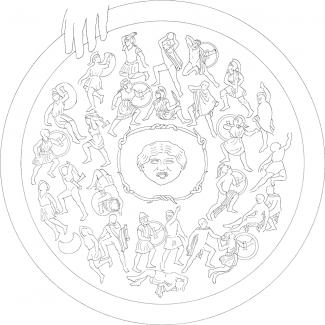
[Reconstruction of the Amazonomachy scenes on the exterior of the
shield of the Athena Parthenos. Plate 38 of E. B. Harrison, “The
Composition of the Amazonomachy on the Shield of Athena Parthenos,”
Hesperia 35 (1966), pp. 107–133. Courtesy of the Trustees of the
American School of Classical Studies at Athens.]
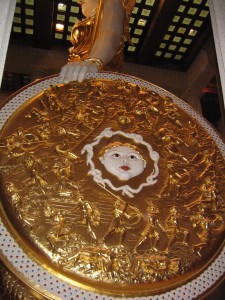
[Shield of Athena Parthenos, Nashville Parthenon, Tennessee. Image via
Flickr user Lucas, reproduced under a CC BY 2.0 license.]
