Pausanias Description of Greece 1.1

W.H.S. Jones (Translator), H.A. Ormerod (Translator)

View: By Section

Description of Greece. Pausanias. W.H.S. Jones (Translator), H.A. Ormerod (Translator). Cambridge, MA. 1918-1935.

Sponsored by Perseus Project, Tufts University.

Funding provided by The Annenberg CPB/Project.

Current edition Perseus

Description of Greece (English) (Pausanias. Pausanias Description of Greece, Volumes 1-4. Jones, W.H.S. (William Henry Samuel), translator; Ormerod, Henry Arderne, translator. London, New York: W. Heinemann, G.P. Putnam's Sons, 1918-1935.)

Editions (1)
Ἑλλάδος Περιηγήσεως Perseus (Pausanias. Pausaniae Graeciae descriptio, Volumes 1-3. Spiro, Friedrich, editor. Leipzig: Teubner, 1903.) — 1.1 focus
Translations (1)
English (Jones and Ormerod; retranslated Gregory Nagy, CHS, 2018) (OCR draft) Experimental (CHS Pausanias Reader retranslation by Gregory Nagy, based on Jones and Ormerod, with marked Greek terms, notes, quotations, and bibliographic attributions preserved.) — 1.1 focus

Notes on the current edition

Description of Greece

1. c. 267-263 B.C.
2. 493 B.C.
3. 323 B.C.
4. fl. c. 350 B.C.
5. 394 B.C.
6. fl. 440-400 B.C.

New Alexandria Commentaries

Gregory Nagy, Editors: Angelia Hanhardt and Keith DeStone, Web producer: Noel Spencer, Consultant for images: Jill Curry Robbins, \[\[Noel gives this a separate URN\]\]

Scroll I. Attica

subject heading(s): Hellēnikos/Hellēnikē ‘Greek, Hellenic’; ēpeiros ‘mainland’; Cyclades Islands; Aegean Sea; akrā ‘headland’; Sounion; Attica; nāos ‘temple, shrine’; Souniás ‘Athena-of-Sounion’; koruphē ‘summit’

§1.1. The first two sentences of the whole narrative are crafted in such a way as to set the trajectory for everything that will be narrated hereafter. In the translation as I have configured it, to be found in A Pausanias reader in progress (hereafter abbreviated as APRIP),I have tried to simulate the structure of the Greek text by following as closely as possible the original word order.

§1.2. Pausanias has been sailing on a westward journey along the Aegean Sea, making his way past the Cycladic Islands and heading toward a magnificent headland named Sounion as his first point of contact with the mainland of Europe. The view of this headland will create for Pausanias, as the viewer, his first impression not only of Europe in general but also of Attica in particular, which was a land-mass dominated by the city of Athens. And, just as the view of Attica is already now emerging as the dominant view of Europe for Pausanias, so also the upcoming view of Athens will dominate his entire narrative. Further, as we will see, the viewer’s first impression of Athens will be linked with Athena, the goddess of Athens.
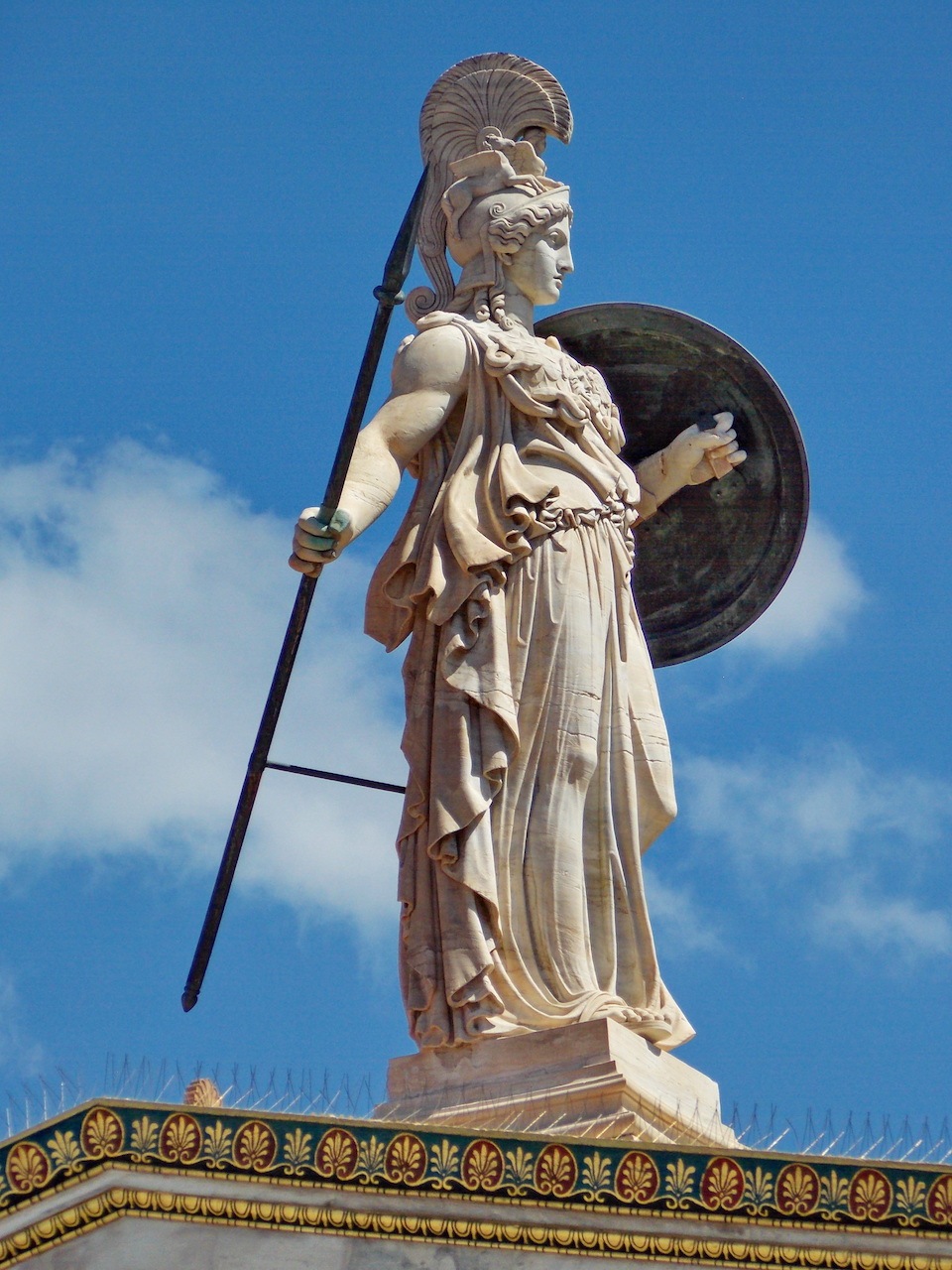
[Athena Promachos, British, Australian and New Zealand WWII soldiers memorial, Pedion tou Areos. Image via Flickr user Dimitris Kamaras, reproduced under a CC BY 2.0 license.]

§1.3. The first two words in the Greek text of 1.1.1 are a noun and an adjective referring to the European mainland of the Greek-speaking world as it existed in the era of Pausanias, and the genitive case of the noun and adjective here anticipates what is about to be highlighted as the subject of the sentence: ‘Belonging to the Greek mainland [ēpeiros] …is…’. And we already know that the very first place that is highlighted as ‘belonging to the Greek mainland’ is the magnificent headland of Sounion.

§1.4. Here I need to ask a question that turns out to be most relevant: what is the ‘Greek’ mainland? The adjective describing the noun ēpeiros ‘mainland’ in Pausanias 1.1.1 is Hellēnikē, which I translate as ‘Greek’. Here and everywhere in this Reader, ‘Greek’ translates the adjective Hellēnikos/Hellēnikē ‘Hellenic’ as well as the noun Hellēn ‘Hellene’; and ‘Greece’ translates Hellás ‘Hellas, Hellenic land’. On the use of these words in the era of Pausanias, I recommend the observations of Habicht 1998:25–27. I must add as a further observation, however, that the use of these same words Hellēnikos/Hellēnikē and Hellēn and Hellás in earlier eras was more complicated. A case in point is the era marked by the sea battle at Salamis in 480 BCE, where the navies of Athens and of other European Greek city-states defeated the invading naval forces of the Persian Empire: at the time, as I argue in Nagy 2017.06.25 §§43–50 on the basis of what we read in Scroll 8 of Herodotus, the words that I am now translating as ‘Hellenic’ or ‘Greek’ did not apply to all the Greeks involved in that sea battle: besides the Greeks of Europe who fought against the Persian Empire at Salamis, there were Greeks from Asia Minor and from outlying islands such as Samos who were fighting on the other side, and such Asiatic Greeks, who lived under the rule of the Persian Empire, thought of themselves as Ionians, not as Hellenes. More than six centuries later, however, in the era of Pausanias, Asiatic Greeks no longer thought of themselves as non-Hellenes. A case in point is Pausanias, who was a native of the Asiatic Greek mainland but who considered himself to be a Hellene. On Pausanias as a spokesman for Hellenic identity, I refer again to the observations of Habicht 1998:25–27.

§1.5. But now I need to ask another relevant question: why does Pausanias, who thinks of himself as a Hellene, refer to the mainland of Greek Europe as the ‘Hellenic’ mainland? What seems problematic here is the fact that the mainland of Greek Asia Minor was just as ‘Hellenic’ in the era of Pausanias as was the mainland of Greek Europe. But the problem is solved if we keep in mind the fact that Asiatic Hellenes thought of the European mainland as the homeland from where they had migrated eastward in prehistoric times. There is a multitude of myths centering on the migrations of Greeks from Europe to Asia Minor, and Pausanias himself is a source for some of these myths, as we see for example at 7.2.1, 7.2.4, 7.3.2, 7.3.6. Even many of the place-names in Greek Asia Minor reflect indirectly such myths. I choose here as prominent examples a pair of two cities in Asia Minor that are both named Magnesia: one is Magnesia-at-Sipylos, situated at the foot of a mountain range known as Sipylos and contiguous with the river Hermos, while the other is Magnesia-at-the-Maeander, which was a city further south, contiguous with the river Maeander. Both sites were evidently named after a well-known site in European Thessaly that was likewise named Magnesia. I have chosen as prominent examples these two cities of Magnesia in Asia Minor because Pausanias in his reportage shows an intimate familiarity with both these Magnesias and their environs, and, as I infer from this familiarity, he thought of himself as a Magnesian in origin. A similar inference, again on the grounds of the familiarity shown by Pausanias, has been made by Habicht 1998:14–15—though he is speaking there only about Magnesia-at-Sipylos as the homeland of Pausanias, whereas I include also Magnesia-at-the-Maeander, which the text describes in comparably familiar terms. To justify this inclusion, I refer to my comment at 1.1.2, which can be supplemented by the relevant comments of Habicht 1998:5, 15. In his comments as cited here, as also further at his p. 17, Habicht acknowledges that Pausanias was familiar with both Magnesia-at-Sipylos and Magnesia-on-the-Maeander—as also with practically all of Greek Asia Minor—even though the trajectory of the travels that he narrates in sequence does not include those parts of the Greek-speaking world that are situated on the mainland of Asia Minor: for more on the travels of Pausanias beyond the travels that he narrates in the ten scrolls attributed to him, I recommend the analysis of Habicht 1998:17. To sum up, then, what has been argued so far: in the overall narrative that Pausanias is about to present at the beginning of his work, he will be focusing not on the mainland of Greek Asia Minor, which is his homeland, but on the mainland of Greek Europe, which he is about to highlight at the very beginning of his narrative.

§1.6. That said, I am ready to take a closer look at the very first place that Pausanias highlights as ‘belonging to the Greek mainland’. This place, as we will now see, is relevant to the European identity of the ‘Greek’ mainland. In the wording that follows the first two words of the Greek text, the very idea of a ‘mainland’ is now highlighted as the magnificent akrā or ‘headland’ named Sounion. As if to intensify the highlighting, Pausanias uses the word akrā three times here at 1.1.1. The view of this headland will give the viewer his first impression not only of the ‘Greek mainland’ in general but also of Attica in particular, which as I have already noted was the name of the land-mass dominated by the city of Athens. Here is Pausanias sailing east to west, from the direction of Asia Minor to Europe, and his first impression of Europe is already becoming an Athenian impression. Just as the view of Attica has already now become the dominant way to view Europe, so also the upcoming view of Athens will become the dominant way to view Attica. Further, as we will see in §1.7, the viewer’s first impression of Athens will be linked with the goddess of Athens, Athena, who is signaled here as presiding over a temple at Sounion. The presence of the goddess at Sounion anticipates her presence in Athens, which will be the first city to be visited by Pausanias. And, as the first city, Athens will dominate the entire narrative of Pausanias.

§1.7. As Pausanias proceeds to sail round the headland of Sounion, now heading toward Athens, he sees a sacred space where the goddess Athena is worshipped. As he notes at a later point, 1.28.2, it is when you round the headland of Sounion that you see from far off in the distance the tip of the spear of Athena Promakhos, a famous outdoors statue of the goddess Athena imagined as fully-armed—hence her epithet promakhos ‘leading the battle’. As we see at 1.28.2, this statue of the goddess Athena was situated in the heights of the Acropolis of Athens, guarding the entrance to the sacred space. The mention of Athena at 1.28.2 can be linked with the context here at 1.1.1, where the goddess is mentioned for the first time by Pausanias. The sacred space of Athena at Sounion, 1.1.1., is mentally connected here with the spear tip of the goddess high up and far away on the Acropolis of Athens. We see here a metonymy. The metonymy here is relevant to the relationship between the name of the goddess, Athēnē, and the name of the city over which the goddess presides, Athēnai. As I have pointed out in HC 4§117, the Greek language has preserved a most ancient and fundamental connection that exists between the name of Athena and the name of Athens. The singular name of the goddess Athena, Athḗnē, is coextensive with the plural name of her city of Athens, Athênai. This plural name means, elliptically, ‘Athena and everything/everyone connected to her’. In other words, the name of the city of Athens is itself a most ancient metonym that expresses the divine power of integrating and unifying the diversity of all things and all people connected with the city of Athens. From the vantage point of Pausanias, as I infer from what he says at 1.28.2, the metonymy can start at the moment when you see the tip of Athena’s spear as you sail around the headland of Sounion. From the tip of the spear your mental image can work its way down, down, further down, and, the next thing you know, you grasp the totalizing concept of Athens. [[GN 2017.10.14]]

Pausanias at Sounion: why no mention of Poseidon?

subject heading(s): Poseidon, temple (sanctuary) of Poseidon, Athena, temple (sanctuary) of Athena

§2.0. At the very beginning of the Description of Greece as narrated by Pausanias (1.1.1), when the ship carrying our traveler approaches the east side of the akrā or ‘headland’ of Sounion, he must have been struck by the view of a magnificent temple situated at the highest point of the headland—a temple that archaeologists have identified as sacred to the god Poseidon, lord of the seas. The visual power of this view is evident from the photograph I show, where we see the temple of Poseidon as viewed from the east side of the headland. But why does Pausanias make no mention of Poseidon? My answer, in what follows, will require a shift in emphasis. What I really need to ask is this: why does Pausanias make no mention of Poseidon as a god who presides over the headland of Sounion? And the answer, I will argue, is that the god Poseidon is at least for the moment eclipsed, in the mind of Pausanias, by the goddess Athena.

§2.1. But what is this moment? It happens, as I picture it, when the ship bringing our traveler has rounded the akrā or ‘headland’ of Sounion and is now making its way toward the nearby harbor, located on the west side of the headland. At this moment my mind’s eye, as if it were a camera, zooms out, moving backward, backing away—far back enough to take in a full view, looking east, of the west side of this massive headland of Sounion, with its rugged profile defiantly jutting out into the turbulent seas that rage against it. What I imagine can be seen in this photograph of the west profile:
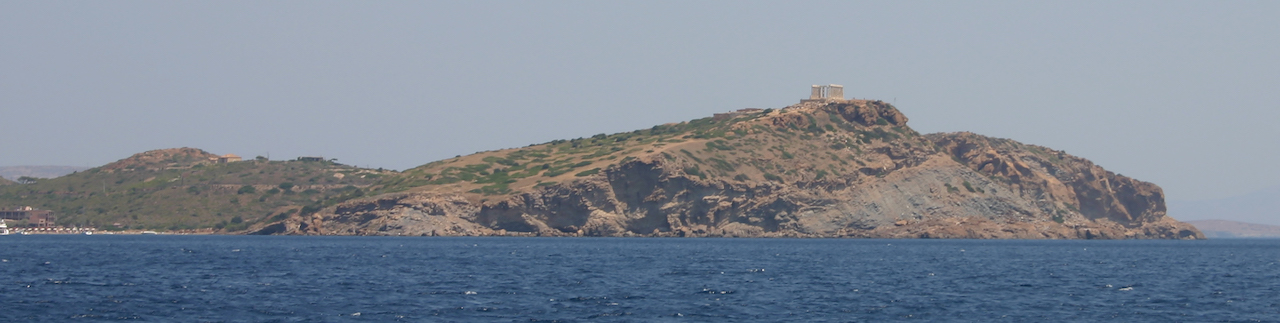
[Cape Sounion in profile. Image via Wikimedia Commons.]
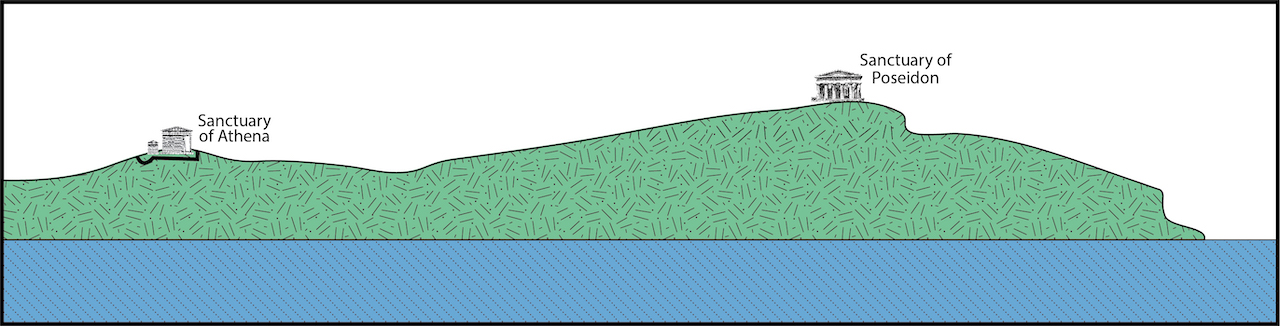
[Drawing, by Jill Curry Robbins, of the profile of Cape Sounion.]

§2.2. In this photograph of the west profile of Sounion, matched by the drawing underneath it, we can see at the right, which is south, the highest point of the headland, and, sitting on top of this point, this elevation, is the temple of Poseidon—or, to put it more broadly, the sanctuary of the god. Then there is a lower point, further to the left, that is, further to the north (more precisely, north-east), and, sitting on top of this lower point—but this point too is an elevation—is the sanctuary of Athena Souniás, as Pausanias refers to her. So, the goddess is, for Pausanias, ‘Our Lady of Sounion’. I have already commented, at §1.1 through §1.7 [Nagy 2017.10.10], about the connections of Athena with the headland of Sounion in the thinking of Pausanias.

§2.3. But what about Poseidon? Why does Pausanias not refer to ‘Our Lord of Sounion’, as it were? The absence of any mention of the god in the description given by our traveler had led to the common assumption, shared even by James Frazer in his commentary on Pausanias (1913 2:2), that the temple of Poseidon, far better preserved than the temple of Athena Souniás, was really the temple of the goddess. As is evident, however, from the text of an inscription dating from around 460–450 BCE (Inscriptiones Graecae I3 8), the temple that we still see today at the highest point of the headland has been identified, in the words of the archaeologist Barbara Barletta (2017:10) as “belonging not to Athena, as earlier believed, but to Poseidon.”

§2.4. It does not necessarily follow, however, that Pausanias made a mistake and wrongly identified the structure situated at the higher elevation, further south, with the sanctuary of Athena, which was situated at the lower elevation, further north. There may be other explanations that absolve Pausanias from having made such a mistake, and I recommend the relevant discussion of Barletta (2017:9–10), who surveys a wide variety of such explanations, with bibliography.

§2.5. I can agree with none of the explanations published so far. But I disagree only in one detail with the formulation of an archaeologist I knew in the early 1970s, John Young (1961), who has this to say in a terse abstract he published about the relevant testimony of Pausanias (1.1.1): “although the author did neglect to mention the temple of Poseidon, his location of the other points [that he did mention] is correct.” And the first two of the points highlighted by Young are the harbor at the west bay and the temple of Athena Souniás, sitting on the elevation overlooking the harbor. I do agree with Young that Pausanias was “correct” in saying as much as he said in his description. I show here a photograph of the west bay, as viewed from the elevation overlooking the harbor. It is on top of this elevation that the remains of the temple of Athena are still visible.
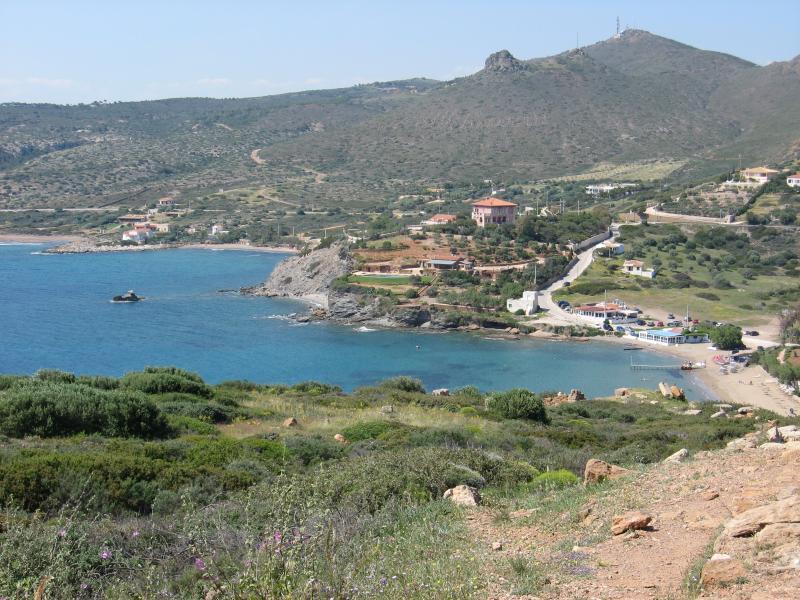
[The bay west of Cape Sounion. Image via Flickr, under a CC BY-SA 2.0 license.]

§2.6. My one point of disagreement with the formulation of Young (1961) centers on his idea that Pausanias “neglected” Poseidon. Instead, as I already indicated at the beginning of my relevant comments here, I argue that the god Poseidon is at least for the moment eclipsed, in the mind of Pausanias, by the goddess Athena. It is not a matter of neglect. Rather, Pausanias prioritizes Athena in the context of her rivalry with Poseidon, a rivalry that can be viewed on the level of ritual, not only on the level of myth. There is a similar eclipse I see happening when Pausanias visits the Acropolis of Athens: at 1.26.5–6, his treatment of the old sanctuary of Athena Poliás eclipses his treatment of the adjacent sanctuary of Poseidon.

§2.7. For Poseidon to be eclipsed by Athena is not a matter of neglect on the part of the ancients who worshipped both these divinities. Rather, it is a matter of their recognizing, in ritual as well as in myth, the dominance of one divinity over another. It is a matter of picturing a sacred space that is shared by two such divinities, one of whom is dominant while the other is, by comparison, recessive. I will have more to say in later comments about such a pattern of sharing, such a condominium of sacred space. [[GN 2020.06.12]]

The island of Patroklos

subject heading(s): Island of Patroklos; defamiliarization

Island of Patroklos… Our first impression, as we read the name Patroklos, may be that the referent here is the Homeric hero Patroklos. As we read on, however, we are quickly defamiliarized: this Patroklos is a historical figure, stemming from the Hellenistic era—which is the period of time starting with the conquests of Alexander the Great in the fourth century BCE and lasting up to the time when the Roman Empire takes possession of Hellas or ‘Greece’ in the second century BCE. I think that Pausanias, by way of his defamiliarizing gesture in introducing the name of Patroklos, is creating a signature, as it were, for the genre in which he is expressing himself. I agree with Cohen 2001:95 when she says that the work of Pausanias is one of the few surviving examples of this genre, which has “a Hellenistic background.” [[GN 2014.04.03.]]

source

Scroll I. Attica

subject heading(s): Peiraieus; dēmos ‘deme’; epineion ‘seaport’; Themistocles; spelling of Greek names; arkhōn ‘archon’; Phaleron; Athenian thalassocracy; neōs oikoi ‘ship-sheds’; Menestheus: Athenian signatures in Homeric poetry; Theseus; Minos; Minoan thalassocracy; Androgeos ‘man born of Earth’; speaking name; limēn ‘harbor’; tomb of Themistokles at Peiraieus

spelling of Greek names… I offer a general comment on the spelling of Greek names, with primary reference to the name of Themistocles here at 1.1.2… The name of this famous Athenian statesman could have been spelled here and elsewhere in the hellenized way, as Themistokles. The same can be said about the name of another famous Athenian statesman, Pericles, who is first mentioned by Pausanias at 1.25.1: here as well, the name could have been spelled in the hellenized way, as Perikles. In general, however, I spell any Greek name in a latinized way wherever the said name has become a “household word” in English, as in the case of Themistocles and Pericles. When I say latinized I mean spellings where Latin lettering is substituted for the corresponding hellenized lettering: so, c for k, ch for kh, ae for ai, oe for oi, u for ou, -us for –os, and so on. Besides Themistocles and Pericles, I will spell in a latinized (and anglicized) way such other “household words” as represented by the following Greek names: Academy (not Akademeia), Achilles (not Akhilleus), Acropolis (not Akropolis), Aeneas (not Aineias), Ajax (not Aias), Alcibiades (not Alkibiades), Alexander (not Alexandros), Anacreon (not Anakreon), Andromache (not Andromakhe), Apollo (not Apollon), Arcadia (not Arkadia), Attica (not Attike), Cambyses (not Kambuses), Cassandra (not Kassandra), Chersonesus (not Kherronesos), Chios (not Khios), Chrysippus (not Khrusippos), Cleisthenes (not Kleisthenes), Corcyra (not Kerkura), Corinth (not Korinthos), Cyclades (not Kuklades), Cyrene (not Kurene), Cythera (not Kuthera), Delphi (not Delphoi), Dionysus (not Dionusos), Euboea (not Euboia), Herodotus (not Herodotos), Hesiod (not Hesiodos), Hippolytus (not Hippolutos), Homer (not Homeros), Isocrates (not Isokrates), Lacedaemonia (not Lakedaimonia), Lyceum (not Lukeion: see my comments on Pausanias 1.19.3), Lycurgus (name of the Athenian statesman, as also of the early Spartan ‘lawgiver’; not Lukourgos), Maeander (not Maiandros), Menander (not Menandros), Musaeus (not Mousaios), Oedipus (not Oidipous), Palladium (not Palladion), Peloponnesus (not Peloponnesos), Phaedra (not Phaidra), Philip (not Philippos), Pindar (not Pindaros), Philoctetes (not Philoktetes), Plato (not Platon), Pluto (not Plouton), Polygnotus (not Polugnotos), Polyxena (not Poluxene), Ptolemy (not Ptolemaios), Socrates (not Sokrates), Sophocles (not Sophokles), Syracuse (not Surakoussai), Tarentum (not Taras), Thermopylae (not Thermopulai), Thucydides (not Thoukudides). All these examples come from Pausanias 1.1 through 1.30. Some “household names” of the past, however, are less likely to qualify as such today, and I include in this smaller list such names as Antipatros (not Antipater), Kassandros (not Cassander), Aratos (not Aratus), Eurydikē (not Eurydice), Oitē (not Oeta), Rōxanē (not Roxana), Khairōneia (not Chaeronea), Aigeus (not Aegeus), Daidalos (not Daedalus), Ikaros (not Icarus), Hipparkhos (not Hipparchus). I have included in this shorter list even the names of the father of Theseus, Aigeus (not Aegeus), after whom the Aegean Sea is named, and of the Ptolemaic queen Eurydikē, despite the association of the mythical figure Eurydice with Orpheus, as in Pausanias 9.30.6. In many cases, it is relatively easy to recognize the latinized versions underneath the more hellenized spellings. A shining example is the father-and-son pair Daidalos and Ikaros, for Daedalus and Icarus. Another such example is Kleopatra, for Cleopatra. In many cases, my reasons for preferring the hellenized spelling over the latinized version have to do with word-associations that become evident in contexts highlighted by Pausanias. In the case of Daidalos, for example, the meaning of his name is relevant to the name of a festival, the Daidala, as described by Pausanias 9.3.2–6. [[GN 2017.10.05.]]

archon [arkhōn]… As we see later in our readings, Pausanias 4.5.10, this word ‘archon’ [arkhōn], meaning literally ‘leader’, was the Athenian title of an official who was appointed yearly by lot. The traditional Athenian way of dating any given year when any event happened was by remembering the name of the archon [arkhōn] who was in charge during that year.

thalassocracy… In the history of Athens, the era of the Athenian Empire was most noted for the city’s maritime power, the Greek word for which was thalassokratiā or ‘thalassocracy’. For background on this word, see 1§§5–6 in Nagy 2017.04.11, “Diachronic Homer and a Cretan Odyssey.” [[GN 2014.04.13]]

ship-sheds [neōs oikoi]… In the glory days of the Athenian Empire, a most celebrated visual marker of the magnificence as well as the power of its thalassocracy was the architectural complex of colossal buildings known as neōs oikoi ‘ship-sheds’ at the dockyards of seaport of Peiraieus. I have invited Mills McArthur to write a comment here about these buildings. [[GN 2014.04.13]]

The neōs-oikoi ‘ship-sheds’–literally ‘ship houses’–of Peiraieus sheltered the warships so critical to the military success of the city of Athens. Ships would be drawn up out of the water on ramps into their ‘houses’. But these utilitarian dockyard structures ultimately transcended their function, gaining great symbolic importance for the Athenians—so much so that Demosthenes (fourth century BCE), enumerating some of the prominent symbols of Athens’ glory, grouped the ship-sheds of the dockyards of Peiraieus together with the Parthenon itself (Speech 22 section 76)! The atmosphere of the docks on the verge of an expedition is vividly captured in Greek literature, ranging from the hustle and bustle (Aristophanes Acharnians 544–554) to a mixture of hope and foreboding on occasions when the ships were launched in the glory days of the Athenian Empire (Thucydides 6.30–32). Even after the empire went into decline, the glory of the dockyards of the Peiraieus was still very much in evidence, as we see from the testimony of Demosthenes. See also Pausanias 1.29.16, where he speaks about the rebuilding of the neōs oikoi ‘ship-sheds’ of the Peiraieus in the era of the statesman Lycurgus of Athens, who dominated the cultural and political life of Athens in the late fourth century BCE. The Roman general Sulla sacked the Peiraieus in 86 BCE, and so Pausanias in the second century CE would have seen just a trace of the structures that formerly highlighted the naval power of Athens. [[MM 2014.04.15.]]

Magnesia-at-Maeander… The city of Magnesia, contiguous with the river Maeander, is situated on the mainland of Greek Asia Minor. In the time of Themistocles, Magnesia was part of the Persian Empire. After Themistocles was banished from his native city of Athens, he eventually defected to the king of the Persians, Artaxerxes I, who appointed him as ruler of Magnesia. See Pausanias 1.26.4, also the comments of Habicht 1998:5. On the symbolism implicit in the name of Magnesia, see HC 3§§77–94. [[GN 2017.10.15.]]

tomb of Themistocles at Peiraieus… This detail in Pausanias 1.1.2 is of special interest to me. I find it intriguing that Pausanias, visiting Athens in the second century CE, is foregrounding here a detail about Themistocles that could easily be ignored by professional Classicists who study only the testimony of the Classical period of the fifth and the fourth centuries BCE. It is as if he were saying to such professionals: here is something that I bet you did not know—or had ignored… Themistocles was rehabilitated by the Athenians, despite his having defected to the Persian Empire after his political successes in Athens had gone sour. And the visible sign of his rehabilitation is his tomb. The tomb of Themistocles, as a visible reminder, reconnects the memories about Themistocles with the present. Here the medium of Pausanias, which is a visual journey that reconnects with the history of the past, shows its power to reshape or even restore history as he sees it. I see a comparable gesture of rehabilitation in my comment on a later passage, Pausanias 1.23.9. [[GN 2014.04.13.]]

Parthenon… The political as well as the cultural significance of the Parthenon here is made evident by the context. We see here in Pausanias 1.1.2 his first mention of the Parthenon. The author has not wasted much time in making mention of this all-important monument. [[GN 2017.10.15.]]

source

Scroll I. Attica

subject heading(s): théā ‘seeing’

worthy of viewing [théā]… To translate this phrase as ‘worth seeing’ is to blur the significance of théā ‘viewing, seeing’ as a ritual activity. [[GN 2017.10.18.]]

source

Scroll I. Attica

subject heading(s): hērōs ‘hero’; hero cult; Phaleros; Argonauts; Phaleros as culture hero linked with myth of the Argonauts; Androgeōs; hero cult of Androgeōs; mystical name of cult hero as Hērōs; epichoric myths and rituals

heroes… So, already at this early stage in his narrative, Pausanias shows a special interest in hero cults. [[GN 2017.10.15.]]

those, however, who pay special attention to the study of their local-antiquities [enkhōria] know that… We see here Pausanias in the role of a researcher interested in epichoric myths and rituals. [[GN 2017.10.20.]]

source

Scroll I. Attica

subject heading(s): Ionia as a region of Asia Minor; Pausanias as a researcher of Ionian traditions

On observations made by Pausanias about the cultural identity of Ionia and the Ionians in Asia Minor, I have comments on one of the examples in Nagy 2017.06.25 §33, with reference to Pausanias 7.3.3. [[GN 2017.11.05.]]

source

Scroll I. Attica

subject heading(s): mnēma ‘tomb’; Antiope the Amazon; first impressions of the visual kind; Antiope the Amazon as first impression; name of Amazon Antiope as ‘rivaling in looks/appearances’; Murinē the Amazon; Amazons as cult heroes; Molpadia the Amazon; war between Amazons and Athenians; Theseus; abduction of Antiope by Theseus; theme of Amazon falling in love with her abductor; Hippolyte the Amazon; Megara; lupē ‘pain’; Pindar F 174; Pindar F 175

As one enters the city, there is a tomb [mnēma] of Antiope the Amazon…We read in Frazer 1913 II 37 about the wording here: “it appears that the tomb of Antiope was just inside the city-wall of Athens”; Frazer also comments here on the relevant information provided by Plutarch Life of Theseus 27. I find it most significant that the tomb of Antiope the Amazon should be the very first thing to be seen by Pausanias as he enters the city of Athens. We have already seen that first impressions of the visual kind are very important to Pausanias. In the case of the temple sacred to the goddess Athena at Sounion, for example, the traveler’s first impression of the goddess there is linked to the view, from there, of the tip of Athena’s spear on the Acropolis of Athens. And now, as Pausanias enters the city of Athens, the very first thing he says he sees is the mnēma ‘tomb’ of Antiope the Amazon. Once again, the traveler’s first impression becomes a dominant theme in his narrative. From the wording at Iliad 2.811–815, we can see that the tomb of the Amazon Murinē is pictured there as the monument of a cult hero: see the comments at I.02.811–815 in A Sampling of Comments on the Iliad and Odyssey. Similarly here, the tombs of the Amazons Antiope and Molpadia are pictured as monuments of cult heroes. On the symbolism of Athenian myths about a primordial antagonism between Athens and the Amazons, I refer to my analysis in HC 4§§213–215, 4§224. According to one myth, this antagonism was precipitated by the abduction of Antiope, queen of the Amazons, by Theseus, king of Athens. The idea that Antiope then falls in love with Theseus as her abductor, as mentioned by Pausanias here at 1.2.1, is a topic that disturbs—and that needs further investigation. Relevant, I think, is what we read later on at 1.41.7 in the narrative of Pausanias, where he says that he saw in the city of Megara a mnēma ‘tomb’ of another Amazon, Hippolyte, who was sister of Antiope. Pausanias says that this tomb was linked with a myth about Hippolyte: how this hero became queen of the Amazons after her sister Antiope was abducted by Theseus, king of the Athenians, and how Hippolyte and her fellow Amazons then went to war against Athens to avenge the abduction. The outcome was a bitter defeat for the Amazons, and most of them perished in the war, but Hippolyte survived and sought refuge at Megara, where she died from her lupē. This word lupē as used by Pausanias at 1.41.7 can best be translated as the ‘pain’ of mourning. By combining what we read at 1.2.1 and at 1.41.7 in the narrative of Pausanias, we can piece together a central theme in the overall myth that is linked to the hero cults of the Amazons Antiope, Molpadia, and Hippolyte: that all the pain resulting from the war between the Amazons and the Athenians can be traced back to the primal abduction of Antiope, queen of the Amazons, by Theseus, king of the Athenians. That abduction must have been highlighted in a song of Pindar as mentioned by Pausanias 1.2.1. Classicists track this mention by referring to it this way: Pindar F 175 ed. Maehler. In Pausanias 7.2.6, we read another mention of these Amazons, and Classicists refer to this mention as Pindar F 174 ed. Maehler. One final word about the references made by Pausanias to Amazons as cult heroes: I deliberately use the word “hero” and not “heroine” in such contexts because I seek to challenge the assumption, common to native speakers of English, that only men are heroes. In terms of ancient Greek hero cults, both men and women could become cult heroes after death, and the wording of Pausanias at 1.2.1 and at 1.41.7 makes it clear that the Amazons Antiope, Molpadia, and Hippolyte were all three considered to be cult heroes. [[GN 2017.11.06.]]

source

Scroll I. Attica

source

Scroll I. Attica

subject heading(s): court poets and their patrons

As an example of the relationship between court poets and their patrons, Pausanias here at 1.2.2 refers to a Homeric passage at O.03.267–271. The generic aoidos ‘singer’, as represented by the anonymous figure who is mentioned there, has the power to supervise the deeds of men and women by way of praising what is good and blaming what is bad. The aoidos that Agamemnon left behind to supervise Clytemnestra cannot be neutralized by way of removal from the scene. The aoidos does not need to see bad deeds in order to tell about them, since he can hear about them from the Muses. [[GN 2017.03.29 via BA 37–38, 2§13n5; PH 392.]]

source

Scroll I. Attica

source

Scroll I. Attica

source

Scroll I. Attica

source

Scroll I. Attica

subject heading(s): harpazein ‘abduct’; Eos; Kephalos; Phaethon; Aphrodite

On the myth about the abduction of Kephalos by Eos, see the commentary at O.15.250–251 as presented in https://chs.harvard.edu/CHS/article/display/6718. On the myth about the abduction of Phaethon by Aphrodite, as narrated in Hesiod Theogony 986–991 and as mentioned here in Pausanias 1.3.1, see again the commentary at O.15.250–251.

source

Scroll I. Attica

source

Scroll I. Attica

source

Scroll I. Attica

source

Scroll I. Attica

subject heading(s): Gauls [Galatai]; defamiliarizing

In his narrative, Pausanias will focus here on the ancient Celtic people known as the Gauls, called Galatai in Greek, as they existed in the third century BCE. By maintaining this focus, Pausanias will be defamiliarizing the Gauls as they existed in his own time, that is, in the second century CE. I say this because it stands to reason that educated Greeks in the time of Pausanias would have been well enough informed about the existence of romanized Gauls living in the western and non-Greek part of Roman Empire—in what is now northern Italy, France, and Spain. By contrast, educated Romans in the time of Pausanias—and even Greeks—would have been relatively unfamiliar with the reality of earlier Gauls who figured in the pre-imperial history of the eastern and Greek part of the same Roman Empire.

source

Scroll I. Attica

subject heading(s): Ēridanos; Gauls [Galatai]; Hēlios; [Hēliades ‘Daughters of the Sun’;] ēlektron ‘amber’; Phaethon

I highlight here the linking of a river named Ēridanos with the ancient Gauls—Galatai in Greek. Although Pausanias is vague about the location of this river, he is explicit about linking it with the Gauls, as we see here. Why is he explicit? In looking for an answer, I turn to an early work of mine where I studied in some detail the ancient Greek sources concerning this river: Nagy 1973, rewritten as Ch.9 in the book Nagy 1990b (page-references to this study of mine will be keyed to the version printed in the book). As I show in that study, ancient Greek sources other than Pausanias likewise link the name Ēridanos with rivers flowing through territories once settled by Gauls: thus, Ēridanos was once the Greek name for the river Po, located in the formerly Gaulish territory of northern Italy, and it was also the Greek name for the river Rhône in France, that is, in the heartland of ancient Gaul (Nagy 1990b:237–238). But there is a problem with the traditional Greek naming of such real rivers as the Po and the Rhône. The problem is, the name Ēridanos is linked not only with these rivers flowing in Gaulish territories. As Pausanias himself says, Ēridanos is linked also with myths about the hero Phaethon, son of Hēlios. This hero had plunged into a river by the name of Ēridanos when the solar chariot that he was driving across the sky was shattered in a spectacular cosmic crash. There, by the banks of the river Ēridanos, the dead hero Phaethon, son of Hēlios, will be lamented forever by his mourning sisters, the Hēliades or ‘Daughters of the Sun’, who will be shedding tears of ēlektron ‘amber’ in their sorrow for the death of their solar brother. The myth, including the detail about the tears of amber shed by the Daughters of the Sun, is most beautifully retold in the Hippolytus of Euripides, where the chorus is singing a song of escapist reveries:

ἀρθείην δ’ ἐπὶ πόντιον \| κῦμα τᾶς Ἀδριηνᾶς \| ἀκτᾶς Ἠριδανοῦ θ’ ὕδωρ, ἔνθα πορφύρεον σταλάσ\|σουσ’ εἰς οἶδμα τάλαιναι \| κόραι Φαέθοντος οἴκτῳ δακρύων \| τὰς ἠλεκτροφαεῖς αὐγάς
Let me fly off \[like a bird\], soaring over the sea wave of the Adriatic headland and the water of Ēridanos, where the wretched girls, in sorrow for Phaethon, pour forth into the seething sea their shining-amber \[*ēlektrophaeis*\] rays of tears.
Euripides Hippolytus 735–741

In the wording of Euripides, as we see in the passage I just quoted, the river Ēridanos is evidently mythical: on its banks are stationed the solar sisters of Phaethon, shedding tears of amber that signal the golden redness of a most spectacular sunset. In the myths about Phaethon, the river Ēridanos is a cosmic fresh-water stream that encircles the world, interacting with the celestial dynamics of the sun. This Ēridanos is like another famous cosmic fresh-water stream, the river Ōkeanos, which in other myths likewise encircles the world. The sun sets into the waters of such cosmic streams at sunset and rises from the same waters at sunrise. And the myth of Phaethon is an episodic retelling of one aspect of the solar cycle—the aspect of sunset. Phaethon plunges into the river Ēridanos just as the sun plunges into the cosmic stream of the Ōkeanos—or of the Ēridanos—at sunset. (For the sources, I refer to my analysis of the relevant myths in Nagy 1990b:236–238.) Such parallelism between the river Ēridanos and the river Ōkeanos, was not to last, however: while the first of the two cosmic rivers remains a river, the second eventually becomes the Ocean in the current sense of the name—that is, the Atlantic Ocean. (Again, I refer to my analysis in Nagy 1990b:236–238. In that analysis, I explain how the myth about Phaethon son of Hēlios god of the sun is distinct from another myth about Phaethon son of Ēōs goddess of the dawn—a myth that is also familiar to Pausanias, as we saw already at 1.3.1.)

And so, as I already said a minute ago, the river Ēridanos is mythical in the poetic description of Euripides. But the river Ēridanos is simultaneously “real” in the wording of that very same description, Hippolytus 736–737: This wording envisions Ēridanos as the river Po, seen at the climactic moment when its waters stream into the Adriatic Sea at the Gulf of Venice. (I have further comments in Nagy 1990b: 236–238. At p. 236 there, I should add, I had translated ἐπὶ πόντιον \| κῦμα at lines 735–736 of the Hippolytus as ‘heading for the sea wave’. I now regret that interpretation, since the Gulf of Venice is not the final destination of the flying bird, and so I follow Barrett 1964:300–301 in translating as ‘soaring over’.)

For a rationalist like the geographer Strabo (5.1.9 C215), what needs to be said first and foremost about Ēridanos is that this river simply cannot be real, belonging as it does to the mythical world of Phaethon and his cosmic sisters, the Daughters of the Sun. Although Strabo cannot deny that real rivers can be named Ēridanos, this reality is for him delegitimized by the existence of myths about a mythical Ēridanos. Even rationalists like Strabo linked the name Ēridanos primarily with the myth about a solar boy and the solar girls who forever lament his death by shedding tears of amber. Thus, Strabo would link the same name only secondarily with the reality of real rivers named Ēridanos, such as the Po.

Pausanias too is such a rationalist, I think, and that is why he distances his thoughts from the reality of real rivers named Ēridanos. For him to be vague about the precise location of the Ēridanos in Gaul is to achieve such a mental distancing. Even if the Gaulish territories of northern Italy and southern France, as integral parts of the Roman Empire, must have been familiar to educated Greeks in the age of Pausanias, the mythical associations of the name Ēridanos would still lead to an attitude of defamiliarization in thinking about real rivers that went by that name in these territories.

That said, I return to my initial question: why is Pausanias explicit about linking the name Ēridanos with the Gauls? By now I see that I should have asked, rather, a different question: why is Pausanias vague about the existence, inside the territories of the Gauls, of a real river that the Greeks knew by the name of Ēridanos? And I have already offered an answer to such a question in my previous comment: Pausanias is defamiliarizing the Gauls in the western and non-Greek part of the Roman Empire by way of highlighting the earlier Gauls who figured in the pre-imperial history of the eastern and Greek part of the same Roman Empire.

source

Scroll I. Attica

source

Scroll I. Attica

source

Scroll I. Attica

source

Scroll I. Attica

source

Scroll I. Attica

source

Scroll I. Attica

subject heading(s): phūlē (plural phūlai) ‘subdivision’

Here and elsewhere, I avoid translating phūlē as ‘tribe’, which is a misleading rendition. See Nagy 1990b:277–293.

source

Scroll I. Attica

source

Scroll I. Attica

source

Scroll I. Attica

subject headings: Procne (Proknē), Philomela (Philomēlā), Tereus (Tēreus).

On the form Philomēlā: grammarians in the ancient world (for example, Herodian 3.1 p. 255 line 14 ed. A. Lentz 1867) called attention to the exceptional ending ā instead of the expected ē. The catastrophic story of Procne, Philomela, and Tereus is best known today from the celebrated retelling by Ovid, Metaphorphoses 6.401–674. A briefer retelling of the myth can be found in “Apollodorus” Bibliotheca 3.193–195. These retellings seem to originate from a version of the myth that was anchored in the region of Athens. Another version, anchored in the region of Ephesus, is analyzed at §23 in Nagy 2016.01.07. As for the version anchored in Athens, it is linked to still another version that is anchored in the region of Megara, as we see later when we read Pausanias 1.41.8–9, where I offer further comments. Pausanias refers to the myth of Procne, Philomela, and Tereus also at 9.16.4 and at 10.4.8–9, where I offer still further comments. For now, I simply introduce the myth, epitomizing from §§19–23 in Nagy 2016.01.07:

As we read in Ovid, Metamorphoses 6.401–674, Procne and Philomela are women who become transformed respectively into the prototypical Nightingale and the prototypical Swallow in the course of their tragic interaction with the king of Thrace, a man named Tereus. In some versions of the myth, the names of the two women are more overt: *Aēdōn *and *Khelidōn*, that is, Nightingale and Swallow (for more such versions, I cite Levaniouk 2011:215n6). As for the man, King Tereus, he becomes transformed into a bird known in Greek as *epops*. To say it in English, Tereus becomes the prototypical Hoopoe. The myth about these three doomed humans who are turned into birds is a story of an Eternal Triangle. Tereus marries Procne and then violates her sister Philomela, only to be punished for his crime when Procne takes revenge on her husband by killing their own son and then serving up the child’s cooked body to an unsuspecting Tereus, who thinks he is eating the meat of an animal. That is the *dikē *or ‘retribution’ to which the narrative of Pausanias is referring here. Once Tereus discovers that his stomach has become the tomb of his own son, Tereus experiences a grief that matches the grief of the two sisters. The combined grief becomes too much for all three to bear, and the gods take pity by transforming them all into birds. In Ovid’s Metamorphoses 6.576–578, we read that Philomela the would-be Swallow weaves into a web the story of her violation by Tereus. She cannot express the sad story in words, since Tereus had cut out her tongue and now keeps her imprisoned in a fortress, hidden away from her sister. For Philomela, the act of weaving a web becomes a substitute for the act of singing a lament in expressing her grief.
source

Scroll I. Attica

source