ODYSSEY BOOK IX
HIM then in answer addressed these words deep-plotting Odysseus:
1
"Ο King Alcinous, illustrious prince of the people,
Truly a thing right pleasant it seemeth to list to a minstrel
Such as this singer of thine, for in voice he is like an immortal.
Nay, for myself, I avow there is nought more perfect and gracious
5
Than when the heart of a people o'erfloweth with mirth and with gladness,
While at the feast in the palace they list to the voice of a singer,
Sitting the one by the other before full banqueting-tables
Laden with bread and with flesh; and drawing the wine from the wine-bowl
Beareth the steward around to the guests and filleth the goblets :
10
This to my mind is the thing on the earth which seemeth the fairest.
But for thy spirit inclineth to learn of my grievous afflictions—
All will I tell, though more I shall suffer and grieve in the telling.
What then first shall I tell thee of all, what lastly relate thee,
Since full many a woe have sent me the gods of Olympus?
15
Well then, firstly my name will I utter, in order that ye too
Learn it, and, should I escape from the pitiless day of destruction,
Still your friend I shall ever remain, though far is my homeland.
I am Odysseus, the son of Laertes, to every mortal
Known for my manifold craft; and the fame of it reacheth to heaven.
20
Ithaca, isle far-seen, is my home; therein is a mountain
Neriton, waving with woods, conspicuous; islands around it
Lie full many and closely adjacent the one to the other,
Samos and Dulichium and the woodland heights of Zacynthus.
Lowly doth Ithaca lie and is highest out in the ocean,
25
Far in the western gloom—but the rest t'ward dawn and the sunrise;
Rough—but for youths 'tis an excellent nurse ; nor truly, meseemeth,
Sweeter is aught on the earth for a man to behold than his homeland.
Verily fain had retained me the beautiful goddess Calypso
There in her hollow caves in her longing to make me her husband;
30
Yea and in selfsame wise in her palace did Circe withhold me,
Crafty enchantress of Aea, in longing to make me her husband;
Yet did they never persuade me nor soften the heart in my bosom;
So is it true that on earth there's sweeter than country and parents
Nought to be found—nay, e'en if afar in a right fat homestead
35
Distant from parents aloof one lives in a country of strangers.
Come now—all of the tale of that doleful return I will tell thee,
All that I suffered of Zeus when I sailed from the land of the Trojans.
Wafted by winds from the Troad we reached a Ciconian city,
Ismarus. Here did I plunder the town and harried the people.
40
Carrying then from the city the women and plentiful substance,
All we divided, that none might lack fair share in the booty.
Then did I order my men with a foot right nimble retreating
Quickly to flee; but, alas, in their infinite folly they would not;
Nay, strong wine in abundance they set them a-drinking and slaughtered
45
Many a sheep on the shore and shambling crook-horned cattle.
Meantime hasting away the Ciconians called to their fellows,
Neighbours of theirs and withal far greater in number and braver,
Mainland dwellers, and skilful as fighters from horses or war-cars
Battle to wage with a foe, or on foot, should danger demand it.
50
These came thronging as thickly as leaves and flowers in spring-time,
Early at dawn, and a doom right evil from heaven was sent us,
Hapless men that we were; and a great disaster we suffered.
Setting ourselves in array by the swift-winged ships we contended,
Hurling the one at the other with spears keen-bladed and bronzen.
55
Now while new was the day and the sacred light was increasing
Steadily standing we warded them off, though greater in number,
Till, when the sun passed o'er to the time of the loosing of oxen,
Then the Ciconians driving them back o'ermastered the Grecians.
Six of the well-greaved fighters belonging to every vessel
60
Perished, and all of the rest took flight and escaped from destruction.
Onward thence did we sail, our hearts sore laden with sorrow,
Gladly escaping from death, yet mourning for much-loved comrades;
Neither in sooth did I lead with the twy-beaked ships to the open
Ere three times we had called on the souls of the pitiful comrades
65
Fallen in fight on the field, by Ciconian foes overmastered.
Now on the vessels was sent by the Father who gathers the tempests
Boreas, rushing with terrible blasts; and covered with cloud-rack
Earth was at once and the sea; and down from the sky fell midnight.
Headlong a squall swept onward the ships. Of a sudden the sails split,
70
Sundered in three and in four by the furious might of the storm-blast.
These forthwith did we lower and stow, foreboding destruction.
Hastily then with the oars our vessels we urged to the mainland.
Here two days and two nights we remained unceasingly watching,
Ever in grief and exhaustion consuming the spirit within us,
75
Till, when the third day rose from the lap of the fair-tressed Morning,
Then we uplifted the masts and with white sails spread to the breezes
Sat, as the vessel was kept to her course by the wind and the steersman.
Verily now I had come unscathed to the land of my fathers,
Had not the stream of the sea and the roll as I rounded Malea
80
Carried me, under the stress of the Boreas, south of Cythera.
Hence nine days was I borne by the ruinous blasts of the storm-winds
Over the teeming deep. On the tenth we arrived at the mainland,
Land of the Lotus-eaters, whose food is the fruit of a flower.
Here on the shore disembarking we drew from a fountain of water.
85
Hastily then did my mates make midday meal by the vessels.
Now when of meat and of drink we had all of us fully partaken,
Then of my men did I send forth certain to go and assure them
What was this people, of all bread-nourished races of mortals.
Two of my men did I choose, and a third as a herald I added.
90
These then, swiftly departing, discovered the Eaters of Lotus;
Nor did the Lotus-eaters devise for my comrades destruction;
Nothing they did save only they gave them to eat of the lotus.
Now whoever did eat of the fruit honey-sweet of the lotus
Felt no longer the wish to return nor tidings to carry,
95
Caring for nought but to stay with the Lotus-eaters for ever,
Feeding on lotus, forgetting his home and the land of his fathers.
These, though bitterly weeping, I brought to the ships by compulsion,
Bound them, and under the thwarts in the hollow vessel I thrust them.
Urgently then did I call on the rest of my trusty companions,
100
Hasting as much as they might, on the swift-winged ships to embark them,
Lest still more might eat of the fruit and forget their homeland.
All then quickly embarked and taking their seats on the benches
Smote with the well-ranged oars on the grey-green brine of the ocean.
Onward voyaging hence, our hearts o'erwhelmed with affliction,
105
Unto the land of the Cyclops, a race overbearing and lawless,
Soon we arrived. Here, trusting the favour of powers immortal,
None with his hands e'er planteth a plant or tills with the ploughshare,
Yet untilled and unplanted, behold, all groweth in plenty,
Wheat and barley and vine; and the vine's luxuriant clusters
110
Bear rich juice of the grape that the rain of the heaven doth nourish.
Neither assemblies for counsel they have nor laws and traditions;
Dwelling apart on the crests of the highest mountains the Cyclops
Hollow caverns inhabit, and each gives law to his household,
Children and wives; nor care they at all each one for the other.
115
Nigh to the land of the Cyclops a rich-soiled island is lying
Stretching in front of a harbour—not near nor yet very distant—
Covered with forest ; and goats with a numberless progeny breed there,
Wandering wild, by the tread of a human foot unaffrighted.
Never is entered the island by hunters who hunt in the greenwood,
120
Suffering many a toil as they harry the heights of the mountains;
Nor is it held as a meadow for flocks or as tilth for a corn-land;
All untilled and unplanted it lieth, for ever and alway
Widowed of men; but to bleating goats it affordeth a pasture.
Vessel is none whose red bow plougheth the sea for the Cyclops,
125
Nor to be found in the land are builders to toil and to fashion
Well-decked vessels, to traverse the sea and all to accomplish,
Visiting cities of mortals (as ofttimes truly it happens
Men cross over the ocean in ships each other to visit);
Else maybe they had laboured the soil and had settled the island,
130
Since not barren it seems, and all 'twould bear in the season.
Meads are there close-skirting the grey-green brine of the ocean,
Flooded with water and soft; and the vine would flourish unrotting;
Smooth and stoneless the tillage, and deep is the crop that the reaper
Ever in season can reap, for below right rich is the bottom.
135
Here is a haven secure where never is needful a mooring,
Neither the anchor to cast, nor e'en stern-cables to fasten;
Beaching the ship one waiteth awhile, till the heart of the sailor
Stirreth within him to go, and a favouring breeze is arising.
Now at the head of the harbour a freshet of glittering water
140
Floweth from under a cavern, with poplars growing around it.
Here did we first reach land, and a deity guided us surely
Thorough the thick dark night, where all was invisible round us,
Such was the deepness of mist that enveloped the ships, and above us
Shone from the heav'n no light of the moon, for in clouds she was hidden.
145
Thus did it happen that none of the watch was aware of the island;
Nor that the league-long waves went thundering on to the mainland
Saw we until on the isle our well-decked ships we had stranded.
Then, when at last we had beached them and every canvas was lowered,
Out of the vessels we stepped on the surf-beat strand of the ocean,
150
Laid us to sleep, and awaited the sacred light of the morning.
Now when the morning was newly arisen, the roseate-fingered,
Saw we with wonder the island, and questing around it we wandered.
Then did the Oreads, daughters of Zeus who beareth the aegis,
Startle the goats of the crags, to provide a repast for my comrades.
155
Quickly on well-bent bows and long-shanked javelins seizing
Hurried we forth of the ships, and in three our company ranging
Shot; and at once vouchsafed us a god right plentiful booty.
Now was the number of vessels that followed me twelve, and to each one
Fell nine goats as a portion, and ten for myself they selected.
160
So for the whole of the day till the sun sank down in the ocean
Sitting we feasted on flesh in abundance and quaffed of the wine-cup,
Since not yet was the good red wine consumed in the vessels,
Some was remaining, for many a jar each crew of my shipmates
Filled for themselves when we plundered the sacred Ciconian city.
165
Then did we turn our gaze to the neighbouring land of the Cyclops,
Noting the smoke and the bleating of sheep and of goats in the distance,
Till, when the sun went down and come was the gloom of the twilight,
Weary we laid us to sleep on the surf-beat strand of the ocean.
Now when the morning was newly arisen, the roseate-fingered,
170
Calling together a council of all, these words I addressed them :
'Here all others I wish to remain, O trusty companions,
Waiting awhile till alone with my ship and the crew of my shipmates
Trial I make what manner of mortals inhabit the country,
Whether a folk that is wanton and wild, despisers of justice,
175
Or with a love for the stranger and hearts that revere the immortals.'
Thus did I speak, and I mounted aboard, and I bade my companions
Likewise mounting the vessel to loose from the mooring the cable.
These then quickly embarked and taking their seats on the benches
Smote with the well-ranged oars on the grey-green brine of the ocean.
180
Now when at last we arrived at the land—for it lieth not distant—
There on the margin we noted a cavern anigh to the water
Lofty and shaded with laurel, wherein were wont to repose them
Flocks right many of sheep and of goats, and around it a courtyard,
Lofty and builded of boulders enormous and deeply embedded,
185
Woven with tall-stemmed pines and with trunks of the high-branched oak-trees.
Here was the nightly resort of a human monster, who alway
Lonely abode and pastured his flocks, nor was ever with others
Wont to frequent, but apart aye brooded on impious horrors.
Yae and a monstrous marvel was he—not fashioned in seeming
190
Like to a mortal that liveth on bread but the peak of a mountain
Covered with forests and standing alone, o'ertopping the others.
Now straightway I commanded the rest of my trusty companions
There to remain by the ship and keeping them close to defend her,
Then of the crew of my vessel selecting a dozen, the bravest,
195
Started; and sweet dark wine in a goatskin bottle we carried.
This was a wine once given by Maro, son of Euanthes,
Priest of Apollo, the god who the city of Ismarus guardeth.
Us did he give it, for him and his wife and his child we protected,
Sparing with reverence, since in a dense dark grove was his dwelling
200
Holy to Phoebus Apollo; and gifts right splendid he gave me :
Talents seven he gave me of gold well wrought in the furnace ;
Gave me a mixing-bowl all solid of silver, and lastly
Wine did he give us, decanting it off in a dozen of wine-jars,
Sweet, unmingled, a potion divine; nor knew of it any,
205
None of the thralls in his house, nor even a woman attendant—
None but himself and his consort dear and the dame of his household.
Now when it happed that they drank of this red wine sweet as the honey,
Filling a cup, therewith did he mix full measures of water
Twenty, and out of the bowl came floating an odour of sweetness
210
Marvellous. Verily then to refuse it was nowise a pleasure.
This was the wine that I bare in a great skin bottle, and viands
Stored in a pouch; for at once in my valiant heart I had boded
Here to encounter a man with a power gigantic invested,
Savage and knowing aright no customs of law and of justice.
215
Speedily then we arrived at the cave, but within it was no one ;
Gone was the monster to shepherd and batten his flocks on the pasture.
Entering therefore with wondering gaze all things we examined.
Baskets laden with cheeses we found, and penned in the sheepfolds
Lambs were thronging and kids; each flock was distinct from the others;
220
Firstlings folded apart, and apart were lambs of the summer,
Lambkins apart; and with whey o'erflowing was every vessel,
Buckets and bowls well fashioned of wood, that he used for the milking.
Then did my comrades entreat me, exhorting and bidding me firstly
Taking a spoil of the cheeses to go then later returning,
225
Speedily loosing the kids and the lambkins from out of the sheepfolds,
Unto the vessel to drive them and launch forth over the ocean.
Them unheeding I heard (far better had been had I heeded),
Wishing the man to behold and to claim me a gift as a guest-friend.
Ah but he gave to my men when he came no loving reception !
230
Then did we kindle a fire and offerings make and unbidden
Take of the cheeses and eat; and we sat us adown in the cavern
Waiting—till.. lo! he appeared with his flock, and a burden enormous
Bare he of wood well-seasoned, to serve him for making his supper.
This at the mouth of the cavern he cast with a crash and a clatter,
235
While in a panic we rushed to the innermost end of the cavern.
Then of his fat-fed flock to the spacious grotto admitting
Such as he milked (but the others he left outside of the doorway,
Males of the sheep and the goats, in the high-walled court of the cavern),
Lifting a monstrous rock in the doorway he set it as door-stone,
240
Ponderous, such that of wagons not two and twenty together
Goodly and strong, four-wheeled, could heave it away from the threshold;
Such a precipitous mountain of rock did he set in the doorway.
Then by the bleating goats and the ewes down-sitting, he milked them,
All of them duly in turn, and he put to the mothers the lamblings.
245
Then straightway of the white warm milk one half did he curdle,
Gathered it all to a mass, and in baskets of wicker he stored it;
Half of it set he in vessels to stand, for it aye to be handy
Either to take and to drink or to serve him for making his supper.
Now when awhile he had busied himself and had finished his labours,
250
Then did he kindle the fire—and straight he espied and addressed us :
'Ha! Who are ye, good friends? Whence sail ye the paths of the waters?
Come ye to chaffer for gain, or recklessly roaming at random,
Like to the robbers and rovers who wander and rob on the ocean,
Setting their lives on the hazard in bringing disaster on others?'
255
Thus did he speak, and at once our hearts were broken within us,
Smitten with fear at the deep dread voice and the form of the monster.
Yet e'en then did I find me a word to address him in answer:
'Men of Achaea, who wandering come from the land of the Trojans,
Driven by many a storm on the boundless gulf of the ocean.
260
Steering for home we had sailed, but by ways far other and courses
Hither arrived; and Zeus, I believe, thus willed to devise it.
Men of the host we avow us of King Agamemnon Atrides,
Whose fame verily now is the greatest under the heaven,
Such was the city he sacked; and he smote full many a people.
265
Lo, now! brought to thy knees by misfortune we humbly entreat thee,
Whether a guest-friend's gift thou'rt willing to give, or another
Present to grant us—as aye to expect is the right of a stranger.
Fear, brave Sir, the immortals! As suppliants, lo, we entreat thee.
Ay, it is Zeus that the guest and the suppliant ever avengeth;
270
He is the god of the stranger and nigh to the one that he pities.'
Thus did I speak, but with pitiless heart he addressed me in answer:
'Either a fool, O stranger, thou seem'st or art come from a distance,
Seeing thou biddest me fear the immortals and shun to offend them.
Little the Cyclops careth for Zeus who beareth the aegis,
275
Or for the blesséd immortals for we are greatly the stronger;
Neither in awe of the anger of Zeus would ever I spare thee,
Thee or thy mates, were not in my bosom my spirit to bid me.
Say now where at thy coming thy well-built vessel was lying!
Lies it on some far foreland, or near? Come, speak, and inform me!'
280
Thus did he tempt me to speak, but I knew too much to be cheated;
Answering therefore in turn with a story of guile I addressed him:
'Touching my ship—it was broke by the King Earth-shaking Poseidon,
Shattered to pieces on rocks in the uttermost bounds of thy country,
Cast on a cape by the wind from the open expanse of the ocean.
285
Then I escaped, with the men thou beholdest, from utter destruction.'
Thus did I speak, but with pitiless heart, and answering nothing,
Suddenly making a spring, out-darting his hands on my comrades,
Two in his clutches he seized and as whelps on the floor of the cavern
Dashed and the brains flowed forth on the floor and the earth was bespattered.
290
Cutting them member from member he straight made ready his supper;
Then as a mountain lion he ate, not leaving a morsel,
All the intestines, all of the flesh and the bones with the marrow.
Meantime weeping to Zeus we upraised our hands in entreaty,
Seeing the terrible deed; and helpless terror possessed us.
295
Now when at last he had glutted his monstrous maw to repletion,
Feasting on human flesh and the raw milk drinking thereafter,
Stretching him out in the midst of the flocks he reclined in the cavern.
Then did I seek for advice from the valiant spirit within me,
Whether to steal me anigh, and, my sharp sword drawn from the scabbard,
300
Into his body to smite, where midriff toucheth the liver,
Groping to find me the spot. But I thought once more and restrained me :
Here in the cave we too must perish in utter destruction,
Seeing we ne'er had the strength from the spacious vault of the doorway
Pushing amain to remove the enormous stone he had set there.
305
Therefore with many a moan we awaited the sacred morning.
Now when the morning was newly arisen, the roseate-fingered,
Then did he kindle anew and his fine flocks draw to the milking,
All of them duly in turn, and he put to the mothers the lamblings.
Then, when awhile he had busied himself and had finished his labours,
310
Seizing again two men in his clutch he prepared them for dinner.
After his dinner he hurried his fat-fed flocks from the cavern,
Easily lifting aside the enormous rock; and he set it
Back in the door as a man might place on a quiver the cover.
Then with a whoop and a whistle he hurried his flock to the mountain,
315
Leaving me there devising him ills in the depths of my bosom,
Hoping to gain me revenge and renown by the help of Athene.
This now seemed to my mind to be counsel the best and the wisest.
Lying anigh to the fold was a monstrous club of the Cyclops,
Yet unseasoned, of olive, the which he had hewn him to carry
320
After 'twas dry; and we deemed it as huge as the mast of a vessel,
E'en of a great black vessel of twice ten rowers the mainmast,
Yea, of a broad-beamed trader that crosses the gulf of the ocean ;
Such was the length of the club to behold, and such was the thickness.
Creeping anigh it I severed so much as the reach of a fathom,
325
Handed it o'er to my mates and ordered them taper and plane it.
These then tapered it even, and standing before it I shaved it
Sharp to a point, then charring it quick in the glow of the embers
Stowed it for safety away in the sheep-dung carefully hidden,
Masses of which were lying around in the depths of the cavern.
330
Then I commanded my comrades to settle by lot and determine
Who with myself should venture the spar to uplift and to twirl it
Round in the Cyclops' eye while slumber sweet was upon him.
Chosen by lot were just those men I had willingly chosen,
Four of my fellows, and I as the fifth to the number was added.
335
Now in the even, arrived with his fair-fleeced flocks from the pasture,
Into the spacious cavern the fat-fed beasts he admitted,
All of them; none did he leave outside in the high-walled courtyard,
Boding of ill—or perchance some deity bade him to do so.
Next he uplifted the boulder enormous and set it as door-stone.
340
Then by the bleating goats and the ewes down-sitting he milked them,
All of them duly in turn, and he put to the mothers the lamblings.
So, when awhile he had busied himself and had finished his labours,
Seizing again two men in his clutch he prepared them for supper.
Forthwith venturing nigh to the Cyclops thus I addressed him,
345
Holding between both hands dark wine in a mazer of ivy :
'Cyclops, drink of the wine—since done is thy cannibal banquet.
Take it and see what manner of drink I had stowed in my vessel.
Lo, as an offering this was I bringing thee, hoping for pity,
Hoping for homeward return; but thy rage exceedeth endurance.
350
Pitiless being!— and how might ever another approach thee,
Any of all mankind?—for thy deeds are verily lawless.'
Thus did I speak, and he took it and drank, and a wonderful pleasure
Felt he in draining the luscious draught; and he asked for another :
'Give me again, an thou wilt! and tell me thy name right quickly,
355
Now straightway! Thou'lt get thee a stranger's gift to delight thee.
Here too beareth the earth, rich giver of grain, for the Cyclops
Juice of the clustering grapes that the rain of the heaven doth nourish ;
Ah but a wine like this is a draught of ambrosial nectar!'
Thus did he speak, and again of the fiery liquor I gave him ;
360
Thrice did I bring it and give it, and thrice in his folly he drained it.
Now when I saw that the wine was invading the wits of the Cyclops,
Speaking with words right gentle and winning again I addressed him:
'Cyclops—lo, thou demandest my name. Well, listen! for plainly
Now will I tell it. So give me thy promise, the gift of a stranger!
365
Nobody—that is my name, and nothing but Nobody call me
Mother and father and all of the rest of my fellows and comrades.'
Thus did i speak, but with pitiless heart he addressed me in answer:
'Nobody then I shall eat when I've eaten his fellows and comrades—
All of the others before him; and that is my gift to the stranger.'
370
Speaking, he downward sank and fell on his back, and he lay there
Bending his monstrous neck to the side, o'ermastered by slumber,
Slumber that mastereth all; and out of his gullet there issued
Wine and the gobbets of human flesh; and he retched as a drunkard.
Then did I thrust me the stake in the midst of the embers to make it
375
Fiery hot, and with comforting words I addressed my companions,
Giving them courage lest any in fear might fail and desert me.
So, when at last that stake sharp-pointed of olive was almost
Bursting to flame, though green was the wood, and was terribly glowing,
Then did I fetch it anigh from the fire, and around it my comrades
380
Posted themselves, and courage immense some deity gave us.
Seizing the stake all glowing and sharp at the point, with a strong thrust
Into the eye full deeply they drove it; and I at the top end
Twisted it round, as a man that is boring the beam of a vessel
Bores with an auger, and others below with the leather revolve it,
385
Holding by both ends fast, as the auger is ceaselessly spinning.
Thus in his eye did we bore, and the stake sharp-pointed and glowing
Twisted about, red-hot; and the blood ran spluttering round it.
Then did the breath of the flame scorch all of his eyelid and eyebrow,
While consumed was the ball of the eye, and the roots of it crackled.
390
E'en as a worker of metal who fashions an adze or a hatchet
Dips it aglow in the water to chill it, and fiercely it hisseth
(Thus it is tempered, and thus there cometh a strength to the iron),
So did his eyeball hiss at the fiery stake as it entered.
Then with a loud and a terrible yelling the cavern re-echoed,
395
While in a panic we fled; and seizing the stake did the Cyclops,
Drawing it out of his eye with the blood all smeared and bedabbled,
Hurl it amain and afar with his hands, as if maddened by anguish.
Then with his monstrous voice did he call to his fellows, the Cyclops
Dwelling in caverns around on the wind-swept heights of the mountain.
400
These then, hearing the cry, came flocking from this and from that side,
Gathering nigh to the cavern and asking what was the trouble :
'What is it troubles thee, O Polyphemus, that thus thou art calling
Through the ambrosial silence of night, and making us sleepless?
No one surely of mortals is trying of flocks to despoil thee?
405
No one surely by force or by cunning is trying to kill thee?'
Forthwith out of the cavern addressed them the huge Polyphemus:
'Friends, it is Nobody trying by craft, not force, to destroy me.'
Then did they answer and speak, and swift-winged words they addressed him :
'Seeing that nobody trieth to harm thee, nor comes to disturb thee,
410
Sickness none can avoid that cometh from Zeus the Almighty.
Nay now, offer a prayer to thy sire, Earth-shaking Poseidon!'
Spake it, and went; and the heart in my bosom was shaken with laughter,
So had the Nobody name of my faultless cunning deceived them.
Groaning and travailing sore in his agony then did the Cyclops
415
Grope with his hands all round and lifting the stone from the portal
Seat him adown by the door with his hands outspread in the doorway,
Any to catch who was issuing forth with the sheep from the cavern;
Such was the witless fool that, I ween, he expected to find me.
Then I revolved in my mind what best to devise, and bethought me
420
Whether a way of escaping from death for myself and my comrades
Were to be found; and I wove all manner of schemes and devices,
E'en as a man for his life; for a terrible danger was nigh us.
This now unto my mind of devices appeared to be wisest :
Rams with the sheep there were, well nurtured, heavily coated,
425
Beautiful beasts and great, and with fleeces violet-coloured.
Quietly these did I fasten with withes that I twisted together
(Bedding whereon he had slept, that impious monster, the Cyclops),
Taking them three and three—for a man to be borne by the midmost,
Each of the others on each of the sides protecting my comrades.
430
Thus three sheep bare each of my mates—and then for my own self
There was a ram that of all of the flock was the greatest and finest ;
Him did I seize by the back and under the thick-fleeced stomach
Curled me and lay, and my hands in the shags of the wonderful sheep-wool
Tightly I twisted, and thus with a heart courageous I hung there.
435
So then uttering moans we awaited the sacred morning.
Now when the morning was newly arisen, the roseate-fingered,
Then did the males of the flock haste eagerly forth to the pasture,
While unmilked went bleating the mothers around in the sheepfolds,
Udders a-bursting. But he, their lord, in his terrible anguish
440
Travailing still, groped over the backs of the rams, as before him
Halting in turn each stood; nor, fool that he was, did he notice
How right under the breasts of the shag-fleeced sheep I had bound them.
Last of the flock came slowly the ram, and he paced to the doorway
Cumbered with all of his wool and weighted with me and my cunning.
445
Him too handled and thus accosted the huge Polyphemus:
"What is the reason, my pet, thou art issuing forth from the cavern
Last of the flock? Not ever before wast led by the others,
Nay but afar in the front didst graze fresh blooms of the meadows
Mightily striding, and first didst come to the streams of the rivers ;
450
First too ever 'tis thou who at eveningtide to the homestead
Longst to return—while now thou art last! Ay surely thou grievest,
Mourning the eye of thy lord, that an impious mortal hath blinded,
He and his fellows accursed, my wits with his wine overcoming—
Nobody—Ah but I deem he is not yet safe from destruction!
455
Verily hadst thou but feeling as I and the power of speaking,
So as to tell me the place where shunning my wrath he is skulking,
Then all over the cavern his brains were this way and that way
Dashed on the ground as I crushed him to death, and happy my heart were,
Lightened of all of the woe that a worthless Nobody brought me.'
460
Thus then speaking, the ram he released, and it passed from the doorway.
Now when a little away we had got from the cavern and courtyard,
First from the ram I unfastened myself, then loosed my companions.
Hastily then those sheep high-stepping and rich in their fatness,
Ofttimes turning to look, did we drive, till at last to the vessel
465
Safe we arrived; and welcome we came to the rest of my comrades,
We who from death had escaped. For the others they fain had lamented;
Yet I forbade it, and frowning and nodding in silence I bade them
Not to BLAMENT, but the fair-fleeced sheep, right many in number,
Hurriedly casting aboard launch forth on the salt sea water.
470
Speedily then they embarked and taking their seats on the benches
Smote with the well-ranged oars on the grey-green brine of the ocean.
PATTEN WILSON
ODYSSEUS AND THE CYCLOPS
Now when as far I was come as the voice of a shouter will carry,
Then to the Cyclops I called and with words of derision addressed him:
'Cyclops! wert not fated, it seems, those treats of a weakling
475
There in thy hollow cavern to eat, thou insatiable monster!
Nay, much rather 'tis thou wert fated to light on misfortune,
Pitiless one, ay truly and shameless, the guests in thy homestead
E'en to devour! Lo, Zeus and the other immortals avenged it!'
So I did speak. Thereat, with a heart more maddened to fury,
480
Breaking a peak clean off from a huge high mountain, he hurled it.
Down on the water it fell to the front of the blue-prowed vessel,
Just to the fore, and it missed by a little the end of the rudder.
High upheaved was the sea when the crag descended upon it;
Backward the vessel was borne, for the swirl of the roller returning
485
Swept to the shore as a surge of the ocean and lifted it landward.
Then on a long punt-pole did I seize, and strongly I thrust her
Off from the shore and exhorted and urgently bade my companions
Lay them with might on the oar and gain them escape from destruction,
Nodding command. Then forward they bent, all hastily rowing.
490
Soon now over the brine we had traversed double the distance.
Then to the Cyclops anew I had willingly called, but my comrades,
One and the other, with words of entreaty restraining addressed me :
'Madman! wherefore arouse this terrible being to fury ?
Even already the bolt that he seaward hurled hath the vessel
495
Drifted again to the shore, where truly we thought we had perished.
Ay and had any but uttered a word or a sound—had he heard it—
Straight he had shattered the heads of us all and the beams of the vessel,
Hurling a huge jagged block—such monstrous missiles he launches.'
Thus did they speak; but they pleaded in vain to my valiant spirit,
500
Since once more with a heart all flaming in wrath I addressed him :
'Cyclops, listen! If ever it happen that any of mortals
Wishes to learn of the cause of thine eye's disfiguring blindness,
Say that Odysseus, sacker of cities, was he that did blind thee,
Son of Laertes and having his dwelling in Ithaca's island.'
505
So did I speak—whereat with a groan he addressed me in answer:
'Ah! Ah! Surely the doom predestined is falling upon me!
Here in the land was a prophet of old both holy and famous,
Telemus Eurymidés, who in augury ever unrivalled
Plying the art of a seer waxed old in the land of the Cyclops.
510
He was the man foretold me of yore this fate to befall me,
How at Odysseus' hands I was doomed to be reft of my eyesight.
Ay but a man right tall and goodly I ever awaited
Some day hither to come, with a power gigantic invested.
Now hath a dwarf-like creature, a worthless wight and a weakling,
515
Robbed me of sight, with the fumes of his wine o'ercoming my senses.
Well—come hither, Odysseus! I'll give thee the gifts of a stranger,
Ay and will speed thy return by the grace of the great Earth-shaker,
Since that I boast me his son, and the god as my father avows him ;
He too, should he but wish, could heal me—if never another
520
Either of blesséd immortals or earth-born men that be mortal.'
So did he speak. Straightway then answering thus I addressed him :
'Would to the gods that of life and of soul 'twere mine to bereave thee
No less surely, and send thee below to the mansion of Hades,
Than it is sure not even Poseidon shall heal thee of blindness.'
525
Thus did I speak; whereat to the King Earth-shaking Poseidon
Praying he stretched both hands to the starry expanse of the heaven:
'Hear me, caerulean-tressed Earth-girdler! Hear me, Poseidon!
Am I thy son, and dost thou indeed as my father avow thee,
Home let him never return, this sacker of cities, Odysseus,
530
Son of Laertes and having his dwelling in Ithaca's island!
Or, if indeed he is fated his friends to behold and in safety
Win to his well-built home and arrive at the land of his fathers,
Late and in pitiful plight, and with none of his comrades surviving,
Borne on an alien ship let him come, and at home find sorrows!'
535
So did he pray, and was heard by the god of caerulean tresses.
Then once more on a rock far greater he seized, and upraised it—
Swung it around him and hurled—and a measureless might he exerted.
Down on the water it fell to the rear of the blue-prowed vessel,
Just to the stern, and it missed by a little the end of the rudder.
540
High upheaved was the sea when the crag descended upon it;
Forward the vessel was borne by the billow and swept to the island.
Now when at last we arrived at the isle, where waiting the other
Well-decked ships were ranged all closely together, and round them
Sat lamenting the men, scarce more expecting to see us—
545
Hither as soon as we came and the ship on the sands we had driven,
Out of her all of us stepped on the surf-beat strand of the ocean.
Then from the hollow vessel unlading the flock of the Cyclops,
All we divided, that none might lack fair share in the booty.
Also to me was the ram by my well-greaved company given.
550
Him, as a prize of the spoil, did I straight on the shore of the ocean
Offer to Zeus who dwells in the storm-clouds, Ruler of all things,
Burning the flesh of the thighs—but in vain; for he scorned the oblation,
Pondering still in his mind how all might utterly perish,
All of my well-decked vessels and all of my trusty companions.
555
So for the whole of the day till the sun went down in the ocean
Sitting we feasted on flesh in abundance and quaffed of the wine-cup.
Then, when the sun sank down and come was the gloom of the twilight,
Weary we laid us to sleep on the surf-beat strand of the ocean.
Now when the morning was newly arisen, the roseate-fingered,
560
Then straightway I exhorted my fellows and urgently bade them
Quickly embark on the vessels and loose from the moorings the cables.
All then quickly embarked and taking their seats on the benches
Smote with the well-ranged oars on the grey-green brine of the ocean.
Onward thence did we sail, our hearts sore laden with sorrow,
565
Gladly escaping from death, yet mourning for much-loved comrades.

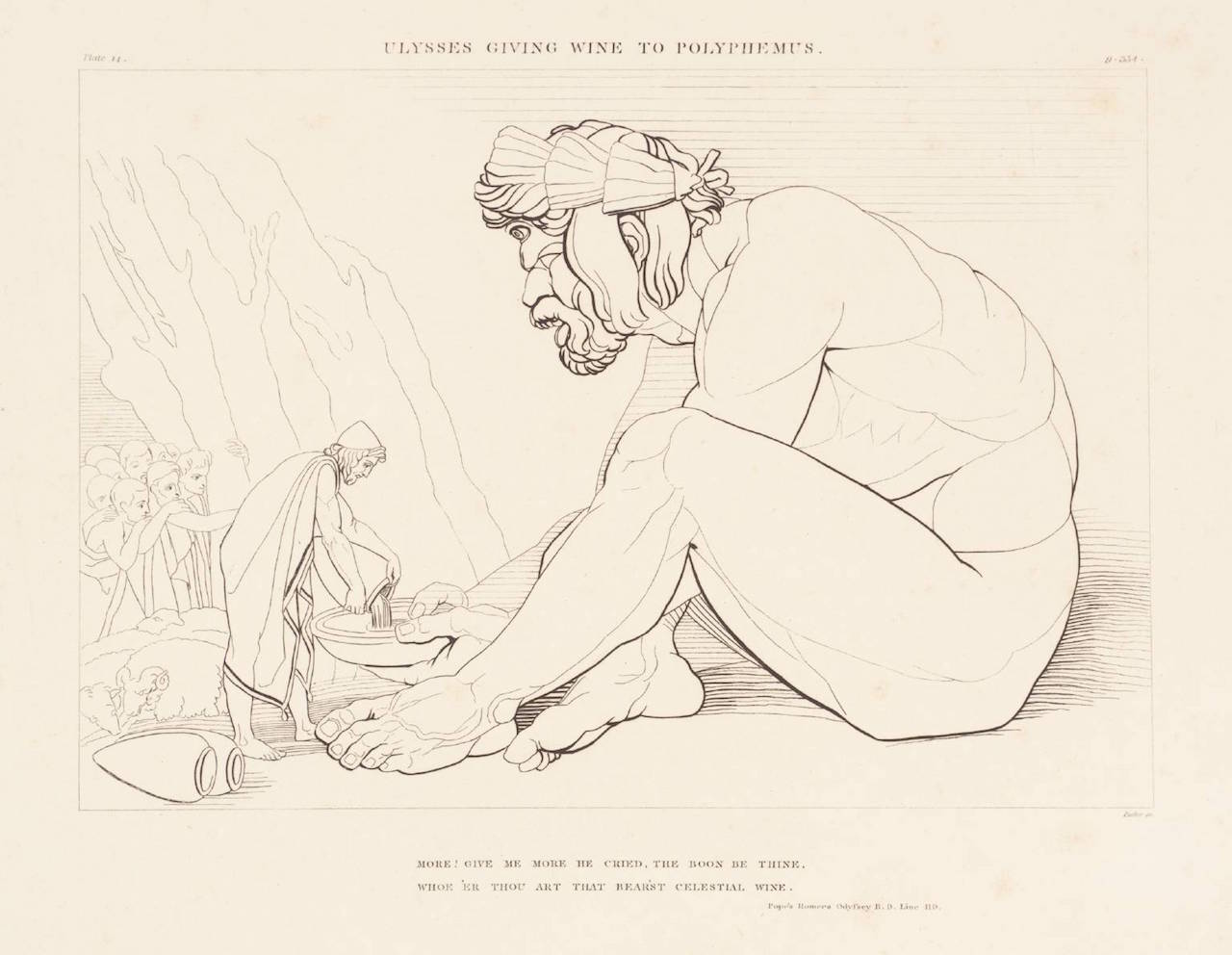 “Ulysses Giving Wine to Polyphemus” (1805). John Flaxman (1755–1826). Purchased as part of the Oppé Collection with assistance from the National Lottery through the Heritage Lottery Fund, 1996.