
ODYSSEY BOOK I
Odyssey. Homer. H. B. Cotterill (Translator), ed. Patten Wilson. London. 1911.
English (H. B. Cotterill, 1911) (OCR draft) (English) (English (H. B. Cotterill, 1911))
Provisional text from uncorrected OCR; expect errors.
Telemakhos appeals to the principle of reciprocity in his address to the Ithacans: his speech shows that feasting, such as the suitors are undertaking at Odysseus’ house, is a matter that calls for reciprocation (when correctly conducted; O.2.74-78). Conversely, an evil turn should likewise be reciprocated by an evil turn, another aspect of reciprocity that Telemakhos’ words make clear, and which their chiastic arrangement further underscores (δυσμενέων κάκ’ ἔρεξεν … κακὰ ῥέζετε δυσμενέοντες ‘[if Odysseus,] bearing ill-will, did evil deeds … you are doing evil deeds, bearing ill-will,’ O.2.72-73). The Ithacans’ not stopping the suitors would in Telemakhos’ words be explicable as a return for an earlier bad turn by Odysseus, but if that is not the case, they deserve as punishment the mēnis of gods (O.2.66-67).
As for what mēnis is, let us take a step back and look at some elements in Telemakhos’s speech: he describes the wrongs of the suitors (O.2.63-64), presents a principle for the maintenance of the proper state of affairs – mēnis of gods as the punishment for the outrageous situation in Ithaca (O.2.66-67) – and extends the blame from the culprits proper to their solidarity group (O.2.64-66). As Muellner argues with regards to Telemakhos’ speech, mēnis is a sanction aimed at maintaining the cosmic order and incurring it implies the transgression of fundamental cosmic rules, such as the ones the suitors break in abusing the hospitality of Odysseus’ household. Furthermore, given the role of solidarity in maintaining the continuity of the world order, those in the solidarity group of a transgressor are liable for punishment along with the culprit. Thus the three elements singled out from Telemakhos’ speech conform to the concept of mēnis and its functioning in maintaining social and cosmic order. (Compare the speech of Mentor at O.2.229-241, in my note on which I discuss mēnis and memory, which works towards the same end as mēnis but in a symmetrically opposite manner, and the ethical function of the two further. With regard to reciprocity, Mentor, in contrast to what Telemakhos says here, is clear on the point that there has been no earlier bad turn by Odysseus that would justify the current outrage in Ithaca, and so, the people deserve a punishment as a reciprocation for their actions).
To return to reciprocity: just as mēnis has a moral dimension and a function in upholding the proper social and cosmic order, so, too, is reciprocity involved in morality. Reciprocal exchange is a total social phenomenon in the Maussian sense of the term, such that reciprocal exchange is also an articulation of the social order, of the cosmic hierarchy, and an instance of the working of themis (the rules that enforce cosmic hierarchy and proper social behavior) – it is worth noting here that Telemakhos appeals to Themis in his speech (O.2.68). mēnis in fact protects the rules of exchange and the hierarchy of proper cosmic order, and reciprocity and mēnis are thus interconnected. Telemakhos’ speech neatly illustrates this web of interconnected concepts, and his argument relies on understanding their role within the Homeric society.
See further:
Mauss, Marcel. 1990. The Gift: The form and reason for exchange in archaic societies. Transl. W. D. Halls. London: Routledge.
Muellner, Leonard. 1996. The Anger of Achilles: Mênis in Greek Epic. Ithaca; London: Cornell University Press.
Seaford, Richard. 1994. Reciprocity and Ritual: Homer and Tragedy in the Developing City-State. Oxford: Clarendon Press; New York: Oxford University Press.
The wording of Mentor’s address to the assembly demonstrates the ethical dimension of the archaic Greek concept of memory: the failure of the people of Ithaca to respect Odysseus and behave appropriately towards him and his household is attributed to their not remembering him. Conversely, the speech also indicates that such forgetful subjects deserve harsh rulers (O.2.230-234): memory is the principle that maintains good social interactions and proper social order, and its absence brings about the opposite. Mentor’s name, ‘he who reminds,’ ‘he who stirs up’, is not inappropriate to the context, either.
Comparing Mentor’s speech with that of Telemakhos earlier in the assembly (O.2.45-69; some of what I discuss here is also included in my comment on O.2.63-79), we see further dimensions of memory as the principle that maintains proper social order. Telemakhos in his speech describes the wrongs of the suitors (O.2.63-64), presents a principle for the maintenance of the proper state of affairs – in his speech, it is mēnis of gods as the punishment for the outrageous situation in Ithaca (O.2.66-67) – and extends the blame from the culprits proper to their solidarity group (O.2.64-66). As Muellner argues with regards to Telemakhos’ speech, mēnis is a sanction aimed at maintaining the cosmic order and incurring it implies the transgression of fundamental cosmic rules, such as the ones the suitors break in abusing the hospitality of Odysseus’ household. Furthermore, given the role of solidarity in maintaining the continuity of the world order, those in the solidarity group of a transgressor are liable for punishment along with the culprit. Thus the three elements singled out from Telemakhos’ speech conform to the concept of mēnis and its functioning in maintaining social and cosmic order.
Likewise, then, we find all three elements of Telemakhos’ speech in that of Mentor’s, albeit with slight changes: the wrongs of the suitors are there (O.2.235-238) and the blame is extended to their solidarity group, the Ithacans (O.2.239-241, also O.2.233-234). Where there is a notable difference, however, is in the principle for the maintenance of the proper state of affairs: while in Telemakhos’ speech it is mēnis, in Mentor’s it is memory (O.2.233). However, Mentor makes clear that what is being perverted is the sovereign order, that of Odysseus’ position as the king over the Ithacans (O.2.230-234): this complements the role of mēnis in maintaining cosmic order, including the hierarchies of the sovereign order between and among gods and men. To underscore the parallelism of their speeches, at this very point Mentor’s words even echo those of Telemakhos’ (cp. πατὴρ δ’ ὣς ἤπιος ἦεν ‘and how kind a father he was’, Telemakhos at O.2.47 and Mentor at O.2.234). Memory thus appears as the flipside of mēnis: just as the latter’s function is maintaining the cosmic order as a sanction, a punishment for transgressing the rules, memory is the principle that promotes behavior that agrees with cosmic order.
See further:
Muellner, Leonard. 1996. The Anger of Achilles: Mênis in Greek Epic. Ithaca; London: Cornell University Press.
Telemakhos’ appeal to Nestor makes use of – and demonstrates – the function of memory in the context of appropriate reciprocation, another instance of the ethical aspect of memory: the typical scenario is one where the speaker asks the addressee to remember an earlier favor, and remembering this, it is implied, results in reciprocation of that favor as is fitting. The formula asking for remembering and reciprocation, τῶν νῦν μοι μνῆσαι καί μοι… ‘remember them for me now and [do something] for me’ (O.3.100) after mentioning the earlier favor(s) is repeated elsewhere in similar contexts, and so appears to be traditional (these exact same lines are repeated in Telemakhos’ appeal to Menelaos at O.4.328-331, and the formula recurs also in Penelope’s prayer to Athena at O.4.762-766).
As the cause of Athena’s mēnis here shows, besides failing to remember and therefore to act appropriately, failing to be νοήμων ‘thoughtful,’ ‘intelligent,’ ‘in possession of noos [mind]’ and δίκαιος ‘just’ can also lead to behavior that transgresses against the cosmic order. Words indicating mental qualities such as noos, noēmōn and phrenes are linked to the good kind of mindfulness and memory indicated by words such as mimnēskomai, and lack of them is associated with behavior that incurs mēnis (cp. I.15.128-129). In contrast to the Argives’ failures with respect to their minds and their subsequent punishment, a good mind is given as the reason for unfailing good conduct, for example Eumaios in his sacrifices to the gods on account of his good phrenes (O.14.420-421; cp. also O.24.194-195).
These lines repeat O.3.98-101, Telemakhos’ appeal to Nestor. Just as there, so here Telemakhos’ appeal to Menelaos makes use of – and demonstrates – the function of memory in the context of appropriate reciprocation, another instance of the ethical aspect of memory: the typical scenario is one where the speaker asks the addressee to remember an earlier favor, and remembering this, it is implied, results in reciprocation of that favor as is fitting. The formula asking for remembering and reciprocation, τῶν νῦν μοι μνῆσαι καί μοι… ‘remember them for me now and [do something] for me’ (O.4.331) after mentioning the earlier favor(s) is repeated elsewhere in similar contexts, and so appears to be traditional (in addition to Telemakhos’ appeal to Nestor at O.3.98-101, the formula recurs in Penelope’s prayer to Athena at O.4.762-766).
This speech by Penelope echoes the themes of those of Telemakhos and Mentor in O.2.63-79, O.2.229-241. When she asks her rhetorical question of whether the suitors listened to their parents tell of Odysseus, Penelope maintains, like Mentor, that it is ignorance or forgetfulness of Odysseus’ kindness as a ruler that explains the suitors’ arrogance. ἀκούετε (O.4.688), “you (pl.) hear,” here corresponds to a function of mimnēskomai, ‘remember’, when the latter denotes the performance of klea andrōn, epic songs about the glory of men: as mimnēskomai marks the activity of the bard, akouō, ‘hear’, is what the audience would do. The applicability of this constellation of concepts to the present passage is supported by Penelope’s insistence that Odysseus’ actions in the past were not only praiseworthy, but in fact also the subject of discourse – we can picture the suitors’ parents performing klea andrōn, specifically the kleos of Odysseus.
She also echoes Mentor, as well as Telemakhos, when she spells out that the suitors’ behavior is no fitting return for Odysseus’ treatment of his fellow men, and that the appropriate kind of reciprocation is manifestly not to be had (O.4.693-695). Where she differs from Mentor and Telemakhos, however, is in articulating the idea of reciprocity by using the term kharis, which here could be translated as ‘gratitude’, though its range of meanings is wider. In her speech, then, a connection is drawn between memory and reciprocity, specifically reciprocity denoted by kharis (see O.22.318-319 and my note there on the conventionality of the idea that good deeds deserve good kharis in return, and when that does not happen, the social system is being perverted).
Looking at how Telemakhos’, Mentor’s, and Penelope’s speeches converge on a topic but use different vocabulary to articulate what is involved makes apparent the connections between these key terms. We perceive the parallelism of mēnis and memory and their association with reciprocity in Telemakhos’ and Mentor’s speeches on the one hand, and the connection between memory and reciprocity denoted by kharis in particular in Penelope’s on the other. In addition, just as we can see that memory and mēnis are closely linked to themis, proper conduct, and upholding the cosmos (e.g. in Telemakhos’ speech in O.2), so the social role of kharis, especially as a force for or indication of proper social order (as in Penelope’s speech here), fits well in this network of concepts. Indeed, since the reciprocation of kharites (plural of kharis) is intended to establish a stable relationship with benefits to both parties, it appears to create an effect similar to that of the fear of mēnis or the positive guidance of memory. Just as mēnis and memory work to maintain the existing world order, so relationships of kharis are a further manifestation of the stability of the cosmos (see further O.24.281-286 and my note there on the connections between kharis and themis). Furthermore, a relationship of kharis involves memory (cp. e.g. dedications such as CEG 332 calling themselves mnāma), which can, in part, explain its similarity – or its kinship – to the purposes of mēnis and memory. The ideal of a remembering relationship of kharis as a manifestation of good behavior, however, is the opposite of what Penelope is talking about: in the scenario she describes, there is no kharis, no good conduct, and no memory of Odysseus. Compare Hesiod Works and Days 182-194 on the disruption of social order, proper reciprocal relationships and lack of kharis.
See further:
CEG = Hansen, P. A. 1983. Carmina Epigraphica Graeca saeculorum viii-v a. Chr. n. Berlin: de Gruyter.
MacLachlan, Bonnie. 1993. The Age of Grace: Charis in Early Greek Poetry. Princeton, NJ: Princeton University Press.
Nagy, Gregory. 1974. Comparative Studies in Greek and Indic Meter. Cambridge, Massachusetts: Harvard University Press. (pp. 244-246 on akouō, ‘hear’, as specifically a verb applied in Homeric diction to the hearing of kleos)
Penelope’s prayer to Athena to save Telemakhos in return for the sacrifices Odysseus has made for the goddess is another example of the function of memory in the context of appropriate reciprocation, as seen with Telemakhos with Nestor (O.3.98-101) and Menelaus (O.4.328-331). This scene between Penelope and Athena offers a slight variation in that the addressee is a divinity and the earlier favor a sacrifice; however, the interrelation of memory and proper reciprocation remains the same, including the use of the formula, τῶν νῦν μοι μνῆσαι καί μοι… ‘remember them for me now and [do something] for me’ (O.4.765).
Compare Sappho fr. 5.3-7: praying for the wishes of someone to be fulfilled, combined with bringing kharmata to friends and pain to enemies appears to be traditional. Both here and in Sappho, the context is that of achieving a nostos after dangerous seafaring.
Odysseus is wishing Nausicaa a marriage like his own: for the likemindedness of Odysseus and Penelope, see e.g. O.18.281-283 on their similarity in cunning and O.24.192-195 on their good minds. Singling out likemindedness as the greatest good for the couple accords also with the Hesiodic representation of the fifth age of men, where the lack of likemindedness is the most prominent sign of the failures of this age (Works and Days 182-184).
Odysseus’ contemplation of the ideal feast while visiting the Phaeacians presents us with a picture of the sort of situation where kharis (reciprocal exchange of good turns; see O.24.281-286 and my comment there for this meaning of kharis) points to the upholding of good social order, and the meal can be seen as a manifestation of the good social bond in the community. Here, not only is the ideal meal pleasant, endowed with kharis and euphrosune, ‘good cheer’ – Euphrosyne even being the name of one of the Kharites – but it is orderly (ἑξείης, “in order,” O.9.8) and upheld as the best state of affairs (κάλλιστον, “finest,” “most beautiful,” “best,” O.9.11). The participants in such a meal, then, are morally good, following the principles for good conduct. This ideal meal, endowed with kharis, is in stark contrast with the one foreshadowing the doom of the suitors at O.20.392-394 (where see my comment), described as akharistos, ‘lacking kharis,’ and payback for their evil deeds.
See further:MacLachlan, Bonnie. 1993. The Age of Grace: Charis in Early Greek Poetry. Princeton, NJ: Princeton University Press.
Seaford, Richard. 1994. Reciprocity and Ritual: Homer and Tragedy in the Developing City-State. Oxford: Clarendon Press; New York: Oxford University Press.
Just as memory is the principle that maintains good behavior and keeps one on the right track (cp. O.2.229-241 and see note there), this passage illustrates the power of forgetting in leading people astray from their proper path and failing to do the right thing. Eating lotus makes Odysseus’ men want νόστου τε λαθέσθαι ‘forget return home’ (the same effect of forgetting caused by lotus at O.9.102). Not only do they no longer think about it, but they are unable to act on it either: it takes Odysseus’ using force to bring them back to their ship and carry on. Indeed, forgetting appears to be one of the main obstacles for Odysseus’ reaching home (cp. O.1.57, O.10.236), and Ithaca, or nostos, is one of the two recurring objects of forgetting in the Odyssey (the other object being grief, regularly unforgettable, e.g. Penelope’s unforgettable grief at the loss of Odysseus, O.1.342). In contrast, it is with a call to remember his fatherland that Odysseus’ companions get him to act and make him continue on his way home from Kirke’s island (O.10.472).
This attempt by the Cyclops to trick Odysseus illustrates the way lanthanein/lēthein is used in the context of speech in the Odyssey: in such context lanthanein/lēthein consistently indicates deceit. So here, it is in his devious speech (ὣς φάτο) to Odysseus that the Cyclops attempts to escape the notice and so deceive our hero, but the wily man that he is, Odysseus is not taken in (οὐ λάθεν).
This passage demonstrates the reciprocity, or complementarity, of memory and mēnis in the context of upholding proper social and cosmic order and the value system based on reciprocal exchange. Elpenor asks Odysseus to remember (μνήσασθαι, O.11.71) him and the funerary rites that are his due so as not to have Elpenor become a mēnima, ‘cause of mēnis’ (O.11.73), of the gods toward Odysseus. If Odysseus remembers and performs the rites, all is well, the cosmic order is maintained; if he forgets, he will incur mēnis as a punishment. Here, too, we can see that memory leads to proper conduct and helps avoid both the wrong courses of action and mēnis; mēnis, in turn, is the punishment when the rules are transgressed, and the fear of mēnis keeps one on the right path. This is central to the complementarity of memory and mēnis and neatly illustrated by the passage: when there is memory, there will be no mēnis, as memory keeps one mindful of the danger of incurring mēnis, and so helps avoid it in the first place. On the contrary, there will only be mēnis when this memory is absent. The relationship between memory and mēnis is thus not of perfectly symmetrical reciprocity, but the provision of one in the absence of the other.
See further:
Watkins, Calvert. 1977. “On Μῆνις.” Indo-European Studies 3:686-722.
This phrase about the good mental abilities of a character is here used of Amphinomos, the suitor who appears to be the least rotten of the lot. His better qualities are further brought out in this passage by mentioning that he pleases Penelope the most with words (μύθοισι; O.16.397-398) and that he thinks well (ἐῢ φρονέων, O.16.399), in both cases vocabulary we can see elsewhere in the Odyssey to connect with a good mind and memory. The same formulaic phrase φρεσὶ γὰρ κέχρητ' ἀγαθῇσιν, “for he had good phrenes,” is used of Eumaios and his unforgetful, unfailing observance of the gods (O.14.420-421): the formula indicates the connection between good memory, good phrenes, and respect of the cosmic order. Sharing this formulaic description with Odysseus’ exemplarily upright swineherd, Amphinomos appears to be of this more mindful sort, too. This characterisation is furthermore supported by Amphinomos’ deference to the gods’ will (O.16.402-403). Elsewhere, his exceptionality among the suitors is brought out in his treatment of Odysseus disguised as a beggar (O.18.122-123): he is deferential and kind when all others insult Odysseus.
In this passage Penelope appeals to Antinoos in a way that follows the model of the invocational theme. It refers to memory in order to elicit the desirable action, and the usual phrase for the theme is ἦ οὐ μέμνῃ, “or do you not remember” (e.g. O.24.115). Here, however, we have a variation on the formulaic phrase, as Penelope says ἦ οὐκ οἶσθ', “or do you not know,” to introduce a reminiscence on how Odysseus protected Antinoos’ father from the angry people. Penelope’s appeal corresponds to the invocational theme in also including a command: σε παύεσθαι κέλομαι, “I order you to stop” (O.16.433; compare the invocational theme at O.24.114). Furthermore, Penelope introduces a past favor to remember – an appeal to the rules of reciprocity. She has chosen a particularly relevant example, one that allows to draw clear parallels between the situation of Antinoos’ father in the past and what the son himself is doing in the present. Just as the people wanted to kill his father, so now the suitors, with Antinoos spearheading the plans, are plotting to kill Telemakhos (O.4.660-672, and again at O.16.363-392). And just as the people also wanted to eat up Antinoos’ father’s livelihood, so the suitors are eating up that of Odysseus (or Telemakhos). These are correspondences that Penelope herself points out specifically (O.16.431-432). What is more, Penelope refers to a social institution that entails bonds of obligation, which has been established between Odysseus and Antinoos’ father: hiketeia, ‘supplication’, or the relationship between the suppliant and the supplicated created through the ritual (cp. xenia, ‘guest-friendship’) – and these bonds are hereditary. Here Penelope reminds Antinoos of the very institution itself by using a specific term, ἱκέτας, “suppliants,” (Odyssey 16.422; also ἵκετο, “[Antinoos’ father] came [as a suppliant],” O.16.424) to indicate it, and spells out both the origin of this special relationship between his family and that of Odysseus (Odyssey 16.424-430), and how Antinoos is breaking it in the current situation (Odyssey 16.421-22, 431-32).
It should not, then, take much noos, ‘understanding’, ‘intelligence’, ‘mind’, to get the message, but does Anti-noos get it? He does not get a chance to respond as Eurymakhos takes over, assuring Penelope that Telemakhos has nothing to fear – while plotting his demise (O.16.419-448). But neither of the two suitors give an indication that Penelope’s speech has the desirable effect, as Eurymakhos’ immediate response and Antinoos’ subsequent behavior show. He instead proves to be worthy of his name, ‘Counter-noos.’ It is this faculty, noos, which is needed in good working order to avoid transgressing the rules of social and cosmic order, and the lack of which is associated with incurring mēnis, the sanction guaranteeing the maintenance of this order. Memory, in a role complementing that of mēnis, also upholds this order and these rules, and does so by keeping one mindful, in the right way, of the proper course of action. In addition to containing a variation on the invocational theme’s formulaic phrase appealing to memory, then, Penelope’s speech diverges from it also in not eliciting the morally desirable action.
See further:
Gould, John. 1973. “ΗΙΚΕΤΕΙΑ.” The Journal of Hellenic Studies 93:74-103.
Moran, William Stephen. 1975. “Μιμνήσκομαι and ‘Remembering’ Epic Stories in Homer and the Hymns.” Quaderni Urbinati di cultura classica 20:195-211.
Muellner, Leonard. 1996. The Anger of Achilles: Mênis in Greek Epic. Ithaca; London: Cornell University Press.
In this speech by Odysseus, words indicating good mental abilities, pepnumenos, ‘being in full possession of one’s senses’, ‘wise’ and epētēs, ‘courteous’, ‘gentle’, or, as Annette Dale argues, ‘very proficient in speech,’ are applied to Amphinomos, the noblest among the suitors. The first of these, pepnumenos, is often applied to Telemakhos to indicate his good sense (e.g. O.1.367, O.2.208, O.4.593), whereas epētēs is used in conjunction with adjectives pointing to good sense: angkhinoos, ‘ready of wit’, ‘shrewd’, and ekhephrōn, ‘sensible’, literally, ‘having phrenes’ – and all three are applied to Odysseus, a prime example of possessing a good mind (O.13.322, the only other occurrence of epētēs in Homer). Furthermore, epētēs, especially in the sense ‘very proficient in speech,’ ties in with Amphinomos’ description at O.16.397-398: that he is most pleasing to Penelope when it comes to speech (see also my comment at O.16.397).
In another passage illustrating Amphinomos’ positive difference from the rest of the suitors, he seconds Telemakhos’ reproach of the suitors’ riotousness at supper and suggestion it is time they go home (O.18.414-421). Amphinomos maintains that Telemakhos is right and proposes a libation before they head home - and here too, his ability at speaking plays a part: what he says is to all ἑαδότα μῦθον, “a pleasing speech” (O.18.422). His good sense not only leads to sensible speech, but his speech is effective, he can persuade his listeners: the suitors leave. So even in one of the suitors – the noblest one – we are shown the connection between good sense and speaking well, and that the first needed for the second.
See further:
Dale, Annette Teffeteller. 1982. “Homeric ἐπητής/ἐπητύς: Meaning and Etymology.” Glotta 60:205-214.
Russo, Joseph, Manuel Fernández-Galiano, and Alfred Heubeck. 1992. A Commentary on Homer’s Odyssey, vol. III. Oxford: Clarendon Press.
Penelope’s memory and mindfulness of her marriage to Odysseus are exceptional in the Odyssey: other women, we are told (O.15.20-23), tend to forget their previous marriage and children when remarrying, but Penelope here, in proposing the contest of the bow to determine the successful suitor, presents herself as doing the opposite (these lines are repeated at O.21.77-79 when she actually issues the challenge). Compare O.24.194-198, where Agamemnon singles out Penelope’s memory of Odysseus as that which deserves commemorating as a kleos. Penelope stands out as an example of socially ethical behavior.
In this passage we see that the suitors’ lack of kharis in their dealings with Odysseus’ household is repaid by an akharistos meal, one that has no kharis (as the term applies to the reciprocal exchange of good turns; see O.24.281-286 and my comment there for this meaning of kharis). Although the end of the passage, “for they were the first to contrive unseemly things” (O.20.394), appears to explain the meal’s lack of kharis as a result of Athena’s and Odysseus’ initiative in unjust machinations, according to Penelope, the suitors have done ἀεικέα ἔργα, “unseemly deeds,” before this. Furthermore, she connects the suitors’ unseemly deeds directly with a lack of kharis in return for good deeds (O.4.694-695, where see my comment). The lack of kharis in this meal as the reciprocation of the lack of kharis in the suitors’ feasting in Odysseus’ house, therefore, is another manifestation of the interconnections of kharis, reciprocity and social order, and the concerns regarding them that run through the fabric of the Odyssey.
See further:Seaford, Richard. 1994. Reciprocity and Ritual: Homer and Tragedy in the Developing City-State. Oxford: Clarendon Press; New York: Oxford University Press.
The inset narrative of how Odysseus came to have the bow that Penelope challenges the suitors to string and shoot with in order to win her hand has (as often for inset narratives in the Homeric poems) layers of meaning relevant to the main narrative. The bow is a gift of friendship from Iphitus, whom Odysseus meets while in Messene to collect a debt owed by the Messenians: they had taken three hundred sheep and their shepherds from Ithaca. Iphitus likewise is in search of twelve lost mares. The situation framing their encounter sets out a model for how reciprocation should work, even if “negative” as here, starting in theft: Odysseus is due recompense for the three hundred sheep and their shepherds. The theft of the sheep and shepherds parallels the suitors’ slaughtering of and feasting on Odysseus’ livestock and abuse of his household.
The suitable recompense for the suitors’ arrogance is foreshadowed in the story of the bow, as well. The twelve mares that Iphitus has come to reclaim turn out to be his undoing when Herakles kills him to keep the mares. Herakles does this while a guest in Iphitus’ house, without regard for the fact that he is offered food there – and without regard for the opis of the gods (O.21.28: σχέτλιος, οὐδὲ θεῶν ὄπιν αἰδέσατ’, “merciless one, and he did not fear the opis of gods”). Watkins (1977) has shown that opis is synonymous with mēnis. In comparing this line with a nearly identical one in Hesiod’s Works and Days (σχέτλιοι, οὐδὲ θεῶν ὄπιν εἰδότες, “merciless ones, and they did not know the opis of gods,” 187) where the transgressions incurring the opis are also listed, it is evident that divine retribution for transgression against the rules that maintain the cosmic order is meant. The scene between Herakles and Iphitus is one of hospitality (O.21.28-29), which parallels the situation between the suitors and Odysseus in the main narrative. Just as Herakles in the inset narrative breaks the rules of hospitality, so in the framing narrative do the suitors. Where the inset narrative contrasts with the main narrative is in the punishment: unlike Herakles, the suitors do not get out scot-free. The instrument of their undoing is the bow, the weapon that gives rise to this inset narrative. It is a gift of friendship (O.21.35), and as Seaford (1994) notes, it embodies the relationship of guest-friendship and the rules of hospitality; as such, it is an appropriate punisher for the abuse of hospitality. I would like to add that we are even told that Odysseus does not take this bow with him when he goes to Troy, but leaves it at home as a μνῆμα ξείνοιο φίλοιο, “a reminder of a dear guest-friend” (O.21.40). Appropriately, in a further way, then, the instrument of the suitors’ punishment embodies also the memory that leads to good conduct as a marker and upholder of a relationship of exchanging kharites, the reciprocal exchange of good turns.
See further:
Muellner, Leonard. 1996. The Anger of Achilles: Mênis in Greek Epic. Ithaca; London: Cornell University Press. (see pp. 36, 40, 187 on opis = mēnis and applications of Watkins’ argument)
Seaford, Richard. 1994. Reciprocity and Ritual: Homer and Tragedy in the Developing City-State. Oxford: Clarendon Press; New York: Oxford University Press.
Watkins, Calvert. 1977. “On Μῆνις.” Indo-European Studies 3:686-722. (see pp. 708-709, where he posits “a virtual semantic identity” between theōn opis and theōn mēnis)
West, Martin Litchfield, ed. 1966. Hesiod, Theogony. Oxford: Clarendon Press. (see p. 230 on Theogony 222 for theōn opis in Hesiod as meaning divine punishment rather than mere divine regard)
Compare O.19.576-581, where these same lines occur when Penelope proposes the contest of the bow. As noted there, Penelope’s memory and mindfulness of her marriage to Odysseus are exceptional in the Odyssey: other women, we are told (O.15.20-23), tend to forget their previous marriage and children when remarrying, but Penelope, as she issues the challenge of the bow to the suitors here, presents herself as doing the opposite (these lines are also found at O.19.576-581 where Penelope proposes the contest of the bow to determine the successful suitor). Compare O.24.194-198, where Agamemnon singles out Penelope’s memory of Odysseus as that which deserves commemorating as a kleos. Penelope stands out as an example of socially ethical behavior.
This speech of Leiodes the sacrificing priest as he begs Odysseus to spare him during the massacre of the suitors contains a line ending that also appears in Penelope’s speech at O.4.695: οὐδέ τίς ἐστι χάρις μετόπισθ’ εὐεργέων, “and there is no kharis afterwards for good deeds.” Here, Leiodes claims that he has not done anything, but will lie dead beside the suitors, “and there is no kharis afterwards for good deeds” (O.22.318-319). Although Odysseus does not believe him and slays him, Leiodes’ words confirm the conventionality of the thought: good deeds deserve good kharis in return, and when that does not happen, the social system is being perverted.
These words of Agamemnon show that the likeminded couple, Penelope and Odysseus (cp. O.6.181-184), is worthy of #kleos, a glorious epic song – and what is more, this kleos is characterized by #kharis. His praise makes the source of kleos in the Odyssey explicit. It is the mind (phrenes, O.24.194) of Penelope and her remembering Odysseus (O.24.195) that is worthy of celebration. And it is, again, a much-contriving Odysseus (O.24.192), his epithet pointing to his mental abilities, who has the luck of having Penelope as his wife. Although what exactly the arēte, ‘excellence’ (O.24.193, O.24.197), that both gives rise to this song and is its subject, is in, is left somewhat ambiguous, or even whether it is the arēte of Penelope or Odysseus – or, as I would like to take it, of the couple together – we can see that mental abilities are central to it, and throughout the Odyssey, the couple standing out for theirs are Penelope and Odysseus.
Further, Agamemnon’s words show the connection between the worthy achievements and their commemoration in song very clearly. Agamemnon speaks specifically of songs and reputation conveyed through them, contrasting Penelope with Klytaimestra. The balance of the comparison of the two women creates an effect of symmetrical opposition. As Penelope is called κούρῃ Ἰκαρίου, “daughter of Ikarios” (O.24.195), so Klytaimestra is Τυνδαρέου κούρη, “daughter of Tyndareos” (O.24.199), both named through their fathers, but with the word order reversed as if to draw out the contrast between them. While Penelope εὖ μέμνητ’ Ὀδυσῆος, / ἀνδρὸς κουριδίου, “well remembered Odysseus, her wedded husband” (O.24.195-196), Klytaimestra κακὰ μήσατο ἔργα, / κουρίδιον κτείνασα πόσιν, “devised her evil deeds, killing her wedded husband” (O.24.199-200). In both cases, the object of the wife’s action is her respective husband, both times qualified by “wedded” (there is perhaps even a suggestion of further parallelism in the alliterative echoing in memnēt’, ‘remembered’, and mēsato, ‘devised’). As Penelope occasions κλέος, “song of glory,” and ἀοιδὴν / […] χαρίεσσαν, “kharis-filled song,” to delight mortals (O.24.196-198), so Klytaimestra gives rise to στυγερὴ […] ἀοιδὴ, “hateful song,” among humans (O.24.200-201), the words and phrases mirroring one another again. The parallelism and even repetitions of specific words and phrases concretely demonstrates the opposition between the two kinds of song, the praise poetry of epic on one hand, and the blame poetry on the other.
Finally, khalepe, ‘grievous’, ‘harsh’, ‘hard to bear’, that qualifies the repute Klytaimestra gives women is the same word as we have seen in Mentor’s speech qualifying the harsh (khalepos, O.2.232) king that he takes the Ithacans to deserve for not remembering Odysseus. Therefore, in the polarities between good, ethical conduct and memory on the one hand and bad behavior and incurrence of mēnis on the other, Klytaimestra’s song would fall on the side of the latter, leading to grief and pain. If we compare this picture with that presented by Odysseus in his wishes for a happy marriage to Nausikaa, we can see that this pain aligns with the algea, ‘griefs’, suffered by the enemies of the ideal likeminded couple (O.6.184). In contrast, the good person’s praise poetry in Agamemnon’s exclamation is characterized by kharis: the kleos is an aoidē khariessa, a ‘kharis-filled song’ (O.24.197-198), just as the likemindedness of the couple in Odysseus’ wishes for Nausikaa is the cause of kharmata, ‘source of joy’ (O.24.185), for their well-wishers. And here we have one such well-wisher, Agamemnon, exclaiming on the happiness of Odysseus and Penelope, and even calling their kleos kharis-filled himself.
See further:
Nagy, Gregory. 1974. Comparative Studies in Greek and Indic Meter. Cambridge, Massachusetts: Harvard University Press.
_. 1979. The Best of the Achaeans: Concepts of the hero in Archaic Greek Poetry. Baltimore: The Johns Hopkins University Press. Revised edition, 1999.
In this passage, Laertes provides us with more insights on the proper kind of relationship of kharis, of reciprocal exchange of good turns. Most importantly, he specifies what is themis, right in accordance with the rules that enforce cosmic hierarchy and proper social behavior, in relationships of kharis: the ample reciprocal exchange of gifts and hospitality (O.24.285). Both of the key terms for reciprocity, in the form of words connected to kharis (χαρίζεο, “gave freely,” O.24.283) and amoibe (ἀμειψάμενος, “having requited,” O.24.285), are present. In addition, the way the themis of relationships of kharis is phrased, with ὅς τις ὑπάρξῃ, “when one has begun,” (O.24.286), implies that the relationship is continuous, with a potentially infinite number or reciprocations. This confirmation the ongoing nature of kharis also supports its connection to memory, which is necessary for sustaining this continuity. This is the kind of reciprocity, Laertes maintains, that Odysseus would have shown.
Laertes also characterizes the suitors (and by extension, especially given the impreciseness of his words, their solidarity group) as ἀτάσθαλοι ἄνδρες, “wicked men” (O.24.282). This adjective is applied to their behavior elsewhere in the poem, too, and it is the opposite of Odysseus’ conduct according to Penelope (O.4.693). Laertes also characterizes the suitors as ὑβρισταὶ, “men of hubris,” making explicit their status as violators of the rules maintaining the cosmic order (cp. O.24.458 on atasthalia; O.1.368, O.3.206-207, O.4.321, O.4.625-627, O.16.85-86, O.16.410, O.15.328-329 on hubris). The contrast drawn here between the suitors and Odysseus implies that what qualifies the suitors as men of hubris is their failure in matters of kharis in accordance with themis. What Laertes says of the suitors matches what we see in Penelope’s speech at O.4.687-695 (where see my comment).
Zeus’ speech here offers a solution to what may appear to be the beginning of a continuous cycle of violence and one of the tensions set up early in the poem. The speech recalls that of Telemakhos’ to the assembly, which forecast the threat of mēnis to the suitors and Ithacans (O.2.63-69). Instead of the extension of the retributive power of mēnis to the suitors’ solidarity group, however, Zeus here proposes to cancel it with the help of divinely inspired total forgetting of the suitors and their killing (ἔκλησιν, O.24.485). We can see that lēthē is opposed not only to memory, but also to its flipside mēnis. Furthermore, by comparing Zeus’ speech with that of Mentor’s in the assembly, another way in which it resolves the tensions set up in the poem becomes apparent: just as Mentor says that the Ithacans deserve a harsh ruler for not remembering how kind a ruler Odysseus was (O.2.230-234), here Zeus promises that Odysseus will in fact continue to rule, and there will be love between him and his subjects. This outcome, too, depends on the eklēsis, and so we can see that the ills resulting from mēnis and not remembering are both countered by this divine forgetting, further underlining their parallelism.
This line marks the first occurrence in the Odyssey of a formulaic expression"then he/she thought of other things"(ἔνθ᾽ αὖτ᾽ ἀλλ᾽ ἐνόησε) that occurs, with minor variations, eleven times in the Odyssey and twice in the Iliad. The formula shows interesting patterns of restriction in both poems. In the Odyssey, it is always used with a female subject (Athena [2.382, 2.393, 4.795, 5.382, 6.112, 18.187, 23.242, 23.344], Helen [4.219], Nausikaa [6.251], or Penelope [16.409]). In the Iliad, it is used exclusively of Achilles (23.140, 23.193). See Iliad 23.140 for discussion of the two Iliadic instances; here I concentrate on the formula’s occurrences in the Odyssey.
\r\nFrom a narratological point of view, the expression has an important function: as noted by de Jong 2001:66, it “highlights a new, often sudden or unexpected turn in the story,” in this case “the—abrupt—change of scene from Telemachus to Athena.” In other words, the formula marks the development of the plot in a new direction that is not a mere continuation of what has preceded. (Odyssey 23.242 is a significant exception.) Furthermore, it links this new development with the intervention of some specific agent, who is thus momentarily represented as controlling the plot. De Jong 2001:66 notes that the frequency with which the expression is used of Athena corresponds to the goddess’s “role of ‘director’ of the story of the Odyssey.” Occurrences of the formula with Helen, Nausikaa, and Penelope as subjects extend this plot-making power to other prominent women. In this way, a convenient narrative device serves also to underscore one of the poem’s major thematic concerns, namely, the way in which the story of Odysseus’ homecoming—the plot of the Odyssey—depends upon the favorable disposition of certain women, above all Penelope. The poem has numerous ways of signaling that its plot hinges on female agents (see Odyssey 11.226, Odyssey 11.436-39). This should not, however, be interpreted as a subversive gesture: as stressed by Murnaghan 2005, Athena as “source and sponsor” of the Odyssey’s plot works to uphold the authority of the patriarchal oikos.
\r\n\r\nReferences
\r\nde Jong, Irene J. F. 2001. A Narratological Commentary on the Odyssey. Cambridge and New York.
\r\nMurnaghan, Sheila. 1995. “The Plan of Athena.” In The Distaff Side: Representing the Female in Homer’s Odyssey (ed. B. Cohen) 61-80. New York and Oxford.
The so-called “Catalogue of Heroines” is bracketed by references to Persephone’s role in summoning and then dispersing the heroines whose appearances occasion the various entries in the Catalogue. Here, Odysseus stresses that Persephone “bid” the psukhai of the heroines to approach the animals he had slaughtered; at Odyssey 11.385-86, resuming his narration after an “intermezzo” in which he converses with Arete and Alkinoos, Odysseus transitions to the “Catalogue of Heroes” by explaining that Agamemnon appeared “when reverend Persephone scattered in various directions the psukhai of the women.” Odysseus thus presents Persephone as the ‘director’ of this portion of his narrative, a position that corresponds to that of Athena as ‘director’ of the plot of the Odyssey (on Athena as ‘director,’ see Murnaghan 2005, de Jong 2001:66). The emphasis on Persephone, then, is one of several reminders of the fact that the story of Odysseus’ homecoming unfolds as a result of Athena’s active intervention (see note on Odyssey 2.382). It also points to the importance of another female sponsor, Arete, at this particular moment in Odysseus’ story. Odysseus has been advised by Athena that his hopes for a homecoming depend especially on Arete's good will (Odyssey 7.75-9; the importance of Arete in this regard seems to figure the importance of Penelope as the woman on whose good will Odysseus’ homecoming ultimately depends). The “Catalogue of Heroines” has been described as “Odysseus’ gift to Arete” (Pache 1999:28), an effort to appeal to her interests just as the “Catalogue of Heroes” explicitly answers Alkinoos’ request to hear about the psukhai of those who fell at Troy. The appeal is a success: Arete responds by urging the Phaeacians to present Odysseus with additional gifts. By underscoring the importance of Persephone as the one who directs the Catalogue, Odysseus may subtly suggest to his patroness that she has the power to direct the subsequent course of his own story.\r\n\r\n \r\n\r\nReferences\r\n\r\nde Jong, I. J. F. 2001. A Narratological Commentary on the Odyssey. Cambridge and New York.\r\n\r\nMurnaghan, S. 1995. “The Plan of Athena.” In The Distaff Side: Representing the Female in Homer’s Odyssey (ed. B. Cohen) 61-80. New York and Oxford.\r\n\r\nPache, Corinne. 1999. “Odysseus and the Phaeacians.” In Nine Essays on Homer (eds. M. Carlisle and O. Levaniouk) 21-33. Lanham, MD.
Odysseus characterizes the suffering attendant on the Trojan expedition—including the many deaths depicted in the Iliad—as a consequence of Zeus’ displeasure and the “will (βουλαί) of women.” This description substantially modifies the causal framework put forward by the Iliad, which presents the events it describes as the result of “the will of Zeus” (Διὸς βουλή, as in Iliad 1.5) alone. Odysseus’ reconfiguration of Iliadic causality reflects the distinctive vision of the Odyssey, which portrays female figures as exercising considerable control over events: Athena, with the support of Zeus, is the divine sponsor of the plot (see Murnaghan 2005), and the success of Odysseus’ homecoming is repeatedly represented as depending on the goodwill of various women, above all Penelope. (See also Odyssey 2.382, 11.226).\r\n\r\n \r\n\r\nReferences\r\n\r\nMurnaghan, S. 1995. “The Plan of Athena.” In The Distaff Side: Representing the Female in Homer’s Odyssey (ed. B. Cohen) 61-80. New York and Oxford.
The “he/she thought of other things” (ἄλλ᾽ ἐνόησε) formula ordinarily signals a change of scene or turn of the plot in a substantially new direction (see Odyssey 2.382). Here, exceptionally, it marks a continuation of the current scene: Athena devises a way to avoid a narrative shift. The remarkable reversal of normal usage draws attention to the passage that follows (Odyssey 23.247-343), a passage that is concluded by another instance of the formula, used, as usual, to signal a change of scene engineered by Athena (Odyssey 23.344; this is an instance of “ring composition”). The lines thus enclosed describe the long-awaited reunion of Penelope and Odysseus, and include the verse that Aristophanes of Byzantium and Aristarchus, according to the scholia, designated as the τέλος (the “end” or “fulfillment”—the meaning of this remark is much debated) of the Odyssey (see 23.296). The passage also includes the recapitulation of prior events by both Penelope and Odysseus. The integration of their respective stories (Penelope narrates what has happened on Ithaka in Odysseus’ absence, while Odysseus relates the tale of his wanderings) not only figures the reunion of the lovers; it also reconstitutes in a straightforward, linear fashion the fabula of the Odyssey, which has been presented by the poem’s master narrator in a self-consciously disjointed manner (compare de Jong 2001:563). The bracketing of these signal acts of narration by references to Athena’s agency underscores the goddess’s role as “source and sponsor of the plot” (quotation from Murnaghan 2005:61): it is Athena who makes possible the recapitulation of the plot on this occasion, just as it is she who sets in motion and directs events throughout the poem.\r\n\r\n \r\n\r\nReferences\r\n\r\nde Jong, I. J. F. 2001. A Narratological Commentary on the Odyssey. Cambridge and New York.\r\n\r\nMurnaghan, S. 1995. “The Plan of Athena.” In The Distaff Side: Representing the Female in Homer’s Odyssey (ed. B. Cohen) 61-80. New York and Oxford.
use of nḗpioi echoes Od. IX.44-46
quoted and translated: analysis of role of Helios in correct understanding of the root *nes-. Earliest meaning is a “return from death and darkness” or “having returned to life and light” whose context is hieratic. Helios takes away from Odysseus’ companions their day of return because only the hero, like the sun, can pass through the regions of death without dying
comparison of “foolish” companions to Odysseus, archetype of intelligence. Signifies traditional association of companions’ loss of nóstos with their lack of nóos
citation of Zeus’ characterization of Odysseus’ preeminent quality, nóos
analysis of Odysseus’ role and function in the Odyssey as expressed by Zeus. His destiny is to “return home,” an idea expressed by the word nóstos – a nominal derivative of néomai
Athena announces here her plan to visit Telemachus in order to ‘arouse’ him and ‘put spirit in his mind’. These two expressions mean the same thing. When Athena carries out her plan she disguises herself, in Book 1, as Mentes, a foreign trader, and then, in Books 2 and 3, as Mentor, an old man of Ithaca, and both these names mean the same thing, ‘he who arouses, he who stirs up’. The noun menos, ‘spirit’, in Od. 1.89 contains the same verbal root men- as the names Mentēs and Mentōr, and the occurrence of the noun in Athena’s speech anticipates her two disguises. For the meaning of the name Mentōr, particularly in relation to the name Nestōr, see the essay “Nestor’s Name”. As ‘he who stirs up’ the name Mentōr implies an active verb menō, ‘stir up’, which does not occur in Greek. The active verb with the meaning ‘stir up’ is epotrunō, which is what occurs in Athena’s speech. To make the verbal connection with the names Mentēs and Mentōr the verb epotrunō is glossed in Athena’s speech by the phrase with menos. For more on the verb (ep)otrunō in relation to the name Mentōr*, see Frame 2009:25n37.
Frame, Douglas, 2009. Hippota Nestor. Cambridge, 2009
analysis of formulaic variation of Od. XI.114, Od. XII.141. The traditional context of prophesy is preserved without implication of “returning from death,” but Homer substitutes oíkad’ eleústhai for neȋai
quoted as evidence that Homer understood neȋai as simply meaning “you will return home”
citation of Nestor’s appraisal of Odysseus as the “shrewdest” of the Achaeans. Suggests that whereas Nestor symbolizes nóos, Odysseus makes nóos effective
example of relationship between verbs signifying mind as nóstos. Compare to Il. X.509, Od. III.142
analysis of Telemachus’ description of Nestor, who appears “immortal.” Suggests that Nestor’s apparent “immortality” is a remnant of his possible former mythological status as a god
analysis of an available solution to the imprecise opposition between “escaping death” and “being caught” explored in Od. V.312, Il. XXI.281, Od. XXIV.34
reference to Homeric passage where nóos is connected to traditional sense of return.
citation of Phaeacian epithet, ankhítheoi, “close to the gods”
analysis of the role of Hermes’ staff in suggesting that that the return of Odysseus is a return to consciousness and life
analysis of original notion of verb halṓō, “to be seized by death”
analysis of Pylos’ (púlai of Hades) possible connection to lost story of Nestor’s cave, which Homer might here allude to: en Pulōi en nekúessin, “in Pylos amongst the dead”
analysis of the use of nóēma to describe the Phaeacian ships. The simile “as quick as thought” is unique in Homer
analysis of the equation of sleep with death. Argues that details show that sleep is a basic part of the “return” motif
analysis of reference to “counsels” as a suggestion that Oydesseus is on his final “return to life,” and that his nóos is ready to emerge. This same theme is seen in the return from Cyclops’ cave (Od. IX.444-445)
analysis of lḗthē as the “forgetfulness of death” in the description of the sleeping hero because his nóos is removed by lḗthē
citation of the fact that the Phaeacian ship arrives at dawn. Suggests tentative link to the role of the sun in the final voyage of Odysseus
This passage, beginning with the expression ho d'asphaleōs agoreuei 'he speaks to the point unfailingly' is remarkably similar, even word-for-word the same, as what the poet Hesiod says in Theogony lines 86 and 91-92 in describing the gift of fair speech which the Muses give to a king when they honor him from birth. The difference is that Hesiod names the context—kings—whereas Odysseus does not, but the reason for this is clear: for Odysseus to do so would require him to identify himself before his dramatic self-disclosure in Book 9. Once the reason for Odysseus’s silence, namely his still hidden identity, is taken into account, the context of the two passages is the same, namely fair speech as the essential quality of a king.
The close correspondence in phrasing between the two passages has raised the question whether one passage imitates the other, but no consensus has ever been reached. The answer seems to lie not in the imitation of one poet by the other, but in a common poetic tradition behind both poets. This tradition has been identified in a perceptive study by Richard Martin as “the instruction of princes,” a wide-spread genre with important examples in Greek, from Hesiod’s Works and Days and the poetry of Theognis, to the lost Instructions of Chiron. The Hesiodic passage fills in for us what is deliberately withheld in Odysseus’s speech, namely that he is speaking about what it is to be a king. The Homeric audience would have understood this, because they, like us, knew that the speaker is not only a king, but, in the Homeric scheme of things, the ideal king.
This is only half the story, however. When Odysseus delivers his piece of princely instruction, he does more than hint at his own identity. He also brings the Homeric audience into the story through a more subtle case of hidden identity than his own. In spite of surface appearances the intended recipient of Odysseus’s instruction is not in fact the young Phaeacian to whom it is overtly addressed: his name, Euryalos, which relates to the sea, does not distinguish him from the other Phaeacians, twenty-one of whom have similar sea-related names. That name is generic, a reflection of the Phaeacians’ mythic function as sea-farers. Odysseus does indeed reprove Euryalos at the start of his speech, saying “you are like a reckless man,” and again at the end, where he acknowledges Euryalos’s fine physical appearance, but censures his lack of understanding (noos). However, the burden of Odysseus’s speech is not this reproof, but a positive portrayal of fair speech and its salutary effects.
The figure who stands most to benefit from this positive instruction is not Euryalos, but the future king of the Phaeacians, who is part of the whole episode from the start. It is Laodamas, the favorite son and heir apparent of king Alcinous, who first sets the episode in motion by inviting—indeed challenging—Odysseus to participate in contests (Odyssey 8.131-151), an invitation which Odysseus turns down with some asperity (Odyssey 8.152-157). This occasions Euryalos’s ill-considered words to Odysseus (Odyssey 8.158-164) and Odysseus’s response. But if Laodamas is the intended recipient of Odysseus’s instruction, why is he not presented as such, but instead kept far enough from the hero’s display of mettle to escape notice entirely? Odysseus himself provides one answer after his mighty rock toss, when he challenges all the Phaeacian youths to compete with him in further contests but excepts Laodamas from his challenge: only a fool would compete with his host, and Odysseus will not do that(Odyssey 8.204-208). This prudent respect for a host can be seen as present in the prior situation as well, in which Euryalos draws a reproof that all but touches Laodamas, but does not in fact touch him.
Now Laodamas' name, which means “he who controls the people,” is well suited to a future king, but that is not its real significance, or not all of it. The last Neleid king of Miletus had this name—Leōdamas in its Ionic form—and, while dates are uncertain, this Leōdamas can easily be placed in the Homeric era. Leōdamas is a good candidate to have been the prime mover of Panionian unity in the late eighth and early seventh century BC. We are fortunate indeed to know something of this Leoōamas beyond his name. His memory has been preserved in fragments of two historians of the Roman era. Leōdamas was successful in a foreign war which benefited Miletus and confirmed him as king, and as king he went on to become much loved by his people. His story ended tragically when he was murdered by a rival for the kingship, and this brought kingship itself to an end in Miletus.
Now the Ionian Greeks of Asia Minor traced their pre-migration origins back to the Bronze Age city of Pylos and its legendary founder, king Neleus. More precisely, the royal family of the Ionian city of Miletus traced their origins back to king Neleus, and they were therefore called Neleidai, “descendants of Neleus.” These Neleids then extended their pedigree to other Ionian cities in the process of forming a greater Ionian community, the so-called Ionian dodecapolis. This union of twelve cities, meeting at its cult center Panionion, gave rise to the two Homeric epics as part of the process of Ionian community formation. It is this Ionian community, as it met at Panionion, that the Phaeacians represent.
In Homer it is not Neleus himself but his son Nestor who plays a great role. It is he who represents the earliest stage in the picture of a common Panionian origin. Alcinous, the Phaeacian king, is a second Nestor, a conscious duplication of the Pylian king. Athena reveals this when she disguises herself as a maiden and meets Odysseus on his way to the Phaeacian palace (Odyssey 7.19-81) . She tells Odysseus about the king and queen he is about to meet inside the palace, and for the king she gives a genealogy extending over four generations, which is in effect Nestor’s genealogy: the names are different but the genealogy’s intricate structure is the same. By her action Athena also identifies the queen, Arete, as a second stage in the picture of a common Panionian origin when she leaves Odysseus and flies to Athens and enters the royal palace, her place of worship. The Neleids were said to have migrated from Pylos to Athens at the end of the Bronze Age, where they became the ruling family; Arete, who is cast in the mold of the Athenian city-goddess, Athena Polias, represents this second stage. It was from Athens that the Neleids next founded Miletus and became its ruling family: the founder of Miletus was named Neleus like his Pylian ancestor, and this gave the Neleid kings of Miletus two ancestors to explain their name.
When Odysseus gives princely instruction in Book 8 of the Odyssey, identifying fair speech as the essential quality of a king, the instruction is really addressed not to his apparent interlocutor, a misbehaved youth, but to a future king who stands by unnoticed. This future king in turn represents an actual king, ruling in the Homeric present. The Phaeacian Laodamas has as yet done nothing to distinguish himself except behave properly to a stranger. He is all future potential. That potential, we are meant to understand, has now been fulfilled in the actual present. The king who rules now is fictively pictured as having been present to hear the ideal king discourse on what it is to be a king. He has heard the lesson of the past—the heroic past—from the very hero of the poem. The Homeric audience is equally honored in this because like their king they also are like the Phaeacians, since they are also listeners to Odysseus' discourse, and as such they also have received the lessons of the heroic past from the hero’s own mouth.
Bibliographical references
Douglas Frame, "New Light on the Homeric Question: the Phaeacians Unmasked,” http://chs.harvard.edu/CHS/article/display/4453. For more details on the argument excerpted above, see this article.
Douglas Frame, "Odysseus and Kingship: Commentary on Odyssey 8.166-177," Classical Inquiries, June 3, 2016, http://classical-inquiries.chs.harvard.edu/odysseus-and-kingship-commentary-on-odyssey-8-166-177. The above comment is excerpted from this article.
Richard P. Martin, “Hesiod, Odysseus, and the Instruction of Princes,” Transactions of the American Philological Association 114 (1984), pp. 29–48.
analysis of the role of Phaeacians as sea-faring escorts who have a peculiar status halfway between gods and men
citation of Athena’s creation and then removal of the mist upon Odysseus’ arrival. Argues this reinforces the thematic connections between the arrival of Odysseus and the Sun
analysis of the use of nóos and nóēma as the proper reappearance of Odysseus’ nóos when he awakens in his homeland
example of the appearance of nóos linked to Odysseus’ return
example of the appearance of nóos linked to Odysseus’ return. Analysis of Athena as representation of the intelligence of Odysseus
citation of Athena’s creation and then removal of the mist upon Odysseus’ arrival. Argues this reinforces the thematic connections between the arrival of Odysseus and the Sun
analysis of the verb stugéō and its Stygian (Stúx) connotations
analysis of the Phaeacians’ preparation for Odysseus’ sleep. Argues that details show that sleep is a basic part of the “return” motif
reference to special pride of the Phaeacians as escorts, same lines appear in Od. VIII.174
reference to connection between description of the Phaeacian of ships and nóos and néomai
reference to the conventional nature of Homer’s description the sacking of the Ciconian city
comparison of the cause of destruction here with the slaughter of the cattle of Helios: the nḗpioi. Mindlessness as a cause of destruction is also emphasized by the suggestion of drunkenness
use of nḗpioi echoes Od. I.8-9
reference to the conventional nature of the Ciconian warriors who stand closest the world of the Iliad
suggestion that the poet who constructed this episode might have still understood the ancient thematic role of the sun. This could explain the peculiar usage of “dawn,” since much has already happened before the battle begins. Compare to Od. XVI.777ff
example of similarities between the Laestrygonians and the Cyclopes. Compare to Od. X.112-113, Od. X.120, Od. X.121-122, Od. X.82-183, Od. X.98, Od. X.116, Od. X.124, Od. IX.190-192, Od. IX.482, Od. IX.537, Od. IX.108, Od. IX.167, Od. IX.187-188, Od. IX.291
example of similarities between the Laestrygonians and the Cyclopes
analysis of Homer’s reinterpretation of the traditional collocation ásmenoi ek thanátoio, as phúgomen thánaton
analysis of the collocation ásmenoi ek thanátoio. Proposes ásmenos is derivative of *nes- and suggests collocation originally meant “having returned from death”
suggestion that collocation nóstou te lathésthai, “to forget their homecoming,” is related to a loss of “mind”
suggestion that collocation nóstoio láthētai, “that he might forget his homecoming,” is related to theme of a loss of “mind”
reference to the modification of the traditional full refrain seen at the end of the first, third, and fifth episodes
citation of the offshore island as a threshold to the encounter with the Cyclops [MRBTP: 'ff']
comparison to Paṇi myth in which a cave dwelling demon keeps flocks he encloses at night and releases by day
evidence of the role of Odysseus’ intelligence in the Cyclops episode
analysis of the pun between mêtis and the name Oûtis. The equation between the two words, coupled with the latent meaning of death in Oûtis, suggests that Homer has preserved the relation between death and nóos
analysis of close connection between the latent “return from death” and words denoting intelligence
analysis of Odysseus’ words thanátou lúsin, a “loosening of death,” and hṓs te per psukhēs, “as of for my psukhē,” which equate the Cyclops’ cave with death
evidence of the role of Odysseus’ intelligence in the Cyclops episode
analysis of phrase pukinà phronéonti as the closest Homer comes to realizing the original sense of nóos. Also suggests connection between “counsels” and the return from the Cyclop’s cave as a manifestation of a “return to life”
suggests connection between “counsels” and the return from the Cyclops’ cave as a manifestation of a “return to life.”
analysis of another Homeric recasting of the traditional collocation ásmenoi ek thanátoio as phúgomen thánaton. Two observations are made: (1) The traditional “return from death” theme is here, as in the minor episodes, latent. (2) This latent feature is closely connected with the Cyclops’ cave. Traces of the cave’s connection with the realm of the dead remain in Odysseus’ calling himself Oûtis while within the cave
analysis of Odysseus’ loss of the anonymity as death, the regaining of his name as a rebirth. Compare to words of Alcinous (Od. VIII.552-553)
analysis of formulaic variation of Od. XI.114, Od. XII.141. The context is changed from prophesy to curse, élthoi substituted for traditional neȋai. Dependence of élthoi on previous mention of “home” and “fatherland” shows the secondary nature of this passage
citation of the offshore island as a threshold to the encounter with the Cyclops [MRBTP: 'ff']
analysis of the location and context of the appearance of the traditional refrain
analysis of the collocation ásmenoi ek thanátoio. Proposes ásmenos is derivative of *nes- and suggests collocation originally meant “having returned from death”
example of Aeolus adventure as another instance of the “mindlessness” of the companions
reference to the modification of the traditional full refrain seen at the end of the first, third, and fifth episodes
analysis of the episode that describes the Laestrygonian kingdom. Argues that the phrase “the paths of day and night are close together” refers not to a geographic location (as Thucydides 6.2.1 attests) but rather the latent mythic background of the gates (or threshold) of night and day (as attested by Pamenides Proem 11, Hesiod Theogony 744ff.)
description of the Laestrygonian harbor, which is compared to the cave of the Cyclops
analysis of why Odysseus alone does not enter the Laestrygonian harbor, the place of death. Argues that Homer’s understanding of what was once a “return from death” as a matter of “escape” means that it is no longer necessary to enter the place of death
suggestion that the episode with the Laestrygonian queen shows this episodes original underworld context
analysis of Homer’s reinterpretation of traditional ásmenoi as aspasíōs… phúge, which shows that Homer understood ásmenoi to mean “happy”
analysis of the collocation ásmenoi ek thanátoio. Proposes ásmenos is derivative of *nes- and suggests collocation originally meant “having returned from death”
Homer says Circe was the daughter of Helios
Explanation of Odysseus’ odd description Circe’s land as “where the darkness is and where the dawn.” Circe’s land is equated with sunset when Odysseus ventures into “death and darkness” but with the dawn when he “returns to life and light”
evidence of “witlessness” of the companions as a negative indication of the thematic presence of nóos
evidence for suggestion that collocations utilizing forms of lanthánomai with nóstos are semantically related to theme of a loss of “mind.” Comparison with intended effect of Circe’s drugs: to make the companion forget their homeland
analysis of ambiguity about nature of companions who are turned into swine but retain their nóos
analysis of Hermes’ role in providing Odysseus the knowledge necessary to “return” from the wiles and dangers of Circe. Thus, nóos is the nóstos of the Circe episode
suggests a comparison between pent up companions of Odysseus and the imprisoned beasts of the Sun
analysis of Hermes’ role in providing Odysseus the knowledge necessary to “return” from the wiles and dangers of Circe. Thus, nóos is the nóstos of the Circe episode
evidence for notion that Hermes as psychopomp leads Odysseus to death and back to life
analysis of Hermes’ role in providing Odysseus the knowledge necessary to “return” from the wiles and dangers of Circe. Thus, nóos is the nóstos of the Circe episode
Description of the phármakon Hermes provides Odysseus, a plant with back root and white blossom – an appropriate symbol of for the underlying meaning of the Circe episode
evidence for Circe episode as a “return from death”
analysis of Homer’s use of the verb nostḗsein
evidence for suggestion that collocations utilizing forms of lanthánomai with nóstos are semantically related to theme of a loss of “mind.” Comparison with intended effect of Circe’s drugs: to make the companion forget their homeland
analysis of Teiresias’ retention of nóos as the distinguishing characteristic which separates him from the dead
analysis of Homer’s emphasis on journey to Hades as a journey “to gain knowledge”
analysis of Elpenor (described as oúte phresìn hê̄isin arērṓs) as a survival of the traditional notion that a lack of nóos meant a lack of nóstos
analysis of voyage to Cimmerians as Homer’s attempt to add verisimilitude to traditional theme of “death and darkness.” Compare to Hesiod’s description of twilight region (Theogony 758ff.), where the original context is preserved
analysis of Homer’s emphasis on journey to Hades as a journey “to gain knowledge”
analysis of the Sun’s apparent endowment with an all-embracing consciousness. Compare to Xenophanes frag.20 (Diehl)
analysis of mimnḗskeo and médomai, argues they have the same significance for the connection between nóos and néomai as does lanthánomai in Od. X.236, Od. X.472
comparison of the formulaic diction of ásmenoi in Od. IX.62-62 and néomai, which elucidates common meaning. Dates probable composition of lines to second millennium B.C.
traditionally an essential part of a Nekuomanteίa
evidence for connection of prophesy of Teiresias with the theme of “life and death”
analysis of mimnḗskeo and médomai, argues they have the same significance for the connection between nóos and néomai as does lanthánomai in Od. X.236, Od. X.472
analysis of language used to describe the imprisonment of Melampus
analysis of survival of the role of nóos in the story of Melampus, which suggests a the context of prophesy similar to Teiresias’ relationship to the theme of “returning from death”
brief analysis of the Dioscuri, who as a combination of immortal and mortal elements, experience an alternation between life and death
This passage featuring three Athenian heroines belongs to the Panathenaic version of the catalogue of heroines. It is the final such Athenian expansion of the catalogue, and functions as an "Athenian signature." In the last line of the passage the god Dionysus is mentioned in connection with the third Athenian heroine, Ariadne. The form of his name in Greek is the Athenian form versus the usual Homeric form (Διόνυσος, with a short -o- vs. the usual Epic form Διώνυσος, with -ō-), and this is part of the "signature." If the whole signature is deliberate - if it is asserting its Athenian origin- the phrase containing the name Dionysus may have a double meaning. On the surface of the narrative Ariadne is killed Dionusou marturiēisi "on the evidence of Dionysus." In terms of an "Athenian signature" the "evidence of Dionysus" could suggest a slightly different translation, "the evidence of the word Dionysus."
analysis of antithetical fates of Achilles and Odysseus as contrasted by the by the “wits” of Odysseus and Achilles’ fate amongst the “mindless” dead
reference to Odysseus’s remarks that Achilles is even a king in the underworld
reference to Achilles’ response that he would rather be a serf in life that a king amongst the dead – a reference to Achilles’ juxtaposition with Odysseus (the one who has nóos will return, the one who does not will not)
citation of Odysseus’s appraisal of himself and Nestor as the foremost Greek counselors. Suggests that whereas Nestor symbolizes nóos, Odysseus makes nóos effective
analysis of Nestor’s battle with the Epeians as latent conveyor of traditional conception of Nestor as leader of his people from the dark night of danger to the daylight of victory
analysis of the traditional story in which Nestor alone survived the attack of Heracles on Pylos
description of the near extinction of the people of Pylos before Nestor’s cattle raid and battle rout. Evidence for contention that Nestor brings his people back to life
quoted and translated: reference to the fact that Nestor, as the only son of Neleus associated with life, is the only one to survive Hercules’ attack on Pylos
description of the near extinction of the people of Pylos before Nestor’s cattle raid and battle rout. Evidence for contention that Nestor brings his people back to life
analysis of apparent discrepancy of Odysseus’ and Hesiod’s (Theogony 1011ff.) described location of Circe’s land. Circe’s land is equated with sunset when Odysseus ventures into “death and darkness” but with the dawn when he “returns to life and light”
analysis of Circe’s emphatic connection of Nekyia with theme of a “return from death”
reference to Circe’s description of the cattle and sheep of Helios. Comparison with the parallel story of Euenius (Hdt. 9.92.2-95), which suggests traditional link between prophesy, intelligence, sleep, and death that lies behind Od. XII. Similar association between cattle and the return from darkness and death is found in Vedic mythology (RV 2.24.3, 6.65.5, 6.13.3), the story of Hercules and cattle of Geryon, and the Homeric Hymn to Apollo (411 ff.)
analysis of the name, Néaira, as derivative of néomai, which refers both to the returning light of day and to light in the context of salvation – a name suitable for guardian of the cattle of Helios
comparison of the formulaic diction of ásmenoi in Od. IX. 62-62 and néomai, which elucidates common meaning. Dates probable composition of lines to second millennium B.C. Traditionally, essential part of a Nekuomanteίa
comparison of the formulaic diction of ásmenoi in Od. IX.62-62 and néomai, which elucidates common meaning. Dates probable composition of lines to second millennium B.C.
analysis of the relation between escape and intelligence. Suggests that Homer was “dimly” aware of the relation between “mind” and the “return from death”
analysis of the Sun’s apparent endowment with an all-embracing consciousness. Compare to Xenophanes frag.20 (Diehl)
interpretation of Helios episode as “return from death.” Sleep, or unconsciousness, is analyzed as the death from which nóstos is the “return”
analysis of possible reminiscence of Helios’ descent into Hades as the means by which the companions, who equated with sunset, were put to death
analysis of formulaic variation of Od. XI.114, Od. XII.141. Homer substitutes derivative form of νοστήσεις. Context of prophesy almost absent as a result of Homer’s modification of traditional diction
example of stock nature of the description of Odysseus’ possessions
example of a line which displays the ambiguity of halṓō, meaning either “to be captured” or “to be killed.” Only external evidence makes the meaning clear. However, the opposition between pheúgein and halonai is clear
evidence for reading nései instead of anései in Od. XVIII.256-266
evidence for contention that Odysseus’ voyage home is a passage through darkness to light, made in the company of one whose presence reflects the original role of nóos
analysis of the release of Malampus – ékfuge kêra, he “escaped death,” a phrase similar to phúgomen thánaton
evidence for contention that Odysseus’ voyage home is passage through darkness to light
comparison of the diction hormaínōn ḗ ken thánaton phúgoi êken halṓēi to the proposed reconstruction of line tō ouk oȋd’ ḗ kén me nései theòs êken halṓō (Od. XVIII.265). Strongly supports the substitution of nései for anései in Od. XVIII.256-266
analysis of language used to describe the imprisonment of Melampus.
comparison to Od. IX.56-59
suggests that transitive force of Nestor’s name could have created new transitive verb néō, which was restricted to hieratic contexts
analysis of the verb anései, which is argued in the phrase m’anései stands for original *me nései – a future of the hitherto hypothetical verb néō. This would have the lines read “therefore I do not know whether the god will bring me home or whether I will die in Troy.” Argues that proposed verb néō can mean to “bring back from death”
reference to Odysseus’ statement that he did not think all the Achaeans would return home
evidence not to postulate sn- initial for etymology of nóos
analysis of the close relationship between metis. Suggests that Homer was “dimly” aware of the relation between “mind” and the “return from death”
evidence for the description of D.B. Monro’s understanding of the verb anései, as a compound verb meaning “to place” or “set upon”
analysis of original notion of verb halṓō, “to be seized by death”
evidence for rarity of ἠέ κεν instead of ἤ κεν. Appears to appear only once
By saying ‘tell me, Muse’, the Master Narrator is saying that the song that he will perform is something that he hears from a goddess who is invoked here as a singular Mousa ‘Muse’. See also I.01.001, where the Master Narrator likewise calls on a singular Muse. Although ennepein ‘narrate, tell’ here at O.01.001 does not explicitly refer to singing as does aeidein ‘sing’ at I.01.001, the narrative that the Master Narrator narrates is notionally a song in both the Iliad and the Odyssey. See in general the comment on O.01.001–010.
We have seen that the epithet polutropos ‘turning-into-many-different-selves’ at O.01.001 describes the narrative subject of the entire performed narration of the Odyssey as designated by the driving word anēr ‘man’ in the accusative, andra at O.01.001, used here as the grammatical object of the verb ennepein ‘narrate, tell’. Now we see that this epithet polutropos ‘turning-into-many-different-selves’ at O.01.001 is immediately followed at O.01.001–002 by a relative clause that outlines the overall narrative of the Odyssey: Odysseus veered many times and in many ways before he achieved a safe homecoming for himself. Similarly, we saw that the epithet oulomenē ‘disastrous’ at I.01.002 describes the narrative subject of the entire performed narration of the Iliad as designated by the driving word mēnis ‘anger’ in the accusative, mēnin at I.01.001, used there as the grammatical object of the verb aeidein ‘sing’. And we saw that this epithet oulomenē ‘disastrous’ is immediately followed at I.01.002 by a relative clause that outlines the overall narrative of the Iliad: the anger of Achilles caused immeasurable suffering. And we will see a further similarity when we consider the epithet lugros ‘disastrous’ at O.01.327, which describes the poetic subject of a performed narration as designated by the driving word nostos ‘homecoming’ in the accusative, noston at O.01.326, used there as the grammatical object of the verb aeidein ‘sing’. This epithet lugros ‘disastrous’ at O.01.327 is then immediately followed in the same verse by a relative clause that outlines the overall narrative there. See the comment on O.01.326–327.
The multiplicity to be seen in the shape-shifting figure of Odysseus is poeticized by way of repeating the element pol(l)- ‘many’ of polutropos ‘turning-into-many-different-selves’, spilling over from O.01.001 into O.01.003–004: πολύτροπον…πολλὰ |…|πολλῶν… |πολλά.
|1 That man, tell me O Muse the song of that man, the one who-turns-into-many-different-selves [polutropos], who in very many ways |2 veered from his path and wandered off far and wide, after he had destroyed the sacred [hieron] citadel of Troy. |3 Many different cities [astea] of many different people did he see, getting to know different ways of thinking [nóos]. |4 Many were the pains [algea] he suffered in his heart [thūmos] while crossing the sea [pontos], |5 struggling to merit [arnusthai] the saving of his own life [psūkhē] and his own homecoming [nostos] as well as the homecoming of his companions [hetairoi]. |6 But do what he might he could not save his companions [hetairoi], even though he very much wanted to. |7 For they perished through their own deeds-of-recklessness [atasthaliā plural], |8 disconnected [nēpioi] as they were, because of what they did to the cattle of the sun-god Hēlios. |9 They ate them. So, the god [Hēlios] deprived them of their day of-homecoming [nostimon]. |10 Starting-from-any-single-point-of-departure [hamothen], O goddess, daughter of Zeus, tell-me-as-you-have-told-those-who-came-before-me [eipe kai hēmīn].
There are three main points to be made in my comments here.
Point 1. The epic of the Homeric Odyssey begins in a way that resembles closely the beginning of its twin, the epic of the Homeric Iliad. On the term epic, used here for the first time in these comments on the Odyssey, see the inventory of Words and Ideas. The main theme of the Odyssey is signaled right away. On the term theme, see again the inventory. The signaling is accomplished by way of the first word of the very first verse of the epic. This word is the noun andra ‘man’, in the accusative case, which would be anēr in the nominative. The accusative case of anēr ‘man’ here marks this noun as the grammatical object of the verb ennepein ‘narrate, tell’, O.01.001. The Master Narrator is addressing a goddess who is the Muse of the Odyssey, asking the goddess to narrate for him the story of a man who is not yet named as Odysseus. On the term Master Narrator, see the inventory of Words and Ideas. The ‘man’ is the subject of the story. In other words, he is the subject of the narration, or the narrative subject. And this narrative subject is the grammatical object of the verb ennepein, meaning ‘narrate, tell’. Similarly at the beginning of the Homeric Iliad, as analyzed at I.01.001–012, the narrative subject is the first word in the very first verse. That word is the noun mēnin ‘anger’, in the accusative case, which would be mēnis in the nominative. The accusative case of mēnis there marks that noun as the grammatical object of the verb aeidein ‘sing’, I.01.110. There the Master Narrator is addressing a theā ‘goddess’ who is the Muse of the Iliad, asking that goddess to sing for him that anger, I.01.001. The song that will be narrated by the Muse for the Master Narrator will in turn be narrated by the narrator for his listeners. That song is The Song of the Anger, in the sense that the anger is the song. The anger is the narrative subject. Similarly in the Odyssey, the Master Narrator calls on the Muse of the Odyssey to ‘narrate the man’, that is, to ‘tell the song of the man’. Here too the song that will be narrated by the Muse for the Master Narrator will in turn be narrated by the narrator for his listeners. This song is The Song of the Man, in that the man is the song. The man is the narrative subject. And the song captures the total reality of the man.
Point 2. But this reality is not so easy to capture, since the man who is Odysseus is many-sided, as we will now see. Odysseus at O.01.001 is polutropos ‘turning-into-many-different-selves’. This translation makes explicit what is only implied in an alternative way of rendering this elusive word, ‘versatile in many ways’ (H24H 0§21, also 9§4, also 10§2), where the Latin root vert- ‘turn’ of the Latinate word versatile can mean not only ‘turn around’ but also ‘turn into a different self’, as we see most clearly in the Latin word for ‘werewolf’, versi-pellis, which literally means ‘he whose skin has turned’ (Pliny Natural History 8.34; Petronius 62; details in GMP 264–265). Similarly, polutropos applies to a figure who is different at every turn, and who becomes different many times and in many ways. That is why the ultimate shape-shifter, the god Hermes, is polutropos in the Homeric Hymn to Hermes (verses 13, 439). And that is why, in the only other context where Odysseus is described as polutropos, O.10.330, he is associated in that context with his polytropic model, Hermes himself, O.10.331–332. (Further commentary in GMP 34.) Since Odysseus can turn into something different at every turn, the multiplicity of angles to be seen at every turn helps explain why this hero will not yet be named at the beginning of the Odyssey.
Point 3. There is still more to be said about this adjective polutropos ‘turning-into-many-different-selves’ describing Odysseus at O.01.001: it is used here as an epithet for the narrative subject, which in this case is anēr ‘man’. Another such epithet is the adjective oulomenē ‘disastrous’ describing the mēnis ‘anger’ of Achilles at I.01.002. See the comment there.
The comments I offer on Odyssey Rhapsody 1 through Rhapsody 24, starting here with Rhapsody 1, were based mostly on details that derive from seven books that I indicate in the Bibliography by way of these abbreviations: BA, GMP, H24H, HC, HPC, HQ, HR, MoM, PasP, PH. Each one of these books has its own index locorum. My colleague Anita Nikkanen, an Associate Editor for this online project, tracked the sequences of Homeric verses as listed in the indices for six of these books and then summarized my comments on those verses. Following up on her meticulous work, I am in the process of converting her summaries into a form of commentary. My comments on the Odyssey as I presented them in Classical Inquiries are merely samplings of the content that I hope to contribute to the overall commentary, to which a number of other colleagues are also contributing their own comments. That said, I now proceed to offer a sampling of comments on Rhapsody 1. At this point, my comments about the beginning of the Odyssey need no further introduction of their own.
Zeus, Athena, and Hermes (1810). Drawing by John Flaxman.
Image via Wikimedia Commons.
Odysseus in the Odyssey gets credit already here, at the very beginning of the epic, for the conquest of Troy. By contrast, Achilles will never get credit for such a deed, even though he is the dominant hero of the Iliad, which means ‘the story of Ilion=Troy’ and which presents itself as the primary epic about the Trojan War. It is made explicit elsewhere in the Odyssey, though not here at the beginning, that mētis ‘mind, intelligence’ was the heroic quality that made it possible for Odysseus to become the conqueror of Troy. This theme is relevant to an epic story about a competition between Achilles and Odysseus centering on this question: who will get credit for conquering Troy? Will it be Achilles, exponent of biē ‘force, violence, strength’, or will it be Odysseus, exponent of mētis ‘mind, intelligence’? The story is reflected in the First Song of Demodokos in Odyssey 8, and it can be argued that the beginning of the Odyssey here alludes to that story. It can also be argued that the beginning of the Iliad also alludes to that same story. See the comment on I.01.001–012. In the end, though, as we know from the story of the Trojan Horse in the Third Song of Demodokos, retold in Odyssey 8, the mētis ‘mind, intelligence’ of Odysseus did succeed. And, by implication, the biē ‘force, violence, strength’ of Achilles had already failed, since Achilles was already dead by the time when Troy was conquered.
Etymologically, the noun nóos ‘mind’ indicates consciousness as distinct from the unconsciousness of sleeping, swooning, and death itself. This noun is derived from the verb-root nes*- ‘return, come back’. The root nes- has a deeper meaning: ‘come to’, in the sense of ‘come back to consciousness’. Another noun derived from nes- is nostos ‘homecoming, song of / about homecoming’. This noun nostos also has a deeper meaning: ‘coming back to light and life’. See the comment on O.01.05. Two definitive books on the Greek reflexes of the root nes- ‘return, come back’: Frame 1978 and 2009. I add here a special note on my translation of O.01.003: ‘Many different cities of many different people did he see, getting to know different ways of thinking [nóos]’. I translate nóos* ‘mind’ here as ‘way[s] of thinking’ because the wording says that Odysseus gets to know different ways of thinking by making contact with many different persons in the course of all his travels. Because he gets to know their different ways of thinking, his knowledge now makes it possible for Odysseus himself to think in many different ways. So he is getting to know his own ‘mind’ differently by getting to know the different minds of others.
It is announced here, at the very beginning of the Odyssey, that many algea ‘pains’ await Odysseus in this epic, O.01.004. There is a parallel announcement at the beginning of the Iliad: many algea ‘pains’ await the Achaeans in that epic, I.01.002. See further the comment on I.01.002.
Etymologically, the noun nostos ‘homecoming’ indicates a ‘return’ or ‘coming-back’, derived from the verb-root nes*- ‘return, come back’. This root nes-, as already noted, has a deeper meaning: ‘come to’, in the sense of ‘come back to consciousness’. The noun nostos itself, meaning ‘homecoming’, also has a deeper meaning: ‘coming back to light and life’. Etymologically related to the noun nostos in the sense of ‘coming back to light and life’ is the noun nóos ‘mind’, which has the deeper meaning of ‘coming to’ in the sense of ‘coming back to consciousness’. Two definitive books on the Greek reflexes of the root nes- ‘return, come back’: Frame 1978 and 2009. As for nostos ‘homecoming’ in the sense of ‘song of homecoming’, see O.01.326–327. On arnusthai in the sense of ‘struggle to merit’ (or ‘struggle to win as a prize’), see also the comment on I.18.121.
The companions of Odysseus are destroyed because of their own atasthaliai ‘deeds-of-recklessness’. The narrative emphasizes that the companions must own their mistakes. It is essential to note here that the destruction of the companions here is caused not by the Will of Zeus: rather, they are destroyed because they suffer the consequences of doing what they did of their own free will. I add a further note here: I translated the plural of atasthaliā ‘recklessness’ here as ‘deeds-of-recklessness’ in order to convey the fact that a singular noun expressing an abstraction can refer to concrete examples of the abstraction when it is used in the plural. So for example atasthaliā ‘recklessness’ is an abstraction, but here at O.01.007 the plural atasthaliai refers to concrete examples of recklessness—in this case, the recklessness is exemplified by the killing and eating of the Cattle of the Sun.
The Homeric contexts of nēpios, as the work of Edmunds 1990 | 2016 has shown, point to an etymology involving a combination of the negative prefix n̥*- with the root Hp- in the sense of ‘connect’, as in Latin in-eptus ‘non-connected’, not with the root u̯ekw- in the sense of ‘speak’, as in Latin in-fāns ‘non-speaking’. What is at stake in the meaning of nēpios is connectivity with parental models and, by extension, with ancestral models. The connectivity may be merely behavioral, as in the case of young animals that survive by staying connected to the older animals that generated them. In the case of humans, the connectivity that begins at infancy is not only behavioral but also mental, extending into adult patterns of consciously following ancestral models of behavior. Further, such connectedness to models may be not only mental but also emotional and even moral. And to be disconnected from such models runs the risk of being doomed for destruction, as we see here at O.01.008 in the case of the companions who did not heed Odysseus. Their disconnectedness is moral as well as mental.
Detail 1. I translate hamothen as ‘starting-from-any-single-point-of-departure’ as a way of differentiating this expression from enthen ‘starting-from-that-[specific-]point-of-departure’ as at O.08.500, where Demodokos starts his narrative at a specific point in the action.
Detail 2. The form theā ‘goddess’ is Aeolic: see the comment at I.01.001.
Detail 3. On the epithet thugatēr (vocative thugater) Dios ‘daughter of Zeus’, see the anchor comment at I.03.374.
Detail 4. I translate eipe kai hēmīn, which means literally ‘tell us also’, as ‘tell-me-as-you-have-told-those-who-came-before-me’ in order to convey the idea that the ‘us’ here refers not only to the ‘me’ of the Master Narrator but also, elliptically, to all the previous master narrators of the Odyssey. In other words, the narration acknowledges not only the horizontal singular ‘me’ of O.01.001 but also the vertical plural succession of performers that led up, in the course of time, to the ultimate ‘me’ of the here-and-now in performance. On ellipsis, the elliptic plural, and the ellipsis of successive ‘I’-s in the ‘we’ of the Master Narrator, see also the comment on I.02.486. On ellipsis in general, see I.04.196; also I.06.209, I.07.015–017.
The Olympians habitually go to the realm of the Aethiopians, situated on the banks of the cosmic river Ōkeanos, to dine with them there. The Aethiopians simultaneously inhabit the Far West and the Far East. This simultaneity is a mark of a theme that can best be described as a coincidence of opposites. See the comments on I.01.423–425. Here at O.01.022–026, only Poseidon is visiting the Aethiopians. Unlike other humans, who no longer dine with the gods, the Aethiopians still dine with them. Other humans have been separated from the gods and must therefore sacrifice to them instead of dining with them.
Near the beginning of the Iliad, in contemplating the countless algea ‘pains’, I.01.002, suffered in the Trojan War, the Master Narrator declares that his narration is the Will of Zeus in the process of reaching fulfillment, I.01.005. Near the beginning of the Odyssey, by contrast, Zeus himself declares that mortals are unjustified in saying that the algea ‘pains’ that they suffer, O.01.034, are caused by the gods. The god continues: it is of their own free will, O.01.033–034, that mortals commit atasthaliai ‘deeds of recklessness’, O.01.034, and so their pains are huper moron ‘beyond what is fated’, O.01.034. See already the relevant comments at O.01.007. So, mortals are unjustified in trying to hold the gods legally responsible, as expressed by the verb aitiâsthai ‘hold responsible’, O.01.032.
Here is the first mention of Peisistratos, son of Nestor, in the Odyssey. (He is not mentioned in the Iliad.) It can be argued that this Peisistratos was claimed to be the ancestor of Peisistratidai, the lineage that dominated Athens in the sixth century BCE. On Peisistratos of Athens, see also I.10.000.
(What follows is epitomized from H24H 9§17.) At a council of the gods, the goddess Athena declares her intention to go to Ithaca to become a mentor to the young hero Telemachus, O.01.088–089. Descending from Olympus and landing in Ithaca, the goddess assumes the human form of a fatherly hero named Méntēs, O.01.105, who proceeds to give wise advice to the young hero. In a subsequent intervention, O.02.268, the goddess will assume the human form of another fatherly hero, named Méntōr, and, as in the present intervention, this other father-substitute will likewise proceed to give wise advice to the young hero. These two names Méntēs and Méntōr are both related to the noun menos, which I translate as ‘mental power’. This word, as we can see here at O.01.089, refers to the heroic ‘power’ that the goddess Athena says she will put into Telemachus. The noun menos, usually translated as ‘power’ or ‘strength’, is derived from the verb-root mnē-, meaning ‘mentally connect’ (details in GMP 113). Likewise derived from this verb-root are the agent nouns Méntēs and Méntōr, which both mean ‘he who connects mentally’. When a divinity connects a hero to his heroic mentality, the hero will have menos, that is, ‘power’ or ‘strength’. To have heroic power or strength, you have to have a heroic mentality. See further the comment on O.01.320–322.
|88 αὐτὰρ ἐγὼν Ἰθάκηνδε ἐλεύσομαι, ὄφρα οἱ υἱὸν |89 μᾶλλον ἐποτρύνω καί οἱ μένος ἐν φρεσὶ θείω, |90 εἰς ἀγορὴν καλέσαντα κάρη κομόωντας Ἀχαιοὺς |91 πᾶσι μνηστήρεσσιν ἀπειπέμεν, οἵ τέ οἱ αἰεὶ |92 μῆλ’ ἁδινὰ σφάζουσι καὶ εἰλίποδας ἕλικας βοῦς. |93 πέμψω δ’ ἐς Σπάρτην τε καὶ ἐς Πύλον ἠμαθόεντα |94 νόστον πευσόμενον πατρὸς φίλου, ἤν που ἀκούσῃ, |95 ἠδ’ ἵνα μιν κλέος ἐσθλὸν ἐν ἀνθρώποισιν ἔχῃσιν.
|88 As for me, I will go travel to Ithaca, going to his [= Odysseus’] son |89 in order to give him [= Telemachus] more encouragement and to put mental power [menos] into his heart [phrenes]. |90 He is to summon the long-haired Achaeans for a meeting in assembly, |91 and he is to speak out to all the suitors [of his mother Penelope], who persist in |92 slaughtering again and again any number of his sheep and oxen. |93 And I will conduct [pempein] him to Sparta and to sandy Pylos, |94 and thus he will learn [punthanesthai] the return [nostos] of his dear [philos] father, if by chance he [= Telemachus] hears [akouein] it, |95 and thus may genuine glory [kleos] possess him throughout humankind.
Here the nostos of Odysseus, O.01.094, is shown to be not only a ‘homecoming’ but also a ‘song of homecoming’. On the meaning ‘song of homecoming’, see the comment on O.01.326–327. On kleos in the sense of an overall reference to the ‘glory’ of poetry, see the comment on I.02.325. Here at O.01.088–095, we can see that nostos as a ‘song of homecoming’ is a prerequisite for the quest of Odysseus to achieve the kleos ‘glory’ of poetry. Odysseus will receive the kleos ‘glory’ of his own Odyssey only if he achieves a successful nostos ‘homecoming’, and it is the kleos ‘glory’ of poetry that turns his homecoming into a song of homecoming. What the goddess says at O.01.094 is not that Telemachus will learn about the nostos of Odysseus if he is fortunate enough to hear about it. In the original Greek text, the noun nostos is the direct object of both the verb punthanesthai, ‘learn’ and the verb akouein ‘hear’ at O.01.094 here, and that is why I chose to translate the verse this way: ‘and thus he will learn [punthanesthai] the return [nostos] of his dear [philos] father, if by chance he [= Telemachus] hears [akouein] it’. Elsewhere too in the Odyssey, we see nostos as the direct object of punthanesthai ‘learn’: O.02.215, O.02.264, O.02.360, O.04.714—as also of akouein ‘hear’: O.01.287, O.02.218, O.02.360. It is not a question of learning about a homecoming, of hearing about a homecoming. Rather, Telemachus will learn the actual song of the homecoming, the song of nostos, by hearing it. He will actually hear the song from the hero Nestor in Odyssey 3 and from the hero Menelaos along with his divine consort Helen in Odyssey 4. (This formulation is epitomized from H24H 9§20; see also Stone 2016.09.28.)
Athena (1810). Drawing by John Flaxman.
Image via Wikimedia Commons.
The text as transmitted by Aristarchus (see the inventory of Words and Ideas) reads:
πέμψω δ’ ἐς Σπάρτην τε καὶ ἐς Πύλον ἠμαθόεντα
‘I [= Athena] will conduct [pempein]him [= Telemachus] on his way to Sparta and to sandy Pylos’
But the text as transmitted by Zenodotus (see again the inventory of Words and Ideas) reads:
πέμψω δ’ ἐς Κρήτην τε καὶ ἐς Πύλον ἠμαθόεντα
‘I [= Athena] will conduct [pempein] him [= Telemachus] on his way to Crete and to sandy Pylos’
The variant reading that we see transmitted here by Zenodotus (quoted in the scholia for O.03.313) indicates a variant epic tradition to which I will refer hereafter as a Cretan Odyssey. Further details at O.01.284–286, anchor comment on Cretan Odyssey.
Here Ithaca is figured as one single dēmos ‘community, district’.
The meaning of the name Méntēs, ‘he who connects mentally’, is relevant to the plot of the Odyssey: see the comments on O.01.088–089.
The singer of tales here, named Phemios, O.01.154, is ‘singing’ for the suitors as his audience, and the word translated as ‘sing’ here is aeidein at O.01.154 and at O.01.155. Such a singer is not exactly the equivalent of a “court poet,” since Phemios is singing for the suitors against his will, that is, he is singing anankēi ‘by way of constraint’, O.01.154. And what kind of a singer is this Phemios? He sings while accompanying himself on a kind of lyre, designated by the noun kitharis at O.01.153; also, his playing on the lyre is designated by the verb phormizein at O.01.055. In Plato Ion 533b-c, Phemios is described as a rhapsōidos ‘rhapsode’. The description is accurate in the sense that rhapsodes were professional performers of Homeric poetry in the classical period, as we see clearly in the overall context of Plato’s Ion. But this same description is inaccurate in the sense that rhapsodes in the classical period performed Homeric poetry without accompanying themselves on the kitharā ‘lyre’: as we see overall in Plato’s Ion and elsewhere, the rhapsodic form of ‘singing’ Homeric poetry was basically recitative, with reduced melody. By contrast, as we read in Plato Ion 533b-c, performers in the classical period who sang with full-blown melody while accompanying themselves on the kitharā ‘lyre’ were called kitharōidoi ‘citharodes’, that is, ‘kitharā-singers’. In other words, these ‘lyre-singers’ were performers of what we call lyric. At the festival of the Panathenaia in Athens during the classical period, these lyre-singers or citharodes competed with each other in singing lyric, while rhapsodes competed with each other in singing epic. As we can learn from Plato Ion 533b-c, the prototypical citharode was considered to be Orpheus, while the prototypical rhapsode was Phemios. But Phemios, even though he sings epic and not lyric, is not exactly a rhapsode in the classical sense of the term: as I have already pointed out, Phemios sings while accompanying himself on a kind of lyre, designated by the noun kitharis at O.01.153; also, his playing on the lyre is designated by the verb phormizein at O.01.055. Nevertheless, Plato has a point in considering Phemios a prototypical rhapsode, since what he sings is epic, which is what rhapsodes recite in the classical period—and which is not what citharodes any longer sing. On Phemios as a singer of epic, see the comment on O.01.325–327.
The theme of abduction by gusts of wind is analyzed at length in the comment at O.15.250-251.
The text as transmitted by Aristarchus (see inventory of Words and Ideas) reads:
πρῶτα μὲν ἐς Πύλον ἐλθὲ καὶ εἴρεο Νέστορα δῖον,
κεῖθεν δὲ Σπάρτηνδε παρὰ ξανθὸν Μενέλαον·
ὃς γὰρ δεύτατος ἦλθεν Ἀχαιῶν χαλκοχιτώνων.
‘First you [= Telemachus] go to Pylos and ask radiant Nestor
and then from there to Sparta and to golden-haired Menelaos,
the one who was the last of the Achaeans, wearers of bronze tunics, to come back home.’
But the text as transmitted by Zenodotus (see again the inventory of Words and Ideas) reads:
πρῶτα μὲν ἐς Πύλον ἐλθέ, …
κεῖθεν δ’ ἐς Κρήτην τε παρ’ Ἰδομενῆα ἄνακτα,
ὃς γὰρ δεύτατος ἦλθεν Ἀχαιῶν χαλκοχιτώνων.
‘First go to Pylos …
and then from there to Crete and to king Idomeneus
who was the last of the Achaeans, wearers of bronze tunics, to come back home.’
Here at O.01.284–286, as also already at O.01.093, the variant reading that we see transmitted by Zenodotus (quoted in the scholia for O.03.313) indicates a variant epic tradition to which I have already referred as a Cretan Odyssey in my comment on O.01.093. As I argue in Nagy 2015.09.24§§36–37, what we see in these variant verses is a trace of a Cretan Odyssey as primarily represented in our Odyssey by the “Cretan lies,” which are micro-narratives embedded in the epic macro-narrative of the Homeric Odyssey. In comments forthcoming, there will be more to say about these “Cretan lies.” Here I confine my comments to points that are relevant to what we read at O.01.093 and O.01.284–286. In “our” Odyssey, as Nestor reports at O.03.191–192, Idomeneus after the Trojan War returns to Crete with all his men safe and sound. In the Cretan Odyssey, by contrast, Idomeneus seems to have traveled with Odysseus after the conquest of Troy by the Achaeans, and this king of the Cretans even experienced, together with Odysseus, the horrors of the Cave of the Cyclops: such a story about joint adventures experienced by Idomeneus and Odysseus is attested in a painting on a red-figure stamnos, 480 BCE, featuring the name-tags ΙΔΑΜΕΝΕΥΣ ‘Ida-meneus’ [sic] and ΟΔΥΣΥΣ ‘Odusus’ [sic] appended to images of these two heroes, showing each one of the two clinging to a ram’s underbelly (Levaniouk 2011:105).
This expression ep’ anthrōpous ‘throughout humankind’ is conventionally associated with words referring to remembrance by way of song. See the anchor comment at I.10.213.
The noun thūmos, which I translate here as ‘heart’, expresses in Homeric diction the human capacity to feel and to think, taken together. In some Homeric contexts, thūmos is used as a synonym of phrenes, which can also be translated as ‘heart’, as in my comment on O.01.089. In other Homeric contexts, on the other hand, thūmos is pictured as the vital force that is contained by the phrenes (details in GMP 113n111). Even in such contexts, both words can be approximated as ‘heart’. In still other contexts, phrenes is best translated as ‘thinking’. Such a meaning is not contradictory, since Homeric diction leaves room for the idea that you can think with your heart.
|320 … Into his heart [thūmos] |321 she [= Athena] had placed mental power [menos] and daring, and she had mentally-connected [hupo-mnē-] him with his father |322 even more than before.
(Here I epitomize from H24H 9§§18–19.) The idea of menos as ‘mental power’ is elegantly recapitulated here at O.01.320–321. The goddess Athena has just finished the first phase of her role as mentor to Telemachus. She had initiated this phase at O.01.088–089 after having assumed, as we saw at O.01.105, the human shape of the fatherly Méntēs. This name Méntēs, as I indicated in the comment on O.01.088–089, means ‘he who connects mentally’. Having finished with the role of Méntēs, the goddess now transforms herself into a bird and flies out of the palace through a lightwell on the roof, and what we see here at O.01.320–321 is the wording that describes what Athena had accomplished so far in connecting the mind of Telemachus with the mind of his father. In her role as Méntēs, ‘he who connects mentally’, the goddess has given to the hero Telemachus the menos or ‘mental power’ of connecting with the heroic identity of his father. That act of doing this is expressed here at O.01.321 by the verb hupo-mnē-, which means literally ‘mentally connect’ (details in GMP 113). But the mental connectivity of Telemachus is not yet complete, as we will see in the comment on O.01.346–352.
At O.01.325, Phemios is described as the aoidos ‘singer’ who aeidei ‘sings’ epic songs, and the epic song that he sings here is the nostos of the Achaeans, also at O.01.325, where nostos can be translated as not only ‘homecoming’ but also ‘song of homecoming’. Such a song is evidently epic, as we see for example in the title Nostoi ‘Songs of Homecoming’ in the epic Cycle. See under epic and epic Cycle in the inventory of Words and Ideas. See also the comment on O.01.153–155.
The syntax here in O.01.326–327 shows that the use of the noun nostos ‘homecoming, song of homecoming’ at O.01.326 as the grammatical object of aeidein ‘sing’ in the same verse makes this same noun the narrative subject of the song that is being sung by the singer Phemios. The nostos ‘homecoming’ is the song that the singer sings, and so the ‘homecoming’ is also a ‘song of homecoming’. My translation ‘song of homecoming’ is meant to show that the homecoming is the song. The placement of the adjective lugros ‘disastrous’ at O.01.327 as an epithet for the narrative subject nostos ‘homecoming’ in the previous verse at O.01.326 is parallel to the placement of the adjective oulomenē ‘disastrous’ at I.01.002 as an epithet for the narrative subject mēnis ‘anger’ in the previous verse at I.01.001. See the comment on I.01.001–002. Another parallel is the placement of the adjective polutropos ‘turning-into-many-different-selves’ at O.01.001 as an epithet for the preceding narrative subject anēr ‘man’ in the same verse. There is further parallelism to be noted here. The epithet lugros ‘disastrous’ at O.01.327 for the narrative subject nostos ‘homecoming, song of homecoming’ at O.01.326 is immediately followed by a relative clause that outlines the overall narrative here: Athena caused misfortune for some of the Achaeans. Similarly, the epithet oulomenē at I.01.002 for the narrative subject mēnis at I.01.001 is immediately followed by a relative clause that outlines the overall narrative of the Iliad: the anger of Achilles caused immeasurable misfortune. See the comment on I.01.002. Also, the epithet polutropos ‘turning-into-many-different-selves’ at O.01.001 for the preceding narrative subject anēr ‘man’ in the same verse is immediately followed by a relative clause that outlines the overall narrative of the Odyssey: the hero Odysseus suffered many misfortunes by veering many times and in many ways before he achieved a safe homecoming for himself.
To sing the kind of song that the singer Phemios sings—the song is called nostos ‘homecoming, song of homecoming’ at O.01.326—is described here at O.01.338 as an act of transforming the erga ‘deeds’ of men and gods into the kleos ‘glory’ of poetry. The verb kleiein ‘turn into glory [kleos]’ takes as its direct object the noun erga ‘deeds’.
At O.01.326–327, we saw lugros ‘disastrous’ functioning as the epithet of the narrative subject of nostos ‘homecoming, song of homecoming’. The narrative subject nostos as ‘song of homecoming’, O.01.326, was followed by the epithet as the first word in the next verse, lugros ‘disastrous’, O.01.327. So, the epithet was carried over from one verse to the next. Similarly here at O.01.340–341, the word aoidē ‘song’ referring to the song of homecoming, O.01.340, is followed by the epithet lugrē ‘disastrous’ as the first word in the next verse, O.01.341. Once again, the epithet is carried over from one verse to the next. Similarly also at I.01.001–002, the word mēnis referring to the song of the anger of Achilles, I.01.001, is followed by the epithet oulomenē ‘disastrous’ as the first word in the next verse, I.01.002. Yet again, the epithet is carried over from one verse to the next.
For Penelope, the song that is sung by the singer Phemios, which is supposed to turn the deeds of men and gods into the kleos ‘glory’ of poetry, as we saw at O.01.338, produces the opposite effect here at O.01.342. The song sung by Phemios reminds her of her missing husband Odysseus, making her feel penthos alaston ‘grief unforgettable’, O.01.342. This expression signals lament, which is presented here as antithetical to the kind of kleos ‘glory’ that is heard by the audience of Phemios, who are the suitors of Penelope. The personal involvement of Penelope in the song of Odysseus is what makes the kleos that she hears different from the kleos that the suitors hear. For her the kleos contains penthos, while for them it does not. Relevant here is the meaning of the “speaking name” (nomen loquens) of Phemios: the adjectival Phēmios is derived from the noun phēmē, which can be interpreted as meaning ‘something said that means more than what is meant by the one who says it’. On phēmē, see the comment at O.02.035. In terms of this interpretation, Phemios is a singer whose songs mean more than what is meant by that singer.
Telemachus argues with his mother, defending the song that is sung by the singer Phemios about misfortunes experienced by heroes in the course of seeking a successful homecoming. There is a pleasure in the hearing of such a song, Telemachus says at O.01.346–347. Evidently, he does not yet understand the personal involvement of Penelope in the story of such homecoming—or of course his own involvement—because he does not yet understand that the ultimate character in the ultimate story of homecoming will be Odysseus himself. Telemachus speaks positively about the reception of the song of homecoming as sung by the singer Phemios. He says that the audience gives glory to the song, and the verb that is used in his wording is epi-kleiein at O.01.351, which I translate as ‘turn [deeds] into glory [kleos] and pass it on’. I render the epi- of epi-kleiein here as ‘and pass it on’, in the sense that epi- conveys the idea of ‘in addition to, on top of’, supplementing -kleiein in the sense of ‘turn [deeds] into glory [kleos]’. The wording of Telemachus is justifiable to the extent that the glory of heroes and gods as produced by the singer produces also glory for the song itself as received by the audience. That is to say, this verb epi-kleiein ‘turn [deeds] into glory [kleos] and pass it on’ is reciprocal: there is not only the giving of glory by the audience to the song sung by the singer but there is also the giving of glory by the singer to the song that he sings. Thus it is justifiable for Telemachus to say that the greatest glory goes to the aoidē ‘song‘, O.01.351, that is neōtatē ‘newest’, O.01.352, since the glory to be transmitted must be the latest glory to be received. The reception by the most recent audience must be decisively successful. What Telemachus does not yet understand, however, is that the most recent audience for an ongoing song of homecoming will be not the suitors but the ultimate audience of the Odyssey. The audience of the Odyssey will be the definitive audience for the reception of this ongoing song of homecoming. And, for that ultimate audience of the Odyssey, the ultimate hero of the song of homecoming will be Odysseus himself.
Here we see for the first time the leader of the suitors. His name, Anti-noos, is antithetical to the identity of Odysseus as an exponent of nóos ‘mind’, which stands for that hero’s special way of thinking in the Odyssey. On the nóos of Odysseus, see already the comment on O.01.003.
This epithet of Ēōs, goddess of the dawn, has a prefix ēri-, meaning ‘early’. See the comment at O.19.320.
The mentoring of Telemachus by Athena continues. First the goddess was Méntēs. Now she will become Méntōr to the young hero. Through the mentorship of the goddess, Telemachus modulates into mental connectivity: he will no longer be disconnected from the epic legacy of his father. As he boards the ship that will take him to Pylos, he is ready to connect with the Odyssey in progress.
Telemachus with Athena as Mentor (1810). Drawing by John Flaxman. Image via Wikimedia Commons.
Thanks to mentoring by the goddess Athena, Telemachus takes the initiative of assembling an assembly.
As we see from the context here, the agorē ‘assembly’ that is about to take place now in Ithaca is the first assembly to be assembled since Odysseus had left for Troy twenty years earlier.
The verb piphauskesthai ‘say formally’, referring here to what is being spoken in the agorē ‘assembly’, can be compared with the active form of the verb, piphauskein ‘say formally’, as it is used at I.18.500 in the context of describing what is happening at an agorē ‘assembly’, I.18.497, which is the context for the litigation scene as depicted on the Shield of Achilles. Whatever is spoken at an assembly like the one that is now in progress, O.02.032, can qualify as dēmion ‘of the community [dēmos]’ if it is public business, not private business. If whatever is spoken at the assembly qualifies as public business, then it is the business of the dēmos. See also the comment on O.02.080. On dēmos as ‘community, district’, see O.01.103; see also I.05.077–078.
The speech of the old man Aiguptios, O.02.025–034, is described by the Master Narrator as a phēmē ‘something said’, O.02.035. This translation ‘something said’ does not fully capture, however, the deeper meaning of the word, which is something like this: something said that means more than what is meant by the one who says it. Such a deeper meaning is made explicit at O.20.100 and O.20.105. See the comment at O.20.098–121, [HR]3§23. This interpretation of the meaning of phēmē is relevant to the meaning of the “speaking name” (nomen loquens) of Phemios the singer: the adjectival Phēmios is a derivative of the noun phēmē. Accordingly, Phemios is a singer whose songs mean more than what is meant by that singer. See the comment on O.01.342.
The context here shows that a speaker in an assembly holds the skēptron ‘scepter’ when it is his turn to speak. See I.01.015 and the cross-references there.
See the comment on O.02.032.
This form is a back-formation from nēpios ‘disconnected’, becoming that negative word’s positive alternative. A typical source of connectivity is the father in relation to his son. Full argumentation by Edmunds 1990 | 2016.
Here the word refers generally to the cosmic sanction of the immortals in reaction to injustices committed by mortals. On mēnis ‘anger’ as cosmic sanction in general, I refer to the definitive work of Muellner 1996.
The gesture here of throwing the scepter to the ground is comparable with what happens at I.01.233–246. See the comment there.
This speech is most noteworthy for its incorporation of the myth about the continual weaving and unweaving of the web of Penelope.
The intent of Penelope to outwit the suitors by way of her continual weaving and unweaving of her web is described in terms of her qualities of nóos ‘mind’, O.02.092.
The mental feats of Penelope are described here as noēmata ‘feats of the mind [nóos]’ that are incomparable to any other woman’s feats. The comparison is expressed by way of the adjective homoio- ‘similar to, same as’ (further analysis in MoM 2§12). This adjective homoio- ‘similar to, same as’ can be used in comparisons that express rhetorically the incomparability of the referent, as here.
The oncoming pēma ‘pain’ is pictured here as a boulder that breaks off from mountainous heights overhead and starts rolling downward from above, ever increasing in speed as it nears ground zero: only when the boulder has reached a level plain does it finally stop ‘rolling’, as expressed by the verb kulindesthai. For other instances of such an image, see the comment on I.11.347.
Athena’s idea of conducting Telemachus on a journey to Pylos and Sparta is introduced, as we saw, already at O.01.088–095. See the comment there. Here too at O.02.212–218, as there, nostos in the sense of ‘song of homecoming’ is the direct object of the verb punthanesthai ‘learn’, O.02.215, and also the direct object of the verb akouein ‘hear’, O.02.218. Elsewhere too in the Odyssey, we see nostos as the direct object of punthanesthai ‘learn’: O.02.264, O.02.360, O.04.714. Also of akouein ‘hear’: O.01.094, O.01.287, O.02.360. Further, such nostos as ‘song of homecoming’ is linked with kleos ‘glory’ (of poetry), as at least indirectly at O.02.217 here.
Athena speaks as mentor and as Méntōr.
The meaning of the name Méntōr, ‘he who connects mentally’, is relevant to the plot of the Odyssey: see the comments on O.01.088–089.
On this back-formation from nēpios ‘disconnected’, see again the comment on O.02.047.
From the context here, we can see that the dēmos ‘community’ of Ithaca is populated not only by the families of the suitors.
In the exchange between Athena and Telemachus here, the role of the goddess as mentor of the young hero converges with her role as the hero Méntōr. Once again here, nostos ‘homecoming, song of homecoming’ is the direct object of punthanesthai ‘learn’ at O.02.264.
The idea that menos ‘mental power’, O.02.271, has been instilled into Telemachus by his father is conveyed here by the verb stazein, which literally means ‘drip’. We may compare line 35 of Archilochus F 196A (ed. West), where menos refers explicitly to ejaculated semen. For other references to male arousal by way of words referring to mental power, see Nagy 1974:267–268. [[GN 2017.03.08.]]
We see here at O.02.282 an occurrence that is rare in Homeric diction: dikaios in the sense of ‘righteous’, derived from dikē in the absolutized sense of ‘justice, righteousness’.
Telemachus admits here that he had been nēpios ‘disconnected’ in the immediate context of asserting that he is now no longer so. What made him grow up, so to speak? The overall context shows that it was the mentorship of the goddess Athena.
The verb lōbeuein ‘say words of insult’ is parallel to kertomeîn ‘say words of insult’, on which see the comment at I.02.256.
This word may be related to the name Larikhos: Nagy 2015.10.01 §54.
Odysseus’ double frame of reference – unlike Achilles, he gets both kleos and nostos – in the context of analyzing the application of the phrase “best of the Achaeans” to him
On nostos ‘homecoming, song of homecoming’ as the direct object of both punthanesthai ‘learn’ and akouein ‘hear’, see again the comment on O.01.088–095.
reference to the importance of δέ at the beginning of a rhapsodic performance. Argues that separation of μέν and δέ does not signify that book-divisions are a product of the Hellenistic age but of rhapsodic practices
At O.02.434, which is the last verse of Rhapsody 2, there is a clause featuring the particle men (μέν). And now at O.03.001, which is the first verse of Rhapsody 3, there is a clause featuring the particle de (δέ). It can be argued that such divisions are typical of rhapsodic practice, where one performing rhapsode (rhapsōidos) could leave off performing after he finishes with the men-part of a syntactical construction while the next rhapsode, in relay, could take up the performance by restarting with the following de-part. See the comment at I.09.001–003 / anchor comment on a Rhapsody as one of 24 units of performance.
Aided by the goddess Athena, young Telemachus becomes an ideal guest for his host, the elderly Nestor. Telemachus dearly needs the diplomatic skills of Athena, since Nestor is a prime devotee of the god Poseidon, who is not only a major rival of the goddess but also a relentless antagonist of Odysseus. Nestor’s stories about the travels of the Achaeans as they try to make their way back home after the Trojan War will help connect Telemachus with the ultimate story of his father’s own homecoming.
Nestor’s Sacrifice (1805). Engraving after John Flaxman (1755-1826). Purchased as part of the Oppé Collection with assistance from the National Lottery through the Heritage Lottery Fund 1996. Image released under Creative Commons CC-BY-NC-ND (3.0 Unported).
See the comments on I.01.423–425 and I.04.048.
Here is the first mention of Peisistratos, son of Nestor, in the Odyssey. (He is not mentioned in the Iliad.) It can be argued that this Peisistratos was claimed to be the ancestor of Peisistratidai, the lineage that dominated Athens in the sixth century BCE. On Peisistratos of Athens, see also I.10.000.
The derivation of the noun dais ‘feast; division of portions (of meat); sacrifice’ from the verb daiesthai ‘feast; divide(meat), apportion, distribute’ is re-enacted here by way of a figura etymologica: that is to say, the combination of the verb here with the noun as its direct object actually re-enacts the etymology.
On the collocation of kleos ‘glory’ (of poetry) with nostos ‘homecoming, song of homecoming’ in the context of references to the glorification of Odysseus in the Odyssey, see the comments on O.01.088–095; also O.02.212–218 and O.02.360.
Here is the first mention of Antilokhos, son of Nestor, in the Odyssey. On the importance of this figure in the Iliad, see I.08.078–117 / anchor comment on Nestor’s entanglement and the poetics of evocation. See also the comments on I.09.057–058.
Metaphors of fabric-work can have negative connotations, as here.
This adjective homoio- ‘similar to, same as’ and its verb homoioûn ‘compare’ can be used in comparisons that express rhetorically the incomparability of the referent, as here. See also I.02.553–554 and I.10.437.
Nestor’s story about the nostos ‘homecoming’ of the Achaeans’ is in and of itself a ‘song of / about homecoming’, as we see from the description of this nostos as lugros ‘disastrous’, an adjective that is used here as an epithet of the narrative subject. See the comment on O.01.326–327, where nostos ‘homecoming, song of homecoming’ at O.01.326 is described as lugros ‘disastrous’ at O.01.327. See also the comment on I.01.002, where the adjective oulomenē ‘disastrous’, describing mēnis ‘anger’ in the previous verse, I.01.001, is likewise an epithet of the narrative subject. In that case, the narrative subject is the mēnis ‘anger’ of Achilles. Similarly in the context of the ‘disastrous [lugros] homecoming [nostos]’ of the Achaeans here at O.03.130, there is a foregrounding of mēnis ‘anger’, at O.03.135. In this case, the anger emanates from the goddess Athena herself.
Epitome from Nagy 2015§§69–75:
[§69] In Odyssey O.03.130–183, old Nestor is telling a tale to young Telemachus about the various homecomings of the Achaeans after they succeeded in conquering the city of Troy. (Nestor’s tales of homecoming in Odyssey 3 reflect poetic traditions of great antiquity, which are analyzed most incisively and intuitively by Frame 2009:180–193.) The tale is told from the perspective of Nestor’s own experiences. My point of departure is a detail at O.03.169, where Nestor says that he and a group of his fellow Achaeans stopped over at the island of Lesbos on their way home from Troy, O.03.169. One time before and one time after their stopover at Lesbos, Nestor and his group participated in making sacrifices. The story about the first of these two sacrifices, as we will see [§75], contradicts a story in Song 17 of Sappho, which tells about a single sacrifice that involves Agamemnon and Menelaos.
[§70] The first of the two sacrifices mentioned by Nestor in Odyssey 3 takes place at the island of Tenedos, O.03.159, which is situated directly to the west of Troy. By contrast, the island of Lesbos is further away, to the southwest of the Trojan coastland. In Odyssey 3, the divine recipients of the sacrifice at Tenedos are designated only in general terms, as theoi ‘the gods’, O.03.159. Then, continuing their voyage back home from Troy, Nestor and his group set sail from Tenedos, and their next stopover, as already noted, is the island of Lesbos, O.03.169.
[§71] After their stopover at Lesbos, O.03.169, Nestor and his group continued their sea voyage back home. Next, they sailed over the open sea, with no more stopovers, until they reached the city of Geraistos, at the southern tip of the island of Euboea, O.03.177. By now the homecoming of this group of heroes was nearly complete, since the island of Euboea is situated right next to the European mainland. And here, at Euboea, Nestor participated in the second of the two sacrifices to which I have been referring, O.03.178–179. This second sacrifice involving Nestor was meant as a signal of thanksgiving for the successful homecoming of his group of Achaean voyagers, and the divine recipient of the sacrifice here is specified as the god Poseidon, O.03.178, whom Nestor and his fellow Achaeans honored by slaughtering, according to his tale, a multitude of bulls, O.03.178–179.
[§72] So, the second sacrifice attended by Nestor and his group, which took place on the island of Euboea, was a success. But the first sacrifice, which he had also attended and which had taken place on the island of Tenedos, was a failure. The failure, as narrated by Nestor in Odyssey 3, can be linked with a quarrel that broke out, evidently in the context of the feasting that followed this first sacrifice. The quarrel is marked by the word eris ‘strife’, O.03.160. Compare the words erizein ‘have strife’ at I.01.006 and eris ‘strife’ at I.01.008, with reference to the quarrel between Achilles and Agamemnon. In the case of the eris ‘strife’ at O.03.160, who quarreled with whom? The narrative answers the question: the two heroes who quarreled with each other were Nestor and Odysseus, O.03.161–166.
[§73] This quarrel between Nestor and Odysseus, O.03.161–166, cannot be understood without first considering an earlier quarrel that is central to the narration of Odyssey 3, and the narrator is once again Nestor. According to the tale as Nestor tells it, the two Sons of Atreus, Agamemnon and Menelaos, had quarreled with each other right after their victory at Troy. In this case as well, quarrel is marked by the word eris ‘strife’, O.03.136. And, as a result of this quarrel, all the Achaeans had split into two groups, so that half of them followed Menelaos as he sailed off from Troy to Tenedos while the other half stayed with Agamemnon at Troy, O.03.130–158. In terms of this story, Agamemnon intended to perform a sacrifice of one hundred cattle to the goddess Athena before leaving Troy, O.03.143–144, but Menelaos, leading half of the Achaeans, had sailed off together with Nestor and Odysseus and Diomedes before such a sacrifice could take place, O.03.153–154. It was only after Menelaos and his half of the Achaeans stopped over at the nearby island of Tenedos that they arranged for their own sacrifice there, O.03.159. And it was there at Tenedos that a second quarrel broke out—the quarrel between Nestor and Odysseus, O.03.161–166.
[§74] This second quarrel in the tale told by Nestor in Odyssey 3 resulted in a splitting of the group that had sided with Menelaos after the original splitting of all the Achaeans into one separate group siding with Menelaos and another separate group siding with Agamemnon. What resulted from the new split after the quarrel between Nestor and Odysseus was that Odysseus, together with his followers, now sailed off from Tenedos back to Troy in order to rejoin Agamemnon there, O.03.160–164, while Nestor together with Diomedes sailed on from their stopover at the island of Tenedos and arrived with their followers at the next stopover, at the island of Lesbos, O.03.165–169. When Nestor and Diomedes were already at Lesbos, O.03.169, they were joined there by Menelaos, who arrived later, O.03.168
[§75] And here I stop to highlight the contradiction between the story as told here in the Odyssey and the story as told in Song 17 of Sappho. In the Odyssey, we see that Menelaos came to Lesbos, but there is no mention here of Agamemnon. In Song 17, by contrast, it seems that both brothers came to Lesbos [Nagy 2015§50]:
|1 πλάϲιον δη μ̣[.....]...οιϲ᾿ α̣[ ̣ ̣ ̣ ̣]ω |2 πότνι’ Ἦρα, ϲὰ χ[…..]ϲ̣ ̣ἐόρτ[α] |3 τὰν ἀράταν Ἀτρ[έϊδα]ι̣ π̣ό̣ηϲαν |4 τόι βαϲίληεϲ, |5 ἐκτελέϲϲαντεϲ μ[εγά]λ̣οιϲ ἀέθλοιϲ̣ |6 πρῶτα μὲν πὲρ Ἴ̣[λιον]· ἄψερον δέ̣ |7 τυίδ’ ἀπορμάθεν[τεϲ, ὄ]δ̣ο̣ν γὰρ̣ εὔρη̣[ν] |8 οὐκ ἐδ[ύναντο⌋, |9 πρὶν ϲὲ καὶ Δί’ ἀντ[ίαον] π̣εδέλθην̣ |10 καὶ Θυώναϲ ἰμε̣[ρόεντα] π̣αῖδα· |11 νῦν δὲ κ[αί..... …] ]...πόημεν |12 κὰτ τὸ πάλ̣[αιον {464|465} |13 ἄγνα καὶ κα̣[..... ὄ]χλοϲ |14 παρθέ[νων..... γ]υναίκων |15 ἀμφιϲ̣.[…] |16 μετρ’ ὀ̣λ̣[ολύγαϲ].
|1 Close by, …, |2 O Queen [potnia] Hērā, … your […] festival [eortā], |3 which, vowed-in-prayer [arâsthai], the Sons of Atreus did arrange [poieîn] |4 for you, kings that they were, |5 after first having completed great labors [aethloi], |6 around Troy, and, next [apseron], |7 after having set forth to come here [tuide], since finding the way |8 was not possible for them |9 until they would approach you (Hērā) and Zeus lord of suppliants [antiaos] |10 and (Dionysus) the lovely son of Thyone. |11 And now we are arranging [poieîn] [the festival], |12 in accordance with the ancient way […] |13 holy [agna] and […] a throng [okhlos] |14 of girls [parthenoi] […] and women [gunaikes] |15 on either side … |16 the measured sound of ululation [ololūgā].
Sappho Song 17.1–16
On the reading τόι (with the acute accent preserved in P.GC inv. 105 fr. 2) , see Nagy 2015§50.
The mēnis ‘anger’ of the goddess Athena, O.03.135, is provoked by a failure, on the part of some of the Argives=Achaeans, to be dikaioi ‘righteous’ and noēmones ‘mindful [= having nóos]’, O.03.133–134. The wording of Nestor is diplomatic in avoiding the mention of specific heroes as deserving blame for a failure in dikē ‘justice, righteousness’ and nóos ‘mind, mindfulness’. Among those heroes who are implicated, even without being named, is Odysseus himself, so that even this hero may be a target here of the mēnis ‘anger’ of Athena.
Epitome from Nagy 2017§78:
Here we see that Odysseus together with a sub-group of Achaean followers had already sailed from Tenedos back to Troy in order to rejoin Agamemnon, who was still there, O.03.160–164, while Nestor and Diomedes together with their Achaean followers sailed on from their stopover at the island of Tenedos and arrived at the next stopover, which was the island of Lesbos, O.03.165–169. There, at Lesbos, Nestor and Diomedes were joined by Menelaos, who arrived later, O.03.168–169.
|168 ὀψὲ δὲ δὴ μετὰ νῶϊ κίε ξανθὸς Μενέλαος, |169 ἐν Λέσβῳ δ’ ἔκιχεν δολιχὸν πλόον ὁρμαίνοντας|168
He came late, golden-haired [xanthos] Menelaos did, after the two of us [= Nestor and Diomedes]. |169 It was at Lesbos that he [= Menelaos] caught up with us, as we were planning the long part of our sea voyage.
O.03.168–169
Nestor and Diomedes are already at Lesbos, and there they are joined by Menelaos, who arrived later. What follows is an epitome of Nagy 2017§§101–103, 105–106:
[§101] I interpret the wording of O.03.168–169 to mean that Menelaos arrived too late to participate fully in a sacrifice of one hundred cattle at Lesbos. And the place for this sacrifice to happen would have been the precinct of Hērā on that island. From the standpoint of the local myth that originated from Lesbos, as I have argued with reference to Song 17 of Sappho (Nagy 2015§§51–67), both Agamemnon and Menelaos had announced-in-prayer, already at Troy, the arrangement of a festival for Hērā at Lesbos, and what was wished-for in return was to find the best possible way to achieve a safe homecoming from Troy. So, in terms of my argument, what was announced-in-prayer was the performing of a sacrifice as the centerpiece of the festival to be arranged, but only one of the Sons of Atreus did his part in at least trying to make the sacrifice a success. That was Agamemnon. As for the other Son, Menelaos, he somehow failed to do his part. And, in terms of my reconstruction, it was because Menelaos arrived too late for the sacrifice. Similarly, as we will see in Odyssey 4, Menelaos arrived too late in his homecoming: by the time he got home, he was too late to save his brother—and he was too late even to avenge his brother’s death, since Orestes, son of Agamemnon, had already done so by killing Aigisthos, O.04.546–547.
[§102] This theme of failing by being late is an essential piece of my overall reconstruction of the myth about a sacrifice of one hundred cattle at Lesbos—a sacrifice that is featured as the climax of the festival that was announced-in-prayer by Agamemnon and Menelaos in Song 17 of Sappho (again, Nagy 2015§§51–67). In terms of this reconstruction, Agamemnon sailed to the island and arranged to sacrifice one hundred cattle to Hērā there, but Menelaos joined him only after the sacrifice was already in progress, since he did not arrive at Lesbos on time. In terms of this reconstruction, the quarrel between the Sons of Atreus, Agamemnon and Menelaos, must have happened during the feast that followed the sacrifice at Lesbos, just as the quarrel between Nestor and Odysseus happened at the feast that followed the sacrifice at Tenedos.
[§103] Menelaos seems to be idiosyncratic in his arrivals at sacrifices. For a striking example, see the comment on I.02.402–429. In that passage, we see a mental link between Menelaos and Agamemnon, allowing one brother to read the mind of the other.
[§105] At Lesbos, by contrast, it seems that the mental link between the brothers has somehow been broken. That is why Menelaos fails to arrive in time for the festival. And now the quarrel between Menelaos and Agamemnon ensues. So, who is to blame? Perhaps it was Menelaos, who was late. Or perhaps it was Agamemnon, who might have forgotten to invite Menelaos, assuming that his brother was still reading his mind.
[§106] But what was the quarrel about, anyway? Here I must add one last relevant detail to be found in Odyssey 3. As Nestor is recounting the moment when Menelaos arrives late at Lesbos, O.03.168–169, he himself adds the detail that I have in mind here: the fact is, Nestor and Diomedes and the other Achaeans who were there at Lesbos were already ‘deliberating’, O.03.169 (ὁρμαίνονταϲ), about two alternative ways of continuing their sea voyage. I argue that, in the version of the myth originating from Lesbos, Agamemnon was also part of these deliberations, and then the latecomer Menelaos joined in as well. I must stress that, although Menelaos was late for the sacrifice at Lesbos, he would have been there for the feasting that happened after the sacrifice. That was when, in terms of my reconstruction, the deliberations took place—and that was when the quarrel between the Sons of Atreus broke out in the version of the story that originated from Lesbos.
What follows is an epitome of Nagy 2017§§107–108:
[§107] In the deliberations, as narrated in Odyssey 3, about two alternative ways for the Achaeans to sail home after their conquest of Troy, one of the two ways was to take the sea route north of Chios, thus venturing into the open sea and heading straight for the island of Euboea, O.03.170–171. The alternative way was to take the sea route south of Chios, O.03.172. That was the safer way. Nestor goes on to say that he and Diomedes and their followers, before deciding which sea route to take, had consulted a divinity, not named, who advised that they should head straight for the distant island of Euboea, thus taking the more direct sea route, O.03.173–178. In this version of the story as transmitted in Odyssey 3, Menelaos and his followers sailed along with Nestor and Diomedes, Ο.03.276–277. Or, to say it more precisely, Menelaos sailed with them at least as far as Cape Sounion.
[§108] Here I reconstruct another aspect of the alternative version of the story, originating from Lesbos, that told about the deliberations following the sacrifice performed by Agamemnon at Lesbos. After the deliberations, Agamemnon did not sail along with Nestor and Diomedes, and, instead, he took the more indirect sea route after he left Lesbos, while Menelaos, unlike Agamemnon, had taken the more direct sea route, choosing the same way that was chosen by Nestor. In terms of this alternative version, I argue, the deliberations about choosing between more direct and less direct sea routes led to a quarrel between Agamemnon and Menelaos, who disagreed about which way was the right way. I see an irony built into the idea that the setting for the quarrel would have been the sacrifice at Lesbos—and that Menelaos had been late in arriving at that ritual event. And, as I have already noted [§101], he will also be late—eight years too late—in arriving back home, O.04.546–547, even though he had chosen the more direct route from Lesbos.
variants for I.09.653 [MRBTP: scholia]
The syntax of the wording at O.03.205–207 indicates that Telemachus is on the verge of giving up hope, but the fuller use of comparable syntax in the wording of Nestor at O.03.218–224 reaffirms the hope. Telemachus uses a curtailed form of the syntax and then overtly says that his wish is impossible—only to be corrected by Nestor, who uses a full form. Telemachus wishes that the gods could give him the dunamis ‘power’ to kill the suitors: αἲ γάρ ἐμοὶ τοσσήνδε θεοὶ δύναμιν περιθεῖεν ‘if only the gods would grant me a power so great’, O.03.205. Then, instead of giving a premise as grounds of hope, he gives up hope by claiming that the gods have granted such a power neither to him nor to his father, O.03.208–209. At this point Nestor responds by resorting to a full form of the idiom: εἰ γάρ σ’ ὣς ἐθέλοι φιλέειν γλαυκῶπις Ἀθήνη | ὡς τότ’ Ὀδυσσῆος περικήδετο κυδαλίμοιο | δήμῳ ἔνι Τρώων ‘If only Athena with the looks of the owl would deign to love you | as surely as in those days she cared for glorious Odysseus in the district [dēmos] of Troy’, O.03.218–220. This time there is indeed a premise, there is reason to hope: if Athena does love you this much, Nestor is telling Telemachus, then the suitors will indeed be killed, O.03.223–224.
These two negative terms hubris ‘outrage’ and atasthalo- ‘reckless’ are closely linked with each other in Homeric diction.
On the use of this word aethloi (āthloi) ‘ordeal’ with reference to the Trojan War, see the comment on I.03.125–128.
In the scholia for O.03.267 we see the only incontrovertible reference to Demetrius of Phaleron.
The generic aoidos ‘singer’, as represented by the anonymous figure who is mentioned here, has the power to supervise the deeds of men and women by way of praising what is good and blaming what is bad. The aoidos that Agamemnon left behind to supervise Clytemnestra cannot be neutralized by way of removal from the scene. The aoidos does not need to see bad deeds in order to tell about them, since he can hear about them from the Muses.
(What follows is epitomized from Nagy 2017.03.16.) Telemachus the son of Odysseus is bathed in a tub called an asaminthos, O.03.468. The bath is part of a welcoming ceremony organized by Nestor, king of Pylos, who is hosting the young prince. Telemachus is being bathed by Polykaste, youngest daughter of Nestor. After the bath, O.03.469, Telemachus proceeds to a dinner hosted by Nestor in his honor. But while he is still finishing the bath, as we see him emerging from the bathtub, Telemachus is described this way at O.03.468: ‘he [= Telemachus] emerged from the bathtub [asaminthos], looking the same as [homoios] the immortals in shape’ (ἔκ ῥ’ ἀσαμίνθου βῆ δέμας ἀθανάτοισιν ὁμοῖος). For more on homoio- in the sense of ‘same as’, see the comment on O.16.172–212.
As Telemachus, accompanied by Peisistratos, arrives at Sparta, he finds that a wedding feast is in progress, in celebration of not one but two weddings. Menelaos, king of Sparta, is giving away his daughter in marriage to Neoptolemos, son of Achilles. She will be sent off to Neoptolemos. Meanwhile, Menelaos is also marrying off his bastard son Megapenthes.
With the continued aid of the goddess Athena, young Telemachus now becomes an ideal guest for his new hosts, Menelaos together with Helen. The identity of Helen as a goddess becomes more evident now that she is back in Sparta. This divine identity will point to the future immortalization of the hero Menelaos by virtue of his winning back Helen as his consort.
“The Fair Helen.” Willy Pogany (Hungarian, 1882–1955).
Image via.
We see at work here the mythological convention of naming a son after a primary heroic trait of the father, as in the case of the son of Ajax, whose name Eurusakēs means ‘the one with the wide shield [sakos]’; the meaning of this “speaking name” (nomen loquens) is made explicit in the wording of Sophocles Ajax 574–578. See also the comment on I.22.506–507 with reference to the the first of two names given to the son of Hector, Astyanax [Astuanax], I.06.403, which means ‘king [anax] of the city [astu]’. This meaning is relevant to the heroic role of the father as protecting a citadel from sieges. Such a role is expressed by the very name of Hector, Héktōr, which is an agent noun meaning ‘one who holds [ekhein]’ in the sense of ‘one who protects’. In the case of Megapenthēs, the meaning of his name as ‘the one with the great sorrow [penthos]’ is made explicit by references to the great penthos ‘sorrow’ experienced by the Achaeans in reaction to a most painful wounding of Menelaos in the context of the Trojan War, I.04.197, I.04.207. Also viewed in general are the sorrows of the Trojan War itself, which Menelaos expresses in detail at O.04.093–112. See the comment on O.04.093–116. As we will see at O.04.220–226, Helen attempts to neutralize such sorrows by drugging the wine to be poured for the feast hosted by Menelaos in honor of Telemachus: the word for this drug is nēpenthes, Ο.04.221, which can be interpreted as ‘negating sorrow [penthos]’.
|15 ὣς οἱ μὲν δαίνυντο καθ’ ὑψερεφὲς μέγα δῶμα |16 γείτονες ἠδὲ ἔται Μενελάου κυδαλίμοιο, |17 τερπόμενοι· μετὰ δέ σφιν ἐμέλπετο θεῖος ἀοιδὸς |18 φορμίζων· δοιὼ δὲ κυβιστητῆρε κατ’ αὐτοὺς |19 μολπῆς ἐξάρχοντος ἐδίνευον κατὰ μέσσους.
|15 So they feasted throughout the big palace with its high ceilings, |16 both the neighbors and the kinsmen of glorious Menelaos, |17 and they were feeling delight [terpesthai]; in their midst sang-and-danced [melpesthai] a divine singer [aoidos], |18 playing on the special lyre [phorminx]; two special dancers [kubistētēre] among them |19 were swirling as he led [ex-arkhein] the singing-and-dancing [molpē] in their midst.
This passage provides comparative evidence for interpreting both the shorter and the longer versions of another passage, analyzed in the comment on I.18.603–604–(605–)606. As argued in that comment, a formulaic analysis of both the longer and the shorter versions of I.18.603–604–(605–)606 indicates that both versions are compatible with Homeric diction, suiting different phases in the evolution of this diction as a formulaic system.
Aristarchus accepting the wording in these verses while rejecting the same at I.18.604-605, in the context of the analysis of the medieval manuscript tradition’s not attesting I.18.604-605, their restoration based on Athenaeus, and authentication on the basis of O.13.027-028
Epitome from Nagy 2016.02.18§§1–4
[§1] The wording about to be quoted describes the very first impression experienced by the young hero Telemachus when he sees the splendor of the palace of Menelaos and Helen. We join the action as Telemachus and his traveling companion, the young hero Peisistratos, son of Nestor, are both being escorted into the palace of Menelaos and Helen:
|43 αὐτοὺς δ’ εἰσῆγον θεῖον δόμον. οἱ δὲ ἰδόντες |44 θαύμαζον κατὰ δῶμα διοτρεφέος βασιλῆος· |45 ὥς τε γὰρ ἠελίου αἴγλη πέλεν ἠὲ σελήνης |46 δῶμα καθ’ ὑψερεφὲς Μενελάου κυδαλίμοιο. |47 αὐτὰρ ἐπεὶ τάρπησαν ὁρώμενοι ὀφθαλμοῖσιν …
|43 They were escorted inside the heavenly [theion] palace. Seeing what they were seeing, |44 they were filled with awe [thauma] as they proceeded through the palace of the king, that man whose origins are celestial. |45 There was a gleam [aiglē] there, which was like the gleam of the sun or the moon, |46 spreading throughout that palace famed for its high ceilings, that home of radiant Menelaos. |47 But then, after they had feasted their eyes on what they saw …
O.04.043–047
[§2] At this point, the story proceeds to take the visitors through a series of welcoming rituals, followed by a grand dinner arranged by Menelaos as the gracious host, O.04.047–070. And now the dinner conversation gets underway, starting with words of appreciation spoken by Telemachus and intended for Menelaos. Telemachus speaks here as a grateful guest, addressing his fellow guest Peisistratos, son of Nestor, but his words are really intended for Menelaos as the generous host. I will now quote these words of Telemachus as spoken to the son of Nestor—words that not only compliment Menelaos but also express most sincerely the young guest’s awestruck reaction to the splendor of the king’s palace:
|71 “φράζεο, Νεστορίδη, τῷ ἐμῷ κεχαρισμένε θυμῷ, |72 χαλκοῦ τε στεροπὴν κατὰ δώματα ἠχήεντα |73 χρυσοῦ τ’ ἠλέκτρου τε καὶ ἀργύρου ἠδ’ ἐλέφαντος. |74 Ζηνός που τοιήδε γ’ Ὀλυμπίου ἔνδοθεν αὐλή, |75 ὅσσα τάδ’ ἄσπετα πολλά· σέβας μ’ ἔχει εἰσορόωντα.”
|71 “I want you to notice something, son of Nestor, you who are so dear to my heart: |72 notice the flash [steropē] of bronze [khalkos] as its light pervades the echoing hall |73 and also the flash of gold and of electrum and of silver and of ivory. |74 I’m guessing that Zeus, who lives on Olympus, has such a hall inside his palace, |75 and he would have as many indescribable things as are here. A sense of holy awe [sebas] takes hold of me as I look at these things.”
O.04.071–075
[§3] What first catches the young man’s eye here is all the shining bronze he sees. And then it’s the gold, then the electrum, then the silver, and finally the ivory. But the first impression is the bronze, all that bronze. The light that he sees streaming from the bronze envelops everything with its radiance, and it’s just like heaven for the young man.
[§4] “Thought I’d died and gone to heaven.” The colloquial saying that I just quoted, which has become the title of a popular song recorded in 1991 by Bryan Adams, captures the young man’s awareness that he has just experienced something celestial. The reduced theology of this kind of imagined heaven resembles the celestial realm of the ancient Greek gods. Their ‘sky’ or ouranos, as we read at I.17.425, is traditionally visualized as ‘made of bronze’, khalkeos (χάλκεον οὐρανόν). This expression shows its own special kind of reduced theology: from out of the sky, when it’s bright, the gleam of a mighty bronze dome envelops everything on earth. Presiding over this bronze dome is the god Zeus, whose heavenly residence is called the khalkobates dō, ‘the palace with floor made of bronze’ (χαλκοβατὲς δῶ), I.01.426; I.14.173, I.21.438, I.21.505, O.08.321—a residence situated high above Mount Olympus, I.01.426, I.21.438, I.21.505. As we will see at O.07.084–090, the heavenly residence of Menelaos is comparable to the palace of Alkinoos (latinized as Alcinous), king of the Phaeacians.
Menelaos laments here the sorrows of Trojan War, O.04.093–112, and Telemachus responds by weeping, O.04.113–116. These sorrows are accentuated by the personal involvement of heroes like Menelaos and Odysseus as main participants in the war. The very idea of lament, as signaled elsewhere by words like penthos and akhos, is seen here as an aspect of genuine narrative about the heroic world. As we are about to see, such a genuine narrative is to be contrasted with the false narrative induced by the drug nēpenthes, O.04.221, which prevents contact with the emotional world of lament. For the interpretation of nēpenthes as ‘negating sorrow [penthos]’, I refer ahead to the comment on O.04.220–226.
On aethlos (āthlos) ‘ordeal’ in the specific sense of ‘ordeal of war’, see the comment on I.03.125–128.
At O.04.113–116, we saw that Telemachus weeps in response to the laments of Menelaos over the sorrows of the Trojan War. And now we see at O.04.182–185 that Telemachus weeps again in response to further laments of Menelaos, whose sad words are at this point referring directly to the disappearance of Odysseus; also weeping are Helen and Menelaos himself, O.04.184–185, and Peisistratos too, O.04.186–189, who laments the death of his brother Antilokhos in the Trojan War. As we are about to see, the emotions conjured by such events as transmitted in genuine narratives about the Trojan War are to be contrasted with the absence of emotions in a false narrative induced by the drug nēpenthes, O.04.221, which prevents contact with the emotional world of lament. For the interpretation of nēpenthes as ‘negating sorrow [penthos]’, I again refer ahead to the comment on O.04.220–226.
On the traditions surrounding the death of Antilokhos, son of Nestor and brother of Peisistratos, see the anchor comment at Ι.08.078–117 on: Nestor’s entanglement and the poetics of evocation. See also the comment on I.09.057–058.
Before she narrates her own version of the Trojan War at O.04.235–264, Helen attempts to neutralize the sorrows experienced by those involved in the war. Most prominent among those present who had in fact been involved in the war is of course Helen’s consort Menelaos, who laments at O.04.093–112 the sorrows of the war. See the comment on O.04.093–116. Helen attempts to neutralize such sorrows by drugging the wine to be poured for the feast hosted by Menelaos in honor of Telemachus: the word for this drug is nēpenthes, Ο.04.221, which can be interpreted as ‘negating sorrow [penthos]’. So, nēpenthes is an antidote to the pain of penthos ‘sorrow’.
The application of this epithet ‘daughter of Zeus’ to Helen is an overt reference to her divinity. On the use of Dios thugatēr / thugatēr Dios ‘daughter of Zeus’ as an epithet for goddesses, see the anchor comment at I.03.374. For more on the divinity of Helen, I epitomize from Nagy 2016.05.02§§0–4:
[§0] The picturing of Helen as a ‘daughter of Zeus’ here at O.04.227 is a most fitting description of a goddess who was already worshipped at Sparta in an era as early as the second half of the second millennium BCE—an era that marks the rise and the eventual fall of an early Greek civilization that archaeologists recognize as the Mycenaean Empire. But there is a problem with this picture: how do we square the idea of Helen as goddess of Sparta with the idea of Helen of Troy as we see her come to life in the Homeric Iliad? I hope to address this problem here by taking a second look at the idea of Helen’s ‘image-double’, the word for which in Greek was eidōlon.
[§1] Helen of Troy, as we know her in the Homeric Iliad, appears to be a woman, not a goddess. But the remarkable fact is—I spotlight its relevance from the start—that the Homeric Odyssey describes Helen here at O.04.227 by way of the epithet Dios thugatēr, which means ‘daughter of Zeus’. And I spotlight here another relevant fact that is even more remarkable: the Homeric Iliad describes Helen as Dios ekgegauia ‘daughter of Zeus’ at I.03.199, I.03.418, and the same epithet occurs also at O.04.184, O.04.219, O.23.218. But the most remarkable relevant fact of them all is that Dios thugatēr ‘daughter of Zeus’, as we see this epithet deployed elsewhere not only in the Iliad but also in the Odyssey, can be used only with reference to goddesses: Aphrodite at I.03.374 and I.05.131 and I.05.312, Athena at I.02.548 and I.04.128 and I.04.515, Artemis at O.20.061, Persephone at O.11.217, Ate at I.19.091, and the Muses at I.02.491–492 (plural) and at O.01.010 (singular). These and other facts to be brought up later lead me to argue that, although Helen appears to be a woman and not a goddess in the Iliad, she is still a goddess. And I argue further that, despite appearances as poetically created in the Iliad, Helen is recognized even there as a goddess. In terms of my argument, then, Helen is recognized as a goddess not only in Sparta but also in the Troy or ‘Ilion’ of the Iliad, the name of which epic means of course ‘the song of Ilion’. And she is a goddess in ‘the song of Ilion’ precisely because she is Helen of Sparta.
[§2] Someone may object that, even if it is a fact that you have Zeus as your father, this fact alone is not enough to make you a goddess or a god. Your mother must also be a goddess. In other words, you have to have two divine immortals as your biological parents in order to be worshipped as an immortal divinity in your own right. After all, as I myself have argued in H24H 0§5, the dominant gene in the genetic code of ancient Greek mythmaking is mortality while the recessive gene is immortality, not the other way around. In other words, if the family tree that produced you includes even one solitary mortal ancestor, that will be enough to make you mortal as well—no matter how many immortal ancestors grace your genealogy. So, what about Helen’s mother in Sparta? If she were a goddess, then the status of Helen as a goddess in her own right would be a given.
[§3] In one version of the surviving myths about Helen, the mother of Helen is in fact a goddess, named Nemesis (Cypria fragment 7 ed. Allen, by way of Athenaeus 8.334b–d). In terms of this version, then, there is no question about the divinity of Helen. But things are more complicated. There are also other versions, native even to Sparta, where the mother of Helen is not Nemesis but Leda, as we read in the wording of a Spartan song dramatized by Aristophanes in the Lysistrata (line 1314). And this Leda, as we are about to see, is a mortal woman who is impregnated by Zeus. So, I am faced with a problem here. In terms of my own argumentation concerning mortality as the dominant gene, as it were, I should expect the mortality of Leda as mother to undo the divinity of Helen as daughter of Zeus. In other words, even the paternity of immortal Zeus would not be enough to cancel the mortality of a mortal mother.
[§4] But Leda is no ordinary mortal mother, since her impregnation by Zeus produces not only Helen but also two sons who are twins, commonly known in English by their Latin names Castor and Pollux—Kastōr and Poludeukēs in the original Greek—who are also known as the Dioskouroi, meaning ‘sons of Zeus’ in Greek. See the comment on I.03.237. I argue that the mythological identity of Helen as a goddess at Sparta can best be understood by contemplating the mythological identity of these two brothers of hers, the Dioskouroi.
These verses, cited by Herodotus 2.116.1–117.1 derive from a narrative tradition that indicates more than one stopover for Paris=Alexandros and Helen after her abduction/elopement from Sparta. I epitomize here from HPC 75–79 [= I§§184–187]]:
Herodotus makes a point of distinguishing Homer from what he describes as the poet of the Cypria, and, in making this distinction, he actually quotes a passage from the Homeric Iliad to prove his point (Herodotus 2.116.1–2.117.1):
Δοκέει δέ μοι καὶ ῞Ομηρος τὸν λόγον τοῦτον πυθέσθαι· ἀλλ’, οὐ γὰρ ὁμοίως ἐς τὴν ἐποποιίην εὐπρεπὴς ἦν τῷ ἑτέρῳ τῷ περ ἐχρήσατο, [ἐς ὃ] μετῆκε αὐτόν, δηλώσας ὡς καὶ τοῦτον ἐπίσταιτο τὸν λόγον. Δῆλον δέ, κατά περ ἐποίησε ἐν Ἰλιάδι (καὶ οὐδαμῇ ἄλλῃ ἀνεπόδισε ἑωυτόν) πλάνην τὴν Ἀλεξάνδρου, ὡς ἀπηνείχθη ἄγων Ἑλένην τῇ τε δὴ ἄλλῃ πλαζόμενος καὶ ὡς ἐς Σιδῶνα τῆς Φοινίκης ἀπίκετο. Ἐπιμέμνηται δὲ αὐτοῦ ἐν Διομήδεος Ἀριστηίῃ· λέγει δὲ τὰ ἔπεα ὧδε·
ἔνθ’ ἔσαν οἱ πέπλοι παμποίκιλοι, ἔργα γυναικῶν
Σιδονίων, τὰς αὐτὸς Ἀλέξανδρος θεοειδὴς
ἤγαγε Σιδονίηθεν, ἐπιπλὼς εὐρέα πόντον,
τὴν ὁδὸν ἣν Ἑλένην περ ἀνήγαγεν εὐπατέρειαν.
[I.06.289–292]
Ἐπιμέμνηται δὲ καὶ ἐν Ὀδυσσείῃ ἐν τοῖσδε τοῖσι ἔπεσι·
τοῖα Διὸς θυγάτηρ ἔχε φάρμακα μητιόεντα,
ἐσθλά, τά οἱ Πολύδαμνα πόρεν Θῶνος παράκοιτις
Αἰγυπτίη, τῇ πλεῖστα φέρει ζείδωρος ἄρουρα
φάρμακα, πολλὰ μὲν ἐσθλὰ μεμιγμένα, πολλὰ δὲ λυγρά.
[O.04.227–230]
Καὶ τάδε ἕτερα πρὸς Τηλέμαχον Μενέλεως λέγει·
Αἰγύπτῳ μ’ ἔτι δεῦρο θεοὶ μεμαῶτα νέεσθαι
ἔσχον, ἐπεὶ οὔ σφιν ἔρεξα τεληέσσας ἑκατόμβας.
[O.04.351–352]
Ἐν τούτοισι τοῖσι ἔπεσι δηλοῖ ὅτι ἠπίστατο τὴν ἐς Αἴγυπτον Ἀλεξάνδρου πλάνην· ὁμουρέει γὰρ ἡ Συρίη Αἰγύπτῳ, οἱ δὲ Φοίνικες, τῶν ἐστι ἡ Σιδών, ἐν τῇ Συρίῃ οἰκέουσι. Κατὰ ταῦτα δὲ τὰ ἔπεα καὶ τόδε [τὸ χωρίον] οὐκ ἥκιστα ἀλλὰ μάλιστα δηλοῖ ὅτι οὐκ Ὁμήρου τὰ Κύπρια ἔπεά ἐστι ἀλλ’ ἄλλου τινός· ἐν μὲν γὰρ τοῖσι Κυπρίοισι εἴρηται ὡς τριταῖος ἐκ Σπάρτης Ἀλέξανδρος ἀπίκετο ἐς τὸ Ἴλιον ἄγων Ἑλένην, εὐαέϊ τε πνεύματι χρησάμενος καὶ θαλάσσῃ λείῃ· ἐν δὲ Ἰλιάδι λέγει ὡς ἐπλάζετο ἄγων αὐτήν. Ὅμηρος μέν νυν καὶ τὰ Κύπρια ἔπεα χαιρέτω.
I think that Homer was aware of this story [= the story of Helen in Egypt]. But, because it [= this story] was not as appropriate for epic composition as was the other one [= the other story] that he used, he omitted it, though he made it clear that he was aware of this story [= the story of Helen in Egypt] as well. It is clear on the basis of the way he composed in the Iliad (and nowhere else has he [= Homer] retraced his steps to this) the detour of Alexandros [= Paris]—how he [= Paris], as he was bringing Helen, was blown off course and was detoured in various places and then how he reached Sidon in Phoenicia. He [= Homer] mentions the story [of Helen in Egypt] in the part about the greatest deeds of Diomedes. And the epic words he says are as follows.
There they were, the peploi, completely pattern-woven [poikiloi], the work of women
from Sidon, whom Alexandros [= Paris] himself, the godlike,
had brought home [to Troy] from the land of Sidon, sailing over the vast sea,
on the very same journey as the one he took when he brought back home [to Troy] also Helen, the one who is descended from the most noble father.
[I.06.289–292]
He [= Homer] mentions it [= the story of Helen in Egypt] in the Odyssey also, in these epic words:
Such magical things she had, the daughter of Zeus,
things of good outcome, which to her did Polydamna give, wife of Thon.
She was Egyptian. For her, many were the things produced by the life-giving earth,
magical things—many good mixtures and many baneful ones.
[O.04.227–230]
And these other things are said to Telemachus by Menelaos:
I was eager to return here, but the gods still held me in Egypt,
Since I had not sacrificed entire hecatombs [hekatombai] to them.
[O.04.351–352]
In these epic verses the Poet makes clear that he knew of the detour of Alexandros [= Paris] to Egypt; for Syria borders on Egypt, and the Phoenicians whose territory is Sidon dwell in Syria. In terms of these epic verses, this shows most clearly that the epic of the Cypria is not by Homer but by someone else. For in the Cypria it is said that on the third day after setting sail from Sparta Alexandros [= Paris] arrived in Troy bringing Helen, having made good use of a favorable wind and smooth seas. In the Iliad, on the other hand, he [= Homer] says that he [= Paris] was detoured as he was bringing her [= Helen]. So much for Homer and the epic of the Cypria.
(A note on Herodotus 2.116.4–5.) I question the judgment of modern editors who bracket sections 4 and 5 of Herodotus 2.116. Granted, the topic in these sections is the detour of Menelaos and Helen in Egypt after the war at Troy, not the detour of Paris and Helen before the war. But these passages are relevant to what Herodotus says thereafter (2.118–119) about Helen in Egypt after the war. Herodotus is making the point that there are other Homeric stories about Helen in Egypt, whereas there are no other Homeric stories about Helen in Phoenicia.
I now offer a paraphrase of the arguments made by Herodotus here at 2.116.1–2.117.1:
In a non-Homeric version of an epic called the Cypria (a version known to Herodotus but not to us), it is said that Paris and Helen sailed to Troy without making any detour. There is an alternative version in the Homeric Iliad, and Herodotus quotes the relevant verses. In this version, it is said that Paris and Helen did make a detour: they went to Phoenicia before they went to Troy. On the basis of an Egyptian story about Paris and Helen, Herodotus goes on to argue that they went to Egypt as well as Phoenicia, and that Homer knew it. After all, Egypt is next to Phoenicia. But the problem is, Homer later elided the story of Helen in Egypt as inappropriate. So the Iliad tells the story about Helen in Troy, not the story about Helen in Egypt. And the Odyssey follows the Iliad in accepting the story of Helen in Troy. Both epics, however, show traces of the story of Helen in Egypt, though the traces in the Iliad are only indirect.
Next, I offer a critical analysis of this paraphrase:
Herodotus considers the stories about detours in Egypt and Phoenicia within the larger context of stories about Helen in Egypt. Upon retelling an Egyptian version of a story about a detour of Paris and Helen in Egypt after he abducted her from Sparta (2.112–115), Herodotus says that Homer must have known that story (2.116.1). Then, in order to show that this is so, Herodotus offers proof (2.116–117), quoting I.06.289–292 and O.04.227–230 together with O.04.351–352. The passage I.06.289–292 concerns the detour of Paris and Helen before the war at Troy while the passages O.04.227–230 and O.04.351–352 concern the detour of Menelaos and Helen after the war. The first passage is meant as indirect proof that the story of Helen in Egypt was recognized by Homer in the Iliad while the other two passages are meant as direct proof that the story of Helen in Egypt was recognized by Homer in the Odyssey. The passages from the Odyssey are relevant to what Herodotus goes on to argue about the story of Helen in Egypt: he finds that this story is more believable than the story of Helen in Troy (2.118–119). In the Egyptian version, Paris is forced to leave Helen behind in Egypt after the two of them are detoured there (2.115.5). That is where Menelaos finds her after the war. According to this Egyptian version, then, Helen never went to Troy. For Herodotus, this version makes more sense than the Homeric version that dominates the Iliad and Odyssey.
I conclude by considering again the fact that Herodotus distinguishes Homer as the poet of the Iliad from the poet of the Cypria. This fact shows that the historian is familiar with the Panathenaic Homer. That is, he thinks of Homer as the poet of the two epics performed at the Panathenaia, the Iliad and the Odyssey. Nevertheless, Herodotus does not presuppose that everyone thinks this way. That is why he makes a point of establishing the distinction in the first place. He speaks of the poet of the Cypria as someone who may be considered to be Homer by others, but Herodotus knows better.
Helen presents her story about the sorrows of the Trojan War as an entertainment, marked by the the programmatic word terpesthai ‘feel delight’, O.04.239. Evidently, the drug nēpenthes has occluded the sorrow of her listeners. See the comment on O.04.220–226.
Here, unlike elsewhere, the cognitive act of recognizing Odysseus, as marked by the verb anagignōskein ‘recognize’, does not require the explicit use of the word sēma ‘sign’.
Helen refers to her elopement with Paris=Alexandros as an atē ‘aberration’ caused by Aphrodite.
φωνὴν ἴσκουσ’ ἀλόχοισιν.
‘She [= Helen] was likening [eïskein] her voice to the voices of their wives.’
Helen possesses the art of ‘making a likeness’ of the voices of others. By ‘likening’ her voice to the voices of any wife of any Homeric hero, she is actually making her voice the same as theirs. We see here a Muse-like feat of verbal art. On this point, I have more to say in the comment on O.19.203.
In Odyssey 3, Nestor was telling young Telemachus tales about the adventures experienced by the Achaeans after their capture of Troy. Some of the tales involved the brothers Agamemnon and Menelaos. In the context of those tales, there was a mention of the island of Lesbos at O.03.169. And now in Odyssey 4, we get to know more about the adventures of Agamemnon and Menelaos after Troy, but here it is Menelaos himself who is telling tales about these adventures, and, in his tale, there is a detail about Lesbos that contradicts the tale told by Nestor in Odyssey 3.
Here I epitomize from Nagy 2015§§ 77–78:
[§77] While telling his tale to Telemachus in Odyssey 4, Menelaos expresses a wish that the young man’s father, Odysseus, will return to Ithaca and will defeat the suitors of Penelope—just as this hero of the Odyssey had once upon a time defeated an opponent named Philomeleides in a wrestling match that had taken place on the island of Lesbos, O.04.341–344. The verses here at Odyssey 4.341–344 are repeated at 17.132–135, where Telemachus retells to Penelope the story told to him by Menelaos.
[§78] In terms of what Menelaos says at O.04.341–344, he was in Lesbos when Odysseus performed his heroic feat there. There is some agreement here with the narrative of Nestor at O.03.168–169, who says that Menelaos had sailed from Tenedos to Lesbos. So too had Nestor himself and Diomedes sailed to Lesbos, and they were already there by the time Menelaos arrived. See the comment on O.03.168–169. But the problem is, Odysseus himself did not sail from Tenedos to Lesbos in the narrative of Nestor: rather, as we saw at O.03.160–169, Odysseus together with a sub-group of Achaean followers had already sailed from Tenedos back to Troy in order to rejoin Agamemnon, who was still there at Troy, O.03.160–164, while Nestor and Diomedes together with their Achaean followers sailed on from their stopover at the island of Tenedos and arrived at the next stopover, which was the island of Lesbos, O.03.165–169. There, at Lesbos, Nestor and Diomedes were joined by Menelaos, who as we saw arrived later, O.03.168–169. In short, the parting of ways for Odysseus in Odyssey 3 had already happened on the island of Tenedos, when he had left Nestor and Diomedes and Menelaos in order to rejoin Agamemnon. Here in Odyssey 4, by contrast, Odysseus seems to be still present in Lesbos when Diomedes and Nestor and Menelaos are present in Lesbos. And that is how Menelaos could have witnessed the victory of Odysseus in a wrestling match at Lesbos.
Epitome from Nagy 2015§§79–91:
[§79] I argue that there were two variant myths at work in Odyssey 3 and 4, and that these myths could never be completely reconciled with one another. Nor, as I also argue, did they ever really need to be reconciled. In Homeric poetry, there is a built-in awareness of mutually contradictory local variations in mythmaking, and there are many examples where the poetry shows this awareness by ostentatiously including, without overt self-contradiction, details from recessive as well as dominant versions of any given myth. For another example, see the anchor comment at O.04.512–522 on: mutually contradictory local variations in mythmaking.
[§80] Keeping in mind the Homeric capacity to track such mutually contradictory local variations, let us consider the myth, as we saw it at work in Odyssey 3, about a grand sacrifice that took place on the island of Tenedos, O.03.159. Of the two Sons of Atreus, only Menelaos was present, while Agamemnon had stayed behind at Troy and was arranging a correspondingly grand sacrifice back there, to be attended by his half of the Achaeans—and that sacrifice was intended for Athena, Ο.03.143–145. As for the sacrifice at Tenedos, the divine recipients are not named, O.03.159. And, at the competing sacrifice on the island of Tenedos, arranged by Menelaos and attended by his half of the Achaeans, a quarrel broke out between Nestor and Odysseus, with the result that Odysseus and his followers went back to Agamemnon, O.03.160–164. After Tenedos, the only Achaean leaders who sailed on homeward with their followers were Nestor and Diomedes, O.03.165–167—to be joined later by Menelaos at Lesbos, O.03.168.
[§81] From here on, I refer to this ‘Tenedos version’ of the myth, O.03.159–164, as Myth One. But there is also a Myth Two, which is the ‘Lesbos version’, O.04.341–344. According to Myth Two, as we see it at work under the surface in Odyssey 4, there was a grand sacrifice that took place on the island of Lesbos, not on the island of Tenedos. At Lesbos, Odysseus was still together with Nestor and Diomedes—to be joined later by Menelaos. Unlike Myth One as we read it at O.03.159–164, which is a myth originating from Tenedos, this second variant myth originates from Lesbos. A signature of this Myth Two at O.04.341–344 is the reference, initiated by the speaking persona of Menelaos, to that primal wrestling match between Odysseus and Philomeleides on the island of Lesbos. In fact, there are traces of this Myth Two in sources external to Homeric poetry. As we learn from Hellanicus of Lesbos (FGH 4 F 150), the people of Lesbos had their own local stories about Philomeleides: he had been a king of theirs in the age of heroes, and he used to challenge visitors to engage with him in a wrestling match—but then his reputation for invincibility was undone by Odysseus, helped by Diomedes, when these heroes visited Lesbos. On Philomeleides of Lesbos, I have more to say in Nagy 2008:57.
[§82] I have so far left out a further detail in Myth Two as I have reconstructed it. According to this myth, which would be compatible with the myth as we see it at work in Song 17 of Sappho, Menelaos was not the only one of the two Sons of Atreus who visited Lesbos. Also visiting was his brother Agamemnon.
[§83] We have already seen that Myth One, compatible with the mythological traditions of Tenedos, situates the quarrel between Menelaos and Agamemnon at Troy, even before Agamemnon arranges for a sacrifice of one hundred cattle there. But now I argue that Myth Two, compatible with the mythological traditions of Lesbos, situates the quarrel of Menelaos and Agamemnon not at Troy—and certainly not at Tenedos—but rather at Lesbos. In Myth Two, as we are about to see, both Sons of Atreus visited Lesbos, and they quarreled there with each other. Further, we will see that such a quarrel between Menelaos and Agamemnon at Lesbos happened not before but after a grand sacrifice of one hundred cattle there. And, even further, we will see that the quarrel was linked with the ultimate failure of that sacrifice.
[§84] Here we return to Song 17 of Sappho, the relevant parts of which are quoted in the anchor comment at O.03.130–183 on two variant myths in Odyssey 3 and Odyssey 4, part 1 at §75. The clearest sign of failure, in terms of the narrative embedded in Song 17 of Sappho, is the wish that we see being formulated in heroic times—when it was announced-in-prayer that a festival is to be arranged at Lesbos. The eortā ‘festival’ (2: ἐόρτ[α]) that was arātā ‘announced-in-prayer’ (3: ἀράταν)—in the context of an animal sacrifice, as I reconstruct it—was instituted in hopes of ‘finding the way’ back home from Troy (7: [ὄ]δ̣ο̣ν … εὔρη̣[ν]). Hērā, as the primary divinity to whom it was announced-in-prayer that there would be a seasonally recurring festival at Lesbos, would be heeding the Sons of Atreus, who had prayed to her, imploring her to help them find their way back home safe and sound.
[§85] But the question remains: did Hērā heed the prayer of the Sons of Atreus? In the mythical world of heroes, a wish expressed by a hero who makes an announcement-in-prayer to a divinity is often not heeded by the divinity. See the anchor comment at I.02.402–429 on prayers heeded or not heeded by gods; also the comment on I.04.118–121.
[§86] Similarly, in terms of my reconstruction of the announcement-in-prayer made by the Sons of Atreus in Song 17 of Sappho, the sacrifice that was announced-in-prayer by these heroes was a failure, since their wish to find the safest way back home was not granted to either one of them. In the case of Agamemnon, we will see that he was killed after having sailed home safely, O.04.514–537. As for Menelaos, he will be sailing around aimlessly for eight years before he finally finds his way back home. At least, that is what we read in the version of the story as told at O.04.082 (see [§98] below).
[§87] Before I can proceed with my reconstruction, I must first situate its relevance to Song 17 of Sappho. In this song, I argue, we see a reference to a sacrifice of one hundred cattle in the precinct of Hērā at Lesbos, and this sacrifice is viewed, I also argue, as a failed ritual in the heroic past of a myth. In the myth, there is an announcement-in-prayer about performing the sacrifice, which will turn out to be a failure, whereas the seasonal reperforming of this sacrifice at the same place during the festival of Hērā is expected to be a successful ritual in the present time of reperformance as signaled in the song. In Song 17, as we have already seen (§75), the persona of Sappho is praying to Hērā herself, speaking to her about the eortā ‘festival’ (2: ἐόρτ[α]) that is being arranged in honor of the goddess. The speaking Sappho goes on to say that this festival, which ‘we’ in the present are arranging (11: πόημεν) as ‘we’ offer supplications to Hērā, is being arranged ‘in accordance with the ancient way’ (12: κὰτ τὸ πάλ̣[αιον) of celebration. In terms of the reading that we find in the papyrus, both Agamemnon and Menelaos had arranged (3: π̣ό̣ηϲαν) such a festival in ancient times by virtue of having announced-in-prayer the arrangement of such a festival in the first place. These conquerors of Troy needed to offer their prayer to Hērā, Zeus, and Dionysus (9-10), and, in that prayer, they were to announce the arrangement of the eortā ‘festival’ (2: ἐόρτ[α]), which was thus arātā ‘announced-in-prayer (3: ἀράταν). It is at this festival that the persona of Sappho is ‘even now’ praying to Hērā, nun de (11). And, in terms of my reconstruction, I argue that the centerpiece of such a seasonally recurring festival at Lesbos was a hecatomb, that is, the sacrificial slaughter of one hundred cattle. On the word hekatombē ‘hecatomb’, see the comment on O.04.351–353.
[§88] So, the central question is this: if such a ritual of sacrificing one hundred cattle was a failure in the past time of the myth, how could it become a model for the success of that ritual as it exists in its own present time?
[§89] Such an idea of failure in myth and success in ritual is typical of an aetiology. I repeat here my working definition (see the comment on I.23.01–064 Point 1): an aetiology focuses on a foundational catastrophe in the mythologized past that explains and thus motivates continuing success in the ritualized present and future.
[§90] An example of an aetiology that I have studied elsewhere in some detail is a complex of rituals and myths involving the god Apollo and the hero Pyrrhos at Delphi, where the overall ritual of slaughtering sheep and distributing in an orderly way their sacrificial meat inside the precinct of Apollo stands in sharp contrast with a myth, as reflected in Pindar’s Nemean 7 and Paean 6, about a disorderly distribution that resulted in the slaughtering of Pyrrhos himself when the hero arrived at Delphi to make sacrifice inside the precinct of the god (Nagy 2011a§§67–68, 70–72).
[§91] For another example of such an aetiology, I cite a story as retold by Herodotus (1.31.1–5) about a priestess of Hērā and her two boys, named Kleobis and Biton. The mother and the two sons, all three of them, are involved as major characters in an aetiological myth about the ritual practice of the hecatomb, which was a sacrificial slaughtering of one hundred cattle in the precinct of the goddess Hērā at the climax of the festival celebrated in her honor at Argos. On the word hekatombē ‘hecatomb’, see the comment on O.04.351–353. Also involved as major ‘characters’ in the story are two sacrificial oxen. The two boys, described as āthlophoroi ‘prize-winning athletes’, willingly took the place of the two sacrificial oxen, chosen to pull the wagon carrying the priestess across the plain of Argos—over a distance of 45 stadium-lengths—along a sacred way leading up to the precinct of Hērā (1.31.2). The oxen had been late in arriving at the starting-point of the procession (again, 1.31.2), and this lateness, in terms of the story, is the aetiological explanation for their replacement by the two athletes. If these two oxen had not been late, they would have been slaughtered along with the other ninety-eight oxen that had been chosen for the mass sacrifice of one hundred cattle at the finishing-point of the procession, inside the precinct of Hērā. At the feast that followed the sacrifice inside the precinct, the two boys died a mystical death after having pulled the wagon of the priestess from the starting-point all the way to this finishing-point of the procession (1.31.5). Thus, by way of this death that they shared with each other, the boys became sacrificial substitutes for the two premier victims of the animal sacrifice. (See Nagy 2015 ch. 4§142*1, with references to further commentary.)
|351 Αἰγύπτῳ μ’ ἔτι δεῦρο θεοὶ μεμαῶτα νέεσθαι |352 ἔσχον, ἐπεὶ οὔ σφιν ἔρεξα τεληέσσας ἑκατόμβας· |353 οἱ δ’ αἰεὶ βούλοντο θεοὶ μεμνῆσθαι ἐφετμέων.
|351 In Egypt did they hold me up, the gods did, though I sorely wanted to make a homecoming [neesthai] back here [deuro = at home, where I am speaking now]. |352 Yes, they held me up, since [epei] I did not perform for them a perfect sacrifice of one hundred cattle [hekatombai]. |353 The gods always wanted their protocols to be kept in mind.
O.04.351–353
I interpret hekatom-b-ē ‘hecatomb’ as ‘sacrifice of one hundred [hekaton] cattle [b-]’ in Homeric contexts, as here. But I should note that there are some cases where the sacrifice is scaled down, referring not to cattle but to other sacrificial animals. In I.04.102, for example, the hekatombē involves sheep, not cattle. The passage here at O.04.351–353 is relevant to the narrative in Song 17 of Sappho, as quoted in the anchor comment at O.03.130–183 on two variant myths in Odyssey 3 and Odyssey 4, part 1.
Epitome from Nagy 2015§92:
Menelaos, narrating for Telemachus and the assembled company the tale of his own homecoming from Troy, explains why the gods had temporarily checked the winds that could bring him back home in the final phase of his sea voyage, O.04.351–362. At one point in the tale, Menelaos is stranded on the island Pharos, offshore from Egypt O.04.354–360. And, in telling this part of the tale, the explanation that he gives for his temporary failure to sail on and to reach his homeland is this: because (352: ἐπεί) he had not performed a hecatomb. On the word hekatombē ‘hecatomb’, referring to a sacrificial slaughtering of one hundred cattle, see the comment on O.04.351–353.
analysis of lines appearance in Plutarch Life of Alexander 26.5. Evidence for argument that Ptolemaic dynasty created the charter myth that they possessed the text of Alexander the Great, Aristotle’s text of Homer
This description of Pharos is most relevant to the charter myth narrated in Plutarch Life of Alexander 26.5 about the Library of Alexandria.
See the comments on I.01.155.
This adjective adeukḗs is used in contexts referring to an interrupted sequence. In the present context, for example, adeukḗs describes the ólethros ‘doom’ that destroys a ship. See also O.06.273, O.10.245. The opposite of this adjective adeukḗs ‘discontinuous, interrupting’ can be seen in the adverb endukéōs, which can be interpreted as ‘continuously, uninterruptedly’. See the anchor comment at O.07.256. In terms of this interpretation, the root deuk-/duk- for this adjective/adverb conveys the sense of ‘continue’.
|512 σὸϲ δέ που ἔκφυγε κῆρας ἀδελφεὸς ἠδ’ ὑπάλυξεν |513 ἐν νηυσὶ γλαφυρῇσι· σάωϲε δὲ πότνια Ἥρη.
|512 But your brother [= Agamemnon] escaped from the forces of destruction, and he slipped away |513 in his hollow ships. Hērā had saved [sōzein] him.
O.4.512–513
Epitome from Nagy 2015§§93–100:
[§93] By contrast with the temporary failure of Menelaos in his homecoming, as narrated by the hero himself at O.04.351–353, Agamemnon had already succeeded in sailing home, and Menelaos himself mentions this detail as he tells his own tale in Odyssey 4. In telling the tale, the explanation that Menelaos gives for his brother’s successful sea voyage is this: because the goddess Hērā had saved Agamemnon. I note here the background: Proteus had told Menelaos about this salvation of Agamemnon from the sea, and that is how Menelaos knows about it. As he retells the tale to Telemachus, Menelaos is quoting here the words of Proteus about the success of Agamemnon at sea, to be contrasted with the temporary failure of Menelaos himself.
[§94] As we learn, then, from the words of Proteus in Odyssey 4, Agamemnon was in fact saved at sea, since his voyage by sea was successful. But then he was killed after he landed near home, ambushed by Aigisthos, and so the rest of his voyage, by land, became a failure O.04.514-537. After treacherously hosting him at a dinner, Aigisthos had slaughtered Agamemnon as if that hero were some sacrificial ox that is being fed in a manger, O.04.535. By contrast, the voyage of Menelaos by sea was ultimately successful, because he finally got around to making a sacrifice of one hundred cattle in Egypt, O.04.581–586. In making this sacrifice, Menelaos was following the instructions of Proteus, O.04.472–480, and, this way, he appeased the anger of the gods, O.04.583. Now Menelaos could at long last sail back to his homeland, safe and sound O.04.584–586. At I.05.714–717, Hērā remarks to Athena that the two of them had promised to Menelaos a safe homecoming after the conquest of Troy.
[§95] We have seen, then, from the narrative of Menelaos in Odyssey 4, that Agamemnon was saved at sea by the goddess Hērā, O.04.512–513. But why had Hērā saved him? It was because, I argue, Agamemnon had at least tried to make a perfect sacrifice of one hundred cattle at Lesbos. By contrast, Menelaos had somehow failed to do his part in the corresponding sacrifice. In terms of my interpretation, based on the wording of Song 17 of Sappho, both Sons of Atreus had made an announcement-in-prayer about performing a sacrifice at Lesbos, but only Agamemnon succeeded in following through on that announcement.
[§96] I have already quoted the passage at O.04.252–254 where Menelaos says that the final phase of his sea voyage as he headed back home was held up by the gods precisely because he had not made a sacrifice of one hundred cattle. From the context, it is clear that this failure that made the gods so angry was a sin of omission, not commission. And his sin, I argue, was that he somehow failed to perform a sacrifice of one hundred cattle at Lesbos. But later on, when Menelaos does finally get around to performing a sacrifice of one hundred cattle in Egypt O.04.581–586, his performance is successful, and thus he finally appeases the anger of the gods, O.04.583.
[§97] The reader’s first impression may be that the sin of omission on the part of Menelaos, that is, his failure to perform a successful sacrifice of one hundred cattle, happens in Egypt: after all, the finding of a solution for the sin happens at this place—when Menelaos finally gets around to performing such a sacrifice. But such a first impression is wrong, I think, since Egypt was merely the last possible place as an occasion for such a sin of omission. There were many other places that Menelaos had visited before he ever reached Egypt, and Egypt had been for him merely the final stopover in the course of a most problematic overall sea voyage back home from Troy. Yes, the gods were in the process of punishing Menelaos in Egypt for his sin of omission when we see them interfering there with his sea voyage. And yes, the gods kept on interfering until Menelaos finally made the sacrifice, in Egypt, which was the place that turned out to be his point of departure in the very last phase of his sea voyage. But, as we will now see, the gods were already interfering with Menelaos in earlier phases of his sea voyage, and so the divine punishment for his sin of omission can be viewed as an ongoing series of misfortunes that kept on interfering with his travels after Troy.
[§98] The first such misfortune is already narrated by Nestor in Odyssey 3, concerning the death, at Cape Sounion, of the hero Phrontis, who had been steering the ship of Menelaos, O.03.276–283. That death, caused by the god Apollo, O.03.279–280, holds back Menelaos from sailing ahead. Only after he conducts a proper funeral for his companion, O.03.284–285, does he recommence his sea voyage. Then, as Menelaos sails past the headlands of Maleiai, his ships are blown off course: some are swept away to Crete, where they run aground and are shattered, O.03.286–299, while five of them reach Egypt, O.03.299–300. (The details here are parallel to what is narrated in the epic Cycle: Nostoi, Proclus summary p. 108 lines 20–23 ed. Allen 1912). In sharp contrast, the hero Nestor has a safe and swift sea voyage back home to Pylos, O.03.182–183, having evidently rounded successfully the headlands of Maleiai (I follow here the analysis of Frame 2009:184n79.) Meanwhile, once he reaches Egypt, Menelaos takes to plundering and looting there, and he amasses vast treasures, O.03.301, as ‘he was wandering around with his ships’, O.03.302 (ἠλᾶτο ξὺν νηυϲί). Later, in Odyssey 4, we learn from the narrative of Menelaos that his sea voyage had reached not only Egypt but also other exotic places, including Cyprus and Phoenicia, O.04.083, even Libya, O.04.085. After experiencing all these adventures, he was still just ‘wandering around’ in an aimless way, O.04.081 and O.04.083 (ἐπαληθείϲ), O.04.091 (ἠλώμην). As Menelaos himself remarks, he spent eight years just wandering around, O.04.082.
[§99] Already in the narrative of Nestor in Odyssey 3, the aimlessness of the sea voyage of Menelaos is anticipated: whereas Agamemnon got back home from Troy relatively soon, only to get killed by Aigisthos, Menelaos kept on wandering from one place to the next in his many sea voyages, and the word for his directionless maritime wanderings is plazeto ‘he was veering’, O.03.254 (πλάζετ’). Comparable, of course, are the even more extensive veerings of Odysseus in the overall Odyssey, as expressed by the same word plazesthai ‘veering’ already at the beginning of the epic: Odysseus is a hero ‘who veered [plangthē] in very many ways’, O.01.001–002 (ὃς μάλα πολλὰ | πλάγχθη).
[§100] So, where did all the veering begin for Menelaos? Where did his sea voyage start to go off course? According to one version of the myth about this hero’s travels by sea after Troy, as I will now argue, the veering can be traced all the way back to something that happened at Lesbos. I focus here on a detail we find in the tale told by Nestor in Odyssey 3. In that tale, Menelaos was late in arriving at Lesbos. See the comment on O.03.168–169.
Epitome from Nagy 2015§79:
Narrated here in O.04.512–522 is the final phase of the sea voyage of Agamemnon as he sails his way back home after the Trojan War. At first, the winds carry him around the headlands of Maleiai, bringing him toward Spartan territory, but then, before he can land there, the winds correct themselves, as it were, and they now carry him in a different direction, toward Argive territory, which is where he finally lands. This way, the Spartan myth that localizes the home of Agamemnon at Amyklai in Spartan territory is recognized—before it is overruled by the rival Argive myth that localizes his home at Mycenae in Argive territory. In Homeric poetry, the Argive version of the myth is dominant, while the Spartan version is recessive.
Proteus makes a prophecy here, foretelling the immortalization of Menelaos in a pedion ‘field’ named Ēlusion ‘Elysium’, O.04.563. A comparable setting for immortalization is a place known as the Makarōn nēsoi ‘Islands of the Blessed’ (as in Hesiod Works and Days 164–173). The name Ēlusion ‘Elysium’, as is evident from attestations outside of Homeric poetry, can refer to a mystical setting of immortalization as experienced by heroes worshipped in cult. From what evidence we have about hero cults, we can see that the rituals of worshipping heroes in cult places are ideologically synchronized with corresponding myths about the immortalization of these same heroes in paradise-like settings that are far removed from the everyday world. In fact, the forms Ēlusion 'Elysium' and Makarōn nēsoi 'Isles of the Blessed' are appropriate as names for actual cult sites. The proper noun Ēlusion coincides with the common noun en-ēlúsion, referring to a place made sacred by virtue of being struck by the thunderbolt (Pollux 9.41, etc.). The form Ēlúsion itself is glossed in the Alexandrian lexicographical tradition (Hesychius) as κεκεραυνωμένον χωρίον ἢ πεδίον ‘a place or field that has been struck by the thunderbolt', with this added remark: καλεῖται δὲ καὶ ἐνηλύσια ‘and it is also called enēlusia’. As for Makarōn nēsos ‘Island of the Blessed’, there is a tradition that the name was actually applied to the old acropolis of Thebes, the Kadmeion; specifically, the name designated the sacred precinct where Semele, the mother of Dionysus, had been struck dead by the thunderbolt of Zeus (Parmenides via the Suda and via Photius, under Makarōn nēsos; Tzetzes on Lycophron 1194, 1204). We are immediately reminded of the poetic tradition that tells how Semele became immortalized as a direct result of dying from the thunderbolt of Zeus (see Pindar Olympian 2.25, in conjunction with Hesiod Theogony 942). Inhabiting Elysium is the hero Rhadamanthys, O.04.564, who is described in this context as xanthos ‘with golden hair’. Similarly, Menelaos himself is conventionally described as xanthos: I.03.284, I.03.434, I.04.183, I.04.210, I.10.240, I.11.125, I.17.006, I.17.018, I.17.113, I.17.124, I.17.578, I.17.673, I.17.684, I.23.293, I.23.401, I.23.438, O.01.285, O.03.168, O.03.257, O.03.326, O.04.030, O.04.059, O.04.076, O.04.147, O.04.168, O.04.203, O.04.265, O.04.332, O.15.110, O.15.133, O.15.147.
Gusts of wind emitted by the cosmic river Ōkeanos have the power of ‘reviving’ humans in the sense of ‘reanimating’ them, as expressed by way of the verb ana-psūkhein, O.04.568. On the mystical force of this verb, see the comment on I.05.795.
See the comment on O.01.241.
See also the contexts of I.03.125–128, I.03.212, I.07.324, I.18.367, O.03.118, O.12.189-191.
On pulai ‘gates’ as liminal points of entry and departure for consciousness and for the sun itself, see the comments at I.05.395–404, I.05.646. See also the anchor comment at I.08.367 on the Gates of Hādēs; also the anchor comment at I.23.071–076 on what the psūkhē ‘spirit’ of Patroklos really wants for itself—and for Achilles (Points 5 and 6 and 9).
Only here in the Odyssey is the hero Tīthōnos ever mentioned, O.05.001. In the Iliad, there is a parallel mention of Tīthōnos at I.11.001. The wording of O.05.001–002 here matches the wording of I.11.001–002. The story of the abduction of Tīthōnos by Ēōs, goddess of dawn, is told in the Homeric Hymn to Aphrodite 218–238. The liaison between the mortal man Tīthōnos and the immortal goddess Ēōs is parallel to the liaison between the mortal man Anchises and the immortal goddess Aphrodite. And, as a result of both these affairs, the mortal man is permanently damaged. In the case of Tīthōnos, he loses his youth though he holds on to life, but old age renders him immobile, as we read in the Homeric Hymn to Aphrodite, verse 234. In the case of Anchises, he too is afflicted with immobility—which is why his son Aeneas has to carry him on his shoulders in ancient depictions of that hero’s escape from Troy together with his family (for a splendid example, I refer to a vase painting dated to the early fifth century BCE, British Museum inventory number 1836.0224.138). Such stories of permanent damage are relevant to the story of the affair between Odysseus and the goddess Calypso. In sum, the fact that Rhapsody 5 begins with a reference to an affair between a mortal man and an immortal goddess indicates the dangers that now threaten Odysseus.
The rhapsody starts with the releasing of Odysseus by one goddess and ends with the mystical saving of his life by a second goddess, who is Leukotheā, the White Goddess. The beautiful Leukotheā saves Odysseus by undoing her hair and giving him as a life-saver the veil that had held her curls in place. As for the first goddess, who is Calypso, her action in releasing Odysseus from their mutual love affair becomes another life-saver for him. That is because the chances of success for such an affair between a mortal man and an immortal goddess would have been minimal, as we will see by observing other myths that tell about other such affairs. If the liaison of Odysseus with Calypso had continued, it is a certainty that he would have been killed off, just as Orion had died because of his liaison with Ēōs the goddess of the dawn.
“Leucothea, the White Goddess, Preserving Ulysses” (1805). John Flaxman (1755–1826). Purchased as part of the Oppé Collection with assistance from the National Lottery through the Heritage Lottery Fund, 1996. Image via the Tate.
The accusative of ommata ‘eyes’ here, as the direct object of thelgein, indicates that the idea of looking is built into this verb. Accordingly, it can be argued that the Lithuanian verb žvelgiù ‘look’ is a cognate of thelgein, which I translate as ‘put a trance on, enchant’. I interpret the enchantment here as an effect of visual attraction.
The verb heleto ‘took’ referring here at O.05.121 to the seduction of Orion by Ēōs the goddess of the dawn is neutral in comparison to other verbs indicating an abduction by force, as when Ēōs hērpasen ‘seized’ Tīthōnos in Homeric Hymn to Aphrodite 218. For more on the links of heroes like Orion and Tithōnos with Ēōs, see the comment on O.15.250–251.
The myth about the liaison between the mortal man Orion and the immortal goddess Ēōs is retold by Calypso herself as an example of the double standard shown by the divine powers in not tolerating a relationship where the immortal lover of a mortal is female, not male. It is to be noted that Ēōs, at the moment when she takes the initiative in seducing Orion at O.05.121, is described with the epithet rhododaktulos ‘rosy-fingered’ instead of the epithet thugatēr Dios ‘daughter of Zeus’, which would have been appropriate if the seducer had been a goddess like Aphrodite. See the anchor comment at O.12.001–010.
The goddess Artemis shoots Orion with her arrows.
At O.05.136, Calypso says that she was intending to make Odysseus athanatos ‘immortal’ and agērōs ‘ageless’. Similarly in Homeric Hymn to Aphrodite 214, Zeus when he abducts Ganymedes makes him athanatos ‘immortal’ and agērōs ‘ageless’. By contrast, in Homeric Hymn to Aphrodite 221, Ēōs forgets to ask for agelessness after she abducts Tīthōnos and asks only that her mortal lover be athanatos ‘immortal’. So, she forgot to ask that he should have lasting hēbē ‘youth’, Homeric Hymn to Aphrodite 224.
At O.05.160, aiōn ‘life-force, lifetime’ is a potential recycling of time: see the comment on I.01.052. But such a recycling is threatened at O.05.161 by a linear prolongation of life, which would result in what is indicated here by the verb phthinesthai ‘wilt, perish’.
For a god to swear by the Styx is to reaffirm the absolute permanence of its waters, as indicated by the epithet aphthito- ‘imperishable’ in Hesiod Theogony 389, 397, 805. See the comment on I.02.046; also the comment on Homeric Hymn to Demeter 259, where Demeter swears by the Styx that she would have made the child Demophon athanatos ‘immortal’ and agērōs, 260, if the mother of this child had not spoiled what the goddess intended.
We see here a specialized sense of this noun harmoniā ‘joint’, derived from the root ar- as in arariskein ‘join’.
If Odysseus could read the stars correctly, he would see that the constellation of Orion shows him what would have happened if his liaison with Calypso had been prolonged: Odysseus too would have been killed off, like Orion. The astral configuration of Orion the Hunter and Arktos the Bear here at O.05.273–275 is pictured also at I.18.487–489. The stars in this configuration are re-enacting the myth of Orion: how Ēōs the goddess of dawn made Orion her lover and how the goddess Artemis the huntress then shot Orion with her arrows and killed him. The myth, as we have already seen, is narrated at O.05.121–124. A special point of interest in the description of Arktos the Bear at O.05.274—also at I.18.488—is the expression dokeuei: it appears that this she-bear is ‘taking aim’ at Orion. It can be argued that this pose of Arktos the she-bear reveals her to be a stand-in for the goddess Artemis herself at the moment when the goddess takes aim at Orion in order to shoot him dead with her arrows. It can also be argued that the dangerous liaison of Ēōs with Orion at O.05.121–124 is viewed as a relevant parallel to the liaison of Calypso with Odysseus.
The formulation of this wish shows that Odysseus is longing to be defined by an epic that is limited to the happenings in the Trojan War, excluding the happenings that he experiences in the Odyssey. But this is not to be. For Odysseus to be hero in his own epic, he must have a safe homecoming from Troy.
Odysseus is saved from drowning by Ino, O.05.333, who was once a mortal woman but who has become immortalized after death by becoming the Leukotheā or ‘White Goddess’, O.05.334. The White Goddess gives to Odysseus her krēdemnon, that is, her headdress or ‘veil’, which becomes his life-saver: O.05.346, O.05.351, O.05.373, O.05.459. In order to give the hero her headdress, she would first have to undo her hair, as we can see by comparing the scene where Andromache lets fall from her head her own headdress, the word for which is, here again, krēdemnon, I.22.470. See the commentary on I.22.460–474, where I noted that the undoing of a woman’s hair, caused by the undoing of her krēdemnon, produces what I called an Aphrodisiac effect. So long as a woman’s krēdemnon is in place, her sexuality is under control just as her hair is under control. When the krēdemnon is out of place, however, her sexuality threatens to get out of control. Also, while saving the hero, the goddess assumes the form of a diving bird called aithuia, O.05.337 and O.05.353. These actions of Ino in saving Odysseus from the mortal dangers of the sea are parallel to the actions of the goddess Athena herself. [What follows is epitomized from Nagy 1985:80–81 (= §78).] Ino as aithuia has a parallel agent in ensuring the salvation of Odysseus from the sea: Athena herself redirects the storm sent against the hero by Poseidon, O.05.382–387, and then she saves him from immediate drowning by giving him a timely idea for swimming to safety, O.05.435–439. The hero submerges but then emerges from a wave that would surely have drowned him had it not been for Athena, O.05.435 and O.05.438, and this detail corresponds closely to the preceding emergence and submergence of Ino herself, O.05.337 and O.05.352–353. Such a correspondence suggests that Ino, the former mortal who is now a goddess, O.05.334 and O.05.335, is a model for a transition from death to life anew.
Here the verb tēkesthai ‘melt away’ refers to wasting away in illness. For other metaphorical applications, see especially the comment at O.19.204–212
The comparison of Odysseus to an octopus here is a signature, as it were, of his reputation for being polutropos ‘turning-into-many-different-selves’. This epithet is analyzed in the comment on O.01.001–010. On the polytropic nature of the octopus, I cite two relevant passages: Theognis 215–218 and Pindar F 43 SM.
For this translation of epiphrosunē, ‘impulse of wisdom’, see HPC 45n33.
This verb expresses the idea of revival, ana-pneîn (ἄμπνυτο) in the sense of ‘taking a breath’ or ‘breathing in’. See the comment on I.05.696–698.
The elements ponos ‘pain’ and kamatos ‘pain’ in the expression δυσπονέος καμάτοιο at O.05.493 are conventional designations of the life-and-death struggles of a hero.
The wording that starts Rhapsody 6 here at O.06.001–112 picks up where the wording of Rhapsody 5 left off, at O.05.491–493, where Odysseus had fallen asleep after his ordeals at sea.
Nausicaa, princess of the Phaeacians, makes her appearance as a potential but unattainable love-interest for Odysseus—and as a delight for all who find themselves irresistibly drawn into the story of her girlish but principled encounter with the enthralled hero.
“Nausicaa” (1878), Frederick Leighton (English, 1830–1896).
Image via Wikimedia Commons.
This Rhapsody belongs to Nausicaa. I spell her name in its familiar latinized form, with a c, since her fame extends far beyond the ancient Greek world, where she appears as Ναυσικάα. In any case, the name has a certain primacy of place. I have no idea who said it first, but I first heard it from the long-departed Sterling Dow in the early 1960s: if you look up all surviving ancient Greek names in reverse alphabetical order, the first one you see is Nausicaa = Ναυσικάα, while the very last of them all is Calypso = Καλυψώ. Surely we see here a coincidence, not some mysterious signal emanating from some grand cosmic plan, but the coincidence itself seems just as lovely as Nausicaa is lovely. Some critics view her as a youthful love-interest for Odysseus, matching Calypso as the hero’s divine love-interest. But such a view detracts from the loveliness: Nausicaa is meant to be a love-interest for all who hear her story—just as Calypso is a universal love-interest in her own story as told in Rhapsody 5. In the story of Nausicaa as told in Rhapsody 6, she is pictured as the perfect bride for any man fortunate enough to succeed in marrying her—and she knows it. The self-awareness of Nausicaa is shaped by the poetry that idealizes her eligibility by animating her beauty and her charm to the point where she becomes comparable to the goddess Artemis. Odysseus himself initiates the comparison and, by comparing the girl to the goddess, he is signaling to himself that Nausicaa, even if she does not know it yet, is for him enticingly unattainable.
The Cyclopes, when they were neighboring enemies of the Phaeacians, O.06.005, are said to have been superior because of their biē ‘force, violence, strength’, O.06.006.
Nausicaa, daughter of Alkinoos (latinized as Alcinous), is named here for the first time, O.06.017. She is a kourē ‘girl’, O.06.015, and she is said to be homoiē ‘similar to’ or ‘same as’ the immortal goddesses. This comparison is a prelude to the wording of the narrative at O.06.102–109, where Nausicaa is compared directly to the goddess Artemis; also to the wording of Odysseus himself at O.06.150–152, where the hero himself compares Nausicaa directly to Artemis.
Nausicaa wakes up at dawn, O.06.048–049, and goes from her room to the central part of the palace O.06.050–051, where she finds her mother sitting at the hearth and spinning wool in the company of the women who attend her O.06.052–053. A question here: did the mother start her spinning at dawn, or has she been spinning all night?
At O.06.085–099, Nausicaa and the girls who attend her are at the banks of a river, washing the clothes they have brought from the palace, and then waiting for the wet clothes to dry in the sun; while they wait, they clean up and enjoy each other’s company as they indulge in a picnic. Next, at O.06.100–101, after having finished eating and drinking, they start playfully singing and dancing with each other: the playfulness of the song and dance is expressed by the verb paizein ‘play’ at O.06.100, while the actual singing /dancing is expressed by the noun molpē ‘singing and dancing’ at O.06.101. The prima donna / prima ballerina of the singing / dancing is Nausicaa herself, as expressed by the verb arkhesthai ‘lead off [in performing]’, again at O.06.101. The dancing in this case includes the playful tossing of a sphaira ‘ball’, O.06.100. While the girls are feeling all freed up in their playfulness, they throw off the krēdemna or ‘veils’ that they are wearing. So, now we can see that Nausicaa and the girls who attend her would not even think of going out in public without first putting on their krēdemna ‘veils’. They won’t leave home without wearing their headdresses. But now they are no longer in public—or so they imagine. The detail about wearing a veil when the girls leave home and go outdoors is hardly a signal of their being married. Clearly, all these girls are unmarried. So, we see here that unmarried women as well as married women like Andromache wear the krēdemnon in public. The custom is simply a signal of propriety. On the function of the krēdemnon ‘headdress’ as an equivalent of a ‘veil’, I recommend the work of Levine 1995 (especially pp. 96–110), who shows that the custom of wearing a veil is part of a “cultural grammar of hair” (Levine p. 95). Relevant are my comments about O.05.333–353 with reference to Ino the White Goddess and, earlier, about I.22.460–474 with reference to Andromache. In both sets of comments, I noted that the undoing of a woman’s hair, caused by the undoing of her krēdemnon, produces what I called an Aphrodisiac effect. So long as a woman’s krēdemnon is in place, her sexuality is under control just as her hair is under control. When the krēdemnon is out of place, however, her sexuality threatens to get out of control. But there is even more to it. When a woman or girl has her hair undone in a private place, then her sexuality is under control—so long as the vision of the woman or girl with hair undone is private. But what happens when the undoing of the hair is represented in the verbal arts or visual arts? Then the view becomes public and even voyeuristic, as we see for example in the painting I show here:
Red-figured pyxis, picturing Nereids at home, “indoors”: the Nereid with her hair down is labeled as Thaleia.
Image via The British Museum.
Similarly, there is something voyeuristic about the representation of Nausicaa and the girls who attend her as they sing and dance without wearing their veils: they imagine they are in a private place, but the medium of verbal art is watching them, making their performance public. In this scene, Odysseus is not the only voyeur.
Nausicaa is compared directly to the goddess Artemis: just as Nausicaa is the prima donna / prima ballerina in relation to the group of singing / dancing girls who attend her, so also is Artemis in relation to the group of nymphs that correspondingly attend her, O.06.105; their singing / dancing here is expressed by way of the word paizein ‘play’ at O.06.106, corresponding to the singing / dancing of Nausicaa and of the girls attending her at O.06.100–101.
Odysseus here compares Nausicaa directly to Artemis. He is not only saying that Nausicaa is ‘the same as’ Artemis, as expressed by the adjective homoio- ‘similar to, same as’. Rather, the hero is saying that perhaps Nausicaa is in fact Artemis.
Odysseus here compares Nausicaa in all her beauty to a sacred phoinix ‘date palm’, O.06.163, which is located next to the altar of the god Apollo at Delos, O.06.162. The phoinix is also mentioned in the Homeric Hymn to Apollo 18 and 117. Odysseus claims to have seen this date palm with his own eyes when he visited Delos, O.06.163–165. This mention of Delos is a rare Homeric reference to locales that are distinctly Ionian in culture (HPC 227). Also, we see epic distancing here (Taplin 1996): back in the age of heroes, the date palm was still young and small, O.06.166–168—much smaller than it is imagined to be in the post-heroic age.
The comparison of hair here to hyacinth blossoms is analogous to the comparison of hair with myrtle blossoms, as at I.17.051–052.
See the anchor comment at O.04.489 on root duk-/deuk-‘continue’
This adjective adeukḗs occurs in contexts referring to an interrupted sequence. Nausicaa is concerned that the Phaeacians may say something, as expressed by the noun phēmis ‘something said’, that is adeukḗs for her reputation. Good reputation is conceived as a steady stream of speech, the interruption of which threatens to produce a bad reputation.
Odysseus arrives at the palace and garden of Alkinoos (Alcinous), king of the Phaeacians, whose island was equated in ancient times with Kerkyra/Corcyra, the modern Corfù.
View of Garitsa, region right outside the northern walls of the city of Corfu, and according to the legend the site of Alcinous’s gardens (1867). Étienne Rey (French, 1789–1867). Image via the Aikaterini Laskaridis Foundation.
Following the instructions of Nausicaa, Odysseus approaches the palace of her father Alkinoos (latinized as Alcinous), king of the Phaeacians. This palace and the adjacent garden of Alkinoos are not only enchanting but even enchanted, as will be argued in the comments for Rhapsody 7 here. And, as we will see later in the comments for Rhapsody 13, the garden of Alkinoos was thought to have survived on the island of Kerkyra, known in Roman sources as Corcyra and in modern times as Corfù. In ancient times, the people of Kerkyra claimed that their island was in fact the fabled realm of the Phaeacians.
The mythical Gigantes 'Giants' are relevant to Athenian mythology.
The name Athḗnē applies both to the goddess known in English as ‘Athena’, as at Odyssey 7.78, and to the place that is seen as the possession of the goddess—which is the territory of the place known in English as ‘Athens’, as at Odyssey 7.80.[1] The suffix -ḗnē is visible also in the name of the nymph Mukḗnē, who presides over the acropolis of Mycenae.[2]
\r\nThe same suffix -ḗnē is visible also in the place-name Messḗnē, which means something like ‘Midland’.[3] Here I compare the place-name me-za-na written on a Linear B tablet from Pylos, Cn 3.1. On the basis of this comparison, I have observed: “I suspect that the suffix -ḗnē is endowed with an elliptic function.”[4] What I meant is this: a form that is elliptic refers not only to X but also to everything that belongs to X, such as X2, X3, X4 etc. An elliptic form of X implies X2, X3, X4 etc. without naming X2, X3, X4 etc. explicitly. In terms of this definition, the name Athḗnē refers not only to the goddess ‘Athena’ but also to everything that belongs to the goddess. The primary example of that ‘everything’ in this context is the acropolis of Athens. And we see another level of ellipsis in the plural form Athênai: this elliptic plural refers not only to the acropolis of Athens but also to everything that belongs to the acropolis of Athens, which is the city of Athens, and, by extension, to everything that belongs to the city, which is ultimately the region of Attica.[5]
\r\nI see a parallel situation in the use of the form Aswia (/Aswiās) in the Linear B texts, where Aswia is evidently a goddess, as we see from the collocation po-ti-ni-ja a-si-wi-ja = potnia Aswia ‘[Our] Lady Aswia’ as written on a tablet from Pylos, Fr 1208. In the case of Aswia, the name survives into the classical period of recorded texts in the fifth century BCE and later: now the name is pronounced Asíā, meaning ‘Asia’, and the referent here is what we call ‘Asia Minor’ in English. So, from a diachronic perspective, this name applies both to the goddess and to the realm of the goddess. She is ‘Our Lady of Asia’ or ‘Asia’ personified.
\r\nI emphasize here that the form Athḗnē at line 80 of Odyssey 7 is the only instance, in all surviving texts ever written in the ancient Greek language, where the name of the place ‘Athens’ is found in the singular, not in the plural. Everywhere else in attested Greek, we read the elliptic plural Athênai, which I now interpret to mean ‘everything that belongs to the acropolis of Athḗnē’. And there is also a deeper level of ellipsis here: the suffix -ḗnē of Athḗnē indicates that the goddess Athena is also a personification of the place of Athena, which is the acropolis of Athens and, by extension, the city of Athens, and by further extension, everything that belongs to the city of Athens.
\r\n[1] Commentary in Nagy 2004:159-164.
\r\n[2] See Nagy 2004:163; also Palaiologou 2013:250n5.
\r\n[3] Nagy 2004:163n17.
\r\n[4] Again, Nagy 2004:163n17.
\r\n[5] See also Muellner 1976:70, who notes that the singular form of Athḗnē vs. the plural form Athênai can in fact refer to the place that we know as 'Athens'. Muellner also analyzes here the elliptic function of the plural form here. On the elliptic plural in general, see Nagy 2004:157-175.
|78 ὣς ἄρα φωνήσασ’ ἀπέβη γλαυκῶπις Ἀθήνη |79 πόντον ἐπ’ ἀτρύγετον, λίπε δὲ Σχερίην ἐρατεινήν, |80 ἵκετο δ’ ἐς Μαραθῶνα καὶ εὐρυάγυιαν Ἀθήνην, |81 δῦνε δ’ Ἐρεχθῆος πυκινὸν δόμον. αὐτὰρ Ὀδυσσεὺς |82 Ἀλκινόου πρὸς δώματ’ ἴε κλυτά·
|78 Speaking thus, Athena [Athḗnē], with the looks of an owl, went off |79 over the barren sea, leaving behind lovely Skheria. |80 She came to Marathon and to Athens [Athḗnē], with its wide causeways, |81 and she entered the well-built palace of Erekhtheus. As for Odysseus, |81 he headed for the renowned palace of Alkinoos.
The comments that follow are epitomized from Nagy 2015.09.10§§6–9:
At O.07.078, we see the name Athḗnē for the goddess Athena. At O.07.080 we see the same name Athēnē for the place that is known in historical times as the city of Athens. As a place-name, Athḗnē is attested only here in the singular. Everywhere else, in the entire surviving textual evidence of the Greek language, this place-name is attested only in the plural, Athênai. The plural has an elliptic function, but I think that even the suffix -ḗnē of Athḗnē is elliptic. Here is a working definition of ellipsis: a form that is elliptic refers not only to X but also to everything that belongs to X, such as X2, X3, X4 etc. An elliptic form of X implies X2, X3, X4 etc. without naming X2, X3, X4 etc. explicitly. In terms of this definition, the name Athḗnē refers not only to the goddess ‘Athena’ but also to everything that belongs to the goddess. An example of such ‘everything’ would be the acropolis of Athens. And we see a further level of ellipsis in the plural form Athênai: this elliptic plural refers not only to the acropolis of Athens but also to everything that belongs to the acropolis, and this everything becomes the city of Athens. Eventually, the ellipsis extends to everything that belongs to the city, which is ultimately the region of Attica. Earlier, however, in the second millennium BCE, the extended region of Attica was not yet dominated by Athens. And a rival dominant power in Attica was Marathon, mentioned here at O.07.80 as an alternative residence of the goddess Athena. But even if Athena had alternative residences in Attica, only in one place did she have a condominium, as it were, with Erekhtheus, and that place was the acropolis of Athens. On the relationship of the goddess Athena with the hero Erekhtheus, see the comment on I.02.546–552. Comparable to the name Athḗnē is the name of the nymph or local goddess Mukḗnē, who presides over the acropolis of Mycenae. As for the elliptic plural Mukênai, it must refer not only to the acropolis but also to the region dominated by the acropolis. Another comparable form is the place-name Messḗnē, which means something like ‘Midland’. Here I compare the place-name me-za-na written on a Linear B tablet from Pylos, Cn 3.1. And here is another relevant piece of information from the Linear B texts: in a tablet from Knossos, V 52, the name of a female divinity in line one is a-ta-na-po-ti-ni-ja, which could possibly be intepreted as athānās potniāi ‘to the lady [potnia] of Athens’. I translate athānā here as ‘Athens’, by which I mean simply the acropolis of Athens as it existed as far back as the second millennium BCE. [Further analysis in Nagy 2015.09.10.]
The palace of Alkinoos, described at O.07.081–111, is comparable to the heavenly residence of Menelaos. See the comment at O.04.043–075. I now argue here that the garden of Alkinoos, described at O.07.112–132, is likewise presented as a heavenly place. At O.07.103–130, where we see verses that overlap the descriptions of the palace and the garden, we find that the describing verbs avoid the past tense. The descriptions are restricted to the present tense. It has been argued that a textual interpolation has happened here (West 2000:480), on the grounds that Homeric diction does not use the present tense to indicate the past, and that only those aspects of the past that are viewed as permanent can be described in the present tense: examples include the chariot of Hērā, I.05.724–728; the abode of Poseidon under the sea at Aigai, I.13.021–022; the springs of the river Scamander, I.22.147–154; the harbor and cave of the Nymphs at Ithaca, O.13.096–112; and, most important for my argumentation here, the dwelling-place of the gods on Mount Olympus, O.06.043–046. Arguing against the theory of interpolation, I propose that not only the palace of Alkinoos but also his garden are modeled on an idealized and thus heavenly prototype. Both the palace and the garden are models of permanence. In the case of the palace, its permanence is actually made explicit in a reference at O.07.091–094 to golden and silver watchdogs that guard the palace and that are made to last forever by the divine smith Hephaistos. The aura of this beautiful place is not only enchanting but even enchanted. In terms of my argument, then, there is no need to posit (as does West 2000:483–486) a textual interpolation from an unattested passage that would have followed what is spoken by Nausicaa at O.06.255–303 with reference to the palace of Alkinoos and its environs. The present tenses that are used in descriptions of the palace and the garden at O.07.081–111 and 112–132 respectively are appropriate to the heavenly aura of the whole place.
Alkinoos here qualifies for an epithet that would mean ‘he whose mental-power [menos] is sacred [hieron]’. Instead, however, the name of Alkinoos is expressed periphrastically: ‘the sacred [hieron] mental-power [menos] of Alkinoos’, as if the agency of the king originated from his mental power, not from his existence as a person. See also O.07.178.
Hunger for food in the gastēr ‘stomach’ drives the poet as guest to say what his host wants to hear. The poet, then, is dependent on the patronage of his local audiences.
The idea of forgetting as expressed by lēth- is the poetic foil for the idea of remembering as expressed by mnē- 'mentally connect'.
This adverb endukéōs ‘continuously, uninterruptedly’ expresses the idea of an uninterrupted sequence. The opposite of this adverb endukéōs ‘continuously, uninterruptedly’ can be seen in the adjective adeukḗs, which can be interpreted as ‘discontinuous, interrupting’. See the anchor comment at O.04.489. In terms of this interpretation, the root duk-/deuk- for this adverb/adjective conveys the sense of ‘continue’.
The project of Calypso was to make Odysseus immortal, he reports.
The Ionian island of Euboea is ostentatiously described as very far away from the island of the Phaeacians. The point of this description may be related to the poetic agenda of the Odyssey in describing the kingdom of the Phaeacians as a mythological replica of the confederation known as the Ionian Dodecapolis as it existed around the late eighth and early seventh centuries BCE. (On the Ionian Dodecapolis, see the anchor comment on I.01.463; also the comment on I.02.867–869 and on I.20.403–405; see also under Ionian Dodecapolis in the inventory of Words and Ideas.) For a reconstruction of the poetic agenda originating from the Ionian Dodecapolis around the late eighth and early seventh centuries BCE, I recommend the analysis of Frame 2009 ch. 7. (As for a relatively later phase of the poetic agenda, where the kingdom of Alkinoos is reshaped as a mythological replica of the island-state of Kerkyra / Corcyra, I refer to my initial comments on Rhapsody 7 of the Odyssey, where I cross-refer to my further comments on Rhapsody 11.) From the standpoint of Ionian Dodecapolis, dominated by the city-state of Miletus in Asia Minor, the island of Euboea was situated far away to the west. The territory of Euboea was shared by two rival Ionian cities, Eretria and Khalkis, and the first of the two was a close ally of Miletus. The distancing of the Ionian Dodecapolis from Ionian Euboea could be explained as a playfully ostentatious reference to the far reach of East Greeks in dealing with West Greeks.
Odysseus encounters the blind singer Demodokos, who performs three songs that reveal hidden truths about the hero of the Odyssey.
Blind Demodokos sings of the siege of Troy (1810), by John Flaxman (English, 1755–1826). Image via Wikimedia Commons.
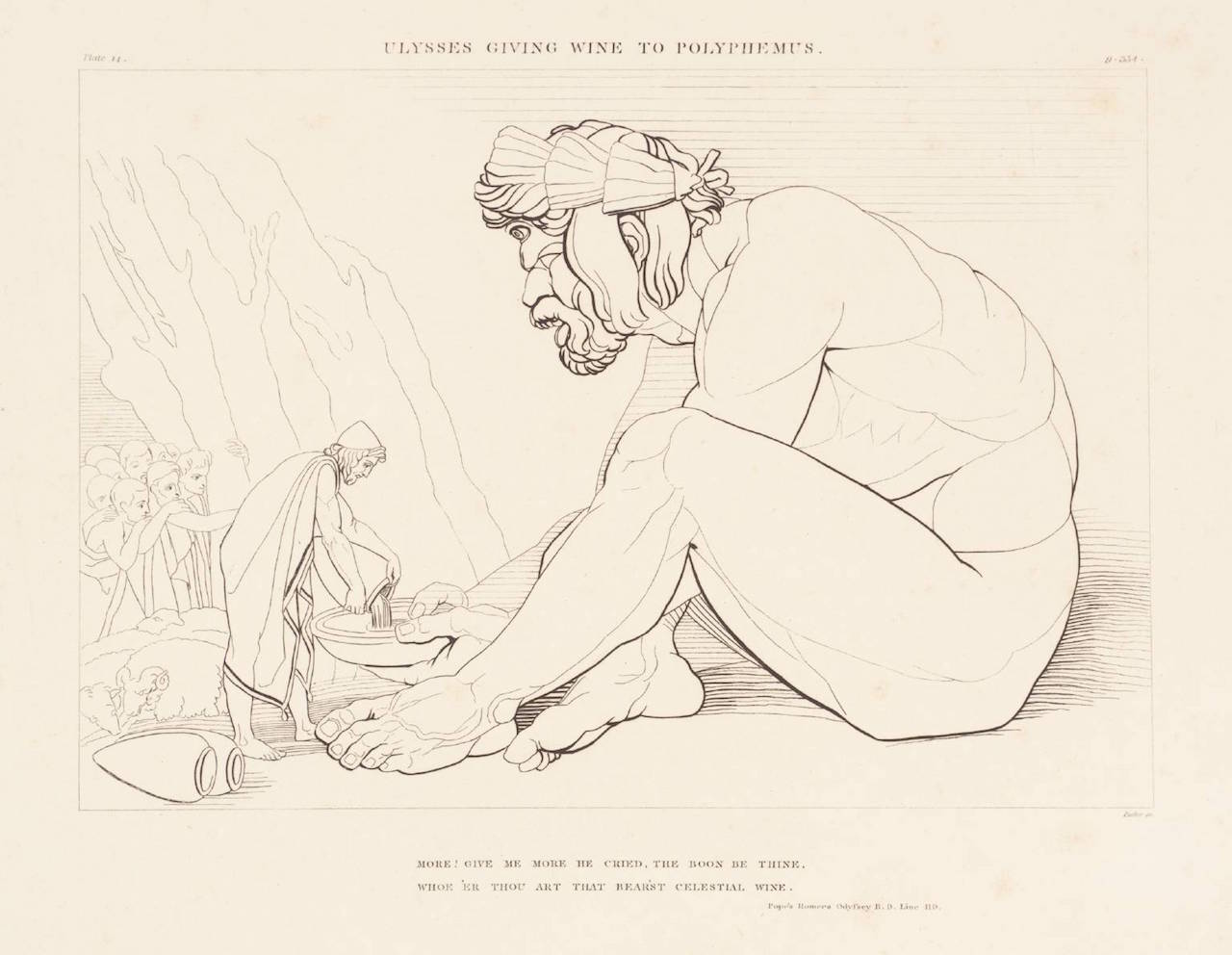
Alkinoos prepares a feast for Odysseus, who has not yet identified himself. This feast becomes a mythologized replica of a festival that puts on display a dazzling variety of old poetic traditions, soon to be replaced by the new poetry of the Odyssey.
Once again, as at O.07.167 and O.07.178, the name of Alkinoos is expressed periphrastically: ‘the sacred [hieron] mental-power [menos] of Alkinoos’, as if the agency of the king originated from his mental power, not from his existence as a person. See also O.08.04.
Alkinoos the king is addressing his subjects, the Phaeacians, and he speaks of the ‘escort’ that he plans to provide for the stranger who has not yet identified himself as Odysseus. The word that I translate as ‘escort’ here is pompē: O.08.030, O.08.031, O.08.033. And the word that I translate as ‘stranger’ is xenos: O.08.028. Alkinoos intends to be a host to this stranger, treating him as a ‘guest’, and the word that I translate as ‘guest’ here is likewise xenos, O.08.042. What Alkinoos plans to offer his guest is a dais, which refers on the surface to a ‘feast’. The feast will evidently include a dinner, O.08.042, and this dinner will include entertainment in the form of ‘singing’, the noun for which is aoidē at O.08.044 and the verb for which is aeidein at O.08.045. The one who will be singing is an aoidos ‘singer’, O.08.043, whose name is Demodokos, O.08.044. This singer’s singing ‘gives delight’, as expressed by way of the verb terpein, O.08.045.
The idea of hosting the still-unidentified guest here is connected with the idea of the dais 'feast' of the Phaeacians as a stylized festival.
Here the entire kingdom of the Phaeacians is figured as one single dēmos ‘community, district’. On dēmos as ‘community, district’, see the comments on O.01.103 and O.02.032; and see also the comment on I.18.497–508, with reference to a scene of litigation in the context of a dēmos ‘district’ (δήμῳ at I.18.500), which is parallel to a litigation recorded in the Linear B tablet Ep 704 from Pylos, again in the context of a dāmos (da-mo) ‘district’ (HR 75–76).
The god who is the hymnic subject of Demodokos’ ongoing humnos and who presides over the stylized festival is ultimately Zeus.
As I will start to argue in the comment at O.08.061, the dais ‘feast’ that is planned here by king Alkinoos for his guest will eventually be rethought as a stylized festival, centering on a sacrifice that leads to a division of meat at the feast.
The word dais here, which can generally be translated as 'feast', signals the idea of a festival. It can be argued that the dais of the Phaeacians is a stylized festival, starting in Odyssey 8 and ongoing till Odyssey 13.
With reference to the dais of the Phaeacians as a stylized festival: an aspect of the festival is the singing performed by Demodokos. This singing is meant to be a source of delight to those attending, and the programmatic word for 'delight' here is terpein at verse 45.
The “speaking name” (nomen loquens) of the singer, Dēmódokos, can be interpreted as meaning ‘one who is received [verb dek(h)esthai] by the community [dēmos]’, and, in the present context, the dēmos ‘community, district’ that gives to the singer’s singing its reception is indicated at O.08.036: that community is the dēmos or ‘district’ of the kingdom ruled by Alkinoos the king. I translate Dēmódokos as ‘received by the community’, not just ‘received in the community’, because the noun dēmos implies an authority that is endowed with agency: the dēmos can perform a function, such as the reception of a song. We can see such agency at work in the use of the word dāmos (da-mo) in the Linear B tablet Ep 704 from Pylos: in the litigation that is described in that text, the dāmos literally speaks as one of the two parties engaged in the litigation over land-tenure: dāmos de min phāsi … ekheen (da-mo-de-mi-pa-si … e-ke-e) ‘but the dāmos says [phāsi] that she [= the priestess] has …’ (HR 75–76).
In Homeric Greek as also in the language of Linear B, dēmos (dāmos) refers to a local 'district' that has its own customary laws. The element dēmo- in compound names like Dēmodokos in this verse highlights the localized functions of such figures.
The king Alkinoos ‘sacrifices’, as indicated by the verb hiereuein at O.08.059, a number of sacrificial animals. They are twelve sheep, eight pigs and two head of cattle, as indicated at O.08.059–060, and the meat of these sacrificial animals will now be prepared for a dais ‘feast, division of portions (of meat); sacrifice’, as indicated at O.08.061—and as already indicated earlier at O.08.038. Following up on my comment at O.08.038 as also on the comment here at O.08.059–061, I will have more to say in the comment at O.08.061, coming up, about the dais ‘feast’ that is planned by king Alkinoos for his guest.
With reference to the dais of the Phaeacians as a stylized festival:
We see in this context that the dais, as a feast, involves an animal sacrifice that leads to feasting on the meat of the sacrificial animal.
An animal sacrifice marks the ritual start of the festival. The festival is understood to be the context of an agōn – between Demodokos and Odysseus.
The starting of the dais 'feast' is signaled at O.8.61. The dais is ongoing until late at night, all the way to the end of O.12, and then it gets restarted on the next day, in O.13. Note the ring composition that articulates the restarting.
[Epitomized from MoM 4§73:] The noun dais ‘feast’, as we see it used here at O.08.061, is derived from the verb daiesthai in the basic sense of ‘distribute’, which is used in contexts of animal sacrifice in referring to the ‘distribution’ of cooked meat among the members of a community, as at O.15.140 and O.17.332. Then, by way of synecdoche, the specific idea of distribution extends metonymically to the general idea of feasting and further to the even more general idea of a festival. Following the logic of this sequence of meanings, we see that the animal sacrifice at O.08.059 had led to the cooking and the distribution of the meat, O.08.061, which will lead to communal dining, O.08.071–072, which will lead to the First Song of Demodokos, O.08.073–083, and so on. On metonymy and * synecdoche, see the inventory of Words and Ideas. In terms of this logic, the metonymic use of the word dais in the sense of ‘feast’ here at O.08.061 marks a whole complex of events that are typical of festivals: animal sacrifice, communal feasting, singing as well as dancing at the feast. As we will see in comments that follow, this dais ‘feast’ as signaled at O.08.061 will be rethought as a stylized festival, centering on a sacrifice that leads to a division of meat at the feast. Such a festival will continue from here in Odyssey 8 all the way to the beginning of Odyssey* 13.
The composition of song in this first performance of Demodokos is compared metaphorically to the weaving of a web. Note the context of oimē as ‘thread’ at verse 74.
Demodokos is an aoidos ‘singer,’ O.08.062, and he is is blind, O.08.63–64. The song that he sings about the Trojan War, O.08.073–082, prompts Odysseus to break down in tears and weep, O.08.083–095. Every time the singer ‘leaves off’ singing, as indicated by lēgein, O.08.087, he then restarts his song, as indicated by aps arkhesthai, O.08.090, since his Phaeacian listeners ‘feel delight’, as indicated by the verb terpesthai, as they hear his singing, O.08.091. So, the listeners of Demodokos so enjoy his singing that they don’t let him stop. (See the comments at HC 2§299 and 2§343.) There is a contradiction here between the reactions of Odysseus and the other listeners. Every time the singer restarts his singing, Odysseus restarts his weeping, O.08.092. But Odysseus pretends to be enjoying the performance of Demodokos, O.08.089, and he manages to evade the notice of all the Phaeacians, O.08.093—except for Alkinoos, O.08.094–095. As I will argue with reference to the Third Song of Demodokos, that song can be interpreted as a restarting of the First Song of Demodokos—followed by a parallel restarting of the tears of Odysseus in response to it.
The singers as represented in Homeric poetry are traditionally pictured as accompanying themselves on a string instrument or ‘lyre’, called a phorminx here.
Before the singer starts singing, the Phaeacians and their unidentified guest are already feasting: they partake of both food and drink, O.08.072. The eating and drinking had begun at O.08.071, signaled already at O.08.061 by the noun dais ‘feast, feasting’. As we will see later, however, the singing itself is part of the dais ‘feasting’.
The expression aristoi Akhaiōn (ἄριστοι Ἀχαιῶν) at verse 78, which I translate as ‘the best of the Achaeans’, here is in the plural, and nowhere else in either the Iliad or the Odyssey do we find such a plural (for a different, distributive plural by implication of this same expression 'best of the Achaeans', see my note on Iliad 8.228-235). Rather, we find the singular aristos Akhaiōn (ἄριστος Ἀχαιῶν), which I again translate as ‘the best of the Achaeans’. Although many heroes contend for this title in the macro-epic of the Iliad, only one of them, Achilles, emerges as eligible to be known in that epic as the absolute best of all the Achaeans, by contrast with such rivals as Agamemnon, Diomedes, and Ajax. Similarly in the Odyssey, only Odysseus emerges as the absolute best, by contrast with the suitors of Penelope. So, in terms of both these two macro-epics, the Iliad and the Odyssey, there can only be one hero who is truly ‘the best of the Achaeans’.
reference to the mixing of the ashes of Achilles and Patroklos in O.24.077 as not a duplication of references to the same mixing in the Iliad (I.23.243-244 and 23.091-092), therefore not violating Munro’s law, in the context of analyzing a traditional suppression of anything overtly Iliadic in the Odyssey (p. 21), and analysis of Demodokos’ first song on the neikos of Odysseus and Achilles, including the theory that it refers to an incident in the middle of the Cypria, comparison with the beginning of the Iliad, and the tradition of the quarrel between Odysseus and Achilles over whether Troy would be captured by might or artifice
\n\n----- Merged Content -----
\n\n reference to the mixing of the ashes of Achilles and Patroklos in O.24.077 as not a duplication of references to the same mixing in the Iliad (I.23.243-244 and 23.091-092), therefore not violating Munro’s law, in the context of analyzing a traditional suppression of anything overtly Iliadic in the Odyssey (p. 21), and analysis of Demodokos’ first song on the neikos of Odysseus and Achilles, including the theory that it refers to an incident in the middle of the Cypria, comparison with the beginning of the Iliad, and the tradition of the quarrel between Odysseus and Achilles over whether Troy would be captured by might or artifice
analysis of Demodokos as an idealization of an artist by the art form of epic
\r\n----- Merged Content -----
\r\nOdysseus as implicitly the “best of the Achaeans” in the epic compositions of Demodokos, and Odysseus’ earning the title for what he did within the Odyssey rather than at Troy
\r\n----- Merged Content -----
\r\nanalysis of the song of Demodokos on the neikos of Achilles and Odysseus as compared with themes that surface in the Iliad, and in terms of a tradition that contrasted the heroic worth of Odysseus and Achilles in terms of mētis and biē
\r\n----- Merged Content -----
\r\ncomparison of the themes in the quarrel of Odysseus and Achilles in Demodokos’ song with those in the embassy scene in I.09 in an argument for the existence of a common epic heritage on the enmity between Achilles and Odysseus on which they draw
\r\n----- Merged Content -----
\r\nanalysis of the passage against the background of the patterns of traditional diction to do with pēma and Dios boulē, and Demodokos’ alluding to an Iliad that would have featured Odysseus as the prime offender of Achilles and his chief resentment as centering on the slighting of his biē
\r\n----- Merged Content -----
\r\nanalysis of the name of Achilles, as associated with pēma decreed by the Will of Zeus
\r\n----- Merged Content -----
\r\nanalysis of the references to Delphi in the Odyssey, the thematic correlation of the death of Achilles with Delphi/sacrifice/quarrel, and its parallels to a variant myth about the death of Pyrrhos
\r\n----- Merged Content -----
\r\nanalysis of Achilles’ (and the Aeacids) connections with the themes of dais and neikos, and comparison of this passage on the song of Demodokos with the Cypria and Achilles’ and Agamemnon’s quarrel at the beginning of the Iliad
\r\n----- Merged Content -----
\r\nanalysis of Achilles’ connections with the themes of dais and neikos, and comparison of this passage on the song of Demodokos with Odysseus’ words regarding dais to Achilles in I.09.225-228
\r\n----- Merged Content -----
\r\nanalysis of the thematic correlation of the death of Achilles with Delphi/sacrifice/quarrel and its parallels to a variant myth about the death of Pyrrhos, of Achilles’ (and the Aeacids) connections with the themes of dais and neikos, and the song of Demodokos on the quarrel of Achilles and Odysseus as incorporating Delphic lore
\r\n----- Merged Content -----
\r\nOdysseus’ and Achilles’ quarrel as serving as a context to define the themes of mētis of Odysseus and biē of Achilles (comparison with the neikos of Hesiod and Perseus in W&D)
\n\n----- Merged Content -----
\n\n comparison of Demodokos’ first song with the newer Iliad, both featuring Zeus as the implicit hymnic subject of the epic about the Trojan War, inspired by a singular Muse and subsuming the divine agency of Apollo under the Plan of Zeus \n\n----- Merged Content -----
\n\n The genitive of oimē 'thread' here marks the point of departure for the performance of the first song of Demodokos.
\n\n----- Merged Content -----
\n\n Here oimē can be translated as ‘song’ in the context of analyzing the meanings of prooimion, oimos, oimē.
\n\n----- Merged Content -----
\n\n analysis of the parallelism of Odysseus’ restarted outpouring of tears and Demodokos’ restarted epic, and of the plot of the epic about the Trojan War as equated with the prophecy of Apollo and the plan of Zeus \n\n----- Merged Content -----
\n\n argument that oimos/oimē/prooimion and humnos derive from roots referring to fabric making, and the metaphors of fabric making for composition of song \n\n----- Merged Content -----
\n\n analysis of the metaphors from weaving for the composition of song, here especially oimē as ‘thread’ \n\n----- Merged Content -----
\n\n analysis of Demodokos’ first and third song as parts of the same humnos, restarted, provoking the same response of tears in Odysseus, and Zeus as the cause of the pains and as the ultimate hymnic subject \n\n----- Merged Content -----
\n\n analysis of the kind of epic that the first song of Demodokos is, that is, older kind of epic analogous to what would have been introduced by the Homeric Hymns \n\n----- Merged Content -----
\n\n analysis of the kind of epic that the first song of Demodokos is, that is, older kind of epic, in the context of arguing that the poetic form of the epic of Demodokos is cognate with the poetic form of the epic Cycle \n\n----- Merged Content -----
\n\n analysis of the parallels between the prooimion in Herodotus and Homer (here, use of relative clauses as indirect questions) \n\n----- Merged Content -----
\n\n analysis of the dais of the Phaeacians as a stylized festival, here with reference to its epithet thaleiēi \n\n----- Merged Content -----
\n\n argument that a hymnic prooimion is not obligatory if Zeus is the implied hymnic subject authorizing the epic, here exemplified by Demodokos’ first and third song
\r\n----- Merged Content -----
\r\ncomparison of the Cypria and Demodokos’ first and third song in terms of the Plan of Zeus as the frame of narration for the Trojan War
\r\n----- Merged Content -----
\r\nanalysis of the Plan of Zeus as a sign of Homeric poetry
\r\n----- Merged Content -----
\r\nanalysis of the Plan of Zeus, here Hector’s not returning to Andromache (in these verses) as the most special and most Iliadic view of the Plan of Zeus, and its being connected with the Plan of Zeus in the singing of Demodokos
\n\n----- Merged Content -----
\n\n analysis of the dais of the Phaeacians as a stylized festival
For more on the epic traditions of klea andrōn ‘the glories [klea] of men’, see the comment on I.09.185–191; also on I.09.524–599. On the poetics of kleos ‘glory’ as the glory conferred by poetry, especially by epic, see the comment on O.01.088–095.
At O.08.073–082, we see the plot of the First Song—at least, the plot of the start of the First Song. We cannot be sure about the whole plot because the singer more than once ‘leaves off’ his song, as signaled by lēgein at O.08.087, and then ‘restarts’ it, as signaled by aps arkhesthai at O.08.090. The multiple restartings are prompted by the fact that the singer’s Phaeacian listeners ‘feel delight’, as indicated by the verb terpesthai, as they hear his singing, O.08.091, and they want to hear more. As I noted in my comment for O.08.062–095, even Odysseus pretends to be enjoying the performance of Demodokos, O.08.089. On points of comparison between the Iliad and the First Song of Demodokos as a micro-Iliad, see HPC 115–116, especially with reference to (1) the idea of being inspired by a single Muse and (2) the subsuming of the agency of Apollo under the Plan of Zeus; see also HC 2§309. On the Third Song of Demodokos as a continuation of the First, see HPC 101. On epic poetry about the Trojan War as a hymnic consequent, see MoM 4§73 and 4§99.2; also HC 2§326. (By hymnic consequent here, all I mean is whatever comes after something that is shaped like a hymn.) On the epic of Demodokos as cognate with the poetic form of the epic Cycle, see HC 2§331.
I translate the genitive of oimē (οἴμης) here as ‘starting (from a story-thread)’. (See also PP 63, HC 2§92n.) The paraphrasing here of the song of Demodokos recapitulates the prooimion ‘proemium, prelude’ of the song. [What follows is epitomized from HC 2§§92–93:] In the case of the compound noun prooimion / προοίμιον, conventionally translated as ‘proemium’, the element -oim- / -οιμ- is derived from a root that we find also attested in two simple nouns, oimos / οἶμος and oimē / οἰμή. The Attic by-form of prooimion / προοίμιον, which is phroimion / φροίμιον, elucidates the prehistory of the root: we must reconstruct it not as oim*- but as hoim-, from soim-. This reconstruction helps elucidate the surviving contexts of both oimos / οἶμος and oimē / οἰμή, which do not always give a clear picture of the basic meaning of either form. In some contexts, the meaning seems to be ‘song’, as here at O.08.074, while in others it seems to be ‘way, pathway’, as in Hesiod Works and Days 290. With the help of comparative evidence, however, the primary meaning of oimos and oimē can be reconstructed as ‘thread, threading’, and the meanings ‘song’ or ‘way, pathway’ can be explained as secondary: that is, ‘song’ and ‘way, pathway’ are metaphorical generalizations derived from the meaning ‘thread, threading’ (PR 72, 81; also PP 63n20). And it is such a primary meaning ‘thread, threading’ that we find in comparable forms attested in other Indo-European languages: for example, the form soimos that we reconstruct from Greek oimos is attested as Old Icelandic seimr, meaning ‘thread’ (for this and other examples, see Durante 1976:176). In terms of such a primary meaning, the etymology of the compound noun prooimion ‘proemium’ can be interpreted as a metaphor referring to the ‘initial threading’ of a song. A close semantic parallel to the etymology of Greek prooimion ‘proemium’ as an ‘initial threading’ of a song is the etymology of Latin exordium, which likewise means ‘proemium’ in poetic and rhetorical contexts: the meaning of this noun as well can be traced back to the basic idea of an ‘initial threading’ (PP 63n20). The poetic and rhetorical concepts of both Greek prooimion and Latin exordium in the sense of ‘proemium’ have a common Indo-European ancestry. As I will argue later, not only oimos / oimē / prooimion but also humnos, ordinarily translated as ‘hymn’, are derived from roots that refer to the making of fabric. Moreover, I note that the word oimos is formulaically interchangeable with the word humnos at verse 451 of the Homeric Hymn (4) to Hermes, where we see the attestation of both οἶμος ἀοιδῆς and ὕμνος ἀοιδῆς in the manuscript tradition; at a later point, we will also consider the cognate expression ἀοιδῆς ὕμνον at verse 429 of Odyssey 8. I interpret the combinations of humnos and oimos with aoidē ‘song’ to mean respectively the ‘weaving’ of song and the ‘threading’ of song. Relevant to this interpretation is the context of oimē at verse 74 of Odyssey 8: we see here a metaphorical reference to the initial part of performing a song, that is, to the ‘initial threading’ of a song. To sum up, the meaning of oimos or oimē as ‘song’ results from a metaphorical extension: the idea of making song is being expressed metaphorically through the idea of making fabric. As for contexts where oimos and oimē seem to mean ‘way, pathway’, I argue that such a meaning is likewise a result of metaphorical extension: here the general idea of moving ahead from one point to another is being expressed metaphorically by applying the specific idea of threading one’s way from one point to another (more on this point at HC 2§311, in the excursus there). On points of comparison with the proemium that introduces the History* of Herodotus, see PH 221.
The narrative subject of the epic that is being paraphrased here is a neikos ‘quarrel’ between Odysseus and Achilles, O.08.075. And the setting for this quarrel is a dais ‘feast’ that is explicitly correlated with a ‘sacrifice’, O.08.076: θεῶν ἐν δαιτὶ θαλείῃ ‘at a celebratory feast [dais] of the gods’. The same epithet thaleiēi (θαλείῃ) is also used to describe the ongoing dais ‘feast’ at O.08.099. This epithet is of special interest in light of the meaning of the noun thaliai in the plural, ‘celebrations, festivities’, as at O.11.603 (HPC 85n13). We may compare another feast, described at I.08.228–235, where the describer is Agamemnon, recalling a scene from the collective past of the Achaeans: the setting of this other feast was the island of Lemnos, and each one of the Achaean leaders took turns in boasting that he was the best Achaean of them all, I.08.229. In my comment on I.08.228–235, I noted that the noun eukhōlai ‘boastings’ in the plural at I.08.229 indicates a distributive action: the Achaeans were boasting not as a group but individually and competitively. The competitive boasting evidently centered on the question: who would be superior to all others in performing heroic exploits in the upcoming Trojan War? And the setting for this quarrel was a feast where the meat of oxen to be eaten in vast quantities was being apportioned among the Achaean leaders, I.08.231. Since the narrative here makes a point of adding that these leaders were also drinking wine, I.08.232, it is implied that all the boasting could get out of hand and lead to quarrels about the awarding of prime cuts of meat. It would have been expected that the best portion of meat should go to the best hero. On the idea of a champion’s portion of meat, see the comment on I.07.319–322. Having reconstructed for I.08.228–235 a scene of quarreling in the context of apportioning cuts of meat, I return to the scene at O.08.075–078, where we see once again a scene of quarreling in the context of apportioning cuts of meat. And here the ‘quarreling’ is explicitly called a neikos, O.08.075, while the ‘apportioning of meat’ is explicitly called a dais, O.08.076. As we saw in the comment for I.01.423–425, a dais is a feast where meat is distributed, and this meat comes from the sacrifice of sacrificial animals. Thus the act of sacrifice converts the feast of humans into a notional feast of the gods. This notion, ‘feast of the gods’, is made explicit at O.08.076, where the setting is described explicitly this way, as we have already seen: θεῶν ἐν δαιτὶ θαλείῃ ‘at a celebratory feast [dais] of the gods’. In this festive setting, as I already highlighted in the comment on I.08.228–235, the neikos ‘quarrel’ at O.08.075 is between Odysseus and Achilles, who are described at O.08.078 as ‘the best of the Achaeans’. In terms of such a dispute in the context of a feast, each one of the two heroes would be claiming to be the ‘best of the Achaeans’. Achilles would have claimed to be ‘best’ because of his superior biē ‘force, violence, strength’, while Odysseus would have counter-claimed to be ‘best’ because of his superior mētis ‘mind, intelligence’. See the comments on O.01.002; see also, further back, the comments on I.01.001–012, where I argue that the quarrel between Odysseus and Achilles came from an epic tradition that was independent from the epic tradition that featured the quarrel between Agamemnon and Achilles. Further, see the comment on I.09.346–352, where I note that this Iliadic passage was thought by Aristarchus (scholia A for I.09.347) to be an allusion to the quarrel at O.08.075–078 between Achilles and Odysseus over one overriding question: will Troy be conquered by relying on the physical power of Achilles or on the mental power of Odysseus?
In the Iliad and Odyssey, Apollo at Delphi is mentioned only at Ι.09.404–405 and here at O.08.079–081. Agamemnon consults the oracle at Delphi, and he misunderstands what the oracle prophesies to him. See the next note, on O.08.081–082.
Agamemnon misunderstands the oracle of Apollo at Delphi, which had evidently prophesied to him that Troy would be captured when the ‘best of the Achaeans’—Odysseus and Achilles—engage in a quarrel at a feast. Agamemnon rejoices when he sees the two heroes quarreling, since he thinks that victory over the Trojans will be quick and easy—and painless. But the war will be a great pēma ‘pain’, O.08.081, for the Achaeans as also for the Trojans, O.08.082. This pain is compared to a breakaway boulder that ‘rolls’ down from the heights above, as expressed by way of kulindesthai, O.08.081, and this boulder will crush anyone that stands in its way. And all that pain will be caused by the Will of Zeus, O.08.082. For another comparable misunderstanding on the part of Agamemnon, see the comments on I.02.007–015 and on I.02.036–040.
The micro-epic of Demodokos as embedded in Odyssey 8.73–82, merges the poetic agenda that are kept separate in the macro-epics of the Iliad and the Odyssey. And, correspondingly, this same micro-epic merges the plan of Zeus as it operates in the Iliad with the plan of Zeus as it operates in the Odyssey. These mergers are compatible with the plural form boulai ‘plans’ referring to the plot of the micro-epic at verse 82 of Odyssey 8, as opposed to the singular form boulē ‘plan’ referring to the plot of the macro-epic at verse 5 of Iliad 1. Likewise in the Odyssey, as the book of Jim Marks has shown clearly, the whole plot of this macro-epic is driven by a singular plan of Zeus.
Bibliographical references
Marks, J. 2008. Zeus in the Odyssey. Hellenic Studies 31. Washington DC. http://nrs.harvard.edu/urn-3:hul.ebook:CHS_Marks.Zeus_in_the_Odyssey.2008.
In Classical Inquiries, I note:
The epic singing of the first song of Demodokos in Odyssey 8, once it gets started by the prooimion as indicated by the syntax at verse 74, keeps getting restarted. Whenever the performer ‘leaves off’, as indicated by the word lēgein at verse 87, he keeps on ‘restarting’ the epic, as indicated by the wording aps arkhesthai ‘start again and again’ at verse 90. The continual restarting creates the effect of an endless narrative: the epic performance of the first song of Demodokos seems to have no end in sight.
----- Merged Content -----
analysis of the leaving off and restarting of the hymnos in Demodokos’ songs and Odysseus’ reaction of dissolving into tears each time Demodokos restarts
With reference to the 'leaving off' (lēgein) and the restarting of the humnos in the performance of Demodokos: in the case of this performance, which is about the Trojan War, Odysseus 'dissolves' (tēkein, tēkesthai) into tears each time Demodokos restarts.
Alkinoos notices the weeping of Odysseus, and this act of noticing will lead to recognition. See the anchor comment at I.05.669 on noeîn ‘take note (of), notice’. This characteristic of Alkinoos, to ‘notice’ things, is relevant to his “speaking name”: see the comment at O.22.031–033.
Alkinoos pauses the dining and the singing, though the dais at O.08.098 and at O.08.098 in the general sense of ‘feasting’ can continue. But now, instead of dining and singing, what will commence are aethloi (āthloi) in the sense of ‘athletic contests’, O.08.100. Listed at O.08.103 are athletic events in boxing, wrestling, long-jump, and footracing.
Once again, as at O.08.076, the epithet thaleiēi (θαλείῃ) ‘celebratory’ is used to describe the ongoing dais ‘feast’ (δαιτί), O.08.099. On the meaning of this epithet, see the comment on O.08.075–078.
All those attending the athletic event ‘felt delight’, as expressed by way of the verb terpesthai; in Hittite, the cognate noun tarpa-, likewise derived from the root *terp-, is used with reference to athletic events. (See MoM 4§78.)
Here at O.08.200 the word agōn ‘competition’ is used with reference to a continuum of competitive athletic events. In this context, it becomes clear that the entire series of athletic events in this festive continuum can be viewed as an agōn ‘competition’. See also O.08.238.
In the Second Song, Ο.08.329–332, Hephaistos as the god who is slow on his feet will catch up with the fleet-footed god Ares the adulterer. Similarly, Odysseus says here at O.08.230–233 that he is slow on his feet. But, when the time comes, we know that he too will catch up with those fleet-footed would-be adulterers, the suitors of his wife.
|250 “ἀλλ’ ἄγε, Φαιήκων βητάρμονες ὅσσοι ἄριστοι, |251 παίσατε, ὥς χ’ ὁ ξεῖνος ἐνίσπῃ οἷσι φίλοισιν, |252 οἴκαδε νοστήσας, ὅσσον περιγινόμεθ’ ἄλλων |253 ναυτιλίῃ καὶ ποσσὶ καὶ ὀρχηστυῖ καὶ ἀοιδῇ. |254 Δημοδόκῳ δέ τις αἶψα κιὼν φόρμιγγα λίγειαν |255 οἰσέτω, ἥ που κεῖται ἐν ἡμετέροισι δόμοισιν.” |256 ὣς ἔφατ’ Ἀλκίνοος θεοείκελος, ὦρτο δὲ κῆρυξ |257 οἴσων φόρμιγγα γλαφυρὴν δόμου ἐκ βασιλῆος. |258 αἰσυμνῆται δὲ κριτοὶ ἐννέα πάντες ἀνέσταν, |259 δήμιοι, οἳ κατ’ ἀγῶνα ἐῢ πρήσσεσκον ἕκαστα, |260 λείηναν δὲ χορόν, καλὸν δ’ εὔρυναν ἀγῶνα. |261 κῆρυξ δ’ ἐγγύθεν ἦλθε φέρων φόρμιγγα λίγειαν |262 Δημοδόκῳ· ὁ δ’ ἔπειτα κί’ ἐς μέσον· ἀμφὶ δὲ κοῦροι |263 πρωθῆβαι ἵσταντο, δαήμονες ὀρχηθμοῖο, |264 πέπληγον δὲ χορὸν θεῖον ποσίν. αὐτὰρ ᾿Οδυσσεὺς |265 μαρμαρυγὰς θηεῖτο ποδῶν, θαύμαζε δὲ θυμῷ. |266 αὐτὰρ ὁ φορμίζων ἀνεβάλλετο καλὸν ἀείδειν |267 ἀμφ’ Ἄρεος φιλότητος ἐϋστεφάνου τ’ Ἀφροδίτης, |268 ὡς τὰ πρῶτ’ ἐμίγησαν ἐν Ἡφαίστοιο δόμοισι |269 λάθρῃ. [The story that has just started at line 266 now continues, ending at line 366.] |367 ταῦτ’ ἄρ’ ἀοιδὸς ἄειδε περικλυτός· αὐτὰρ Ὀδυσσεὺς |368 τέρπετ’ ἐνὶ φρεσὶν ᾗσιν ἀκούων ἠδὲ καὶ ἄλλοι |369 Φαίηκες δολιχήρετμοι, ναυσικλυτοὶ ἄνδρες. (At line 267, there is a variant reading attested: φιλότητα in the accusative, instead of φιλότητος in the genitive.)
|250 [Alkinoos is speaking.] “Let’s get started. I want the best of the Phaeacian acrobatic dancers [bētarmones] |251 to perform their sportive dance [paizein], so that the stranger, our guest, will be able to tell his near-and-dear ones, |252 when he gets home, how much better we (Phaeacians) are than anyone else |253 in sailing and in footwork, in dance [orkhēstus] and song [aoidē]. |254 One of you go and get for Demodokos the clear-sounding special lyre [phorminx], |255 bringing it to him. It is in the palace somewhere.” |256 Thus spoke Alkinoos, the one who looks like the gods, and the herald [kērux] got up, |257 ready to bring the well carved special lyre [phorminx] from the palace of the king. |258 And the organizers [aisumnētai], the nine selectmen, all got up |259 —they belonged to the district [dēmos]—and they started arranging everything according to the rules of the competition [agōn]: |260 they made smooth the place of the singing-and-dancing [khoros], and they made a wide space of competition [agōn]. |261 The herald [kērux] came near, bringing the clear-sounding special lyre [phorminx] |262 for Demodokos. He [= Demodokos] moved to the center [es meson] of the space. At his right and at his left were boys [kouroi] |263 in the first stage of adolescence [prōthēboi], standing there, well versed in dancing [orkhēthmos]. |264 They pounded out with their feet a dance [khoros], a thing of wonder, and Odysseus |265 was observing the sparkling footwork. He was amazed in his heart [thūmos]. |266 And he [= Demodokos], playing on the special lyre [phormizein], started [anaballesthai] singing beautifully |267 about [amphi] the bonding [philotēs] of Ares and of Aphrodite, the one with the beautiful garlands [stephanoi], |268 about how they, at the very beginning, mated with each other in the palace of Hephaistos, |269 in secret. [The story that has just started at line 266 now continues, ending at line 366.] |367 These things, then, the singer [aoidos] was singing [aeidein], that very famous singer. As for Odysseus, |368 he felt delight [terpesthai] in his heart as he was listening—and so too did all the others feel, |369 the Phaeacians, those men with their long oars, men famed for their ships.
As we are about to see, the Second Song of Demodokos is remarkably different from the First and the Third Songs—not only in form but also in content.
Officials who are experts in setting up a place for holding competitive choral events of singing and dancing are here preparing to set up such a place. Such a choral event is an agōn ‘competition’, just like the athletic events that preceded. So, all these events are seen as a festive continuum.
So, the competitive choral event is properly arranged, and a place is prepared for the ‘choral singing /dancing’, the word for which is khoros. The stylized festival continues.
Acrobatic dancers lead off the choral singing and dancing, and the khoros or ‘place for choral singing-and-dancing’ becomes their dancing floor. This pattern of leading off resembles the pattern we see in versions of Ο.04.019 and Ι.18.606 where we see the variant reading ἐξάρχοντες instead of ἐξάρχοντος. In terms of this reading, the acrobatic dancers lead off, starting their performance before the singer starts.
Now Demodokos the singer ‘begins performing’, as indicated by anaballesthai, and he sings, O.08.266. What the singer now sings is a proemium, the form of which is analogous to what we read in the Homeric Hymns.
The subject of the song is the philotēs ‘sexual bonding’ of Ares and Aphrodite. The adulterous lovers will be caught in the act by the husband of Aphrodite, Hephaistos. The introduction of the story by way of the preposition amphi ‘about’ is typical of hymns. The story of the sexual encounter of Ares and Aphrodite is typical of a genre known as divine burlesque, on which see the comment on I.21.385–514. The subject of such a philotēs ‘sexual bonding’ is treated seriously by Empedocles DK B 35.
verses matching these quoted in the Derveni Papyrus and considered by the commentator as Orphic (Obbink 1997:41n4)
Reacting to the Second Song of Demodokos, both Odysseus and the Phaeacian listeners react by ‘feeling delight’ as expressed by way of terpesthai, O.08.368.
|250 “ἀλλ’ ἄγε, Φαιήκων βητάρμονες ὅσσοι ἄριστοι, |251 παίσατε, ὥς χ’ ὁ ξεῖνος ἐνίσπῃ οἷσι φίλοισιν, |252 οἴκαδε νοστήσας, ὅσσον περιγινόμεθ’ ἄλλων |253 ναυτιλίῃ καὶ ποσσὶ καὶ ὀρχηστυῖ καὶ ἀοιδῇ. |254 Δημοδόκῳ δέ τις αἶψα κιὼν φόρμιγγα λίγειαν |255 οἰσέτω, ἥ που κεῖται ἐν ἡμετέροισι δόμοισιν.” |256 ὣς ἔφατ’ Ἀλκίνοος θεοείκελος, ὦρτο δὲ κῆρυξ |257 οἴσων φόρμιγγα γλαφυρὴν δόμου ἐκ βασιλῆος. |258 αἰσυμνῆται δὲ κριτοὶ ἐννέα πάντες ἀνέσταν, |259 δήμιοι, οἳ κατ’ ἀγῶνα ἐῢ πρήσσεσκον ἕκαστα, |260 λείηναν δὲ χορόν, καλὸν δ’ εὔρυναν ἀγῶνα. |261 κῆρυξ δ’ ἐγγύθεν ἦλθε φέρων φόρμιγγα λίγειαν |262 Δημοδόκῳ· ὁ δ’ ἔπειτα κί’ ἐς μέσον· ἀμφὶ δὲ κοῦροι |263 πρωθῆβαι ἵσταντο, δαήμονες ὀρχηθμοῖο, |264 πέπληγον δὲ χορὸν θεῖον ποσίν. αὐτὰρ ᾿Οδυσσεὺς |265 μαρμαρυγὰς θηεῖτο ποδῶν, θαύμαζε δὲ θυμῷ. |266 αὐτὰρ ὁ φορμίζων ἀνεβάλλετο καλὸν ἀείδειν |267 ἀμφ’ Ἄρεος φιλότητος ἐϋστεφάνου τ’ Ἀφροδίτης, |268 ὡς τὰ πρῶτ’ ἐμίγησαν ἐν Ἡφαίστοιο δόμοισι |269 λάθρῃ. [The story that has just started at line 266 now continues, ending at line 366.] |367 ταῦτ’ ἄρ’ ἀοιδὸς ἄειδε περικλυτός· αὐτὰρ Ὀδυσσεὺς |368 τέρπετ’ ἐνὶ φρεσὶν ᾗσιν ἀκούων ἠδὲ καὶ ἄλλοι |369 Φαίηκες δολιχήρετμοι, ναυσικλυτοὶ ἄνδρες. (At line 267, there is a variant reading attested: φιλότητα in the accusative, instead of φιλότητος in the genitive.)
|250 [Alkinoos is speaking.] “Let’s get started. I want the best of the Phaeacian acrobatic dancers [bētarmones] |251 to perform their sportive dance [paizein], so that the stranger, our guest, will be able to tell his near-and-dear ones, |252 when he gets home, how much better we (Phaeacians) are than anyone else |253 in sailing and in footwork, in dance [orkhēstus] and song [aoidē]. |254 One of you go and get for Demodokos the clear-sounding special lyre [phorminx], |255 bringing it to him. It is in the palace somewhere.” |256 Thus spoke Alkinoos, the one who looks like the gods, and the herald [kērux] got up, |257 ready to bring the well carved special lyre [phorminx] from the palace of the king. |258 And the organizers [aisumnētai], the nine selectmen, all got up |259 —they belonged to the district [dēmos]—and they started arranging everything according to the rules of the competition [agōn]: |260 they made smooth the place of the singing-and-dancing [khoros], and they made a wide space of competition [agōn]. |261 The herald [kērux] came near, bringing the clear-sounding special lyre [phorminx] |262 for Demodokos. He [= Demodokos] moved to the center [es meson] of the space. At his right and at his left were boys [kouroi] |263 in the first stage of adolescence [prōthēboi], standing there, well versed in dancing [orkhēthmos]. |264 They pounded out with their feet a dance [khoros], a thing of wonder, and Odysseus |265 was observing the sparkling footwork. He was amazed in his heart [thūmos]. |266 And he [= Demodokos], playing on the special lyre [phormizein], started [anaballesthai] singing beautifully |267 about [amphi] the bonding [philotēs] of Ares and of Aphrodite, the one with the beautiful garlands [stephanoi], |268 about how they, at the very beginning, mated with each other in the palace of Hephaistos, |269 in secret. [The story that has just started at line 266 now continues, ending at line 366.] |367 These things, then, the singer [aoidos] was singing [aeidein], that very famous singer. As for Odysseus, |368 he felt delight [terpesthai] in his heart as he was listening—and so too did all the others feel, |369 the Phaeacians, those men with their long oars, men famed for their ships.
As we are about to see, the Second Song of Demodokos is remarkably different from the First and the Third Songs—not only in form but also in content.
What follows the Second Song of Demodokos, which can be viewed as a hymnic proemium, is further dancing and perhaps singing, which can be viewed together as a hymnic consequent. And the setting is called an agōn ‘competition’, O.08.380.
Alkinoos says that the kingdom of the Phaeacians, described here as a dēmos ‘community, district’, is ruled by twelve basilēes ‘kings’, O.08.390, and that he counts himself as the thirteenth. (On krainein in the sense of ‘authorize’ and thereby ‘rule’, see GMP 59.) In terms of this description, Alkinoos figures himself as an over-king, and maybe the word basilēes here has the meaning of ‘sub-kings’—which is in fact the meaning of the corresponding word gwasilēwes (qa-si-re-we) in Linear B texts. According to Frame 2009 ch. 7, the twelve kings of the Phaeacians may represent a mythological replica of the confederation known as the Ionian Dodecapolis as it existed around the late eighth and early seventh centuries BCE. On the Ionian Dodecapolis, see the anchor comment on I.01.463; also the comment on I.02.867–869 and on I.20.403–405; see also under Ionian Dodecapolis in the inventory of Words and Ideas.
Alkinoos wishes that the feasting should continue and that Odysseus should continue to ‘feel delight’, as expressed by terpesthai, while he hears at this feast the ‘weaving’ of the aoidē ‘song’ that started with the First Song of Demodokos and that will now connect with the Third Song. In this context, we see the meaning of the noun dais extended from the specific idea of ‘feast’ to the more general idea of a stylized ‘festival’. And the continued weaving of the song, which corresponds to the continuation of the stylized festival, is expressed here by way of the noun humnos, which is attested only here and nowhere else in either the Iliad or the Odyssey. In this unique context at O.08.429, the meaning of humnos can be reconstructed as ‘web’ or ‘connecting by way of fabric work’. In terms of such a reconstructed meaning, the humnos as a ‘web’ connects the First and the Second and the Third Songs of Demodokos and forms a continuum of song that extends throughout Odyssey 8, as if the ongoing dais of this Rhapsody were not only a continued feast but also a sustained festival. This festival makes room for events of athletics as well as songmaking.
|485 αὐτὰρ ἐπεὶ πόσιος καὶ ἐδητύος ἐξ ἔρον ἕντο, |486 δὴ τότε Δημόδοκον προσέφη πολύμητις Ὀδυσσεύς· |487 “Δημόδοκ’, ἔξοχα δή σε βροτῶν αἰνίζομ’ ἁπάντων· |488 ἢ σέ γε Μοῦσ’ ἐδίδαξε, Διὸς πάϊς, ἢ σέ γ’ Ἀπόλλων· |489 λίην γὰρ κατὰ κόσμον Ἀχαιῶν οἶτον ἀείδεις, |490 ὅσσ’ ἕρξαν τ’ ἔπαθόν τε καὶ ὅσσ’ ἐμόγησαν Ἀχαιοί, |491 ὥς τέ που ἢ αὐτὸς παρεὼν ἢ ἄλλου ἀκούσας. |492 ἀλλ’ ἄγε δὴ μετάβηθι καὶ ἵππου κόσμον ἄεισον |493 δουρατέου, τὸν ᾿Επειὸς ἐποίησεν σὺν Ἀθήνῃ, |494 ὅν ποτ’ ἐς ἀκρόπολιν δόλον ἤγαγε δῖος Ὀδυσσεὺς |495 ἀνδρῶν ἐμπλήσας, οἳ Ἴλιον ἐξαλάπαξαν. |496 αἴ κεν δή μοι ταῦτα κατὰ μοῖραν καταλέξῃς, |497 αὐτίκα καὶ πᾶσιν μυθήσομαι ἀνθρώποισιν, |498 ὡς ἄρα τοι πρόφρων θεὸς ὤπασε θέσπιν ἀοιδήν.”
|485 When they had satisfied their desire for drinking and eating, |486 then Odysseus, the one with many a stratagem, addressed Demodokos: |487 “Demodokos, I admire and pointedly praise you, more than any other human. |488 Either the Muse, child of Zeus, taught you, or Apollo. |489 All too well, in accord with its construction [kosmos], do you sing the fate of the Achaeans |490 —all the things the Achaeans did and all the things that were done to them, and they suffered for it— |491 you sing it as if you yourself had been present or had heard it from someone else. |492 But come now, move ahead and shift forward [metabainein] and sing the construction [kosmos] of the horse, |493 the wooden horse that Epeios made with the help of Athena, |494 the one that Odysseus, the radiant one, took to the acropolis as a stratagem, |495 having filled it in with men, who ransacked Ilion. |496 If you can tell me these things in due order [katalegein], in accord with proper apportioning [moira], |497 then right away I will say the authoritative word [muthos] to all mortals: |498 I will say, and I see it as I say it, that the god [theos], favorably disposed toward you, granted [opazein] you a divinely sounding song.”
When Odysseus calls on Demodokos to sing his Third Song, he challenges the singer at O.08.492 to metabainein ‘shift forward’. So, the starting point of the Third Song is not where the singer had left off when he last sang about the Trojan War. Demodokos will have to begin his story at a new starting-point, at a later starting point.
This verb hormân (/ hormâsthai), meaning ‘set up (/ get set up) for a point of departure’, is understood as a poetic concept by Plato, Ion 534c.
|499 ὣς φάθ’, ὁ δ’ ὁρμηθεὶς θεοῦ ἤρχετο, φαῖνε δ’ ἀοιδήν, |500 ἔνθεν ἑλών, ὡς οἱ μὲν ἐϋσσέλμων ἐπὶ νηῶν |501 βάντες ἀπέπλειον, πῦρ ἐν κλισίῃσι βαλόντες, |502 Ἀργεῖοι, τοὶ δ’ ἤδη ἀγακλυτὸν ἀμφ’ Ὀδυσῆα |503 εἵατ’ ἐνὶ Τρώων ἀγορῇ κεκαλυμμένοι ἵππῳ· |504 αὐτοὶ γάρ μιν Τρῶες ἐς ἀκρόπολιν ἐρύσαντο. |505 ὣς ὁ μὲν ἑστήκει, τοὶ δ’ ἄκριτα πόλλ’ ἀγόρευον |506 ἥμενοι ἀμφ’ αὐτόν· τρίχα δέ σφισιν ἥνδανε βουλή, |507 ἠὲ διατμῆξαι κοῖλον δόρυ νηλέϊ χαλκῷ, |508 ἢ κατὰ πετράων βαλέειν ἐρύσαντας ἐπ’ ἄκρης, |509 ἢ ἐάαν μέγ’ ἄγαλμα θεῶν θελκτήριον εἶναι, |510 τῇ περ δὴ καὶ ἔπειτα τελευτήσεσθαι ἔμελλεν· |511 αἶσα γὰρ ἦν ἀπολέσθαι, ἐπὴν πόλις ἀμφικαλύψῃ |512 δουράτεον μέγαν ἵππον, ὅθ’ εἵατο πάντες ἄριστοι |513 Ἀργεῖοι Τρώεσσι φόνον καὶ κῆρα φέροντες. |514 ἤειδεν δ’ ὡς ἄστυ διέπραθον υἷες Ἀχαιῶν |515 ἱππόθεν ἐκχύμενοι, κοῖλον λόχον ἐκπρολιπόντες. |516 ἄλλον δ’ ἄλλῃ ἄειδε πόλιν κεραϊζέμεν αἰπήν, |517 αὐτὰρ Ὀδυσσῆα προτὶ δώματα Δηϊφόβοιο |518 βήμεναι, ἠΰτ’ Ἄρηα, σὺν ἀντιθέῳ Μενελάῳ. |519 κεῖθι δὴ αἰνότατον πόλεμον φάτο τολμήσαντα |520 νικῆσαι καὶ ἔπειτα διὰ μεγάθυμον Ἀθήνην. |521 ταῦτ’ ἄρ’ ἀοιδὸς ἄειδε περικλυτός· αὐτὰρ ᾿Οδυσσεὺς |522 τήκετο, δάκρυ δ’ ἔδευεν ὑπὸ βλεφάροισι παρειάς. |523 ὡς δὲ γυνὴ κλαίῃσι φίλον πόσιν ἀμφιπεσοῦσα, |524 ὅς τε ἑῆς πρόσθεν πόλιος λαῶν τε πέσῃσιν, |525 ἄστεϊ καὶ τεκέεσσιν ἀμύνων νηλεὲς ἦμαρ· |526 ἡ μὲν τὸν θνῄσκοντα καὶ ἀσπαίροντα ἰδοῦσα |527 ἀμφ’ αὐτῷ χυμένη λίγα κωκύει· οἱ δέ τ’ ὄπισθε |528 κόπτοντες δούρεσσι μετάφρενον ἠδὲ καὶ ὤμους |529 εἴρερον εἰσανάγουσι, πόνον τ’ ἐχέμεν καὶ ὀϊζύν· |530 τῆς δ’ ἐλεεινοτάτῳ ἄχεϊ φθινύθουσι παρειαί· |531 ὣς Ὀδυσεὺς ἐλεεινὸν ὑπ’ ὀφρύσι δάκρυον εἶβεν. |532 ἔνθ’ ἄλλους μὲν πάντας ἐλάνθανε δάκρυα λείβων, |533 Ἀλκίνοος δέ μιν οἶος ἐπεφράσατ’ ἠδ’ ἐνόησεν
|499 Thus he [= Odysseus] spoke. And he [= Demodokos], getting set up for his point of departure [hormētheis], started [arkhesthai] from the god [theos]. And he made visible the song, |500 taking it from the point where they [= the Achaeans], boarding their ships with the strong benches, |501 sailed away, setting their tents on fire. |502 That is what some of the Argives [= Achaeans] were doing. But others of them were in the company of Odysseus, the one with the great glory, and they were already |503 sitting hidden inside the Horse, which was now in the meeting place of the Trojans. |504 The Trojans themselves had pulled the Horse into the acropolis. |505 So there it was, standing there, while they [= the Trojans] were saying many different things, |506 sitting around it. There were three different plans: |507 to cut open the hollow wood with pitiless bronze, |508 or to throw it off the rocky heights after pulling it up to the peak [of the acropolis], |509 or to leave it, great artifact [agalma] that it was, as a charm [thelktērion] of the gods |510 —which, I now see it, was exactly the way it was sure to [mellein] reach an outcome [teleutân], |511 because it was fate [aisa] that the place would be destroyed, once the city had enfolded in itself |512 the great Wooden Horse, when all the best men were sitting inside it, |513 the Argives [= Achaeans], that is, bringing slaughter and destruction upon the Trojans. |514 He sang how the sons of the Achaeans destroyed the city, |515 pouring out of the Horse, leaving behind the hollow place of ambush. |516 He sang how the steep citadel was destroyed by different men in different places. |517 —how Odysseus went to the palace of Deiphobos, |518 how he was looking like Ares, and godlike Menelaos went with him, |519 and how in that place, I now see it, he [= Demodokos] said that he [= Odysseus] dared to go through the worst part of the war, |520 and how he emerged victorious after that, with the help of Athena, the one with the mighty spirit. |521 Thus sang the singer [aoidos], the one whose glory is supreme. And Odysseus |522 dissolved [tēkesthai] into tears. He made wet his cheeks with the tears flowing from his eyelids, |523 just as a woman cries, falling down and embracing her dear husband, |524 who fell in front of the city and people he was defending, |525 trying to ward off the pitiless day of doom hanging over the city and its children. |526 She sees him dying, gasping for his last breath, |527 and she pours herself all over him [amphi-khu-] as she wails with a piercing cry. But there are men behind her, |528 prodding her with their spears, hurting her back and shoulders, |529 and they bring for her a life of bondage, which will give her pain and sorrow. |530 Her cheeks are wasting away with a sorrow [akhos] that is most pitiful [eleeinon]. |531 So also did Odysseus pour out a piteous tear [dakruon] from beneath his brows; |532 there he was, escaping the notice of all while he kept pouring out his tears [dakrua]. |533 But Alkinoos was the only one of all of them who was aware, and he took note [noeîn].
Complying with the request of Odysseus, Demodokos begins the story of his Third Song at a later point in the story—evidently later than where he had left off before. As signaled at O.08.500, the story begins with the Wooden Horse, exactly as Odysseus had requested. And the story can now focus on the greatest deed accomplished by Odysseus in the Trojan War: he was the hero who invented the Wooden Horse. Here was a feat of intelligence that finally resulted in the capture of Troy by the Achaeans. But the story also focuses on what was perhaps the worst deed of Odysseus in the Trojan War: as we can read in the surviving plot-outline of the Iliou Persis, an epic belonging to the epic Cycle and attributed to Arctinus of Miletus, Odysseus had a major role in the grim story of Troy’s final hours. He was the Achaean hero who captured Andromache, widow of Hector, and who executed the child of this doomed couple. But right before Demodokos reaches this horrific part of the story, Odysseus breaks down in tears, and his tears will interrupt the outcome of this story. The interruption, as we see in the narration that I have just quoted, takes the form of a simile that compares the weeping of the hero with the lament of an unnamed woman who has just been captured in war, O.08.521–531. The simile of the unnamed lamenting woman is substituted for the outcome of the story that tells of the final tearful moments of Troy’s destruction (HC 2§§334–344). In the epic Cycle, as represented by the Iliou Persis, that unnamed lamenting woman would be Andromache (HC 2§344). In the Homeric Odyssey, the tears of the captive woman lead to the tears of Odysseus, which in turn can now lead to the story of his own odyssey as a continuation of the tearful story that almost ended the narrative continuum at the feast of the Phaeacians. The story can now continue, shifting from an Iliad to an Odyssey.
The metaphor of ‘dissolving’ into tears while weeping, as expressed here by way of the verb tēkesthai ‘melt away, dissolve’, extends into a further metaphor: with your own tears, you can be ‘pouring all over’ a loved one whom you are embracing: see the comment at O.08.527. Further relevant comments at O.19.204–212.
We see here a simile comparing Odysseus to a weeping widow, and this simile is comparable to what happens to Andromache at the end of the Iliou Persis. We see here a relevance to the distinction between kleos and penthos (Odysseus’ weeping at Demodokos’ songs)
\r\nWe can compare Andromache’s lament in Iliad 24 and Kleopatre’s stance of lamentation in Iliad 09
\r\nContext: we see here a description of Odysseus as experiencing akhos when he hears Demodokos’ third song as signaling the form of the epic as that of the Cycle
The metaphor of ‘pouring all over’ someone in the act of embracing that someone, as expressed here by way of the verb amphi-khu-, is an extension of the metaphor of ‘dissolving’ while weeping, on which see the comment at O.08.522. When you are weeping, pouring out your tears from your eyes, it is as if your whole self were dissoving into tears, which can then ‘pour all over’ the beloved someone whom you are embracing. Further relevant comments at O.16.214 and especially at O.19.204–212.
Once again, Alkinoos notices that Odysseus is weeping, and this act of noticing will lead to recognition. See again the anchor comment at I.05.669 on noeîn ‘take note (of), notice’. This characteristic of Alkinoos, to ‘notice’ things, is relevant to his “speaking name”: see the comment at O.22.031–033. But the tears of Odysseus will conjure not only his own past sorrows: these sorrows are inseparable from the story of that dashing young rival of Odysseus, Achilles himself, who had died far too soon before his time.
See the comment on O.13.175–177, where the lines are quoted and translated.
the convention of the Dios boulē as at I.01.005 treated as a foil in this verse
At O.08.581–583, Alkinoos asks the unrecognized Odysseus: does the singing of Demodokos about the Trojan War make you sad because you lost a relative in that war? Then, he asks an alternative question at O.08.584–586: or did you lose a hetairos ‘companion’ in the Trojan War? Well, Odysseus did in fact lose many companions, but the greatest of them all was Achilles. Pointedly, Alkinoos refers to the sadness of Odysseus as akhos ‘grief’ at O.08.541. In Homeric poetry, this word akhos ‘grief’ conjures the name of Achilles himself, as I noted already in the comment on I.01.002.
The time has come for Odysseus himself to sing his own epic odyssey, and the hero chooses to start with the most celebrated story of the Homeric Odyssey, about the blinding of the Cyclops.
“Ulysses Giving Wine to Polyphemus” (1805). John Flaxman (1755–1826). Purchased as part of the Oppé Collection with assistance from the National Lottery through the Heritage Lottery Fund, 1996. Image via the Tate.
The transition from Rhapsody 8 to Rhapsody 9 marks a change in the form of singing for the singer of tales. The poetic bravura of Demodokos, blind singer of the Phaeacians, will now be superseded by a masterpiece of epic narration performed by Odysseus himself, who is starting to sing his own epic odyssey. The hero’s song will extend from the beginning of Rhapsody 9 here all the way through the end of Rhapsody 12, and the size of this song, consisting of four rhapsodies, will correspond to one-twelfth of the Homeric Iliad and Odyssey combined. Odysseus will perform his song in the style of the Homēridai, notional descendants of Homer who performed the Iliad and Odyssey in relay. The relay performance, which was competitive as well as collaborative, consisted of twelve units, each unit consisting of four rhapsodies, and it took place at the seasonally recurring festival of the Panionia at a place called the Panionion in Asia Minor. As already noted before, this festival was the political and cultural self-expression of the Ionian Dodecapolis, a confederation of twelve states that reached its apogee in the eastern Greek world during the late eighth and early seventh century BCE. (On the Ionian Dodecapolis, see the anchor comment on I.01.463; also the comment on O.07.321; also on I.02.867–869 and on I.20.403–405; see also under Ionian Dodecapolis in the inventory of Words and Ideas.) The division of the Iliad and Odyssey into twelve units, six for the Iliad and six for the Odyssey, with each unit containing four rhapsodies, corresponds to the division of the Ionian confederation into twelve states. It may be argued, then, that each one of the twelve states of the Ionian Dodecapolis fielded a rhapsode for performing competitively one of the twelve epic units. Which rhapsode was assigned which one of the twelve epic units could have been determined by lottery or perhaps by way of seasonal rotation. It may also be argued that the rhapsodic unit extending from the start of Rhapsody 9 here all the way through the end of Rhapsody 12 represents an idealized rhapsodic performance in the style of the Homēridai. And Rhapsody 9 begins with a kind of Homeric signature at O.09.03–011—the mark of Homer, as it were.
|3 ἦ τοι μὲν τόδε καλὸν ἀκουέμεν ἐστὶν ἀοιδοῦ |4 τοιοῦδ’, οἷος ὅδ’ ἐστί, θεοῖσ’ ἐναλίγκιος αὐδήν. |5 οὐ γὰρ ἐγώ γέ τί φημι τέλος χαριέστερον εἶναι |6 ἢ ὅτ’ ἐϋφροσύνη μὲν ἔχῃ κάτα δῆμον ἅπαντα, |7 δαιτυμόνες δ’ ἀνὰ δώματ’ ἀκουάζωνται ἀοιδοῦ |8 ἥμενοι ἑξείης, παρὰ δὲ πλήθωσι τράπεζαι |9 σίτου καὶ κρειῶν, μέθυ δ’ ἐκ κρητῆρος ἀφύσσων |10 οἰνοχόος φορέῃσι καὶ ἐγχείῃ δεπάεσσι· |11 τοῦτό τί μοι κάλλιστον ἐνὶ φρεσὶν εἴδεται εἶναι.
|3 This is indeed a beautiful thing, to listen to a singer [aoidos] |4 such as this one [= Demodokos], the kind of singer that he is, comparable to the gods with the sound of his voice [audē], |5 for I declare, there is no outcome [telos] that is more gratifying [khariestero-]|6 than the moment when the spirit of festivity [euphrosunē] prevails throughout the whole community [dēmos] |7 and the people at the feast [daitumones], throughout the halls, are listening to the singer [aoidos] |8 as they sit there—you can see one after the other—and they are seated at tables that are filled |9 with grain and meat, while wine from the mixing bowl is drawn |10 by the one who pours the wine and takes it around, pouring it into their cups. |11 This kind of thing, as I see it in my way of thinking, is the most beautiful thing in the whole world.
O.09.003–012
(Epitomized from MoM 4§§71–73.) As Odysseus himself says here, as he finally proceeds to identify himself, there no greater kharis or ‘gratification’ in the whole world than the combination of good feasting and good singing, and the model for the general reference to singing here is the singer Demodokos. The kharis ‘gratification’ is signaled by the adjective khariestero- ‘more gratifying’ at O.09.005, referring to a telos ‘outcome’: there is no outcome that is more gratifying than what happens at a feast. The word euphrosunē ‘festivity, merriment’, O.09.006, signals the poetic occasion. (On the programmatic implications of this word as an indicator of the festive atmosphere, as it were, of the poetic occasion, I refer to a definitive formulation by Bundy 1986:2 with reference to the poetics of Pindar (see BA 91, 235; also PH 198). The feast that is going on here at the beginning of Rhapsody 9 is a continuation of the festivity that is already signaled by the word dais at O.08.429, which basically means ‘feast’. In that context, dais refers short-range to an occasion of communal dining as indicated by the word dorpon ‘dinner’, O.08.395, which will take place after sunset, O.08.417. The intended guest of honor at this feast will be Odysseus. This occasion of communal dining leads into the third song of Demodokos, O.08.484–485. But this same word dais at O.08.429 is also making a long-range reference: it refers metonymically to a stylized festival that has been ongoing ever since an earlier occasion of communal dining, O.08.071–072, which actually led into the first song of Demodokos. O.08.073–083. On metonymy, see the inventory of Words and Ideas. And the connectivity goes even further back in time. Leading up to the communal dining, there had been an animal sacrifice as expressed by the word hiereuein ‘sacrificially slaughter’ at O.08.059. Then, the meat of the sacrificed animals had been prepared to be cooked at the feast, O.08.061. And I stress that the word at O.08.061 for ‘feast’ is once again dais. In terms of this sequence, the metonymic use of the word dais ‘feast’ marks a whole complex of events that are typical of festivals.
As with Odyssey 12.69-70 (Ἀργὼ πᾶσι μέλουσα 'the Argo, which-is-on-the-minds-of all'), we find some topic πᾶσι μέλειν 'to-be-on-the-minds-of all humans'. This time, that which is on the mind of the poet as he recites and, by universal extension, on the minds of all humans, is the speaker of the lines, Odysseus himself. Unlike with the Argo of Odyssey 12.69, however, there is a delay here in expressing this universalizing of Odysseus from the mind of the poet to the minds of all humans. The wording begins by saying that I, Odysseus, am linked with 'all' (πᾶσι) my acts of trickery (δόλοισιν), and only then, at line 20, does the wording go on to say the 'I-am-on-the-minds-of' (μέλω) humans. Now the idea that these humans are 'all' (πᾶσι) humans in the universe must be carried over from line 19. What we see in this carrying over is a construction known in ancient rhetoric as apo koinou (ἀπὸ κοινοῦ) 'by way of shared application', where a word is applied consecutively to two different syntactical situations. In this case, pāsi (πᾶσι) 'all' applies first only to the noun doloisin (δόλοισιν), but then, in the next line, to anthrōpoisi (ἀνθρώποισι) 'humans' in a different syntactical situation. Because the application is consecutive, we can understand the lines as meaning: 'first, I am linked with all my acts of trickery, and then, second, I am on the minds of all humans.'
εἴμ’ Ὀδυσεὺς Λαερτιάδης, ὃς πᾶσι δόλοισιν | ἀνθρώποισι μέλω, καί μευ κλέος οὐρανὸν ἵκει.
I am Odysseus son of Laertes, and I, with all [πᾶσι] my acts of trickery, | I-am-on-the-minds-of [melein (μέλω)] all (πᾶσι) humans, and my glory [kleos] reaches all the way up to the sky.
(Epitomized from Nagy 2016.02.11§§4–7.) Here at O.09.019–020, Homeric poetry is channeling Odysseus in the act of starting to tell his own story. The wording begins by saying at O.09.019 that I, Odysseus, am linked with ‘all’ (πᾶσι) my acts of trickery, and only then, at O.09.020, does the wording go on to say that ‘I-am-on-the-minds-of’ (μέλω) humans—but now the idea that these humans are ‘all’ (πᾶσι) humans in the universe has to be carried over from the previous line, O.09.019. What we see here is a construction known in ancient rhetoric as apo koinou (ἀπὸ κοινοῦ) ‘by way of shared application’, where a word is applied consecutively to two different syntactical situations. (In 2016.02.11§4, I cite an example in Sappho Song 1 lines 7–8). In the Homeric example that we are now considering, O.09.019–020, the adjective pāsi (πᾶσι) meaning ‘all’ applies first only to the noun doloisi (δόλοισι) meaning ‘acts of trickery’ at line 19, but then at line 20 it applies also—and in a different syntactical situation—to the noun anthrōpoisi (ἀνθρώποισι) meaning ‘humans’. This way, the meaning ‘all’ applies to two different words belonging to two different syntactical situations. And the application of the meaning is consecutive: first, I am linked with ‘all my acts of trickery’, and then, second, I am on the minds of ‘all humans’. The verb melein, which I translate here with the wording ‘be-on-one’s-mind’, normally has as its grammatical subject whatever is on the mind of someone. In everyday contexts, what is on the mind of someone is incidental: someone happens to be thinking about something, and so that something is on the mind of that someone. In Homeric contexts, however, whatever is on someone’s mind is special and worthy of being recorded in poetry. Here is a striking example: when Andromache in the Iliad says to Hector that she is thinking thoughts about the uncertain future that awaits her and the child they had together, he remarks that ‘all these things are-on-my-mind [melei] as well’, I.06.441: ἦ καὶ ἐμοὶ τάδε πάντα μέλει. Such things are the subject of Homeric poetry, and so Homer must have such things on his mind as well. In poetic as also in prosaic contexts, the things that are on someone’s mind may be simply things that this someone is thinking about. But they may be more than that, as in the example I just gave concerning the things that are on the minds of Andromache and Hector. And these things are not just thoughts: they are caring thoughts, concerned thoughts, even worried thoughts. A word that refers to a song about such worried thoughts, as an expression of caring and concern, is merimna ‘care’, as used in the Hippolytus of Euripides, with reference to a custom originating in the city of Trozen, where girls who were celebrating their coming of age are seen in the act of singing and dancing a song. Their song is described as a sad love song, ‘a troubled thought that comes along with songmaking’ (μουσοποιὸς … μέριμνα 1428–1429). The noun that I translate here as ‘a troubled thought’ is merimna, which means literally a ‘care’ or a ‘concern’. A merimna, in other words, is what you have on your mind. In a song of Bacchylides (19.11), the same noun merimna, which I translate here as ‘a troubled thought’, refers to the thought-processes of the poet himself as he is pictured in the act of composing his song. A merimna, then, is a song that is ‘on one’s mind’. Similarly, I argue, the noun melos in the sense of ‘melody’ is derived from melei ‘is on one’s mind’; a melos is a song that is ‘on one’s mind’. Further examples in Nagy 2016.02.11§7.
Odysseus and most of his companions have escaped from the land of the Kikones, where some of them died, and now the survivors are sailing on, described as ásmenoi, which I translate as ‘returning to light and life’. See the anchor comment on O.09.566.
(What follows is epitomized from H24H 10§§8–9.) As we saw already at the very beginning of the Odyssey, the hero’s nostos, ‘return’ at O.01.005 connects with his nóos ‘mind, thinking’ at O.01.003 not only in the explicit sense of thinking about saving his own life but also in the implicit sense of being conscious of returning home. This implicit sense is encoded in the telling of the myth about the land of the Lotus-Eaters here at O.09.082–104. When Odysseus visits this land, those of his comrades who eat the lotus lose their consciousness of home and therefore lose their power to return home. The verb lēth-, ‘forget’, combined with nostos, ‘return’, as its object, conveys the idea of such unconsciousness, O.09.097/102. By contrast, the noun nóos ‘mind, thinking’ conveys the idea of being conscious of nostos. So, here is the basic teaching to be learned from the myth about the land of the Lotus-Eaters: if you lose the “implant” of homecoming in your mind, you cannot go home because you no longer know what home is.
This land, as described here with reference to a mainland correlated with an offshore island, is a poeticized version of a colony in the making—before colonization actually happens. The Greek word for such colonization is ktisis, which literally means ‘foundation’. On ktisis poetry, see BA 180–181 and GMP 74; see also under ktisis poetry in the inventory of Words and Ideas.
(Epitomized from PP 172.) Eustathius (1.9), in the Prolegomena to his commentary on the Iliad, says that performers of the Iliad wore red while performers of the Odyssey wore purple. He may perhaps be guessing when he attributes to ‘the ancients’ the idea that red stands for the blood shed in war, and purple, for the sea, as the setting for the wanderings of Odysseus. Still, his report about the actual dichotomy in color seems to be grounded in tradition. In Homeric diction, we find a parallel dichotomy of red and purple in descriptions of colors painted on ships: we already saw nēes miltoparēioi ‘ships having cheeks of red’ at I.02.637, with reference to the ships of Odysseus, and now we see it again here at O.09.125, with reference to generic ships. To be contrasted is the expression neas phoinīkoparēious ‘ships with cheeks of purple’ at O.11.124 and O.23.271. Moreover, the inventories of chariots in the Linear B tablets show yet another parallel dichotomy of red and purple in descriptions of colors painted on chariots: the noun i-qi-ja ‘chariot’ is described as either mi-to-we-sa = miltówessa ‘red’ as in Knossos tablet Sd 4407 or po-ni-ki-ja = phoinikiā ‘purple’ as in Knossos tablet Sd 4402. For the translation ‘purple’ in the latter case, I note φοινικόβαπτα ἐσθήματα ‘clothing dyed in purple’ in Aeschylus Eumenides 1028.
analysis of Eustathius’ notion (1.9) of the ancient rationale of distinct color schemes
The description of the Cyclopes ostentatiously presents them here as non-seafarers. But there were other traditions where the Cyclops and his followers were aggressively seafaring: they could even pursue Odysseus all over the Mediterranean Sea, as we see from the explicit testimony of the scholia PY for O.01.198: see Alwine 2009.
In the context of this idealized description of a colony in the making, the use of aphthito- ‘imperishable, unwilting’ in describing the vines growing there can be explained as an aspect of the poetic idealization, indicating a wished-for permanence by way of imposing culture on nature.
(Epitomized from Nagy 2007b:70–72.) Even in situations where the mētis ‘mind, intelligence’ of Odysseus in the specialized sense of ‘craft’ helps advance the homecoming of the hero in the Odyssey, it does nothing to advance the kleos or poetic ‘glory’ of his past epic exploits at Troy. A case in point is the decisive moment in the Odyssey when Odysseus devises the stratagem of calling himself Outis ‘no one’, O.09.366, in order to deceive and then blind Polyphemus the Cyclops. The pronoun ou tis ‘no one’ used by the hero for the crafting of his false name deceives not only the Cyclops but also the monster’s fellow Cyclopes when they use the same pronoun to ask the blinded Polyphemus this question: perhaps someone has wronged you?—O.09.405–406. The syntax of the question, expressing the uncertainty of the questioners, requires the changing of the pronoun ou tis ‘no one’ into its modal byform mē tis ‘perhaps someone’, which sounds like the noun mētis ‘craft’. The modal byform mē tis is intentionally signaling here the verbal craft used by Odysseus in devising this stratagem. And this intentional act of signaling is made explicit later on when the narrating hero actually refers to his stratagem as a mētis, O.09.414. The same can be said about the hero’s previous stratagem of blinding the Cyclops with a sharpened stake, an act of craftiness compared to the craft of blacksmiths, O.09.390–394. These and all other stratagems used by the hero against the Cyclops qualify as mētis ‘craft’, O.09.422. It goes without saying that the stratagem of crafting the false name Outis succeeds: when the blinded Cyclops answers the question of his fellow Cyclopes, perhaps someone has wronged you?—O.09.405–406—he uses the non-modal form of the pronoun, saying ou tis ‘no one’ has wronged me, O.09.408. Still, though this stratagem succeeds in rescuing Odysseus (and, for the moment, some of his companions), it fails to rescue the hero’s past kleos in Troy. In fact, the stratagem of Odysseus in calling himself Outis ‘no one’ produces just the opposite effect: it erases any previous claim to any kleos that the hero would have had before he entered the cave of the Cyclops. Such erasure is signaled by the epithet outidanos ‘good-for-nothing’, derivative of the pronoun ou tis ‘no one’: whenever this epithet is applied to a hero in the Iliad, it is intended to revile the name of that hero by erasing his epic identity, as at I.11.390. Such erasure means that someone who used to have a name will now no longer have a name and has therefore become a nobody, a no one, ou tis. In the Odyssey, the Cyclops reviles the name of the man who blinded him by applying this same epithet outidanos ‘good-for-nothing’ to the false name Outis, O.09.460. The effect of applying this epithet completes the erasure of the hero’s past identity that was started by Odysseus when he renamed himself as ou tis ‘no one’. The name that the hero had heretofore achieved for himself has been reduced to nothing and must hereafter be rebuilt from nothing. It is relevant that the annihilation of the hero’s identity happens in the darkness of an otherworldly cave, in the context of extinguishing the light of the single eye of the Cyclops, thereby darkening forever the monster’s power to see the truth unless he hears it.
(Epitomized from Nagy 2007b:61.) The power of the Homeric simile in advancing the plot of epic is evident in the simile here at O.09.390–394, referring to the blinding of the Cyclops: when Odysseus and his men thrust into the single eye of the monster the fire-hardened tip of a wooden stake they had just crafted, the sound produced by this horrific act is compared to the sound produced when a blacksmith is tempering steel as he thrusts into cold water the red-hot edge of the axe or adze he is crafting. From a cross-cultural survey of myths that tell how a hero who stands for the civilizing forces of culture blinds a monster who stands for the brutalizing forces of nature, it becomes clear that such myths serve the purpose of providing an aetiology for the invention of technology (Burkert 1979:33–34). On the concept of aetiology, see the inventory of Words and Ideas. It is no coincidence that the three Cyclopes in the Hesiodic Theogony (139–146) are imagined as exponents of technology: they are identified as the three blacksmiths who crafted the thunderbolt of Zeus (Burkert 1979:156n23). Thus the simile about the tempering of steel in the Homeric narration of the blinding of the Cyclops serves the purpose of contextualizing and even advancing that narration by way of highlighting aspects of an underlying myth that is otherwise being shaded over.
Odysseus and his companions have escaped from the cave of the Cyclops, where some of them died, and now the survivors are sailing on, described as ásmenoi, which I translate as ‘returning to light and life’. As argued by Frame 1978:6–33 (also 2009:39–41), the etymology of this participle ásmenos can be explained by deriving it from n̥s-menos*, where the element n̥s- is the zero grade of the Indo-European root nes-, meaning ‘return to light and life’. This etymology has been confirmed by de Lamberterie 2014. Here at O.09.566, the etymological explanation ‘returning to light and life’ corresponds to what has just happened to Odysseus and his companions: they have escaped from the darkness of the cave and from the threat of death there, emerging into the light and thus winning back their lives. So, they have literally returnd to light and life. For more on the semantics of ‘return to light and life’ as conveyed by the words nóos ‘mind’ and nostos ‘homecoming’, see the comment on O.01.003.
This Rhapsody centers on the bewitching goddess Circe, whose mystical powers will lead Odysseus to make direct contact with the dead—and with the world of heroes who have already died.
“Circe Invidiosa,” (1892). J. W. Waterhouse (English, 1849–1917).
Image via Wikimedia Commons.
Circe, like her mystical island, is at first disorienting for Odysseus, but the goddess will in due course reorient the hero, making it possible for him to learn how he will ultimately make his way back home. Odysseus will find his reorientation in the realm of the unconscious.
With the help of king Aeolus, keeper of the winds, Odysseus and his companions sail off from this king’s island, propelled by Zephyros, the West Wind, O.10.025. So, they are traveling from west to east. At O.11.0028–030, we see that they have already sailed for nine days, and then, on the tenth day, Ithaca finally comes into view. But now Odysseus falls asleep at the steering oar, and his companions make the human error of opening the Bag of Winds, so that their ships are blown back, east to west—all the way back to where they started, to the island of Aeolus, O.10.031–055. Aeolus now refuses to help Odysseus and his companions any further, O.056–076, and, as they sail on, O.077–79, it is no longer clear where they are headed. No longer will they be propelled toward Ithaca by the favoring West Wind that Aeolus had provided for them earlier. Their sea voyage is now directionless, and, by the time their ship reaches the land of the Laestrygonians, they have already lost their navigational compass, since this land appears to be a twilight zone, O.080–086. The disorientation will only intensify later, after Odysseus and some of his companions manage to escape from the land of the Laestrygonians and sail to the island of Circe: see the comment on O.10.189–202.
Aeolus, god of the winds, tells Odysseus he is sending him off endukéōs, so that the hero could reach home. endukéōs is generally associated with the notion of an uninterrupted sequence. See Od. XIV.337, Od. XIV.334, Od. XIV.338, Od. XIV.111, Od. IX.489, Od. X.245, Od. VI.273, Od. XV.305, Od. XVII.111, Od. XVII.113, Od. XIV.390, Od. X.65, Od. XV.491
See the anchor comment at O.07.256. Aeolus, keeper of the winds, had intended an uninterrupted voyage home for Odysseus, but human error has by now undone all the good intentions.
Odysseus and some of his companions have escaped from the land of the Laestrygonians, where most of them died, and now the survivors are sailing on, described as ásmenoi, which I translate as ‘returning to light and life’. See the anchor comment on O.09.566.
This name for the island of Circe will be a marker for a coincidence of opposites that reveals itself at O.12.001–004.
Odysseus here at O.10.189–197 confesses to his companions that he no longer knows where the sun rises or where the sun sets, O.10.190–192, and, accordingly, he expresses his own despair by questioning whether there will be for him any further access to mētis ‘mind, intelligence’, O.10.193. So, the disorientation of Odysseus is linked with loss of mētis. Clearly, the mind of the hero is correlated here with the celestial dynamics of sunset and sunrise. See further the comment on O.10.190–102. (More on this subject in GMP 246.) In response to the hero’s expression of despair, his companions weep uncontrollably, O.10.198–202, and now all they can think about are the horrors they remember having experienced in their encounters with the Cyclops and with Antiphates the Laestrygonian, O.10.199–200. The epithet for one of these two monsters here, the Cyclops, is androphagos ‘man-eating’, O.10.200, which suits not only the cannibalistic Cyclops but also Antiphates the Laestrygonian, who as can see at O.10.115–116 is likewise a cannibal. These memories of cannibalism are most telling, since the name of the Cyclops is linked here with the biē ‘force, violence, strength’ of this monster, O.10.200. And the link surely extends to Antiphates the Laestrygonian. That monster too, like the Cyclops, is a negative exponent of biē ‘force, violence, strength’. And such memories evoke the worst moments of the story of the Trojan War as narrated in the Iliad, as when Achilles himself expresses the ghastly urge to eat the body of Hector raw, I.22.346–347. See the comment at I.22.346–348; also at I.23.001–064. So, Achilles as the primary exponent of biē ‘force, violence, strength’ in the Iliad can be seen in this context as a foil for Odysseus as the primary exponent of mētis ‘mind, intelligence’ in the Odyssey. Even the Iliadic contexts of biē ‘force, violence, strength’ are evoked here, since Cyclops at O.10.200 is described not only as androphagos ‘man-eating’ but also as megalētor ‘having a heart that is mighty’. Similarly at O.10.106, in an attested variant of that verse, this same description applies also to Antiphates the Laestrygonian. Beyond these two attestations, this epithet megalētor ‘having a heart that is mighty’ occurs nowhere else in the Odyssey, whereas it occurs regularly as a conventional description of generic warriors in the Iliad. That is why I propose to describe the horrific visions of cannibals in the Odyssey as Iliadic nightmares.
|190 ὦ φίλοι, οὐ γὰρ ἴδμεν ὅπῃ ζόφος οὐδ’ ὅπῃ ἠώς, |191 οὐδ’ ὅπῃ ἠέλιος φαεσίμβροτος εἶσ’ ὑπὸ γαῖαν |192 οὐδ’ ὅπῃ ἀννεῖται· ἀλλὰ φραζώμεθα θᾶσσον, |193 εἴ τις ἔτ’ ἔσται μῆτις· ἐγὼ δ’ οὐκ οἴομαι εἶναι.
|190 My friends, I am speaking this way because I do not know which place is west and which place is east |191 - which is the place where the sun, bringing light for mortals, goes underneath the earth |192 and which is the place where it rises. Still, let us start thinking it through, as quickly as we can, |193 whether there is still any craft [mētis] left. I must tell you, though, I think there is none.
(Epitomized from H24H 10§§38, 40, 42.) When Odysseus reaches the island of Circe and learns that this place, though it first seems familiar and reminiscent of his own island, is in fact strange and alien and antithetical to home, he despairs. As noted in the previous comment, the hero feels he has no intelligence or mētis left in him to devise a stratagem for a successful homecoming, and his despair is expressed as a feeling of disorientation. He is no longer able to distinguish between orient and occident. To restate in terms of two words used elsewhere in the Odyssey, the hero is experiencing a loss of orientation in his nóos or ‘thinking’, and this loss is presently blocking his nostos, ‘homecoming’. Despite such moments of disorientation for Odysseus, however, his nóos, ‘thinking’ will ultimately reorient him, steering him away from his Iliadic past and toward his ultimate Odyssean future. That is, the hero’s nóos will make it possible for him to achieve a nostos, which is not only his ‘homecoming’ but also the ‘song about a homecoming’ that is the Odyssey.
See the anchor comment at O.04.489. Again I note the use of this word adeukḗs in a context referring to an interrupted sequence. The potmos ‘fate’ of Odysseus’ companions is adeukḗs because they have been turned into swine and their journey home has thus been interrupted.
In Point 2 of the comment on O.01.001–010, it was noted that the god Hermes, as the ultimate shape-shifter, is described as polutropos ‘turning-into-many-different-selves’ in the Homeric Hymn to Hermes (verses 13, 439). Here at O.10.330, Odysseus is likewise described as polutropos ‘turning-into-many-different-selves’, and the description is happening in a context where the hero is explicitly being linked with the god Hermes. So, Odysseus too is a shape-shifter, like his divine model Hermes. The importance of this quality of Odysseus as polutropos ‘turning-into-many-different-selves’ is highlighted by the use of this epithet in the very first verse of the Odyssey. Only there at O.01.001 and here at O.10.330 is Odysseus described as polutropos ‘turning-into-many-different-selves’.
The use of this verb here in the context of ‘grabbing at’ food is relevant to the wording in Pindar Nemean 8.22, with reference to the language of blame.
See the anchor comment at O.07.256. The ceremonial washing and anointing here is uninterrupted and therefore ritually effective.
|490 ἀλλ’ ἄλλην χρὴ πρῶτον ὁδὸν τελέσαι καὶ ἱκέσθαι |491 εἰς Ἀΐδαο δόμους καὶ ἐπαινῆς Περσεφονείης |492 ψυχῇ χρησομένους Θηβαίου Τειρεσίαο, |493 μάντιος ἀλαοῦ, τοῦ τε φρένες ἔμπεδοί εἰσι· |494 τῷ καὶ τεθνηῶτι νόον πόρε Περσεφόνεια |495 οἴῳ πεπνῦσθαι· τοὶ δὲ σκιαὶ ἀΐσσουσιν.
|490 But first you [= Odysseus] must bring to fulfillment [teleîn] another journey and travel until you enter |491 the palace of Hādēs and of the dreaded Persephone, |492 and there you all will consult [khrē-] the spirit [psūkhē] of Teiresias of Thebes, |493 the blind seer [mantis], whose thinking [phrenes] is grounded [empedoi]: |494 to him, even though he was dead, Persephone gave consciousness [nóos], |495 so as to be the only one there who has the power to think [pepnûsthai]. But the others [in Hādēs] just flit about, like shadows [skiai].
Circe describes for Odysseus what to expect when he sees Teiresias in Hādēs. Exceptionally, the psūkhē ‘spirit’ of the hero, O.10.492, will have consciousness: that is, his phrenes ‘thinking’ will be empedoi ‘grounded’, O.10.493. On phrenes in the sense of ‘thinking’, see the anchor comment at O.01.320, where I note that Homeric diction leaves room for the idea that you can think with your heart. But what is it that confers on the psūkhē ‘spirit’ of Teiresias the exceptional power to think even when he is dead, in Hādēs? The answer is given at O.10.494–495: Persephone, queen of Hādēs, has exceptionally given permission for Teiresias to have the nóos ‘consciousness’, O.10.494, that is needed for ‘thinking’, pepnûsthai, even in Hādēs. Here I translate nóos ‘mind’ as ‘consciousness’, referring to the mystical force that will reintegrate the consciousness of the self with the body after death. It is relevant that the nóos or ‘consciousness’ of the ‘spirit’ or psūkhē of the seer Teiresias is properly activated only after he drinks the blood of two sacrificial sheep that Odysseus slaughters in order to make mental contact, as we will see at O.11.095–098. I offer further analysis in H24H 11§35. But there is a complication that I did not note in that analysis: Circe instructs Odysseus to perform a libation for the dead when he is in Hādēs, O.10.516–520, and he is further instructed to promise in a prayer directed at these dead that he will perform a sacrifice for them if he succeeds in getting back home to Ithaca: there Odysseus will slaughter a barren cow for the dead in general, O.10.522–523, and a black ram for Teiresias in particular, O.10.524–525. When the right time comes in Hādēs, and Odysseus performs his libations for the dead, O11.024–028, he will follow through and make that promise to them, namely, that he will sacrifice in Ithaca a barren cow for the dead in general, O.11.029–030, and a black ram for Teiresias in particular, O.11.032–033. (At H24H 11§35, I leave it unsaid that this black ram to be sacrificed in Ithaca is different from the black ram and black ewe that Odysseus sacrifices in Hādēs: see the comment on O.10.521–537.) As we know from external sources, such as Pausanias 5.13.1-2, a black ram is the preferred sacrificial animal to slaughter for the purpose of making mental contact with a male cult hero (H24H 0§11).
The description of Teiresias as a mantis ‘seer’ is relevant to his prophecy about a future for Odysseus that transcends the boundaries of the narrative that frames the Odyssey.
For Odysseus to make his transition from the realm of the living to the realm of the dead, he must first sail his ship to the end of the sea, delimited by the cosmic river Ōkeanos, and then he must sail on by somehow crossing this river. The verb that I translate here as ‘cross’ is perainein, O.10.508. Then he must beach his ship on the banks of the Ōkeanos, O.10.511, before he can disembark and then proceed into Hādēs.
Circe instructs Odysseus to offer a khoē ‘libation’ to the dead after he enters Hādēs, O.10.518. This libation, to be poured into a shallow bothros ‘pit’ that he is to dig, O.10.517, will consist of three liquids, which will be poured in the following sequence, O.10.519–520: emulsified honey, water, wine.
The dead can be visualized as karēna ‘heads’, that is, ‘skulls’, as here, which no longer contain any menos or ‘mental power’. To be compared are kephalai ‘heads’ at I.11.055 and in the variant verse adduced by Zenodotus at I.01.003.
Circe’s instructions continue: in the course of offering his libation, in Hādēs, to the dead, Odysseus should also offer them a prayer, promising them that, if he succeeds in getting back home to Ithaca, he will then sacrifice there a barren cow for the dead in general, O.10.522–523, and a black ram for Teiresias in particular, O.10.524–525; then, having thus prayed, he should sacrifice to the dead a black ram and a black ewe together, O.10.526–527. It is understood that the blood of the black ram and the black ewe will flow into the bothros ‘pit’ mentioned at O.10.517—and that the dead will drink from there the blood of these sacrificial animals, O.10.536–537.
See the comment on O.10.521.
The death of Elpenor will be most relevant to the homecoming of Odysseus, and this relevance will be signaled at O.11.051–083.
The encounter of Odysseus with the seer Teiresias in Hādēs is a mystical experience that defines the hero of the Odyssey in a new way: Odysseus now learns that he will have a homecoming that leads to a most startling discovery of his own self as a cult hero in the making.
“Teiresias appears to Ulysses during the sacrifice,” (1780–1785). Henry Fuseli (German, 1741–1825). Image via Wikimedia Commons.
As Odysseus and his companions navigate toward the entrance to Hādēs, the atmosphere becomes ever darker. They are pushing the limits of the Extreme West, which the sun no longer illuminates. They are entering a zone where the sun can no longer be seen, O.11.015–016. Here the darkness that comes after sunset will be permanent, unlike the sunset that has already happened at O.11.012, which for the rest of the world will be followed by sunrise on the next day. But here, in this part of the world, the next day will never be found. Demarcating this zone, at the limits of the Extreme West, is the world-encircling cosmic river Ōkeanos, O.11.013.
Having arrived at the Ōkeanos, Odysseus and his companions beach their ship there and disembark, Ο.11.020, proceeding to the place in Hādēs where Circe had instructed them to make sacrifice to the dead, Ο.11.021–022. To get there, they go along the streams of the Ōkeanos, O.11.021. It is not said explicitly here that they have crossed the Ōkeanos in order to make their entrance into Hādēs, though the crossing is made explicit in the instructions of Circe at O.10.508. See the comment on O.10.508–512. Nor is it said that they will cross the Ōkeanos when they finally make their exit from Hādēs, O.11.636–640. When they do make their exit, Odysseus and his companions are pictured as reembarking on their ship and navigating it in the streams of the Ōkeanos, O.11.639–640, heading back to the sea that will take them back to the island of Circe. Then, at O.12.001–003, when they finally reach the sea again, from where they will navigate back to the island of Circe, this island is situated no longer in the Extreme West but in the Extreme East, O.12.003–004. So, by implication, they will have navigated all the way around the world by way of the Ōkeanos, from the Extreme West all the way to the Extreme East. This circumnavigation ends up at the same place where it started, at the island of Circe, but now this island is situated not in the Extreme West but in the Extreme East. So, the location of Aiaia, this island of Circe, is a coincidence of opposites. The achievement of such a coincidence by way of the Ōkeanos can be imagined as either a looping around the world or, better, a looping under the world: either way, the circular cosmic river Ōkeanos flows from West to East to West to East and so on forever. For more on coincidences of opposites, see the comments at I.01.423–425 and at O.01.022–026, O.10.135.
At O.10.516–520, Circe had instructed Odysseus to offer a khoē ‘libation’ to the dead after he enters Hādēs, O.10.518. This libation, to be poured into a shallow bothros ‘pit’ that he had to dig, O.10.517, would consist of three liquids, which would be poured in the following sequence, O.10.519–520: emulsified honey, water, wine. Following the instructions of Circe here at O.11.024–036, Odysseus does as he was told to do. But now we see a further detail: when he digs the shallow bothros ‘pit’, O.11.025, he uses his sword for the digging, O.11.024. Then he goes ahead and pours the khoē ‘libation’ to all the dead, O.11.026, and again the sequence of the three liquids he pours will be the same, O.11.027–028: emulsified honey, water, wine.
The dead can be visualized as karēna ‘heads’, that is, ‘skulls’, as here, which no longer contain any menos or ‘mental power’. See the comment on O.10.521.
Here at O.11.029–036, Odysseus continues to follow the instructions of Circe as articulated earlier at O.10.521–537: in the course of offering his libation, in Hādēs, to the dead, Odysseus should also offer them a prayer, promising them that, if he succeeds in getting back home to Ithaca, he will then sacrifice there a barren cow for the dead in general, O.11.030–031, and a black ram for Teiresias in particular, O.11.032–033. And then, after having performed this prayer and these promises for all the dead, he sacrifices the two sheep that he and his companions have brought with them from the island of Circe: he cuts their throats, O.11.034–035, and then he lets their blood flow into the shallow bothros ‘pit’ that he has dug, O.11.036. Unlike O.10.526–527, where the sheep are said to be one black ram and one black ewe, those details are omitted here at O.11.034–035. Conversely, the detail at O.11.035–036 about the blood that flows into the bothros ‘pit’ from the cut throats of the sheep had been omitted at O.10.526–527. Likewise omitted at O.10.536–537—though it is implied—is the picturing of the dead in the act of actually drinking from the pit this blood that has flowed there from the cut throats of the sheep. Such drinking cannot happen, as Circe had instructed, until Teiresias arrives at the scene, O.10.536–537. And now that the blood has actually flowed into the pit, the instructions of Circe must be followed: no drinking of blood can be allowed until Teiresias arrives at the scene and drinks first, O.11.049–050. Teiresias finally gets to have his drink of blood only in O.11.095–098. Once he has his drink, Teiresias will make mental contact with Odysseus. See already the comment on O.10.490–495.
The very first psūkhē ‘spirit’ of all the dead in Hādēs who will speak to Odysseus in Hādēs is Elpenor, O.11.051–083, who had been left behind, dead and unburied, on the island of Circe. The story of his death was told at O.10.551–560. In the comment on those verses, I already noted that the relevance of this figure to the homecoming of Odysseus is signaled here at O.11.051–083. And there will be a further signal at O.12.014–015.
|75 σῆμά τέ μοι χεῦαι πολιῆς ἐπὶ θινὶ θαλάσσης, |76 ἀνδρὸς δυστήνοιο, καὶ ἐσσομένοισι πυθέσθαι· |77 ταῦτά τέ μοι τελέσαι πῆξαί τ’ ἐπὶ τύμβῳ ἐρετμόν, |78 τῷ καὶ ζωὸς ἔρεσσον ἐὼν μετ’ ἐμοῖσ’ ἑτάροισιν.
|75 Heap up a tomb [sēma] for me [= Elpenor] at the shore of the gray sea, |76 wretched man that I am, so that even those who live in the future will learn about it. |77 Bring to fulfillment [teleîn] these things for me, and stick the oar on top of the tomb [tumbos] |78 —the oar that I used when I was rowing with my companions [hetairoi].
These instructions are given to Odysseus by Elpenor himself or, more accurately, by his psūkhē, O.11.051, and the wording makes it explicit that the tomb that is to be made for this dead sailor is a sēma ‘sign, signal; tomb’.
|90 ἦλθε δ’ ἐπὶ ψυχὴ Θηβαίου Τειρεσίαο, |91 χρύσεον σκῆπτρον ἔχων, ἐμὲ δ’ ἔγνω καὶ προσέειπε· |92 “διογενὲς Λαερτιάδη, πολυμήχαν’ Ὀδυσσεῦ, |93 τίπτ’ αὖτ’, ὦ δύστηνε, λιπὼν φάος ἠελίοιο |94 ἤλυθες, ὄφρα ἴδῃ νέκυας καὶ ἀτερπέα χῶρον; |95 ἀλλ’ ἀποχάζεο βόθρου, ἄπισχε δὲ φάσγανον ὀξύ, |96 αἵματος ὄφρα πίω καί τοι νημερτέα εἴπω.” |97 ὣς φάτ’, ἐγὼ δ’ ἀναχασσάμενος ξίφος ἀργυρόηλον |98 κουλεῷ ἐγκατέπηξ’. ὁ δ’ ἐπεὶ πίεν αἷμα κελαινόν, |99 καὶ τότε δή μ’ ἐπέεσσι προσηύδα μάντις ἀμύμων· |100 “νόστον δίζηαι μελιηδέα, φαίδιμ’ Ὀδυσσεῦ· |101 τὸν δέ τοι ἀργαλέον θήσει θεός. οὐ γὰρ ὀΐω |102 λήσειν ἐννοσίγαιον, ὅ τοι κότον ἔνθετο θυμῷ, |103 χωόμενος ὅτι οἱ υἱὸν φίλον ἐξαλάωσας. |104 ἀλλ’ ἔτι μέν κε καὶ ὧς, κακά περ πάσχοντες, ἵκοισθε, |105 αἴ κ’ ἐθέλῃς σὸν θυμὸν ἐρυκακέειν καὶ ἑταίρων, |106 ὁππότε κεν πρῶτον πελάσῃς εὐεργέα νῆα |107 Θρινακίῃ νήσῳ, προφυγὼν ἰοειδέα πόντον, |108 βοσκομένας δ’ εὕρητε βόας καὶ ἴφια μῆλα |109 Ἠελίου, ὃς πάντ’ ἐφορᾷ καὶ πάντ’ ἐπακούει. |110 τὰς εἰ μέν κ’ ἀσινέας ἐάᾳς νόστου τε μέδηαι, |111 καί κεν ἔτ’ εἰς Ἰθάκην, κακά περ πάσχοντες, ἵκοισθε· |112 εἰ δέ κε σίνηαι, τότε τοι τεκμαίρομ’ ὄλεθρον |113 νηΐ τε καὶ ἑτάροισ’. αὐτὸς δ’ εἴ πέρ κεν ἀλύξῃς, |114 ὀψὲ κακῶς νεῖαι, ὀλέσας ἄπο πάντας ἑταίρους, |115 νηὸς ἐπ’ ἀλλοτρίης· δήεις δ’ ἐν πήματα οἴκῳ, |116 ἄνδρας ὑπερφιάλους, οἵ τοι βίοτον κατέδουσι |117 μνώμενοι ἀντιθέην ἄλοχον καὶ ἕδνα διδόντες. |118 ἀλλ’ ἦ τοι κείνων γε βίας ἀποτείσεαι ἐλθών· |119 αὐτὰρ ἐπὴν μνηστῆρας ἐνὶ μεγάροισι τεοῖσι |120 κτείνῃς ἠὲ δόλῳ ἢ ἀμφαδὸν ὀξέϊ χαλκῷ, |121 ἔρχεσθαι δὴ ἔπειτα, λαβὼν εὐῆρες ἐρετμόν, |122 εἰς ὅ κε τοὺς ἀφίκηαι, οἳ οὐκ ἴσασι θάλασσαν |123 ἀνέρες οὐδέ θ’ ἅλεσσι μεμιγμένον εἶδαρ ἔδουσιν· |124 οὐδ’ ἄρα τοὶ ἴσασι νέας φοινικοπαρῄους, |125 οὐδ’ εὐήρε’ ἐρετμά, τά τε πτερὰ νηυσὶ πέλονται. |126 σῆμα δέ τοι ἐρέω μάλ’ ἀριφραδές, οὐδέ σε λήσει· |127 ὁππότε κεν δή τοι ξυμβλήμενος ἄλλος ὁδίτης |128 φήῃ ἀθηρηλοιγὸν ἔχειν ἀνὰ φαιδίμῳ ὤμῳ, |129 καὶ τότε δὴ γαίῃ πήξας εὐῆρες ἐρετμόν, |130 ἕρξας ἱερὰ καλὰ Ποσειδάωνι ἄνακτι, |131 ἀρνειὸν ταῦρόν τε συῶν τ’ ἐπιβήτορα κάπρον, |132 οἴκαδ’ ἀποστείχειν ἕρδειν θ’ ἱερὰς ἑκατόμβας |133 ἀθανάτοισι θεοῖσι, τοὶ οὐρανὸν εὐρὺν ἔχουσι, |134 πᾶσι μάλ’ ἑξείης. θάνατος δέ τοι ἐξ ἁλὸς αὐτῷ |135 ἀβληχρὸς μάλα τοῖος ἐλεύσεται, ὅς κέ σε πέφνῃ |136 γήρᾳ ὕπο λιπαρῷ ἀρημένον· ἀμφὶ δὲ λαοὶ |137 ὄλβιοι ἔσσονται. τὰ δέ τοι νημερτέα εἴρω.”
|90 Then came also the spirit [psūkhē] of Theban Teiresias, |91 with a golden scepter in his hand. He recognized [gignōskein] me and said, |92 “Odysseus, you who are descended from the gods, noble son of Laertes, |93 why, wretched man, have you left the light of day |94 and come down to see the dead in this place without any delights? |95 Stand back from the trench and draw back your sharp sword |96 so that I may drink of the blood and tell you unmistakably true things.” |97 So he spoke, and I [= Odysseus] drew back, and sheathed my silver-studded sword, |98 putting it back into the scabbard, and then he [= Teiresias], after he had drunk the black blood, |99 began to address me with his words, faultless seer [mantis] that he was: |100 “It’s your homecoming [nostos] that you seek, a homecoming sweet as honey, O radiant Odysseus. |101 But the god will make this painful for you. I say that because I do not think |102 that the earth-shaking god [= Poseidon] will not take notice, who has lodged in his heart [thūmos] an anger [kotos] against you, |103 being angry that you blinded his dear son [= Polyphemus]. |104 Still, even so, after enduring many bad experiences, you all may get home |105 if you are willing to restrain your own heart [thūmos] and the heart of your companions [hetairoi] |106 when you pilot your well-built ship to |107 the island of Thrinacia, seeking refuge from the violet-colored sea, |108 and when you find the grazing cattle and the sturdy sheep |109 that belong to the god of the sun, Hēlios, who sees everything and hears everything. |110 If you leave these herds unharmed and think only about homecoming [nostos], |111 then you could still make it to Ithaca, arriving there after having endured many bad experiences. |112 But if you harm the herds, then I forewarn you of destruction |113 both for your ship and for your companions [hetairoi], and, even if you may yourself escape, |114 you will return [neesthai] in a bad way, losing all your companions [hetairoi], |115 in someone else’s ship, not your own, and you will find painful things happening in your house, |116 I mean, you will find high-handed men there who are devouring your livelihood |117 while they are courting your godlike wife and offering wedding-presents to her. |118 But you will avenge the outrages committed by those men when you get home. |119 But after you kill the suitors in your own house, |120 killing them either by trickery or openly, by way of sharp bronze, |121 you must go on a journey then, taking with you a well-made oar, |122 until you come to a place where men do not know what the sea is |123 and do not even eat any food that is mixed with sea salt, |124 nor do they know anything about ships, which are painted purple on each side, |125 and well-made oars that are like wings for ships. |126 And I will tell you a sign [sēma], a very clear one, which will not get lost in your thinking. |127 Whenever someone on the road encounters you |128 and says that it must be a winnowing shovel that you have on your radiant shoulder, |129 at that point you must stick into the ground the well-made oar |130 and sacrifice beautiful sacrifices to lord Poseidon: |131 a ram, a bull, and a boar that mounts sows. |132 And then go home and offer sacred hecatombs |133 to the immortal gods who possess the vast expanses of the skies. |134 Sacrifice to them in proper order, one after the other. As for yourself, death shall come to you from the sea, |135 a gentle death, that is how it will come, and this death will kill you |136 as you lose your strength in a prosperous old age. And the people all around [your corpse] |137 will be blessed [olbioi]. All the things I say are unmistakably true.”
The very first word uttered by Teiresias is nostos ‘homecoming, song of homecoming’, O.11.100. The use of this word here is connected with the fact that, earlier in the narrative, the seer Teiresias is described as exceptionally possessing consciousness even in Hādēs, and the word used for the idea of consciousness is nóos. The revelations of Teiresias are activated by his nóos ‘mind’, in the specific sense of ‘consciousness’. See the comment on O.10.490–495, with reference to the permission granted by Persephone for Teiresias to have the nóos ‘consciousness’, O.10.494, that is needed for ‘thinking’, pepnûsthai, even in Hādēs. It is relevant that the nóos or ‘consciousness’ of the ‘spirit’ or psūkhē of the seer Teiresias is properly activated only after he drinks the blood of the two sacrificial sheep that Odysseus slaughters in order to make mental contact with this seer, as we see at O.11.095–098. What Teiresias will then reveal, by way of his nóos, will be a heroic definition for Odysseus, whose goal is to achieve a nostos ‘homecoming, song of homecoming’, as signaled at O.11.100. See further the comment on O.11.100. For the centrality of nóos ‘mind’ and nostos ‘homecoming’ in the overall narrative of the Odyssey, see especially the comments on O.01.003 and O.01.005.
This detail about a skēptron ‘scepter’ held by Teiresias is relevant not so much to him but to Odysseus, who is seeking to recover his kingship in Ithaca by way of a homecoming that only Teiresias can help him attain. On skēptron ‘scepter’ as a signal of kingship, see the comment on I.01.015.
The prophetic powers of Teiresias make it possible for him to see beyond the plot of the narrative that frames the Odyssey as we know it. See the comment on O.10.493.
This stretch of the prophecy made by Teiresias, O.11.100–118, covers the plot of the Odyssey as we know it. After this stretch, however, the prophecy will extend beyond such a plot.
This stretch of the prophecy made by Teiresias, O.119–137, will extend beyond the plot or narrative frame of the Odyssey as we know it. (What follows is an epitome of H24H 11§§33, 41–44.) In an essay entitled “Sēma and Noēsis: The Hero’s Tomb and the ‘Reading’ of Symbols in Homer and Hesiod” (GMP 202–222), I analyzed at some length the mystical prophecy spoken by the psūkhē ‘spirit’ of the mantis ‘seer’ Teiresias at O.11.119–137 about an odyssey beyond the Odyssey. As I argued in that essay, the verses of this prophecy point to the future death of Odysseus and to the mystical vision of his own tomb, where he will be worshipped as a cult hero. My argument can be divided into four parts:
Part 1. Teiresias is predicting that Odysseus will meet his death in a mystical moment where he experiences a coincidence of opposites. And what is this mystical moment? It is a point where the sea and the negation of the sea coincide. That is, Odysseus goes as far away as possible from the sea, only to experience death from the sea: ‘death shall come to you from the sea, |135 a gentle death’, O.11.134-135. See the comment below on these lines. At this same point, where the sea and the negation of the sea coincide, the oar that he carries on his shoulder, which is an instrument linked exclusively with the sea, will be mistaken for a winnowing shovel, which is an instrument linked exclusively with the earth, that is, with the cultivation of the land: ‘Whenever someone on the road encounters you |128 and says that it must be a winnowing shovel that you have on your radiant shoulder’, O.11.127-128. And here is another coincidence of opposites: Odysseus at this point must sacrifice to Poseidon, god of the sea, O.11.130-131, even though this point is as far away from the sea as possible.
Part 2. And now we come to a mystical vision: in sacrificing to Poseidon, Odysseus must mark the place of sacrifice by sticking into the ground the oar that he was carrying on his shoulder: ‘at that point you must stick into the ground the well-made oar’, O.11.129. As I will now argue, what we are seeing here is a mystical vision of the tomb of Odysseus himself. The key to my argument is what the psūkhē of Teiresias says in introducing his prophecy: ‘And I [= Teiresias] will tell you [= Odysseus] a sign [sēma], a very clear one, which will not get lost in your thinking’, O.11.126. The wording here matches exactly the wording of Nestor addressed to Antilokhos in the Iliad: ‘And I [= Nestor] will tell you [= Antilokhos] a sign [sēma], a very clear one, which will not get lost in your thinking’, I.23.326. In that case, it can be argued that the sēma of Nestor for Antilokhos is a ‘sign’ as marked by the ‘tomb’ of a cult hero who has not yet been identified as Patroklos. See the comment on I.23.326–343. In the Odyssey as well, I argue, the sēma of Teiresias for Odysseus is a ‘sign’ as marked by the ‘tomb’ of a cult hero who has not yet been identified as Odysseus himself.
Part 3. There is archaeological evidence for the existence of a hero cult of Odysseus on the island of Ithaca, dating back to an early period when the Odyssey as we know it was still taking shape (H24H 11§43). And, in the version of the story as we see it in the Odyssey, Odysseus dies finally in Ithaca, which figures here as his homeland, O.11.132–137. In terms of this version of the story, then, Ithaca is recognized in the Odyssey as a prime location for the hero cult of Odysseus.
Part 4. This is not to say, however, that Ithaca was the only place where Odysseus was worshipped as a cult hero. From the testimony of Pausanias 8.44.4, for example, we see traces of a hero cult of Odysseus in landlocked Arcadia, which is located in the Peloponnesus and which is as far away from the sea as you can possibly be in the Peloponnesus. Here is the relevant testimony of Pausanias 8.44.4:
ἔστι δὲ ἄνοδος ἐξ Ἀσέας ἐς τὸ ὄρος τὸ Βόρειον καλούμενον, καὶ ἐπὶ τῇ ἄκρᾳ τοῦ ὄρους σημεῖά ἐστιν ἱεροῦ· ποιῆσαι δὲ τὸ ἱερὸν Ἀθηνᾷ τε Σωτείρᾳ καὶ Ποσειδῶνι Ὀδυσσέα ἐλέγετο ἀνακομισθέντα ἐξ Ἰλίου.
There is a path leading uphill from Asea [in Arcadia] to the mountain called the North Mountain [Boreion], and on top of that mountain there are traces of a sacred space; it is said that Odysseus had made this sacred space in honor of Athena the Savior [sōteira] and in honor of Poseidon, in return for his having arrived back home safely from Ilion [= Troy].
The description of ships here at O.11.124 and also at O.23.271 as phoinikoparēioi ‘having cheeks of purple’ is to be contrasted with the description miltoparēioi ‘having cheeks of red’ at O.09.125 as also at I.02.637. See the comment on O.09.125.
In this context, where Teiresias is foretelling the death of Odysseus, the word olbioi (plural) means ‘blessed’ or ‘blissful’, applying to ordinary humans who come into mental and even physical proximity to cult heroes by way of worshipping them.
Not only the psūkhē ‘spirit’ of Teiresias but other psūkhai as well can now make mental contact with Odysseus—so long as their consciousness is activated by drinking sacrificial blood: such is the case with Antikleia, mother of Odysseus, O.11.146–153.
This word thesphaton is ordinarily linked with the utterance of a mantis ‘seer’.
Whoever succeeds in marrying Penelope would surely qualify as ‘the best of the Achaeans’. But the events of the Odyssey will prove that only Odysseus is qualified, and, since he has no rivals for that title, he is qualified to stay married to Penelope.
The application of this word in such moments of emotional intensity is not just a metaphor: it is also a metonym, connecting with the dynamics of the cosmos. See the comment at O.19.204–212.
On this epithet, see the anchor comment at I.03.374.
The comparison of a psūkhē ‘spirit’ to a dream is relevant to questions about the connotations of this word with reference to unconsciousness.
I defer here to the definitive analysis of Frame 2009:227-329.
As we saw at I.02.658, the name of Hēraklēs is linked with the epic theme of biē in the sense of martial ‘force, violence, strength’; even the name of Hēraklēs can be formulated periphrastically as ‘the force of Hēraklēs’. And now we see the same pattern of naming applied to a hero named Iphiklēs. The application is all the more apt here, since the element īs ‘force, violence, strength’ in the name of Iphiklēs is a synonym of biē ‘force, violence, strength’.
See the comment on O.11.290.
Kastōr and Poludeukēs, the Divine Twins, are also mentioned at I.03.237. See the comment there.
At O.11.330, Odysseus breaks off his performance, and the break continues till O.11.385, when the performance recommences. In between, there is a series of polite exchanges between Odysseus as performer and Alkinoos as the primary representative of the audience. The question is, has the duration of the performance become overlong? The answer is: no. On behalf of the audience, Alkinoos insists that Odysseus continue, and the master performer obliges.
It is claimed that the deeds of Clytemnestra have disgraced not only herself but all women, and that women will be blamed for her deeds by way of blame poetry. On the poetics of blame, which is antithetical to praise, see the comments on I.02.216 and on I.03.242.
The scene of this encounter in Hādēs between Odysseus and the psūkhē ‘spirit’ of Achilles exemplifies the general tendency in Homeric poetry to shade over any indications of immortalization after death.
The nekroi ‘dead’ who are in Hādēs, O.11.475, have no consciousness: they are aphradees ‘non-conscious’—precisely because they are in Hādēs.
Odysseus pays Achilles the compliment of addressing him here as phertatos 'the best'.
Achilles says that he would give up the status of a king among the dead if he could only be alive again—even if he became an abject underling in life. It is as if Achilles were now ready to trade places with Odysseus.
It is implied here that Ajax, not Odysseus, is really the second-best of the Achaeans.
Odysseus blames the misfortunes of Ajax on the Will of Zeus, saying that the god is aitios ‘responsible’. See the comments on I.01.153, I.11.078–079, I.19.086–088, O.01.032–034.
Minos presides here as judge in Hādēs, and this positioning of Minos was imitated by Hippias of Elis, as we read in Plato’s Hippias Minor.
This form may be compared with krataiḗ as analyzed in the comment on I.05.083. Its meaning can be explained as ‘having a power that has violence’. See also the comment on O.12.124.
On the use of bíē Hēraklēeíē ‘force of Hēraklēs’ to name Hēraklēs, see the comment on I.02.658.
At O.11.602–604, it is said that Hēraklēs, described here as autos ‘himself’, O.11.602, is in Olympus, together with the immortal gods and married to Hēbē, so that the vision of Hēraklēs that is seen in Hādēs is just that, an eidōlon ‘vision’, at O.11.602. At I.01.004, we have seen that autoi ‘selves’ refers to dead bodies of heroes, to be contrasted with the word psūkhē ‘spirit’, which refers to either (A) the life-force of heroes when they are alive or (B) the disembodied conveyor of identity when they are dead—as in the case of the psūkhai ‘spirits at I.01.003. See the comment on I.01.003–005. At O.11.602–604, by contrast, the autos ‘self’ that is Hēraklēs is no longer dead but regenerated and thus immortalized. We may infer, then, that the psūkhē ‘spirit’ of Hēraklēs as his life-force has been reunited with his body, with his self, and that is why his psūkhē in Hādēs must be seen as a disembodied conveyor of his identity—as a mere eidōlon ‘vision’.
The word that is used here for what we translate as the Labors of Hēraklēs is aethlos (āthlos) ‘ordeal’, O.11.622 and O.11.624. See the comment on I.03.125–128.
Hereas of Megara (FGH 487 F 4, via Plutarch Theseus 20.1-2) argued that Peisistratos interpolated this verse about Theseus. As I argue, such narratives about textually added verses reflect the mechanism of expansion (vs. compression) in oral poetics.
After departing from Hādēs, Odysseus and his companions get back into their ship and navigate toward the sea by way of the Ōkeanos, O.11.639.
(What follows is epitomized from H24H 10§§31, 36–38, 42.)
Part 1. After his sojourn in Hādēs, which is narrated in Odyssey 11, here at the beginning of Odyssey 12 Odysseus finally emerges from that realm of darkness and death. As Odysseus now returns from Hādēs, crossing again the circular cosmic stream of Ōkeanos at O.12.001–002 and coming back to his point of departure, that is, to the island of the goddess Circe at O.12.003, we find that this island is no longer in the Far West: instead, it is now in the Far East, where Hēlios the god of the sun has his ‘sunrises’, an(a)tolai, O.12.004, and where Ēōs the goddess of the dawn has her own palace, featuring a special space for her ‘choral singing-and-dancing’, khoroi, O.12.003–004. Before the hero’s descent into the realm of darkness and death, we saw the Ōkeanos as the absolute marker of the Far West; after his ascent into the realm of light and life, we see it as the absolute marker of the Far East (GM 237). In returning to the island of Circe by crossing the circular cosmic river Ōkeanos for the second time, the hero has come full circle, experiencing sunrise after having experienced sunset. Even the name of Circe may be relevant, since the form Kirkē may be a “speaking name” (nomen loquens), cognate with the form kirkos, a variant of the noun krikos, meaning ‘circle, ring’ (DELG under κρίκος). As we will now see, this experience of coming full circle is a mental experience—or, to put it another way, it is a psychic experience.
Part 2. The return of Odysseus to light and life replicates the mystical journey of the sun as it travels every night from the Far West to the Far East, and thus the hero’s return becomes a substitute for the mystical journey of a soul. This way, the nostos ‘return’ of Odysseus, as an epic narrative, becomes interwoven with a mystical subnarrative. While the epic narrative tells about the hero’s return to Ithaca after all the fighting at Troy and all the travels at sea, the mystical subnarrative tells about the soul’s return from darkness and death to light and life.
Part 3. In some poetic traditions, the mystical subnarrative of the hero’s nostos can even be foregrounded, as in these verses of Theognis (1123–1128):
|1123 μή με κακῶν μίμνησκε· πέπονθά τοι οἷά τ’ Ὀδυσσεύς, |1124 ὅστ’ Ἀίδεω μέγα δῶμ’ ἤλυθεν ἐξαναδύς, |1125 ὃς δὴ καὶ μνηστῆρας ἀνείλατο νηλέι θυμῷ, |1126 Πηνελόπης εὔφρων κουριδίης ἀλόχου, |1127 ἥ μιν δήθ’ ὑπέμεινε φίλῳ παρὰ παιδὶ μένουσα, |1128 ὄφρα τε γῆς ἐπέβη δείλ’ ἁλίους τε μυχούς.
|1123 Do not remind me of my misfortunes! The kinds of things that happened to Odysseus have happened to me too. |1124 He came back, emerging from the great palace of Hādēs, |1125 and then killed the suitors with a pitiless heart [thūmos], |1126 while thinking good thoughts about his duly wedded wife Penelope, |1127 who all along waited for him and stood by their dear son |1128 while he [= Odysseus] was experiencing dangers on land and in the gaping chasms of the sea.
Part 4. The return of Odysseus from Hādēs leads to a rebuilding of his heroic identity. Earlier in the Odyssey, the status of Odysseus as a hero of epic had already been reduced to nothing. As we saw in the tale of his encounter with the Cyclops, the return of Odysseus from the monster’s cave deprives him of his past identity at Troy. His epic fame can no longer depend on his power of mētis, ‘craft’, which had led to the invention of the Wooden Horse, which in turn had led to the destruction of Troy. After his encounter with the Cyclops, Odysseus must achieve a new epic identity as the hero of his own epic about homecoming, about his own nostos, but, for the moment, his confidence in his power to bring about this nostos is reduced to nothing. He has lost his confidence in the power of his own mētis, ‘craftiness’, to devise a stratagem for achieving a nostos. When he reaches the island of Circe and learns that this place, though it first seems familiar and reminiscent of his own island, is in fact strange and alien and antithetical to home, he despairs, as we saw at O.10.189-202.
Part 5. Despite such moments of disorientation for Odysseus, his nóos, ‘thinking’, will ultimately reorient him, steering him away from his Iliadic past and toward his ultimate Odyssean future. That is, the hero’s nóos will make it possible for him to achieve a nostos, which is not only his ‘homecoming’ but also the ‘song about a homecoming’ that is the Odyssey. For this song to succeed, Odysseus must keep adapting his identity by making his nóos fit the nóos of the many different characters he encounters in the course of his nostos in progress. In order to adapt, he must master many different forms of discourse. The epithet for this ability to adapt, as we will see, is poluainos, ‘having many different kinds of coded words’: that is how Odysseus is described by the Sirens when he sails past their island, O.12.184).
The storytelling of Odysseus is about to confront three of its most mystical moments here: the Song of the Sirens, Scylla and Charybdis, the Cattle of the Sun. The myths that shape these moments will become for Odysseus a set of powerful metaphors that drive his own odyssey.
“Ulysses and the Sirens” (ca. 1909). Herbert James Draper (English, 1863–1920).
Image via Wikimedia Commons.
Just as the Greek goddess Ēōs is a dancer, so too is the Vedic goddess Uṣas: her epithet sūnr̥tāvatī means ‘good dancer’.
|14 τύμβον χεύαντες καὶ ἐπὶ στήλην ἐρύσαντες |15 πήξαμεν ἀκροτάτῳ τύμβῳ εὐῆρες ἐρετμόν.
|14 We heaped up a tomb [tumbos] for him, and then, erecting as a column on top, |15 we stuck his well-made oar into the very top of the tomb [tumbos].
The story of Elpenor’s death was told at O.10.551–560. In the comment on those verses, I already noted that the relevance of this figure to the homecoming of Odysseus is signaled at O.11.051–083, and, further, here at O.12.014–015. Here we see Odysseus and his men making for Elpenor a tomb by heaping a tumulus of earth over the seafarer’s corpse and then, instead of erecting a stēlē or vertical ‘column’ on top, they stick his oar into the heap of earth. (What follows is epitomized from H24H§§47–50.)
Part 1. The ritual procedure for making the tomb of Elpenor follows the instructions given to Odysseus during his sojourn in Hādēs, O.11.051-080; these instructions were given by Elpenor himself or, more accurately, by his psūkhē ‘spirit’, O.11.051, and the wording makes it explicit that the tomb to be made is a sēma, O.11.075.
Part 2. In the light of this description, we can see that the ritual act of Odysseus when he sticks his own well-made oar into the ground at O.11.129 and sacrifices to Poseidon at O.11.130-131 points to the making of his own sēma or ‘tomb’, corresponding to the sēma or ‘sign’ given to him by Teiresias at O.11.126.
Part 3. There are two meanings to be found in this ritual act of Odysseus, since he sticks his oar into the ground at the precise moment when the oar is no longer recognized as an oar, O.11.129. In this coincidence of opposites, the oar is now a winnowing shovel, O.11.128—an agricultural implement that is used for separating the grain from the chaff after the harvesting of wheat. You toss the harvested wheat up in the air, and even the slightest breeze will blow the chaff further to the side while the grain falls more or less straight down into a heap in front of you. The winnowing shovel looks exactly like an oar, but it is not an oar for agriculturists. Conversely, the oar looks exactly like the winnowing shovel, but it is not a winnowing shovel for seafarers. For Odysseus, however, this implement could be both an oar and a winnowing shovel, since he could see that the same sēma or ‘sign’ has two distinct meanings in two distinct places: what is an oar for the seafarers is a winnowing shovel for the inlanders. And, in order to recognize that one sēma or ‘sign’ could have two meanings, Odysseus must travel, as we see from the key wording he learned from the instructions of Teiresias. Odysseus himself is represented as the user of this key wording when he retells to Penelope a retrospective story of his travels, O.23.266–268. And, as we saw at O.01.003, the travels of Odysseus throughout ‘the many cities of mortals’ were the key to his achieving his special kind of heroic consciousness, or nóos.
Part 4. Just as the implement carried by Odysseus is one sign with two meanings, so also the picture of this implement that we see stuck into the ground is one sign with two meanings. We have already noted the first of these meanings, namely, that the sēma or ‘sign’ given by Teiresias to Odysseus at O.11.126 is in fact the tomb of Odysseus, imagined as a heap of earth with an oar stuck into it on top, just as the tomb of the seafarer Elpenor is a heap of earth with his own oar stuck into it on top, as we just saw at O.12.14-15 and at O.11.075–078 respectively; in fact, as we saw O.11.075, this heap of earth is actually called the sēma of Elpenor, and the word here clearly means ‘tomb’.
Part 5. Accordingly, I paraphrase the first of the two meanings as a headline, “the seafarer is dead.” As for the second of the two meanings, I propose to paraphrase it as another headline, “the harvest is complete.” Here is why: the act of sticking the shaft of a winnowing shovel, with the blade pointing upward, into a heap of harvested wheat after having winnowed away the chaff from the grain is a ritual gesture indicating that the winnower’s work is complete (as we see from the wording of Theocritus 7.155-156). And the act of sticking the shaft of an oar into the ground, again with the blade facing upward, is a ritual gesture indicating that the oarsman’s work is likewise complete—as in the case of Odysseus’ dead comrade Elpenor, whose tomb is to be a heap of earth with the shaft of his oar stuck into the top, as we see at O.11.075–078 and here at O.12.014–015. So also with Odysseus: he too will never again have to sail the seas.
|21 σχέτλιοι, οἳ ζώοντες ὑπήλθετε δῶμ’ Ἀΐδαο, |22 δισθανέες, ὅτε τ’ ἄλλοι ἅπαξ θνῄσκουσ’ ἄνθρωποι.
|21 Wretched men! You went down to the House of Hādēs while you were still alive. |22 You are dis-thanees [= you experience death twice], whereas other mortals die only once.
Circe understands the mystical experience that Odysseus and his companions have undergone by entering Hādēs in the Far West and then returning from there in the Far East, just as the sun mystically travels from west to east during the night. That is why Circe, after Odysseus and his men arrive back on her island, addresses the whole group as dis-thanees, that is, ‘those who experience death twice’. (What follows is epitomized from H24H 11§61.) So, Odysseus together with his companions had died metaphorically when he went to Hādēs in Odyssey 11 and then he had returned to light and life in Odyssey 12. But Odysseus will die for real in a future that is beyond the limits of the story told in the Odyssey as we have it: just as the seer Teiresias had predicted it when he gave to Odysseus a sēma or ‘sign’ at O.11.126, Odysseus will die after he experiences another coincidence of opposites—while carrying the oar that becomes a winnowing shovel.
Here the thuella ‘gust of wind’ is linked with fire, and this link evokes a visualization of fire caused by the thunderbolt of Zeus.
οἴη δὴ κείνῃ γε παρέπλω ποντοπόρος νηῦς | Ἀργὼ πᾶσι μέλουσα, παρ’ Αἰήταο πλέουσα
The only seafaring ship that has ever yet sailed past that [rock] was | the Argo, which-is-on-the-minds-of [μέλουσα] all [πᾶσι], and this was when it sailed away from Aietes.
(What follows is epitomized from Nagy 2016.02.11.) Homeric poetry is here telling a story by channeling Odysseus in the act of telling his own story, and the act of universalizing is immediately expressed. It happens at O.12.070 here: the wording says right away that the ship Argo, ‘which-is-on-the-minds-of’ (μέλουσα) humans, is an all-important subject, since it is on the minds of ‘all’ (πᾶσι) humans in the universe. The sailors of the good ship Argo faced the challenge of sailing past a most dangerous rock in the treacherous seas, and now Odysseus, admirer of the Argonauts, is faced with the same challenge in his own story. The verb melein ‘be on one’s mind’ is used here in the sense of referring to a song that is on the minds of all who hear it or want to hear it. See the comment on O.09.019–020.
The ship Argo is πᾶσι μέλουσα 'on-the-minds of all humans', because Homer himself has these things on his mind when he mentions them. This universalizing of the Argo, from the mind of the poet to the minds of all humans, makes sense only because this poetry assumes its own universal appeal as a given.
The verb μέλουσα comes from the infinitive μέλειν, which I translate with the wording 'to-be-on-the-mind-of'. The subject of this verb μέλειν is whatever is on the mind of someone. In everyday contexts, what is on the mind of someone is incidental: someone happens to be thinking about something, and so that something is on the mind of that someone. In Homeric contexts, however, whatever is on someone's mind is special and worthy of being recorded in poetry. This worthy something, then, as signaled by μέλειν, is more than just an incidental thought: it is a caring thought, a concerned thought, even a worried thought. A striking example comes at Iliad 6.441, when, after Andromache says to Hector that she is thinking thoughts about the uncertain future that awaits her and their child, Hector responds that 'all these things are-on-my-mind [melei] as well' (ἦ καὶ ἐμοὶ τάδε πάντα μέλει).
This name Krataiḯs is parallel to the epithet krataiḯs at O.11.597, the meaning of which can be explained as ‘having a power that has violence’. See the comment on I.05.083.
The names for these two daughters of Hēlios the god of sunlight, Phaéthousa and Lampetíē, both refer to the radiance of the sun. These names are parallel to the names Phaéthōn and Lámpos as solar horses that draw the chariot of Ēōs the goddess of the dawn. See also the comment at O.23.246. These four names and the myths linked with them reflect mythological traditions that can be reconstructed by way of Indo-European linguistics. Of special interest is the morphology of Lampetíē.
Whereas huperíōn ‘the one who travels up above’ can function as an epithet of Hēlios the god of the sun, it can also function as the name of the father of Hēlios.
The translations ‘of many fables’ or more simply ‘fabled’ reflect the specialized meaning of ainos as ‘fable’. In addressing Odysseus this way, the Sirens are recognizing the hero’s fame as a master of ainos, which is a form of speech that can more generally be described as a coded message (on which see the comment on I.09.524–599). So, Odysseus is recognized as ‘able to speak about many things in code’. Such coded speech is by nature ‘riddling’, as we see from the meaning of ainigma ‘enigma, riddle’, which is a derivative of ainos. In order to survive, Odysseus must master many different forms of discourse, many different kinds of ainos. That is why he is addressed as poluainos ‘having many different kinds of ainos’ by the Sirens here when he sails past their island, O.12.184. (What follows is epitomized from H24H 10§43.) Even the transparent meaning of Polyphemus, Poluphēmos, which is the name of the Cyclops blinded by Odysseus, foretells the hero’s mastery of the ainos. As an adjective, poluphēmos means ‘having many different kinds of things said’, derived from the noun phēmē, ‘thing said’, as at O.20.100 and at O.20.105. See the comment at O.20.098–121, [HR]3§23. This adjective poluphēmos ‘having many different kinds of things said’ is applied as an epithet to the singer Phēmios, O.22.376, portrayed as singing songs that have many different meanings: see the comments at O.01.342 and O.02.035 (see also BA 17). In the case of Polyphemus, the very meaning of his name, which conveys the opposite of the meaning conveyed by the false name of Odysseus, Outis, ‘no one’, foretells the verbal mastery of the hero who blinded the monster.
|184 δεῦρ’ ἄγ’ ἰών, πολύαιν’ Ὀδυσεῦ, μέγα κῦδος Ἀχαιῶν, |185 νῆα κατάστησον, ἵνα νωϊτέρην ὄπ’ ἀκούσῃς. |186 οὐ γάρ πώ τις τῇδε παρήλασε νηῒ μελαίνῃ, |187 πρίν γ’ ἡμέων μελίγηρυν ἀπὸ στομάτων ὄπ’ ἀκοῦσαι, |188 ἀλλ’ ὅ γε τερψάμενος νεῖται καὶ πλείονα εἰδώς. |189 ἴδμεν γάρ τοι πάνθ’, ὅσ’ ἐνὶ Τροίῃ εὐρείῃ |190 Ἀργεῖοι Τρῶές τε θεῶν ἰότητι μόγησαν, |191 ἴδμεν δ’ ὅσσα γένηται ἐπὶ χθονὶ πουλυβοτείρῃ.
|184 Come here, Odysseus, you of many riddling words [ainoi], you great glory to the Achaean name, |185 stop your ship so that you may hear our two voices. |186 No man has ever yet sailed past us with his dark ship |187 without staying to hear the sweet sound of the voices that come from our mouths, |188 and he who listens will not only experience great pleasure before homecoming [néesthai] but will also be far more knowledgeable than before, |189 for we know everything that happened at Troy, that expansive place, |190 —all the sufferings caused by the gods for the Argives [= Achaeans] and Trojans |191 and we know everything on earth, that nurturer of so many mortals—everything that happens.
Part 1. The two Sirens—there are only two of them in the Odyssey—declare here that they know everything in general—but they also declare that they know everything about the Trojan War in particular. By knowing everything, they are like the Muses. The repeated word idmen ‘we know’ at O.10.189/191 is comparable to what the Muses say to the Narrator in Hesiod Theogony 27/28, idmen ‘we know’. Also comparable is what the Narrator says to the Muses at I.02.485: iste te panta ‘you know everything’. By knowing everything about the Trojan War, the Sirens are like the Muses of the Iliad, as at I.02.485. It may be said that the Sirens are the false Muses of the Iliad.
Part 2. The Song of the Sirens is relevant to I.09.413, where Achilles says he will have to choose between a nostos, which is a safe ‘homecoming’, and the kleos or ‘glory’ of the poetry that will be his if he dies young at Troy. See the comment on I.09.410–416. Achilles will have to forfeit nostos in order to achieve his kleos or ‘glory’ as the central hero of the Iliad. By contrast, Odysseus must have both kleos ‘glory’ and nostos ‘homecoming’ in order to merit his own heroic status in the Odyssey (BA 36-40). For him, the nostos is not only a ‘homecoming’ but also a ‘song about a homecoming’, and that song is the Odyssey. It is the kleos or ‘glory’ of that song that will be his—if his quest for a homecoming is to succeed.
Part 3. (What follows is epitomized from H24H 9§14.) The narrative of the kleos or ‘glory’ of song that Odysseus earns in the Odyssey cannot be the Iliad, which means ‘tale of Troy’ (Ilion is the other name for Troy). The Iliad establishes Achilles as the central hero of the story of Troy, even though he failed to destroy the city—while Odysseus succeeded, by devising the stratagem of the Wooden Horse. Because of the Iliad tradition, “the kleos of Odysseus at Troy was preempted by the kleos of Achilles” (BA 41). Thus the kleos that Odysseus should get for his success in destroying Troy is elusive, by contrast with the kleos that Achilles gets in the Iliad, which is permanent. So, Odysseus cannot afford to dwell on his success at Troy, because the kleos he may get for that success will become permanent only if it extends into the kleos that he gets for achieving a successful homecoming. Odysseus, then, must get over the Iliad.
Part 4. As we see from the wording of the Sirens’ Song here in the Odyssey, O.12.184–191, the sheer pleasure of listening to a song about the destruction of Troy will be in vain if there is no nostos, no safe return home from the faraway world of epic heroes; and, by extension, the Iliad itself will become a Song of the Sirens without a successful narration of the Odyssey (BA [1999] xii).
Part 5. (What follows in Parts 5 and 6 is epitomized from H24H 10§§19–20.) So, to repeat, Odysseus must get over the Iliad. But, to get over the Iliad, he must sail past it. His ongoing story, which is the Odyssey, must be about the seafarer who is making his way back home, not about the warrior who once fought at Troy. The kleos of Odysseus at Troy cannot be the master myth of the Odyssey, since the kleos of Achilles at Troy has already become the master myth of the Iliad. As I already noted, the kleos or poetic ‘glory’ of Achilles in the Iliad has preempted a kleos for Odysseus that centers on this rival hero’s glorious exploits at Troy. For the hero of the Odyssey, the ongoing kleos of his adventures in the course of his nostos is actually threatened by any past kleos of his adventures back at Troy. Such a kleos of the past in the Odyssey could not rival the kleos of the more distant past in the Iliad. It would be a false Iliad. That is why Odysseus must sail past the Island of the Sirens. The Sirens, as false Muses, tempt the hero by offering to sing for him an endless variety of songs about Troy in particular and about everything else in general.
Part 6. The sheer pleasure of listening to the songs of the Sirens threatens not only the nostos, ‘homecoming’, of Odysseus, who is tempted to linger and never stop listening to the endless stories about Troy, but also the soundness of his ‘thinking’, his nóos. And it even threatens the ongoing song about the hero’s homecoming, that is, the Odyssey itself (BA [1999] xii). Accordingly, the use of the verb néesthai ‘return, have a homecoming’ at O.12.188 signals what is at stake for both the nostos ‘homecoming’ and the nóos ‘mind’ of Odysseus, and it is no accident that these two nouns are actually both derived from that verb.
(The following is epitomized from H24H 10§28.) At O.07.241–266, Odysseus told the story of his liaison with the goddess Calypso, and that part of the story ended there with the releasing of Odysseus from the cave of the goddess. Here at O.12.447–450, the storytelling comes full circle as Odysseus revisits that story about the liaison, which had led into the story of his arrival in the land of the Phaeacians. The hero’s arrival as revisited at the end of the storytelling in Odyssey 12 is implicitly a return to light and life from the cave of Calypso, comparable to the return of the hero to light and life from the darkness and death that were linked with the cave of the Cyclops Polyphemus at the end of the storytelling in Odyssey 9. Similarly at the end of the storytelling in Odyssey 11, Odysseus was ready to emerge from the darkness and death of Hādēs and return to light and life at the beginning of Odyssey 12.
The storytelling of Odysseus has come to an end, and he will now be sent home to Ithaca by his hosts, Alkinoos and the Phaeacians. Sailing through the night in a ship provided by king Alkinoos, Odysseus is in a deep sleep, which is compared to death itself. At the precise moment when the ship reaches the shores of his homeland, Ithaca, Odysseus will ‘come to’, experiencing a mystical return to light and life.
“Ulysses Asleep Laid on his Own Coast by the Phaeacian Sailors” (1805). John Flaxman (English, 1755–1826). Purchased as part of the Oppé Collection with assistance from the National Lottery through the Heritage Lottery Fund 1996. Image via the Tate.
The mention of dais ‘feast’ here at O.13.023 takes us all the way back to the dais ‘feast’ that is planned by king Alkinoos for his guest back at O.08.038. See the comments at O.08.059–061 and at O.08.061. The dais ‘feast’ is eventually rethought as a stylized festival, centering on a sacrifice that leads to a division of meat at the feast. Such a festival continues from Odyssey 8 all the way to here, at the beginning of Odyssey 13.
The sacrificing of an ox to Zeus here marks this god as the ultimate hymnic subject of the festive performances starting with the three songs of Demodokos in Odyssey 8 and capped by the narrative of Odysseus himself in Odyssey 9–12. As we see most clearly in the Homeric Hymns, the invoked divinity who presides over a given festival is the hymnic subject of the hymn (MoM 4§82). We know from Pindar Nemean 2.1–3 that Zeus was the hymnic subject of the Homēridai, notional descendants of Homer, who performed the Iliad and Odyssey in relay (HPC 240, MoM 4§§99.4, 99.5). Accordingly, I interpret the sacrifice to Zeus here at O.13.024–025 as a signature, as it were, of the Homēridai. See also the comment that introduces Rhapsody 9.
|24 τοῖσι δὲ βοῦν ἱέρευσ’ ἱερὸν μένος Ἀλκινόοιο |25 Ζηνὶ κελαινεφέϊ Κρονίδῃ, ὃς πᾶσιν ἀνάσσει. |26 μῆρα δὲ κήαντες δαίνυντ’ ἐρικυδέα δαῖτα |27 τερπόμενοι· μετὰ δέ σφιν ἐμέλπετο θεῖος ἀοιδός |28 Δημόδοκος, λαοῖσι τετιμένος.
|24 On their [= the Phaeacians’] behalf Alkinoos, the one with the holy power, sacrificed an ox |25 to Zeus, the one who brings dark clouds, the son of Kronos, and he rules over all. |26 Then, after burning the thigh-pieces, they feasted, feasting most gloriously, |27 and they were feeling delight [terpesthai]; in their midst sang-and-danced [melpesthai] the divine singer [aoidos], |28 Demodokos, honored by the people.
(What follows is epitomized from MoM 4§§35–38.)
Part 1. Here the singer Demodokos performs one last song before Odysseus leaves the land of the Phaeacians. The occasion is most festive, marking the conclusion of the overall festivities that had started in Odyssey 8—and had continued ever since then. Bringing these festivities to a spectacular close, Alkinoos the king of the Phaeacians slaughters a sacrificial ox to the god Zeus, and this animal sacrifice is the cue for Demodokos to emerge once again as the lead singer in the midst of a festive crowd.
Part 2. I note that the wording at O.13.027 is exactly the same as at O.04.017. See the comment on O.04.015–019. More important, we see the same wording also at I.18.604, which is the line that shows a part of the longer version of I.18.603–606. See the comment on I.18.603–604–(605–)606. In each one of these three lines that I just noted, O.13.027 and O.04.017 and I.18.604, a solo singer is shown, but the individuated soloist is leading into a choral song combined with dance, as signaled by the word melpesthai in all three contexts. This word, as we have seen, combines the idea of singing with the idea of dancing—that is, choral dancing. That is why I translate melpesthai in a hyphenated format, ‘singing-and-dancing’. See also the comments on I.18.603–604–(605–)606 and O.04.015–019.
Part 3. The text of O.13.024–028 is a most decisive piece of comparative evidence validating the authenticity of the corresponding passage in the longer version of I.18.603–606. Both of these two passages show an individuated lead singer in the midst of a festive crowd surrounding a choral performance that brings delight to all. Both in O.13.027 and in I.18.604, the decisive word that shows the interaction of the individuated lead singer with choral performance is melpesthai ‘sing-and-dance’. (The verb melpesthai ‘sing-and-dance’ at I.18.604 is picked up by the corresponding noun molpē ‘singing-and-dancing’ at I.18.606.) But the passage at O.13.024–028 occludes any direct mention of dancers, thus differing from the corresponding passage in the longer version of I.18.603–606, which highlights two individuated dancers as well as a chorus. Conversely, the passage in the shorter version of I.18.603–606 occludes any direct mention of a singer, thus differing from the corresponding passage in O.13.024–028 here, which highlights Demodokos as an individuated lead singer.
Part 4. The decisive evidence of this passage, O.13.024–028, is missing from the reportage of Athenaeus (5.181c) about the editorial decisions of Aristarchus concerning O.04.015–019 and I.18.603–606. And it is missing also from the argumentations of some who build theories about various kinds of textual interpolation. As I argued in the comment on I.18.603–604–(605–)606, the evidence of the wording at I.18.604–605 indicates that both the shorter and the longer versions result from formulaic variation.
The programmatic word terpesthai ‘feel delight’ as used here at O.13.027 can be connected to the use of the same word at O.08.429 with reference to the festive performances described in Odyssey 8. See the comment on O.08.429.
Aristarchus accepting the wording in O.04.017-018 while rejecting the same at I.18.604-605, in the context of the analysis of the medieval manuscript tradition’s not attesting I.18.604-605, their restoration based on Athenaeus, and authentication on the basis of O.13.027-028
The description here of Demodokos as ‘honored by the people [lāoi]’ reinforces the etymology of his “speaking name” (nomen loquens): ‘one who is received [verb dek(h)esthai] by the community [dēmos]’. See the comment on O.08.044.
|78 εὖθ’ οἳ ἀνακλινθέντες ἀνερρίπτουν ἅλα πηδῷ, |79 καὶ τῷ νήδυμος ὕπνος ἐπὶ βλεφάροισιν ἔπιπτε, |80 νήγρετος ἥδιστος, θανάτῳ ἄγχιστα ἐοικώς. |81 ἡ δ’, ὥς τ’ ἐν πεδίῳ τετράοροι ἄρσενες ἵπποι, |82 πάντες ἅμ’ ὁρμηθέντες ὑπὸ πληγῇσιν ἱμάσθλης |83 ὑψόσ’ ἀειρόμενοι ῥίμφα πρήσσουσι κέλευθον, |84 ὣς ἄρα τῆς πρύμνη μὲν ἀείρετο, κῦμα δ’ ὄπισθεν |85 πορφύρεον μέγα θῦε πολυφλοίσβοιο θαλάσσης. |86 ἡ δὲ μάλ’ ἀσφαλέως θέεν ἔμπεδον· οὐδέ κεν ἴρηξ |87 κίρκος ὁμαρτήσειεν, ἐλαφρότατος πετεηνῶν· |88 ὣς ἡ ῥίμφα θέουσα θαλάσσης κύματ’ ἔταμνεν, |89 ἄνδρα φέρουσα θεοῖσ’ ἐναλίγκια μήδε’ ἔχοντα, |90 ὃς πρὶν μὲν μάλα πολλὰ πάθ’ ἄλγεα ὃν κατὰ θυμόν, |91 ἀνδρῶν τε πτολέμους ἀλεγεινά τε κύματα πείρων· |92 δὴ τότε γ’ ἀτρέμας εὗδε, λελασμένος ὅσσ’ ἐπεπόνθει. |93 εὖτ’ ἀστὴρ ὑπερέσχε φαάντατος, ὅς τε μάλιστα |94 ἔρχεται ἀγγέλλων φάος Ἠοῦς ἠριγενείης, |95 τῆμος δὴ νήσῳ προσεπίλνατο ποντοπόρος νηῦς.
|78 When they [= the Phaeacian seafarers] began rowing out to sea, |79 he [= Odysseus] felt a sweet sleep falling upon his eyelids. |80 It was a deep sleep, the sweetest, and most similar to death. |81 Meanwhile, the ship was speeding ahead, just as a team of four stallions drawing a chariot over a plain |82 speeds ahead in unison as they all feel the stroke of the whip, |83 gallopping along smoothly, with feet raised high as they make their way forward, |84 so also the prow of the ship kept curving upward as if it were the neck of a stallion, and, behind the ship, waves that were |85 huge and seething raged in the waters of the roaring sea. |86 The ship held steadily on its course, and not even a falcon, |87 raptor that he is, swiftest of all winged creatures, could have kept pace with it. |88 So did the ship cut its way smoothly through the waves, |89 carrying a man who was like the gods in his knowledge of clever ways, |90 who had beforehand suffered very many pains [algea] in his heart [thūmos], |91 taking part in wars among men and forging through so many waves that cause pain, |92 but now he was sleeping peacefully, forgetful of all he had suffered. |93 And when the brightest of all stars began to show, the one that, more than any other star, |94 comes to announce the light of the Dawn born in her earliness, |95 that is when the ship, famed for its travels over the seas, drew near to the island.
(The following is epitomized from H24H 10§§11–12.) The very idea of consciousness as conveyed by nóos is derived from the metaphor of returning to light from darkness, as encapsulated in the moment of waking up from sleep, or of regaining consciousness after losing consciousness, that is, of ‘coming to’. See the comment on O.01.003; also on O.09.082–104. This metaphor of coming to is at work not only in the meaning of nóos in the sense of consciousness but also in the meaning of nostos in the sense of returning from darkness and death to light and life. See the comment on O.01.005. Remarkably, these two meanings converge at one single point in the master myth of the Odyssey. It happens here at O.13.078-095, when Odysseus finally reaches his homeland of Ithaca. Odysseus has been sailing home on a ship provided by the Phaeacians, against the will of the god Poseidon, and the hero falls into a deep sleep that most resembles death itself, O.13.079–080. This sleep makes him momentarily unconscious: he ‘forgets’, as expressed by the verb lēth-, O.13.092, all the algea, ‘pains’, of his past journeys through so many different cities of so many different people, O.13.090-091. Then, at the very moment when the ship reaches the shore of Ithaca, the hero’s homeland, the morning star appears, heralding the coming of dawn, O.13.093–095. The Phaeacians hurriedly leave Odysseus on the beach where they placed him, still asleep, when they landed, O.13.119, and, once they sail away, he wakes up there, O.13.187. So, the moment of the hero’s homecoming, which is synchronized with the moment of sunrise, is now further synchronized with a moment of awakening from a sleep that most resembles death.
Homeric references to four-horse chariots are confined to contexts having to do with chariot racing. For chariot fighting, two-horse chariots are the Homeric norm. For exceptions, see the comments on I.05.263–273 and on I.08.185.
|149 νῦν αὖ Φαιήκων ἐθέλω περικαλλέα νῆα |150 ἐκ πομπῆς ἀνιοῦσαν ἐν ἠεροηδέι πόντῳ |151 ῥαῖσαι, ἵν’ ἤδη σχῶνται, ἀπολλήξωσι δὲ πομπῆς |152 ἀνθρώπων, μέγα δέ σφιν ὄρος πόλει ἀμφικαλύψαι
|149 So now I want to smash the very beautiful ship of the Phaeacians |150 when it comes back, in a misty crossing of the sea, from its conveying mission, |151 so that these people [= the Phaeacians] will hold off, at long last, and stop their practice of conveying |152 humans. And I want to make a huge mountain envelop their city.
The god Poseidon is speaking, and he is very angry at the Phaeacians for providing Odysseus with one of their ships to convey the hero back to his home in Ithaca. The god now plans to take revenge, and he asks Zeus to approve his plan, which has two parts: (1) to smash the ship as it sails back home to the Phaeacians and (2) to make a huge mountain ‘envelop’ their city.
|155 ὁππότε κεν δὴ πάντες ἐλαυνομένην προίδωνται |156 λαοὶ ἀπὸ πτόλιος, θεῖναι λίθον ἐγγύθι γαίης |157 νηὶ θοῇ ἴκελον, ἵνα θαυμάζωσιν ἅπαντες |158 ἄνθρωποι, μέγα δέ σφιν ὄρος πόλει ἀμφικαλύψαι
|155 When all the people of the city look out and see the ship sailing in, |156 turn it into a rock, just as it is about to reach land. |157 Make it look like a swift ship, so that people will look at it with wonder |158 —all of humanity will do so; and make the huge mountain envelop their city.
Before Zeus gives his approval, he modifies the terms of Poseidon's two-part plan for vengeance. In the case of the first part, as we see here, the Will of Zeus is not that the ship be smashed but only that it be turned into a rock at the very moment that it sails into the entrance to the harbor—a rock destined to be a famous landmark for all time to come. In the case of the second part of the sea god’s plan, it seems that Zeus will indeed allow Poseidon to make a huge mountain ‘envelop’ the city. We see here the precise wording of these two parts of the Will of Zeus, addressed as commands to Poseidon.
(Epitomized from Nagy 2001:84–91, where bibliography is provided about various different views concerning this verse.)
According to the version of O.13.158 that survives only by way of Aristophanes, the future of the Phaeacians is not at all closed off. It remains open-ended, extending into the “present” when the epic is being narrated. The threatening mountain will not block the harbor of the Phaeacians from the outside world —if we read mēde ‘but not…’ instead of mega de ‘and a huge…’ at O.13.158.
Two questions immediately come to mind. First, how could this different version fit the overall narrative of the Homeric Odyssey? Second, is the textual basis of this version “legitimate”?
I already addressed the first question in the comments above, taking a close look at the logic of the narrative after O.13.158. Here I turn to the second question about O.13.158: is the textual basis of the different version featuring mēde ‘but not…’ really “legitimate”? We can now add a related question: if it is legitimate, then does that delegitimize the version featuring mega de ‘and a huge…’?
Whether we need to choose one or the other variant depends on the way we look at Homeric poetry. If this poetry is merely a static text, then we are indeed forced to make a choice. If, however, we view Homeric poetry as a living system—an oral tradition that evolves ultimately into the textual tradition inherited by the Alexandrian editors—then we do not have to choose whenever we see a variation. Rather, as I will now go on to argue, the choices were already being made by Homeric poetry itself, which could opt for different variants in different phases of its own evolution.
My reasoning here derives from an overall “evolutionary model” that I have worked out as a general way of accounting for the making of Homeric poetry (PasP 109–114 and HQ 29–112). In terms of this model, as I now plan to argue, the living and evolving oral tradition of Homeric poetry itself allowed for a choice either to seal off its own past from the present time of narration or to reach into this present time and thereby make its presence fully manifest.
According to the narrative option linked with the first of our two variants from O.13.158, mega de ‘and a huge…’, the outlook is hopeless for the Phaeacians, since Poseidon’s plan to seal off the city of the Phaeacians has been restated by Zeus and is therefore tantamount to the Will of Zeus, which the Homeric tradition conventionally equates with the way things ultimately turn out in epic narrative, as at I.01.005. At the beginning of the Odyssey, however, Zeus himself undercuts the equation of epic plot with the Will of Zeus, O.01.032–034. That is, there are differences in shades of meaning between the Iliadic and the Odyssean perspectives on the Will of Zeus as the plot of epic (PH 241–242).
According to the narrative option linked with the second variant mēde ‘but not…’, the outlook is still hopeful. After all, at an earlier point in the narrative, O.13.144–145, we can see a way out when Zeus tells Poseidon to exact any punishment he pleases ‘if any human honors you not at all’ (ἀνδρῶν δ᾿ εἴ περ τίς σε … | οὔ τι τίει), O.13.143–144. The context is this: Poseidon has been angrily questioning Zeus, calling on him to explain the Will of Zeus (Διὸς δ᾿ ἐξείρετο βουλήν), O.13.127. That is, Poseidon calls on Zeus to explain the overall plot of the narrative—now that the Phaeacians have conveyed Odysseus back home to Ithaca. How can I be honored among the gods, Poseidon plaintively asks Zeus, ‘when the Phaeacians do not honor me at all?’ (ὅτε με βροτοὶ οὔ τι τίουσι | Φαίηκες), O.13.129–130. But then, as we have already seen in the comments, the story goes on to say that the Phaeacians will indeed initiate a remedy after the first disaster by proceeding to honor Poseidon with sacrifice in order to avert the second disaster, which is, the envelopment of their harbor by a huge mountain.
The narrative option that I link with the variant mēde ‘but not…’, according to which the Phaeacians are to be spared the second disaster of an all-enveloping mountain, depends on whether this variant as adduced by Aristophanes of Byzantium in place of mega de ‘and a huge…’ at O.13.158 is a genuine formulaic variant or only a textual variant. If it is the latter, then mēde ‘but not…’ may be just an editorial conjecture. That possibility would severely reduce the chances for arguing that mēde ‘but not…’ is a genuine alternative to mega de ‘and a huge…’. In what follows, however, I will argue against that possibility on several levels.
From an analysis of the formulaic system in which mēde ‘but not…’ is embedded, this form can be justified as a functioning element in that system, just as the form mega de ‘and a huge…’ is a functioning element: in other words, mēde and mega de can be considered compositional alternatives in the formulaic system of Homeric diction.
As Leonard Muellner points out in a message written 1998.03.10 to me and to Chad E. Turner, mega de ‘and a huge…’ at O.13.177 is syntactically and formulaically parallel to mēde ‘but not’ at O.13.183. In a message written 1998.02.03, Turner had pointed out to me that the metrical placement of mēde ‘but not…’ at O.13.198 is singular (although there are cases where this word straddles the last syllable of a spondee and the first syllable of a dactyl in the third and fourth feet, he finds no other cases in the second and third feet). But the formulaic system is capable of generating rare forms and combinations. For a striking example, we may compare the unique attestation of mēden at I.18. 500: here is a word that is found this one and only time in the Iliad and the Odyssey put together, and yet it can be shown to be formulaic. See Muellner 1976:101–102, 106.
Moreover, there is immediate contextual as well as formulaic evidence to support the argument that mēde ‘but not…’ is a functioning compositional variant in the formulaic system. Let us consider the wording of Zeus in his answer to Poseidon’s angry questioning at O.13.145:
|145 ἔρξον ὅπως ἐθέλεις καί τοι φίλον ἔπλετο θυμῷ
|145 Do as you wish and as was pleasing to your heart.
This open-ended wording of Zeus matches formulaically the wording of Alkinoos, when he had originally “quoted” the prophecy of his father, O.08.570–571:
|570 ὣς ἀγόρευ᾿ ὁ γέρων. τὰ δέ κεν θεὸς ἢ τελέσειεν, |571 ἤ κ᾿ ἀτέλεστ᾿ εἴη, ὥς οἱ φίλον ἔπλετο θυμῷ
|570 That is what the old man said. And the god [Poseidon] could either bring these things to fulfillment |571 or they could be left unfulfilled, however it was pleasing to his heart.
The formulation of Zeus, then, in leaving it still undecided whether or not the Phaeacians are to be ‘enveloped’, can be used as evidence to argue that mēde ‘but not…’ is indeed a genuine compositional alternative to mega de ‘and a huge…’.
As for the possibility that mēde ‘but not…’ is an emendation based on an editorial conjecture, my own cumulative work on Homeric variants as adduced by the three great Alexandrian editors of Homer (Zenodotus, Aristophanes, and Aristarchus) leaves me skeptical, since I find that these editors normally do not make emendations without manuscript evidence (PasP 107–152).
In making the specific argument that both variants mega de ‘and a huge…’ and mēde ‘but not…’ are genuine compositional alternatives, I return to my general argument that Homeric poetry is not a static text but a slowly evolving system. In terms of this general argument, the variant mega de produces a narrative closure for the Phaeacians: their fate is sealed. The variant mēde, however, produces an outcome that is open-ended.
These two variants, I contend, reflect different phases in the evolution of Homeric poetry. Let us begin with the variant mega de ‘and a huge…’, the context of which can be linked with a relatively more Panhellenic phase of epic. (On the relativity of Panhellenism—despite the absolutist implications of the term—as a cultural impulse, see PH p. 53.) I have defined this phase elsewhere as one that “concentrates on traditions that tend to be common to most locales and peculiar to none” (PH 54). The Panhellenic phases of epic make contact with the “present” time of narration by shading over any “local color” that might distract from the widest possible range of ways to visualize this “present” (PH 53). A Panhellenic version, then, will tend to universalize the concerns of the present.
But there are also other, less Panhellenic, ways for epic to make contact with the “present” time in which narration happens: the “local color” can be highlighted, though only at the cost of narrowing the range of ways to visualize this “present.” The context of the variant mēde ‘but not…’ can be linked with such a relatively less Panhellenic phase of epic. This variant makes contact with the epic “present” in a less universalized and more localized way. One focus of localization is historical Corcyra, modern-day Corfù.
The fact is, the Corcyraeans of the Classical period claimed to be residents of the land of the Phaeacians, as we know from a remark of Thucydides (1.25.4); from another remark of his, we know also that they worshipped King Alkinoos as their local cult hero (3.70.4).
In O.13.155–158, we hear how the Phaeacians will one day look out at their harbor and see their returning ship suddenly turn into a rock, and we hear also how that fabulous petrified ship will continue to be a most wondrous sight for future generations of humanity to see and to keep on seeing for all time to come. There are references to this “real-life” rock in Pliny (Natural History) 4.53 and Eustathius (Commentary on Odyssey vol. II p. 44 line 27), and to this day the “petrified ship” remains a most celebrated tourist attraction for visitors to Corfù. But the essential point is, the reference to this rock is already there in the Odyssey—that is, in a version of the Odyssey that says mēde ‘but not…’ instead of mega de ‘and a huge…’ at O.13.158.
The identity of the Corcyraeans as descendants of the Phaeacians depends on the Will of Zeus as he formulates it at O.13.155–158, and it depends especially on the variant mēde ‘but not…’ of O.13.158, which yields an open-ended narrative that reaches directly into the “present” of the Classical period and beyond.
As a political and cultural fact of life, the self-identification of the Corcyraeans with the Phaeacians has been dated as far back as the eighth century BCE, when the island was settled by colonists from Eretria and, soon thereafter, from Corinth (Plutarch Greek Questions 293a; further sources analyzed in Frame 257n158). The variant represented by mēde ‘but not…’ at O.13.158 may be just as early, and in fact it may be the vehicle for expressing just such a political and cultural fact of life. This is not to say that the other variant represented by mega de ‘and a huge…’ at O.13.158 may not be just as early. It is only to say that both variants were still available to the Homeric tradition of epic as it evolved during the pre-Classical period. In such an early period, the affirming—or the denying—of a claim of descent from the Phaeacians was essential not just poetically but also politically and culturally. It really mattered then, and it continued to matter well into the Classical period of the fifth century and beyond, as we have seen from the remark of Thucydides (1.25.4, 3.70.4) about the Corcyraeans’ claim that they inhabited the land of the Phaeacians, whose king, Alkinoos, they worshipped as their local hero.
In the Hellenistic period of the Alexandrian editors of Homer, by contrast, the question of choosing mega de ‘and a huge…’ or mēde ‘but not…’ would have mattered purely from a poetical rather than a political or cultural point of view. The Corcyraeans’ claims to the land of the Phaeacians would not be a major concern any more, at least not politically. But it would still really matter in another way: was the petrified ship of the Phaeacians a figment of the poetic imagination, walled off in the epic past, or was it the same thing as the real-life rock at the entrance to the harbor of Corcyra, accessible to all humanity in the contemporary Hellenic world? The disagreement between Aristarchus and Aristophanes over the choice of mega de ‘and a huge…’ or mēde ‘but not…’ respectively must have centered on such questions. One way, we see a beautiful snapshot from the enchanted imaginary world of the epic past. The other way, we see a comparably beautiful vista in the enchanting touristic world of the non-epic present, still anchored in the permanence of the epic past. Either way, petrified ship or scenic rock, what we see is a beloved cultural landmark of Hellenism.
All this is not to say that we must ultimately choose between these two versions of seeing things Homeric. It is only to say that both variants were still available to the Homeric tradition of epic as it evolved into the Classical period and beyond. And it is to ponder the power of epic either to close down or to open up its pathways to the present. The fate of the Phaeacians in conveying the heroic past to the present depends on that power of Homeric dimensions.
|158 ἄνθρωποι, μηδέ σφιν ὄρος πόλει ἀμφικαλύψαι
|158 —all of humanity will do so; but do not make the mountain envelop their city
Here we see another version of O.13.158, adduced by the Alexandrian editor Aristophanes of Byzantium (as we learn from the scholia for O.13.152). This different version was disputed by the later Alexandrian editor Aristarchus of Samothrace: he preferred the version of O.13.158 that I showed earlier, which is the one that survives in the medieval manuscript tradition. According to the version that survives only by way of Aristophanes, the future of the Phaeacians is not at all closed off. It remains open-ended, extending into the “present” when the epic is being narrated. For more, see the Excursus on Odyssey 13.158.
comment on the petrification of the ship of the Phaeacians’’’’’’’’’’’’’’’’’’’’’’’’’’’’’’’’’’’’’’’’’’’’’’’’’’’’’’ as the premier example of landmark poetics involving the theme of petrification (in the context of analyzing the petrified serpent in I.02)
Complying with the reaction of Zeus to the original two-part plan of revenge, Poseidon proceeds to turn the returning ship into a rock at O.13.160–164. The first part of Poseidon's two-part plan has now been accomplished, although in modified form, in compliance with the Will of Zeus. The ship has been petrified at the approach to the harbor, instead of being ‘smashed’ at midsea.
At this midpoint in the ongoing narrative about the fate of the Phaeacians, we see their reaction to the petrifaction of their ship. They are in shock: awestruck as they are, they cannot understand how this disaster could have happened to them, O.13.165–169.
|175 φῆ ποτε Φαιήκων ἀνδρῶν περικαλλέα νῆα |176 ἐκ πομπῆς ἀνιοῦσαν ἐν ἠεροηδέι πόντῳ |177 ῥαισέμεναι, μέγα δ᾿ ἧμιν ὄρος πόλει ἀμφικαλύψειν
|175 He [= Nausithoos] once said that he [Poseidon] will smash the very beautiful ship of the Phaeacian men |176 when it comes back, in a misty crossing of the sea, from its conveying mission, |177 and that he will make a huge mountain envelop our city.
Alkinoos, king of the Phaeacians, has comprehended what is still in the process of happening. He explains to the Phaeacians that he now understands a prophecy that his father Nausithoos had once told him: it must have been this present disaster, Alkinoos says, that his father had prophesied to him—along with that other disaster still waiting to be narrated in the Odyssey, which is, the occlusion of the Phaeacians from the world of the present. Such an occlusion will happen if Zeus arranges for a huge mountain to envelop the city of the Phaeacians, thus blocking their harbor from access to the sea.
|178 ὣς ἀγόρευ᾿ ὁ γέρων. τὰ δὲ δὴ νῦν πάντα τελεῖται. |179 ἀλλ᾿ ἄγεθ᾿, ὥς ἂν ἐγὼ εἴπω, πειθώμεθα πάντες.
|178 That is what the old man said. And now you and I see that all these things are being brought to fulfillment. |179 But come, let us all comply with exactly what I am about to say.
The audience of our Odyssey already knows this prophecy as recapitulated in O.13.173–177, because Alkinoos had already "quoted" it to Odysseus at O.08.565-569. The textual transmission of O.08.565–569 and O.13 173–177 leaves the two passages matching almost exactly, word for word. There is some degree of non-matching, though: for example, the ship is εὐεργέα ‘well-built’ in most manuscripts at O.08.567 vs. περικαλλέα ‘very beautiful’ in most manuscripts at O.13.175, while the mutually alternative forms are attested in a minority of manuscripts at both places. In terms of oral poetics, such variation may be justified even where the “quoting” of a character’s words happens to be a narrative requirement of the composition, as it is here. At that earlier point in the narrative, however, Alkinoos had said something in addition, which he does not say now (O.08.570–571):
|570 ὣς ἀγόρευ᾿ ὁ γέρων. τὰ δέ κεν θεὸς ἢ τελέσειεν, |57 ἤ κ᾿ ἀτέλεστ᾿ εἴη, ὥς οἱ φῦλον ἔπλετο θυμῷ
|570 That is what the old man said. And the god [Poseidon] could either bring these things to fulfillment |571 or they could be left unfulfilled, however it was pleasing to his heart.
Now, instead of “repeating” this part of the old man’s prophecy, Alkinoos commands the Phaeacians to take immediate action, as we see from the wording of O.13.178–179, quoted and translated above. When Alkinoos had first “quoted” the prophecy of his father at O.08.570–571, the “quotation” had left a loophole: Poseidon may or may not bring ‘these things’ to fulfillment, as he wishes. But now at O.13.178–179 there is the greatest urgency, and Alkinoos exclaims hyperbolically that ‘all these things are being brought to fulfillment’. The rhetorical point of this hyperbole is to motivate the Phaeacians to take immediate action. Even though the half-hopeful words of Alkinoos at O.08.570–571 are not repeated but are replaced by the increasingly desperate words of O.13.178–179, there is still a trace of hope—provided that the Phaeacians take immediate action by following the emergency orders of Alkinoos, which are formulated in the verses that immediately follow, O.13.180–182.
King Alkinoos here orders the Phaeacians to do two things without delay: to resolve never again to engage in the otherworldly pompē ‘conveying’ of mortals back to their real world, O.13.180, and to offer a sacrifice of twelve bulls to Poseidon, O.13.180–182. The Phaeacians must do these two things before the second of the two disasters should happen, which is, the blocking of their harbor by a huge mountain.
The Phaeacians immediately proceed to make sacrifice to the sea god, supplicating him, O.13.184–187. At this sacrifice, we may presume that they do indeed resolve never again to engage in the otherworldly “conveying” of mortals back to their “real” world. Such a resolution by the Phaeacians would of course cancel their own otherworldly status as mediators between the inner world of the narrative and the outer world of “reality” as implicit in the “present” time when the narration of epic is actually happening.
|182 … αἴ κ᾿ ἐλεήσῃ |183 μηδ᾿ ἥμιν περίμηκες ὄρος πόλει ἀμφικαλύψῃ
|182 … in hopes that he [Poseidon] will take pity |183 and will not make the tall mountain envelop our city.
The hope, Alkinoos says here, is that Poseidon may still take pity and stop his plan.
So, what will happen to the Phaeacians according to the narrative? We cannot be completely certain. The Homeric narrative about the Phaeacians breaks off here at O.13.187, at the very moment when they are offering sacrifice and praying to Poseidon to take pity on them. The narrative break takes place most abruptly, dramatically, and even exceptionally—at mid-verse. In the first part of the verse at O.13.187, the Phaeacians are last seen standing around the sacrificial altar; in the second part of the verse, Odysseus has just woken up in Ithaca. A new phase of the hero’s experiences has just begun in the “real” world of Ithaca.
Here at O.13.256–286 we see the first example of “Cretan lies” told by Odysseus in the context of his re-entry into the kingdom of Ithaca. The concept of “Cretan lies” was introduced in the anchor comment at O.01.284–286 on a Cretan Odyssey.
The goddess here formally declares to Odysseus her support for the hero, which leads ultimately to his success in his final confrontation with the suitors. But there is an undercurrent of antagonism between the goddess and the hero, insofar as they are both exponents of mētis ‘mind, intelligence’. Here it is Athena who boasts of her own poetic glory for possessing qualities of mētis ‘mind, intelligence’, O.13.299.
Now that he has finally returned to his homeland of Ithaca, Odysseus must accomplish another kind of return: he must be restored to kingship. Such a restoration, however, must start from the bottom up. The goddess Athena, his ultimate benefactor but occasional antagonist, has made Odysseus seem to be ‘base’ on the outside, hiding his inner moral nobility. Only those who are likewise morally ‘noble’ will be able to read, as it were, the hero’s true nature. Meanwhile, the coded tales told by Odysseus point toward the truth of his kingship—without revealing it outright. A telling example here in Rhapsody 14 is the second Cretan tale told by Odysseus: it is about a Cretan princeling, not unlike the dapper figure we see in the romanticized restoration of a Minoan fresco as featured in the cover-illustration for Rhapsody 14.
Minoan—probably Neopalatial—fresco commonly known as the “Lily Prince.” Whatever the exact type of this personage (perhaps a crowned acrobat, according to the interpretation of Maria Shaw), the Lily Prince is certainly a Minoan of elite standing. Public domain image based on a famous watercolor by Émile Gilliéron of a reconstruction by Arthur Evans.
Image via Wikimedia Commons.
Here is the first time in the Odyssey that Eumaios is mentioned by name. On the meaning of Eúmaios, see the note on O.17.292.
See the anchor comment at O.07.256. Here at O.14.063, the idea of ritual and moral correctness in host-guest relationships is conveyed by the idea of not interrupting the proper sequence of procedures and protocols.
See the comment on O.14.063.
The wording at O.14.124–125 refers indirectly to itinerant poets/singers who are ready to adapt the content of their poetry/song to whatever the local audience expects to hear as its own local truth-value. It is as if such poets/singers were ‘lying’, as expressed at O.14.125 by the verb pseudesthai, which is contrasted here in this line with the adjective alēthe- ‘true’. Such itinerant poets/singers are described here as if they were wanderers in general who are ready to adapt the content of whatever they say to the standards of whomever they encounter in a given locale. By implication, those standards represent the real truth, while the mental process of adapting the truth is the equivalent of lying. Wandering beggars are like that: they will lie in order to please those who might give them food to express their pleasure. By implication, hunger for food in the stomach drives the poet as guest to say what his host wants to hear. The poet, then, is dependent on the patronage of his local audiences. See also the comment on O.07.215–221. There is a relevant passage in Hesiod Theogony 26–28, quoted in the comment on O.19.203.
Here again Ithaca is figured as one single dēmos ‘community, district’. See already the comment on O.01.103.
This scenario, where a man falls overboard into the sea and dies, so that his body is devoured by fish, is a “favorite fear” that motivates the epithet ikhthuoeis ‘fish-swarming’ as an adjective describing pontos ‘crossing [of the sea]’. See the comment on I.09.004.
Here at O.14.192–359 we see the second example of “Cretan lies” told by Odysseus in the context of his re-entry into the kingdom of Ithaca. The first example is at O.13.256–286. The concept of “Cretan lies” was introduced in the anchor comment at O.01.284–286 on Cretan Odyssey.
ἐκ μὲν Κρητάων γένος εὔχομαι εὐρειάων
I say-solemnly [eukhesthai] that I was born and raised in Crete, the place that reaches far and wide
(What follows is epitomized from Nagy 2017.04.11 5§§27–28.) Odysseus, disguising himself as a Cretan princeling, begins with a statement about his origins. He says he is from Crete. In the singular, Krētē refers to the island of Crete. But here at O.14.199 we see the plural Krêtai, which cannot mean a multiplicity of islands named Crete. There is no such thing. Rather, we see here an elliptic plural, meaning ‘Crete and everything that belongs to it’. And of course whatever belongs to Crete are all the Aegean islands and lands controlled by the thalassocracy of Crete (HTL 163–164, following Muellner 1976:70). At O.19.178, we will see a pronoun that refers to Crete, and, like the noun Krêtai here at O.14.199, that pronoun too appears not in the singular but in the plural. So, again at O.19.178, we will see an elliptic plural. Also, in the comment on O.07.078–081, I noted a parallel example: it is the elliptic plural Athênai, which means ‘Athēnē and everything that belongs to it’. My translation here shows ‘it’ instead of ‘her’ for a simple reason: the fact is, the singular form Athēnē refers not only to the goddess Athena but also to the place that she personifies. As we see at O.07.080, the noun Athēnē in the singular can refer not only to the goddess Athena but also to the place that she controls, which was primarily the acropolis of Athens. So, to put that singular form into the plural, which is an elliptic plural, is a way of referring to all the places controlled by the acropolis of Athens. Besides Athênai in the sense of ‘Athens’, other such elliptic plurals include Mukênai ‘Mycenae’ and Thêbai ‘Thebes’. See the comment on O.07.078–081 (see also, again, HTL 163-164). On ellipsis in general, see the comment on I.04.196; also on I.06.209, I.07.015–017.
(What follows is epitomized from HPC 289–290, where I offer supplementary bibliography.) A comparable pairing of Ares and Athena as divinities of war is found at I.18.515–519. See the comments on those lines. As I noted already in those comments, such a pairing of Ares and Athena is so old as to be traceable all the way back to the Bronze Age. Here I offer some details. As we know from the documentary evidence of the Linear B tablets found in the palace of Knossos in Crete, the divinities Athena and Ares (in that order) are paired as symmetrical recipients of offerings: in one tablet, V 52, a-ta-na-po-ti-ni-ja is listed together with e-nu-wa-ri-jo and pa-ja-wo-ne and po-se-da-o-ne. I interpret these syllabic spellings as follows: a-ta-na-po-ti-ni-ja = Athānāi potniāi or perhaps Athānās potniā (see the comment on O.07.078–081), e-nu-wa-ri-jo = Enūaliōi, pa-ja-wo-ne = Paiāwonei, po-se-da-o-ne = Poseidāonei. As we know from the evidence of Homeric diction, the divine name Enūalios became an epithet of Ares, as we see for example at I.18.211. In some Homeric contexts, as at I.20.069, Enūalios is a god in his own right, distinct from Ares, just as Paiāwōn (Homeric Paiēōn) is in some contexts distinct from Apollo, as at I.05.401, I.05.899–900. As for the name of Ares, it too is attested in the Linear B tablets, Knossos Fp 14 and Fp 5816, in the form a-re = Arei. The Cretan connection of Athena and Ares is attested here at O.14.216 as well, where Odysseus in the second of his “Cretan lies” represents himself as a Cretan prince who professes his devotion to these two divinities in moments of crisis in battle. I should add that the pairing of Ares and Athena in the world of images represented on the Shield of Achilles is expressed by way of bronzework that is overlaid with gold, I.18.517–519. Such a technique of metalwork, as narrated on the Shield, is notionally linked to the heroic age or, as archaeologists would say it, to the Bronze Age.
See the comment on O.14.063.
The theme of abduction by gusts of winds is analyzed at length in the comment at O.15.250–251.
This expression ep’ anthrōpous ‘throughout humankind’ is conventionally associated with words referring to remembrance by way of song. See the anchor comment on I.10.213.
We see here a rare Homeric glimpse of a sacrificial practice where sacrificers deposit choice cuts of meat in honor of the gods.
Syntactically, the premise here reinforces the probability of the wish.
|462 κέκλυθι νῦν, Εὔμαιε καὶ ἄλλοι πάντες ἑταῖροι, |463 εὐξάμενός τι ἔπος ἐρέω· οἶνος γὰρ ἀνώγει, |464 ἠλεός, ὅς τ’ ἐφέηκε πολύφρονά περ μάλ' ἀεῖσαι |465 καί θ’ ἁπαλὸν γελάσαι καί τ' ὀρχήσασθαι ἀνῆκε, |466 καί τι ἔπος προέηκεν, ὅ πέρ τ' ἄρρητον ἄμεινον. |467 ἀλλ' ἐπεὶ οὖν τὸ πρῶτον ἀνέκραγον, οὐκ ἐπικεύσω.
|462 Listen to me now, Eumaios and all you other companions! |463 Speaking proudly [eukhesthai], I will tell you an utterance. The wine is telling me to do so. |464 Wine, distracting as it is, impels even the thinking man to sing |465 and to laugh softly. And it urges him on to dance. |466 It even prompts an utterance that may be better left unsaid. |467 But now that I have shouted out loud [anakrazein], I will not suppress it.
The wording here, as delivered by the disguised Odysseus to Eumaios, is cognate with the poeticized replication of a festive occasion in the words of Pindar, Nemean 7.75–76:
ἔα με· νικῶντί γε χάριν, εἴ τι πέραν ἀερθείς | ἀνέκραγον, οὐ τραχύς εἰμι καταθέμεν.
Your indulgence, please! If I—to reciprocate the victor—shouted something out loud [anakrazein] as I soared too far up, I am not unversed in bringing it back down.
The discourse of the disguised Odysseus, shown here in the act of speaking to Eumaios, matches the discourse of a poet/singer who is performing at a festive occasion.
Eumaios compliments the discourse of Odysseus, calling it a fine example of an ainos. Here the meaning of ainos can be interpreted in a general poetic sense, as ‘coded words’—a ‘coded message’. But there is also a specific poetic sense that is conveyed by the same word: an ainos can be festive, highlighting the merriment of song and dance. The same kind of festivity is formalized also in the victory odes of Pindar, where the medium of the odes can refer to itself by way of the same word, ainos, as we see for example in the case of Olympian 11.7. See also the general comment on O.09.003–011 and the specific comment there on the word euphrosunē ‘festivity, merriment’ at O.09.006. On the programmatic implications of this word as an indicator of the festive atmosphere, as it were, of the poetic occasion, I refer again here to a definitive formulation by Bundy 1986:2 with reference to the poetics of Pindar (see BA 91, 235; also PH 198).
At O.13.439–440 it was said that the goddess Athena, after parting with Odysseus on the island of Ithaca, ‘next’ went off to Sparta in order to connect with Telemachus there. The moment of that connection, which was going to happen ‘next’, was expressed by way of the adverb epeita, O.13.439. Now at O.15.001–003 this moment that had been destined to happen ‘next’ is finally at hand, and we see the goddess arriving at Sparta, where she will make it possible for Telemachus to connect mentally with his own nostos ‘homecoming’ to Ithaca, O.15.003. Essential here at O.15.03 is the use of the verb hupo-mnē-, meaning ‘mentally connect’. The same verb is used in a comparable context at O.01.322. See the comment on O.01.320–322. Here at O.15.001–003, Telemachus will mentally connect not only with the idea of his own homecoming but also with the song of that homecoming, which will merge with the song of his father’s homecoming. Telemachus needs to be mentally connected to his own nostos not only in the sense of ‘homecoming’ and ‘song of homecoming’ but also, more mystically, ‘return to light and life’. On this mystical meaning, see the comment on O.01.005, where this noun nostos is explained as meaning etymologically a ‘return’ or a ‘coming-back’, derived from the verb-root nes- ‘return, come back’, which has a deeper meaning as well: ‘come to’, in the sense of ‘come back to consciousness’. The noun nostos itself, meaning ‘homecoming’, likewise has a deeper meaning: ‘coming back to light and life’. Etymologically related to this noun nostos in the sense of ‘coming back to light and life’ is the noun nóos ‘mind’, which has the deeper meaning of ‘coming to’ in the sense of ‘coming back to consciousness’. As I argued in the comment on O.13.078–095, the idea of ‘coming to’ as embedded in the noun nostos is activated at the moment when Odysseus comes home to Ithaca: there he wakes up from a death-like sleep at the precise moment when the sun rises. To experience such a nostos as a ‘homecoming’, as I also argued in the same comment, is to experience a symbolic ‘return to light and life’, and the Odyssey as a ‘song of homecoming’ is such a nostos. Here at O.15.001–003, we see that the son of Odysseus must likewise experience a nostos, expressed here at O.15.003 not only by the noun nostos but also by the verb néesthai*, derived from the root nes-. This line, O.15.003, shows that the song of this nostos*, of this homecoming, is meant to merge with the song of the father’s homecoming. See also the comment on O.01.088–089.
(What follows is epitomized from Nagy 2017.04.11 5§§29–31.) In the Homeric Odyssey, the Minoan-Mycenaean world is linked more directly to Sparta than to Crete. To make this point, I start with the beginning of Odyssey 15, where the goddess Athena appears in an epiphany to Telemachus at Sparta. As Athena tells Telemachus at O.15.001–009, it is time for the young hero to conclude his visit at Sparta and to go back home to Ithaca. I highlight the fact that Sparta is described here at O.15.001 as eurukhoros (εἰς εὐρύχορον Λακεδαίμονα), meaning ‘having a wide dancing-place’. I see here a Minoan-Mycenaean signature. Relevant is the word Kallikhoron, which is explained this way in the dictionary of Hesychius: Καλλίχορον· ἐν Κνωσσῷ ἐπὶ τῷ τῆς Ἀριάδνης τόπῳ ‘Kallikhoron was the name of the place of Ariadne in Knossos’. And the meaning of this ‘place of Ariadne’, Kallikhoron, is ‘the dancing-place that is beautiful’. It is most relevant to highlight here the fact that the word khoros can designate either the ‘place’ where singing and dancing takes place or the group of singers and dancers who perform at that place. Such a beautiful place, as we already saw in the comment on I.18.590–606, is made visible by the divine smith Hephaistos when he creates the ultimate masterpiece of visual art, the Shield of Achilles. At I.18.593–606, we see in action the singing-and-dancing that happens in the picturing of the divine place, the word for which is khoros, I.18.590. And the prima donna for such singing and dancing can be visualized as the girl Ariadne, for whom Daedalus had made the ultimate place for song and dance, I.18.592.
Now that Odysseus is back home in Ithaca, it is time for his son Telemachus to return home as well. The goddess Athena now travels to Sparta, where she will initiate the return of Telemachus back home to Ithaca.
Detail from a fresco found at Hagia Triadha in Crete. Reconstruction by Mark Cameron, p. 96 of the catalogue Fresco: A Passport into the Past. Minoan Crete through the eyes of Mark Cameron. 1999. Catalogue curated by Doniert Evely. Athens: British School at Athens; and N. P. Goulandris Foundation, Museum of Cycladic Art. Reproduced with the permission of the British School at Athens. BSA Archive: Mark Cameron Personal Papers: CAM 1.
See further details in the comment on O.08.061; also in the comment on I.03.059.
Here as also at O.15.253, it is said explicitly that the hero Amphiaraos died in the war of the Seven against Thebes. See also the note on O.15.253 (details in BA 204). (What follows is epitomized from H24H 15§34.) In the myth about the death of Amphiaraos as retold by Pausanias (1.34.2), the hero is riding back home on his war chariot after the defeat of the Seven against Thebes, when suddenly the earth opens up underneath and swallows him—together with his speeding chariot and horses and all—and, at the spot where this engulfment happened, there is a hieron, ‘sacred space’, where worshippers of the hero come to consult him, though Pausanias reports that there is some disagreement about matching the place of the ritual consultations with the actual place of the mythical engulfment. In any case, I propose that the engulfment of Amphiaraos by the earth signals not only his death but also his subsequent return from death as a cult hero. Here at O.15.247 and at O.15.253, the death of Amphiaraos after the expedition against Thebes is made explicit, though this death is only implicit in the references to the engulfment of the same hero as narrated in the songs of Pindar: Olympian 6.14; Nemean 9.24-27, 10.8-9. The poetic reticence we see in Pindar’s songs about mentioning the actual death of Amphiaraos at the moment of his engulfment by the earth is a sign, I also propose, of a keen awareness about the subsequent resurrection of the hero (BA 154, 204).
The morphology of this name Polupheídēs can be interpreted as meaning ‘having parsimony in many different ways’ or ‘... many times’.
Here at O.15.250–251, Ēōs the goddess of the dawn abducts the beautiful young hero Kleitos by way of ‘snatching’ him away, as expressed by the verb harpazein ‘snatch, seize’. The picturing of such an abduction is part of an overall mythological complex that I analyzed in some detail in GMP 242–245. I epitomize that analysis in what follows:
Part 1. Here is an inventory of verbs expressing the abduction of beautiful heroes by divinities:
A. Ēōs abducts Kleitos, here at O.15.250: hḗrpasen ‘snatched’
B. Ēōs abducts Tithōnos, Hymn to Aphrodite 218; hḗrpasen ‘snatched’ (on Ēōs and Tithōnos, see already the comment at O.05.001–002)
C. Ēōs abducts Orion, O.05.121: héleto ‘seized’
D. Ēōs abducts Kephalos, Euripides Hippolytus 455: an-hḗrpasen ‘snatched up’
E. Aphrodite abducts Phaethon (son of Kephalos), Hesiod Theogony 990: anereipsaménē ‘snatching up’.
Part 2. I draw attention here to a parallelism found in another case of abduction, where Zeus abducts Ganymedes. The parallelism is explicit in the Hymn to Aphrodite, where Aphrodite herself mentions the abduction of Ganymedes by Zeus at lines 202-217 and the abduction of Tithonos by Ēōs at lines 218-238 as precedents for her own seduction of the beautiful hero Anchises. In the Iliad, we find a further detail about the myth of Ganymedes: the gods abduct him for Zeus ‘on account of his beauty, so that he may be with the immortals’, I.20.235 (κάλλεος εἵνεκα οἷο, ἵν’ ἀθανάτοισι μετείη). So also here at O.15.250–251: when Ēōs abducts Kleitos, it is for the same reason: ‘on account of his beauty, so that he may be with the immortals’ (κάλλεος εἵνεκα οἷο, ἵν’ ἀθανάτοισι μετείη). These thematic parallelisms of Ganymedes/Tithōnos and Ganymedes/Kleitos are relevant to the fact that the verb used in the Iliad to describe how the gods abducted Ganymedes is an-ēreípsanto ‘snatched up’, I.20.234. This verb an-ēreípsanto, used here as an aorist indicative, corresponds to the aorist participle an-ereipsaménē ‘snatching up’, which designates how Aphrodite abducted the beautiful hero Phaethon (son of Kephalos) in Hesiod Theogony 990. But how are we to imagine this divine action of ‘snatching up’ a beautiful hero? The answer to this question is signaled at line 208 of the Homeric Hymn to Aphrodite, where the verb that is used to describe the abduction of Ganymedes is an-hḗrpase ‘snatched up’, line 208—and where the subject of the verb is áella ‘gust of wind’. The verb an-hḗrpase ‘snatched up’ at line 208 is coextensive with hḗrpase at line 202—where the subject of this verb is specifically Zeus himself, to be contrasted with the more general theoí ‘gods’, subject of anēreípsanto ‘snatched up’ at I.20.234. Not only in the case of an-ēreípsanto ‘snatched up’ with reference to the abduction of Ganymedes at I.20.234 but also in every other Homeric case of an-ēreípsanto ‘snatched up’, the subject of this verb refers to gusts of wind. In such contexts, we can see that thúella ‘gust of wind’ can be used as a synonym of áella ‘gust of wind’. When Penelope bewails the unknown fate of the absent Telemachus, she says that it was thúellai ‘gusts of wind’ that an-ēreípsanto ‘snatched up’ her son, O.04.727. Further, when Telemachus bewails the unknown fate of the absent Odysseus, he says that it was hárpuiai ‘snatching winds, Harpies’ that an-ēreípsanto ‘snatched up’ his absent father, O.01.241. The same expression is used when Eumaios bewails the unknown fate of the absent Odysseus, O.14.371. In general, the meaning of thúella ‘gust of wind’ is coextensive with the meaning of hárpuia ‘snatching wind, Harpy’: see the comments at O.20.061–080, where we find the combination of thuéllai ‘gusts of wind’ with an-hélonto ‘seized’ at O.20.066. Comparable is the combination of Ēṓs with héleto ‘seized’ at O.05.121—where Ēōs the goddess of the dawn abducts Orion. In the context of O.20.061–080, as highlighted in the comments on those lines, the combination of thuéllai ‘gusts of wind’ with an-hélonto ‘seized’ at O.20.066 is then restated at O.20.077 by way combining hárpuiai ‘snatching winds, Harpies’ with an-ēreípsanto ‘snatched up’. By now I have accounted for all the Homeric attestations of anēreípsanto ‘snatched up’ as also for the solitary Hesiodic attestation of anereipsaménē ‘snatching up’.
Part 3. As for hárpuia ‘snatching wind, Harpy’, the only other Homeric attestation besides those already surveyed in Part 2 is in the Iliad. At I.16.149–151, we see that a hárpuia ‘Harpy’ by the name of Podárgē, meaning ‘swift of foot’, was the mother of Xanthos and Balios, horses of Achilles, while the father of these horses was Zephyros the West Wind. In this connection, we may consider the Hesiodic description of the hárpuiai ‘snatching winds’ or ‘Harpies’, two in number, in Theogony 267–269: one is named Aellṓ, line 267, from áella ‘gust of wind’, and the other, Ōkupétē, the one who is ‘swiftly flying’, line 267. In short, the epic attestations of hárpuia betray a regular association with wind. Furthermore, this noun hárpuia may be formally connected with the verb transmitted as anēreípsanto ‘snatched up’ and anereipsaménē ‘snatching up’ in Homeric and Hesiodic diction respectively, as surveyed in Part 2: a decisive piece of evidence is a variant of hárpuia, shaped arepuîa (ἀρεπυῖα), attested in the Etymologicum Magnum (138.21) and on a vase inscription from Aegina (dual αρεπυια, see DELG under ῞Αρπυια).
Part 4. On the basis of these surveys in Parts 1–3, we can see how beautiful young heroes like Kleitos, Tithōnos, Orion, Kephalos, Phaethon, and Ganymedes were abducted: in the poetic imagination, they were snatched away by gusts of wind. The imagery is most explicit in the story of Ganymedes. The immediate agent of the abduction is a gust of wind, and the father of Ganymedes does not know what happened to his son after the áella ‘gust of wind’ ‘snatched [him] up’, an-ḗrpase, as we read at line 208 of the Homeric Hymn to Aphrodite. We should observe, however, that the ultimate agent is Zeus himself, who is the subject of the verb hḗrpasen ‘snatched’ designating the abduction of Ganymedes at line 203 of the Hymn to Aphrodite. As compensation for the abduction of Ganymedes, Zeus eventually gives to the boy’s father a team of wondrous horses, lines 210-211, who are described as aellópodes ‘having gusts of wind as their feet’, line 217 (ἀελλοπόδεσσιν). In this instance, both the action of taking and the action of giving in return center on the element of wind. But now, after having ascertained how such heroes were abducted, we may still ask where they were taken. In some cases, we can see that the outcome is positive, as when Ganymedes is taken to Olympus. In other cases, however, where a crossing of the cosmic river Ōkeanos is involved, the outcome may be either positive or negative. A case in point is a complicated passage at O.20.061–080, which I will analyze when I reach my comment on those lines, though I highlight already here a relevant detail. When Penelope wishes for a gust of wind to snatch her up and drop her into the Ōkeanos, O.20.063–065, the immediate agent is a thúella ‘gust of wind’, O.20.063, though the ultimate agents are the gods themselves, O.20.079. This linking of the Ōkeanos at O.20.063–065 with the wished-for abduction of Penelope by gusts of wind is relevant to what we read at I.16.149–151: it is on the banks of this cosmic river Ōkeanos that the hárpuia ‘Harpy’ named Podárgē ‘swift of foot’ gave birth to the wind-horses of Achilles. See the comment at Part 3 above. I note also that a variant reading for Ὠκεανοῖο ‘Ōkeanos’ at I.16.151 is Ἠριδανοῖο ‘Ēridanos’. The cosmic river Ēridanos as a mythological variant of the cosmic river Ōkeanos’: see the comment on O.19.320.
Here as also at O.15.247, it is said explicitly that the hero Amphiaraos died in the war of the Seven against Thebes. For details, see the note on O.15.247 (further details in BA 204).
Besides the anchor comment on endukéōs ‘continuously, uninterruptedly’ at O.07.256, see also the comment on O.14.063.
The parallelism of biē ‘force, violence, strength’ with hubris ‘outrage’ here at O.15.329 shows that the first word, as applied to the suitors of Penelope, is to be interpreted in a strictly negative sense.
Syntactically, the premise here reinforces the probability of the wish. See also the comment on O.14.440–441.
Besides the anchor comment on endukéōs ‘continuously, uninterruptedly’ at O.07.256, see also the comment on O.14.063.
Here again, as at O.11.179, it is said that whoever succeeds in marrying Penelope would surely qualify as ‘the best of the Achaeans’.
Odysseus, because of his external appearance as an old beggar, cannot be recognized by his own son Telemachus. To make the recognition happen, the goddess Athena temporarily transforms the father into a young aristocrat. For Telemachus, however, the transformation itself can be read as the epiphany of a god.
“Minerva Restoring Ulysses to his Own Shape” (1805). John Flaxman (English, 1755–1826). Purchased as part of the Oppé Collection with assistance from the National Lottery through the Heritage Lottery Fund 1996.
Image via the Tate.
Here at O.16.062 as also at O.14.199, we see an elliptic plural, meaning ‘Crete and everything that belongs to it’. See the note on O.14.199.
Here again, as at O.11.179 and at O.15.521–522, it is said that whoever succeeds in marrying Penelope would surely qualify as ‘the best of the Achaeans’.
These two negative terms hubris ‘outrage’ and atasthalo- ‘reckless’ are closely linked with each other in Homeric diction. The two words together are also closely linked with the suitors of Penelope in the Odyssey.
The fact that Athena here can be recognized by the main character of the Odyssey may be relevant to the role of Athena as the goddess presiding over the festival of the Panathenaia in Athens as the venue for the performance of this epic.
The act of noticing is sometimes connected with special signals, as here: neuein ‘nod’; see also the comment on I.09.223.
|172 ἦ, καὶ χρυσείῃ ῥάβδῳ ἐπεμάσσατ’ Ἀθήνη. |173 φᾶρος μέν οἱ πρῶτον ἐϋπλυνὲς ἠδὲ χιτῶνα |174 θῆκ’ ἀμφὶ στήθεσφι, δέμας δ’ ὤφελλε καὶ ἥβην. |175 ἂψ δὲ μελαγχροιὴς γένετο, γναθμοὶ δ’ ἐτάνυσθεν, |176 κυάνεαι δ’ ἐγένοντο ἐθειράδες ἀμφὶ γένειον. |177 ἡ μὲν ἄρ’ ὣς ἔρξασα πάλιν κίεν· αὐτὰρ Ὀδυσσεὺς |178 ἤϊεν ἐς κλισίην. θάμβησε δέ μιν φίλος υἱός, |179 ταρβήσας δ’ ἑτέρωσε βάλ’ ὄμματα, μὴ θεὸς εἴη, |180 καί μιν φωνήσας ἔπεα πτερόεντα προσηύδα· |181 “ἀλλοῖός μοι, ξεῖνε, φάνης νέον ἠὲ πάροιθεν, |182 ἄλλα δὲ εἵματ’ ἔχεις καί τοι χρὼς οὐκέθ’ ὁμοῖος. |183 ἦ μάλα τις θεός ἐσσι, τοὶ οὐρανὸν εὐρὺν ἔχουσιν· |184 ἀλλ’ ἵληθ’, ἵνα τοι κεχαρισμένα δώομεν ἱρὰ |185 ἠδὲ χρύσεα δῶρα, τετυγμένα· φείδεο δ’ ἡμέων.” |186 τὸν δ’ ἠμείβετ’ ἔπειτα πολύτλας δῖος Ὀδυσσεύς· |187 “οὔ τίς τοι θεός εἰμι· τί μ’ ἀθανάτοισιν ἐΐσκεις; |188 ἀλλὰ πατὴρ τεός εἰμι, τοῦ εἵνεκα σὺ στεναχίζων |189 πάσχεις ἄλγεα πολλά, βίας ὑποδέγμενος ἀνδρῶν.” |190 ὣς ἄρα φωνήσας υἱὸν κύσε, κὰδ δὲ παρειῶν |191 δάκρυον ἧκε χαμᾶζε· πάρος δ’ ἔχε νωλεμὲς αἰεί. |192 Τηλέμαχος δ’,—οὐ γάρ πω ἐπείθετο ὃν πατέρ’ εἶναι,—|193 ἐξαῦτίς μιν ἔπεσσιν ἀμειβόμενος προσέειπεν· |194 “οὐ σύ γ’ Ὀδυσσεύς ἐσσι πατὴρ ἐμός, ἀλλά με δαίμων |195 θέλγει, ὄφρ’ ἔτι μᾶλλον ὀδυρόμενος στεναχίζω. |196 οὐ γάρ πως ἂν θνητὸς ἀνὴρ τάδε μηχανόῳτο |197 ᾧ αὐτοῦ γε νόῳ, ὅτε μὴ θεὸς αὐτὸς ἐπελθὼν |198 ῥηϊδίως ἐθέλων θείη νέον ἠδὲ γέροντα. |199 ἦ γάρ τοι νέον ἦσθα γέρων καὶ ἀεικέα ἕσσο· |200 νῦν δὲ θεοῖσιν ἔοικας, οἳ οὐρανὸν εὐρὺν ἔχουσι.” |201 τὸν δ’ ἀπαμειβόμενος προσέφη πολύμητις Ὀδυσσεύς· |202 “Τηλέμαχ’, οὔ σε ἔοικε φίλον πατέρ’ ἔνδον ἐόντα |203 οὔτε τι θαυμάζειν περιώσιον οὔτ’ ἀγάασθαι· |204 οὐ μὲν γάρ τοι ἔτ’ ἄλλος ἐλεύσεται ἐνθάδ’ Ὀδυσσεύς, |205 ἀλλ’ ὅδ’ ἐγὼ τοιόσδε, παθὼν κακά, πολλὰ δ’ ἀληθείς, |206 ἤλυθον εἰκοστῷ ἔτεϊ ἐς πατρίδα γαῖαν. |207 αὐτάρ τοι τόδε ἔργον Ἀθηναίης ἀγελείης, |208 ἥ τέ με τοῖον ἔθηκεν ὅπως ἐθέλει, δύναται γάρ, |209 ἄλλοτε μὲν πτωχῷ ἐναλίγκιον, ἄλλοτε δ’ αὖτε |210 ἀνδρὶ νέῳ καὶ καλὰ περὶ χροῒ εἵματ’ ἔχοντι. |211 ῥηΐδιον δὲ θεοῖσι, τοὶ οὐρανὸν εὐρὺν ἔχουσιν, |212 ἠμὲν κυδῆναι θνητὸν βροτὸν ἠδὲ κακῶσαι.”
|172 So spoke Athena, and she touched him [= Odysseus] with her golden wand. |173 First she made his mantle and his tunic to be cleanly washed, |174 she made it be that way, what he was wearing over his chest, and she augmented his size and his youthfulness. |175 His tan complexion came back, and his jaws got firmed up, |176 and dark again became the beard around his chin. |177 Then she [= Athena], having done her work, went back where she came from, while |178 Odysseus headed for the shelter. His dear son [= Telemachus] marveled at him, |179 and, in his amazement, he [= Telemachus] cast his gaze away from him, in another direction, fearing that he [= Odysseus] might be a god. |180 And he [= Telemachus] addressed him [= Odysseus], speaking winged words: |181 “As a different kind of person [alloio-], stranger, have you appeared [phainesthai] to me just now, different than before. |182 You have different clothes and your complexion is no longer the same kind [homoio-]. |183 You must be some god, one of those gods who hold the wide sky. |184 So be gracious, in order that we may give you pleasing sacrifices |185 and golden gifts of good workmanship. Have mercy on us.” |186 And he [= Telemachus] was answered then by the one who suffered many things, the radiant Odysseus: |187 “I am not some god. Why do you liken [eïskein] me to the immortals? |188 But I am your father, for whom you mourn and |189 suffer many pains, enduring the violent acts of men.” |190 Having said these things, he kissed his son and let fall from his cheeks |191 a tear, letting it fall to the ground. Until then he had persisted in showing no sign of pity. |192 And Telemachus, since he was not yet convinced that he [= Odysseus] was his father, |193 once again addressed him with words in reply: |194 “You are not Odysseus my father. Instead, some superhuman force |195 is enchanting me, and it makes me weep and mourn even more. |196 I say this because no mortal man could craft these things that are happening to me, |197 no mortal could do these things by way of his own devising, unless a god comes in person |198 and, if he so wishes, easily makes someone a young man or makes him an old man. |199 Why, just a little while ago you were an old man wearing unseemly clothes, |200 but now you look like [= perfect of eïskein] the gods who hold the wide sky.” |201 He was answered by Odysseus, the one with many kinds of craft, who addressed him thus: |202 “Telemachus, it does not seem right [= perfect of eïskein] for you to be amazed at your father who is right here inside [the shelter], |203 for you to be amazed too much or to feel overwhelmed. |204 There will never again be some different [allos] person who comes here, some different Odysseus, |205 but here I am such [toiosde] as I am. I have had many bad things happen to me. I have been detoured in many different ways. |206 But now I am here, having come back in the twentieth year to the land of my ancestors. |207 I tell you, this was the work of Athena, the giver of prizes, |208 who has made me be such [toios] as she wants me to be, for she has the power. |209 One moment, she has made me to be looking like [enalinkios] a beggar, and then, the next moment, |210 like a young man who has beautiful clothes covering his complexion. |211 It is easy for the gods, who hold the wide sky, |212 to make a mortal man become exalted with radiance or to debase him.
(What follows is epitomized from MoM 2§§18–20.) As soon as Odysseus has been stroked by the wand of Athena, his outward appearance—his khrōs ‘complexion’—is no longer the same as it had been before, O.16.182. That is what Telemachus is saying to Odysseus. The son is amazed that the father no longer looks like an old beggar. The word used here to express the idea of sameness is homoio- ‘similar to, same as’, O.16.182. This word homoio-, derived from homó-, further derives from the Indo-European form somo- meaning ‘same’. In fact, the English word same is cognate with the Greek word homó-. See the anchor comment at I.05.441. Because the complexion of Odysseus is no longer the same, he no longer looks the same. Now he looks different. He is now a different kind of person. In the wording of O.16.181, Odysseus the person is now alloio- ‘a different kind’. This word alloio- (ἀλλοῖο-) ‘a different kind’ is the opposite of homoio- (ὁμοῖο-) ‘the same kind’. I note that the extension -io- (-ιο-) of the adjectives homoio- (ὁμοῖο-) ‘the same kind’ and alloio- (ἀλλοῖο-) ‘a different kind’ is parallel to the extension -io- (-ιο-) of the adjectives hoio- (oἷο-) ‘what kind’ and toio- (τοῖο-) ‘that kind’. At O.16.205 and O.16.208 in the passage I have just quoted and translated, we also see this meaning of toio- ‘that kind’ in action. In this same passage, it is said that Odysseus looks like an old man or looks like a young man, whatever a divinity may wish, O.16.198. But when he looks like a young man for Telemachus to see, his son needs to avert his eyes because he sees what he now sees, O.16.179. What he now sees is that Odysseus at that moment looks not only like a young man but also like a divinity. Relevant is the question that Odysseus asks his son at O.16.187: ‘Why do you liken [eïskein] me to the immortals?’... In answer to this question, Telemachus can rightly say at O.16.200: ‘but now you look like [= perfect of eïskein] the gods who hold the wide sky’. And, in terms of the ritual transformation of Odysseus by way of a sacred contact with the wand of the goddess Athena herself, this mortal not only looks like one of the gods but he actually becomes a god in the ritual moment marked by the similes that liken him to the god. So, the contexts of eïskein ‘make likenesses, liken’ at O.16.187 and O.16.200 show that Telemachus was justified in saying that Odysseus looks the same as a god after being touched by the wand of Athena. Similarly at O.03.464–468, there is a ritual transformation of Telemachus when he is bathed in a bathtub called an asaminthos, O.03.468. As I note in the comment on O.03.464–468, here is what happens at O.03.468 to Telemachus as a result of this ritual bath: ‘he [= Telemachus] emerged from the bathtub [asaminthos], looking the same as [homoio*-] the immortals in shape’ (ἔκ ῥ’ ἀσαμίνθου βῆ δέμας ἀθανάτοισιν ὁμοῖος).
In the light of this analysis, I offer a general formulation: for a mortal to appear like an immortal to other mortals is to become a divinity in a ritual moment of epiphany—as marked by the similes that make mortals equal to divinities in that ritual moment.
The image of ‘pouring all over’ someone whom you are embracing, as expressed here by way of the verb amphi-khu-, extends from the idea of dissolving in tears: when you are weeping, pouring out your tears from your eyes, it is as if your whole self were dissoving into tears, which can then ‘pour all over’ that beloved someone whom you are embracing. The metaphor of dissolving while weeping, as here, can also be found at O.08.527. See also the comment at O.19.204–212.
The act of noticing is here again connected with a special signal: neuein ‘nod’; see the comment on I.16.164.
As Penelope says in her words of blame directed at Antinoos here, this suitor of hers violates the rules of reciprocity more blatantly than any of the other suitors. That is because he shows no gratitude for the kindness that Odysseus as king had shown to Eupeithes, the father of Antinoos, back when Eupeithes was a refugee seeking the favor of Odysseus the king. In the story as told all too briefly by Penelope, O.16.424–429, this man Eupeithes had once sought refuge at the palace of Odysseus, asking the king to protect his food-supply, which was about to be expropriated, O.16.429. The threat of expropriation came from the dēmos ‘community’, described here as being very angry at Eupeithes, O.16.425. But Odysseus had intervened and prevented the expropriation, O.16.430. That is why it is now all the more outrageous, says Penelope at O.16.431, that the son of the same man whose livelihood had thus been saved by a beneficent king should now turn right around and expropriate the livelihood of his family’s benefactor, since Antinoos and the other suitors are now consuming the livelihood of Odysseus, depleting the resources of that generous king. That is bad enough, says Penelope, but Antinoos goes even further, much further: this ingrate also makes advances at the king’s wife and even plots the murder of the king’s son, O.16.431–432.
Back in Rhapsody 16, Eumaios the swineherd had left behind in his shelter an unrecognized Odysseus and had gone off to the palace in order to contact Penelope; in the swineherd’s absence, Telemachus, left alone with Odysseus, could now get to see his father transformed into an idealized godlike hero, made visible through a luminous epiphany produced by the sacred wand of the goddess Athena. This way, Telemachus could recognize the true Odysseus. But this true hero must not yet be recognized by the returning Eumaios. So, before the swineherd had ever made his return from the palace to the shelter, Athena had already produced a reverse transformation of Odysseus, and the hero could thus revert to his disguise as a lowly beggar. Now, at the beginning of Rhapsody 17, Odysseus can ready himself to go off to the palace in order to engage the suitors as a beggar, thus testing them. The testing will clearly reveal that all the suitors, down to the last man, are morally debased on the inside while seeming to be noble on the outside. Odysseus, in his degraded state as an elderly beggar, is matched by the degradation of his beloved hunting dog Argos, who at least lives long enough to recognize the hero.
“Ulysses and his Dog” (1805). John Flaxman (English, 1755–1826). Purchased as part of the Oppé Collection with assistance from the National Lottery through the Heritage Lottery Fund 1996. Image via the Tate.
To beg for a meal is to engage at ground zero, as it were, in the protocols of the dais as a ‘feast’. But even at ground zero, a dais is a dais, and such feasting requires the moral observance of ritualized protocols.
Again, a dais is a dais, even for beggars.
See the anchor comment at O.07.256.
This adjective argós ‘swift, alert; bright’, applied here at O.17.062 to two hunting dogs of Telemachus (κύνες ... ἀργοί), is relevant to the name of the dog Árgos: see the comment at O.17.292.
See again the anchor comment at O.07.256. Here at O.17.111 and at O.17.113, Telemachus is saying that Nestor as a host ephílei ‘loved’ him endukéōs ‘continuously, uninterruptedly’, fostering him as if he had been a son of his own who had just returned after an absence. In this case, then, the status of a child as a dependent has been interrupted, but the love of the father has not, thanks to the ritual and moral correctness of observing the protocols of fosterage: Nestor as a foster father substitutes for Odysseus in fostering Telemachus.
See again the anchor comment at O.07.256.
The element al- of an–al–tos ‘unnourished’ here is cognate with the root al- of Latin alō ‘nourish’.
The outrageousness of the wish here is correlated with the self-deluding assumption that is built into the premise.
On Phemios as a singer of tales, see the comment at O.01.153–155. On anaballesthai ‘begin performing’, see the comment at O.08.266. On the phorminx as a ‘special lyre’, see the comment at O.08.067.
In the exchange that takes place between Eumaios and Odysseus here at O.17.273–289, both speakers express their awareness of the need for awareness as indicated by the verb noeîn ‘take note (of), notice’, O.17.281, which must anticipate the awareness of those who are ready to harm them, O.17.278.
The comments here can be divided into five parts.
Part 1. The form Árgos, as used here at O.17.292 and also at O.17.300, derives from the adjective argós ‘swift, alert; bright’. For example, hunting dogs or kúnes are conventionally described as argoí (κύνες ... ἀργοί). See the comment at O.17.062. The recessive accentuation of Árgos marks it as a proper noun—a name—as distinct from the adjective argós ‘swift, alert; bright’, which has a word-final accent. This “speaking name” (nomen loquens) here applies to a beloved hunting dog of Odysseus. It has been twenty years since the hero last saw Argos, and he finds the hound in a pathetically degraded state: old and decrepit, Argos dies almost immediately after recognizing Odysseus, who appears on the surface to be similarly old and decrepit. The recognition is signaled by the verb noeîn ‘take note of, notice’, O.17.301, which is used elsewhere as well in contexts of signaling recognition, as at O.08.094 and at O.08.533. See the comments there. See also the anchor comment at I.05.669 on noeîn ‘take note (of), notice’. Relevant is the note at I.13.726–735 about a generalizing statement that is made in those lines: it is said there that a person’s nóos ‘mind’, I.13.732, is what enables him or her to ‘recognize’, gignōskein, I.13.734.
Part 2. At O.17.301, the recognition of the true Odysseus by a hound named Árgos can be seen as a Hermetic signature. In Homeric diction, the god Hermes is conventionally described as argeïphóntēs, as at O.01.038, and this agent noun can be read etymologically as ‘killing by way of speeding light’. The translation ‘speeding light’ corresponds to the etymology of the adjective argós ‘swift, alert; bright’, the more basic meaning of which is ‘shining with the speed of light’. (The etymology is analyzed at length in DELG under ἀργός.) Such a meaning is evident in forms that we find attested also in other Indo-European languages: for example, a cognate form of the es-stem arges- as in argeï-phóntēs is attested in the Indic epithet/name r̥jí-śvan- (as in Rig-Veda 1.101.1), where -śvan- is cognate with Greek kúon- ‘dog’: this epithet means something like ‘he whose hounds are swift’. But argeï-phóntēs must also have meant ‘killer of Argos’ in contexts where the name Árgos refers to a many-eyed and thus all-seeing hound that had been killed once upon a time by the god Hermes. The relevant myth, which centers on the transformation of a woman named Io into a cow guarded by Argos, is reflected for example in Aeschylus Suppliants 305: Ἄργον, τὸν Ἑρμῆς παῖδα γῆς κατέκτανεν ‘Argos the earthborn, whom Hermes killed’; at 304, in the same context, Argos is described as panóptēs ‘all-seeing’. In this myth, the name Árgos signals a monstrous double of Hermes himself, who is in his own right a panoptic marvel of perception and perceptiveness.
Part 3. We find a comparable situation in a medieval Irish myth about the hero Cú Chulainn, whose name is overtly understood to mean ‘Hound of Culann’. This hero had once upon a time killed a monstrous watchdog belonging to a smith named Culann. According to the myth as retold in Recension 1 of The Cattle Raid of Cooley (http://celt.ucc.ie/published/T301012/index.html, p. 142), the smith laments the death of the hound, saying that this wondrous beast had been the main protector of his herds of cattle and flocks of sheep; responding to the lament, Cú Chulainn promises that (1) he will raise another hound to replace the watchdog he had killed and that, in the meantime, (2) he, Cú Chulainn, will serve as the main protector of the smith’s herds of cattle and flocks of sheep. Hearing the twofold promise of Cú Chulainn, a man named Cathbad, who is the druid of Conchobar, king of the Ulstermen, now makes a pronouncement: from here on, says the druid, the hero who killed the hound of the smith Culann will forever be called Cú Chulainn, which means ‘Hound of Culann’. Cú Chulainn responds to the druid’s pronouncement by formally accepting his new name. In this Irish myth, the detail about the association of Cú Chulainn with herds of cattle and flocks of sheep is comparable with what we know about the association of the god Hermes with cattle and sheep, as for example in the Homeric Hymn (4) to Hermes: sheep at line 2, cattle at line 14. In the same Irish myth, we see another detail that is comparable to what we know about Hermes: Cú Chulainn, before he kills the Hound of Culann, is named Sétantae (http://celt.ucc.ie/published/T301012/index.html, p. 137). Etymologically, the meaning of this name seems to be ‘knower of the roads’ (sét mean ‘road’: see Ó hUiginn 2006:508). [[I owe this reference to Joseph Nagy.]]
Part 4. By way of comparison, I highlight a detail in the Homeric Hymn (4) to Hermes, line 303, where Hermes is told to lead the way to the secret place where he had hidden the cattle of Apollo: ‘you lead the way’ (σὺ δ' αὖθ' ὁδὸν ἡγεμονεύσεις); the idea of ‘leading the way’ is repeated at line 392 (Ἑρμῆν δὲ ... ἡγεμονεύειν). In the case of Hermes, the myth about his killing Argos, who can be seen as a monstrous canine version of his other self, signals the god’s absolutized powers of perception and recognition. Such powers are characteristic of the hero Odysseus as well, who as we have seen already at O.01.001 is linked with the god Hermes by way of his own heroic capacity for shape-shifting, which can be viewed as the ultimate challenge to a recognition of the true self. See the comment on O.01.001–010, Point 2.
Part 5. Another relevant Hermetic signature, I propose, is the name Eúmaios, the first occurrence of which can be found at O.14.055. The context there is this: Eumaios the swineherd has just called off a pack of fierce watchdogs that had been threatening to harm the disguised Odysseus, O.14.029–038. What seems to be Hermetic about the name of this swineherd is the element -maios, which I connect with the name of the god’s mother, Maîa, as in the Homeric Hymn (4) to Hermes line 4. This name is derived from the noun maîa, meaning ‘midwife’ (DELG under μαῖα). Accordingly, I interpret Eúmaios as a “speaking name” (nomen loquens) meaning something like ‘linked with good midwifery’.
On daiesthai ‘feast; divide (meat), apportion, distribute’, see the comments at O.03.066 and at O.08.061. The one who cuts and distributes the meat is the daitros ‘distributor’, as here at O.17.331.
What the speakers are speaking about here at O.17.336–355 is the ethical imperative of feeding the hungry who cannot afford to feed themselves. Someone who responds to such an ethical imperative will be performing an act of generosity that shows ethical nobility. Such nobility, which comes from within, distinguishes Telemachus from the suitors of Penelope, who are noble only in their exterior appearance. The begging that is about to be performed by the disguised Odysseus here will be a testing of the suitors—whose lack of generosity will fully expose them in all their ethical deficiency.
Addressing Antinoos, Eumaios scolds him for his lack of generosity. Antinoos, he says, fails to observe the common rules of decency, which require that you treat any ‘stranger’ as a ‘guest’, xenos, O.17.382. Thus you must perform the role of a good host. See the comment at O.08.026–045 on the meaning of xenos as both ‘stranger’ and ‘guest’. If you treat a stranger as a guest, then you will be reciprocated—unless of course the stranger turns out to be an enemy, in which case the reciprocity can be canceled. Still, you must first presume that the stranger will reciprocate you. True, strangers who are beggars can reciprocate you the least or not at all, but, all the same, your inner nobility must still oblige you to treat even beggars as guests. The irony here, of course, is that Antinoos is in no position to act as a host, since he is expropriating the property and livelihood of the absent Odysseus, who should be the real host, while Antinoos is the worst of guests, since he denies food to strangers when the food does not even belong to him.
Aside from beggars, there are of course many other kinds of xenoi ‘strangers’ to be hosted as potential guests. In the wording of Eumaios, such potential xenoi include various kinds of craftsmen or dēmiourgoi (dēmioergoi), O.17.383. This word means literally ‘craftsmen of the dēmos’, where dēmos ‘community, district’ is to be understood as a legally-sanctioned zone of activity within which craftsmen are authorized to be practicing their crafts. Comparable is the concept of áes cerd ‘people of the crafts’ in medieval Irish legal traditions: these craftsmen are entitled to juridical immunity as they travel from one petty kingdom or túath to another in the course of practicing their crafts, and the practitioners of such crafts include various social grades of poets. (Details in Nagy 2011a§149.) Similarly in the case of the dēmiourgoi (dēmioergoi) ‘craftsmen of the dēmos’ at O.17.383: these craftsmen too must have been juridically immune as they traveled from one dēmos to another in the course of practicing their crafts. The practicioners of such crafts included the categories of mantis ‘seer’, iētēr ‘physician’, and tektōn ‘carpenter, joiner’, as we see at O.17.384. And, as in the case of the medieval Irish craftsmen, these crafts also included the category of the aoidos ‘singer’ or poet, as we see at O.17.385.
The parallelism of the tektōn ‘carpenter’ with the aoidos ‘singer’ is particularly noteworthy, since the craft of the singer is conventionally compared to the craft of the carpenter. Especially relevant here is the wording in Pindar Pythian 3.113–114: here the poets of epic are compared metaphorically to tektones ‘carpenters, joiners’ who ‘join together’— as expressed by the verb-stem harmot-/harmod- —the epea ‘words’ of poetry (ἐπέων ... τέκτονες οἷα ... | ἅρμοσαν). The verb-stem harmot-/harmod- that I translate as ‘join together’ here (ἅρμοσαν) derives from the root ar-, meaning ‘join’. Relevant is the “speaking name” (nomen loquens) of Homer, Hóm-ēros, which can be analyzed morphologically as a compounding of homo- ‘together’ with the root ar*- ‘join’, meaning ‘he who joins together’ in the metaphorical sense of a ‘joiner, carpenter’. See also the note at I.05.722.
Here at O.17.494 the premise is indicated simply by way of houtōs ‘thus’.
Here at O.17.496–497 the wish is predicated on the wish that has just been uttered at O.17.494. That previous wish, since it is a curse, can be treated as a premise in its own right.
Speaking to Penelope, Eumaios describes the stranger whom he has been hosting in his shelter: for Eumaios, the disguised Odysseus is comparable to an aoidos ‘singer’, O.17.518. Thus the reciprocity that this would-be beggar is offering in the role of a would-be guest needs to be reassessed from minimum to maximum. The reciprocation that Eumaios as a good host will ultimately receive from Odysseus—and from the poets for whom Odysseus as poet will be a model—is destined to be most positive. Most negative, on the other hand, is the reciprocation that is destined for Antinoos and for the other suitors.
|1 ἦλθε δ᾽ ἐπὶ πτωχὸς πανδήμιος, ὃς κατὰ ἄστυ |2 πτωχεύεσκ᾽ Ἰθάκης, μετὰ δ᾽ ἔπρεπε γαστέρι μάργῃ |3 ἀζηχὲς φαγέμεν καὶ πιέμεν· οὐδέ οἱ ἦν ἲς |4 οὐδὲ βίη, εἶδος δὲ μάλα μέγας ἦν ὁράασθαι
|1 Then came a beggar [ptōkhos], ranging-all-over-the-district [dēmos], who all through the town [astu] |2 of Ithaca would go around begging. He stood out, with his gluttonous [margē] stomach, |3 because of his endless eating and drinking. And he had no īs, |4 nor biē, but in appearance he was big to look at.
Here I leave untranslated the synonyms īs and biē, both of which I had previously translated as ‘force, strength, violence’ in the note at O.18.001–117. As I already observed in that note, appearances here are deceiving: Iros looks strong on the outside but he is weak on the inside, and the exposure of his weakness will prove to be something that is ridiculed in epic. The act of ridiculing is the program, as it were, of mock epic, but here the mocking is reversed: now it is epic that will be mocking mock epic. As we are about to see, epic will overcome mock epic. Odysseus, even though he looks weak on the outside, will beat up on Iros, who looks strong on the outside. The mock epic form to which the epic refers here is signaled by a most telling word: it is margos ‘gluttonous, wanton’, at O.18.002, describing the gastēr ‘stomach’ of Iros, who stands out as an ostentatiously greedy consumer of food and drink, O.18.002–003. A character who is margos is not just a negative example of lowly humans in general: in the poetic language of praise/blame, such a character is a negative example of lowly poets in particular. A lowly man who is margos ‘gluttonous, wanton’ is to be seen generically as a greedy blame poet. Such a blame poet, as we will now see, is typical of a poetic form that I describe here as mock epic. We can see the formal features of such a poetic form at the very beginning of Rhapsody 18, where the wording matches in syntax the beginning of a mock epic known as the Margites. There the main character to be introduced on stage, as it were, is described not as a ptōkhos ‘beggar’, as here at O.18.001, but as a poet who turns out to be a blame poet. I show here the actual wording that we find at the beginning of that mock epic (Margites F 1 ed. West):
|1 ἦλθέ τις ἐς Κολοφῶνα γέρων καὶ θεῖος ἀοιδός, |2 Μουσάων θεράπων καὶ ἑκηβόλου Ἀπόλλωνος, |3 φίλῃς ἔχων ἐν χερσὶν εὔφθογγον λύρην
|1 Then came to Colophon some man, an old man, a divine [theios] singer [aoidos], |2 surrogate [therapōn] of the Muses and of Apollo who shoots from afar, |3 and in his hands, those hands of his, he held a lyre that made a beautiful sound.
As we see from the explicit description here, Margites is an aoidos ‘singer’: that is, he is a poet. Moreover, he is a blame poet, as we see even from the morphology of his name Margī́tēs, derived from the adjective margós ‘gluttonous, wanton’. This “speaking name” (nomen loquens) Margī́tēs is morphologically parallel to another “speaking name,” Thersī́tēs, which means ‘the bold one’ (tharsos/thersos is ‘boldness’ in negative contexts of blame poetry). This character named Thersites is represented in the Iliad as a blame poet of the worst kind: see the comments at I.02.214, I.02.216, I.02.217–219, I.02.221, I.02.222, I.02.224, I.02.225–242, I.02.235, I.02.241–242, I.02.243, I.02.245, I.02.246–264, I.02.246, I.02.247, I.02.248–249, I.02.251, I.02.255, I.02.256, I.02.265–268, I.02.269–270, I.02.275, I.02.277. In the narrative about Thersites in the Iliad, as I pointed out in my comments on the verses I just listed, it is clear that blame poetry is antithetical not only to praise poetry but also to epic, and that epic has the power to blame, in its own right, this blame poetry. Thus, epic can defeat blame poetry, making it an object of ridicule just as blame poets attempt to make epic an object of ridicule. When Odysseus beats up on Thersites in the Iliad, epic is defeating blame poetry. Similarly, when Odysseus beats up on Iros in the Odyssey, epic is defeating blame poetry and, further, epic is also defeating mock epic. In the case of the Margites, this mock epic starts off mock seriously by describing the poet simply as a poet, though he will turn out to be a blame poet as the narrative proceeds. The metrical form of such mock epic is a combination of two kinds of verses: (1) dactylic hexameters, which are the medium of epic, and (2) iambic trimeters, which had once been the medium of mock poetry in general—the word for which is iambos (BA 243–252). A case in point is what we find in the attested fragments of the Margites: in the three verses of this poem’s beginning, already quoted above, the first two verses are dactylic hexameters, to be contrasted with the third verse, which is an iambic trimeter (Nagy 2015.10.15§§28–29). At a later point in this same fragmentary poem, we see other such iambic trimeters, the most notable example of which is this verse (Margites F 201.1 ed. West F 4b.1):
πόλλ’ οἶδ’ ἀλώπηξ, ἀλλ’ ἐχῖνος ἓν μέγα.
The fox knows many things, but the hedgehog knows one big thing.
The same verse is attested in a fable, “The Fox and the Hedgehog,” which is embedded in blame poetry attributed to Archilochus (F 201.1 ed. West):
πόλλ’ οἶδ’ ἀλώπηξ, ἀλλ’ ἐχῖνος ἓν μέγα.
The fox knows many things, but the hedgehog knows one big thing.
Such uses of fables in both poetry and prose are suitable for praising or for blaming or simply for warning (BA 280–288; Nagy 2011a§§6–7, 129, 138–146). In the case of “The Fox and the Hedgehog,” Fable 427 (ed. Perry), there is such an element of warning attested in a version attributed to Aesop by Aristotle Rhetoric 2.1393b22–1394a1, who reports that this fable was narrated by Aesop to the people of Samos on the occasion of their impending execution of a ‘demagogue’.
Addendum: In Poetics 1448b24–34, Aristotle reconstructs an early phase of praise poetry and blame poetry where praise evolves into epic, as exemplified by the Homeric Iliad and Odyssey, while blame evolves into the poetry of playful ridicule, as exemplified by the mock epic Margites, which Aristotle actually attributes to Homer. In Poetics 1448b34–1449a6, Aristotle goes on to argue that the poetry of epic evolved further into tragedy while the poetry of playful ridicule evolved further into comedy (additional comments in Nagy 2015.10.15§§15–16). In terms of Aristotle’s terminology, then, the mock epic Margites can be described as a hybrid form of comedy.
This story, extending from line 1 of Rhapsody 18 all the way through line 117, shows a temporary change in poetic form. There is a sudden switch here from epic to non-epic. The character of Iros, as named at O.18.06, is non-epic, even anti-epic or, better, mock epic. We see here the story of a mock epic character who looks like an epic hero on the outside but who does not measure up, on the inside, to epic standards. In outward appearance, he qualifies as megas ‘great, big’, O.18.04, but he is ridiculously weak on the inside: that is, he lacks the epic inner quality of īs ‘force, violence, strength’, O.18.03. This quality, so blatantly lacking in the character of Iros, is also indicated by way of the word biē at O.18.04, which means the same thing as does īs at O.18.03: ‘force, violence, strength’. The action that will take place after Iros insults and even threatens Odysseus will prove that Iros is weak on the inside, and this weakness will disqualify him from surviving in epic.
In Rhapsody 18, Odysseus as a make-believe beggar is challenged by a most questionable character named Iros, who figures as a real beggar. What makes Iros so questionable is his similarity to characters who figure in a poetic form that can best be described as mock epic.
“Ulysses Preparing to Fight with Irus” (1805). John Flaxman (English, 1755–1826) Purchased as part of the Oppé Collection with assistance from the National Lottery through the Heritage Lottery Fund 1996. Image via the Tate.
The “speaking name” (nomen loquens) of Îros (῏Ιρος), Ο.18.006, is linked here with the name of Îris (῏Ιρις), the goddess who functions as divine messenger. On the name of Iris, see the comment on I.17.547–549. Iros too carries messages, as we see here from the use of apangellein ‘carry messages’ at O.18.008; unlike Iris, however, Iros carries messages indiscriminately: ‘whenever anyone tells him [to carry a message]’, O.18.008. Such an indiscriminate function as performed by Iros is ridiculous compared to the deliberate and serious function performed by Iris, who carries only those messages that are sent by the immortal gods themselves. Just as Iros himself has no inner ‘force’—no īs and no biē, as we saw at O.18.003 and O.18.004 respectively, so also the messages that he carries from one random person to another random person have no inner ‘force’ either. To be contrasted is the goddess Iris, who as carrier of divine messages is the embodiment of the inner ‘force’ that is contained in these messages: her name actually derives from the root u̯ī- as in īs ‘force, violence, strength’. Also, as I point out in the comment at I.17.547–549, the conventional association of this goddess Iris with windspeed is parallel with the association of windspeed with the words īs and biē*, which both mean ‘force, violence, strength’.
When Iros ‘quarrels with’ Odysseus, as expressed by the verb neikeîn here at O.18.009, he is acting as a blame poet who is hostile not only to Odysseus but also to the epic of the Odyssey. See the comment at I.02.221, where neikeîn ‘quarrel with’ refers to the blame that Thersites aims at both Achilles and Odysseus, the main heroes of the Iliad and Odyssey respectively. On blame as blame poetry, see the comment at O.18.001–004.
|15 δαιμόνι᾽, οὔτε τί σε ῥέζω κακὸν οὔτ᾽ ἀγορεύω, |16 οὔτε τινὰ φθονέω δόμεναι καὶ πόλλ᾽ ἀνελόντα. |17 οὐδὸς δ᾽ ἀμφοτέρους ὅδε χείσεται, οὐδέ τί σε χρή |18 ἀλλοτρίων φθονέειν· δοκέεις δέ μοι εἶναι ἀλήτης |19 ὥς περ ἐγών, ὄλβον δὲ θεοὶ μέλλουσιν ὀπάζειν
|15 O you, you who must be possessed by some superhuman-force [=daimōn]! I am harming you by neither deed nor word. |16 And I do not begrudge [phthoneîn] that someone should be a giver [to you], even when someone [like you] has already been a taker in great quantities. |17 This threshold will accommodate both of us, and you should not |18 be begrudging [phthoneîn] about the property of others. You seem to be a wandering-beggar [alētēs] |19 like me, and it is the gods who are likely to grant prosperity [olbos].
(What follows is epitomized from BA 228.) The verb phthoneîn ‘begrudge’ corresponds to the noun phthonos ‘being begrudging’. To begrudge is to feel ungenerous about giving something for someone else to have, or even about accepting a pre-existing situation where someone else already has something that you don’t want for that someone to have—because you want to have it instead. In the praise poetry of Pindar, as at Olympian 8.55, phthonos conventionally applies to blame poetry. In such praise poetry, blame poets are viewed as ungenerously negative about the very thought that someone should be getting praised by praise poetry. It is this kind of phthonos ‘begrudging’ that we find encapsulated in the behavior of Iros toward Odysseus. Picking a quarrel, as expressed by the verb neikeîn at O.18.009, Iros hurls words of blame against Odysseus. In doing so, he also orders Odysseus to get out of the way, O.18.010, threatening that the present eris ‘strife’ between the two of them, O.18.013, may escalate from verbal to physical violence, Ο.18.010–013. The disguised master of the household refuses to budge from the doorway, answering Iros with the words that I have just quoted from O.18.015–019. There the collocation of olbos ‘prosperity’ at O.18.019 with phthoneîn ‘begrudge’ at O.18.016 and O.18.018 reflects a traditional way of thinking, well attested also in Pindar’s praise poetry, which teaches that prosperity is given by the gods to the righteous—and that this gift is threatened by the unrighteous, who feel begrudging about such god-given prosperity. Ironically, the prosperity of Odysseus himself is now being threatened by the suitors, whose messenger Iros, as a mock Iris, is so begrudging as to hinder our hero from even entering his own household. Without having to identify himself as the real householder, however, Odysseus warns Iros not ‘to be begrudging [phthoneîn] about the property of others’ (ἀλλοτρίων φθονέειν), O.18.018. Such a begrudging attitude on the part of Iros is directly comparable to blame poetry in its function as a traditional negative foil of praise poetry within praise poetry, where the vice of gluttony is pictured as a prime characteristic of blame poetry: hence the saying ‘words are a morsel for those who are begrudging [phthoneroi]’ (ὄψον δὲ λόγοι φθονεροῖσιν) in Pindar Nemean 8.21. In fact, we now see from the Homeric description of Iros that his role as a blame poet is manifested in precisely this sort of gluttony. And the key word is margos 'gluttonous, wanton'.
Even before the physical combat between the disguised Odysseus and Iros takes place, Iros is already losing his nerve as he sees Odysseus half-revealed in the hero’s true form through the intervention of the goddess Athena, O.18.069–071. The reaction of the suitors is to start maliciously gloating over the fear shown by Iros, and the Master Narrator quotes here at O.18.073–074 what any one of the suitors might be saying as they gloat. And what the suitors say is already mocking Iros for failing to live up to his outward appearance of manly strength: the suitors are saying derisively that Iros is really unmanly, not manly. Just as the Master Narrator had previously said—and I highlighted this already in the comment at O.18.001–004—Iros may seem to be megas ‘great, big’ on the outside, O.18.004, but he is ridiculously weak on the inside: that is, he lacks the epic inner quality of īs ‘force, violence, strength’, O.18.003. This quality, so blatantly lacking in the character of Iros, is also indicated by way of the word biē at O.18.04, which means the same thing as does īs at O.18.03: ‘force, violence, strength’. The fear shown by Iros, leading to his defeat at the hands of Odysseus, proves that he really has no īs, no bíē. Accordingly, the suitors now call him Á-īros, O.18.073, which may be reconstructed as n̥-u̯īros* and glossed etymologically as ‘he who has no force = u̯īs’. This form serves as a comic correction for what now emerges as the sarcastically misapplied meaning of the “speaking name” (nomen loquens) Îros as u̯īros ‘he who has force = u̯īs’. Now we see that the form Îros* seems is a play on an unattested Greek word u̯īros, cognate with Latin vīr ‘man’, etc. The mocking name Á-īros O.18.073 explains the sarcasm built into the mocking name Îros. This mocking name Îros in the sense of u̯īros ‘he who has u̯īs’ is not incompatible with the likewise mocking assocation of Iros with Iris, the messenger of the gods, as analyzed in the comment at O.18.006–007: as I argued in that comment, the name Îris* itself can be derived from the same root u̯ī- as in ī́s* ‘force, violence, strength’.
The words that Antinoos addresses to the beggar Iros here at O.18.079–087 intensify the fear already felt by this beggar at O.18.075, now that he has had second thoughts about ever having challenged Odysseus, disguised as a rival beggar. The intensification of the fear is understandable, given that Antinoos threatens to do horribly cruel things if Iros loses his upcoming fight against this rival, O.085–087.
Here is what Antinoos threatens to do to Iros if this beggar loses the fight with the disguised Odysseus, O.18.085–087: Iros will be put on a ship and sent off from the island of Ithaca over to the mainland, and there the hapless beggar will be handed over to a mysteriously infernal figure named Ekhetos, who will proceed to cut off his prisoner’s nose and ears and then ‘pull out’ his genitals, feeding them to the dogs. I have a special reason for choosing to focus on these horrific torments in presenting my anchor comment on extreme cruelty in Homeric narrative. Here is the reason: these same horrific torments, which are imagined here at O.18.085–087 as happening only in the future, become realities later on, at O.22.474–479. But who will inflict the same torments in this later passage? Will it be the infernal Ekhetos? No, in this case, the agents of torment will be Philoitios the cowherd and Eumaios the swineherd, perhaps with the help of Telemachus, the son of Odysseus. True, the person who is punished at O.22.475–477, the goathered Melanthios, is presented as a morally negative character, no better than the beggar Iros. But the persons who inflict the torments in this passage are understood to be morally positive. See the comment at O.22.437–479. So, an explanation is still needed for understanding how these supposedly righteous men could ever bring themselves to the point of inflicting horrors that were parallel to the horrors potentially inflicted by the mysteriously infernal Ekhetos. Part of an explanation can be found in another passage, O.21.308–309, where Antinoos commands the disguised Odysseus not even to make an attempt at stringing the bow: if you persist, Antinoos threatens, you will be sent off to that infernal character Ekhetos. Although the words of Antinoos leave unmentioned here at O.21.308–309 any threatened loss of nose and ears and genitals, his earlier words at O.21.300–301 have already compared Odysseus to a Centaur named Eurytion, whose ears and nose were indeed chopped off by his outraged hosts after he misbehaved at their feast. For more on the story of Eurytion the Centaur, see the comment at O.21.288–310.
The suitors as a group reinforce the threat to send Iros to the mysteriously infernal Ekhetos. See the anchor comment at O.18.085–087.
See the comments at O.05.160–161 and I.01.052.
Here the reference to mōlos ‘struggle’ is comic, in that the fight between Odysseus and Iros is a mock struggle, not serious fighting that befits epic, as in the case of mōlos Arēos ‘struggle of Ares’, analyzed in the comment at I.02.401.
Syntactically, the premise here reinforces the probability of the wish. See also the comments on O.14.440–441 and O.15.341–342.
The speaker here is Antinoos himself: whoever succeeds in marrying Penelope, he says, would surely qualify as ‘the best of the Achaeans’. As the narrative will make clear, however, Antinoos is the least worthy of all the suitors in pursuit of this double goal of marrying Penelope and thus qualifying as ‘the best of the Achaeans’. See also the comments at O.11.179, O.15.521–522, and O.16.076.
The insults hurled by Melantho at the disguised Odysseus are replete with words indicating the language of blame poetry. For aiskhro- ‘disgraceful, shameful’, see the comments at I.02.216, I.03.038, I.06.325. For oneideio- ‘insulting’, see the comments on oneidos (plural oneidea) ‘words of insult’ at I.01.291, I.02.222, I.03.242, I.20.244–256. As for eniptein ‘scold’ at O.18.321 and O.18.326, it applies not only to unrighteous blame, as here, but also to righteous blame, as when Penelope scolds Antinoos at O.16.417.
See the comment on lōbeuein ‘say words of insult’ at O.02.323.
On kertomeîn ‘say words of insult’, see the comments at O.02.323 and I.02.256.
What Odysseus says to Eurymakhos here at O.18.366–386 can be seen as a poetic admonition given by the righteous to the unrighteous, especially in the wording at O.18.366–375, which is comparable to what Hesiod says to Perses in the Hesiodic Works and Days.
The suitor Eurymakhos is stung by the words spoken to him by the disguised Odysseus. These words, spoken tharsaleōs ‘boldly’, O.18.390, can be seen as blame poetry—but here the blame is justified, unlike the blame that is hurled at Odysseus by the suitors and by the disloyal members of his own household.
In the immediate context, here at O.18.424, only the surface meaning of therapōn as ‘attendant’ is evident.
Rhapsody 19 is best known for a scene where Odysseus is recognized by his old nurse Eurykleia. She notices a tell-tale scar on his leg—the result of a wound that marks the moment in his youth when he was gored in a boar hunt. This scar can be seen as a sēma or ‘sign’ of the hero’s identity.
“Euryclea Discovers Ulysses” (1805). John Flaxman (English, 1755–1826). Purchased as part of the Oppé Collection with assistance from the National Lottery through the Heritage Lottery Fund 1996. Image via the Tate.
|107 ὦ γύναι, οὐκ ἄν τίς σε βροτῶν ἐπ’ ἀπείρονα γαῖαν |108 νεικέοι· ἦ γάρ σευ κλέος οὐρανὸν εὐρὺν ἱκάνει, |109 ὥς τέ τευ ἦ βασιλῆος ἀμύμονος, ὅς τε θεουδὴς |110 ἀνδράσιν ἐν πολλοῖσι καὶ ἰφθίμοισιν ἀνάσσων |111 εὐδικίας ἀνέχῃσι, φέρῃσι δὲ γαῖα μέλαινα |112 πυροὺς καὶ κριθάς, βρίθῃσι δὲ δένδρεα καρπῷ, |113 τίκτῃ δ’ ἔμπεδα μῆλα, θάλασσα δὲ παρέχῃ ἰχθῦς |114 ἐξ εὐηγεσίης, ἀρετῶσι δὲ λαοὶ ὑπ’ αὐτοῦ.
|107 My lady, who among mortals throughout the limitless stretches of earth |108 would dare to quarrel [neikeîn] against you with words? For truly your glory [kleos] reaches the wide firmament of the sky itself |109 —like the glory of some faultless king [basileus], who, godlike as he is, |110 and ruling over a population that is multitudinous and vigorous, |111 upholds good acts of dikē [= eu-dikiai], while the dark earth produces |112 wheat and barley, the trees are loaded with fruit, |113 the ewes steadily bring forth lambs, and the sea abounds with fish, |114 by reason of the good directions he gives, and his people are-meritorious [aretân] under his rule.
(What follows is epitomized from H24H 12§§4–12§§4–7.) The wording here at O.19.107–114 shows the only place in the Odyssey where Penelope is said to have kleos or ‘glory’ herself, O.19.108, but even here the glory emanates more broadly from the poetic tradition that features primarily Odysseus and only secondarily those who are close to him, especially Penelope. This passage here will be relevant to the context of the kleos ‘glory’ attributed to Odysseus at O.24.196, to be analyzed in the comment on that line (further analysis in H24H 9§§22–23; also BA 38). Here at O.19.107–114, the kleos ‘glory’ of Penelope depends on the validity of comparing this glory with the corresponding glory of the unnamed king whose ‘good acts of dikē’ energize the fertility and prosperity of the land he rules. Since the words about this just king are spoken by the disguised Odysseus, it is evident that he himself will take the role of that just king when the time comes. But when exactly will that time come? Will it be after he kills the suitors? Or will it be after he dies? I ask the second question because the wording that refers to the inhabitants of the fertile and prosperous land of the just king is remarkably parallel to the wording that referred to the inhabitants of the kingdom of Odysseus after he is dead: they are said to be olbioi ‘blessed’, O.11.137. See the comment at O.11.136–137. This wording comes from the prophecy of Teiresias to Odysseus at O.11.090-137, which I quoted in my comments on Rhapsody 11. As also in those comments, I draw attention once again to the word olbioi here, which I continue to translate here as ‘blessed’, and which describes the inhabitants of the kingdom of Odysseus. As I argued in the comment at O.11.136–137, this word olbioi, ‘blessed’, refers to the blessings of fertility and prosperity that the inhabitants of Ithaca receive as a result of the hero’s death (the prophecy of his death at O.11.136–137 will be retold at O.23.283–284). This death will lead to the transformation of Odysseus into a cult hero (further analysis in H24H 11§59). In the Hesiodic Works and Days, verse 172, this same word olbioi, ‘blessed’, is used to describe cult heroes who are immortalized after death and who enjoy a state of bliss in the Islands of the Blessed, which is a paradisiacal setting that transcends the temporal and the spatial constraints associated with sites where the bodies of cult heroes are believed to be buried (further analysis in H24H 11§15). My argument, then, is that the picture of a just king who rules over a fertile and prosperous land here at O.19.107–114 refers to the future status of Odysseus as a cult hero. But I still need to confront a possible objection: why would a cult hero be described as a basileus, ‘king’, at O.19.109? And besides, would not the title of ‘king’ fit Odysseus when he is alive, right after he kills the suitors and recovers his kingdom—and before he is dead? True, the title would fit then as well, but I maintain that the context of the words spoken by the disguised Odysseus to Penelope is more transcendent. The fact is, the title of ‘king’ fits the cult hero as well. There is evidence to show that the generic cult hero is conventionally described as a basileus, ‘king’ (further analysis in BA 170–172). In a stylized thrēnos or ‘lament’ composed by Pindar (F 133, quoted by Plato Meno 81b), for example, hēroes hagnoi, ‘holy heroes’, are equated with basilēes, ‘kings’ (βασιλῆες ἀγαυοὶ … ἥροες ἁγνοί). Also, in an inscription grounded in rituals honoring the dead, in a context of promising a blissful life after death, the dead person is told: καὶ τότ’ ἔπειτ’ ἄ[λλοισι μεθ’] ἡρώεσσιν ἀνάξει[ς] ‘and then you will be king [anassein] among the other heroes [hērōes]’ (IG XIV 638 = SEG 40:824[2]; further analysis in BA 171, where the citation needs to be corrected).
In the comment at O.17.381–394, I noted the listing there of four kinds of craftsment who belong to the category of dēmiourgoi (dēmioergoi) ‘craftsmen of the dēmos’, where dēmos ‘community, district’ is to be understood as a legally-sanctioned zone of activity within which craftsmen are authorized to be practicing their crafts. The four kinds of craftsmen were the mantis ‘seer’, the iētēr ‘physician’, and the tektōn ‘carpenter, joiner’ at O.17.384 and the aoidos ‘singer’ or poet at O.17.385. Now we see here at O.19.135 a fifth kind of craftsman, the kērux ‘herald.’
For more on tēkesthai ‘melt away, dissolve’ as a metaphor for weeping, see the note at O.19.204–212.
οὐ γὰρ ἀπὸ δρυὸς ἐσσὶ παλαιφάτου οὐδ’ ἀπὸ πέτρης
‘For surely you are not from an oak, going back to an old saying, or from a rock.’
In asking the disguised Odysseus to reveal his origins, Penelope says she assumes that the genealogy of this unidentified man is not all that difficult to trace: surely this man does not need to trace his ancestry all the way back to the prototypes of humanity, which would be an exercise in a special kind of mythology that can best be described as anthropogony. In the anthropogonic myths that have survived in the Greek language—as also in other Indo-European languages—two most common alternative versions claim that the First Human originated from a tree or from a rock. The tree is commonly pictured as an oak. The epithet palaiphato- ‘going back to an old saying’ here at O.19.163 applies not only to the proverbial drūs ‘oak’ but also to the comparably proverbial petrē ‘rock’. Both versions of such an anthropogonic myth center on a violent act that is simultaneously destructive and regenerative: the ignition, as it were, of the First Human happens when a thunderbolt strikes a primordial tree or rock. Details in GMP ch. 7, “Thunder and the Birth of Humankind.” See also Forte 2015.
Here at O.19.165–203 we see the third example of “Cretan lies” told by Odysseus in the context of his re-entry into the kingdom of Ithaca. The first example is at O.13.256–286 and the second is at O.14.192–359. The concept of “Cretan lies” was introduced in the anchor comment at O.01.284–286 on Cretan Odyssey.
|172 Κρήτη τις γαῖ’ ἔστι μέσῳ ἐνὶ οἴνοπι πόντῳ, |173 καλὴ καὶ πίειρα, περίρρυτος· ἐν δ’ ἄνθρωποι |174 πολλοὶ ἀπειρέσιοι, καὶ ἐννήκοντα πόληες· |175 ἄλλη δ’ ἄλλων γλῶσσα μεμιγμένη· ἐν μὲν Ἀχαιοί, |176 ἐν δ’ Ἐτεόκρητες μεγαλήτορες, ἐν δὲ Κύδωνες |177 Δωριέες τε τριχάϊκες δῖοί τε Πελασγοί· |178 τῇσι δ’ ἐνὶ Κνωσός, μεγάλη πόλις, ἔνθα τε Μίνως |179 ἐννέωρος βασίλευε Διὸς μεγάλου ὀαριστής, |180 πατρὸς ἐμοῖο πατήρ, μεγαθύμου Δευκαλίωνος. |181 Δευκαλίων δ’ ἐμὲ τίκτε καὶ Ἰδομενῆα ἄνακτα· |182 ἀλλ’ ὁ μὲν ἐν νήεσσι κορωνίσιν Ἴλιον εἴσω |183 ᾤχεθ’ ἅμ’ Ἀτρεΐδῃσιν· ἐμοὶ δ’ ὄνομα κλυτὸν Αἴθων, |184 ὁπλότερος γενεῇ· ὁ δ’ ἅμα πρότερος καὶ ἀρείων.
|172 There’s a land called Crete, in the middle of the sea that looks like wine. |173 It’s beautiful and fertile, surrounded by the waves, and the people who live there |174 are so many that you can’t count them. They have 90 cities. |175 Different people speak different languages, all mixed together. |176 There are Eteo-Cretans, those great-hearted ones. And Cydonians. |177 There are Dorians, with their three divisions, and luminous Pelasgians. |178 In this land [plural] is Knossos, a great city. There it was that Minos, |179 who was renewed every nine years [enneōros], ruled as king. He was the companion [oaristēs] of Zeus the mighty. |180 And he was the father of my father, Deukalion, the one with the big heart. |181 Deukalion was my father, and the father also of Idomeneus the king. |182 That man [= Idomeneus], in curved ships, went off to Ilion [= Troy], |183 yes, he went there together with the sons of Atreus [= Agamemnon and Menelaos]. As for my name, which is famous [kluton], it is Aithōn. |184 I’m the younger one by birth. As for the other one [= Idomeneus], he was born before me and is superior to me.
(What follows is epitomized from Nagy 2017.04.11 4§§1–2.) In the Third Cretan Tale of Odysseus, the hero assumes the “false” identity of a Cretan prince named Aithōn, who is a grandson of Minos and the younger brother of Idomeneus. The relationship of Aithōn to Minos and to Idomeneus reflects a synthesizing of Minoan and Mycenaean “signatures.” A clearly Minoan signature is the detail about Minos as the grandfather, and a clearly Mycenaean signature is the detail about Idomeneus as the older brother: this Idomeneus is of course one of the most prominent Achaean warriors in the Homeric Iliad as we know it. On Idomeneus, Mycenaean king of Crete, see the anchor comment at O.01.284–286.
Here at O.19.177, the epithet of the Dorians is trikhā́īkes (Δωριέες ... τριχάϊκες), which reflects the traditional division of Dorian communities into three phūlai ‘subdivisions’, Dumânes/Hulleîs/Pámphūloi. So, I interpret the formation trikhā-u̯īk- *to mean ‘with three-way homes’, where u̯īk- is the same root that we find in oikos ‘home’, from u̯oikos.
Here at O.19.178, I translate the pronoun têisi (τῇσι) as ‘in this land [plural]’. This pronoun, referring to the land of Crete, is in the plural, not in the the singular, as we might have expected. The explanation can be found in the comment at O.14.199, where we see Krētē, the name of Crete, not in the singular but in the plural, Krêtai. As I point out in that comment, plural Krêtai cannot mean a multiplicity of islands named Crete. There is no such thing. Rather, we see there an elliptic plural, meaning ‘Crete and everything that belongs to it’. And of course whatever belongs to Crete are all the Aegean islands and lands controlled by the thalassocracy of Crete. So also in the case of the pronoun τῇσι that I translate as ‘in this land [plural]’ at O.19.178, we see an elliptic plural referring to Crete together with everything that belongs to Crete. Even the pronoun signals the imperial power of Crete.
This name Aithōn derives from the participle aíthōn of the verb aíthein ‘burn’. In the lore of fable, aithōn suits such characters as the crafty fox who is ‘burning’ with hunger and will rely on his craftiness to find ways to feed his insatiable stomach. Such lore is reported in the scholia for Pindar Olympian 11.9, where the generic alōpēx ‘fox’ is actually described as aithōn. Such a description can apply in negative contexts to a beggar in pursuit of food for his insatiable stomach, who in turn is comparable to a greedy blame poet in pursuit of rewards for his poetry. See the comment on O.18.001–004. In positive contexts, on the other hand, the name Aithōn can apply to a righteous man who is ‘burning’ with hunger for justice, as in Theognis 1209–1210 (commentary and further details in GMP 273–274). For more on Aithōn, I strongly recommend the analysis of Levaniouk 2011:36–49.
|185 ἔνθ’ Ὀδυσῆα ἐγὼν ἰδόμην καὶ ξείνια δῶκα. |186 καὶ γὰρ τὸν Κρήτηνδε κατήγαγεν ἲς ἀνέμοιο |187 ἱέμενον Τροίηνδε, παραπλάγξασα Μαλειῶν· |188 στῆσε δ’ ἐν Ἀμνισῷ, ὅθι τε σπέος Εἰλειθυίης, |189 ἐν λιμέσιν χαλεποῖσι, μόγις δ’ ὑπάλυξεν ἀέλλας. |190 αὐτίκα δ’ Ἰδομενῆα μετάλλα ἄστυδ’ ἀνελθών· |191 ξεῖνον γάρ οἱ ἔφασκε φίλον τ’ ἔμεν αἰδοῖόν τε. |192 τῷ δ’ ἤδη δεκάτη ἢ ἑνδεκάτη πέλεν ἠὼς |193 οἰχομένῳ σὺν νηυσὶ κορωνίσιν Ἴλιον εἴσω.
|185 There [in Crete] is where I [= Aithōn] saw Odysseus and gave him gifts of guest-host friendship [xenia]. |186 You see, he had been forced to land at Crete by the violent power [īs] of a wind. |187 He was trying to get to Troy, but the wind detoured him as he was sailing past the headlands of Maleiai, |188 and he was dropped off [by the violent wind] at Amnisos, exactly where the cave of Eileithuia is situated. |189 It was a harsh landing, and he just barely avoided being destroyed by the blasts of the sea-gales. |190 Right away he asked to see Idomeneus as soon as he came to the city [= Knossos]. |191 You see, he was saying that he was a guest-friend [xenos] [of Idomeneus] and that they had a relationship of mutual respect. |192 But it was by now already the tenth or eleventh day since he [= Idomeneus] |193 had departed, sailing off with a fleet of curved ships on his way to Ilion [Troy].
(What follows is epitomized from Nagy 2017.04.11 4§3.) Here, at this confluence of Minoan-Mycenaean signatures, is where the hero of the Odyssey once again enters the stream of mythmaking about a Cretan Odyssey. In this version, Odysseus has not yet reached his destination, which is Troy, but Idomeneus has presumably already arrived.
Detoured by violent winds, the Odysseus of this Cretan Odyssey lands in Crete. The place where he lands is Amnisos, and a poetic landmark for this place is a cave of Eileithuia. As we know from the reportage of Strabo, who flourished in the first century BCE, Amnisos was reputed to be the sea harbor of Minos the king. Here is the precise wording of Strabo (10.4.8 C476): Μίνω δέ φασιν ἐπινείῳ χρήσασθαι τῷ Ἀμνισῷ, ὅπου τὸ τῆς Εἰλειθυίας ἱερόν ‘they say that Minos used Amnisos as his seaport, and the sacred-space [hieron] of Eileithuia is there’. According to Pausanias (4.20.2), the priestess of Eileithuia at Olympia makes a regular offering to this goddess as also to her cult-hero protégé Sosipolis, and this offering is described as mazas ... memagmenas meliti ‘barley-cakes [mazai] kneaded in honey [meli]’ (μάζας ... μεμαγμένας μέλιτι). In Laconia and Messenia, the goddess Eileithuia was known as Eleuthia, and this form of her name is actually attested in a Linear B tablet found at Knossos. Here is my transcription of the relevant wording that is written in Knossos tablet Gg 705 line 1:
a-mi-ni-so / e-re-u-ti-ja ME+RI AMPHORA 1
Amnisos: Eleuthiāi meli [followed by the ideogram for “amphora”] 1
‘Amnisos: for Eleuthia, honey, one amphora’.
We see here at O.19.188 a striking example of details in Homeric poetry that show continuity with the era of Minoan-Mycenaean civilization. My original argumentation concerning the Minoan-Mycenaean heritage of the details we read in this Homeric verse at O.19.188 appeared in Nagy 1969. For further details on what is said by Pausanias 4.20.2 about Eileithuia, see Nagy 2015.02.25. For more on O.19.188 in the overall context of O.19.185–193, I strongly recommend Levaniouk 2011:93–96.
ἴσκε ψεύδεα πολλὰ λέγων ἐτύμοισιν ὁμοῖα
‘He made likenesses [eïskein], saying many deceptive [pseudea] things looking like [homoia] genuine [etuma] things.’
This verse, which closes the Third Cretan Tale, signals that Odysseus has been speaking as a poet whose art can be understood only by those who are qualified. Most comparable are the verses that are said to be spoken by the Muses to Hesiod in the Hesiodic Theogony, 26–28:
|26 ποιμένες ἄγραυλοι, κάκ᾿ ἐλέγχεα, γαστέρες οἶον, |27 ἴδμεν ψεύδεα πολλὰ λέγειν ἐτύμοισιν ὁμοῖα, |28 ἴδμεν δ᾿, εὖτ᾿ ἐθέλωμεν, ἀληθέα γηρύσασθαι.
|26 Shepherds camping in the fields, base objects of reproach, mere stomachs [gasteres]! |27 We know how to say many deceptive [pseudea] things looking like [homoia] genuine [etuma] things, |28 but we also know how, whenever we wish it, to proclaim things that are true [alēthea].
(What follows is epitomized from MoM 2§§22–28.) In these Hesiodic verses, what is deceptive is not the fact that some things ‘look like’ other things. Rather, what is deceptive is that pseudea ‘deceptive things’ can look like etuma ‘real things’. On this point, see also the comment at O.14.124–125. And even deceptive things that look like real things can still be equal to real things, the same as real things. As I indicated in my comments at O.16.172–212, for example, Odysseus is really ‘equal to the immortals’ when he looks like an immortal in ritual contexts. As I also indicated in those comments, the contexts of eïskein ‘make likenesses, liken’ at O.16.187 and O.16.200 show that Telemachus was justified in saying that Odysseus looks the same as a god after being touched by the wand of Athena. If Telemachus was at first deceived by the looks of Odysseus in such contexts, then the deception was happening from the viewpoint of an uninitiated beholder who could not yet distinguish between what is deceptive and what is real. Similarly in the Hesiodic Theogony, the figure of Hesiod has been such an uninitiated beholder before his poetic initiation into the art of the Muses. After his initiation, however, he can now envision what is real even when he beholds things that can be deceptive. The same principle holds whenever Odysseus utters words to be envisioned only by those who have already been initiated into the art of the Muses of poetry. That is what happens here at O.19.203. What is deceptive about the deceptive things that Odysseus is saying in his Third Cretan Tale is not the fact that some things ‘look like’ other things. Rather, what is deceptive is that pseudea ‘deceptive things’ look like etuma ‘real things’. And, once again, even these deceptive things that look like real things can still be equal to real things—the same as the real things that are seen by those who are initiated into the art of the Muses. This art is the art of poetic imagination, which can make even deceptive things look like real things, be equal to real things, be the same as real things. Such is the art that is borrowed by the alluring figure of Helen when she makes her voice identical to the voice of any wife of any Homeric hero: see the comment on eïksein ‘liken’ at O.04.279. Helen’s voice, borrowed from the poetry of the Muses, has the power of conjuring the voices of the wives themselves. And, by extension, her poetic voice has the power of conjuring the very images of the wives. True, Helen means to deceive, but her deceptive words in this narrative frame are the same as the real words of Homeric poetry in the overall narrative frame of that poetry—real words that activate visions of the real things of Homeric poetry. These real things are whatever is real for this poetry, which is figured as true overall, even if it contains things that seem at first to be deceptive. For Homeric poetry, whatever is divinely true can contain deceptions and still be true.
The emotional response of Penelope to the Third Cretan Tale as told by the disguised Odysseus is to break down in tears. The idea of her melting away in tears, as expressed by way of the verb tēkesthai ‘melt away, dissolve’ at O.19.204 and O.19.208, is directly compared here by way of simile—ὡς ‘just as’ at O.19.205—to the melting of snow on top of a mountain when it makes contact with the West Wind: here the basic physical process of a melting of snow is expressed by way of the verb kata-tēkesthai/kata-tēkein ‘melt away, dissolve’ at O.19.205/O.19.206. If such familiar idioms as melting away in tears did not exist in the English language today, as also in other modern languages, then the very idea that the khrōs ‘complexion’ of Penelope at O.19.204 and her parēïa ‘cheeks’ at O.19.208 were ‘melting away’, as expressed by tēkesthai’, would surely seem far more defamiliarizing. But the fact is, a feeling that is quite alien is happening in the Homeric comparison here: a macrocosmic process of melting snow is being drawn into a microcosmic personal experience of pouring out your tears from your eyes, all over your complexion—with the result that all of you liquifies. Here the world of similes and metaphors extends into the world of metonymy: the emotional intensity of personal experience connects to the dynamics of the cosmos, as when snow melts. On simile and metaphor, also on metonymy, see the inventory of Words and Ideas.
Penelope tests the disguised Odysseus, who claims to have encountered the real Odysseus. If you really did encounter him, tell me details about him! Here are the questions at O.19.215–219: what was his outer appearance, what did he wear, and who were his nearest companions? In responding to Penelope with a detailed description, O.19.221–248, the disguised Odysseus displays his mental bravura in making connections between his disguised self and his real self. In this context, at I.19.132, while describing a tunic worn by the real Odysseus, the disguised Odysseus uses the word noeîn: ‘I took-note [noeîn] of the tunic’ (τὸν δὲ χιτῶν’ ἐνόησα). As we have already seen in other contexts, the act of noticing as indicated by noeîn ‘take note (of), notice’ is programmed to lead toward recognition. See the comments at O.08.094 and O.08.533. See also especially the anchor comment at I.05.669 on noeîn ‘take note (of), notice’.
The disguised Odysseus has just finished narrating to Penelope a description of the real Odysseus, giving a variety of details. Here at O.19.250, these details are described as sēmata ‘signs’ that are all ‘recognized’ by Penelope, as indicated by the verb anagignōskein (σήματ' ἀναγνούσῃ). As noted already in the comment at O.19.215–248, the verb noeîn ‘take note of, notice’ already indicates that a recognition is about to take place.
Penelope formally confirms here that the details recounted by the disguised Odysseus at O.19.221–248 have been recognized by her as indications of the real Odysseus.
Once again, the emotional experience of Penelope is conveyed by the metaphor of dissolving while weeping. See especially the comment at O.19.204–212.
Penelope shows that she knows how to match the hospitality that Odysseus had consistently demonstrated as king of Ithaca. What she says here will be elaborated further at O.19.325–334. See the comments on those verses.
The goddess of the dawn, Ēōs, has a fixed epithet ēri-géneia, meaning ‘early-generated’ or ‘early-generating’, as at O.02.001. This epithet, which is exclusively hers, has a prefix that derives from the old locative adverb êri ‘early’, and Homeric diction actually preserves êri in collocation with ēṓs ‘dawn’ here at O.19.320. This form ēri-géneia is comparable to the name of the earth-encircling river Ēri-danós, as described in Apollonius of Rhodes Argonautica 4.596. The first part of this name Ēri-danós likewise has the prefix êri; the second part –danos seems to mean ‘dew’ or ‘fluid’, and a likely cognate is Indic dā́nu- ‘fluid, dew’. See also Part 4 of the comment on O.15.250–251.
Once again, Penelope shows that she knows how to match the hospitality that Odysseus had consistently demonstrated as king of Ithaca—hospitality that will earn for him poetic kleos ‘glory’, O.19.333. This passage, then, will be relevant to the context of kleos ‘glory’ at I.24.196.
Here at O.19.331 the objects of mockery as expressed by the verb ephepsiaâsthai ‘mock’ are the unjust, who therefore deserve to be mocked. Such mockery comes from blame poetry, and here the blame is directed at those who violate the moral protocols of hospitality.
This expression ep’ anthrōpous ‘throughout humankind’ here at O.19.334 is conventionally associated with words referring to remembrance by way of song. In this case, the relevant word is kleos, O.19.333, referring to the ‘glory’ of poetry and song. See the anchor comment at I.10.213.
Here at O.19.370 and O.19.372 the objects of mockery as expressed by the verb ephepsiaâsthai ‘mock’ are not the unjust but the just, such as the disguised Odysseus and others like him who are despised as beggars. Once again, such mockery comes from blame poetry, but here the blame is unjustifiable. The women who mock the disguised Odysseus are described at O.19.373 as engaging in lōbē ‘words of insult’ and aiskhea ‘disgraceful things’. Both these words point to unjustified forms of blame. On lōbē ‘words of insult’, see the comment at O.18.347. As for aiskhea ‘disgraceful things’, it is the concrete plural of the abstract singular aiskhos, which means ‘disgrace, shame’: see the comment on aiskhos at O.11.433.
Eurykleia recognizes Odysseus when she is washing his feet. The sign for her recognition is the scar that she notices on his leg—a wound that marks the time when he went on a boar hunt to Parnassus with his mother’s father, Autolykos. The word that signals the recognition is gignōskein ‘recognize’ at O.19.392 and at O.19.468. The scar that Eurykleia recognizes here turns out to be a sēma ‘sign, signal’ of the hero’s true identity, as we see from the use of that word at O.21.217 and at O.23.073. See the comments at O.21.217–224 and at O.23.073–077 respectively. This word sēma ‘sign, signal’ does not occur here at O.19.388–507, but the occurrences at O.21.217 and O.23.073 and O.24.329 indicate clearly that the scar as a sēma is a subtext, as it were, for the recognition scene that frames the narrative about the boar hunt at Parnassus.
As we see here at O.19.433–434, the sun rises from the waters of the world-encircling river Ōkeanos at sunrise, as also at I.07.421–423, and it sets into these same waters at sunset, as we see at I.08.485–486. See the comment at I.07.421–423.
The translation of menos here at O.19.440 as the ‘mental power’ of winds is explained in the note at I.12.018. I epitomize here: forces of nature can have a mind of their own, as it were, because they are connected to the mental power of divinities who control the cosmos and to whom humans using their own mental power can pray for the activation of such control.
|518 ὡς δ᾿ ὅτε Πανδαρέου κούρη, χλωρηῒς ἀηδών, |519 καλὸν ἀείδῃσιν ἔαρος νέον ἱσταμένοιο, |520 δενδρέων ἐν πετάλοισι καθεζομένη πυκινοῖσιν, |521 ἥ τε θαμὰ τρωπῶσα χέει πολυηχέα φωνήν, |522 παῖδ᾿ ὀλοφυρομένη Ἴτυλον φίλον, ὅν ποτε χαλκῷ |523 κτεῖνε δι᾿ ἀφραδίας, κοῦρον Ζήθοιο ἄνακτος.
|518 As when the daughter of Pandareos, the nightingale [aēdṓn] in the green |519 sings beautifully at the onset anew of springtime, |520 perched in the dense foliage of trees, |521 and she pours forth, changing it around [trōpôsa] thick and fast, a voice with many resoundings [poluēkhḗs], |522 lamenting her child, the dear Itylos, whom once upon a time with weapon of bronze |523 she killed inadvertently, the son of Zethos the king.
Here at O.19.518–523 the figure of Penelope expresses her anxieties by comparing them to the emotions expressed in the song of a generic aēdōn ‘nightingale’, O.19.518, and the bird is in this context immediately identified with a woman named Aēdōn who became the prototype of all nightingales when she was turned into a nightingale as a result of the immeasurable sorrow she experienced over having inadvertently killed her own son. What is most remarkable about this comparison, framed as a simile by way of the phrase ὡς δ' ὅτε ‘just as when’ at O.19.518, is that the primal emotions of the woman Aēdōn are figured as the prototype of the emotions conveyed by the song sung by any nightingale. For mythological variations on the theme of a woman who turned into the prototype of all nightingales, see Nagy 2016.01.07. For more on the myth of Aēdōn and its relevance to Penelope, I strongly recommend the analysis of Levaniouk 2011:213–228.
The generic nightingale, as she sings her song, modulates her tune, ‘changing it around’—which is how I translate trōpôsa (τρωπῶσα) here at I.19.521. The sound made by the songbird’s song is described in this same verse as poluēkhḗs ‘with many resoundings’ (accusative πολυηχέα), but there is a variant reading reported by Aelian On the nature of animals 5.36: poludeukḗs (likewise accusative πολυδευκέα) ‘with many continuations’. Morphologically, this form poludeukḗs ‘with many continuations’ is the opposite of adeukḗs, meaning ‘discontinuous, interrupting’—in other words, ‘with no continuations’. For more on the meaning of adeukḗs, see the anchor comment at O.04.489.
There is a pattern of onomatopoeia built into the name Itylos = ´Itulos, as derivative of ´Itus (Ἴτυς), a name of the son of the unfortunate mythical woman who was turned into a nightingale. The doubling of this name produces a “tweeting” effect, as in Aeschylus Agamemnon 1144: Ἴτυν Ἴτυν στένουσ᾿ ‘[the nightingale] mourning “´Itun ´Itun”’; also Sophocles Electra 148: ἃ Ἴτυν αἰὲν Ἴτυν ὀλοφύρεται ‘who keeps on mourning “´Itun ´Itun”’.
Here again at O.19.528, as at O.11.179, O.15.521–522, O.16.076, O.18.289, it is said that whoever succeeds in marrying Penelope would surely qualify as ‘the best of the Achaeans’. And now it is Penelope herself who is saying this.
ἀλλ’ ἄγε μοι τὸν ὄνειρον ὑπόκριναι καὶ ἄκουσον
‘Come, respond [hupo-krinesthai] to my dream [oneiros], and hear my telling of it.’
When Penelope challenges the disguised Odysseus to interpret her oneiros ‘dream’, the word that is used in her challenge here at O.19.535 is hupo-krinesthai, which I translate as ‘respond to (a sign), interpret’; the same word is used at O.19.555 when the disguised Odysseus refers to the challenge. The verb hupo-krinesthai is used at O.19.535 in the imperative, and the word for ‘dream’, oneiros, is in the accusative; likewise at O.19.555, hupo-krinesthai takes the accusative of the word for ‘dream’, oneiros. This verb is derived from krinein/krinesthai, the basic meaning of which is ‘separate, distinguish, judge’. The verb krinein, in the active voice, can be translated as ‘interpret’ when combined with the noun opsis, ‘vision’, as its object (Herodotus 7.19.1-2) or with enupnion, ‘dream’, as its object (Herodotus 1.120.1). It is a question of interpreting-in-performance. In the middle voice, hupo-krinesthai suggests that the performer is interpreting for himself as well as for others. The basic idea of hupo-krinesthai, then, is to see the real meaning of what others see and to quote back, as it were, what this vision is really telling them. Such a vision distinguishes what is real from what is unreal.
Penelope tests the disguised Odysseus by challenging him to interpret a dream that she had, which is for her a sign that she says she needs to be interpreted for her, O.19.535–553. Odysseus responds to the sign, giving his interpretation, O.19.555–558, and then Penelope responds to the interpretation, O.19.560–569. What Penelope dreams, O.19.535–553, is that the geese in her courtyard are suddenly killed by an eagle that swoops down on them. She cries and cries over the loss of her geese. But then, within the narrative of the dream itself, O.19.546–550, the eagle is quoted as saying to Penelope that he is Odysseus and that the geese are the suitors, who are to be punished for their unjust behavior. The disguised Odysseus responds to the convoluted words of Penelope by saying that her dream has already interpreted itself and that no response is needed from him—except to say what he has just said, that the dream has already interpreted itself, O.17.555–558. This way, Odysseus postpones identifying himself to Penelope, but at the same time he shows his good judgment in distinguishing between what is false and what is true about his own heroic identity as defined by his sense of justice, which is being challenged by the injustices inflicted on him by the suitors.
In Penelope’s dream as she reports it here at O.19.547, the talking eagle that dream-interprets itself to be really Odysseus says that this dream is not just any onar or ‘dream’ but rather, more than that, it is a hupar esthlon or ‘waking reality’ (οὐκ ὄναρ, ἀλλ' ὕπαρ ἐσθλόν). The reality that is being foretold in the dream here at O.19.547 is signaled by the word hupar, which refers to a dream that is seen when one is asleep but will also be seen after one is awake, as opposed to the word onar (also oneiros), which refers to a dream seen only in sleep. (The word hupar is cognate with the element suppar- of the Hittite verb suppariya- ‘sleep’: see DELG under ὕπαρ.) The reality foretold by a dream that is hupar is reinforced here at O.19.547 by the epithet esthlon ‘real, genuine, good’, which is derived from the root es- ‘to be’ as in esti ‘is’. The vision signaled by the hupar esthlon or ‘waking reality’, as I have translated it, will come to fulfillment, that is, it will reach its real outcome, as expressed by the verb teleîn ‘reach an outcome’. Imperfective uses of this verb teleîn ‘reach an outcome’ refer to realities that are still in the making, that have not yet come to fulfillment: see for example the comment at I.02.330. Perfective uses of this same word, on the other hand, refer to a reality that has come to fulfillment. Here at O.19.547, we see a future perfect use: the talking eagle of the dream is foretelling a reality that will have already happened when the right moment in the narrative finally arrives. This verb teleîn ‘reach an outcome’, as used here at O.19.547, focuses on a central idea in contexts of composition-in-performance. The idea is this: whatever is being said in the performance will come to fulfillment in the composition when all is said and done.
The adjective amenēna ‘having no mental power [menos] inside’ applies elsewhere exclusively to the dead. Here it applies to dreams. See further the comment at O.10.521.
In the response of Penelope, O.19.562–569, to the response of Odysseus in interpreting her dream, she says that there are two kinds of dreams, passing through two kinds of pulai ‘gates’, O.19.562: the first kind passes through a gate of keras ‘horn’, and the second kind, through a gate of elephas ‘ivory’, O.19.563. The first kind signals what is real, while the second, what is deceptive. That is why the mental power of distinguishing what is real from what is unreal becomes so seriously important. But there is also a playful side to these images of horn and ivory, as reflected in the word play that links (1) the noun keras ‘horn’ with the verb krainein in the sense of ‘authorize as real’, O.19.567, and (2) the noun elephas ‘ivory’ with the verb elephairesthai in the sense of ‘deceive’, O.19.565. The object of the verb krainein ‘authorize as real’ here is etuma ‘real things’ (ἔτυμα), O.19.567: that is what dreams from a Gate of Horn will bring. Correspondingly, the object of what is brought by dreams from a Gate of ivory is a-kráan-ta ‘unauthorized’ (ἀκράαντα), O.19.565. The playfulness extends further: I suspect that the symbolism of keras ‘horn’ here involves not only the elevated sense of ‘authorization’ but also the earthy sense of sexual desire. I suspect that the Aphrodisiac properties linked with horn as a substance are in play here. Perhaps relevant is all the folkore surrounding the earthy English adjective ‘horny’. When I speak of ‘horn’ here, I have in mind primarily the kerata ‘antlers’ of deer, the aphrodisiac properties of which are highlighted for example by the physician Galen (vol. 14 p. 240 ed. C. G. Kühn 1827). I ask myself: why does Penelope cry and cry in her dream about losing her geese? Perhaps her familiarity with the geese can be linked with her familiarity—however unwelcome—with the suitors. The geese have been around for twenty years, and where was the eagle during all this time? Perhaps that is why it is safe for Penelope to offer a recusal at O.19.568–569: surely my dream came from a Gate of Ivory, not from a Gate of Horn. For more on Penelope’s dream, I strongly recommend the analysis of Levaniouk 2011:229–246, with a critical survey of the multifarious interpretations that have been offered over the years by experts and nonexperts alike.
Rhapsody 20 reveals the darkest thoughts of Penelope. There she is, lying awake in bed, unable to fall asleep, and now she starts to think the unthinkable, tearfully spilling her private thoughts by praying to Artemis: I want to die in the worst way, she confides to the goddess, so why don’t you shoot me with your arrows, putting me out of my misery? Or maybe my death should be even worse? Penelope is now haunted by horror stories about unfortunate girls who thought they were getting married but who instead became servants to infernal Furies. She cries for them and she cries for herself, thinking of a dream she had about sleeping with Odysseus, who was looking the way he had looked twenty years ago. Her crying carries over till daybreak, and her laments are overheard from not that far away by Odysseus, who is having his own dark thoughts about the vengeance he so passionately desires.
“The Harpies Going to Seize the Daughters of Pandareus” (1805). John Flaxman (English, 1755–1826). Purchased as part of the Oppé Collection with assistance from the National Lottery through the Heritage Lottery Fund 1996.
Image via the Tate.
This epithet thugatēr Dios ‘daughter of Zeus’, applied here to the goddess Artemis, derives from contexts that apply to the goddess of the dawn, Ēōs. See the anchor comment at I.03.374.
In a despondent mood, unable to fall asleep, Penelope prays to the goddess Artemis, wishing for a death that should happen ēdē ‘already now’, O.20.061 (ἤδη), that is, autika nūn ‘right this instant’, O.20.063 (αὐτίκα νῦν). Such a death, if it is to happen ‘right this instant’, would come from arrows shot by Artemis, O.20.061–063. And such an instantaneous death would thus happen before Penelope were to be forced into marrying one of the suitors. Alternatively, however, the death that she wishes for could happen at a later point, as indicated by way of the expression ē epeita ‘or later’, O.20.063 (ἢ ἔπειτα). In the case of such a postponed death, the sequence of events would have already reached a moment where a forced marriage has already been arranged for an unwilling Penelope—and where the wedding is already about to take place. Penelope’s alternative wish to die at such a later moment, right before an actual wedding, pictures the same kind of death that had been experienced once upon a time by the daughters of Pandareos, whose story will now be retold, starting at O.20.066. The retelling of this story from a distant past will be worded by Penelope herself, who will now make a comparison between what had happened to the daughters of Pandareos and what she imagines will eventually happen in her own story if she is forced to marry one of the suitors. I will now consider the wording that introduces the comparison between the dreaded future of Penelope and the dreaded past of the daughters of Pandareos. A moment in that past time is described most ominously here: ‘just as when gusts of wind [thúellai] took away [an-heleîn] the daughters of Pandareos’, O.20.066 (ὡς δ’ ὅτε Πανδαρέου κούρας ἀνέλοντο θύελλαι). Thus, just as the daughters of Pandareos had been taken away by gusts of wind right before their wedding, so also Penelope, in her prayer, wishes for a comparable death if she cannot die right away. Here is how she says it: ‘or later [ē epeita] may a gust of wind [thúella], snatch me away [an-harpáxāsa]...’, O.20.063 (ἢ ἔπειτά μ’ ἀναρπάξασα θύελλα), ‘... and drop me into the forward-flowing streams of the Ōkeanos’, O.20.063–065 (ἐν προχοῇς βάλοι ... Ὠκεανοῖο). This world-encircling river Ōkeanos, as we have already seen in other Homeric contexts, separates the living from the dead. See especially the comment at O.10.508–512: to cross the streams of the Ōkeanos is to cross into Hādēs. So, if Penelope cannot be granted her first wish, which is, to die right now, shot to death by the arrows of Artemis, then the wording of her prayer allows her to ask for her alternative second wish, which is, to experience death before any wedding is arranged against her will. But how does such a wedding, dreaded by Penelope, compare with the wedding that had been arranged for the daughters of Pandareos? At O.20.073–076, we see that the divinity who was arranging for these girls to get married was Aphrodite, seemingly acting as a sole agent. Earlier, at O.20.067–069, we see that Aphrodite had saved the girls from dying after their parents had been destroyed by the gods: it seems that the orphan girls were still infants, and Aphrodite raised them on a diet of cheese, honey, and wine, O.20.068–069. As the little orphans, saved by Aphrodite, were growing up, other female deities took part in raising them: (1) Hērā gave them beauty and intelligence, O.20.070–071, (2) Artemis gave them just the right dimensions to grow into, O.20.71, and (3) Athena gave them skills, O.20.072—which surely included expertise in weaving. But then, at a point where the girls are already so perfectly ready for marriage—a marriage that Aphrodite had personally arranged for them—they are snatched away by violent gusts of wind, O.20.077, which deliver them to Erīnues ‘Furies’ whom they are now destined to serve as attendants, O.20.078. And the removal of the girls from the visible world is described here in wording that is more violent than the wording that had previously described the death wished by Penelope for herself. Penelope’s wording had referred to a thúella ‘gust of wind’ that would snatch her away from the visible world, O.20.063, and carry her off to the Ōkeanos, where she would cross into the realm of Hādēs. But now, at O.20.077, the gusts of winds that snatch away the daughters of Pandareos are hárpuiai, and the violence of these gusts of wind is evident in the English word that is used to translate the personifications of these ‘rapacious gusts of wind’. These personified gusts of wind are the Harpies. And the death of these unfortunate girls who were seized by the Harpies is then followed by a horrific afterlife, imagined as an eternity of servitude to Erīnues ‘Furies’, O.20.078. How, then, to account for the dreaded fate of the daughters of Pandareos? Something went very wrong here. Although the Homeric narrative gives no details about the identity of the bridegrooms intended for these would-be brides, I suspect that there was something wrong with them in particular—and that the sole agency of Aphrodite in arranging for the would-be wedding, seemingly to the exclusion of Hērā, Artemis, and Athena, signals what might have gone wrong for the daughters of Pandareos. Whatever it was that did go wrong for these doomed girls, Penelope says that the infernal fate that awaited them is for her still preferable to the dreaded prospect of her getting married off to any of the suitors. Before I can bring this analysis to a close, I must return here to the wording ē epeita at O.20.063, which I have translated simply as ‘or later’. The function of this wording can easily be misunderstood if we lose track of the ring composition that is activated at this point. Penelope wishes for an immediate death caused by the shafts of Artemis, O.20.061–063, or a delayed death caused by the abducting winds, O.20.63–65. At O.20.066, the story about the abduction of the daughters of Pandareos is introduced as a precedent. The story is further developed at O.20.067–076, climaxed at O.20.077, where we see a recap of O.22.066. Then the line at O.20.079 recaps Penelope's wish for a delayed death, and, to close out the ring composition, the line at O.22.080 recaps her original wish for an immediate death. So, the force of ē epeita ‘or later' in expressing a delayed death at O.20.063 is that the winds would snatch Penelope away at a later point in the presumed narrative, right before her marriage to one of the suitors, just as the Harpies abducted the daughters of Pandareos right before the arranged marriage of these doomed girls, O.20.073–074. My interpretation of ē epeita 'or later' here at O.20.063 helps explain the connotations of the epithet metakhróniai 'delayed' as applied to the Hárpuiai ‘Harpies’ at Hesiod Theogony 269.
In her wakeful agonizing, Penelope recalls a dream she had, O.20.087–090, where she was lying in bed with Odysseus at her side, and he looked the way he had looked when she had last seen him twenty years earlier. It seemed to her, she says at O.20.090, that this was not an onar ‘dream’ but a hupar esthlon ‘wakeful reality’ (οὐκ ὄναρ, ἀλλ’ ὕπαρ ἐσθλόν). On my interpretation of this ‘wafkeful reality’, see the note at O.19.547. Penelope’s remembrance of such a dream here validates the reality that is foretold in the dream as narrated and then interpreted at O.19.535–565. See the comment on the lines there. Further, this dream as remembered here at O.20.087–090 will in fact come true in Odyssey 23, when Penelope and Odysseus are finally reunited. As we will see, Odysseus at O.23.163 emerges from a ritual bath looking like a perfect bridegroom. See the comment at that line. So, Penelope will soon be lying together in bed with the man of her dreams.
(What follows is epitomized from HR 55–60 = 3§§20–33.)
[§20.] At O.20.103–104 Odysseus is praying to Zeus for both an omen and a phēmē ‘something said’ as indications telling him that he will indeed prevail over the suitors. Zeus responds by sending both thunder, O.20.103–104, and a phēmē, O.20.105.
[§21.] The phēmē takes the form of a prayer uttered by an anonymous woman grinding grain with her handmill, O.20.112–119. She is not sure for whom the sign of the god’s thunder is intended, O.20.114 (τεῳ ‘for someone), but she prays to Zeus that he should intend it for her too, O.20.115 (καὶ ἐμοί ‘for me too’) by bringing to fulfillment the epos ‘words’ that she now speaks, O.20.115. The narrative that frames what she says in her prayer likewise refers to the prayer as an epos, adding that this epos is meant to be a sēma ‘sign’ for Odysseus, O.20.111.
[§22.] What the woman is quoted as saying is poetically represented here as a song, as we can see from the reference to “milling songs” in Plutarch Banquet of the Seven Sages 157 (Carmina Popularia [PMG] no. 869): in this case, it is stated explicitly that a woman is heard singing while grinding grain with her handmill. At O.20.111, the poetic representation of singing here is also indicated by way of the word epos, plural epea, which means not just ‘words’ but also specifically ‘poetic words’ in Homeric diction (see the comments on epea ‘words’ at I.12.387–391 and at I.20.248–250; see also GMP 221).
[§23.] For some interpreters, an irreversible mistake can be found here in what seems to be a contradiction between the words of the narrative framing the phēmē and the words of the “quoted” phēmē itself. In the words of the phēmē as spoken by the woman, she says that the thundering of Zeus came from the starry sky, O.20.113 (οὐρανοῦ ἀστερόεντος), where no cloud is to be seen, O.20.114 (οὐδέ ποθι νέφος ἐστί ‘and there is not a cloud [nephos] anywhere’). This, then, was the sign that the woman had received: it was a thundering from a clear sky. By contrast, the narrative that frames what she says refers to the thundering of Zeus ‘from ‘radiant Olympus’, O.20.103 (ἀπ᾿ αἰγλήεντος Ὀλύμπου), and the thundering had come ‘from on high, from out of the clouds [nephea]’, O.20.104 (ὑψόθεν ἐκ νεφέων).
[§24.] Of course, no Homer critic would have any problem if the narrative frame here had been more simple, featuring only one sign—that is, if Odysseus had prayed for only one sign, the thunder of Zeus. The problem seems to arise from the combining of two signs in the narration—the thunder of Zeus and the song of the anonymous woman. It is this combination that has led to what appears to be a contradiction between these two signs. And yet, I propose that the combining of two narrative signs here amounts to an artistic narratological elaboration, which succeeds in producing a special poetic effect by way of juxtaposing the perceptions of the anonymous woman and the perceptions of Odysseus.
[§25.] For the anonymous woman, only one sign had been needed, the thundering of Zeus, and that is the sign that she had received. For Odysseus, however, the thundering of Zeus was not the complete sign that he had received. It was an incomplete sign. In terms of his own prayer, it had to be completed, complemented, by something that is actually said, which turned out to be the words of the woman. Those words, however, could not become a completed phēmē for Odysseus unless Zeus heeded those words on their own terms, on the woman’s terms. For the woman, the thundering of Zeus came from a clear sky. For Odysseus, the same thundering had come from a clouded sky, and the message of Zeus became clear only after the woman received her own message from a clear sky. The wording of the woman, an incipient epos that was as yet unclear for her, became a finished epos that was indeed clear for Odysseus, just as the thundering of Zeus shifted perceptually from a clouded to a clear sky. For Odysseus, the clarification and hence the fulfillment of the epos of the woman makes this epos into a genuine prophetic utterance: the phēmē ‘thing said’ as it is called at O.20.100 and at O.20.105 turns out to be a kleēdōn ‘prophetic utterance’, as it is finally called at O.20.120. The woman’s words have now become fulfilled as a speech-act. Her speech—or song—has now become an act of special prophecy, of cledonomancy. At the moment of fulfillment, Odysseus rejoices at both omens: (1) the prophetic utterance, kleēdōn, and (2) the thundering of Zeus. Here is the wording: ‘he rejoiced at the kleēdōn | and at the thundering of Zeus’, O.20.120–121 (χαῖρεν δὲ κλεηδόνι ... | Ζηνός τε βροντῇ).
[§26.] The prophecy, of course, starts with Zeus, whose thundering is in itself the primal act that leads to the cledonomancy. Zeus himself is ultimately prophetic in his manifestations of weather, and his meaning can be ambivalently bright or dark, clear or cloudy, positive or negative. The Indo-European form di̯eu-, which becomes Greek Zeus* (Ζεύς), means basically ‘sky’, thus conveying a cledonomantic ambivalence: it portends either clear or clouded weather. Despite this ambivalence of clear or clouded, positive or negative, in the meaning ‘sky’, the Indo-European noun di̯eu- stems from the verb diu̯-, which has only the positive meaning ‘be bright / clear’, not the negative ‘be dark / cloudy’. The darkness and the clouds show the other side of Zeus.
[§27.] There is a similar cledonomantic ambivalence in the meaning of the Indo-European form nebhos, which becomes Greek nephos* (νέφος) ‘cloud’: it means basically ‘cloud’ in ambivalently good or bad weather. This ambivalence explains the fact that in some Indo-European languages the derivative of nebhos means primarily ‘sky’, by way of metonymy. Such is the case with Russian nebo ‘sky’. Thus in Russian idiom, na nebe ni oblaka means ‘there’s not a cloud [oblako] in the sky [nebo]’. From the standpoint of Indo-European linguistics, we see here a new word for ‘cloud’, oblako, while the old word for ‘cloud’ has become, metonymically, the new word for ‘sky’. This new word can even stand for a cloudless sky, as in the idiom we have just seen: na nebe ni oblaka means ‘there’s not a cloud [oblako] in the sky [nebo*]’.
[§28.] Such a metonymic sense of Indo-European nebhos as ‘sky’ is visible also in some Homeric usages of the noun nephos / nephea ‘cloud’ / ‘clouds’, which is potentially ambivalent in its own right concerning questions of good or bad weather. When Zeus thunders ‘from on high, from out of the clouds [nephea]’ at O.20.105 (ὑψόθεν ἐκ νεφέων), he is thundering from the sky, through the metonymy of the clouds. In this case, the ambivalence of clouds or sky is canceled only by the explicit statement, in the words of the singing woman at 20.114, that there is no nephos ‘cloud’ in the sky. In all other Homeric attestations, the potential metonymic sense of nephos / nephea as ‘sky’ can remain in force. A particularly striking example of this metonymic sense of ‘sky’ is evident at I.13.523–524, where Zeus is pictured as sitting in grand isolation on the summit of Olympus, under a shining canopy of ‘golden nephea’ (ἀλλ᾿ ὁ γὰρ ἄκρῳ Ὀλύμπῳ ὑπὸ χρυσέοισι νέφεσσιν | ἦστο). At that moment in the narrative, the god is described as ‘wrapped up’ in his own thoughts, which are conventionally called the Will of Zeus, I.13.524 (Διὸς βουλῇσιν ἐελμένος). The scholia V for O.20.104 actually cite this Iliadic passage, explaining the usage of nephea at O.20.104 in terms of metonymy. A similar explanation is offered in Scholia BQ: that the word nephea* at O.20.102 is to be understood as referring to a realm where clouds can be expected to happen.
[§29.] I propose that the theme of the Will of Zeus, as a conventional plot device of Homeric narrative, is essential for understanding the double omen of Zeus’ thunder and the woman’s song in the Odyssey. I propose, further, that the weather in this passage of the Odyssey depends on the Will of Zeus, and that the sudden shift from a cloudy to a clear sky is a choice in Homeric narratology, not a mistake in Homeric meteorology.
[§30.] Moreover, the sudden shift from cloudy to clear skies can happen only after the narrative makes it clear that there is not a cloud in the sky. Before that clarification, it was left unclear whether or not the sky was cloudy. If the thundering of Zeus comes out of a clear blue sky, it is a bigger omen than if it comes out of a cloudy sky. If Odysseus had prayed for just one omen, not two, it would not be clear whether the thundering of Zeus had happened in cloudy or in clear weather. Since he prayed for two omens, however, and since the second omen was granted, now everything is clear, and the prophecy is augmented.
[§31.] The shift from a clouded sky to a clear one depends on the clarification of the Will of Zeus in the course of the narrative. Further, the sēma ‘sign’ meant by Zeus for Odysseus at O.20.111 depends implicitly on the faculty for both encoding and decoding it, and that faculty is conventionally expressed by the noun nóos ‘mind’ and the verb noeîn ‘take note (of), notice’ (see the anchor comment at I.05.669). The nóos or ‘intentionality’ of Zeus is key to understanding the plot-constructions of Homeric narrative. In the Iliad, for example, when Zeus expresses his Will by nodding his head, I.01.524–527, Hērā reacts by chiding him for not telling what it is that he really intends—literally, for not making an epos out of what he ‘has in his nóos’, as expressed by the verb noeîn at I.01.543. Zeus replies that the mūthos ‘wording’ that he ‘has in his nóos’ as expressed again by noeîn at I.01.549, is for him alone to know. And yet, the Homeric audience may already know, since the Iliad declares programmatically that its plot is the Will of Zeus, I.01.005. See the comment at that line (see also GMP 222).
[§32.] To sum up, I repeat my earlier formulation: when Zeus thunders ‘from on high, from out of the clouds [nephea]’ at O.20.105 (ὑψόθεν ἐκ νεφέων), he is essentially thundering from the sky, through the metonymy of the clouds. This poetic description in the framing narrative does not contradict, per se, the later perception of a clear sky within the framed speech, O.20.114: ‘and there is not a cloud [nephos] anywhere’ (οὐδέ ποθι νέφος ἐστί). But that later perception does indeed clarify the earlier narrative perception of a sky that may be clouded over. Now the sky is clear, as the cledonomantic words have finally been clarified.
[§33.] The time has come to rethink the passage I have analyzed here in terms of oral poetics, not just poetics per se. I hold that the complexities of this passage reflect the accretions of a highly sophisticated oral poetic tradition that kept on continually recombining its older and its newer elements in the productive phases of its evolution. These older and newer elements may at times seem to contradict each other if we stop and view each of them as individual parts, but I suggest that such contradictions were transcended by the actual re-combinations of these parts into the totality of an ongoing system that we know as Homeric poetry. In order to account for such an ongoing system, I developed my evolutionary model for the making of Homeric poetry. For more on such a model, see the comment at I.12.335–336 and at I.13.066; also the Excursus on O.13.158.
The cognitive process of noeîn ‘take note (of), notice’ at O.20.204 is associated here with a moment of ‘remembering’ as expressed by the root of the verb mnē- ‘mentally connect’ at O.20.205.
The noun kertomiai ‘words of insult’ is correlated with the verb kertomeîn ‘say words of insult’, as attested at I.02.256, O.02.323, O.18.350.
The noun enīpē ‘scolding’ is correlated with the verb eniptein ‘scold’, on which see especially the comment at O.18.321–326.
The feasting that we see being described here at O.20.276–280 involves the whole astu ‘city’ of Ithaca, O.20.276, and, as we see in the wording of O.20.276–277, all this feasting climaxes in a hekatombē ‘hecatomb’, as proclaimed throughout the city by kērūkes ‘heralds’. On the word hekatombē ‘hecatomb’, a priestly word referring to the sacrifice of one hundred cattle, see the comment on O.04.351–353. The occasion for this hecatomb is evidently a festival of Apollo, signaled by the vivid description at O.20.277–278: the Achaeans are now seen assembling inside the sacred alsos ‘grove’ of the god Apollo, O.20.278. What follows after the sacrifice of a hundred cattle is then described at O.20.279–280: the meat is cooked and divided among the participants. And the whole occasion of this feasting is indicated at O.20.280 by way of two all-important words here: (1) dais ‘feast, division of portions (of meat); sacrifice’, and (2) daiesthai ‘feast; divide (meat), apportion, distribute’. On dais ‘feast’ as a stylized way of referring to an overall festival, see the introductory comments at O.08.038 and at O.08.061; also the follow-up comments at O.08.429, O.09.003–111, O.13.023. For further references to the festival of Apollo, see the comments at O.21.267, O.21.404-411, and O.21.429-430.
See also O.18.347
The suitor Ktesippos goes even beyond the base behavior of the other suitors by throwing the pous ‘foot’ of a cow at Odysseus, O.20.299, though he misses. Presumably, this part of the sacrificial animal was the least prestigious portion of all the beef to be consumed on the occasion of the feasting that followed the hecatomb marking the festival of Apollo. For more on this hecatomb, which involved the sacrifice of notionally one hundred cattle to celebrate the festival of Apollo, see the anchor comment at O.20.276–280. The insulting of the disguised Odysseus by the provocative Ktesippos is bipartite here: (1) Ktesippos mocks Odysseus in words by sarcastically offering him a portion of the feast that would suit the most lowly of participants, and (2) he mocks him in action by throwing that portion at him instead of handing it over to him.
See also O.11.179, O.15.521–522, O.16.076, O.18.289, and O.19.528. Here again it is said that whoever succeeds in marrying Penelope would surely qualify as ‘the best of the Achaeans’.
Because the goddess Athena has destabilized for the suitors their noēma ‘thinking [by way of nóos]’, they will be incapable of ever recognizing the disguised Odysseus—until it is too late for them. The noun noēma is derived from the verb noeîn ‘take note of, notice’, which signals the kind of thinking that leads to recognition. See especially the comment at O.19.215–248.
Among the many signs that signal the doom of the suitors, this omen as pictured here at O.20.354 is perhaps the most striking.
Theoklymenos the seer can read with his mind, as expressed by the verb noeîn ‘take note (of), notice’, the doom of the suitors.
Toward the end of Rhapsody 21, Odysseus will pass an all-important test set by Penelope: he will string his famous bow—which none of the suitors could string, no matter how hard they tried—and he will shoot an arrow straight through all the holes of twelve axe-heads lined up in a row for this one-time occasion, designed to be viewed as the contest to end all contests in the skills of archery. This contest will determine, once and for all, who is really eligible, among all the Achaeans, to be recognized as the husband of the queen. But the winning of this ultimate contest by Odysseus is not enough: the king must now kill, with the same bow, all the would-be husbands of the queen. So, once Odysseus passes the test set by Penelope, as narrated toward the end of Rhapsody 21, the killing of the rival Achaeans can begin in Rhapsody 22. And the overall occasion for both the passing of Penelope’s test and the killing of the suitors is the beginning of a grand festival celebrating the god Apollo and the arrival of spring.
Hēraklēs stringing a bow. Silver stater, c. 450–440 BCE, Thebes (Boeotia). Image via Wikimedia Commons.
Hēraklēs is involved here, however indirectly, in the story that tells how Odysseus once upon a time acquired his famous bow. The epithet epi-histōr describing Hēraklēs in this context, at O.21.026, can be interpreted as an agent noun: ‘one who has witnessed great events’ (Ἡρακλῆα μεγάλων ἐπιίστορα ἔργων). As an agent noun, histōr is derived not only from eidénai ‘know’ but also from ideîn ‘see’: a case in point is the meaning of ep-ideîn at I.22.061, ‘having witnessed many evil events’ (κακὰ πόλλ’ ἐπιδόντα).
Telemachus recognizes here that the praise deserved by Penelope is self-evident, in the sense that the word ainos here can mean ‘praise’. What is less clear, however, is whether he fully recognizes—as of yet—the right words to use for encoding and decoding what should be said about his mother. The further meaning of ainos as ‘coded words’ leaves room for such lack of full clarity.
Here we see that Odysseus is a paragon of biē ‘force, violence, strength’ in his own right. He and only he has the strength to string his own bow, while all the suitors fail to show any matching strength. So, Odysseus here is a paragon not only of mētis ‘mind, intelligence’ but also of biē ‘force, violence, strength’.
Odysseus here can read minds, as it were. What Philoitios the cowherd and Eumaios the swineherd are thinking is understood by Odysseus, as expressed by way of the verb anagignōskein ‘recognize’, which takes as its object here the noun nóos ‘mind’.
Odysseus at O.21.217–224 shows his scar to Philoitios the cowherd and Eumaios the swineherd: this way, he is finally recognized by them. In this context, the scar is explicitly called a sēma ‘sign’, O.21.217. As we saw at O.21.205, Odysseus already knows that both the cowherd and the swineherd have the right way of thinking, the right nóos ‘mind’, and it is this mentality that will enable them to recognize him. See the comment on O.21.205.
Already here at O.21.253–255, it is becoming evident that the suitors will not have the strength to string the bow of Odysseus, and the word for ‘strength’ here is biē, O.21.253. For more on the relevance of this word, see the comment at O.21.185.
The wording of Antinoos here refers to an act of sacrifice that the Achaeans are expected to perform in worshipping Apollo on the occasion of his festival. See the anchor comment at O.20.276–280 on the festival of Apollo; also the comment at O.21.429–430.
The story about the drunken and reckless behavior of the Centaur Eurytion when he was a guest of Perithoos and his Lapiths is embedded in a morally flawed mental exercise here. The narrator of the story is Antinoos, whose behavior as a bad guest is comparable to that of the Centaur, but the suitor is perversely comparing the behavior of the Centaur to that of Odysseus. Antinoos is feeling outraged that a lowly beggar would dare to compete with the suitors as Odysseus prepares to string the bow, and so the suitor warns the disguised king at O.21.305–306, threatening that Odysseus will receive the same cruel punishment that was once upon a time received by the Centaur at the hands of his outraged hosts. On the horrific details of this punishment, see the anchor comment at O.18.085–087 on extreme cruelty in Homeric narrative.
Once again, it is made evident that Odysseus will be able to string his bow by virtue of his strength, as indicated by that most telling word biē ‘force, violence, strength’, O.21.315.
In this case, a negative wish is correlated with a faulty premise.
Swallows, detail of the Spring Fresco at Thera, image via Flickr user F. Tronchin, reproduced under a CC BY-NC-ND 2.0 license.
Odysseus effortlessly strings his bow, O.21.409, and this feat of strength for a warrior in stringing his weapon is now compared to a feat of skill for a singer who effortlessly strings his musical instrument, which is here a phorminx, a special lyre played by the singer in accompanying his aoidē ‘song’, O.21.406. Next, Odysseus tests the tautness of his bowstring, plucking it, and the sound that emanates from the string is said to be like a song: the string literally ‘sings’, as expressed by the verb hup–aeidein ‘sing [aedein] while accompanying [hupo-]’, O.21.411. The bowstring ‘sings’ like a singer who sings while accompanying himself by playing on the strings of his lyre. So, the sound of the bowstring that is plucked matches not only the sound of the strings on a lyre that are being plucked by the singer as he sings but also the sound of the singer’s voice. The metaphor is complex, since the comparison with the sound of the taut bowstring combines the sound of a musical instrument with the sound of the human voice. And the complexity is now intensified by the addition of a simile that follows the metaphor: this sound of the plucked bowstring, first compared by way of metaphor to the sound of a singer’s voice combined with the sound of the strings that he plucks in accompaniment of his song, is next compared, by way of simile, to the sound of the singing of a swallow, O.21.411. This singing of the swallow heralds not only the coming of spring but also the occasion that inaugurates this season of renewal, which is, a festival sacred to Apollo. See the anchor comment at O.20.276–280 on the festival of Apollo.
Original artwork, by Flickr user Veronica Roth, reproduced under a CC BY-NC-ND 2.0 license.
In the context of a future celebration, taking place in a post-heroic age at the festival of Apollo, the term hepsiâsthai ‘mock’ could refer to the ridiculing of the suitors by way of blame poetry. Odysseus as speaker here may be speaking beyond his own epic time, beyond the heroic age, by mocking his rivals for not yet knowing what he already knows full well will happen to them. On the perspectives of a post-heroic age with regard to the festival of Apollo, see the comment at O.22.437–479, where it is argued that the various grim dysfunctionalities that pollute the heroic world in myth are expurgated in the post-heroic world by way of ritual, as in the case of seasonally recurring festivals where primal ordeals are re-enacted in contexts of festive celebration, even merriment.
The wording here at O.21.429–430 is a reference to the festival of Apollo, picking up from O.20.276–280. See the anchor comment on those lines. After having successfully accomplished the two feats of stringing the bow and shooting through the holes of the twelve axe-heads, Odysseus can truly say to Telemachus: now is the hōrā ‘season’, O.21.428 (νῦν δ’ ὥρη). As the wording of Odysseus goes on to explain at O.21.429–430, now is the season for ‘the Achaeans’ to be feasting, in daylight, and there will be eating and drinking, also singing and dancing, as expressed by the noun molpē ‘singing-and-dancing’, O.21.430. On molpē as a combination of singing and dancing, see the note at O.04.015–019. Such merriment, as the wording highlights in the same line, O.21.430, is what happens on the occasion of a dais ‘feast. The word is used here in the general sense of ‘feast’, with reference to a stylized festival. On the use of this word dais ‘feast’ elsewhere as well in this general sense, see especially the comments at O.08.429 and at O.13.023; also the comment at O.20.276–289 with specific reference to the festival of Apollo. The overall wording of Odysseus here at O.21.429–430 can be read as good news about good feasting ahead for those in the post-epic future who will be participating in the festival of Apollo—but it is bad news for the suitors, whose perverted feasting in the epic present will soon lead to the carnage that commences in Rhapsody 22. This killing of the suitors, which follows the stringing of the bow and the winning of the ultimate contest in archery, is the third part of an epic mythological complex that functions as an aetiology for the post-epic ritual complex of celebrating the festival of Apollo by happily eating and drinking, singing and dancing. As Odysseus says at O.21.428, the season has arrived for such celebration. It is the season of springtime, and the song of swallows has once again returned to the land, as we saw previously at O.21.411. See again the comment at O.21.404–411. The mythological violence in the epic present will lead to ritual order in the post-epic future as celebrated at the festival of Apollo. For more on the ritualized function of this festival as stylized in the narrative of the Odyssey, I recommend the comprehensive analysis of Levaniouk 2011, especially pp. 13–15.
Here at O.22.001–007 is the moment when Odysseus finally strips off the rags of a beggar and stands tall at the threshold as he scatters at his feet the arrows from his quiver. He will now pick up the arrows, one by one, and shoot them at the suitors. And he starts by taking aim at Antinoos. In Plato’s Ion, this moment is treated as the greatest of all scenes pictured in Homeric poetry. In a conversation with the rhapsode Ion, who specializes in the performance of Homeric poetry, Plato’s Socrates is making a mental list of what he considers to be the greatest Homeric scenes. First place in the list goes to the moment that we see here at the beginning of Rhapsody 22, where Odysseus stands at the threshold and pours the arrows from his quiver. This moment in the Odyssey, as we see in the order of mention by Plato’s Socrates, outranks even the greatest moment in the Iliad, which gets only second place. The Iliadic moment is where Achilles lunges at Hector, evidently for the last time. And third place goes to any one of those moments in the Iliad where Andromache or Hecuba or Priam, in that order, are shown lamenting. In this mental list of Plato’s Socrates, we see two examples of fear or terror and one combined example of pity—two emotions that are considered to be primary in tragedy as analyzed by Aristotle in his Poetics. I quote here the relevant wording, where Plato’s Socrates is speaking directly to the Homeric rhapsode Ion (Plato Ion 535b–c):
ΣΩ. Ἔχε δή μοι τόδε εἰπέ, ὦ Ἴων, καὶ μὴ ἀποκρύψῃ ὅτι ἄν σε ἔρωμαι· ὅταν εὖ εἴπῃς ἔπη καὶ ἐκπλήξῃς μάλιστα τοὺς θεωμένους, ἢ τὸν Ὀδυσσέα ὅταν ἐπὶ τὸν οὐδὸν ἐφαλλόμενον ᾄδῃς, ἐκφανῆ γιγνόμενον τοῖς μνηστῆρσι καὶ ἐκχέοντα τοὺς ὀιστοὺς πρὸ τῶν ποδῶν, ἢ Ἀχιλλέα ἐπὶ τὸν Ἕκτορα ὁρμῶντα, ἢ καὶ τῶν περὶ Ἀνδρομάχην ἐλεινῶν τι ἢ περὶ Ἑκάβην ἢ περὶ Πρίαμον, τότε πότερον ἔμφρων εἶ ἢ ἔξω {c} σαυτοῦ γίγνῃ καὶ παρὰ τοῖς πράγμασιν οἴεταί σου εἶναι ἡ ψυχὴ οἷς λέγεις ἐνθουσιάζουσα, ἢ ἐν Ἰθάκῃ οὖσιν ἢ ἐν Τροίᾳ ἢ ὅπως ἂν καὶ τὰ ἔπη ἔχῃ;
SOCRATES: Hold it right there. Tell me this, Ion—respond to what I ask without concealment. When you recite well the epic verses [epos plural] and induce a feeling of bedazzlement [ekplēxis] for the spectators [theōmenoi]—when you sing [as the subject of your singing] Odysseus leaping onto the threshold and revealing himself to the suitors and pouring out the arrows at his feet, or [as another subject of your singing] Achilles rushing at Hector, or [as still another subject of your singing] something connected to the pitiful things about Andromache or Hecuba or Priam— are you then in your right mind, or outside yourself? Does your spirit [psukhē], possessed by the god [enthousiazein], suppose that you are in the midst of the actions you describe in Ithaca or Troy, or wherever the epic verses [epos plural] have it?
This description captures the high drama of Homeric performance, as here at the beginning of Rhapsody 22.
The rapid succession of actions at the end of Rhapsody 21, where the stringing of the bow had been followed immediately by the shooting of the first arrow, is now matched at the beginning of Rhapsody 22 by a similarly rapid succession of actions taken by Odysseus. The king shows no hesitation as he proceeds to kill Antinoos, O.22.008–021. And he will thereafter keep on killing the suitors, one after the other. Correspondingly, the transition from Rhapsody 21 to Rhapsody 22 shows no hesitation: the shooting of the first arrow, which wins the contest in archery at the end of one rhapsody, is followed immediately by the shooting of the next arrow that kills Antinoos here in the next rhapsody—to be followed in turn by the successive killings that will ultimately eliminate all the other would-be husbands of Penelope.
Now, at the beginning of Rhapsody 22, a third test awaits Odysseus: he must kill the suitors. The king shows no hesitation. Having just won the contest in archery with the very first arrow that he shoots after stringing his mighty bow, he now goes on to aim his next arrow at Antinoos, who has been by far the worst of those leftover Achaeans of Ithaca. Odysseus shoots the arrow, and it hits the mark: Antinoos is instantly killed, O.22.008–021. The successive arrows, each one of them, will also hit the mark, and he keeps on shooting until there are no arrows left, O.22.116–119. Then, after Odysseus has run out of arrows to shoot, he arms himself with his armor for hand-to-hand combat, O.22.120–125. The slaughter of the suitors will continue until in the end all are killed.
At the end of Rhapsody 21, Odysseus has already passed, in rapid succession, two of three successive tests that needed to be endured by the true king of Ithaca. That is, he has already performed a stringing of his mighty bow and has already won an ultimate contest in archery by executing a perfect shot with the very first arrow that he shoots from the bow. But now, at the beginning of Rhapsody 22, the third test awaits Odysseus. He must now kill the suitors, and the successive killings that follow will ultimately eliminate all the would-be husbands of Penelope. In the end, Odysseus will be the only Achaean left standing. And he has by now been revealed as the only true husband, the only true king. So, he has become the best of the Achaeans in the Homeric Odyssey. But a question remains. Now that all the suitors have been killed, what will happen to the other characters in the Odyssey who had turned against the king in the course of his lengthy absence? Here is where things get really ugly. The extreme cruelty of the retribution that awaits these characters, as we see it narrated here in Odyssey 22, presents the modern reader with moral problems that cannot be evaded.
Odysseus kiling Penelope’s suitors. Attic red-figure skyphos, ca. 440 BCE. Image via Wikimedia Commons.
As noted in the comment at O.22.001-125, Odysseus passes three tests in proving that he is the lawful husband of Penelope and the genuine king of Ithaca: (1) the stringing of the bow, (2) the contest in archery, and (3) the killing of the suitors. Here at O.22.005, we see that the Greek word referring to the second test, the contest in archery, is aethlos (āthlos) ‘ordeal’. Now that he has performed his winning shot, Odysseus is saying that the contest has ‘reached an outcome’, as expressed by the verb ek-teleîn, O.22.005. On the use of this word aethlos (āthlos) ‘ordeal’ with reference to the heroic Labors of Hēraklēs, see the comment at O.11.620–624. On the use of this same word with reference to the ‘ordeals’ of warfare, see the comments at I.03.125–128; also at O.03.262 and O.04.170. On its use with reference to contests in athletics, see the comment at O.08.096–103. The masculine noun aethlos (āthlos), in referring to the ritualized ‘ordeal’ of āthlētai ‘athletes’, is correlated with the neuter noun aethlon (āthlon), which refers to a ‘prize’ that is won in competition among athletes.
Seeing that Odysseus has just now shot an arrow that has killed the suitor Antinoos, the rest of the suitors are feeling outraged, assuming as they do that this killing was accidental, O.22.031–032. They revile Odysseus, whom they still fail to recognize, exclaiming that he has accidentally shot the very best of all the young men in Ithaca, O.22.029–030. In effect, they are delusionally assuming that Odysseus has killed the best of the Achaeans in Ithaca. They exclaim further that they will kill the would-be beggar and feed his corpse to vultures, O.22.030, adding derisively: so, don’t expect to win some prize for this shot of the arrow, O.22.027–028. And the word that is used here at O.22.027 for ‘prize’ is aethlon (āthlon), O.22.027. Whereas the masculine noun aethlos (āthlos) refers to the ritualized ‘ordeal’ of competition, as noted in the comment at O.22.005, the neuter noun aethlon (āthlon) ordinarily refers to a ‘prize’ that is won in the competition—as also noted in the comment at O.22.005.
Reacting to the death of Antinoos, the remaining suitors were now ‘making likenesses’, as expressed by the verb eïskein ‘make likenesses, liken’, O.22.031. That is, each one of them was ‘making likenesses’ in his own mind. They made things up in their own minds, and these things were not just illusions: they were delusions. They were still imagining that Odysseus was a mere beggar, since he had up to now looked like a beggar. The likeness of Odysseus to a beggar made the suitors imagine something different than what was really happening. They imagined that the shooting of Antinoos must have been a grotesque accident. After all, how would a mere beggar dare to shoot the best of the Achaeans in Ithaca? The suitors’ mistaken way of thinking shows a lack of the mental qualities it would take to recognize Odysseus as the true king, as the best of the Achaeans. By the time Odysseus reveals himself as his true self, it is too late for the suitors. Possession of the mental qualities that they would have needed to have—but did not have—for a timely recognition of Odysseus is expressed here by way of the verb noeîn ‘take note (of), notice’, O.22.032. This verb, derived from nóos, which means basically ‘mind, way of thinking’, signals the capacity to recognize what is true. Such a capacity is characteristic of Alkinoos, who ‘notices’ things about the disguised Odysseus, as expressed by way of the verb noeîn ‘take note (of), notice’ at O.08.094 and at O.08.533, where the power of this king to ‘notice’ is what leads ultimately to the self-revelation of Odysseus to the Phaeacians in Odyssey 8. See the comments at O.08.094 and at O.08.533; see also the anchor comment at I.05.669 on noeîn ‘take note (of), notice’. Relevant also is the note at I.13.726–735 about a generalizing statement that is made in those lines: it is said there that a person’s nóos ‘mind’, I.13.732, is what enables him or her to ‘recognize’, gignōskein, I.13.734; see also the comment at O.17.292. In the case of Alkinoos, his mental power to ‘notice’ is the motivation for his “speaking name” (nomen loquens), alkí-noos, ‘he who has the power [alk- as in alkē ‘power’] of mind [nóos]’. By contrast with Alkinoos, whose “speaking name” is positive, Antinoos as the worst of the suitors has a “speaking name” that is negative: antí-noos ‘he who has a mind [nóos] that is opposed [anti]’. The opposition between the meanings of these two names may also go deeper, involving the root *nes- in the older sense of ‘return to life and life’: Alkinoos had the mental power to promote such a return, whereas Antinoos was in the end powerless to prevent it (on this point, see also H24H 10§10).
On the infusion of strength as by way of divinely breathing it into the hero and thus reminding him of his own menos in the sense of his ‘power’, see the comments at I.10.482, I.11.508, I.15.059–060, I.15.262. Here at O.22.203, the menos ‘power’ that is breathed-out had been presumably breathed-in by divine agency.
At O.22.285–286, the cowherd Philoitios kills the suitor Ktesippos, who had thrown at the disguised Odysseus a most lowly portion of beef as a physical insult that augmented his verbal insults during the feast that followed the sacrifice of one hundred cattle in celebration of the festival of Apollo. See the comment at O.20.292–302. Then at O.22.287–291, having killed the suitor, the cowherd mocks the dead Ktesippos for having mistreated a lowly guest who should have really been the kingly host at the feast celebrating the festival of Apollo. In mocking Ktesippos here, the cowherd resorts to the language of blame: he addresses the dead suitor as ‘son of Poluthersēs’, where this “speaking name” (nomen loquens) Polu-thersēs means ‘he who has much boldness [tharsos]’, O.22.287. Such a name is parallel to Thersītēs, the name of a character in the Iliad who is represented as a blame poet of the worst kind. Philoitios also addresses the dead Ktesippos as philo-kertomos ‘lover of insults, O.22.287. On kertomeîn ‘say words of insult’ as used in the language of blame poetry, see the comments at I.02.256, O.02.323, O.18.350; also at O.20.263.
The name of this aoidos ‘singer’ Phemios is a “speaking name” (nomen loquens): the adjectival Phēmios is derived from the noun phēmē, defined in the comment at O.02.035 as ‘something said that means more than what is meant by the one who says it’. Accordingly, as I note in the same comment, Phemios is a singer whose songs mean more than what is meant by that singer. On the content of what Phemios sings, see the comment on O.01.342. For still more on the content, see the comment at O.22.376, where we see that an epithet of this singer is poluphēmos having many different kinds of things said’. Not only the name Phēmios is a “speaking name”: so too is the patronymic of this singer, Terpiadēs, O.22.330, derived from the verb terpein meaning ‘give delight’. On the poetic connotations of this verb, see especially the comment at O.08.026–045.
All those who cooperated with the suitors are killed, except for two: Odysseus spares the lives of the poet Phemios and the herald Medon. Phemios is described as an aoidos ‘singer’ at O.22.330 and Medon as a kērux ‘herald’ at O.22.357.
On oimē as the ‘story-thread’ of song, see the comment at O.08.074.
The description of the aoidos ‘singer’ here at O.22.376 as poluphēmos ‘having many different kinds of things said’ is relevant what is noted in the comments at O.01.342 and O.02.035: the content of the epic songs sung by this singer could be understood differently by different listeners. See also the comment at O.22.330–331 and, further back, at O.12.184.
At O.22.437–473, the disloyal handmaidens of the household are executed by hanging. There is considerable emphasis on the terror and suffering of these wretched women as they get strung up in a row, twisting and turning in their agony, O.22.471–473. Those who participate in the execution are Telemachus, the cowherd Philoitios, and the swineherd Eumaios; Odysseus too is present. Then at O.22.474–479 follows the punishment of the goatherd Melanthios: his nose and his ears are chopped off, then his genitalia are ‘pulled out’, to be fed to the dogs, and then, finally, his hands and his feet are also chopped off. After these torments, it appears that he is left still alive. Participating in this horrific retribution are the cowherd Philoitios and the swineherd Eumaios. It is not clear in this case whether Telemachus is also participating, though it is clear enough from O.22.479 that Odysseus is no longer present. In any case, as I already noted in the anchor comment at O.18.085–087 with specific reference to the extreme cruelty involved in the punishment of the goatherd, an explanation is needed for understanding how the supposedly righteous adherents of Odysseus could inflict horrors that were parallel to the horrors inflicted by the mysteriously infernal Ekhetos, as recounted in ghastly detail at O.18.085–087. In the anchor comment, I already indicated that at least one part of the explanation may involve the words of Antinoos at O.21.300–301 concerning a comparable mutilation inflicted on the Centaur Eurytion. But we are still left with the moral problem of the extreme cruelty at work here. Addressing this problem, I now turn to another part of my explanation, which involves what I described in the comment at I.23.001–064 as a dynamic tension between dysfunctionality in the heroic world of myth and functionality in the post-heroic world of ritual. I find it significant, in this regard, that the main agents of extreme cruelty in the narrative about the punishment inflicted on Melanthios are herdsmen, just as Melanthios himself is a herdsman. This pastoral context is relevant, I think, to the cruelty described in the narrative of O.22.474–479, which takes place in the festive setting of a festival that is sacred to Apollo. This festival, after all, is a pastoral celebration, centering on the sacrifice of a hundred cattle. For further pastoral details, I refer again to the anchor comment at O.20.276–280 on the festival of Apollo. But this festival as narrated here in Rhapsody 22 is not yet a ritually correct event: a correction can come about only in the post-heroic age, when the pollutions of the heroic age that happen in myth, including all the horrific cruelty, are purified year after year, into eternity, by way of festive re-enactment in ritual. The pastoral festivities of a festival of Apollo in the post-heroic world of ritual can now transcend the horrors that still pollute the heroic world of myth. But the first steps in purifying the pollution are already being taken in the myth, since Odysseus insists on the fumigation of his household in the aftermath of all the carnage. In my overall explanation, I have been emphasizing the festivities that mark the occasion of any festival, and this emphasis is relevant to a most telling insight shown by Plato when he looks into one of the most horrific of all narratives in Greek mythology. I am thinking here of the myth about Marsyas, a satyr who was an ultimate master in the art of playing the double-reed known as the aulos. According to this myth, Marsyas was skinned alive by the god Apollo, that ultimate master in the art of playing the lyre known as the kitharā. In Plato’s Symposium 215a-b, we can see how the extreme violence of Apollo in the world of myth, where he strips the skin from the body of Marsyas, is counterbalanced by the festive merriment of discovering what is under the skin of Marsyas in the world of ritual. In the passage that I have just cited from the Symposium, the speaker is Alcibiades, and he is comparing the external ugliness of Socrates to that of Marsyas—but here the focus is on the Marsyas of ritual, not of myth. As we now learn, there used to be a festive custom of making hollow figurines of Marsyas that contained in the inside the smaller figurines of gods. I infer that the defining god that was hidden in the inside of Marsyas was Apollo himself, so that, when you peeled off the Marsyas on the outside of the figurine, you found the god Apollo on the inside. Thus, the grim violence of the myth is purified here in the festive merriment of a ritual celebrating Apollo. There could be many parallels I could draw from other festive customs as we find them world-wide—perhaps my favorite is what I could fancifully call the “John Barleycorn Syndrome”—but I content myself here with presenting my formulation in its most basic form. Of course, the shock of the violence in myth remains, and I cannot exorcise it in my own mind, but at least it is expurgated by the merriment in ritual. A similar explanation could be attempted in the case of those wretched women who were caught in that snare, O.22.471–473, since they are compared to kikhlai ‘thrushes’ and peleiai ‘pigeons’ at O.22.468. These birds get comparably snared—but the difference is, they are caught in order to be cooked and eaten as delicacies.
Still life showing eggs, thrushes, napkin: from the House of Julia Felix, Pompeii. Image via Wikimedia Commons.
The women who were loyal to Odysseus, now that he has emerged victorious, weep with joy as they embrace him. The metaphor of ‘pouring all over’ someone in the act of embracing that someone, as expressed here by way of the verb amphi-khu-, is an extension of the metaphor of ‘dissolving’ while weeping, on which see especially the comments at O.08.522 and at O.08.527.
After the killing of the suitors, Eurykleia rushes to the bedroom of Penelope, waking her up. The queen has slept through it all—the first good night’s sleep she has had in the longest time, she admits. Eurykleia goes on to tell Penelope that Odysseus has really returned and has killed the suitors, but the patient wife will need one more test, to make it perfectly certain that she has recovered her husband. The sēma ‘sign’ of the royal bed that once was theirs and will be theirs once again can now seal their perfect mutual understanding.
Eurykleia waking Penelope (1773). Print by Thomas Burke, after a painting by Angelika Kauffmann. Image via the British Museum.
The reference here at O.23.031 to the biē ‘force, violence, strength’ of the suitors shows that this word is used here in a strictly negative sense. See the comment at O.15.329.
Eurykleia reassures Penelope that the real Odysseus has returned, O.23.073–077, and she notes as proof the hero’s tell-tale scar, O.23.074, which she saw with her own eyes, as first narrated at O.19.388–507. See the comment on those lines. This scar, says Eurykleia, is a sēma ‘sign, signal’ of the hero’s true identity, O.23.073. Again, I refer to the comment on O.23.073–077.
The ultimate sēma ‘sign, signal’ for the mutual recognition of Penelope and Odysseus is the immovable bed that the king had made to be shared with the queen. Within the space of the lines demarcated by O.23.107–230, the noun sēma recurs at O.23.110, O.23.188, O.23.202, O.23.206, O.23.225. The mutual recognition is confirmed by the verb anagignōskein ‘recognize’, when Penelope at long last overtly recognizes Odysseus at O.23.206.
Odysseus instructs his dear ones, together with the household servants, to make merry by singing and dancing, led off by the singing of Phemios to the tune of the lyre. It is as if they were all attending a feast in celebration of a wedding. Such a pretend-feast in heroic-time, where the purpose is to fool those on the outside of the royal household who would start to retaliate if they only knew what had really happened to the suitors on the inside, would be a mock feast, of course. But such a mock feast could also be seen as a preview, as it were, of the merry feasting that will happen at a seasonally recurring festival of Apollo in post-heroic time. By now the feasting would be real, no longer mock feasting—except insofar as the merriment at the feast would be mocking the misfortunes of the suitors while celebrating the eternally recycled sacred wedding of a righteous king and queen. On the epic stylization of Apollo’s festival, see the anchor comment at O.20.276–280; also the comments at O.21.404–411, O.21.429–430, O.21.429, O.22.285–291, O.22.437–479. On the mocking of the suitors in the context of such a festival, see the comments at O.21.429 and especially at O.22.437–479.
With reference to the mock feast that Odysseus has orchestrated, the use of this word molpē ‘singing-and-dancing’ at O.23.145 here makes it clear that the merriment of the feasting involves singing as well as dancing. On the use of this same word at O.21.430 with reference to singing and dancing at the festival of Apollo, see the comment at O.21.429–430. While molpē at O.23.145 refers to the actual singing-and-dancing, the playfulness of the song and dance is expressed by the verb paizein ‘play’ at O.23.147. For comparable wording, see the comment at O.06.100–101.
Odysseus is given a ritualized bath, in the course of which the goddess Athena transforms his appearance: he now looks the way he did on his wedding day. One detail here is of special interest: at O.23.158, the hero’s locks of hair are said to look like blossoms of hyacinth. Such a simile fuses the picturing of blossoms woven together in a garland with the picturing of the hair that is adorned by the garland. Similarly at I.17.051–052, the droplets of blood that are splattered over a dead hero’s locks of hair evoke a picturing of myrtle blossoms, but the simile here compares the locks themselves, not the droplets of blood, with the blossoms. Here again, then, we see a fusion in visualizing garland and hair. See the comment on I.17.051–052.
After a ritual bath in an asaminthos ‘bathtub’, O.23.163, Odysseus is described this way: ‘he [= Odysseus] emerged from the bathtub [asaminthos], looking the same as [homoios] the immortals in shape’ (ἔκ ῥ’ ἀσαμίνθου βῆ δέμας ἀθανάτοισιν ὁμοῖος). For parallel wording in a description of Telemachus emerging from a ritual bath in an asaminthos ‘bathtub’, see O.03.468 and the comment at O.03.464–468. For homoio- in the sense of ‘same as’ in a similar ritual context, signaling an epiphany, see the comment on O.16.172–212. At this point, Odysseus no longer looks like a middle-aged man: in the context of the ritual bath that he has taken, he looks like a perfect bridegroom, at the perfect age for a perfect wedding. Thus he looks like the Odysseus who slept with Penelope in her dream as described at O.20.087–090. I review here the essentials: in her wakeful agonizing, unable to fall asleep, Penelope had recalled a dream she once had: there she was, lying in bed with Odysseus at her side, and he was looking the way he had looked when she had last seen him twenty years earlier. It seemed to her then, she says at O.20.090, that this was not an onar ‘dream’ but a hupar esthlon ‘wakeful reality’ (οὐκ ὄναρ, ἀλλ’ ὕπαρ ἐσθλόν). But now at O.23.163, as Odysseus emerges from his ritual bath looking like a perfect bridegroom, that dream of Penelope is about to become a wakeful reality.
Big Ed and Norma have just now broken free of the troublesome relationships that have kept these lovers apart for 27 years. Now at long last they can have a life together.
Still from Twin Peaks 3 Episode 15, reworked by Jill Curry Robbins.
The two divine horses that draw the chariot of Ēōs, goddess of the dawn, are here named as Phaéthōn and Lámpōn. These names, both referring to the radiance of the sun, are parallel to the names for the two daughters of Hēlios, god of sunlight, who are Phaéthousa and Lampetíē. See also the comment at O.12.132. As already noted there, these four names and the myths linked with them reflect mythological traditions that can be reconstructed by way of Indo-European linguistics.
At O.23.264–284, Odysseus retells to Penelope the prophecy of Teiresias about the odyssey that still awaits the hero after he has re-established himself as husband of Penelope and as king of Ithaca. The retelling here does not add to what was said already at O.11.119–137, on which I refer to the comment at those lines. But there is one big exception, centering on a most interesting detail: in his quest to travel as far inland as possible, until the oar that he carries on his shoulder is mistaken for a winnowing shovel, the wording of Odysseys has it that he will be passing through many astea ‘cities’ of humankind, Ο.23.267–268. The word astea ‘cities’ here recalls the same word as used in O.01.003, with reference to the journeys of Odysseus in the Odyssey: there too, it is said, the hero will be passing through many astea ‘cities’ of many different kinds of people. The question is, do those astea ‘cities’ belong to the Odyssey or to an odyssey beyond the Odyssey?
For this epithet of ships, phoinikoparēioi ‘having cheeks of purple’, see also at O.11.124. Also the comment at O.09.125.
The scholia report that this line was the very last line of the Odyssey as supposedly composed by Homer—in the opinion of both Aristarchus and his predecessor, Aristophanes of Byzantium. Whatever their opinion may have been, there is evidence to show that both these editors of Homeric poetry retained in their editions of the base text the remaining lines of Odyssey 23 and the lines of Odyssey 24. For an example of such evidence, see the comment at O.23.310–343.
The scholia report that these lines were athetized by Aristarchus. Such a report shows that, even where editors like Aristarchus expressed doubts concerning the authenticity of a given set of verses in Homeric poetry, they would still retain such verses in the base text of their editions. This point is relevant to the comment at O.23.296. On athetesis and on base text, see the inventory of Words and Ideas.
The god Hermes conducts the psūkhai ‘spirits’ of the dead suitors from the world of light and life into a world of darkness and death. Another way to think of these two distinct worlds is picture consciousness on one side and unconsciousness on the other side. Situated between these two worlds here are five mythological landmarks: the cosmic river Ōkeanos, O.24.011; the White Rock (leukas petrā), O.24.011; the Gates (pulai) of Hēlios the Sun, O.24.012; the District (dēmos) of Dreams (oneiroi), O.24.012, and, finally, the Meadow (leimōn) of Asphodel (the flower asphodelos). In other Homeric contexts, it would be sufficient for only one of these five landmarks, the Ōkeanos, to figure as a separator of light and life from darkness and death, of consciousness from unconsciousness. See especially the comments at O.10.508–512 O.11.012–019, O.11.020–022, O.12.001–004. In the present context, four other separators are listed, each one of which can be considered a multiform that has the same kind of built-in function of referring to a separator and a meeting-point between two opposite worlds. In Homeric poetry, there is no other attestation of the White Rock or of the District of Dreams, although other poetry shows traces of such landmarks (as in Alcman PMG 1.45–49; comments at GMP 224). But Homeric poetry does refer elsewhere to the Gates of the Sun: see the comments at I.05.395–404, I.05.646, I.11.671–761, I.23.071–076, O.04.809; see also the anchor comment at I.08.367 on the Gates of Hādēs and the anchor comment at I.23.071–076 on what the psūkhē ‘spirit’ of Patroklos really wants for itself—and for Achilles (Points 5 and 6 and 9). As for the Meadow of Asphodel, see the comment at O.24.014–023.
Before the Odyssey comes to an end, the Singer of Tales reaches back to what seems to be the beginning of the Iliad. It is as if the second epic, the Odyssey, could now restart before it ends by reaching back into the first epic, the Iliad. Still, there will be no restart here. The plot of that first epic had started with a grand feud between Achilles and Agamemnon, but the plot of the second epic will now come to an end with a resolution of that feud. The feuding is over, so that the two main characters of the Iliad can now take time to review not only what happened in the Iliad but also, beyond the Iliad, how the two of them died, each his own way. Since they are now dead, they have to speak ghost to ghost, but that is not enough for Agamemnon. He must also speak with the new ghosts, the suitors, who will now give him a retrospective on the Odyssey. This way, Agamemnon can compare the story of his own life with the stories of both Odysseus and Achilles. And the comparison must be most depressing for him. But the Odyssey does not end with the sad thoughts of Agamemnon. Odysseus still has to reconnect with his own ancestors, and so there needs to be a final recognition scene between the son and his father Laertes. But even after this reconnection of the generations is finally achieved, the story is still not done. The feuding that has been triggered by the killing of the suitors must end; otherwise, the story cannot end.
“Mercury Conducting the Souls of the Suitors to the Infernal Regions” (1805). John Flaxman (English, 1755–1826). Purchased as part of the Oppé Collection with assistance from the National Lottery through the Heritage Lottery Fund 1996. Image via the Tate.
See the comment at O.5.047.
As the psūkhai ‘spirits’ of the dead suitors are being conducted by the god Hermes toward their ultimate otherworldly destination, which is unspecified, they come to a place called the Meadow of Asphodel, O.24.013, which is an abode for psūkhai ‘spirits’ described here as eidōla ‘images’ of the dead, O.24.014. Elsewhere in Homeric diction, I.23.072 and O.11.476, this same description applies to disembodied spirits of the dead who populate a mystical place that resembles what is known in other contexts as Hādēs. But the Meadow of Asphodel is not exactly Hādēs. Elsewhere in Homeric diction, this Meadow is where the spirit of Achilles himself abides, O.11.539. Also, at O.11.573, the Meadow of Asphodel is pictured as a “happy hunting ground”—to borrow an image from the Great Plains tribes of native Americans—where the great hunter Orion can hunt for all time to his heart’s content, O.11.572–575. In the Homeric Hymn to Hermes, verses 221 and 344, the same Meadow of Asphodel becomes a pathway for the Cattle of the Sun after Hermes steals this solar herd from Apollo. And now, as we see here at O.O.24.013 just as we saw earlier at O.11.539, the Meadow of Asphodel is once again featured as the place where the psūkhē ‘spirit’ of Achilles is to be found: here he is, in the company of other psūkhai ‘spirits’, who are listed in the following order: Patroklos, Antilokhos, Ajax, O.24.015–018. In this same context, Ajax is described as the second-best of the Achaeans, after Achilles, O.24.017–018. This company of psūkhai ‘spirits’ is now joined by the psūkhē of Agamemnon, who is coming from some other direction, at the head of another company of psūkhai ‘spirits’—those who had been killed together with Agamemnon by Aigisthos after they had made their way back home from Troy, O.24.021–022. At this point, we might have expected the psūkhē of Agamemnon to address the psūkhai ‘spirits’ of the dead suitors, asking them directly: how did you all die? And then I will tell you how we died. But such a dialogue is postponed till O.24.099–105. Instead, here at O.24.023, it is Achilles himself—or, let us say, it is his psūkhē ‘spirit’—who initiates a dialogue with the psūkhē ‘spirit’ of Agamemnon. You would think that the psūkhē ‘spirit’ of Achilles had only now for the first time encountered the psūkhē ‘spirit’ of Agamemnon since he died. But, as we will see at O.24.024–034, Achilles already knows what happened to Agamemnon and to his followers after they had made their way back home from Troy: they died an ignominious death, through the treachery of Aigisthos. Conversely, as we will see at O.24.036–097, Agamemnon already knows what happened to Achilles: he never went home because he died at Troy, but his glorious death there earned him the greatest honors.
On the parallelism of Antilokhos and Patroklos as dearest companions of Achilles, see especially the comment at I.23.326–343.
Although the gender of psūkhē ‘spirit’ in referring here to the spirits of Achilles and Agamemnon is feminine, O.24.023 and O.24.035, the pronouns referring to the two dead heroes in the narrative that frames their dialogue continue to show the masculine gender, and the use of the feminine gender is discontinued altogether in the wording of the actual I-you dialogue: instead, as Achilles and Agamemnon proceed to speak to each other at O.24.024–034 and at O.24.036–097 respectively, they revert in their I-you dialogue to the masculine gender that they once had owned as speakers in Homeric narrative. The dialogue between the psūkhē ‘spirit of Achilles and the psūkhē ‘spirit’ of Agamemnon frames a retrospective retelling of stories, taken separately, about what the two heroes had achieved at Troy—after all is said and done. In the case of Agamemnon, the retelling centers on his ultimate failure as a character in his own story. In the case of Achilles, on the other hand, the retelling centers on his ultimate success—despite his death. The verses at O.24.024–034 are spoken by the psūkhē ‘spirit’ of Achilles, O.24.023, who is addressing the psūkhē ‘spirit’ of Agamemnon: too bad, Achilles says without gloating, that things did not work out well for you. Then the verses at O.24.036–097 are spoken by the psūkhē ‘spirit’ of Agamemnon, O.24.035, who in turn addresses the psūkhē ‘spirit’ of Achilles: without attempting to detract from the glory in store for Achilles, Agamemnon retells, in second-person narrative, the death and funeral and entombment of Achilles. You were killed; we arranged for your funeral and for funeral games in your honor; and then we made a tomb for you.
In these verses spoken by the psūkhē ‘spirit of Achilles to the psūkhē ‘spirit’ of Agamemnon, O.24.024–034, the outcome of the story about Agamemnon is a foil for the outcome of the subsequent story about Achilles. Whereas Achilles will get glory for dying on the battlefield at Troy, away from home, Agamemnon gets no glory for his ignominious death back home: see the note at O.24.030–034. What gives the story of Achilles a “happy ending,” as we will see in the commentary ahead, is the glory that he gets not only from his death on the battlefield but also from his funeral and his entombment in the environs of Troy. On the tomb of Achilles, see the anchor comment at O.24.076–084.
In the words of Achilles here at O.24.0230–034, Agamemnon would have been better off if he too, like Achilles, had been killed at Troy: then the Achaeans would have made a tomb for him there, just as they had earlier made a tomb for Achilles. See the note at O.24.024–034. This way, as we read at O.24.033, Agamemnon would have achieved a future kleos ‘glory’ of song for himself and also for his son. The reference here to the son of Agamemnon, who would be Orestes, may be relevant to myths concerning the involvement of Agamemnon’s descendants in the region of Troy: for example, the island of Lesbos was reportedly settled by a hero named Penthilos, who was son of Orestes (Pausanias 2.18.5–6, Aristotle Politics 5.1311b27; see further at PH 155).
(What follows is an epitome of the comments in Nagy 2012:49–51.) The narrative here at O.24.036–097 is pervaded by references to the hero cult of Achilles. I offer here a brief inventory of some of these references:
—O.24.036, ὄλβιε Πηλέος υἱέ, θεοῖσ’ ἐπιείκελ’ Ἀχιλλεῦ ‘O you olbios son of Peleus, godlike Achilles’. So, Agamemnon here addresses Achilles as olbios, which would mean ‘fortunate’ on the surface. Beneath the surface, however, olbios here can be interpreted as ‘blessed’, referring to the sacred status of a cult hero: see the comment at O.19.107–114, with special reference to uses of olbios in the sense of ‘blessed’, as at verse 172 of the Hesiodic Works and Days.
—O.037–039, ἀμφὶ δέ σ’ ἄλλοι | κτείνοντο Τρώων καὶ Ἀχαιῶν υἷες ἄριστοι | μαρνάμενοι περὶ σεῖο ‘On all sides of you [= your corpse], the rest of them | were being slaughtered, sons of both Trojans and Achaeans, the best, | as they were fighting over you [= your corpse]’. The Achaeans and the Trojans are battling here over the possession of the corpse of Achilles. The mentality of needing to possess the body of the dead hero, whether he was a friend or an enemy in life, is typical of hero cults, in that the corpse of the cult hero was viewed as a talisman of fertility and prosperity for the community that gained possession of the hero’s body. Details in PH 32, 178; also Nagy 2006§97.
—O.24.039–40, σὺ δ’ ἐν στροφάλιγγι κονίης | κεῖσο μέγας μεγαλωστί ‘There you were, lying in a swirl of dust. | You lay there so huge in all your hugeness’. The corpse of Achilles is described here as larger than life. This wording applies to Achilles also at I.18.026–027, where he stages himself as a corpse in mourning the death of Patroklos and where he is mourned by Thetis as if he were already a corpse: see the comment at I.018.070–071 (see also BA 113, especially with reference to I.18.071). At I.16.775–776, cognate wording applies to the corpse of the hero Kebriones. The corpse of Achilles is described as nine cubits long in the Alexandra of Lycophron (860). As we see from lore preserved in the historical period about cult heroes, they were conventionally pictured as far larger in death than they had been in life. Among the most striking examples is the corpse of Orestes as cult hero, described in Herodotus 1.68.
—O.24.059, περὶ δ’ ἄμβροτα εἵματα ἕσσαν ‘They [= the Nereids] dressed you [= your corpse] in immortalizing clothes’. At the funeral of Achilles, his divine mother and her sister Nereids dress the hero’s corpse in ‘immortalizing’ clothes. On the vital importance of understanding ambrotos as ‘immortalizing’ as well as ‘immortal’, see the comments at I.16.670 and I.16.680; details in GMP 141.
—O.24.073–077. After the cremation of the corpse of Achilles, his bones and those of the already cremated corpse of Patroklos are placed into a golden jar that had been given by the god Dionysus to the goddess Thetis. This jar, as we know from the comparative evidence of other poetic references (especially Stesichorus PMG 234), is a sign of the hero’s immortalization after death. See BA 209; also Dué 2001.
—O.24.085–086. After the making of the tumulus which will be the tomb shared by Achilles and Patroklos, O.24.080–084, funeral games are held in honor of Achilles. The details of this description match closely the details we can gather from historical evidence about athletic contests held in honor of cult heroes. Details in BA 116–117.
—O.24.091. The athletic contests at the funeral games of Achilles and the prizes to be won in these contests are instituted for the purpose of compensating for his death, and, in this verse, such an act of compensation is expressed by way of the prepositional phrase epi soi (ἐπὶ σοί), which can be translated roughly as ‘in your honor’. As we can see clearly from a variety of prose sources, the syntactical construct combining the preposition epi with the dative case of a given hero’s name refers to the cult of that hero. (Details in PH 121.) Perhaps the most striking example is this entry in the dictionary attributed to Hesychius: ‘balletus: a festival event at Athens, held in honor of [epi plus object in dative case] Demophon son of Keleos’ (Βαλλητύς· ἑορτὴ Ἀθήνησιν, ἐπὶ Δημοφῶντι τῷ Κελεοῦ ἀγομένη).
The goddess Thetis and her sister Nereids, as the family of Achilles, are lamenting Achilles: presumably, their singing can be described as góos ‘lament’, as I infer by comparing the use of this word in referring to the laments performed by Hector’s family at I.24.723 / I.24.747 (also at I.24.760) / I. 24.761. In the case of Hector’s funeral, there are also laments performed by non-family professionals, I.24.720–722: these professionals are aoidoi ‘singers’ who are men, I.24.720, and they perform thrēnoi ‘laments’, I.24.721; as they perform, the word that refers to their performance is thrēneîn ‘make lament’, I.24.722, which is a verb derived from the noun thrēnos ‘lament’. So also here at O.24.61, we see the same verb thrēneîn ‘make lament’ applied to the singing of laments by the Muses themselves, who are in this context “professionals” by contrast with the Nereids, who are “family.” The lamenting of Achilles by the Muses is also described in Pindar Isthmian 8.56–60.
What follows was originally posted in Nagy 2017.01.03.
Here is the original introduction to this anchor comment:
The Homeric Iliad as we have it refers at least two times directly and two times indirectly to the tomb of Achilles, while the Odyssey refers to it one time directly. In the direct references that we see in the Iliad, it is made clear that this tomb starts off as a small-scale structure, located at the same place where a funeral pyre is constructed for the cremation of the body of Patroklos, and that the original function of this tomb is to enclose the bones of that hero after his body is cremated. But it is also made clear, in both the direct and the indirect references as we see them in the Iliad, that this same tomb will in a future time enclose the bones of Achilles as well, which will then be mixed together with the bones of Patroklos inside a golden jar. In this future time, when Achilles too is dead, it will be his own body that will need to be cremated at the same place and then entombed in the same structure. For this new entombment to happen, however, the small-scale structure that had enveloped the bones of Patroklos will now grow into a large-scale structure, exponentially larger than the original. Such is the tomb of Achilles as pictured in Odyssey 24.
The Introduction was then followed by five interconnected points:
Point 1. At I.23.125–126 and at I.23.245–248, we find two direct references to the tomb of Achilles, though at first it may seem as if the tomb belongs to Patroklos primarily and to Achilles only secondarily. See the anchor comments at I.23.125–126 and at I.23.245–248. Here at O.24.076–084, however, where we find the third and most detailed direct reference to the same tomb, it becomes clear that (A) this structure belongs primarily to Achilles and (B) the cremation and entombment of Patroklos were designed all along to prefigure the cremation and entombment of Achilles. Even in the Iliad, the two indirect references to the tomb show that Achilles is the primary occupant of the structure: see the comments on I.07.067–091 and on I.19.373–380.
Point 2. In the direct references that we find at I.23.125–126 and at I.23.245–248, it is made clear that this tomb starts off as a small-scale structure, located at the same place where a funeral pyre is constructed for cremating the body of Patroklos, and that the original function of this tomb is to enclose the bones of that hero after his body is cremated. But it is also made clear, not only in the direct references at I.23.125–126 and I.23.245–248 but also in the indirect references at I.07.067–091 and I.19.373–380, that this same tomb will in a future time enclose the bones of Achilles as well, which will then be mixed together with the bones of Patroklos inside a golden jar that had been given by the god Dionysus to the mother of Achilles, I.23.092. In this future time, when Achilles too is dead, it will be his own body that will need to be cremated at the same place and then entombed inside the same structure.
Point 3. Once the cremation of Achilles is completed, O.23.071, the bones of the hero are mixed with the bones of Patroklos and placed inside the golden jar, gift of Dionysus, that Thetis has now brought to the funeral, O.24.072–077. That golden jar signals a future of immortalization for Achilles and, by extension, for Patroklos, whose psūkhē ‘spirit’ had originally indicated the need for the bones of both heroes to be stored inside the golden jar, I.23.092 (BA 209–210). Now that the bones are safely stored in the golden jar, the two heroes must be entombed together. For this new entombment to happen, however, the small-scale structure that had enveloped the bones of Patroklos will now grow into a large-scale structure, exponentially larger than the original. As noted in the anchor comment at I.23.245–248…256–257, the entombment of Achilles together with Patroklos will now lead to an upgrading of the tomb, the size of which will become spectacular in both height and width, I.23.246–247. And it is this large-scale structure, in all its splendor, that we see pictured in Odyssey 24.
Point 4. The structure is a tumbos ‘tomb’, O.24.080, which is ‘heaped up’ by the Achaean=Argive warriors to entomb the bones of Achilles and Patroklos, O.24.081: so the tomb is a tumulus. And this tumulus is situated on top of a high promontory that looks out over the sea of the Hellespont, O.24.082, so that it may shine from afar as a beacon light of salvation for all those who sail through the troubled waters of that dangerous sea—not only ‘now’ in the heroic past but also in the post-heroic future, O.24.083–084. The time frame indicated as ‘now’ here is the era of the heroes who fought in the Trojan War, but the future is of course the ever movable here-and-now of Homeric reception (Nagy 2012:48). Already at I.23.248, Achilles makes a pointed reference to the Achaeans of the future who will be sailing past the promontory on top of which his tomb is located and marveling at the sight of the structure, which is called a sēma ‘tomb’ at I.23.257. See the anchor comment at I.23.245–248…256–257.
Point 5. By now we can picture the tomb of Achilles, situated on a promontory overlooking the dangerous sea of the Hellespont, as a magnificent structure resembling a splendid lighthouse. There is a comparable image to be seen at I.19.373–380: in these verses, which refer indirectly to the tomb of Achilles, the selas ‘flash of light’ streaming from the bright surface of the hero’s Shield, I.19.374, is compared to a selas ‘flash of light’ streaming from a fire that sends forth its light from a lighthouse, I.19.375. See the comment on I.19.373–380. As I note in the comment there, this saving light is described as holding forth a promise of salvation for sailors lost at sea who are longing to be reunited with their loved ones at home, I.19.375, I.19.377–378. And this light is said to be streaming from a fire that is burning at a remote place described here as a solitary stathmos ‘station’ situated in the heights overlooking the dangerous seas below, I.19.376–377. To picture the tomb of Achilles as a stathmos ‘station’ that shelters herdsmen and that protects sailors is another traditional way of viewing the sacred place where the hero Achilles once lived and died. See the comments on I.18.587–589 and I.19.373–380.
See also anchor comment at I.23.125–126 on: tomb of Achilles, part 1; and anchor comment at I.23.245–248 on: tomb of Achilles, part 2.
I.12.030-032 (rivers smoothing over the area by the Hellespont) as a variant of the tradition that Achaeans made a funeral mound for Achilles by the Hellespont in these verses, in the context of analyzing the obliteration of the “props” that mark an Achaean expedition against Troy, and the irony of Xanthos/Skamandros’ threat to bury Achilles under a mound of silt
The location of the tomb of Achilles on a promontory looking out over the Hellespont is consistent with the visualizations of this tomb in the Iliad. See the anchor comment at O.24.076–084.
The expression ep’ anthrōpous ‘throughout humankind’ is conventionally associated with words referring to remembrance by way of song. See the anchor comment at I.10.213.
There is an irony here in the reference to the dead suitors as aristoi ‘the best’, since they have all been already bested by Odysseus in his role as the best of the Achaeans in the Odyssey.
This retelling accentuates one more time the victory of Odysseus over his inferior rivals.
The collocation here of epea ‘words’ and bolai ‘throwings’ is a contextual confirmation of the meaning of epes-bolos as ‘he who hurls words [epea] of insult’, as at I.02.275. See the comment on that line.
“Ulysses Departing from Lacedaemon for Ithaca, with his Bride Penelope” (1805). John Flaxman (English, 1755–1826). Flaxman made this image the last in his Odyssey series, bringing the story of Penelope and Odysseus full circle. Purchased as part of the Oppé Collection with assistance from the National Lottery through the Heritage Lottery Fund 1996. Image via the Tate.
|192 ὄλβιε Λαέρταο πάϊ, πολυμήχαν’ Ὀδυσσεῦ, |193 ἦ ἄρα σὺν μεγάλῃ ἀρετῇ ἐκτήσω ἄκοιτιν· |194 ὡς ἀγαθαὶ φρένες ἦσαν ἀμύμονι Πηνελοπείῃ, |195 κούρῃ Ἰκαρίου, ὡς εὖ μέμνητ’ Ὀδυσῆος, |196 ἀνδρὸς κουριδίου. τῶ οἱ κλέος οὔ ποτ’ ὀλεῖται |197 ἧς ἀρετῆς, τεύξουσι δ’ ἐπιχθονίοισιν ἀοιδὴν |198 ἀθάνατοι χαρίεσσαν ἐχέφρονι Πηνελοπείῃ, |199 οὐχ ὡς Τυνδαρέου κούρη κακὰ μήσατο ἔργα, |200 κουρίδιον κτείνασα πόσιν, στυγερὴ δέ τ’ ἀοιδὴ |201 ἔσσετ’ ἐπ’ ἀνθρώπους, χαλεπὴν δέ τε φῆμιν ὀπάσσει |202 θηλυτέρῃσι γυναιξί, καὶ ἥ κ’ εὐεργὸς ἔῃσιν.
|192 O blessed [olbios] son of Laertes, Odysseus of many wiles, |193 it is truly with great merit [aretē] that you got to have your wife. |194 For the thinking [phrenes] of faultless Penelope was sound: |195 she, daughter of Ikarios, kept Odysseus well in mind, |196 that properly-wedded [kouridios] husband of hers. Thus the glory [kleos] will never perish for him, |197 the glory that comes from his merit [aretē], and a song will be created for earthbound humans |198 by the immortals—a song that brings beautiful and pleasurable recompense for sensible Penelope |199 —unlike the daughter of Tyndareos [= Clytemnestra], who masterminded evil deeds, |200 killing her properly-wedded [kouridios] husband, and a hateful subject of song |201 she will be throughout all humankind, and she will give a harsh reputation |202 to women, female [thēluterai] that they are—even for the kind of woman who does noble things.
Notes on the translation
In the original Greek wording, the prepositional phrase meaning ‘with great merit’ at O.24.193 cannot “modify” a noun, and so we cannot translate this wording as ‘you got to have a wife with great merit’, in the sense of ‘you got to have a wife who has great merit’; rather, the phrase modifies the verb ‘you got’. At O.24.197, I translate ‘his merit’, not ‘her merit’, interpreting this instance of aretē ‘merit’ at verse 197 as referring to the previous instance, at verse 193. At O.24.198, the epithet for aoidē ‘song’ is khariessa ‘having kharis’, and I interpret the concept of kharis as ‘beautiful and pleasurable recompense’ in this context. On kharis as a word that conveys both beauty and pleasure, see HC 2§33. At O.24.202, thēluterai means not ‘more female’ but rather ‘female—as opposed to male’.
Further commentary at BA 36–38.
(What follows is an epitome of H24H 11§23, §§26–27.) The word olbios that we see being used here in the first verse seems at first ambivalent: we cannot be sure whether it means ‘fortunate’ or ‘blessed’. While a hero like Odysseus is still alive, it is dangerous for him to be described as olbios in the sense of ‘blessed’. A negative example of what can happen is the case of the hero Priam. Most telling are the words that Achilles addresses to him at I.24.543: ‘I hear that you, old man, were once upon a time olbios’ (καὶ σὲ γέρον τὸ πρὶν μὲν ἀκούομεν ὄλβιον εἶναι). When Achilles is saying this to Priam, the old man is experiencing the worst moments of his life. During those moments, he is neither fortunate nor blessed. Only after death could Priam ever become truly olbios. In the case of Odysseus, however, the Odyssey shows that this Homeric hero is ultimately not only fortunate but also blessed, and so the epithet olbios will in fact ultimately apply to him.
As we see here in O.24.192–202, Odysseus owes his successful homecoming to the faithfulness of his wife Penelope, who deserves only praise, O.24.193–198. And it is in this context of success that Agamemnon addresses Odysseus as olbios, ‘blessed’, O.24.192. By contrast, Agamemnon blames his own wife Clytemnestra for sabotaging his own ‘homecoming’ or nostos, O.24.096. Agamemnon contrasts his loss of ‘homecoming’ or nostos with the poetic ‘glory’ or kleos that Achilles will keep forever, O.24.094. But now, in O.24.192–202, we see that Agamemnon makes another basic contrast—between himself and Odysseus. What caused Agamemnon to lose his own kleos—and his own nostos—was the fact that his wife was Clytemnestra, who was unfaithful to him and who contrived his murder, O.24.199-202. By contrast, the faithfulness of Penelope to Odysseus helped that hero secure his own kleos, O.24.196, in the context of O.24.196–198. To add to the irony, Agamemnon’s words describe his violent death as lugros, ‘disastrous’, O.24.096, and his wife Clytemnestra as oulomenē, ‘disastrous’, O.24.097. Both of these epithets, as we have seen earlier, are words that evoke the poetry of epic: lugros, ‘disastrous’, is the epithet of both the nostos or ‘song about homecoming’ that Phemios sings in O.01.327 and of the nostos that Nestor narrates in O.03.132, while oulomenē, ‘disastrous’, is the epithet of the anger of Achilles in I.01.002.
As noted before, the expression ep’ anthrōpous ‘throughout humankind’ is conventionally associated with words referring to remembrance by way of song. See the anchor comment at I.10.213. Here at O.24.201 the remembrance is not positive but decidedly negative. So, there is a shift from praise to blame.
See the comment at O.14.135.
Odysseus shows to Laertes his tell-tale scar, O.24.331, after the father asks his son for a sēma ‘sign, signal’ as proof of identity. Odysseus then also proves that he knows every detail about the Garden of Laertes, O.24.336–346. These sēmata ‘signs, signals’, O.24.346, are now recognized by Laertes, and the verb that signals such recognition is once again gignōskein ‘recognize’.
As noted in the anchor comment at O.01.320, I normally translate both thūmos and phrēn (plural phrenes) as ‘heart’. But here at O.24.349 we see an old context where the idea of breathing is still conveyed by both words.
These two negative terms hubris ‘outrage’ and atasthalo- ‘reckless’ are closely linked with each other in Homeric diction. See also the comments at O.03.207 and at O.16.086.
Taking a ritual bath, Laertes emerges looking like the gods, O.24.371. Again we see a transformation in the context of a ritual bath in an asaminthos ‘bathtub’, O.24.370.
In the present context, it is evident that the emotion of grief can undergo a metastasis into the emotion of anger, fueling the desire for vendetta.
Here at O.24.520, Athena ‘breathes’ into Laertes the ‘mental power’ that he needs to be victorious, as expressed respectively by pneîn and menos. This situation is the converse of ‘breathing-out [pneîn] mental-power [menos]’, as attested at O.22.203. For other situations where a divinity breathes menos ‘mental power’ into a hero, see the comments at I.10.482, I.11.508, I.15.059–060, I.15.262.
Athena intervenes in the feuding between the relatives of the suitors on one side and the followers of Odysseus on the other side. She commands the people of Ithaca to stop the feud. She prevents further vendetta, just as she will prevent further vendetta at the conclusion of the Eumenides of Aeschylus.
Odysseus is the only epic personage to share with Hermes the epithet polutropos (Homeric Hymn 4.13). Similarly, in Homeric Hymn 28.2, the second hymn to Athena , she has the epithet polumētis 'cunning in many ways', which is otherwise restricted to Odysseus in the Iliad (I.03.216) and the Odyssey (O.04.763, O.20.168, 22.1). By no coincidence, these are the two divinities who preside over the return of Odysseus as planned by Athena and Zeus in this narrative. See also Odyssey 1.98 and comments on it below. Note also the only other occurrence of polutropos in Homer (O.10.330), applied to Odysseus by Circe when she figures out who he is because he does not take on the appearance of a pig and go to the sty when struck by her rhabdos 'staff, wand'. She explains in the next line (O.10.331) that Hermes (identified only via his epithets, not his name, as though to raise awareness of such terms and who owns them) continually warned her about Odysseus's arrival.
composition presented as something that the poet hears from the Muses
analysis of polútropos as ambiguous epithet of Odysseus, meaning both “very wily” and / or “much wandering.” Suggests ambiguity is intentional and connected to relationship between nóos, “mind,” and néomai, to “return home, ” which are proposed to be etymologically derived from the verbal root *nes-
analysis of the differentiation of blame in the Odyssey, as here between Odysseus and his companions, echoed at the end, at O.24.428
language of this line echoed at the end, at O.24.428 (differentiation of blame)
association of Ithaka with sight of fire and smoke, the etymology of Ithakē connecting it to aithein, and Odysseus’ calling himself Aithōn (comparison with Hermes, who in turn is compared with Prometheus-Ithas)
There is parallelism and overlap between Hermes and Athena (here, Athena is wearing Hermes’ sandals) as in the plotting of the narrative itself; see also the comment on O.01.1 above and the way that Athena takes on the appearance of Hermes in O.13.221-231 (also featuring sandals and a spear).
comparison of Greek formulas for asking a person’s identity with Avestan and Indic parallels, as well as genos eukhesthai einai formulas
analysis of xeinos (etc.) eukhesthai einai formulas as having the same function as genos eukhesthai einai formulas
comparison of Greek formulas for asking a person’s identity with Avestan and Indic parallels, and here specifically the answers to such questions (genos eukhesthai einai formulas), and their demonstrating that such usages can be inherited phenomena
analysis of the development of the formula | eukhomai einai # huios, perhaps from a lyric formula *huios eukhomai einai #
in a list of attestations of genos eukhesthai einai and its transformations
comparison of Greek formulas for asking a person’s identity with Avestan and Indic parallels, and here specifically the answers to such questions (genos eukhesthai einai formulas), and their demonstrating that such usages can be inherited phenomena
one of the three places where the convention of naming-statements to omit one’s own name is broken
analysis of xeinos (etc.) eukhesthai einai formulas as having the same function as genos eukhesthai einai formulas
in a list of eukhesthai einai + social relationship (xeinos, hiketēs)
Athena/Mentes’ misrepresentation of Odysseus’ situation that puts Telemachus in the same position with his father
analysis of the contrast between unmarked phanai and marked eukhesthai in contexts where the latter is associated with asserting superiority, here Telemachus’ modesty about his genos as he uses phanai [MRBTP: 'ff']
comment on Athena’s naming herself (as Mentes, in disguise) as offering a counter-example to Telemachus’ doubt about who his father is (in these verses), one of the three places where the convention of naming-statements to omit one’s own name is broken
comment on birth and death in epic diction in term of being let forth into the light and absence from it, respectively, here, with reference to Odysseus in Kalypso’s cave
association of menos with memnēmai, and argument against the distinction between derivatives from the root mnā- meaning ‘think, remember’ and those from men- meaning ‘to be enraged’ (contra Considine 1985)
comment on the meaning of Mentes and his purpose (reminding Telemachus of his father/putting menos/tharsos in him)
comment on Athena’s naming herself (as Mentes, in disguise) as offering a counter-example to Telemachus’ doubt about who his father is and the pun on the name Mentes in this verse (one of the three places where the convention of naming-statements to omit one’s own name is broken)
analysis of the meaning of epidōsometh’ in I.10.463 and its variant reading epibōsometh’
in a list of attestations of genos eukhesthai einai and its transformations
analysis of the development of the formula | eukhomai einai # huios, perhaps from a lyric formula *huios eukhomai einai #
comment on the etiquette of naming conventions, the omission of one’s own name in geneē-speeches vs. mentioning another’s name in such contexts, and stating one’s own name as a sign of special fame (in the context of analyzing genos eukhesthai einai formulas)
in a list of attestations of genos eukhesthai einai and its transformations
analysis of the meaning and uses of piphauskesthai, here in the sense of ‘reveal through speech’ (in the context of analyzing the semantic and formal confusion of piphaskein and piphauskesthai)
analysis of the passage in terms of the mēnis theme (violation of rules of exchange, offending party’s solidarity group, etc.) and implying that the massacre of the suitors is a variant of the mēnis theme
in the list of offenses that (threaten to) incur mēnis
analysis of the meaning of thēmis and the role of Themis
analysis of the meaning and uses of piphauskesthai, here in the sense of ‘reveal through speech’ (in the context of analyzing the semantic and formal confusion of piphaskein and piphauskesthai)
example of a transformation of the themes in a prayer, in the context of the analysis of composition by theme in prayers, which can be amplified or minimized according to circumstances
analysis of the formula (A), in which there is a series of variations in the verse as a totality, rather than its segments occurring as independent formulas, and comparison of this prayer by Telemachus to Athena with Achilles’ to Thetis
in a list of examples of eukhesthai + dative (sacral)
analysis of the section I of the classification of the attestations of eukhesthai + dative and the flottement in the position of eukheo around the beginning of the line (enjambment and improvisation)
analysis of attestations of eukhesthai + aorist infinitive, here comparing with this verse (eukhesthai + dative) cases where a verse containing an infinitive is enjambed with a verse containing eukhesthai
analysis of the attestations of eukhesthai + aorist infinitive (and the series to which this verse belongs)
analysis of this verse as a transformation of a ritual narrative formula containing eukhesthai and spendein, restricted to sacral contexts
in a list of examples of absolute use of eukhesthai to report prayers
in a list of examples of eukhesthai + dative (formulas which report prayers)
analysis of the enjambed attestations of #[eukh– –] with dative
in a list of examples of absolute use of eukhesthai to report prayers (kluein + eukhesthai formulas)
analysis of kluein + eukhesthai formulas, here, with akouein instead of kluein, and formulas with akouein as formally related to eukhomenos || toud’ eklue (= formula A)
analysis of the unusual enjambment of the formula with eukhesthai and kluein in these verses
examples of the identical contexts in which eukhos and kudos occur
example of a transformation of formula for fulfilling a prayer (here, Athena in disguise fulfilling her own prayer) occurring in narrative, in the context of analyzing examples of formal divergence between phrases which are functionally parallel but occur in spoken dialogue as against narrative (transformations of (A) paralleled in a secular series)
example of akouein as a gloss for kleos/kluein, in the context of the analysis of kluein + eukhesthai formulas, here, with akouein instead of kluein, and formulas with akouein as formally related to eukhomenos || toud’ eklue (= formula A)
analysis of the unclarity on the cause of Athena’s mēnis in the Odyssey as understood through the perspective of the mutual differentiation of the Iliad and the Odyssey, and the transmuting and muting of the Iliadic mēnis theme in the Odyssey
comment on the interconnections of a hero’s wife and kleos, in the context of discussing her representing the hero’s own worth and prestige
comment on the nature of the return expected when making a libation that can be either implicit and ordained by custom or made explicit verbally, with this verse as an example of the inexplicit version of the rite
demonstrating that kluein has no sacral connotations while eukhomenoio/euxamenoio does, in the context of the analyzing kluein + eukhesthai formulas
analysis of the functional overlap between hiketēs and xeinos, argument that in Homer hiketēs still means ‘he who comes, arrives,’ and the constraint to give hospitality to anyone who arrives (hikanein, hikein) at one’s house
in a list of examples of eukhesthai einai + comparative (regarding age)
comparison of eukhos and kudos, and here specifically analysis of the phraseology surrounding them that is paralleled by only kleos
examples of the identical contexts in which eukhos and kudos occur
analysis of the attestations of eukhesthai + future infinitive, where eukhesthai has been translated as ‘vow’ rather than ‘pray’, and arguing that they are not significant transformations of the prayer structure
in the discussion of the rationale of the classification of the attestations of eukhesthai + dative
in a list of examples of eukhesthai + dative (sacral), and in a list of anomalous attestations (divergent inflection of eukhesthai, other imperative)
analysis of the application of ilaos (and cognates) to gods (and heroes) with mēnis
in a list of examples of absolute use of eukhesthai to report prayers
analysis of the transformation of formula (A) to (B), which resumes the narrative after an order/exhortation by a man in authority to a group of men to do something (here, to mount chariots), and conclusion that (A)’s eukhomenos was felt to be have sacral connotations inappropriate to the secular contexts of (B)
analysis of the development of Greek posis compared with Vedic pati-
comment on the numbing of emotions by the instillation of forgetfulness (Memory/Muses, Helen’s pharmakon)
the exception to the rule that those hearing speeches denoted by audēsantos/audēsasēs are men (here Poseidon), in the context of analyzing the substitution of audēsantos/audēsasēs for eukhomenoio/euxamenoio as verifying the sacral-semantic split in eukhesthai as against kluein
comment on megal’ in this verse, attested with eukhesthai but nowhere else with audan, suggesting the presence of eukhesthai formulas in the poet’s mind
demonstrating that kluein has no sacral connotations while eukhomenoio/euxamenoio does, in the context of the analyzing kluein + eukhesthai formulas
analysis of the section I of the classification of the attestations of eukhesthai + dative and the flottement in the position of eukheo around the beginning of the line (enjambment and improvisation)
in the discussion of the rationale of the classification of the attestations of eukhesthai + dative
in a list of examples of eukhesthai + dative (sacral)
comment on overlap between Hermes and Athena (here, Athena’s wearing Hermes’ sandals), in the context of analyzing her reminding of Hermes in O.13.221ff.
analysis of divine mēnis at sexual transgressions (regarding the triangle of a goddess, a mortal, and Zeus, representing the gods as a group – notion of social solidarity in connection with mēnis)
analysis of divine mēnis at sexual transgressions (regarding amphadiēn as “with the knowledge of Zeus”)
analysis of divine mēnis at sexual transgressions (regarding the triangle of a goddess, a mortal, and Zeus, representing the gods as a group – notion of social solidarity in connection with mēnis)
analysis of divine mēnis at sexual transgressions (regarding amphadiēn)
analysis of divine mēnis at sexual transgressions
analysis of divine mēnis at sexual transgressions (regarding amphadiēn as “with the knowledge of Zeus”)
analysis of divine mēnis at sexual transgressions
in the list of offenses that (threaten to) incur mēnis
in a list of examples of eukhesthai einai + comparative/superlative (regarding physical prowess, physical beauty, prestige)
analysis of the functional overlap between hiketēs and xeinos, argument that in Homer hiketēs still means ‘he who comes, arrives,’ and Benveniste’s analysis of its etymology on the basis of figurae etymologicae in Homer
in a list of eukhesthai einai + social relationship (xeinos, hiketēs)
this verse, where secular eukhesthai is used in a prayer to specify the grounds on which a response is expected, as evidence that there is a secondary dictional and thematic association between secular and sacral eukhesthai (contra Perpillou)
analysis of the functional overlap between hiketēs and xeinos, argument that in Homer hiketēs still means ‘he who comes, arrives,’ and here the collocation of hikanein/hikein and xeinos
plural Athēnē (attested in this verse) as meaning ‘Athens and its environs’, in the context of analyzing O.14.199 and O.16.062
comment on the nature of the return expected when making a libation that can be either implicit and ordained by custom or made explicit verbally, with this verse as the only place where the addressee (Hermes) is explained
analysis of the functional overlap between hiketēs and xeinos, argument that in Homer hiketēs still means ‘he who comes, arrives’
association of endukeōs with philein, in the context of the analysis of the language affirming the rules of reciprocal exchange in Achilles’ ransoming Hektor/receiving Priam (Zeus’ words), with particular comment on endukeōs
analysis of the functional overlap between hiketēs and xeinos, argument that in Homer hiketēs still means ‘he who comes, arrives,’ and here the collocation of hikanein/hikein and xeinos
The performance of Demodokos involves 'leaving off' (lēgein) and then restarting the humnos in Demodokos’ songs. There is a comparable mechanism in Theocritus Idyll 1.
in a list of instances where phanai substitutes for eukhesthai where it is combined with comparative/superlative
analysis of philotēs and timē going together with this passage as an example
comparison of variant formulas with eukhetasthai for eukhomai in formulas with enjambed, present tense, sacral eukhesthai, in the context of analyzing Allen’s text of I.08.526
comment on the only other three figures besides Hector for whom descent from Zeus is given, in the context of analyzing the only place in the Homeric corpus where a dative noun after eukhesthai is not a god/gods (but Hektor, and references to his ‘godhead’)
analysis of the development of Greek posis compared with Vedic pati-
analysis of the functional overlap between hiketēs and xeinos, argument that in Homer hiketēs still means ‘he who comes, arrives’
among examples of formal divergence between phrases which are functionally parallel but occur in spoken dialogue as against narrative (transformations of (A) paralleled in a secular series, of which this verse is an example)
one of the three places where the convention of naming-statements to omit one’s own name is broken
comparison of the diction here with that in I.24.039-048 regarding persons incurring mēnis
comparison of eukhesthai einai + social relationship with eukhesthai einai + place/father’s name and arguing that the function of eukhesthai in these is ‘say (proudly, accurately, contentiously)’ [MRBTP: 'ff']
in a list of eukhesthai einai + social relationship and comparison of these kinds of verses with eukhesthai einai + place/father’s name
analysis of the functional overlap between hiketēs and xeinos, argument that in Homer hiketēs still means ‘he who comes, arrives’ [MRBTP: 'ff']
in a list of passages exemplifying the complementary metrical distribution of eukhos and kudos
analysis of eukhesthai in its concrete sense ‘say a prayer’ with the adverb megala, in the context of postulating ‘say (in a functionally marked context)’ as antecedent of ‘pray’ (eukhesthai in sacral contexts)
analysis of the section I of the classification of the attestations of eukhesthai + dative and the flottement in the position of eukheo around the beginning of the line (enjambment and improvisation)
in a list of examples of eukhesthai + dative (sacral)
analysis of ēkousen as a lexical renewal of the petrified ekluen, in the context of analyzing kluō + eukhesthai formulas
on the grammatical constraints, here regarding the use of the second person and fathers eukhomenoi about their sons, in the context of analyzing genos eukhesthai einai formulas
in a list of attestations of genos eukhesthai einai and its transformations
on the grammatical constraints, here regarding the use of the second person and fathers eukhomenoi about their sons, in the context of analyzing genos eukhesthai einai formulas
this verse, where secular eukhesthai is used in a prayer to specify the grounds on which a response is expected, as evidence that there is a secondary dictional and thematic association between secular and sacral eukhesthai (contra Perpillou)
association of Ithaka with sight of fire and smoke, the etymology of Ithakē connecting it to aithein, and Odysseus’ calling himself Aithōn (comparison with Hermes, who in turn is compared with Prometheus-Ithas)
analysis of philotēs and timē going together with this passage as an example
interpretation of kathaptein as “get hold of, grab” and so “restrain”
analysis of the development of Greek posis compared with Vedic pati-
evidence for suggestion that collocations utilizing forms of lanthánomai with nóstos are semantically related to theme of a loss of “mind.” Comparison with intended effect of Circe’s drugs: to make the companion forget their homeland
in the list of offenses that (threaten to) incur mēnis
analysis of the connections of mēnis, status/social hierarchy, and death
in a list of examples of the functional relationship between eukhesthai and phanai (in the context of analyzing genos eukhesthai einai formulas)
comparison of eukhesthai einai + social relationship with eukhesthai einai + place/father’s name and arguing that the function of eukhesthai in these is ‘say (proudly, accurately, contentiously)’
analysis of secular eukhesthai (genos-formula) in catalogue poetry in which phanai can substitute for eukhesthai
in a list of secular eukhesthai reporting speech (absolute usage)
one of Corlu’s examples of eukhesthai referring to past actions
analysis of secular eukhesthai (genos-formula) in catalogue poetry in which phanai can substitute for eukhesthai
place where neither phanai nor eukhesthai are used in the genealogies of the catalogue of heroes in O.11, in the context of the analysis of secular eukhesthai (genos-formula) in catalogue poetry in which phanai can substitute for eukhesthai [MRBTP: 'ff']
analysis of secular eukhesthai (genos-formula) in catalogue poetry in which phanai can substitute for eukhesthai
analysis of the meaning and uses of piphauskesthai, here in the sense of ‘reveal through speech’ (in the context of analyzing the semantic and formal confusion of piphaskein and piphauskesthai)
analysis of the connections of mēnis, status/social hierarchy, and death [MRBTP: 'ff']
comment on the only other three figures besides Hector for whom descent from Zeus is given, in the context of analyzing the only place in the Homeric corpus where a dative noun after eukhesthai is not a god/gods (but Hektor, and references to his ‘godhead’)
analysis of the meaning and uses of piphauskesthai, here in the sense of ‘reveal through speech’ (in the context of analyzing the semantic and formal confusion of piphaskein and piphauskesthai)
hand as regular metonym for a warrior’s biē
analysis of the enjambed attestations of #[eukh– –] with dative
in a list of examples of eukhesthai + dative (formulas which report prayers)
in a list of examples of absolute use of eukhesthai to report prayers, and this verse as a case in point about the abundance of finite verbs in the indicative that characterizes the sub-genre of narratives or ritual scenes
analysis of the formulas with the three places where eukhesthai + dative has the shape eukh ˘ ˘ – [=short short long], as in this verse
in a list of examples of eukhesthai + dative (formulas which report prayers)
among examples of formal divergence between phrases which are functionally parallel but occur in spoken dialogue as against narrative (transformations of (A) paralleled in a secular series, of which this verse is an example)
in a list of examples of eukhesthai + dative
analysis of Athena’s reminding of Hermes [MRBTP: 'ff']
analysis of the formulas with a dative after eukhesthai where it is not explicitly a god/a collection of gods, and the irony present when hōs theōi (as in these verses, Odysseus addressing disguised Athena) is used
analysis of the attestations of sacral eukhesthai in the present tense and comparison of variant formulas with eukhetasthai for eukhesthai in formulas with enjambed, present tense, sacral eukhesthai, in the context of analyzing Allen’s text of I.08.526
anomaly of the formula in this verse, namely, the complement to eukhomai is not a noun (e.g. name of divinity) but a pronoun
in a list of examples of eukhesthai + dative (sacral), and in a list of anomalous attestations (divergent inflection of eukhesthai, other imperative)
comment on Odysseus’ characteristic duplicity (mētis and deceptive communication), in the context of analyzing his speech in I.09 [MRBTP: 'ff']
When Odysseus arrives back in Ithaka in Odyssey 13, he encounters Athene in the shape of young shepherd. After Odysseus lies to her about his identity, Athene reacts with a smile and another transformation:\r\n\r\nὣς φάτο, μείδησεν δὲ θεὰ γλαυκῶπις Ἀθήνη,\r\n\r\nχειρί τέ μιν κατέρεξε· δέμας δ' ἤϊκτο γυναικὶ\r\n\r\nκαλῇ τε μεγάλῃ τε καὶ ἀγλαὰ ἔργα ἰδυίῃ·\r\n\r\n \r\n\r\nSo he spoke, and the goddess gray-eyed Athene smiled,\r\n\r\nand she stroke him with her hand. And she took on the shape of a woman\r\n\r\nbeautiful and tall and skilled in beautiful handiworks,\r\n\r\nand speaking to him she addressed him in winged words.\r\n\r\n \r\n\r\nSome scholars have interpreted this transformation as the goddess revealing herself to the hero in her true form (e.g., Stanford 1948, ad 13.289; Heubeck 1988-1992, ad 13.288), but as Pucci argues, it is unlikely that Odysseus sees the goddess as she really is (Pucci 1986:7-28). The diction of the passage makes clear that Athene’s appearance “in the shape of a beautiful woman” is as much a disguise as the others she adopts elsewhere: as the poet tells us, “she took on (ἤϊκτο) the shape of a woman.”\r\n\r\nThe formulaic language to describe the goddess’ reaction and transformation has both erotic and maternal connotations. The formula “and she/he stroked him/her with her/his hand” appears seven times in Homeric epic, always to describe intimate moments between mother and child or between lovers. In the Iliad, the phrase is mostly used to described mother and child (1.361, 5.372, 23.127) and once of husband and wife (6.484-5). In the Odyssey the phrase occurs two other times: Menelaos smiles and strokes Telemachos in a fatherly manner (4.610), and there is perhaps a maternal aspect to Athene’s concern for Odysseus, but the encounter is not without sexual undercurrents, which are also present in the only other Odyssean instance of the phrase, which involves Kalypso smiling and stroking Odysseus (5.180-1).\r\n\r\nWhen Athene strokes Odysseus, the erotic tenor of her gesture is made evident in both her physical transformation and the conversation that follows, which centers on the like-mindedness of the goddess and the hero, a quality Odysseus praises as the basis of a good marriage (Odyssey 6.183). Athene chooses an appearance that is particularly appropriate to this moment of intimacy between goddess and her mortal protégé: the shape of a seductive woman, beautiful and skilled at handiworks, or in short and as the Greek gunê also denotes, a perfect wife endowed with the most desirable qualities. The encounter between goddess and hero in Odyssey 8 is thus replete with motifs—an encounter with a beautiful female divinity in the countryside, a shrine of the nymphs—usually associated with stories of love between goddesses and men, and Odysseus in this scene is depicted as the notional lover of the goddess, or as a nympholept (numpholeptos).\r\n\r\n \r\n\r\nReferences\r\n\r\nHeubeck, A. et al. 1998-1992. A Commentary on Homer’s Odyssey. Volume 2. Books 9-16. Oxford.\r\n\r\nPache, C. 2011. ‘A Moment’s Ornament’: The Poetics of Nympholepsy in Ancient Greece. Oxford.\r\n\r\nPucci, P. 1986. “Les figures de la Mêtis dans l’Odyssée.” Mètis 1:7-28.\r\n\r\nStanford, W.B. 1948. Homer. Odyssey XIII-XXIV. Edited with Introduction and Commentary. London.
analysis of Athena’s reminding of Hermes in O.13.221ff.
analysis of the interconnections of mēnis, exchange rules, and timē for xenoi
association of endukeōs with philein, in the context of the analysis of the language affirming the rules of reciprocal exchange in Achilles’ ransoming Hektor/receiving Priam (Zeus’ words), with particular comment on endukeōs
analysis of the passages in the Odyssey that imply that a basic component of the story of Odysseus’ return, the massacre of the suitors, is a variant of the mēnis theme
analysis of philotēs and timē going together with this passage as an example
analysis of the passages in the Odyssey that imply that a basic component of the story of Odysseus’ return, the massacre of the suitors, is a variant of the mēnis theme
example of the pairing of question and answer regarding identity (between man and god) in Ancient Greek that matches the Avestan model
contrast between Telemachus and Odysseus disguised as a nobleman who has fallen on hard times in their use of phanai and eukhesthai, respectively, in speaking of their genos
in a list of attestations of genos eukhesthai einai and its transformations and analysis of the archaism in this verse
contrast between Telemachus and Odysseus disguised as a nobleman who has fallen on hard times in their use of phanai and eukhesthai, respectively, in speaking of their genos
in a list of attestations of genos eukhesthai einai and its transformations
example of the pairing of question and answer regarding identity (between man and god) in Ancient Greek that matches the Avestan model
association of (a verbal derivative of) opis and mēnis
in the list of offenses that (threaten to) incur mēnis
analysis of the passages in the Odyssey that imply that a basic component of the story of Odysseus’ return, the massacre of the suitors, is a variant of the mēnis theme
analysis of the formula (A), in which there is a series of variations in the verse as a totality, rather than its segments occurring as independent formulas, contrasted with a whole-line formula (winged words) where segments are substituted
in a list of secular eukhesthai indicating direct speech (introducing speech)
analysis of the non-formulaic eukhesthai introducing speech in this verse, which is nevertheless analogous to formula (X) (death eukhesthai), though it is not followed by a death announcement but an adventure tale (traditional function aborted by genre-suppression)
analysis of the non-formulaic eukhesthai introducing speech in these verses, which is nevertheless analogous to formula (X) (death eukhesthai), though it is not followed by a death announcement but an adventure tale (traditional function aborted by genre-suppression)
analysis of the non-formulaic eukhesthai introducing this speech, which is nevertheless analogous to formula (X) (death eukhesthai), though it is not followed by a death announcement but an adventure tale (traditional function aborted by genre-suppression)
comment on Odysseus’ lack of a cloak in the Doloneia in I.10 in contrast to the other heroes’ elaborately described cloaks, in the context of analyzing O.14.463-466, where the disguised Odysseus tells Eumaios a story of when he tricked Thoas out of his cloak during an ambush
analysis of the non-formulaic eukhesthai introducing this speech, which is nevertheless analogous to formula (X) (death eukhesthai), though it is not followed by a death announcement but an adventure tale (traditional function aborted by genre-suppression)
analysis of the non-formulaic eukhesthai introducing this speech, which is nevertheless analogous to formula (X) (death eukhesthai), though it is not followed by a death announcement but an adventure tale (traditional function aborted by genre-suppression) [MRBTP: 'ff']
comparison of variant formulas with eukhetasthai for eukhomai in formulas with enjambed, present tense, sacral eukhesthai, in the context of analyzing Allen’s text of I.08.526
example of where xeinos de toi eukhomai einai is used to justify asking a host for a special favor
in a list of eukhesthai einai + social relationship (xeinos, hiketēs)
in a list of examples of absolute use of eukhesthai to report prayers, this verse as a case in point about the abundance of finite verbs in the indicative that characterizes the sub-genre of narratives or ritual scenes, and analysis of this verse as a transformation of a ritual narrative formula
analysis of this verse as a transformation of a ritual narrative formula containing eukhesthai and spendein, restricted to sacral contexts
in a list of examples of absolute use of eukhesthai to report prayers (ritual narrative formulas)
comparison of the diction hormaínōn ḗ ken thánaton phúgoi êken halṓēi to the proposed reconstruction of line tō ouk oȋd’ ḗ kén me nései theòs êken halṓō (Od. XVIII.265). Strongly supports the substitution of nései for anései in Od. XVIII.256-266
Odysseus is about to make a speech that is introduced by the narrator with the same words as the last speech he had made, the one at the end of Rhapsody 14: both are described as subōteō peirētizōn “testing the swineherd” (14.459=15.304). The “testing” seems to mean forcing Eumaios to choose between two alternatives: in Rhapsody 15, the narrator says that the goal of Odysseus’ speech is either that Eumaios sustain his ‘continuous affection’ (15.305, endukeōs phileoi)[1] for Odysseus and ask him to remain on the pig farm, or instead that he urge Odysseus to take off for the city (15.305-306). In Rhapsody 14, on a dark, rainy, and windy night, Odysseus wants to force Eumaios, again as a sign of his affection for him (14.461), to slip off his own cloak and give it to him, so that he can sleep warm and tight, or to urge one of his men to do so. For a beggar clothed in rags to wangle a cloak and a tunic from someone higher up on the social scale is really asking a lot. The usual request of a beggar is for a cup of wine and a piece of bread,[2] so rather than, “Buddy, can you spare a dime?” it’s more like, “Buddy, can you spare a fur coat?” In fact, Eumaios had predicted (14.131-132) that the disguised Odysseus would gin up any tale he could to get such clothing, so Odysseus’ attempt to do so has an elaborate prologue that suggests self-assertion (and almost self-identification), along with apologizing, for the brazen story he is about to tell, but he goes ahead with it anyway.[3]
Here in Rhapsody 15, Odysseus makes no apology for what he is about to say, but perhaps he should have. To force Eumaios to invite him to stay longer, he reports the contrary, a decision to leave the pig farm in the morning and go into the city, to beg some food and drink, to give Penelope a message, and to interact with the suitors. The next eight lines (15.317-324) conclude his speech, as follows:
I would immediately work [root dra- ‘do, work’] well among them, whatever they want.
I will speak out to you, so understand and listen:
Because of Hermes diaktoros[4], who awards favor
And superior renown to the deeds of all human beings,
When it comes to ‘working-ness’ [abstract noun derived from root dra-] no other mortal could compete with me
In heaping up fire the good way and splitting dry logs,
In divvying up the meat and roasting it and pouring wine,
The kinds of things that lesser men work at alongside [compound verb from root dra-] the nobles.
So the beggar is touting exceptional skills bestowed upon him by the god Hermes. But why the ones listed, and why with three forms of the verb dra- ‘do’? The words that I have highlighted in bold are all derivatives of the verbal root dra- that means ‘do’, a common verb in Classical (post-Homeric) Greek meaning ‘do/act’ as well as ‘perform a ritual act,’ but a decidedly rare word in Homer. In fact, each of the forms of it in Odysseus' speech occurs only here in all of Homeric epic. The ancient commentators on Homeric poetry say that all three forms in Odysseus’ speech refer to slave/servant behavior, translating the verb ‘serve,’ which would make its meaning in Homer unique, since the verb never occurs in later sources with that sense. The only frequent form of this root in Homeric Greek, the agent noun drēst-ēr/-eira, ‘one who does/works’ or ‘one who performs ritual acts,’ actually occurs five times in the Odyssey, always in the plural, apparently to designate women or men who are in fact servants or slaves. An examination of its usage, however, reveals that it always designates persons, slaves or not, who are performing ritual activities associated with the treatment of guests. It is also used once of males attached to the household of Odysseus who carry out the splitting of word (mentioned by Odysseus above, see also below) alongside the women preparing for the ritual treatment of guests (20.160).
When it comes to the actions that Odysseus in his testing speech describes himself as the unrivaled master of, thanks to the patronage of Hermes, they are, like the guest rituals, also ritual acts, and he specifies that they are things done by ‘lesser’ men ‘alongside’ the nobility — how much ‘lesser’ is not clear, especially given the word ‘alongside.’ All are activities related to the ritual sacrifice and cooking of pastoral animals: the preparation of a fire, the cooking of meat, its division into fair shares, and the pouring of wine over the roasting meat or to consume along with it. The brief mention of splitting wood for the male drēstēres in Odysseus’ palace at 20.160 must be preparatory to lighting a fire and cooking meat. In the Homeric Hymn to Hermes, all the activities that the disguised Odysseus describes himself as expert in, with the exception of pouring wine, are actually ascribed to Hermes himself. [1]
As the Hellenistic Homeric scholar Aristarchus understood,[2] the traditional function of the person called a kērux ‘herald, attendant’ helps to clarify Odysseus’ speech. Hermes is the god of heralds, who carry an emblem of his. In the Iliad, heralds are high-status, sacrosanct persons who convey messages and persons across social and, in the god’s case, cosmic boundaries. In the Odyssey that status also includes the ritual activities around the preparation of the sacrificial meal, an activity that happens to cross cosmic boundaries. Penelope describes such kērukes ‘heralds’ in 19.135 not as slaves but as dēmioergoi ‘men who work in the district’, skilled, itinerant workers of various kinds, like healers and singers (interestingly, kārú-, the exact cognate in Sanskrit of Greek kērux, means 'singer, poet'). The upshot is that the beggar Odysseus is describing himself as having just such skills, and to an unrivalled degree, so there is no need to translate the forms of the verb dra- in his speech as anything other than ‘do/work a ritual activity,’ not ‘do a servant’s work.’
Eumaios, however is horrified by Odysseus’ speech touting the unrivalled ritual skills he could perform for the suitors. He asks Odysseus (15.327-334) if he just wants to die, since the violence and the hubris of the suitors is infamous. “They don’t have sub-workers (root dra- again) like you,” he says, “they have young people wearing tunics and cloaks, with glistening heads and beautiful faces, who work under (root dra-) them, their tables brimming with bread, meat, and wine.” So don’t go into the town, stay with me, he says, and when Telemakhos comes, “he will give you a cloak and a tunic and send you off wherever you wish to go.” In this response, Eumaios twice uses a new dra- compound, hupo-dra- ‘do/work under (the suitors)’ to describe the position that Odysseus is aiming to have, whereas Odysseus had used the form para-dra- ‘do/work alongside,’ portraying himself and the work as higher-ranking than Eumaios does. The difference between ‘under’ and ‘alongside’ may be small, but the repeated, exceptional use of dra- and its derivatives in Odysseus’ speech hints at a coded message, in which the difference in wording bespeaks the actual status of Odysseus, who is in truth more than a peer to the suitors.[3] That is the kind of detail that, like an Easter-egg in computer-code, the Odyssey can playfully insert in its narrative for the delight of a tuned-in external audience. Such tricks are also typical of Odysseus’ lies, in that they tell a deeper truth, but only to those in the know, like the name he gives himself in the Cyclops episode (both ‘no one’ and ‘cunning’), or the story in the speech parallel to this one in Rhapsody 14 about the night raid he went on with Odysseus, when he forgot to wear a cloak.[4]
[1] See also Homeric Hymn to Hermes 108-133, where Hermes himself performs just such a sacrifice of his brother Apollo’s cattle.
[2] Dindorf 1885: II 614 on 15.319: the comment is on the words ‘because of Hermes’, and it says ‘because [he is a] herald (kērux).’ For the ascription of such a comment to Aristarchus, see E. Dickey 2007: p. 122, §4.1.44.
[3] On the concept of ainos ‘coded message,’ see Verdenius 1962: 389 and Nagy 1999: 237-242, 12§17-12§21, citing Jakobson 1960.
[4] That story is in fact qualified as an ainos; for more, see Muellner 1976 p. 97 n.43, https://nrs.harvard.edu/urn-3:hul.ebook:CHS_MuellnerL.The_Meaning_of_Homeric_eukhomai.1976 and Dué and Ebbott 2010: commentary on Iliad 10.149, https://nrs.harvard.edu/urn-3:hul.ebook:CHS_Due_Ebbott.Iliad_10_and_the_Poetics_of_Ambush.2010; see also H. Roisman 1990, who argues that Eumaios and Odysseus recognize each other but without admitting it overtly to each other until the right time.
[1] For the meaning of endukeōs, see the comment on 7.256, G. Nagy, A Sampling of Comments on Odyssey Rhapsody 7, https://classical-inquiries.chs.harvard.edu/a-sampling-of-comments-on-odyssey-rhapsody-7/ This formula is used to express strong affection between hosts and guests, including that between Odysseus and the goddess Kalypso, 7.256, which is erotic as well as emotional; it also implies correct ritual sequencing.
[2] For purnon kai kotulēn ‘bread and a cupful’ see 15.312, 17.12 and compare Iliad 22.494-495, where Hector’s orphaned son is imagined by his mother begging for a drink (again, kotulēn) that will not even moisten the roof of his mouth.
[3] On the nuances of the prologue and the whole speech, Muellner 1976: 96-97 = http://nrs.harvard.edu/urn-3:hul.ebook:CHS_MuellnerL.The_Meaning_of_Homeric_eukhomai.1976.
[4] This epithet of Hermes, conventionally translated either ‘attendant’ or ‘messenger’, is the subject of a forthcoming article by Laura Massetti, who has published a new interpretation of another epithet of Hermes often associated with it, Argeiphontēs, in Massettti 2022. Her forthcoming work on diaktoros interprets it as meaning ‘whose brightness shines through the night,’ with parallels in Sanskrit to epithets of the fire god, Agni, for both names. The importance of the mastery of fire seems as relevant to this context as that of ‘attendant, ritual attendant’, which may be the surface meaning.
G. Dindorf, ed., Scholia Graeca in Homeri Odysseam, Oxford, 1855
E. Dickey, Ancient Greek Scholarship, New York, 2007
L. Massetti, L., “Hermes Ἀργεϊφόντης and Agni bhā́r̥jīka‑.” Indogermanische Forschungen 127/1, 2022, 131–50.
L. Muellner, The Meaning of Homeric ΕΥΧΟΜΑΙ Through its Formulas, Innsbruck, 1976 = https://chs.harvard.edu/book/muellner-leonard-the-meaning-of-homeric-eyxomai-through-its-formulas/
Nagy, The Best of the Achaeans: Concepts of the Hero in Archaic Greek Poetry, 2nd edition, Baltimore, 1999 = http://nrs.harvard.edu/urn-3:hul.ebook:CHS_NagyG.The_Best_of_the_Achaeans.1999
association of endukeōs with philein, in the context of the analysis of the language affirming the rules of reciprocal exchange in Achilles’ ransoming Hektor/receiving Priam (Zeus’ words), with particular comment on endukeōs
analysis of the attestations of eukhesthai + aorist infinitive and that there are no eukhesthai + infinitive formulas, and of the versatility of poetic technique to report prayers (invocation, grant of favor, request of favor)
analysis of the attestations of sacral eukhesthai in the present tense and comparison of variant formulas with eukhetasthai for eukhesthai in formulas with enjambed, present tense, sacral eukhesthai, and switch from Dii patri to Dii t’alloisin te theoisin attested with a variation of the || (short OR two shorts) euxamenos Dii patri # formula which uses epeukhesthai instead of eukhesthai and transformation of the formula with present tense of eukhesthai in I.08.526, in the context of analyzing Allen’s text at I.08.526 vs. Zenodotus’s version of the verse
in a list of passages with eukhesthai + infinitive (aorist)
comment on the contrast between eti and aiei in this passage
example of the pairing of question and answer regarding identity (between man and god) in Ancient Greek that matches the Avestan model
in a list of attestations of genos eukhesthai einai and its transformations
analysis of philotēs and timē going together with this passage as an example
association of endukeōs with philein, in the context of the analysis of the language affirming the rules of reciprocal exchange in Achilles’ ransoming Hektor/receiving Priam (Zeus’ words), with particular comment on endukeōs
analysis of the functional overlap between hiketēs and xeinos, argument that in Homer hiketēs still means ‘he who comes, arrives,’ and here the collocation of hikanein/hikein and xeinos
in a list of attestations of genos eukhesthai einai and its transformations and analysis of the archaism in this verse
analysis of the functional overlap between hiketēs and xeinos, argument that in Homer hiketēs still means ‘he who comes, arrives’
in a list of eukhesthai einai + social relationship (xeinos, hiketēs)
analysis of the functional overlap between hiketēs and xeinos, argument that in Homer hiketēs still means ‘he who comes, arrives,’ and the constraint to give hospitality to anyone who arrives (hikanein, hikein) at one’s house
in the discussion of the rationale of the classification of the attestations of eukhesthai + dative
analysis of the passages in the Odyssey that imply that a basic component of the story of Odysseus’ return, the massacre of the suitors, is a variant of the mēnis theme
in the discussion of the rationale of the classification of the attestations of eukhesthai + dative
analysis of the interconnections of mēnis, exchange rules, and timē for xenoi
in the list of offenses that (threaten to) incur mēnis
in a list of examples of eukhesthai + infinitive, analysis of the fixed doublet passages, the only doublets with sacral eukhesthai (this one and I.17.059-060)
transformation Dii patri Dii t’alloisin te theoisin, in the context of the analysis of O.15.353 and I.08.526
association of endukeōs with philein, in the context of the analysis of the language affirming the rules of reciprocal exchange in Achilles’ ransoming Hektor/receiving Priam (Zeus’ words), with particular comment on endukeōs
analysis of philotēs and timē going together with this passage as an example
in a list of examples of eukhesthai + infinitive, analysis of the fixed doublet passages, the only doublets with sacral eukhesthai (this one and I.17.050-051)
association of endukeōs with philein, in the context of the analysis of the language affirming the rules of reciprocal exchange in Achilles’ ransoming Hektor/receiving Priam (Zeus’ words), with particular comment on endukeōs
in a list of attestations of genos eukhesthai einai and its transformations
comparison with this verse with phanai with xeinos/hiketēs eukhesthai einai formulas and argument that in the latter formulas eukhesthai means ‘say (proudly, accurately, contentiously)’
comparison of the diction here with that in I.24.039-048 regarding persons incurring mēnis, here with reference to biē and themis
in a list of examples of the functional relationship between eukhesthai and phanai (in the context of analyzing genos eukhesthai einai formulas)
among examples of formal divergence between phrases which are functionally parallel but occur in spoken dialogue as against narrative (transformations of (A) paralleled in a secular series, of which this verse is an example)
analysis of the interconnections of mēnis, exchange rules, and timē for xenoi
comment on the nature of the return expected when making a libation that can be either implicit and ordained by custom or made explicit verbally, with this verse as an example of the inexplicit version of the rite
comparison of this verse with phanai with xeinos/hiketēs eukhesthai einai formulas and argument that in the latter formulas eukhesthai means ‘say (proudly, accurately, contentiously)’
association of endukeōs with philein, in the context of the analysis of the language affirming the rules of reciprocal exchange in Achilles’ ransoming Hektor/receiving Priam (Zeus’ words), with particular comment on endukeōs
transformation Dii patri Dii t’alloisin te theoisin, in the context of the analysis of O.15.353 and I.08.526
analysis of eukhesthai in its concrete sense ‘say a prayer’ with the adverb megala, in the context of postulating ‘say (in a functionally marked context)’ as antecedent of ‘pray’ (eukhesthai in sacral contexts)
in a list of attestations of genos eukhesthai einai and its transformations
analysis of the passages in the Odyssey that imply that a basic component of the story of Odysseus’ return, the massacre of the suitors, is a variant of the mēnis theme
analysis of the functional overlap between hiketēs and xeinos, argument that in Homer hiketēs still means ‘he who comes, arrives,’ and the constraint to give hospitality to anyone who arrives (hikanein, hikein) at one’s house
comment on Ktesippos as a villain in terms of the morality of the Odyssey
analysis of thuoskoos as not a particularly prestigious occupation, in the context of analyzing Odysseus’ response to Leodes in O.22.321
analysis of the versatility of poetic technique to report prayers (invocation, grant of favor, request of favor)
analysis of Allen’s text at I.08.526 vs. Zenodotus’s version of the verse, and Allen’s version’s being closer to verses like O.21.211
analysis of extending the formula beyond the verse-end in pairings of akouein and eukhesthai, as in this verse
in a list of passages with eukhesthai + infinitive (aorist)
analysis of the attestations of eukhesthai + aorist infinitive (and the series to which O.21.210-211 belongs)
Apollo’s name-epithet formulas which have the same metrical shape as the divine names in the dative in the eukhomai + dative formulas, but which are not used in this system because, unlike the others, they begin with a vowel (here, words occurring before Apollo’s two dative formulas that always end with a consonant)
analysis of the functional overlap between hiketēs and xeinos, argument that in Homer hiketēs still means ‘he who comes, arrives,’ and the constraint to give hospitality to anyone who arrives (hikanein, hikein) at one’s house
hand as regular metonym for a warrior’s biē
in a list of attestations of genos eukhesthai einai and its transformations
in a list of passages exemplifying the complementary metrical distribution of eukhos and kudos
hand as regular metonym for a warrior’s biē
analysis of the attestations of eukhesthai + aorist infinitive (and the series to which this verse belongs)
analysis of the meaning and uses of piphauskesthai, here in the sense of ‘reveal through speech’ (in the context of analyzing the semantic and formal confusion of piphaskein and piphauskesthai)
analysis of the differentiation of blame in the Odyssey (vs. in the Iliad) and the muting of the mēnis theme in it, here especially regarding the suitors, their relatives, and Odysseus and his family
presence of battle-book formulas in the battle in the Odyssey, here a death announcement, in the context of the analysis of the non-formulaic eukhesthai introducing speech in O.14.463, which is nevertheless analogous to formula (X) (death eukhesthai), though it is not followed by a death announcement but an adventure tale (traditional function aborted by genre-suppression)
in a list of expressions which do not specify the speaker’s name, in the context of analyzing I.11.379 and demonstrating the functional equivalence of eukhesthai in (X) || kai eukhomenos epos ēuda or (Y) hōs ephat’ Argeioisi d’akhos genet’ euxamenoio
analysis of the differentiation of blame in the Odyssey (vs. in the Iliad) and the muting of the mēnis theme in it, here especially regarding the suitors, their relatives, and Odysseus and his family
analysis of thuoskoos as not a particularly prestigious occupation, in the context of analyzing Odysseus’ response to Leodes in O.22.321
analysis of Odysseus’ response to Leodes in O.22.231 as taking him to take pride in his relationship with the suitors
comparison of this use of secular eukhesthai to specify social relationships as marks of privilege and identity with Vedic parallels
analysis of thuoskoos as not a particularly prestigious occupation, in the context of analyzing Odysseus’ response to Leodes in O.22.321
in a list of eukhesthai einai + social relationship
analysis of Odysseus’ response to Leodes in this verse as taking him to take pride in his relationship with the suitors
comparison of this use of secular eukhesthai to specify social relationships as marks of privilege and identity with Vedic parallels
analysis of the differentiation of blame in the Odyssey (vs. in the Iliad) and the muting of the mēnis theme in it, here especially regarding the suitors, their relatives, and Odysseus and his family
contrasting Phemios’ plea to be spared to Odysseus with that of Leodes, in context of the analysis of Odysseus’ response to Leodes in O.22.231 as taking him to take pride in his relationship with the suitors
the morality of the Odyssey, here the forbidding of big talk over dead bodies
analysis of the differentiation of blame in the Odyssey (vs. in the Iliad) and the muting of the mēnis theme in it, here especially regarding the suitors, their relatives, and Odysseus and his family
analysis of the passages in the Odyssey that imply that a basic component of the story of Odysseus’ return, the massacre of the suitors, is a variant of the mēnis theme
analysis of the transformation of formula (A) to (B), which resumes the narrative after an order/exhortation by a man in authority to a group of men to do something (here, to wash hands), and conclusion that (A)’s eukhomenos was felt to be have sacral connotations inappropriate to the secular contexts of (B)
analysis of the meaning and uses of piphauskesthai (in the context of analyzing the semantic and formal confusion of piphaskein and piphauskesthai), in this verse as ‘show, reveal’
Here in Odyssey 24.46, the Achaeans cut their hair at the funeral of Achilles. This ritual gesture, GN argues, signals a symbolic transition from long-haired Achaeans to short-haired Greeks, corresponding to a transition from the heroic age to a post heroic-age. See H24H 14§26a. Commenting on the post-heroic era that follows the death of Achilles, the Ampelourgos says: οὐδὲ κομᾶν ἔτι μετὰ τὸν Ἀχιλλέα καλὸν ἡγούμενοι ‘no longer could they [= the Achaeans] consider it a beautiful thing to grow their hair long, once Achilles was gone’ (Philostratus Hērōikos 51.13). The wording connotes an aetiology, as if the death of Achilles were the single reason that explains why adult men of the post-heroic age no longer wore their hair long - except for such notable counter-examples as the Spartans. The wearing of long hair was a distinctive sign of pre-adult status. Even in the Iliad, the long hair of Achilles ostentatiously signals his pre-adult status, as we can see from the scene describing the funeral of Patroklos, where Achilles cuts off his long blond hair as he stands at the funeral pyre of his best friend (23.141). It is at this same place where the tumulus to be shared by Patroklos and Achilles will be built when the time comes for the funeral of Achilles himself (23.126). In this Homeric scene, as Achilles is standing on the heights of the promontory that will become the setting for the tumulus that houses his own body, he wistfully looks out over the seas of the outer Hellespont, fixing his gaze toward the far west, in the direction of his native land of Thessaly, and longing for the river Sperkheios that flows through that distant land: it was to the waters of that river, which he will never live to see again, that he had hoped to sacrifice his long hair after he came of age and was ready to cut it (23.142-153). But now Achilles cuts off his long hair prematurely and unseasonally as he stands there at the Asiatic promontory that will become the setting for the tumulus that houses his body (23.142). [See also GN HPC 166 = II§85.] And now the Achaean comrades of Achilles follow his example and likewise cut off their hair (23.135-136). So also in the wording that I have just highlighted from the Hērōikos of Philostratus, we see a reference to this ritual of coming of age: now that Achilles is dead, adult males of the future will be wearing their hair short, no longer long. It is as if all the ‘sons of the Achaeans’ were now ready to shift from pre-adult to adult status - now that Achilles is dead and buried. So, now, the huies Akhaiōn, ‘sons of the Achaeans’, as the Achaean warriors are regularly called in the Iliad (1.162 and so on) have reached a post-heroic maturity that inaugurates a post-heroic age.
comment on the identification of Patroklos with Achilles
in a list of eukhesthai einai + social relationship (xeinos, hiketēs)
analysis of the functional overlap between hiketēs and xeinos, argument that in Homer hiketēs still means ‘he who comes, arrives’ and that the only difference between xeinos and hiketēs de toi eukhomai einai is that the speaker of the second has yet to receive hospitality
example of where xeinos de toi eukhomai einai is used to justify asking a host for a special favor
analysis of the development of Greek posis compared with Vedic pati-
analysis of phanai as contrasting with and substituting for eukhomai, in the context of analyzing the meaning of eukhesthai in genos eukhesthai einai formulas
in a list of attestations of genos eukhesthai einai and its transformations
association of endukeōs with philein, in the context of the analysis of the language affirming the rules of reciprocal exchange in Achilles’ ransoming Hektor/receiving Priam (Zeus’ words), with particular comment on endukeōs
interpretation of kathaptein as “get hold of, grab” and so “restrain”
analysis of the differentiation of blame in the Odyssey (vs. in the Iliad) and the muting of the mēnis theme in it, here especially regarding the suitors, their relatives, and Odysseus and his family
analysis of the formulas with the three places where eukhesthai + dative has the shape eukh ˘ ˘ – [=short short long], with this verse showing a process analogous to what we see in I.11.736
in a list of examples of eukhesthai + dative (formulas which report prayers)
analysis of attestations of eukhesthai + aorist infinitive, here comparing with this verse (eukhesthai + dative) cases where a verse containing an infinitive is enjambed with a verse containing eukhesthai
in a list of examples of eukhesthai + dative (formulas which report prayers)
analysis of the formulas with the three places where eukhesthai + dative has the shape eukh ˘ ˘ – [=short short long], with this verse showing a process analogous to what we see in I.11.736
analysis of the differentiation of blame in the Odyssey (vs. in the Iliad) and the muting of the mēnis theme in it, here especially regarding the suitors, their relatives, and Odysseus and his family
This passage describing the coordinated fighting method of the half-brothers Ajax and Teucer may depict a very old style of battle, and connects the identities of the two brothers in an ancient, perhaps even Indo-European, mythic way (Ebbott 2003:41–44). The brief simile comparing Teucer running behind Ajax’s shield in between shots to a child hiding behind his mother (Odyssey 8.271) creates several powerful associations. Teucer’s illegitimacy is highlighted by his comparison to the child, since a “bastard” (nothos) could be imagined as a perpetual child in Greek myth and poetry (Ebbott 2003:31–40). The comparison of Ajax to the mother, moreover, highlights the emotional bonds between warriors: mother similes in the Iliad signify the care, love, and protection that comrades on the battlefield extend to one another (Casey and Ebbott 2012).
\r\n\r\nReferences
\r\nDué, C., and Ebbott, M. 2012. “Mothers-in-Arms: soldiers’ emotional bonds and Homeric similes.” War, Literature, and the Arts. 24.
\r\nEbbott, M. 2003. Imagining Illegitimacy in Ancient Greek Literature. Lanham, MD.
This is the first occurrence of Penelope's name in the Odyssey. Πηνελόπεια is a nom parlant and signals Penelope's belonging to a thematically related group of women in myth. The name was perceived as significant in antiquity and a linguistically unobjectionable derivation from the name of a bird, πηνέλοψ, was known to Didymus (as attested by Eustathius' Commentarii ad Homeri Odysseam 1.65.36). The etymology of the word πηνέλοψ itself is obscure beyond the second part of the compound, derived from the h3ekṷ root and meaning "looking (like)" (Chantraine 2009, s.v. ὄπωπα, πηνέλοψ). Nevertheless, the relevance of the penelops to Penelope can be ascertained. The penelops appears to be a bird similar to a halcyon. According to Aristotle Historia Animalium (593b23) the penelops is a small waterbird and lives at sea. Penelopes are mentioned together with halcyons in Aristophanes Birds 298 and Ibycus fr. 317a PMG. In the latter fragment, penelopes are described as ποικίλαι (2), αἰολόδειροι (2), and possibly also ἁλιπορφυρίδες (3), if Schneidewin's reconstruction is correct (Schneidewin 1833.128-131). Penelopes are said to be ποικιλόδειροι and τανυσίπτεροι in Alcaeus 345 L-P.2. Of these epithets the penelops shares with the halcyon ποικίλος ‘of varied color’ and τανυσίπτερος ‘long-winged’. If ἁλιπορφυρίδες is correctly restored, then this too allies the penelops to the halcyon, which is described by the rare epithet ἁλιπόρφυρος in Alcman 26 PMG.4. The penelops in Alcaeus 345 L-P. and the halcyon in Alcman 26 PMG are represented as (respectively) flying over the waves and coming from Okeanos. In poetry and myth, the (female) halcyon characteristically faithful to her mate, laments when the mate is lost, and is tied to the solar symbolism of death and rebirth (e.g. Alcman 26 PMG, Simonides 508 PMG, Aristotle, Historia Animalium 8.542b4, Dionysius, De Avibus 2.7, Plutarch On the Intelligence of Animals * 983a). These features are shared by a mythological character whose name derives from the name of the bird, Alkyone, the wife of Keyx (Hesiod, fr. 10a.94-96 M, fr. 10d MW, Ovid, Metamorphoses 11.410-748, Ps.-Apollodorus 1.7.4). Alkyone is a woman dominated by faithfulness to her husband, for whom she laments and finally dies when he departs on a long sea voyage and does not return. Just as Penelope's story is morphologically similar to that of Alkyone, so are the two birds that give them their names. Being similar to the halcyon, the penelops is a fitting match for Penelope, among whose dominant features are faithfulness to her husband and lament for him while he is absent. An argument has also been made that Penelope takes part in the operation of the overarching solar metaphor in the Odyssey (Levaniouk 2011:298-312). The similarities between the two myths parallel those between the two bird-named women and also those between the two birds. The connections appear to be systemic rather than accidental. Penelope and Alkyone have further points of contact with yet another woman with a bird's name, Aedon the nightingale, to whom Penelope compares herself in Odyssey 19.518. Penelope and Alkyone are closer to each other than to Aedon, though all three share key features, the most important being their laments. In the same way, penelops and halcyon are more similar to each other than to the nightingale, but both have associations with the latter. Both ποικιλόδειρος and αἰολόδειρος (the epithets of the penelops in Alcaeus and Ibycus respectively) are epithets of the nightingale (Hesiod Works and Days 203; Nonnus Dionysiaca 26.211). In Ibycus’ fragment penelopes and halcyons are represented as sitting πετάλοισιν ἐπ' ἀκροτάτοις ‘on the topmost leaves’, literally ‘petals’, a topos about the nightingale (Odyssey xix 520, Homeric Hymn to Pan 17-18, Anthologia Palatina 12.2.3, 12.136.3). Since the halcyon's voice is described in the same terms as that of the nightingale and since, like the nightingale, the halcyon is imagined as a woman transformed into a bird and forever lamenting, it is likely that the penelops too is a bird of lament similar to the nightingale and the halcyon and that, as with the nightingale (Nagy 196:59n.1), the compounds with -δειρος applied to it (ποικιλόδειρος and αἰολόδειρος) signify the quality of its voice rather than the color of its neck. For a fuller discussion of the name's significance see Levaniouk 2011:287-318.\r\n\r\n \r\n\r\nReferences\r\n\r\nChantraine, P. 2009. Dictionaire etymologique de la langue grecque. Histoire des mots. Paris.\r\n\r\nLevaniouk, O. 2011. The Eve of the Festival. Cambridge, MA.\r\n\r\nNagy, G. 1996. Poetry as Performance: Homer and beyond. Cambridge.\r\n\r\nSchneidewin, F. 1833. Ibyci Rhegini Carminum Reliquiae, Göttingen.\r\n\r\n \r\n\r\n \r\n\r\n