BOOK VII
After such parley, from the gates
outsallied gallant Hector;
1
And with him Alexander went;
and both the royal brothers
Alike were fill'd with eagerness
for man-ennobling combat.
And, as to wishful mariners
when Heaven hath vouchsafed
A wafting breeze, what time as they
with blades of fir well-polish'd
5
Dashing the wave are wearièd,
and toil their limbs hath loosen'd;
So then the brothers twain appear'd
unto the wishful Troians.
Then Alexander cast to earth
Menesthius of Arne,
Son of Areithoüs: for, him
large-ey'd Philomedusa
To a club-wielding chieftain bare,
Areithoüs the hardy.
10
But Hector smote Eïoneus
beneath the helmet's margin
Right thro' the neck with pointed lance,
and cast his body helpless.
And Glaucus Hippolochides,
who was the Lycian leader,
Hit with his spear Iphinoüs
amid the hardy struggle,
Upon the shoulder,——Dexis' son,——
when he upon his horses
15
Would leap; but down to earth he fell,
and there his limbs were loosen'd.
But when, from heaven looking down,
Athene, greyey'd goddess,
Saw them her Argives ravaging
amid the hardy struggle,
Down from Olympus' summits she
with sudden rush descended
Unto the sacred Ilium.
To meet her, sped Apollo,
20
As high from Pergamus he gaz'd
and wish'd success to Priam.
So did the twain from adverse part
beside a beech encounter;
And her the prince, the son of Jove,
Apollo, first accosted:
"Daughter of lofty Jupiter!
and why dost thou so eager
Haste from Olympus? whereto now
doughty passion urge thee?
25
To Argives willest thou to give
the mastery of battle,
Sith thee for Troians perishing
no thought of pity holdeth?
But if my counsel thou regard
(which greatly would be better),
Now let us intermission set
of war and foeman's bargain,
To-day; but afterward shall they
again debate in battle,
30
Till-that an end of Ilium
be found; if thus is pleasant
To you immortal goddesses,
to storm and rieve the city."
Thereat to him responding spake
Athene, greyey'd goddess:
"So be it, Far-averter! sith
myself from high Olympus
Am come, such counsels pondering,
mid Troians and Achaians.
35
But tell me, how designest thou
to stay the war of heroes?"
To her the prince, the son of Jove,
Apollo, thus responded:
"Let us the sturdy prowess rouse
of courser-taming Hector,
If haply to the Danaï
he, one to one, make challenge
In battle's perilous debate
with adverse force to combat;
40
Then, stung by such indignity,
the brazen-greav'd Achaians
Spur-on some single champion
to war with godlike Hector."
He spake, nor uncompliant found
Athene, greyey'd goddess.
But their discourses Helenus,
beloved son of Priam,
Heard, and discern'd the argument,
which pleas'd the gods debating;
45
Then close to Hector's side he stood,
and spake his word of counsel :
"O Hector, Priam's son! to Jove
an equipoise in wisdom!
Wouldest thou haply hark to me?
and sooth, am I thy brother.
Cause all the rest to sit at ease,
Achaïans and Troians,
But from the Achaian host do thou
the bravest hero challenge
50
In battle's perilous debate
with adverse force to combat.
For not yet is thy destiny,
that death and fate shall hend thee;
So am I warned, listening
to gods of birth eternal."
He spake; and great was Hector's joy
to hear his brother's message.
Along the Troian front he mov'd
and check'd their close battalions,
55
Grasping his spear midway; but all
stood motionless in order.
On other side Atrides stay'd
the dappergreav'd Achaians.
Also Athene, heav'nly maid,
and silver-bow'd Apollo
Over the armies took their seats,
in guise of plumed vultures,
Upon the lofty beech of Jove
the ægis-holding father;
60
Delighted with the warriours,
whose ranks were sitting crowded,
Where amid shields and waving plumes
tall pointed lances bristled.
As when the Westwind rising new
across the boundless water
Spreadeth afar a shuddering,
and streaks the sea with darkness;
So were the bright unmoving hosts
in bristling patches darken'd
65
Over the plain. Then Hector spake
betwixt the expectant armies:
"Hear me, ye Troians! hear me too,
ye dappergreav'd Achaians!
That I the counsel may declare
which in my bosom riseth.
The loftybench'd Saturnius
our oaths hath not accomplish'd,
But bodeth on the double host
some plot of dark disaster,
70
Till either ye the ramparts gain
of our high-tower'd city,
Or we your bravery lay low
by your sea-coursing galleys.
Of Pan-Achaia's gather'd chiefs
my eyes behold the bravest:
Now then, whome'er his soul may bid
to join in fight against me,
Let him step forward,——champion
and match for godlike Hector.
75
Such terms of battle do I bear;
——and Jove shall be our witness:——
If with the lengthy edge of brass
your champion shall slay me,
Let him my armour strip, and bear
unto the hollow galleys;
But let him give my body back
unto my home, that honour
From Troian men and wives of Troy
in rightful flames may shrive me.
80
But if Apollo aid my vow
and boast,——to slay your hero,
Then unto sacred Ilium
his armour will I carry,
And hang it on the temple-walls
of Hecatus Apollo,
But will his corpse restore, to bear
unto the wellbench'd galleys;
So shall he find meet burial
from streaminghair'd Achaians,
85
Who hard by Helle's brackish flood,
shall heap for him a barrow.
Then, e'en in late posterity,
each mariner of Argos,
Floating in many-benched ship
over the purple waters,
Shall say: 'Behold the sign of one
who fell in ancient battles;
Of Argive men a champion,
but slain by gallant Hector.'——
90
So shall one say hereafter: then,
ne'er shall my glory perish."
Such was his challenge: thereupon,
they all were dumb in silence:
Refusal was indignity,
acceptance were a danger.
After long pause, at length stood up
the warlike Menelaüs,
And spake with words of contumely,
and deeply groan'd within him.
95
"Ah woe! Achaian threateners,
no longer men, but women!
For verily will grim disgrace
for ever grimly stain us,
If no one now of Danaï
dare Hector to encounter.
But oh! may all of you, who here
thus side by side are seated
Inglorious and cowardly,
be turn'd to earth and water!
100
And I myself against this man
will arm me: but in heaven
The prize of victory is judg'd
by verdict of the immortals."
After such utterance, the prince
did don his beauteous armour.
Then, Menelaüs! had thy life
beneath the hands of Hector
Reach's its fulfilment speedily;
——for greatly was he stronger:——
105
Had not the chieftains of Achaia
started up and caught thee.
And Atreus' elder son, himself,
wide-ruling Agamemnon,
By the right hand his brother seiz'd,
and spake his name pronouncing:
"Art mad, Jove-nurtur'd Menelas?
such madness, troth! is needless
For thee or us: refrain thyself,
tho' bitter is thy sorrow,
110
Nor wish contentiously to fight
with one of higher puissance,
Hector Priamides; at whom
all Argive faces lower.
And even Achileus himself,
a man than thee far stronger,
Did shudder to confront his might
in man-ennobling combat.
Hie thee away and take thy seat
in troop of thy companions,
115
And for this man the Argives soon
will other match discover.
Be he intrepid as he may
and gluttonous of turmoil,
Yet do I deem, right gladly he
his limbs will rest, if safely
He scape from battle's outrages
and grim embrace of foemen."
He spake, and by wellreason'd words
his brother's heart persuaded ;
120
Who yielded and forbare to strive.
Thereat the squires rejoicing
Quickly the beauteous armour drew
from Menelaüs' shoulders.
But Nestor to the Argives rose,
and spake his word among them :
"Good spirits! sure a mighty grief
home to Achaia reacheth.
How deep would groan the aged heart
of charioteering Peleus,
125
Haranguer of the Myrmidons
and counsellor persuasive;
Who in his own abode of yore
rejoic'd to prove my knowledge,
And ask'd of me the parentage
and breed of every Argive.
Now, if he heard that all of these
do quail at sight of Hector,
He his dear hands full oft would raise
in prayer to the immortals,
130
That from his limbs his soul might go
into the house of Pluto.
Would that I had (O father Jove,
Athene and Apollo!)
Such prowess of my youth, as when
Arcadians spear-frenzied
And Pylians assembling fought
by Keladon swift-flowing,
Amid the streams of Yardanus,
beside the walls of Pheia.
135
To them stood Ereuthalion,
a godlike man, as leader,
Bearing of prince Areithoüs
the armour on his shoulders,
Godlike Areithoüs, whom men
and brilliant-girdled women
By a new name did signalize,
and titled him Club-bearer,
For-that he not with lengthy lance
nor arrows dealt his battle,
140
But with an iron-studded club
broke down the thick battalions.
Him did Lycurgus kill by guile,
——for truly not by puissance,——
Within a narrow path, where naught
avail'd his club of iron
Death to avert; for starting up
all suddenly, Lycurgus
Right thro' his body thrust the spear
and down to hard earth dash'd him,
145
And from the corpse the armour stript,
which brazen Ares gave him.
In this, himself thenceforth was clad
amid the broil of Ares.
But when within his palaces
eld-stricken was Lycurgus,
Then he to Ereuthalion,
his dear attendant, gave it:
Who in this panoply array'd,
did all our bravest challenge;
150
And troth! they trembled with alarm,
and none stood forth to front him:
But me my muchenduring soul
drave forward into battle
Against his vaunting: yet was I
of all by birth the youngest :
But I his brunt encounter'd, and
Athene gave me glory.
So slew I then a warriour
the sturdiest and biggest :
155
For plentiful in bulk he lay
this way and that extended.
Oh that I still were thus in youth,
and unimpair'd my vigour!
Then soon should motleyhelmed Hector
meet a foe's encounter.
But ye, who glory in the name
of Pan-Achaia's chieftains,——
To meet the brunt of Hector, now,
not one of you is eager."
160
Thus spake the old man scornfully,
and a full nine upstarted:
But Agamemnon, prince of men,
rose far of all the foremost,
And after him the son of Tydeus,
stalwart Diomedes,
And next the two Ajaces rose,
clad in impetuous valour,
But next to them Idomeneus,
and his belov'd attendant
165
Meriones, an equipoise
to hero-slaying Ares;
And after these Eurypylus,
Euæmon's brilliant offspring;
Andræmon's son too, Thoas, rose,
with the divine Ulysses:
All these were willing combatants,
I say, with godlike Hector.
Again to them the charioteer,
Gerenian Nestor, turn'd him:
170
"Now thro' your whole list cast the lot
to find the lucky hero;
For he, with service good, will aid
the dappergreav'd Achaians,
Yea, and himself to his own life
do service good, if haply
He scape from battle's outrages
and grim embrace of foemen."
When thus he spake, each hero mark'd
upon his lot a token,
175
And cast them in the morion
of royal Agamemnon.
Then all the peoples made their pray'r,
with hands to heaven lifted,
And gazing to the vasty sky,
thus one or other mutter'd:
"To Ajax, father Jove! assign
the lot, or to Tydides,
Or to himself the stately king
of gold-endowed Mycenæ."
180
The lots meanwhile the charioteer
Gerenian Nestor shuffled
And shook within the casque: then out
leapt, as their wishes prompted,
The lot of Ajax: mid the crowd
the herald rightwise moving
Bare and display'd it unto all
the champions of Argos:
But each in turn rejected it
nor recogniz'd the token.
185
But when through all that company
he pass'd, and reach'd the hero,
Illustrious Ajax, who had mark'd
and cast it in the helmet,
Then to the herald's hand outstretch'd
his hollow palm he offer'd,
And knew the token of his lot,
and in his soul was joyful.
It to the ground before his feet
he flung, and straight address'd them:
190
"My friends! the lot, full sure, is mine:
and all my soul within me
Sternly rejoices: for I count
to conquer godlike Hector.
But come! do ye, meanwhile that I
in martial armour busk me,
Your pray'r to princely Jupiter,
the child of Saturn, offer
In silent bosom every man,
lest-that the Troians hear you;——
195
Or even with loud voices; sith
of none do fears possess us.
For no one, fierce in wilfulness,
shall chase me off unwilling,
By force; nor yet by skill of arms:
for 'tis my hope that I too
Was born and bred in Salamis
no despicable witling."
So spake he; then to princely Jove,
Saturnius, they prayed,
200
And gazing to the vasty sky
thus one or other mutter'd:
"Oh father Jove, from Ida ruling,
glorious and greatest,
Grant thou that Ajax carry off
conquest and brilliant glory!
But if with equal tenderness
thou eke dost Hector cherish,
Then unto both the champions
give equal force and honour."
205
They pray'd: but he in dazzling brass
equipp'd him, crown to ankle :
And when around his tender skin
he all his gear had fitted,
Forward he hurried, such in guise
as burly Ares marcheth,
Moving to war in chase of men,
whome'er the child of Saturn
Hath match'd to fight in bitterness
of souldevouring hatred.
210
Such then, huge towering, advanc'd
Ajax, Achaian bulwark,
Smiling with glances horrible;
and with his feet beneath him
Strode long and lofty, brandishing
the spear with lengthy shadow.
Then, measuring their warriour,
the Argives gaz'd rejoicing,
While over every Troian limb
crept grimly-boding terror,
215
And e'en to Hector's self the heart
leapt stronger in his bosom:
Yet now no longer choice to him
was left, to shrink or shuffle,
Hidden in numbers; sith himself
to hero-glee had challeng'd.
1
2
Then Ajax nearer came, his shield
like to a tower bearing,
Which Tychius for him had wrought
of brass and bullhides seven,
220
Who was of tanners craftiest,
and held his home at Hyle,
And made for him the motley frame
complex with folds of leather
From seven bravely-fatted bulls,
and cas'd with brass the seventh.
Bearing this shield before his breast,
then Telamonian Ajax
Stood near to Hector, front to front,
and spake a word of menace :
225
"Hector, alone with me alone,
now shalt thou learn to surety,
Among the ranks of Danaï
what champions are nurtur'd,
Without the hero-crushing might
of lion-soul'd Achilles.
But he, withdrawn within his own
sea-coursing crested galleys,
Darkly, against the people's shepherd
Agamemnon, rageth.
230
But we, the rest, may still suffice
thy onset to encounter,
And many is our crew: but come,
begin the feats of battle."
Then to his argument replied
great motley-helmed Hector:
"Oh Jove-born governour of peoples
Telamonian Ajax :
Tamper not thou with me, as tho'
some puny boy or woman
235
Were I, all-unexperienc'd
in deeds of warlike puissance.
But troth! wellvers'd am I in fight
and murderous encounter.
Toward the right, toward the left,
I know to wield the bullhide
Rigid and sturdy; therefore eke
enduring is my battle.
Amid the race of scouring mares
I know to press the hurtle,
240
And in the standing-fight I know
to dance to grisly Ares.
But, being what thou art, I fain
with javelin would reach thee,
Not by sly peering, but in front,
if haply I may hit thee."
He spake, and poising, forward threw
the spear with lengthy shadow,
And hit the seven-hided frame,
the dreadful shield of Ajax,
245
Upon its outmost edge of brass,
which spread as eighth upon it.
Thro' the six folds the stubborn point
of brass ran keenly piercing,
But in the seventh fold the hide
stay'd it. Then Jove-born Ajax,
Second advancing, forward threw
the spear with lengthy shadow,
And hit the shield of Priam's son,
which equal was on all sides.
250
Right thro' the shield's resplendency
hurtled the massy weapon,
And thro' the corslet's crafty work
with force uncheck'd was planted;
Close to his side from front to back
it glided thro' the tunic,
Harmless: for quick the hero flinch'd,
and gloomy fate avoided.
Then with the hand did each of them
pluck out the dangling weapon,
255
And clos'd in fight anew, in guise
of rawdevouring lions,
Or like to sturdy forest-boars,
no easy prey to spoilers.
The son of Priam with his spear
the middle buckler wounded,
Nor might the metal force its way;
but first the point was broken.
Then Ajax with a mighty bound
smote on the shield, and thro' it
260
Drove deep and far his javelin,
which check'd the eager hero,
And reach'd his neck with force to gash;
and out the dark blood spouted.
Nor yet did motley-helmed Hector,
thus renounce the battle;
But he, retiring on the plain,
with brawny hand uplifted
A stone, which there behind him lay,
mighty and black and rugged,
265
And with it hit the seven hides,
the dreadful shield of Ajax,
Full in the centre of the boss;——
and round it rung the metal.
After him Ajax rais'd aloft
a second stone far bigger,
And, adding impulse measureless,
sent it all-whirling on him.
The massy weight, like stone of mill,
came crushing thro' the buckler,
270
Nor might his knees resist its swing.
Cast on his back, and prostrate
He fell, with shield against him press'd:
yet quick Apollo rais'd him.
Then in close combat of the sword
had each the other wounded,
But that the heralds, who from Jove
bear message and from mortals,
Were present, one from Troians, one
from brazencloak'd Achaians,
275
Idæus and Talthybius,
discreet alike and honor'd.
And they betwixt the twain held out
their sceptres; and Idæus,
A herald sage in canny thought,
thus spake their common errand :
"No longer, children dear! desire
in feats of war to combat:
For cloud-collecting Jupiter
to both of you hath favour,
280
And both of you are warriours;
of which we all have sample.
But now arriveth Night: to Night
'tis wise to yield compliance.'
Then Ajax, son of Telamon,
accosted him responsive;
"Idæus, put thy argument
within the lips of Hector;
For he it was, to hero-glee
that all the bravest challeng'd.
285
Let him commence; then gladly I
will follow, where he leadeth."
Thereat to him responsive spake
great motley-helmed Hector:
"O Ajax, sith as God to thee
both size and force hath given
And cunning, and to wield the spear
art ablest of the Achaians;
Now let us intermission take
of war and foeman's bargain
290
This day; but afterward will we
again contend, till Heaven
Decide our quarrel and bestow
on either army conquest.
For now arriveth Night: to Night
'tis wise to yield compliance;
So all the Achaian host shalt thou
beside their galleys gladden,
Those chiefly who are near and dear,
and whom thou holdest comrades;
295
Whilst I, within the mighty wall
of princely Priam coming,
Bring gladness to the men of Troy
and trailing-robed women,
Who wend in sacred pageant
to win my life of Heaven.
But come now; let us mutual
bestow illustrious tokens,
That thus hereafter each may say
of Troians and Achaians:
300
'These men fought opposite, in cause
of soul-devouring quarrel,
Yet were they after reconcil'd,
and war by friendship parted."
Thus as he spake, he gave to him
a sword with silver studded,
Presenting it with dapper belt
and with the scabbard fitted:
But Ajax offer'd him in turn
a girdle bright with purple.
305
So parted then the twain: and one
hied to the Achaian army,
The other hasted to the crowd
of Troy: and these were joyful,
When they beheld him thus, alive
returning, and deliver'd
Safe from the hands intractable
and grapple fierce of Ajax.
So up the city led they him
nor yet believ'd his safety.
310
But Ajax, him on other side
the dappergreav'd Achaians
To godlike Agamemnon led,
in victory rejoicing.
But when within the royal tent
of Atreus' son they rested,
For them a bull five years in age
the princely Agamemnon
To Saturn's overswaying child
in sacrifice devoted.
315
They kill'd and gash'd and skinn'd and truss'd,
and laid the carcase open,
And nicely slash'd the smaller bits,
and every morsel spitted,
And broil'd them all right cleverly,
and drew them off perfected.
After the toil had found its end,
and all the feast was ready,
They banqueted, nor did their soul
lack wellproportion'd banquet.
320
But widely-ruling Atreus' son,
the hero Agamemnon,
Yielded the chine, from end to end,
to honour valiant Ajax.
And when desire importunate
of food and drink were ended,
Foremost of all the aged man
would weave for them devices,
Nestor, whose counsel heretofore
had eke appear'd the wisest';
325
Who thus with kindly soul harangu'd,
and spake his word among them:
"O Atreus' son, and ye the rest,
chieftains of Pan-Achaia,
Sith as we weep for many lives
of streaming-hair'd Achaians,
Whose dusky blood is spilt, beside
Scamander smoothly-flowing,
By eager Ares, while their souls
are hous'd below by Pluto;
330
Thee it behoveth, with the dawn
to stay the Achaian battle:
But we ourselves, assembling us,
with steers and mules from all sides
Hither will bring the valiant dead;
then will we burn the bodies
Anent the galleys,
high
night at hand;
that, when we homeward voyage,
Each to the children of the slain
may bear their bones and ashes.
335
And we, around the fires of death,
will heap a single barrow,
Rear'd from the plain, promiscuous;
and, close against it, quickly
Build lofty ramparts, for defence
alike of selves and galleys:
And in the ramparts, eke may we
construct wellfitted portals,
Thro' which our charioteers may drive
their chariots and horses:
340
And let us on the outer side
deep dig a moat beneath it,
Which will along the camp protect
our chariots and people,
Lest from the haughty Troïans
rush battle overwhelming."
When thus he counsell'd, all the kings
to his advice assented.
Meanwhile, upon the city's highth,
the Troians held assembly,
345
Tumultuous and turbulent,
beside the doors of Priam.
To them, a leader of harangue
was prudent-soul'd Antenor:
"Troians and Dardans and allies!
to my discourses listen,
That I the counsel may declare
which in my bosom riseth.
Come, let us Argive Helen give
and all her gear around her,
350
For Atreus' sons to bear away:
for now the faithful treaties
Are by our battle falsified;
wherefore disastrous fortune,
That thus we may not deal, do I
expect to meet from heaven."
So spake the sage, and down he sat;
but instantly before them
The lord of bright-hair'd Helen rose,
the godlike Alexander,
355
Who in responsive argument
did winged accents utter:
"Antenor! this thy word to me
no longer friendly soundeth:
Well knowest thou to meditate
some other counsel better.
But if of very truth suchwise
in earnest thou haranguest,
Then surely have the gods themselves
marr'd all thy native prudence.
360
But I do plainly advertise
the courser-taming Troians
And roundly speak it out; that I
the woman will not render:
But all her gear, whate'er I brought
into our house from Argos,
All that will I give back, and eke
from my own stores increase it."
So spake the prince, and down he sat;
then straightway rose before them
365
Priam Dardanides, to gods
an equipoise in counsel,
Who thus with kindly soul harangu'd,
and spake his word among them:
"Troians and Dardans and allies!
to my discourses listen,
And hold remembrance of the watch,
and every one be wakeful:
That I the counsel may declare
which in my bosom riseth.
Now in the city, as afore,
let each man take his supper,
370
And hold remembrance of the watch,
and every one be wakeful:
But let Idæus go at dawn
unto the hollow galleys,
And utter Alexander's word,
for whom this strife hath risen,
To Menelaüs, Atreus' son,
and to his royal brother.
And add the prudent word hereto,
that haply they are willing
375
To stay them from the din of war,
until we burn the corpses.
Yet will we afterward again
the fight renew, till Heaven
Decide our quarrel, and bestow
on either army conquest."
He spake, and they all duteous
did listen and obey him.
[Along the host, by rank and rank,
they took each man his supper;]
380
And with the dawn Idæus went
unto the hollow galleys.
And there he found the Danaï,
the ministers of Ares,
Assembled at the galley's poop
of princely Agamemnon.
Then, standing in the midst, to them
spake forth the loud-voic'd herald:
"Oh Atreus' son, and ye the rest,
chieftains of Panachaia,
385
A charge I bear from Priam's self
and other lordly Troians,
To speak (if so to all of you
pleasant it be and canny),
A word from Alexander's mouth,
for whom this strife hath risen.
Whatever Alexander brought
within his hollow galleys
Of wares and equipage to Troy;
(oh, had he sooner perish'd!)
390
All this will he give back, and eke
from his own stores increase it,
But her, the wife of early love
to famous Menelaus,
No wise doth he restore: but sooth!
greatly the Troians urge it.
Also I bear the prudent word,
that haply ye are willing
To stay you from the din of war,
until we burn the corpses.
395
Yet will we afterward again
the fight renew, till Heaven
Decide our quarrel, and bestow
on either army conquest."
So spake the herald: thereupon
they all were dumb in silence,
Till Diomedes, good at need,
at length his counsel utter'd:
"No more let any now receive
the gear of Alexander
400
Nor Helen's self: for even one
in silliness excelling
May know, that Ruin's meshes are
for Troy already fasten'd."
So spake he; and Achaia's sons
skirl loud in admiration
At the harangue which Diomedes
courser-taming utter'd.
Then royal Agamemnon spake
unto Idæus turning :
405
"Idæus! e'en thyself hast heard
the word of my Achaians,
How they reply: and for myself,
I too thus find it seemly.
But as regards the slaughter'd dead,
I grudge thee not to burn them.
For when a man is reft of life
and death has seiz'd his body,
No one can stingy be to him,
in soothing fires to shrive it.
410
But to the oaths let Jove give heed,
loud-rumbling lord of Juno."
Thus having said, aloft he rais'd
to all the gods his sceptre;
Then back to sacred Ilium
return'd the sage Idæus.
But Troians and Dardanidæ
were in assembly sitting
Publicly gather'd, to await
Idæus: he returning
415
Stood in the midst, and spake his tale:
then quickly they equipp'd them,
Alike, the corpses in to bear,
and others after fuel.
So, from their galleys tightly plank'd,
on other side the Argives
Were urgent to bear-in the dead,
and others after fuel.
420
Newly across the country's tilth
the Sun his beams was casting,
Forth risen from the waters deep
of smoothly-streaming Ocean
Into the steep of heaven, when
each army met the other.
Then hard was it to recognize
each hero from his fellow:
But, warm tears dropping for the slain,
they wash'd away with water
425
The gore's defilement, and uprais'd
the corpses on the waggons.
But wailings, Priam's royal word
forbade; so they in silence,
Grieving with inward heart, did heap
into a pile the corpses;
Then unto sacred Ilium,
when all were burnt, departed.
So likewise on the other side
the dappergreav'd Achaians,
430
Grieving with inward heart, did heap
into a pile the corpses,
And to their hollow galleys back,
when all were burnt, departed.
When not as yet the dawn was come,
but still the night was doubtful,
Already gather'd round the pile
a pick'd Achaian body;
And they, beside the fires of death,
did heap a single barrow
435
Rear'd from the plain, promiscuous;
and close against it, quickly
Built lofty ramparts, for defence
alike of selves and galleys.
And in the ramparts, eke did they
construct wellfitted portals,
Thro' which the charioteers might drive
their chariots and horses.
So did they, on the outer side,
deep dig a moat beneath it,
440
Ample and broad, with pointed stakes
all featly palisaded.
Such were the toils which occupied
the streaminghair'd Achaians.
Meanwhile, with Jove the lightener
the blessed gods were sitting
And gaz'd upon the mighty work
of brazen-cloak'd Achaians.
Then Neptune, shaker of the earth,
to them began discourses :
445
"O Father Jove! will mortal man
on earth's unbounded surface
Henceforward providence ascribe
and counsel to the immortals ?
Seest not thou, that presently
the streaminghair'd Achaians
A rampart there have built, and dug
a moat, anent their galleys,
Yet no illustrious hecatombs
unto the gods have given?
450
And far abroad as Dawn is shed,
so wide shall be its glory;
But that high-tower'd toilsome wall
which I and bright Apollo
Builded for king Laomedon,
no more will men remember."
To him with indignation huge
spake Jove the cloud-collector :
"Good Spirits! what a word was that,
wide-powerful Land-shaker!
455
Some other of the gods mayhap
at mortal schemes might tremble,
One who than thee was weaker far
in sinew and in spirit;
But far abroad as Dawn is shed,
so wide shall be thy glory.
But now, go to! as soon as e'er
the streaminghair'd Achaians
Unto their native land belov'd
hie homeward on their galleys,
460
Do thou break up this rampart huge,
and sweep it all to ocean,
And once again the mighty shore
with heaps of sand envelop;
So shall the vast Achaian toil
eternally be ruin'd."
Thus they reciprocally held
betwixt themselves discourses;
Down sank the sun; yet cannily
their work the Achaians ended,
465
And oxen slew amid their tents,
and set themselves to supper.
But galleys many stood at hand
with wine from Lemnos freighted,
Sent forward by the prudent mind
of Jason's son Euneüs,
Child of Hypsipyle, whom erst
in Lemnos Jason wedded.
But separate, to Menelas
and to his royal brother
470
Did Jason's son a present send,
strong wine, a thousand measures.
Then for supply of wine went down
the streaminghair'd Achaians,
With oxen-hides, or cows alive,
or brass or shining iron,
Or some with slaves, as barter-price;
and made a dainty banquet.
475
Thereafter thro' the livelong night
the streaminghair'd Achaians
Kept banquet; so the Troians
and allies, within the city.
Yet, all night long, for them was Jove
the Counsellor devising
Evil, and thunder'd direfully.
Pale terror seiz'd their bodies;
Oft from their cups they spilt the wine;
nor any dar'd to drain them,
480
Till with libation he should greet
Saturnius o'erswaying:
Thereafter, on their couches laid,
they took the gift of slumber.
3

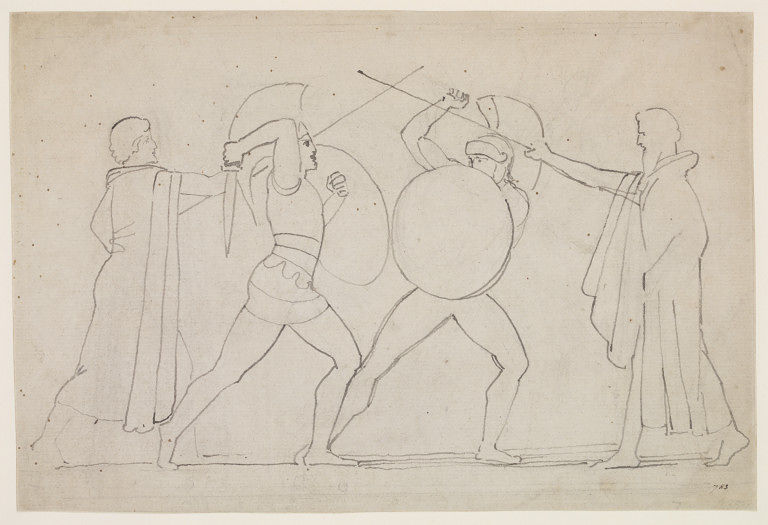 Hector and Ajax separated by heralds, pen and ink drawing by John Flaxman, 1790’s