BOOK XXII
THUS scar'd and routed from the plain,
as fawns, within the city
1
They cool'd themselves from sweat, and drank,
and heal'd the thirst of water,
Against the noble buttresses
reclining: but the Achaians
Nearer unto the wall advanc'd,
with shields aslant on shoulder.
Hector alone by deadly doom
from Jupiter was fetter'd,
5
In front of Ilium, beside
the Skæan gates, to tarry.
But bright Apollo, speaking clear,
address'd the son of Peleus:
"Why, Peleus' son! with speedy foot,
thyself a mortal, chasest
Me, an immortal son of Jove?
nor yet dost thou beknow me;
But hankerest unflinching. Troth!
the Troians are escaped,
10
Whom thou didst late affray: all these
into the town are crowded,
Enjoying thy neglect; and thou
art hither gone aroaming.
But me thou wilt not slay; for I
to Destiny am scatheless."
To him Achilles, fleet of foot,
responded, sore indignant:
"Thou, deadliest of all the gods,
hast foil'd me, Far-averter!
15
Who from the rampart me hast turn'd:
else many an armed Troian,
Ere they might reach to Ilium,
yonder the earth had bitten.
But me of glory great thou now
hast cheated, them reserving
Right easily; for free art thou
from fear of after-vengeance.
Troth, would I vengeance take on thee,
if but I had the power."
20
Thus saying, he with haughty soul
toward the city hied him,
Speeding, as with the chariot
may a prizebearing courser,
Who spanking broad along the lea
full easily careereth:
So Achileus his feet and knees
did ply, untir'd and supple.
But him did aged Priam's eyes
first ken, as o'er the champaign
25
Swift rush'd he, flashing like the star,
which forth in autumn cometh,
Whose rays in gloom of night appear
mid many stars resplendent;
Which was alsó by ancient men
Orion's Dog entitled;
For he by far most brilliant is,
and sign of woe is counted,
30
And beareth fever plentiful
to miserable mortals:
So brilliant was the brass upon
the running hero's bosom.
Then groan'd the aged man, and struck
his head with hands uplifted,
And call'd, imploring his dear son,
who, match'd against Achilles,
35
Before the gates for battle stood,
immeasurably eager.
Him the old man, with arms outstretch'd,
right pious accosted:
"Hector! dear child! with single might
await not thou this hero
Apart from others, lest that thou
do quickly fate encounter,
Vanquish'd by Peleus' son: for he
than thee by far is stronger.
40
Ah cruel! would that from the gods
such tenderness might greet him,
Such as from me: then quickly should
vultures and dogs devour him
Prostrate: so would my inmost heart
of sorrow grim be lighten'd:
A man, who hath bereaved me
of children brave and many,
Slaying, or selling in the mart
of some far-distant island.
45
Now too, my eyes Lycaon miss,
nor Polydorus see I,
Two children, whom Laothoë,
a royal woman, bare me,
Who stand not with the fugitives,
into our city crowded.
Now if amid the foeman's host
they live, we might redeem them
For brass and gold is still within:
for old illustrious Altes
50
Sent many a costly purtenance,
an honour to his daughter.
But if already they be dead
and in the house of Pluto,
This to their parents grief will be,
to me and to their mother;
Yet to the other folk nathless
more shortliv'd were the sorrow,
Unless thou, Hector! fall alsó,
by Achileus o'ermaster'd.
55
Nay, but within the city-wall
be screen'd, my child! to rescue
The Troian dames and men of Troy,
nor yield a mighty glory
To Peleus' son and be thyself
of tender life bereaved.
Pity thou eke unhappy me,
who still have thought and feeling,
Ill-fated; whom on steps of Eld
Saturnius the father
60
By noisome doom shall waste, when I
on many a woe have gazed,—
Sons slaughter'd, daughters torn away,
and bridal chambers ravag'd,
And infants hurl'd upon the ground
in grim embrace of foemen,
And my sons' partners rudely dragg'd
by deadly hands of Argives.
65
Me last of all before my gates
raw-eating dogs shall mangle,
When stab or shot of dart shall take
the life from out my members.
Those dogs, whom in my palace halls
I feed from off my table,
The guardians of my doors, shall lie
raving upon my threshold,
70
Swilling my lifeblood. Naught for youth
unseemly 'tis, in battle
By savage Ares slain,—to lie,
by the sharp weapon mangled.
For to the warriour, in death
happen what may, 'tis comely.
But when an aged man is slain,
and with immodest outrage,
Despite of hoary head and chin,
the dogs his corpse dishonour,
75
This do I deem most piteous
to miserable mortals."
He spake; and many a hoary hair
pluck'd from his head: but Hector
Abode unyielding: thereupon
on other side his mother
With loosen'd robe and open breast
and wailing voice implor'd him.
80
So she with tear-beflooded cheeks
did winged accents utter:
"Hector, my child! revere my breast,
and pity thy own mother.
If e'er the soothing teat to thee
I held; dear child! obey me.
Ward from within the wall the foe,
nor stand in front against him,
85
Cruel! for if he vanquish thee,
never shall I bewail thee
Upon thy pallet, darling bud!
nor thy rich-dowed consort;
But far from us the nimble dogs
by Argive ships shall eat thee."
Thus weeping did the parents twain
address their dearest offspring
90
With much entreaty; nor avail'd
to move the mind of Hector:
But still he waited the approach
of terrible Achilles.
As at his den a mountain-snake,
which evil bane hath eaten,
With direful anger in his heart
a man's assault awaiteth;
And horrid is his glance of eye,
as round his den he twineth:
95
So Hector stirr'd not from his post,
possest by quenchless valour,
But on the tower's shelving ledge
his shining buckler propped.
Then he with indignation spake
to his own haughty spirit:
"Ha, wretched! if I enter now
within the gates and rampart,
Polydamas will earliest
reproaches lay upon me,
100
Who plainly counsell'd, to conduct
the Troians to the city,
During the deadly night, which first
arous'd divine Achilles.
But I his counsel follow'd not,
which verily was better.
Now, sith infatuate I was,
and many lives have wasted,
I blush before the men of Troy
and trailing-robed women,
105
Lest haply some one, than myself
far worser, say hereafter:—
'Hector the Troian folk destroy'd,
on his own might reliant.'
So will they say: thereat to me
the odds were vastly better,
Confronted with Achilles' force,
to come away his victor,
Or else before the city-gate
myself to die with glory.
110
Now, if aside my bossy shield
I lay, and sturdy helmet,
And prop against the wall my spear,
and venture thus, confronting
Spotless Achilles; and behight,
that I will Helen render,
And with her all the gear, whatso
within his hollow galleys
115
Did Alexander bring to Troy;—
which was the strife's beginning;—
That I both this to Atreus' sons
will yield, and give beside it,
All of the city's hidden store,
as payment to the Achaians;
And take upon the Troïans
a solemn oath of elders,
Naught to conceal, but forward bring
for common distribution
120
The gear, whatever may be coop'd
within our lovely fortress:—
But oh fond heart! why holdest thou
within me such discourses?
Should I draw near and supplicate,
yet will he know no pity,
Nor will revere my coming; but
will slaughter me, tho' naked,
Thus helpless as a woman, when
I shall of armour strip me.
125
Nowise from oak or rock may we,
as bachelour to maiden,
Converse; as bachelour and maid
hold, each with other, converse.
Better it is, in instant strife
to grapple; so we quickly
May learn, to which the Olympian
vouchsafeth higher glory."
130
So heaving in his heart, he stood;
but near him came Achilles,
A peer to Enyalius,
that warriour helm-shaking,
And pois'd the ash of Pelion
over his better shoulder,
Dreadful; and brass upon his frame
from head to ankle glitter'd,
In semblance as a blazing fire
or rising sun in splendour.
135
But Hector, when he saw, was seiz'd
with trembling; nor endur'd he
There to abide; but left the gates
behind, and fled in terror.
But after him Pelides rush'd,
on speedy feet reliant.
As o'er the mountain-side a kite,
of feather'd wights the nimblest,
Glideth along his easy path
after a trembler pigeon;
140
Which flees beneath him; he behind
with shrilly scream approaching
Souseth right oft upon the game,
with heart intent to gripe it:
So he, all eager for revenge,
flew straight; but Hector hurried
Plying his supple knees, to course
beneath the Troian rampart.
1
2
And they, within the watchman's highth,
within the windy figtree,
145
Ever beside the chariot-road
under the fortress sped them.
Then to the dainty streaming wells
they came, whereat two sources
Gush forth, that feed the silver depths
of eddying Scamander.
The one with water alway warm
rilleth, and smoke around it,
As tho' from blazing fire, aloft
from off the surface riseth:
150
The other hurrieth abroad
like unto hail in summer,
Or as the cold of melting snow,
or ice from out the water.
Here stand beside them washing-seats,
broad slabs of dainty marble,
Where wives and daughters fair of Troy
did wash their shining garments
In former days, while peace was yet,
ere came Achaia's children.
155
Hereby ran they, in flight the one,
the other close pursuing.
Brave was in sooth the man who fled,
but braver the pursuer,
And fierce their hurry; sith, I wis,
to them the prize of running
No victim was nor hide of ox,
which prizes are of swiftness;
160
Nay, but they scudded for the life
of courser-taming Hector.
As fleetly round the goal may race
the single-hoofed horses
Prize-bearers; when a costly prize,
a tripod or a woman,
Is offer'd, at the burial
of some deceased hero;
So round and round three times the twain
did Priam's city compass
165
In rapid running. All the gods
look'd down to see the contest.
Thereat the Sire of gods and men
to them began discourses:
"Ye Spirits! lo! beneath my eyes
I view a loved hero
Chas'd round his rampart; and my heart
hath pity upon Hector,
Who never fail'd to burn to me
the costly thighs of oxen,
170
One while upon the pinnacles
of dell-abounding Ida,
Elsewhile upon the city's highth:
but now divine Achilles
With speedy feet pursueth him
around the walls of Priam.
But come, bethink you, all ye gods!
and enter into counsel,
Whether we now from coming death
shall save him, or shall quickly
175
Beneath Achiles, Peleus' son.
slay him, albeit noble."
Hereon responsive spake to him
Athene, grey-ey'd goddess:
"Sire of the shining Thunderbolt!
what sayest thou, Dark-clouded!
A man, who mortal is of birth,
long syne by doom predestin'd,
Him from sad-wailing Aïdes
dost ponder to deliver?
180
3
Do it: but we, the other gods,
not all shall praise thy doing."
Then cloud-collecting Jupiter
reciprocal address'd her :
"Cheer thee, beloved, Trito-born!
not with a soul so earnest
Have I harangu'd: and fain would I
to thee, my child! be gentle.
Do, as thy bosom prompteth thee,
and start not from thy purpose."
185
He by such charge Athene spurr'd,
herself already eager,
And, speedy darting, down she came
from summits of Olympus.
But swift Achilles Hector chas'd
with unremitting scuffle.
As o'er the mountains may a hound
pursue thro' glen and thicket
190
A fawn, awaken'd from its lair;
and tho', in bushes crouching,
It hide, yet tracking, on he scuds,
until he overhend it:
So Hector vainly would elude
the race of swift Pelides.
Oft as toward the Dardan gates
and the well-builded towers
195
He sped, in hope they might by darts
scare from above his foeman;
So oft by intercepting rush
toward the plain he turn'd him.
As one who dreaming tries to run,
can neither flee nor follow,
So nor could Hector flee away,
nor could Achilles catch him.
200
Nor troth! had Hector then so long
the fates of Death evaded,
But that Apollo first and last
did faithful stand beside him,
And breathed vigour in his heart
and supple made his members.
Then to the peoples with his head
divine Achilles nodded,
205
Forbidding others at the foe
their stinging darts to shower;
Lest any, hitting, glory win,
and he but follow second.
But when the combatants arriv'd
the fourth time at the fountains,
The general Father thereupon
his golden balance poised,
And, charg'd with death slow-lingering,
two fates he cast within it,
210
That for the son of Peleus;
for courser-taming Hector this.
He rais'd the scales; and tilting fell
the auspicious hour of Hector.
To Pluto fleeted then his years,
and bright Apollo left him.
But to Achilles' aid arriv'd
Athene, grey-ey'd goddess,
And standing near beside him, she
did winged accents utter:
215
"Gallant Achilles, dear to Jove!
now shall we twain, I reckon,
Unto the galleys bear away
great glory for the Achaians
By Hector's slaughter; tho' he be
insatiate of battle.
Sith as no longer now from us
escape to him is open,
Not tho' Apollo Far-averter
strive with much entreaty,
220
Falling around the knees of Jove
the ægisholding Father.
But stand thou now and breath regain;
and I, to him proceeding,
By counsel will persuade his heart
with adverse might to front thee."
So spake Athene: he obey'd,
and in his soul was joyful,
And leaning on the ashen shaft
barbed with brass, he halted.
225
Him then she quitted, and was found
at side of godlike Hector,
With semblance of Deïphobus,
in shape and voice unwearied.
There, near before his face, she stood,
and winged accents utter'd :
"My gracious sir! swift Achileus
too hard doth press upon thee,
Chasing with fleet-careering foot
around the walls of Priam:
230
But let us stand and hold our ground,
and sturdily repel him."
To him with word responsive spake
great motley-helmed Hector:
"Deïphobus! eke heretofore
wast thou to me far dearest
Of all my kin, whom Hecuba
to Priam gave as offspring.
Now, more than ever, in my heart
I purpose, thee to honour,
235
Who, when thy eyes took note of me,
hast for my sake adventur'd
Out of the rampart; but the rest
abide within securely."
Then him reciprocal address'd
Athene, grey-ey'd goddess:
"O gracious brother! truly me
my sire and queenly mother,
By turns embracing, much implor'd,
and after them my comrades, —
240
There to abide: so great a dread
hath overmaster'd all men :
But still my heart was inwardly
by mournful sorrow wasted.
And now with onward eagerness
fight we: no stint is needed
Of javelins: so shall we know,
if of our lives Achilles
Havoc shall make, and bear away
a prize of gory trophies
245
Unto the smoothly-hollow ships,
or by thy spear be vanquish'd."
Thro' such pretences of the lip,
with guile Athene led him.
When they to nearer distance came
advancing each on other,
Unto Achilles 'gan to speak
great motley-helmed Hector:
"No longer, Peleus' son! will I,
as heretofore, avoid thee.
250
Thrice fled I round the mighty wall
of Priam, nor adventur'd
Thy coming to await: but now
in turn my spirit prompteth
To stand against thee: so will I
or vanquish or be vanquish'd.
But come, and gart we by the gods:
these, who of all are highest,
Are eke the best of witnesses
and overseers of treaties.
255
No éxtreme outrage I on thee
will lay, if Jove may haply
Grant me enduring hardiment,
and if I rieve thy spirit:
But soon as I have stript away
thy noble arms, Achilles!
I to thy friends thy corpse will yield:"
to this be
thou too plighted."
To him Achilles, fleet of foot,
with scowling glance responded:
260
"Of no agreements talk to me,
inexpiable Hector!
As not to lions and to men
is oath of faithful treaty,
And as thro' heart of wolf and lamb
no spirit breatheth common,
But each to other constantly
hath naught but evil hatred:
So no affection may arise
'twixt thee and me, nor treaties
265
Will I engage; but first, I ween,
shall one or other falling
Glut with his gore the warriour,
unweariable Ares.
Call to remembrance all thy skill
and valour: now, if ever,
A thorough spearman prove thyself
and warriour intrepid.
No more evasion hast thou here:
straightway doth maid Athene
270
Cast thee beneath my spear, and thou
shalt in one sum repay me
The sorrows of my comrades, whom
thy frantic spear hath slaughter'd."
He spake, and poising forward threw
the spear with lengthy shadow:
But Hector saw it opposite,
and stoop'd to shun its fury;
So o'er him flew the brazen point,
and in the earth was fasten'd.
275
But maid Athene caught it up,
and instant to Achilles
Restor'd it: thus deluded she
Hector, the people's shepherd.
Then Hector confident address'd
the spotless son of Peleus:
"Achilles, image of the gods!
not yet my fate thou knewest
From Jupiter; but me thy spear
has miss'd, despite thy menace.
280
Thou art, methinketh, apt of speech,
and crafty in haranguing,
In hope, so might I thro' alarm
forget intrepid valour.
Not in my fleeing back shalt thou
(If so the god have granted thee)
thy dart implant; but drive it
straight thro' my eager bosom.
Shun now my brazen spear in turn.
O might thy flesh receive it
285
Entire! so should the war become
far lighter to the Troians
By thy destruction; sith to them
art thou the direst noyance."
He spake, and poising forward threw
the spear with lengthy shadow,
Nor miss'd; but in the middle hit
the buckler of Pelides.
290
But from the buckler glanc'd the dart
afar: then shudder'd Hector,
Indignant, that the pointed spear
he fruitlessly had urged.
No other ashen shaft had he;
so stood he there, desponding,
And loudly summon'd to his aid
Deïphobus white-shielded,
Asking of him a lengthy spear:
but nowhere near he saw him.
295
Then Hector in his inward heart
discern'd, and spake foreboding:
"Ye Spirits! verily, I wis,
the gods to death have call'd me.
Right sure was I,—Deïphobus
the hero stood beside me;
But him the wall doth hide, and me
Athene hath beguiled.
And now an evil death to me
is near, nor longer distant:
300
Escape is none: for thus of old,
methinketh, was it pleasing
To Jove and Jove's far-darting son,
who heretofore were alway
Zealous to rescue me; but now
in turn doth Fate o'erhend me.
Yet would I not inglorious
without a struggle perish,
But after some achievement high
for future age to talk of."
305
He spake, and drew his shining sword,
which sharp and great and stalwart
Hung at his hip, then on he rush'd
collected, as an eagle
High-flying thro' the murky clouds
upon the plain descendeth,
Pouncing upon a tender lamb
or trembling hare; so Hector
310
Rush'd, brandishing his whetted sword.
Against him sped Achilles,
With savage rancour full-possest,
and held before his bosom
His buckler fair and curious,
and nodded with the helmet
Four-crested, all-irradiant;
for hairs of gold around it
315
Wav'd plenteous along the ridge
by handicraft of Vulcan.
As in the sky at dusk of night
the Even-star appeareth,
The fairest stud in heaven's host;
such radiance was kindled
From off the polish'd spear-point,
which in his right hand Achilles
Brandish'd, with thoughts of deadly bale
for godlike Hector heaving,
320
And Iraqi ponder'd, where the tender skin
might best admit his weapon.
The brazen armour beauteous,
which he from slain Patroclus
Had stript, did elsewhere screen his flesh:
save twixt the neck and shoulder,
Beside the collar-bone and throat,
where life hath quickest exit;
325
Therein did godlike Achileus
with eager weapon pierce him,
And thro' the tender neck its point
outright behind him issued.
Nor did the brazen-weighted ash
his weazand cut asunder;
So should his throat avail to speak
responsive to Achilles.
Then dropt he in the dust; whereat
divine Achilles boasted:
330
"Hector! thy thought it was, I ween,
in stripping slain Patroclus,
Secure to be, nor heldest count
of me apart remaining.
O simpleton! but I behind,
far mightier avenger,
Was left, beside the hollow ships;
who have thy sinews loosen'd.
335
Now thee foul dogs and birds shall rend,
and him the Achaians bury."
To him, with puny vigour left
spake motley-helmed Hector:
"I by thy life and by thy knees
implore, and by thy parents,
Give me not up, to dogs a prey,
beside the Achaian galleys;
But from my father's hands accept,
and from my queenly mother,
340
Copper in many kinds, and gold,
and other presents costly;
And give my lifeless body back
unto my home, that honour
From Troian men and wives of Troy
in rightful flames may shrive me."
To him Achilles fleet of foot
with scowling glance responded:
"Seek not, O dog, my knees to touch,
and plead not by my parents.
345
Oh that, for all thy outrages,
my heart and soul permitted
To slice raw pieces of thy flesh
and down my throat devour them!
So is there none, who from thy head
may fray the dogs and vultures:
Not if tenfold and twenty-fold
they carry ransom hither,
Of perfect weight presenting it,
and more engage hereafter;
350
Nor if Dardanid Priam claim
thy flesh and bones to balance
In gifts of gold, yet even so
shall not thy queenly mother
Place on the pallet and bewail
Hector, her proper offspring;
But dogs and birds foul-ravining
shall all thy members mangle."
Then spake with dying breath to him
great motley-helmed Hector:
355
"Right true were my forebodings then,
nor mightest thou be soften'd
By prayer: verily thy soul
is iron in thy bosom.
But ponder, lest from wrath of gods
I bring thee woe hereafter,
What time, before the Skæan gates,
by aid of bright Apollo,
The archer Paris thee shall slay,
tho' peerless be thy valour."
360
While thus he spake, the end of death
his mouth and voice foreclosed.
Out of his members flew his soul
and reach'd the house of Pluto,
Mourning its own sad destiny,
from youth and manhood parting.
Divine Achilles to the corpse
a word then utter'd further:
"Die thou: but I shall then to Doom
submit me, whensoever
365
Such is the will of Jupiter
and other gods immortal."
He spake; and from his prostrate foe
pull'd out the brazen weapon:
But, placing it aside, he stript
the armour from his shoulders,
All bloody. Then around him ran
Achaia's other children,
Who, gazing fearfully, admir'd
the form and comely stature
370
Of Hector; nor came any near,
but left some stab upon him.
And thus spake one, with eye that glanc'd
upon some other near him:
"Ye Spirits! softer now in sooth
for touch of man to handle
Is Hector, than when late he wrapt
in wasting fire our galleys."
Thus each man spake, and standing near
one after other stabb'd him.
375
But when Achilles, fleet of foot,
had stript the noble armour,
With winged accents he harangu'd,
among the Achaians standing:
"O friends, who of the Argive folk
are governours and leaders,
Sithence the gods have granted us
this champion to vanquish,
Who hath more evils wrought alone,
than all his gather'd army;
380
Trial behoveth it to make
with arms around the city
And learn what temper doth the foe
within his bosom cherish;
Whether, on such a loss, they think
to quit their lofty fortress,
Or obstinate abide, altho'
no Hector have they longer.
But, O fond heart! why holdest thou
within me such discourses?
385
Alas! for still Patroclus' corpse
beside the galleys lieth,
Unwept, unburied: ne'er will I
forget him, while my spirit
Amongst the living doth abide,
and while my knees support me.
Ay, if in house of Aïdes
each dead forgetteth other,
Yet even yonder still will I
my comrade dear remember.
390
But now, the Pæan shouting high,
youths of Achaia! wend we
Unto the smoothly hollow ships,
and bear this carcase with us.
Great glory have we earn'd; for we
have godlike Hector vanquish'd,
To whom the Troians in their town,
as to a god, made prayer."
So spake he, and unseemly deeds
on godlike Hector plotted.
395
He bor'd the gristle of his feet
betwixt the heel and ankle,
And thongs of bullhide thro' them strung:
so to the car he bound him,
Leaving his head to drag: aloft
he plac'd the beauteous armour,
And mounting, flogg'd the steeds,
not loth in flying course to speed them.
400
As on they dragg'd him, clouds of dust
arose; his locks of purple
Abroad were scatter'd; all his head
was in the dust betossed,
Reft of its former gracefulness:
but then for extreme outrage
Jove unto foemen yielded him,
in his own native country.
Thus in the dust was all his head
defil'd: meanwhile his mother,
405
Her child beholding, rent her hair,
and toss'd her dainty turban
Afar, and wail'd aloud: so eke
groan'd piteous his father,
And all around, the city-folk
was fill'd with shriek and moaning:
Such was the general face of woe,
as tho' from foot to summit
410
Brow-rearing Ilium itself
did all in ashes smoulder.
And hardly might the people then
withhold the aged mourner,
Their king, who thro' the Dardan gates
would hurry to the foeman;
And vilely rolling in the dirt,
entreated his own people,
And singly call'd on every man,
his proper name pronouncing:
415
"O friends, refrain: and from the walls
permit me in my sorrow
Alone to issue, and to seek
the galleys of Achaia.
With prayer let me meet this man
atrocious, direful worker,
If haply he my hoary hair,
and age, revere and pity.
For
he too such a father hath,—
Peleus, who gat and rear'd him,
420
A woe to Troians, and to me
in chief a mighty mischief:
So many children flourishing
his force from me hath rieved.
But tho' I grieve, yet not so great
for all of them my anguish,
As is for one, sharp grief for whom
shall drag me down to Pluto,—
Hector!—Oh would that in my hands
his spirit he had yielded!
425
Then we twain parents,—I myself,
and his illfated mother,—
With tears and wailing o'er his corpse
would take our fill of sorrow."
So spake he weeping: after him
the citizens moan'd also:
But to the women Hecuba
led off the dirge incessant:
"My child! and wherefore live I still,
with direful anguish smitten
430
By thy destruction? thou that wast
to Troian men and women
Within the city, day and night,
a mighty boast and profit!
Who, as a god, did welcome thee;
for thou to them great glory
435
Wast, while alive; but now, alas!
do Death and Fate o'erhend thee."
So spake she weeping: but his wife
not yet had heard the tiding
Of Hector; for no messenger
to her had brought announcement,
Too true; how that without the gates
her lord to stay persisted:
But she, withdrawn in a recess
of the tall house, was working
440
A purple tissue, double web,
with motley flowers broider'd;
And to her dainty-braided maids
she call'd within the chambers,
An ample tripod on the fire
to set, whereby should Hector
Returning from the battle find
water for warm ablution,
O simple! nor discern'd, that far
in sooth from all ablution
445
Grey-ey'd Athene him had slain,
beneath Achilles' onset.
Then heard she shrieks re-echoing
and wailings from the tower,
And dropt upon the ground her mesh;
for fear convuls'd her members;
Then did she once again address
her dainty-braided handmaids:
"Come! follow, two of you, behind:
I go to learn this matter:
450
The voice of our revered queen
I heard, and in my bosom
My heart upleapeth to my mouth;
my knees beneath are palsied
With terror: troth, a mighty woe
is near for Priam's children.
Far from my ear be such a tale!
but grim alarm doth seize me,
Lest-that divine Achilles now
have haply from the city
455
Cut off bold Hector all alone,
and o'er the plain do chase him;
So to the noisome bravery,
which alway did possess him,
Might direful end be set: for ne'er
in the thick troop abode he,
But far in front was wont to rush,
peerless his might esteeming."
Thus saying, from the chamber forth
she rac'd, in frantic fashion,
460
With beating heart, and after her
did eke the handmaids follow.
But when unto the troop of men
she reach'd, and to the tower,
Upon the rampart there she stood
forth gazing; and beheld him
Before the city dragg'd around,
behind the speedy coursers,
Who to Achaia's hollow ships
all-unconcern'd did drag him.
465
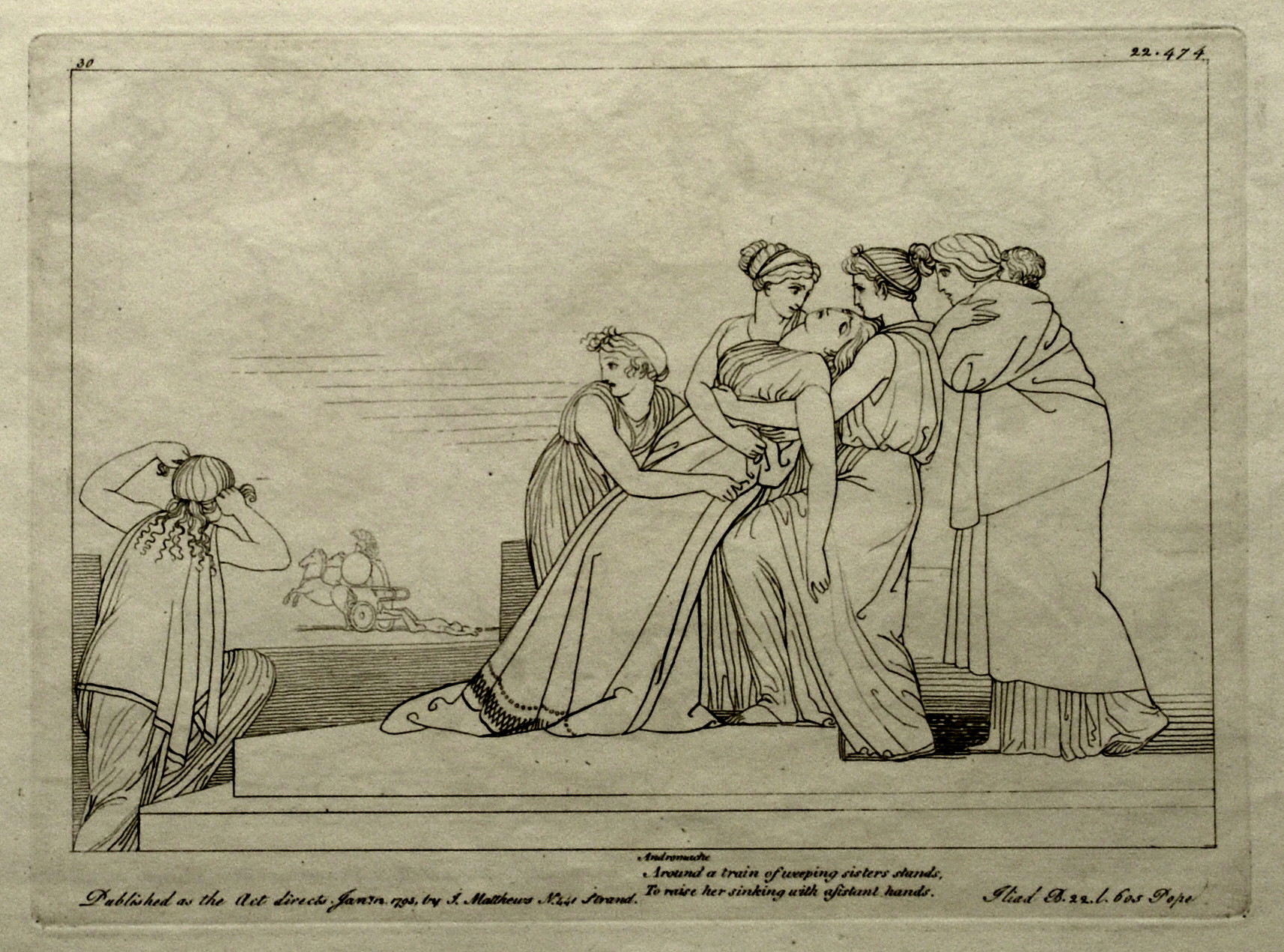
A swoon of horror then her eyes
in murky night enshrouded:
Gasping she fell to earth, and dropt
afar her shining headdress,
The braids and ribbons of her tire,
and woven net and turban,
Which golden Aphrodite gave,
when motley-helmed Hector
470
Her from Eëtion receiv'd
and countless dower paid him.
But round, her female kindred throng'd,
and minist'ring beside her,
Withheld her shatter'd spirit's flight.
With breath and mind returning,
She deeply heav'd a moan, and spake
among the Troian women:
475
"Hector! alas! unhappy me!
one destiny, methinketh,
Forth brought us both; thee here in Troy,
within the halls of Priam,
And me in sacred Thebe's wall,
beneath the woody Placus,
In chambers of Eëtion;
who nurtur'd me when little,
480
Unhappy father, hapless child:
would never had he got me!
But now to Aïdes' abode,
in Earth's profound recesses,
Thou goest, and desertest me
a widow in thy chambers
To hateful mourning: and thy child
is still a helpless infant,
To whom, my Hector! birth we gave,
ill-fated! for no profit
485
Mayest thou be to him, nor he
to thee; sith Death hath riev'd thee.
For even if his life escape
Achaia's tearful battles,
Yet toil and sorrow afterward
never will fail to hunt him;
For, all thy acres broad and fair
will others from him ravish.
Upon the day of orphanhood
a boy his equals loseth:
490
His eyes dejected close their lids;
his cheeks with tears are flooded;
And indigent returneth he
unto his father's comrades.
One then he pulleth by the cloak,
another by the tunic.
Then one, from those who pity him,
awhile a cup forth holdeth,
Which barely moisteneth his lips,
but wetteth not his palate.
495
The boy with double parent blest
him from the banquet driveth,
With blows of fist bemauling him,
and chiding with reproaches:
'Off to ill luck with this! for not
with us thy father feasteth.'
Then weeping, back the boy doth wend
unto his widow'd mother.—
Astyanax, who heretofore
on knees of his own father
500
Did only upon marrow feed
and tender fat of wethers;
And when thro' weariness of sport
slumber might steal across him,
Then he upon a couch would sleep,
within his nurse's bosom,
Or downy pillows, when his heart
with daintiness was filled :—
But henceforth will he suffer much,
bereft of his dear father,
505
He, whom the Troïans have call'd
Astyanax by surname,
For-that thou only diddest guard
our gates and long defences.
Now from thy parents far apart,
beside the crested galleys,
When that the dogs have ta'en their fill,
the crooked worms shall eat thee,
All-naked. Yet are garments here
within thy chambers stored,
510
Fine-spun alike and graceful, wrought
by women's handy cunning.
But verily in wasting fire
I throughly will destroy them:
For, sav'd, they useless are to thee,
sith not in them thou liest;
But, burn'd, they honour thee, in sight
of Troian men and women."
So spake she weeping: after her
with moans the women answer'd.
515

 Copperplate etching (1795) by Tommaso Piroli, after a drawing (1793) by John Flaxman.
